REVIEW 2 major objections 6 minor 51 references
Smart Parking with Pixel-Wise ROI Selection for Vehicle Detection Using YOLOv8, YOLOv9, YOLOv10, and YOLOv11
T0 review · 2 major / 6 minor · reviewed 2026-08-11 · deepseek-v4-flash
Pith's one-line read A pixel-wise post-processing mask lets off-the-shelf YOLO models count parked cars with 99.68% balanced accuracy.
desk verdict The 99.68% balanced accuracy claim is not computable from the count-only labels the paper describes; the useful core is the post-processing mask trick and the hardware latency comparison. read the letter →
The pith
A machine-rendered reading of the paper's core claim, the machinery that carries it, and where it could break.
The reading
What carries the argument
The central mechanism is the pixel-wise post-processing mask: a binary mask, drawn once in an image editor, that labels each pixel as inside or outside the parking ROI. After YOLO inference, the mask is not applied to the image; the detector's bounding boxes are filtered by looking up the pixel value at each box's center and keeping the box only if that pixel is black. This preserves full image context for the network while restricting the count to the area of interest, and it is the component that produces the reported accuracy gap.
What would settle it
Inspect the dataset's annotation files: if each image has only an integer vehicle count and no per-space occupied or empty ground truth, then the per-space TP/TN/FP/FN values and the 99.68% balanced accuracy cannot be reproduced from the described data, and recomputing at the image-count level would yield different error rates.
Extended reading notes
Core claim
The paper's central claim is that applying a pixel-wise region-of-interest mask after object detection, rather than before, materially improves vehicle counting in parking-lot images. The same hand-drawn mask is used either to gray out non-parking areas in the input image or to filter detected bounding boxes by checking whether each box's center falls inside the black ROI. Across all eight YOLO variants tested, the post-processing approach wins; with YOLOv9e it reaches 99.68% balanced accuracy and an F1-score of 0.9975 on a 3,484-image dataset of a 16-space lot, without any fine-tuning of the pretrained models.
Load-bearing premise
The load-bearing premise is that the dataset contains per-space occupancy labels rather than only a total vehicle count per image, since the reported confusion matrices and balanced accuracy are per-space metrics; the paper's labeling description mentions only counting vehicles per image.
Editorial extensions
If this is right
- Post-processing ROI selection improves balanced accuracy over pre-processing for every YOLO model tested, with gains exceeding 28 percentage points for the smallest model.
- A deployment needs no training: pretrained COCO weights, one hand-drawn mask, and a fixed camera are enough for near-perfect occupancy counts in a small lot.
- The method can run at the edge on a Raspberry Pi, sending only the number of vehicles to the cloud and keeping images on site.
- The camera solution is estimated to become cheaper than per-space sensors once a parking lot has more than about four spaces.
- The lightest models run in about one to two seconds per image on Raspberry Pi hardware with only a modest accuracy penalty, making always-on occupancy monitoring feasible on very cheap devices.
Reading between the lines
- The center-point-in-mask filter is object-class agnostic, so the same post-processing trick should transfer to other fixed-camera counting tasks such as people in queues or items on shelves; the paper does not test those cases.
- The 99.68% figure is tied to one camera angle and a 16-space layout; multi-camera lots would need per-camera masks and a fusion step, which the paper flags only as future work.
- Mask geometry is a free parameter that the paper does not sweep; redrawing the same ROI slightly larger or smaller would show how much of the reported accuracy depends on hand-drawn boundaries.
Signed reviews
Editorial analysis
A structured set of objections, weighed in public.
Referee Report
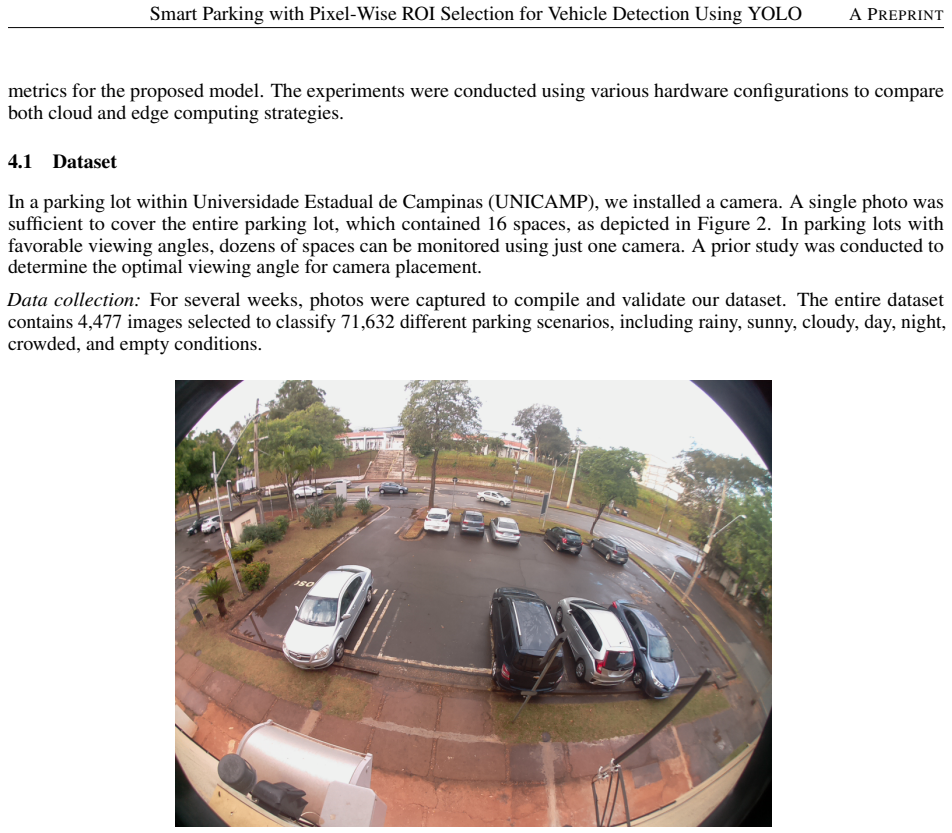
Summary. The paper proposes a smart-parking system that uses off-the-shelf pretrained YOLOv8, YOLOv9, YOLOv10, and YOLOv11 models to count vehicles in a fixed 16-space parking lot. A hand-drawn pixel-wise ROI mask is applied either as a pre-processing step (graying out pixels outside the ROI) or as a post-processing step (keeping only detections whose bounding-box center falls inside the ROI). The paper reports per-space accuracy, balanced accuracy, and F1-score for 16 model/mask configurations on a custom 3,484-image dataset, with a headline balanced accuracy of 99.68% for YOLOv9e with post-processing. It also reports inference-time measurements on six hardware platforms and a cost comparison between camera-based and sensor-based solutions.
Significance. If the reported evaluation were valid, the paper would provide a useful engineering data point for fixed-camera parking occupancy counting with recent YOLO versions. The post-processing ROI filter is simple and practical, and the latency benchmark across GPUs, CPUs, and Raspberry Pi devices together with the cost analysis are concrete, reproducible contributions. The paper correctly gives credit to the use of off-the-shelf models and does not claim to train a new detector. However, the central quantitative claim depends on per-space confusion-matrix metrics that cannot be computed from the count-only labels described in the manuscript, so the headline accuracy and the model-comparison table are not supported by the described evaluation protocol.
major comments (2)
- [§4.1, §4.4, §6] The evaluation protocol is internally inconsistent. Section 4.1 describes labeling only as "counting the number of vehicles in each image," with no spatial annotation, while Section 4.4 defines TP, TN, FP, and FN at the level of individual parking spaces (e.g., TP = "correctly predicted empty space"). Section 6 explicitly lists "improving the labeling of the dataset by following bounding box coordinates" as future work, confirming that no per-space or bounding-box ground truth currently exists. Under count-only labels, the per-space confusion matrices in Figures 7–8 and all metrics in Table 3 are not uniquely determined. For example, for one image with 16 spaces, a true count of 5 vehicles and a predicted count of 3 vehicles, the number of correctly predicted empty spaces can range from 8 to 11, yielding per-image balanced accuracies between 30.77% and 92.31% depending on which specific spaces are misclassified. The reported 99.68% balanced accuracy for YOLOv9e is therefore not computable from the described dataset and labeling procedure, and this is a load-bearing flaw because that value is the paper's headline result.
- [§4.2, §5.1, Table 3] The headline 99.68% balanced accuracy is the maximum over 16 model/mask configurations evaluated on the same 3,484 images, with no confidence intervals, repeated runs, or a separate selection set. Section 4.2 states that "100% of the data was used as validation," so the reported best value is a selected maximum rather than a statistically grounded estimate. The qualitative conclusion that post-processing beats pre-processing is robust across all eight model rows in Table 3, but the specific numerical claim needs an uncertainty estimate or a held-out evaluation protocol to support it.
minor comments (6)
- [§4.4] The definitions of TP and TN are reversed relative to the standard convention: TP is defined as "correctly predicted empty space" and TN as "correctly predicted vehicle." This is confusing and should be clarified by explicitly naming the positive class, or by using labels such as "empty-space detection" rather than the standard TP/TN terminology.
- [§4.1] The statement that filtering out empty images "helps to balance the number of backgrounds and vehicles" is unclear; removing all images with zero vehicles removes the empty-parking-lot class entirely, which seems to unbalance rather than balance the dataset.
- [§5.2, Table 4] Please specify whether the same 80 random images and the same random seed were used for all hardware/model timing measurements, and state how many repeated runs produced the reported standard deviations.
- [§4.3] The mask was manually drawn in GIMP on one image; the paper should describe how the 16 parking spaces are represented in the mask and whether the mask requires fixed camera alignment or per-image registration.
- [§6] The future-work sentence about "improving the labeling of the dataset by following bounding box coordinates" is in direct tension with the space-level confusion-matrix metrics used in Section 4.4; this inconsistency should be resolved explicitly.
- [References] Reference [32] contains a typo ("supremum to" should be "superior to"), and reference [51] lacks journal, volume, and page information.
Circularity Check
No significant circularity: the accuracy claim rests on off-the-shelf YOLO weights, a hand-drawn mask, and independent human count labels; no fitted parameter or self-citation chain forces the result.
full rationale
The paper's central claim (99.68% balanced accuracy for YOLOv9e with the post-processing mask, Table 3) is an empirical comparison. The models are used off-the-shelf: 'The dataset was not used to train the model, as we used only the pre-trained weights of the network, so 100% of the data was used as validation.' The ROI mask is hand-drawn, not learned: 'the same mask was created by selecting a random picture and manually editing it using the free image editor software GNU Image Manipulation Program (GIMP)'. The labels are independent human counts: 'We labeled the dataset, counting the number of vehicles in each image, including cars and trucks.' No fitted parameter is renamed as a prediction; the post-processing method simply filters detections by the mask and compares the resulting count with the labels. The same-author citations ([33], [50]) are used only to support prior feasibility of edge inference on constrained devices, not to justify the accuracy claim, so they are not load-bearing. The admission that 'similar methods can be found in the Ultralytics library... limited to regular polygonal shapes' is an incremental novelty statement, not a circular renaming. The most serious defect is the mismatch between count-only labels in Section 4.1 and the per-space confusion-matrix metrics in Section 4.4 (TP defined as 'Correctly predicted empty space', TN as 'Correctly predicted vehicle'), especially since Section 6 lists 'improving the labeling of the dataset by following bounding box coordinates' as future work. That is a data-availability/internal-consistency problem that may make the reported balanced accuracy non-computable from the described protocol, but it is not a circular derivation: the metric is not defined in terms of the method's output or of the claim itself. Similarly, reporting the best of 16 configurations on the same evaluation set is a selection-maximum effect, not a fitted-input-called-prediction circularity. Therefore no circular step can be exhibited from the paper's own equations or citations, and the appropriate score is 0.
Assumptions & free parameters
free parameters (1)
- Hand-drawn ROI mask =
binary mask (black=ROI, white=excluded), created in GIMP
assumptions (4)
- domain assumption COCO-pretrained YOLO weights generalize to this parking lot without fine-tuning
- domain assumption Image-level vehicle counts are accurate and support per-space confusion-matrix metrics
- domain assumption The center point of a bounding box correctly determines whether a detected vehicle is inside the ROI
- domain assumption Removing images with no vehicles does not bias the comparison of ROI methods
Cite this review
Pith. "Pith review of Smart Parking with Pixel-Wise ROI Selection for Vehicle Detection Using YOLOv8, YOLOv9, YOLOv10, and YOLOv11." pith.science (2026). https://pith.science/paper/VS3YCHXF
@misc{pith2026241201983,
  author       = {Pith},
  title        = {Pith review of: Smart Parking with Pixel-Wise ROI Selection for Vehicle Detection Using YOLOv8, YOLOv9, YOLOv10, and YOLOv11},
  year         = {2026},
  howpublished = {\url{https://pith.science/paper/VS3YCHXF}},
  note         = {Machine review of arXiv:2412.01983}
}
read the original abstract
The increasing urbanization and the growing number of vehicles in cities have underscored the need for efficient parking management systems. Traditional smart parking solutions often rely on sensors or cameras for occupancy detection, each with its limitations. Recent advancements in deep learning have introduced new YOLO models (YOLOv8, YOLOv9, YOLOv10, and YOLOv11), but these models have not been extensively evaluated in the context of smart parking systems, particularly when combined with Region of Interest (ROI) selection for object detection. Existing methods still rely on fixed polygonal ROI selections or simple pixel-based modifications, which limit flexibility and precision. This work introduces a novel approach that integrates Internet of Things, Edge Computing, and Deep Learning concepts, by using the latest YOLO models for vehicle detection. By exploring both edge and cloud computing, it was found that inference times on edge devices ranged from 1 to 92 seconds, depending on the hardware and model version. Additionally, a new pixel-wise post-processing ROI selection method is proposed for accurately identifying regions of interest to count vehicles in parking lot images. The proposed system achieved 99.68% balanced accuracy on a custom dataset of 3,484 images, offering a cost-effective smart parking solution that ensures precise vehicle detection while preserving data privacy
Figures


Figures from the paper (9 more)


Reference graph
Works this paper leans on
-
[1]
Sandeep Saharan, Neeraj Kumar, and Seema Bawa. An efficient smart parking pricing system for smart city environment: A machine-learning based approach. Future Generation Computer Systems, 106:622–640, 2020
work page 2020
-
[2]
Weinberger, Adam Millard-Ball, and Robert C
Rachel R. Weinberger, Adam Millard-Ball, and Robert C. Hampshire. Parking search caused congestion: Where’s all the fuss? Transportation Research Part C: Emerging Technologies, 120:102781, 2020
work page 2020
-
[3]
Ebenezer Okai, Xiaohua Feng, and Paul Sant. Smart cities survey. In 2018 IEEE 20th International Conference on High Performance Computing and Communications; IEEE 16th International Conference on Smart City; IEEE 4th International Conference on Data Science and Systems (HPCC/SmartCity/DSS), pages 1726–1730, 2018
work page 2018
-
[4]
A survey of smart parking solutions
Trista Lin, Herve Rivano, and Frédéric Le Mouël. A survey of smart parking solutions. IEEE Transactions on Intelligent Transportation Systems, 18:3229 – 3253, 04 2017
work page 2017
-
[5]
J. V . Baggio, L. F. Gonzalez, and J. F. Borin. Smartparking: A smart solution using deep learning. Technical report, Instituto de Computação - UNICAMP, 2020
work page 2020
-
[6]
Deep learning for decentralized parking lot occupancy detection
Giuseppe Amato, Fabio Carrara, Fabrizio Falchi, Claudio Gennaro, Carlo Meghini, and Claudio Vairo. Deep learning for decentralized parking lot occupancy detection. Expert Systems with Applications, 72:327–334, 2017
work page 2017
-
[7]
A review of smart parking systems
Sai Sneha Channamallu, Sharareh Kermanshachi, Jay Michael Rosenberger, and Apurva Pamidimukkala. A review of smart parking systems. Transportation Research Procedia, 73:289–296, 2023. International Scientific Conference „The Science and Development of Transport - Znanost i razvitak prometa – ZIRP 2023”. 19 Smart Parking with Pixel-Wise ROI Selection for V...
work page 2023
-
[8]
Automatic parking space detection system based on improved yolo algorithm
Zheng Xie and Xing Wei. Automatic parking space detection system based on improved yolo algorithm. In 2021 2nd International Conference on Computer Science and Management Technology (ICCSMT), pages 279–285, 2021
work page 2021
Show all 51 references
-
[9]
Smart parking applications using rfid technology
Zeydin Pala and Nihat Inanc. Smart parking applications using rfid technology. In 2007 1st Annual RFID Eurasia, pages 1–3. IEEE, 2007
2007
-
[10]
Car park system: A review of smart parking system and its technology
MY Idna Idris, YY Leng, EM Tamil, NM Noor, Zaidi Razak, et al. Car park system: A review of smart parking system and its technology. Information technology journal, 8(2):101–113, 2009
2009
-
[11]
Detecting cars in uav images with a catalog-based approach
Thomas Moranduzzo and Farid Melgani. Detecting cars in uav images with a catalog-based approach. IEEE Transactions on Geoscience and Remote Sensing, 52(10):6356–6367, 2014
2014
-
[12]
A survey of deep learning techniques for vehicle detection from uav images
Srishti Srivastava, Sarthak Narayan, and Sparsh Mittal. A survey of deep learning techniques for vehicle detection from uav images. Journal of Systems Architecture, 117:102152, 2021
2021
-
[13]
Machine vision smart parking using internet of things (iots) in a smart university
Noah Sieck, Cameron Calpin, and Mohammad Almalag. Machine vision smart parking using internet of things (iots) in a smart university. In 2020 IEEE International Conference on Pervasive Computing and Communications Workshops (PerCom Workshops), pages 1–6. IEEE, 2020
2020
-
[14]
Real-time image-based parking occupancy detection using deep learning
Debaditya Acharya, Weilin Yan, and Kourosh Khoshelham. Real-time image-based parking occupancy detection using deep learning. Research@ Locate, 4:33–40, 2018
2018
-
[15]
Pklot–a robust dataset for parking lot classification
Paulo RL De Almeida, Luiz S Oliveira, Alceu S Britto Jr, Eunelson J Silva Jr, and Alessandro L Koerich. Pklot–a robust dataset for parking lot classification. Expert Systems with Applications, 42(11):4937–4949, 2015
2015
-
[16]
An edge based smart parking solution using camera networks and deep learning
Harshitha Bura, Nathan Lin, Naveen Kumar, Sangram Malekar, Sushma Nagaraj, and Kaikai Liu. An edge based smart parking solution using camera networks and deep learning. In 2018 IEEE International Conference on Cognitive Computing (ICCC), pages 17–24, 2018
2018
-
[17]
The nvidia ai city challenge
Milind Naphade, David C Anastasiu, Anuj Sharma, Vamsi Jagrlamudi, Hyeran Jeon, Kaikai Liu, Ming-Ching Chang, Siwei Lyu, and Zeyu Gao. The nvidia ai city challenge. In2017 IEEE SmartWorld, Ubiquitous Intelligence & Computing, Advanced & Trusted Computed, Scalable Computing & Co...
2017
-
[18]
T-yolo: Tiny vehicle detection based on yolo and multi-scale convolutional neural networks
Daniel Padilla Carrasco, Hatem A Rashwan, Miguel Ángel García, and Domenec Puig. T-yolo: Tiny vehicle detection based on yolo and multi-scale convolutional neural networks. Ieee Access, 11:22430–22440, 2021
2021
-
[19]
Real-Time Parking Space Detection and Management with Artificial Intelligence and Deep Learning System , pages 127–139
Shweta Shukla, Rishabh Gupta, Sarthik Garg, Samarpan Harit, and Rijwan Khan. Real-Time Parking Space Detection and Management with Artificial Intelligence and Deep Learning System , pages 127–139. Springer International Publishing, Cham, 2022
2022
-
[20]
Nithya, V
R. Nithya, V . Priya, C. Sathiya Kumar, J. Dheeba, and K. Chandraprabha. A smart parking system: An iot based computer vision approach for free parking spot detection using faster r-cnn with yolov3 method.Wireless Personal Communications, 125:3205–3225, 2022
2022
-
[21]
Smart parking space detection under hazy conditions using convolutional neural networks: a novel approach
Gaurav Satyanath, Jajati Keshari Sahoo, and Rajendra Kumar Roul. Smart parking space detection under hazy conditions using convolutional neural networks: a novel approach. Multimedia Tools and Applications, 117:102152, 2023
2023
-
[22]
Car parking occu- pancy detection using smart camera networks and deep learning
Giuseppe Amato, Fabio Carrara, Fabrizio Falchi, Claudio Gennaro, and Claudio Vairo. Car parking occu- pancy detection using smart camera networks and deep learning. In 2016 IEEE Symposium on Computers and Communication (ISCC), pages 1212–1217, 2016
2016
-
[23]
Optimized real-time parking management framework using deep learning
Sarmad Rafique, Saba Gul, Kaleemullah Jan, and Gul Muhammad Khan. Optimized real-time parking management framework using deep learning. Expert Systems with Applications, 220:119686, 2023
2023
-
[24]
Comparision of yolo models for object detection from parking spot images
Yash Doshi, Khushi Shah, Neha Katre, Vinaya Sawant, and Stevina Correia. Comparision of yolo models for object detection from parking spot images. Educational Administration: Theory and Practice, 30(4):10401–10411, 2024
2024
-
[25]
Comparative analysis of yolov8 and yolov10 in vehicle detection: Performance metrics and model efficacy.Vehicles, 6(3):1364– 1382, 2024
Athulya Sundaresan Geetha, Mujadded Al Rabbani Alif, Muhammad Hussain, and Paul Allen. Comparative analysis of yolov8 and yolov10 in vehicle detection: Performance metrics and model efficacy.Vehicles, 6(3):1364– 1382, 2024
2024
-
[26]
A wsn and vision based smart, energy efficient, scalable, and reliable parking surveillance system with optical verification at edge for resource constrained iot devices
Shreeram Hudda, Rishabh Barnwal, Abhishek Khurana, and K Haribabu. A wsn and vision based smart, energy efficient, scalable, and reliable parking surveillance system with optical verification at edge for resource constrained iot devices. Internet of Things, page 101346, 2024
2024
-
[27]
Image-based parking space occupancy classification: Dataset and baseline
Martin Marek. Image-based parking space occupancy classification: Dataset and baseline. arXiv preprint arXiv:2107.12207, 2021. 20 Smart Parking with Pixel-Wise ROI Selection for Vehicle Detection Using YOLO A PREPRINT
2021 arXiv
-
[28]
Edge intelligence: Paving the last mile of artificial intelligence with edge computing
Zhi Zhou, Xu Chen, En Li, Liekang Zeng, Ke Luo, and Junshan Zhang. Edge intelligence: Paving the last mile of artificial intelligence with edge computing. Proceedings of the IEEE, 107(8):1738–1762, 2019
2019
-
[29]
Edge intelligence: Challenges and opportunities of near-sensor machine learning applications
George Plastiras, Maria Terzi, Christos Kyrkou, and Theocharis Theocharides. Edge intelligence: Challenges and opportunities of near-sensor machine learning applications. In 2018 ieee 29th international conference on application-specific systems, architectures and processors (...
2018
-
[30]
Staying at the edge of privacy: edge computing and impersonal extraction.Media and Communication, 8(2):270–79, 2020
Luke Munn. Staying at the edge of privacy: edge computing and impersonal extraction.Media and Communication, 8(2):270–79, 2020
2020
-
[31]
Yolov10 to its genesis: A decadal and comprehensive review of the you only look once series
Ranjan Sapkota, Rizwan Qureshi, Marco Flores Calero, Muhammad Hussain, Chetan Badjugar, Upesh Nepal, Alwin Poulose, Peter Zeno, Uday Bhanu Prakash Vaddevolu, Hong Yan, et al. Yolov10 to its genesis: A decadal and comprehensive review of the you only look once series. arXiv pre...
2024 arXiv
-
[32]
In object detection deep learning methods, yolo shows supremum to mask r-cnn
Shahriar Shakir Sumit, Junzo Watada, Anurava Roy, and DRA Rambli. In object detection deep learning methods, yolo shows supremum to mask r-cnn. In Journal of Physics: Conference Series, volume 1529, page 042086. IOP Publishing, 2020
2020
-
[33]
Reaproveitamento de tv boxes para aplicação de contagem de pessoas na borda em cidades inteligentes
Gabriel Sato, Gustavo Luz, Luis Gonzalez, and Juliana Borin. Reaproveitamento de tv boxes para aplicação de contagem de pessoas na borda em cidades inteligentes. In Anais do VIII Workshop de Computação Urbana, pages 197–209, Porto Alegre, RS, Brasil, 2024. SBC
2024
-
[34]
Enhancing covid-19 safety: Exploring yolov8 object detection for accurate face mask classification
Sanjog Tamang, Biswaraj Sen, Ashis Pradhan, Kalpana Sharma, and Vikash Kumar Singh. Enhancing covid-19 safety: Exploring yolov8 object detection for accurate face mask classification. International Journal of Intelligent Systems and Applications in Engineering, 11(2):892–897, 2023
2023
-
[35]
You only look once: Unified, real-time object detection
J Redmon. You only look once: Unified, real-time object detection. In Proceedings of the IEEE conference on computer vision and pattern recognition, 2016
2016
-
[36]
Yolov1 to yolov10: The fastest and most accurate real-time object detection systems
Chien-Yao Wang and Hong-Yuan Mark Liao. Yolov1 to yolov10: The fastest and most accurate real-time object detection systems. arXiv preprint arXiv:2408.09332, 2024
2024 arXiv
-
[37]
Feature pyramid networks for object detection
Tsung-Yi Lin, Piotr Dollár, Ross Girshick, Kaiming He, Bharath Hariharan, and Serge Belongie. Feature pyramid networks for object detection. In Proceedings of the IEEE conference on computer vision and pattern recognition, pages 2117–2125, 2017
2017
-
[38]
Spatial pyramid pooling in deep convolutional networks for visual recognition
Kaiming He, Xiangyu Zhang, Shaoqing Ren, and Jian Sun. Spatial pyramid pooling in deep convolutional networks for visual recognition. IEEE transactions on pattern analysis and machine intelligence, 37(9):1904–1916, 2015
1904
-
[39]
Path aggregation network for instance segmentation
Shu Liu, Lu Qi, Haifang Qin, Jianping Shi, and Jiaya Jia. Path aggregation network for instance segmentation. In Proceedings of the IEEE conference on computer vision and pattern recognition, pages 8759–8768, 2018
2018
-
[40]
Ultralytics YOLO (Version 8.0.0)
Glenn Jocher, Anurag Chaurasia, and Jian Qiu. Ultralytics YOLO (Version 8.0.0). https://github.com/ ultralytics/ultralytics, 2023. Computer software
2023
-
[41]
A comprehensive review of yolo architectures in computer vision: From yolov1 to yolov8 and yolo-nas
Juan Terven, Diana-Margarita Córdova-Esparza, and Julio-Alejandro Romero-González. A comprehensive review of yolo architectures in computer vision: From yolov1 to yolov8 and yolo-nas. Machine Learning and Knowledge Extraction, 5(4):1680–1716, 2023
2023
-
[42]
Yolov9: Learning what you want to learn using programmable gradient information
CY Wang, IH Yeh, and HYM Liao. Yolov9: Learning what you want to learn using programmable gradient information. arxiv prepr. arXiv preprint arXiv:2402.13616, 2024
2024 arXiv
-
[43]
Yolov10: Real-time end-to-end object detection
Ao Wang, Hui Chen, Lihao Liu, Kai Chen, Zijia Lin, Jungong Han, and Guiguang Ding. Yolov10: Real-time end-to-end object detection. arXiv preprint arXiv:2405.14458, 2024
2024 arXiv
-
[44]
Ultralytics yolo11, 2024
Glenn Jocher and Jing Qiu. Ultralytics yolo11, 2024
2024
-
[45]
Microsoft coco: Common objects in context
Tsung-Yi Lin, Michael Maire, Serge Belongie, James Hays, Pietro Perona, Deva Ramanan, Piotr Dollár, and C Lawrence Zitnick. Microsoft coco: Common objects in context. In Computer Vision–ECCV 2014: 13th European Conference, Zurich, Switzerland, September 6-12, 2014, Proceedings...
2014
-
[46]
Cmca-yolo: A study on a real-time object detection model for parking lot surveillance imagery
Ning Zhao, Ke Wang, Jiaxing Yang, Fengkai Luan, Liping Yuan, and Hu Zhang. Cmca-yolo: A study on a real-time object detection model for parking lot surveillance imagery. Electronics, 13(8):1557, 2024
2024
-
[47]
Yolo* c—adding context improves yolo performance
Goran Oreski. Yolo* c—adding context improves yolo performance. Neurocomputing, 555:126655, 2023
2023
-
[48]
Impact of image context on deep learning for classification of teeth on radiographs
Joachim Krois, Lisa Schneider, and Falk Schwendicke. Impact of image context on deep learning for classification of teeth on radiographs. Journal of Clinical Medicine, 10(8):1635, 2021
2021
-
[49]
A camera- based smart parking system employing low-complexity deep learning for outdoor environments
Chantri Polprasert, Chaiyaboon Sruayiam, Prathan Pisawongprakan, and Sirapob Teravetchakarn. A camera- based smart parking system employing low-complexity deep learning for outdoor environments. In 2019 17th International Conference on ICT and Knowledge Engineering (ICT&KE), p...
2019
-
[50]
Repurposing of tv boxes for a circular economy in smart cities applications
Gustavo PC P da Luz, Gabriel Massuyoshi Sato, Luis Fernando Gomez Gonzalez, and Juliana Freitag Borin. Repurposing of tv boxes for a circular economy in smart cities applications. 2024
2024
-
[51]
A survey of explainable artificial intelligence for smart cities
Abdul Rehman Javed, Waqas Ahmed, Sharnil Pandya, Praveen Kumar Reddy Maddikunta, Mamoun Alazab, and Thippa Reddy Gadekallu. A survey of explainable artificial intelligence for smart cities. Electronics, 12(4):1020, 2023. 22
2023
Reviewed August 11, 2026 · model on record in the stance chip above.
Discussion (0). Continue with ORCID to comment.