REVIEW 3 major objections 7 minor 1 cited by
COMBO-Grasp: Learning Constraint-Based Manipulation for Bimanual Occluded Grasping
T0 review · 3 major / 7 minor · reviewed 2026-08-08 · deepseek-v4-flash
Pith's one-line read COMBO-Grasp claims a demonstration-free bimanual system can solve occluded grasping better than monolithic RL.
desk verdict Solid system paper with a genuinely new integration, but the headline coordination mechanism has a sign inconsistency in the printed equations that needs to be resolved before I'd trust the main claim. read the letter →
The pith
A machine-rendered reading of the paper's core claim, the machinery that carries it, and where it could break.
The reading
What carries the argument
The load-bearing mechanism is value function-guided policy coordination, implemented as classifier-guidance-style steering of the constraint diffusion policy. In Eq. 4 the denoising update subtracts a scaled gradient of the grasping policy's value function with respect to the state that contains the constraint pose, so each denoising step nudges the stabiliser pose toward states the value function estimates as more promising. This turns the frozen, force-closure-trained constraint policy into a proposal distribution that RL can re-shape online, which is what the paper credits for the improved sample efficiency and final success rate.
What would settle it
Run teacher training with the sign of the value-function guidance term reversed (adding the gradient instead of subtracting it in Eq. 4), all else equal; if success does not drop substantially, value-function-guided coordination is not acting through the claimed direction. As a separate check, ablate the guidance by zeroing only the value-gradient term while keeping the force-closure-pretrained diffusion policy, which the paper shows degrades performance, so the sign flip is the discriminating test.
Extended reading notes
Core claim
The central claim is that decomposing bimanual occluded grasping into a stabilisation subproblem and a grasping subproblem makes the task learnable without demonstrations. The constraint policy is trained with a denoising diffusion model on 144K self-supervised samples in which a sampled stabiliser pose is labelled successful if the object velocity stays below a threshold under a 25N·mass force; the grasping policy is then trained with PPO, and during training the denoising of the constraint pose is steered by the gradient of the jointly trained value function, in direct analogy to classifier guidance in diffusion models. After distillation, the point-cloud student policies execute the full sequence: right arm moves to the refined stabiliser pose, left arm reorients and grasps, right arm returns home, left arm lifts. The paper's experiments support the claim mainly through higher teacher success rates than PPO baselines, better student generalisation to held-out objects, and real-world success of 68.3 percent.
Load-bearing premise
The claim leans on the assumption that gradients of the grasping policy's value function with respect to the stabiliser pose are a correctly signed steering signal; the paper prints the update as subtracting the gradient while describing the value function as maximised, and no experiment isolates the direction.
Editorial extensions
If this is right
- If the claim holds, bimanual occluded grasping no longer needs expert demonstration collection; only a self-supervised dataset in simulation plus RL for one arm.
- The same two-policy structure—self-supervised stabiliser proposal plus value-guided refinement—could transfer to other tasks where one arm must immobilise or support an object while the other manipulates.
- The teacher-student distillation means a point-cloud-only policy can run on a real two-arm system, so the approach is compatible with any grasp-pose predictor that takes a segmented point cloud.
- The paper's own ablations indicate that both pretraining the constraint policy and refining its output are necessary, and that guidance scaling is robust over a range.
Reading between the lines
- The paper's Eq. (4) prints a subtraction where the surrounding prose says the value function is maximised; if the minus sign is the implemented form, the prose should read 'minimise', and an editorially suggested check is to run the teacher ablation with the sign flipped.
- Because the constraint policy is frozen during RL while its output is refined, the system effectively learns a residual correction on the stabiliser pose; a testable extension would be to let the constraint policy itself be fine-tuned with the same value gradients.
- The force-closure proxy—object velocity below threshold after a force push—is a low-cost stand-in for true multi-contact force closure; a natural extension is to replace it with contact-level simulation data or real-world push trials to widen object coverage.
Editorial analysis
A structured set of objections, weighed in public.
Referee Report
Summary. The paper proposes COMBO-Grasp, a bimanual system for occluded grasping in which a right-arm constraint policy generates a stabilising support pose and a left-arm grasping policy reorients and lifts the object. The constraint policy is trained on self-supervised simulation data labelled by a force-closure proxy; the grasping policy is trained with PPO; and during teacher training the constraint pose is refined using gradients from the jointly learned value function. The teacher policies are then distilled into point-cloud-based student policies. Simulation experiments compare COMBO-Grasp with PPO baselines and ablations, and real-world experiments report success rates on six objects, with 68.3% average success with the desired grasp pose as input.
Significance. If the method works as described, it is a useful contribution: it avoids expert demonstrations, introduces a self-supervised constraint-policy training signal, proposes a value-function-guided coordination mechanism, and demonstrates sim-to-real transfer through policy distillation. The paper reports multi-seed teacher training curves, 50-trial simulated student evaluations, an ablation of the guidance scale, and real-world trials, which is a solid empirical package for a robotics paper. The main caveat is that the central coordination mechanism is described inconsistently in Eq. (4), so the significance of the value-function guidance depends on resolving that inconsistency.
major comments (3)
- [IV-D, Eq. (4)] The text states that value-guided coordination obtains gradients 'by maximising the estimated value,' but Eq. (4) subtracts w∇V(x) from the denoising mean. In the DDPM classifier-guidance framework that the paper invokes, conditioning on a high classifier or value output adds the gradient to the mean; as printed, Eq. (4) drives the constraint pose toward lower predicted value. This is load-bearing because Fig. 7 varies only the magnitude w and never compares +w∇V with -w∇V or with a same-scale perturbation that is not value-based. The reported improvement over w=0 could in principle come from the gradient sign as intended, from the opposite sign as printed, or from a generic perturbation effect. I agree with the stress-test concern: please correct Eq. (4) or the prose, state explicitly which sign is used in the implementation, and ideally add a sign-swap or same-scale-noise control to the Section V-E ablation.
- [IV-D, Eq. (4) and Appendix B] The gradient in Eq. (4) is underspecified. The input x to the value function includes object pose, velocities, robot state, and goal information, while only the constraint pose x_const is the free variable being denoised. The paper should state that the update is taken with respect to x_const (or x_k_const) rather than the full state x. It should also specify at which denoising step or steps the guidance term is applied and whether V is evaluated on the noisy constraint sample or on a clean state. Without this information, Eq. (4) is not directly implementable as written.
- [IV-E and V-C] The paper should clarify whether the expert demonstrations used for distillation are collected with the value-function-guided teacher constraint policy. The student constraint policy is a GMM that does not use the value function, so if the demonstration rollouts do not include the value-guided constraint poses, the student policy cannot reproduce the refined behaviour and the real-world results cannot be attributed to the coordination mechanism. If the demonstrations do include guided poses, this should be stated explicitly in Section IV-E, since the current text only says that the teacher policy is rolled out.
minor comments (7)
- [III (Task and System Setup)] The objective is written as sum γ^t ∇(s_t,a_t) with 'r ∈ R'; the gradient symbol should be the reward r(s_t,a_t).
- [IV-C and IV-D] The cross-reference in Section IV-C says the value-function-guided coordination is described in Section IV-C, but it is actually described in Section IV-D; the same cross-reference issue appears in Section IV-B.
- [Fig. 5] The legend uses 'BioGrasp' for configurations that the rest of the paper calls COMBO-Grasp; please unify the terminology.
- [Fig. 7 and Eq. (4)] The guidance scale is written as w in Eq. (4) but as λ in the Fig. 7 legend; please use consistent notation.
- [Table I] Table I does not indicate which objects are seen versus unseen, and the per-object success rates are based on only 10 trials; please add this information and confidence intervals or at least state the trial-count limitation explicitly.
- [V-C] The statement that 'PPO + Constraint Reward performs significantly better on unseen objects' is not supported by any significance test; either add statistical testing or soften the wording.
- [Throughout] There are several typographical errors, including 'gasping policy', 'occulded', 'Additioanlly', and 'refinmenet'; these should be corrected.
Circularity Check
No circular derivation: force-closure data, RL reward, and success metric are distinct; the Eq. 4 sign issue is a correctness/ambiguity concern, not circularity.
full rationale
The paper's derivation chain is self-contained against external empirical benchmarks and does not reduce to its inputs by construction. The constraint policy is trained on a self-supervised dataset where force closure is approximated by object velocity under applied force (Section IV-A), which is distinct from the final grasp-and-lift success metric (Section V-B). The grasping-policy reward (Eq. 3/5) is a weighted sum of distance, collision, lift, and sparse success terms, so the value function used for coordination is a learned critic, not a renamed version of the reported success rate. Value function-guided policy coordination (Section IV-D) is an iterative RL-style refinement of the constraint pose using the jointly trained value function; this is a standard closed-loop optimization mechanism, not a fitted parameter masquerading as a prediction. Ablations vary the guidance weight w against w=0, and evaluations include held-out simulated objects and real-world objects, providing external falsifiability. The self-citations ([12], [40], [41]) are for general frameworks and are not used as load-bearing evidence for the central claim. The one notable concern is not circularity but presentation: Section IV-D says gradients are obtained by maximising the estimated value, while Eq. 4 subtracts w∇V(x); without a sign-isolating ablation or code, the mechanism is ambiguous. That is a correctness or reproducibility risk, not a circular derivation.
Assumptions & free parameters
free parameters (4)
- Reward weights alpha_1..alpha_6 =
0.2, 0.2, 1.0, 0.025, 0.1, 40
- Guidance scaling w =
0.1, 0.5, 1.0 (ablation)
- Force magnitude and velocity threshold for force-closure labeling =
25N x mass; threshold not specified
- Constraint z-height =
Fixed predetermined z
assumptions (4)
- domain assumption Object velocity below an unreported threshold after applying 25N x mass force approximates force closure.
- ad hoc to paper The jointly trained value function V(x) can be differentiated with respect to the constraint pose subset, and moving along that gradient improves grasp success.
- domain assumption The six-term reward function induces the intended bimanual strategy rather than simulator exploitation.
- domain assumption Teacher-student distillation from a privileged-state teacher to a point-cloud student preserves task competence under sim-to-real domain shift.
Cite this review
Pith. "Pith review of COMBO-Grasp: Learning Constraint-Based Manipulation for Bimanual Occluded Grasping." pith.science (2026). https://pith.science/paper/VTBEOISC
@misc{pith2026250208054,
  author       = {Pith},
  title        = {Pith review of: COMBO-Grasp: Learning Constraint-Based Manipulation for Bimanual Occluded Grasping},
  year         = {2026},
  howpublished = {\url{https://pith.science/paper/VTBEOISC}},
  note         = {Machine review of arXiv:2502.08054}
}
read the original abstract
This paper addresses the challenge of occluded robot grasping, i.e. grasping in situations where the desired grasp poses are kinematically infeasible due to environmental constraints such as surface collisions. Traditional robot manipulation approaches struggle with the complexity of non-prehensile or bimanual strategies commonly used by humans in these circumstances. State-of-the-art reinforcement learning (RL) methods are unsuitable due to the inherent complexity of the task. In contrast, learning from demonstration requires collecting a significant number of expert demonstrations, which is often infeasible. Instead, inspired by human bimanual manipulation strategies, where two hands coordinate to stabilise and reorient objects, we focus on a bimanual robotic setup to tackle this challenge. In particular, we introduce Constraint-based Manipulation for Bimanual Occluded Grasping (COMBO-Grasp), a learning-based approach which leverages two coordinated policies: a constraint policy trained using self-supervised datasets to generate stabilising poses and a grasping policy trained using RL that reorients and grasps the target object. A key contribution lies in value function-guided policy coordination. Specifically, during RL training for the grasping policy, the constraint policy's output is refined through gradients from a jointly trained value function, improving bimanual coordination and task performance. Lastly, COMBO-Grasp employs teacher-student policy distillation to effectively deploy point cloud-based policies in real-world environments. Empirical evaluations demonstrate that COMBO-Grasp significantly improves task success rates compared to competitive baseline approaches, with successful generalisation to unseen objects in both simulated and real-world environments.
Figures

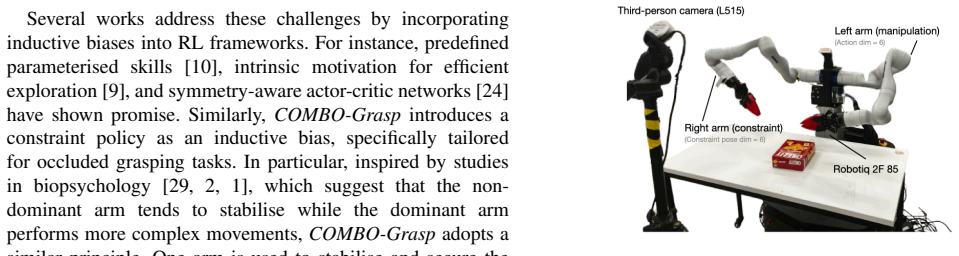

Figures from the paper (7 more)


Forward citations
Cited by 1 Pith paper
-
Leveraging Extrinsic Dexterity for Occluded Grasping on Grasp Constraining Walls
A hierarchical reinforcement learning framework with a CVAE contact-location model lets a parallel gripper grasp otherwise unreachable objects on tall walls by combining pushing, pivoting, and grasping, with 90% real-...
Reference graph
Works this paper leans on
-
[44]
Albert Zhan, Ruihan Zhao, Lerrel Pinto, Pieter Abbeel, and Michael Laskin. Learning visual robotic control efficiently with contrastive pre-training and data augmen- tation, 2022
work page 2022
-
[1]
Nondominant arm advantages in load compensation during rapid elbow joint movements
Leia Bagesteiro and Robert Sainburg. Nondominant arm advantages in load compensation during rapid elbow joint movements. Journal of neurophysiology, 90:1503–13, 10
-
[2]
Handedness: dominant arm advantages in control of limb dynamics
Leia B Bagesteiro and Robert L Sainburg. Handedness: dominant arm advantages in control of limb dynamics. Journal of neurophysiology, 88(5):2408–2421, 2002
work page 2002
-
[3]
Graspldm: Generative 6-dof grasp synthesis using latent diffusion models
Kuldeep R Barad, Andrej Orsula, Antoine Richard, Jan Dentler, Miguel Olivares-Mendez, and Carol Martinez. Graspldm: Generative 6-dof grasp synthesis using latent diffusion models. IEEE Access, 2024
work page 2024
-
[4]
Distilled Domain Randomization
Julien Brosseit, Benedikt Hahner, Fabio Muratore, Michael Gienger, and Jan Peters. Distilled domain randomization. arXiv preprint arXiv:2112.03149 , 2021
work page Pith review arXiv 2021
-
[5]
Yangming Cheng, Liulei Li, Yuanyou Xu, Xiaodi Li, Zongxin Yang, Wenguan Wang, and Yi Yang. Segment and track anything. arXiv preprint arXiv:2305.06558 , 2023
arXiv 2023
-
[6]
Diffusion policy: Visuomotor policy learning via action diffusion
Cheng Chi, Zhenjia Xu, Siyuan Feng, Eric Cousineau, Yilun Du, Benjamin Burchfiel, Russ Tedrake, and Shuran Song. Diffusion policy: Visuomotor policy learning via action diffusion. The International Journal of Robotics Research, page 02783649241273668, 2023
2023
-
[7]
Universal manipulation interface: In- the-wild robot teaching without in-the-wild robots
Cheng Chi, Zhenjia Xu, Chuer Pan, Eric Cousineau, Benjamin Burchfiel, Siyuan Feng, Russ Tedrake, and Shuran Song. Universal manipulation interface: In- the-wild robot teaching without in-the-wild robots. In Proceedings of Robotics: Science and Systems (RSS) , 2024
2024
Show all 62 references
-
[8]
Universal manipulation interface: In-the- wild robot teaching without in-the-wild robots, 2024
Cheng Chi, Zhenjia Xu, Chuer Pan, Eric Cousineau, Benjamin Burchfiel, Siyuan Feng, Russ Tedrake, and Shuran Song. Universal manipulation interface: In-the- wild robot teaching without in-the-wild robots, 2024. URL https://arxiv.org/abs/2402.10329
2024 arXiv
-
[9]
Intrinsic motivation for encouraging syn- ergistic behavior
Rohan Chitnis, Shubham Tulsiani, Saurabh Gupta, and Abhinav Gupta. Intrinsic motivation for encouraging syn- ergistic behavior. In International Conference on Learn- ing Representations, 2020. URL https://openreview.net/ forum?id=SJleNCNtDH
2020
-
[10]
Efficient bimanual manipulation using learned task schemas
Rohan Chitnis, Shubham Tulsiani, Saurabh Gupta, and Abhinav Gupta. Efficient bimanual manipulation using learned task schemas. In 2020 IEEE International Conference on Robotics and Automation (ICRA) , pages 1149–1155. IEEE, 2020
2020
-
[11]
Coleman, Ioan Alexandru Sucan, Sachin Chitta, and Nikolaus Correll
D.M. Coleman, Ioan Alexandru Sucan, Sachin Chitta, and Nikolaus Correll. Reducing the barrier to entry of complex robotic software: a moveit! case study. ArXiv, abs/1404.3785, 2014. URL https://api.semanticscholar. org/CorpusID:13939653
2014 arXiv
-
[12]
Ramp: A bench- mark for evaluating robotic assembly manipulation and planning
Jack Collins, Mark Robson, Jun Yamada, Mohan Srid- haran, Karol Janik, and Ingmar Posner. Ramp: A bench- mark for evaluating robotic assembly manipulation and planning. IEEE Robotics and Automation Letters , 2023
2023
-
[13]
Objaverse: A universe of annotated 3d objects
Matt Deitke, Dustin Schwenk, Jordi Salvador, Luca Weihs, Oscar Michel, Eli VanderBilt, Ludwig Schmidt, Kiana Ehsani, Aniruddha Kembhavi, and Ali Farhadi. Objaverse: A universe of annotated 3d objects. In Proceedings of the IEEE/CVF Conference on Computer Vision and Pattern Rec...
2023
-
[14]
McHugh, and Vincent Vanhoucke
Laura Downs, Anthony Francis, Nate Koenig, Brandon Kinman, Ryan Hickman, Krista Reymann, Thomas B. McHugh, and Vincent Vanhoucke. Google scanned objects: A high-quality dataset of 3d scanned household items, 2022. URL https://arxiv.org/abs/2204.11918
2022 arXiv
-
[15]
A comparison of imitation learning algorithms for bimanual manipulation
Michael Drolet, Simon Stepputtis, Siva Kailas, Ajinkya Jain, Jan Peters, Stefan Schaal, and Heni Ben Amor. A comparison of imitation learning algorithms for bimanual manipulation. IEEE Robotics and Automation Letters , 2024
2024
-
[16]
A billion ways to grasp: An evaluation of grasp sampling schemes on a dense, physics-based grasp data set
Clemens Eppner, Arsalan Mousavian, and Dieter Fox. A billion ways to grasp: An evaluation of grasp sampling schemes on a dense, physics-based grasp data set. In The International Symposium of Robotics Research , pages 890–905. Springer, 2019
2019
-
[17]
Stabilize to act: Learning to coordinate for bimanual manipulation
Jennifer Grannen, Yilin Wu, Brandon Vu, and Dorsa Sadigh. Stabilize to act: Learning to coordinate for bimanual manipulation. In 7th Annual Conference on Robot Learning , 2023. URL https://openreview.net/ forum?id=86aMPJn6hX9F
2023
-
[18]
Soft actor-critic: Off-policy maximum entropy deep reinforcement learning with a stochastic actor
Tuomas Haarnoja, Aurick Zhou, Pieter Abbeel, and Sergey Levine. Soft actor-critic: Off-policy maximum entropy deep reinforcement learning with a stochastic actor. In International conference on machine learning , pages 1861–1870. PMLR, 2018
2018
-
[19]
Denoising diffusion probabilistic models
Jonathan Ho, Ajay Jain, and Pieter Abbeel. Denoising diffusion probabilistic models. Advances in neural infor- mation processing systems , 33:6840–6851, 2020
2020
-
[20]
Dynamic handover: Throw and catch with bi- manual hands, 2023
Binghao Huang, Yuanpei Chen, Tianyu Wang, Yuzhe Qin, Yaodong Yang, Nikolay Atanasov, and Xiaolong Wang. Dynamic handover: Throw and catch with bi- manual hands, 2023
2023
-
[21]
Scalable deep reinforcement learning for vision- based robotic manipulation
Dmitry Kalashnikov, Alex Irpan, Peter Pastor, Julian Ibarz, Alexander Herzog, Eric Jang, Deirdre Quillen, Ethan Holly, Mrinal Kalakrishnan, Vincent Vanhoucke, et al. Scalable deep reinforcement learning for vision- based robotic manipulation. In Conference on robot learning, p...
2018
-
[22]
A unified approach for motion and force control of robot manipulators: The operational space formulation
Oussama Khatib. A unified approach for motion and force control of robot manipulators: The operational space formulation. IEEE Journal on Robotics and Automation, 3(1):43–53, 1987
1987
-
[23]
Model-free friction observers for flexible joint robots with torque measurements
Min Jun Kim, Fabian Beck, Christian Ott, and Alin Albu- Sch¨affer. Model-free friction observers for flexible joint robots with torque measurements. IEEE Transactions on Robotics, 35(6):1508–1515, 2019. doi: 10.1109/TRO. 2019.2926496
2019
-
[24]
Efficient bimanual handover and rear- rangement via symmetry-aware actor-critic learning
Yunfei Li, Chaoyi Pan, Huazhe Xu, Xiaolong Wang, and Yi Wu. Efficient bimanual handover and rear- rangement via symmetry-aware actor-critic learning. In 2023 IEEE International Conference on Robotics and Automation (ICRA) , pages 3867–3874, 2023. doi: 10. 1109/ICRA48891.2023.10160739
2023
-
[25]
Twisting lids off with two hands
Toru Lin, Zhao-Heng Yin, Haozhi Qi, Pieter Abbeel, and Jitendra Malik. Twisting lids off with two hands. arXiv preprint arXiv:2403.02338, 2024
2024 arXiv
-
[26]
6-dof graspnet: Variational grasp generation for object manipulation
Arsalan Mousavian, Clemens Eppner, and Dieter Fox. 6-dof graspnet: Variational grasp generation for object manipulation. In Proceedings of the IEEE/CVF interna- tional conference on computer vision , pages 2901–2910, 2019
2019
-
[27]
Nvidia isaac sim
NVIDIA. Nvidia isaac sim. URL https://developer. nvidia.com/isaac-sim
-
[28]
D. E. Rumelhart, G. E. Hinton, and R. J. Williams. Learning internal representations by error propagation , page 318–362. MIT Press, Cambridge, MA, USA, 1986. ISBN 026268053X
1986
-
[29]
Sainburg
Robert L. Sainburg. Evidence for a dynamic-dominance hypothesis of handedness. Experimental Brain Research, 142:241–258, 2001. URL https://api.semanticscholar.org/ CorpusID:206924666
2001
-
[31]
Proximal policy optimization algorithms, 2017
John Schulman, Filip Wolski, Prafulla Dhariwal, Alec Radford, and Oleg Klimov. Proximal policy optimization algorithms, 2017. URL https://arxiv.org/abs/1707.06347
2017 arXiv
-
[32]
Learn- ing to scaffold the development of robotic manipula- tion skills
Lin Shao, Toki Migimatsu, and Jeannette Bohg. Learn- ing to scaffold the development of robotic manipula- tion skills. In 2020 IEEE International Conference on Robotics and Automation (ICRA) , pages 5671–5677,
2020
-
[33]
Funkhouser
Shuran Song, Andy Zeng, Johnny Lee, and Thomas A. Funkhouser. Grasping in the wild: Learning 6dof closed-loop grasping from low-cost demonstrations. IEEE Robotics and Automation Letters , 5:4978–4985,
-
[34]
Learning pregrasp manipulation of objects from ungraspable poses, 2020
Zhaole Sun, Kai Yuan, Wenbin Hu, Chuanyu Yang, and Zhibin Li. Learning pregrasp manipulation of objects from ungraspable poses, 2020
2020
-
[35]
Curobo: Parallelized collision-free minimum-jerk robot motion generation
Balakumar Sundaralingam, Siva Kumar Sastry Hari, Adam Fishman, Caelan Garrett, Karl Van Wyk, Valts Blukis, Alexander Millane, Helen Oleynikova, Ankur Handa, Fabio Ramos, et al. Curobo: Parallelized collision-free minimum-jerk robot motion generation. arXiv preprint arXiv:2310....
-
[36]
Domain ran- domization for transferring deep neural networks from simulation to the real world
Josh Tobin, Rachel Fong, Alex Ray, Jonas Schneider, Wojciech Zaremba, and Pieter Abbeel. Domain ran- domization for transferring deep neural networks from simulation to the real world. In 2017 IEEE/RSJ in- ternational conference on intelligent robots and systems (IROS), pages ...
2017
-
[37]
Unidexgrasp++: Im- proving dexterous grasping policy learning via geometry- aware curriculum and iterative generalist-specialist learn- ing, 2023
Weikang Wan, Haoran Geng, Yun Liu, Zikang Shan, Yaodong Yang, Li Yi, and He Wang. Unidexgrasp++: Im- proving dexterous grasping policy learning via geometry- aware curriculum and iterative generalist-specialist learn- ing, 2023. URL https://arxiv.org/abs/2304.00464
2023 arXiv
-
[38]
Goal-auxiliary actor-critic for 6d robotic grasping with point clouds
Lirui Wang, Yu Xiang, Wei Yang, Arsalan Mousavian, and Dieter Fox. Goal-auxiliary actor-critic for 6d robotic grasping with point clouds. In Conference on Robot Learning, pages 70–80. PMLR, 2022
2022
-
[39]
Foundationpose: Unified 6d pose estimation and tracking of novel objects
Bowen Wen, Wei Yang, Jan Kautz, and Stan Birchfield. Foundationpose: Unified 6d pose estimation and tracking of novel objects. In Proceedings of the IEEE/CVF Conference on Computer Vision and Pattern Recognition, pages 17868–17879, 2024
2024
-
[40]
Efficient skill acquisition for complex manipulation tasks in ob- structed environments, 2023
Jun Yamada, Jack Collins, and Ingmar Posner. Efficient skill acquisition for complex manipulation tasks in ob- structed environments, 2023
2023
-
[41]
Twist: Teacher-student world model distillation for efficient sim-to-real transfer
Jun Yamada, Marc Rigter, Jack Collins, and Ingmar Pos- ner. Twist: Teacher-student world model distillation for efficient sim-to-real transfer. In 2024 IEEE International Conference on Robotics and Automation (ICRA) , pages 9190–9196. IEEE, 2024
2024
-
[42]
M2t2: Multi-task masked trans- former for object-centric pick and place
Wentao Yuan, Adithyavairavan Murali, Arsalan Mousa- vian, and Dieter Fox. M2t2: Multi-task masked trans- former for object-centric pick and place. arXiv preprint arXiv:2311.00926, 2023
2023 arXiv
-
[43]
3d diffusion policy
Yanjie Ze, Gu Zhang, Kangning Zhang, Chenyuan Hu, Muhan Wang, and Huazhe Xu. 3d diffusion policy. arXiv preprint arXiv:2403.03954, 2024
2024 arXiv
-
[45]
Zhao, Jonathan Tompson, Danny Driess, Pete Florence, Kamyar Ghasemipour, Chelsea Finn, and Ayzaan Wahid
Tony Z. Zhao, Jonathan Tompson, Danny Driess, Pete Florence, Kamyar Ghasemipour, Chelsea Finn, and Ayzaan Wahid. Aloha unleashed: A simple recipe for robot dexterity, 2024. URL https://arxiv.org/abs/2410. 13126
2024
-
[46]
Nerf in the palm of your hand: Corrective augmentation for robotics via novel-view syn- thesis
Allan Zhou, Moo Jin Kim, Lirui Wang, Pete Florence, and Chelsea Finn. Nerf in the palm of your hand: Corrective augmentation for robotics via novel-view syn- thesis. In Proceedings of the IEEE/CVF Conference on Computer Vision and Pattern Recognition, pages 17907– 17917, 2023
2023
-
[47]
Learning to grasp the ungraspable with emergent extrinsic dexterity
Wenxuan Zhou and David Held. Learning to grasp the ungraspable with emergent extrinsic dexterity. In Conference on Robot Learning , pages 150–160. PMLR, 2023. APPENDIX A. Additional Analysis for Experiments
2023
-
[51]
Student Policy Performance per Object: Figure 9 il- lustrates the success rate of COMBO-Grasp for each ob- ject used during training. While COMBO-Grasp demonstrate performant success rate across diverse objects, the occluded grasp performance for small objects or objects with ...
-
[52]
The diffusion policy is implemented using a Denoising Diffusion Probabilistic Model (DDPM), with a multi-layer perceptron (MLP)-based backbone
Teacher Constraint Policy: We employ a diffusion pol- icy [6] as the basis for the teacher constraint policy. The diffusion policy is implemented using a Denoising Diffusion Probabilistic Model (DDPM), with a multi-layer perceptron (MLP)-based backbone. The denoising model is ...
-
[53]
An actor network consists of an MLP with 2 hidden layers of sizes [256, 256]
Teacher Grasping Policy: We train a teacher grasping policy using Proximal Policy Optimisation (PPO). An actor network consists of an MLP with 2 hidden layers of sizes [256, 256]. The actor network is parameterized as a Gaussian distribution with a fixed, state-independent sta...
-
[54]
Reward function: The reward function used in our experiments comprises six terms and is defined as follows: r = α1rdist pos + α2rdist ori − α3rcollision − α4raction + α5rlif t+ α6rsuccess (5) where the weighting coefficients are set to α1 = 0.2, α2 = 0.2, α3 = 1.0, α4 = 0.025,...
-
[55]
The DP3 encoder comprises three fully connected layers with dimensions of [128, 256, 384], followed by a max pooling operation and a final fully connected layer of size 64
Studnet Constraint Policy: The student constraint policy integrates the DP3 encoder [43] and a state encoder to process point cloud and state observations, respectively. The DP3 encoder comprises three fully connected layers with dimensions of [128, 256, 384], followed by a ma...
-
[56]
The architecture of the DP3 encoder and the state encoder is consistent with that employed in the student con- straint policy
Student Grasping Policy: We adopt the 3D Diffusion Policy (DP3) [43] as the foundation for the student grasping policy. The architecture of the DP3 encoder and the state encoder is consistent with that employed in the student con- straint policy. However, the weights of these ...
-
[57]
To train teacher policies efficiently, we spawn 1024 robots and objects in the simulated environment
Training: In order to train a teacher policy from a diverse set of objects, we select 48 objects from the Google Scanned Object dataset, as illustrated in Figure 10. To train teacher policies efficiently, we spawn 1024 robots and objects in the simulated environment. In order ...
-
[58]
Evaluation: To evaluate policies for both seen and novel objects, we also select 10 held-out objects from the Google Scanned Object dataset (see Figure 11). E. Real-World Experiment Setup
-
[59]
We render depth images with the size of 640 × 480 from a Realsense L515 camera to reconstruct point cloud observations
Input Observation for Student Policies: The distilled student policies take point clouds as input in real-world envi- ronments. We render depth images with the size of 640 × 480 from a Realsense L515 camera to reconstruct point cloud observations. Similar to [43], we crop the ...
-
[60]
Using the reconstructed mesh, we generate desired occluded grasp poses using antipodal sampling
Desired Occluded Grasp Pose Generation: In order to scan an object to reconstruct a mesh, we use Polycam, an application that captures pictures of objects and reconstructs an object mesh using Neural Radiance Fields (NeRF). Using the reconstructed mesh, we generate desired occ...
-
[61]
We use the same hyperparameters employed for training COMBO-Grasp, except for the entropy coefficient, which is set to 0.003
PPO: We train a policy using Proximal Policy Optimiza- tion (PPO) [30], where the policy outputs 12-dimensional delta end-effector poses corresponding to both the left and right arms. We use the same hyperparameters employed for training COMBO-Grasp, except for the entropy coe...
-
[62]
In particular, we add a reward rright dist = ||T obj − T RightEE ||2
PPO + Constraint Reward: Similar to the PPO baseline, but we introduce an additional reward term that encourages the right arm to be used as a constraint. In particular, we add a reward rright dist = ||T obj − T RightEE ||2
-
[63]
To accommodate objects of varying sizes and orientations, the constraint is positioned at the right hand side of the workspace rather than at the centre
COMBO-Grasp w/ Fixed Constraint: Instead of employ- ing a trained constraint policy, we place the right arm as a constraint at a fixed pose. To accommodate objects of varying sizes and orientations, the constraint is positioned at the right hand side of the workspace rather th...
-
[2003]
doi: 10.1152/jn.00189.2003
2003
-
[2019]
URL https://api.semanticscholar.org/CorpusID: 209140715
-
[2020]
doi: 10.1109/ICRA40945.2020.9197134
2020
Reviewed August 8, 2026 · model on record in the stance chip above.
Discussion (0). Continue with ORCID to comment.