REVIEW 4 major objections 4 minor 2 cited by
Capturing the Temporal Dependence of Training Data Influence
T0 review · 4 major / 4 minor · reviewed 2026-08-11 · deepseek-v4-flash
Pith's one-line read Training-data influence can be approximated as a dot product between a precomputed data value embedding and the final model gradient.
desk verdict A solid, honest contribution to order-aware data attribution with one under-supported bridge: the SGD-derived embedding is used to make claims about AdamW-trained LLMs. read the letter →
The pith
A machine-rendered reading of the paper's core claim, the machinery that carries it, and where it could break.
The reading
What carries the argument
The load-bearing object is the data value embedding $\mathrm{DVEmb}^{(t_s)}(z_*)$, a vector in parameter-gradient space defined at each training iteration as the gradient of the point at that iteration propagated forward through the products $(I-\eta_k H_k)$ over all subsequent iterations. The central identity is Equation (2) in the paper, which converts any test-time attribution into a dot product with this embedding. To make the embedding computable, the paper relies on the Generalized Gauss-Newton approximation of the Hessians, a recursive backward algorithm (Theorem 2) that expresses each embedding in terms of later embeddings and gradient similarities, and a layer-wise independence assumption plus random projections for storage. Influence checkpointing parallelizes the backward pass by running the recursion from multiple checkpoints, and also enables tracking how a fixed point's influence changes across intermediate checkpoints.
What would settle it
Retrain the small MLP fidelity experiment of Section 5.1 switching the optimizer from SGD to AdamW with the same batch order, and measure the Spearman correlation between ground-truth trajectory-specific LOO and data value embedding scores; a correlation collapse would show the method fails outside SGD. Alternatively, rerun the Pythia-410M pretraining with an actual canonicalized SGD schedule and check whether the three-regime curve matches the AdamW-trained results.
Extended reading notes
Core claim
On its own terms, the paper establishes that the trajectory-specific leave-one-out loss change from removing a training point $z_*$ used at iteration $t_s$ is well approximated by $\nabla\ell(\theta_T,z^{(\text{val})})^\top \mathrm{DVEmb}^{(t_s)}(z_*)$, where $\mathrm{DVEmb}^{(t_s)}(z_*) = \eta_{t_s}\left[\prod_{k=t_s+1}^{T-1}(I-\eta_k H_k)\right]\nabla\ell(\theta_{t_s},z_*)$ accumulates the point's gradient through the remaining training steps. Using the Generalized Gauss-Newton approximation for each Hessian, the embeddings can be computed recursively from the final iteration backward, and gradient decomposition plus random projection keeps storage and compute within reach of foundation-model training. The consequence is that influence estimates are no longer blind to data ordering: identical points at different training times receive different scores, and duplicate points no longer collapse to one attribution. Empirically, the paper reports a consistent three-regime pattern in LLM pretraining and shows that applying online data selection only during the early and late regimes recovers the bulk of the benefit of continuous selection.
Load-bearing premise
The derivation assumes plain SGD, yet the large-scale experiments are run with AdamW; if the SGD-based embedding does not faithfully represent influence under Adam-style updates, the reported temporal regimes and the data-selection timing conclusions are not supported.
Editorial extensions
If this is right
- If the approximation holds, influence attribution for any test query becomes a single dot product per training point, so no retraining and no advance knowledge of validation data are needed.
- Data selection during only the high-influence early phase (under 4% of training) yields roughly half of the gain of continuous selection, and early-plus-late selection yields most of it at over 5x less compute.
- The three-regime influence pattern gives a principled way to schedule online data curation and checkpoint-based attribution in LLM pretraining.
- Influence functions, which assign identical scores to identical points regardless of position, are shown to be a limiting case of the trajectory-based view under strong stationarity assumptions, so their known instability is explained rather than incidental.
Reading between the lines
- If the SGD-derived embedding transfers to optimizers like Adam or Lion, the same dot-product machinery would give a practical attribution tool for routine LLM training runs; a direct test is to compare embedding scores against ground-truth LOO on a small AdamW-trained model.
- The low-influence basin suggests that gradient similarity to validation data is least informative mid-training; this might mean that curriculum or data-pruning schedules should concentrate utility measurements at the start and near the end, which is testable by ablating selection windows at finer granularity.
- The recursive interpretation (an early point's influence is reduced when later similar points appear) implies a notion of influence saturation that could be used to estimate when a corpus is redundant, e.g., by measuring how much embedding norms decay after repeated similar examples.
- The checkpoint reconstruction from saved checkpoints alone (Appendix C.10) suggests that the method can be retrofitted to existing training logs that did not store per-step gradients, assuming one update per checkpoint.
Editorial analysis
A structured set of objections, weighed in public.
Referee Report
Summary. The paper argues that classical influence functions are inadequate for modern training pipelines because they assume permutation-invariance with respect to training data. It formalizes trajectory-specific leave-one-out (TSLOO) influence, which measures the change in validation loss when a training point is removed from the specific iteration at which it was used, and proposes data value embedding (DVE) as an efficient approximation. The core identity is Eq. (2): DVE for a training point z* at iteration ts is the product of a learning-rate factor, a product of Hessian terms (I - η_k H_k), and the gradient at z*, so that TSLOO can be approximated by a dot product of DVE with the final-model validation gradient. The paper derives a recursive GGN-based computation, introduces influence checkpointing for parallelism, and compares favorably to LoGRA in efficiency. Experiments include MNIST fidelity checks against exact retraining LOO, mislabeled-data detection and data selection benchmarks, and large-scale studies on Pythia-410M and GPT-2 that suggest three temporal influence regimes and support early+late online data selection. The paper closes by acknowledging that DVE is specifically tailored to SGD and not directly extendable to Adam.
Significance. If the core approximation holds, this is a valuable contribution: DVE provides a validation-agnostic, dot-product-based attribution estimator that is sensitive to training order, and the projected-gradient storage scheme is markedly cheaper than the most efficient influence-function implementation on the reported Pythia run. The claimed empirical phenomena—high influence at early and late training stages and the effectiveness of early+late data selection—are concrete, falsifiable, and potentially useful for data curation. The algorithmic design, including per-layer computation and checkpointing, is thoughtful. The main weakness is that the load-bearing temporal and optimizer claims are not directly validated: the fidelity experiments do not isolate removal time, the large-scale experiments use AdamW while the derivation assumes SGD, and the theory bounds parameter error rather than the loss difference that TSLOO defines. The paper would also benefit from code and seed-level details to make the large-scale results reproducible.
major comments (4)
- [§5.3, Fig. 1; Appendix E.1; Eq. (2)] The large-scale experiments in Figures 1, 4, and 9 are run with AdamW (Appendix E.1: optimizer AdamW, learning rate 3e-4, weight decay 0.1), while Eq. (1)–(2) and Theorem 2 are derived from the plain SGD update θ_{t+1} = θ_t − η_t Σ_{z∈B_t} ∇ℓ(θ_t,z). Section 6 concedes that DVE is not directly extendable to Adam due to its normalization terms. Thus the three-regime curve in Figure 1(a) and the early+late data-selection result in Figure 1(b) rely on an unvalidated bridge from an SGD derivation to AdamW training dynamics. Please either extend the recursion to AdamW (for example under a diagonal-preconditioner approximation) or validate DVE against ground-truth TSLOO on small AdamW-trained models across training time; at minimum, the large-scale claims should be labeled as relying on an SGD proxy for Adam.
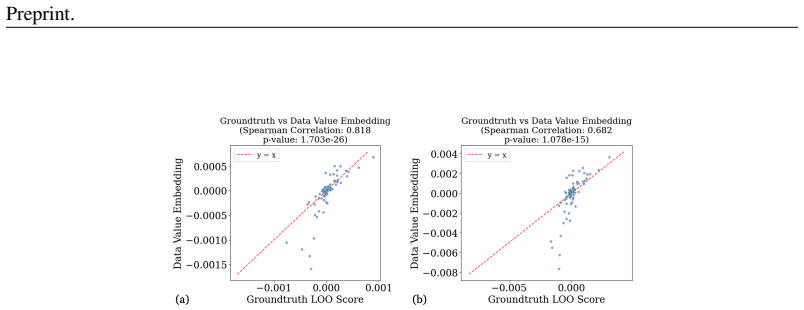
- [§5.1, Figs. 3, 6, 7] The fidelity experiments do not directly validate the temporal dependence that is the paper's central claim. Single-epoch removal removes a point only from the last epoch, and all-epoch removal removes it from every epoch; neither setting reports DVE versus exact TSLOO as a function of ts. I ask for an experiment in which the same training point is removed at several different iterations (e.g., early, middle, and late training) and the Spearman correlation between DVE scores and exact retraining-based TSLOO is reported for each removal time. Without such a test, the statement that DVE 'captures the temporal dependence of data influence' is not directly supported by the fidelity evidence.
- [Appendix C.2, Theorem 3, Eq. (11)] Theorem 3 bounds the parameter-space error ∥(θ_T − θ'_T) − Δθ∥, but TSLOO is defined as a loss difference and Eq. (1) approximates it by a first-order Taylor expansion of the loss. Bounding the parameter error does not by itself bound |ℓ(θ'_T,z_val) − ℓ(θ_T,z_val) − ∇ℓ(θ_T,z_val)ᵀ Δθ|; an additional Taylor remainder bound is needed. The proof also relies on the unverified assumption H_t ⪯ Λ/√t I, which is asserted with anecdotal justification and is not checked in any of the experimental settings. As stated, the theoretical guarantee is one step removed from the quantity the method claims to approximate.
- [Fig. 1(b), §5.3] The key practical claim—that early+late selection recovers 96% of the improvement of continuous selection while reducing computational overhead by more than 5×—is reported without error bars, seed counts, or the total number of training iterations in the main text. Since this result drives the proposed data-curation strategy, please report multiple seeds with variance and specify the full training length and the precise computational-overhead accounting.
minor comments (4)
- [§6, Limitations] The sentence 'While using as a proxy for Adam has proved to be effective in our experiment' is missing its subject and should read 'While using SGD as a proxy for Adam ...'; as written, it also overstates the evidence, since no fidelity experiment uses AdamW.
- [Appendix C.2, Hessian decay justification] The sentence 'this assumption aligns with empirical findings in deep learning literature ()' contains an empty citation; either provide the reference or remove the claim.
- [Appendix E.3.1] The text says 'In Figure 7(b), we consider a simplified setting...' but the discussion is about the analytical curves shown in Figure 8(b); the figure reference should be corrected.
- [§4.4, Appendix C.7] The claim that influence checkpointing 'reduces the overall computational cost by K times' should be stated as reducing wall-clock time when K parallel workers are available; the total number of FLOPs is not reduced by a factor of K.
Circularity Check
No significant circularity: the data value embedding is defined as the test-independent factor of a previously established unrolled-differentiation approximation, and the method is validated against externally computed trajectory-specific LOO.
full rationale
The paper's derivation chain is self-contained and not circular. Trajectory-specific LOO (Definition 1) is defined by counterfactual retraining with a data point removed at a specific iteration. Equation (1) is the standard first-order unrolled-differentiation approximation, credited to Hara et al. (2019), and Equation (2) defines DVEmb as exactly the factor multiplying the test gradient in that approximation. Thus the central dot-product formula is true by construction, but this is a definition, not a validation: the paper's fidelity experiments (Section 5.1 and Appendix E.2) compare DVEmb-based scores against ground-truth TSLOO values obtained by actual retraining, on MNIST MLPs and CNNs, with no fitted constants and no prediction of a quantity used to fit the method. Theorem 2 is an algebraic recursive rearrangement of the same definition under the generalized Gauss-Newton approximation, so it introduces no new empirical circularity. The main weakness flagged in the Limitations section is that DVEmb is derived for SGD while the large-scale experiments use AdamW; this is an external validity gap, not a circular step. Self-citations, such as Wang et al. (2024c) for the gradient decomposition trick, are implementation details and are not load-bearing for the core approximation. No uniqueness theorem or ansatz from the authors' prior work is invoked to force the choice of data value embedding. Therefore the central claim does not reduce to its own inputs.
Assumptions & free parameters
free parameters (2)
- Projection dimension per layer =
1024
- Checkpoint count K =
not reported for main experiments
assumptions (7)
- domain assumption Generalized Gauss-Newton (GGN) approximation H_t ≈ Σ_{z∈B_t} ∇ℓ(θ_t,z) ∇ℓ(θ_t,z)^T for the Hessian
- domain assumption Layer-wise independence of gradients
- ad hoc to paper Hessian spectral norm decay H_t ⪯ Λ/√t I
- domain assumption Learning rate schedule η_t = η_max/√t with η_max = O(1/√T)
- standard math Bounded gradient norm ∥∇ℓ∥ ≤ G and L-Lipschitz Hessian
- domain assumption SGD can serve as a proxy for AdamW influence
- domain assumption Random projections preserve the gradient inner products needed for recursion
Cite this review
Pith. "Pith review of Capturing the Temporal Dependence of Training Data Influence." pith.science (2026). https://pith.science/paper/VV5TQXKP
@misc{pith2026241209538,
  author       = {Pith},
  title        = {Pith review of: Capturing the Temporal Dependence of Training Data Influence},
  year         = {2026},
  howpublished = {\url{https://pith.science/paper/VV5TQXKP}},
  note         = {Machine review of arXiv:2412.09538}
}
read the original abstract
Traditional data influence estimation methods, like influence function, assume that learning algorithms are permutation-invariant with respect to training data. However, modern training paradigms, especially for foundation models using stochastic algorithms and multi-stage curricula, are sensitive to data ordering, thus violating this assumption. This mismatch renders influence functions inadequate for answering a critical question in machine learning: How can we capture the dependence of data influence on the optimization trajectory during training? To address this gap, we formalize the concept of trajectory-specific leave-one-out (LOO) influence, which quantifies the impact of removing a data point from a specific iteration during training, accounting for the exact sequence of data encountered and the model's optimization trajectory. However, exactly evaluating the trajectory-specific LOO presents a significant computational challenge. To address this, we propose data value embedding, a novel technique enabling efficient approximation of trajectory-specific LOO. Specifically, we compute a training data embedding that encapsulates the cumulative interactions between data and the evolving model parameters. The LOO can then be efficiently approximated through a simple dot-product between the data value embedding and the gradient of the given test data. As data value embedding captures training data ordering, it offers valuable insights into model training dynamics. In particular, we uncover distinct phases of data influence, revealing that data points in the early and late stages of training exert a greater impact on the final model. These insights translate into actionable strategies for managing the computational overhead of data selection by strategically timing the selection process, potentially opening new avenues in data curation research.
Figures


Figures from the paper (11 more)




Forward citations
Cited by 2 Pith papers
-
Better Training Data Attribution via Better Inverse Hessian-Vector Products
ASTRA, an EKFAC-preconditioned Neumann series iteration, computes more accurate inverse Hessian-vector products and improves training data attribution scores over EKFAC baselines.
-
Newfluence: Boosting Model interpretability and Understanding in High Dimensions
In high-dimensional regression, classical influence functions underestimate true leave-one-out influence by a per-point factor, and the proposed Newfluence estimator corrects this bias.
Reference graph
Works this paper leans on
-
[1]
write newline
" write newline "" before.all 'output.state := FUNCTION n.dashify 't := "" t empty not t #1 #1 substring "-" = t #1 #2 substring "--" = not "--" * t #2 global.max substring 't := t #1 #1 substring "-" = "-" * t #2 global.max substring 't := while if t #1 #1 substring * t #2 global.max substring 't := if while FUNCTION format.date year duplicate empty "emp...
-
[2]
@esa (Ref
\@ifxundefined[1] #1\@undefined \@firstoftwo \@secondoftwo \@ifnum[1] #1 \@firstoftwo \@secondoftwo \@ifx[1] #1 \@firstoftwo \@secondoftwo [2] @ #1 \@temptokena #2 #1 @ \@temptokena \@ifclassloaded agu2001 natbib The agu2001 class already includes natbib coding, so you should not add it explicitly Type <Return> for now, but then later remove the command n...
-
[3]
\@lbibitem[] @bibitem@first@sw\@secondoftwo \@lbibitem[#1]#2 \@extra@b@citeb \@ifundefined br@#2\@extra@b@citeb \@namedef br@#2 \@nameuse br@#2\@extra@b@citeb \@ifundefined b@#2\@extra@b@citeb @num @parse #2 @tmp #1 NAT@b@open@#2 NAT@b@shut@#2 \@ifnum @merge>\@ne @bibitem@first@sw \@firstoftwo \@ifundefined NAT@b*@#2 \@firstoftwo @num @NAT@ctr \@secondoft...
-
[4]
@open @close @open @close and [1] URL: #1 \@ifundefined chapter * \@mkboth \@ifxundefined @sectionbib * \@mkboth * \@mkboth\@gobbletwo \@ifclassloaded amsart * \@ifclassloaded amsbook * \@ifxundefined @heading @heading NAT@ctr thebibliography [1] @ \@biblabel @NAT@ctr \@bibsetup #1 @NAT@ctr @ @openbib .11em \@plus.33em \@minus.07em 4000 4000 `\.\@m @bibit...
-
[5]
Fundamentals of Task-Agnostic Data Valuation
Mohammad Mohammadi Amiri, Frederic Berdoz, and Ramesh Raskar. Fundamentals of task-agnostic data valuation. arXiv preprint arXiv:2208.12354, 2022
work page Pith review arXiv 2022
-
[6]
If influence functions are the answer, then what is the question? Advances in Neural Information Processing Systems, 35: 0 17953--17967, 2022
Juhan Bae, Nathan Ng, Alston Lo, Marzyeh Ghassemi, and Roger B Grosse. If influence functions are the answer, then what is the question? Advances in Neural Information Processing Systems, 35: 0 17953--17967, 2022
2022
-
[7]
Training data attribution via approximate unrolled differentation
Juhan Bae, Wu Lin, Jonathan Lorraine, and Roger Grosse. Training data attribution via approximate unrolled differentation. arXiv preprint arXiv:2405.12186, 2024
arXiv 2024
-
[8]
Relatif: Identifying explanatory training samples via relative influence
Elnaz Barshan, Marc-Etienne Brunet, and Gintare Karolina Dziugaite. Relatif: Identifying explanatory training samples via relative influence. In International Conference on Artificial Intelligence and Statistics, pp.\ 1899--1909. PMLR, 2020
work page 1909
Show all 80 references
-
[9]
Approximate confidence intervals
MS Bartlett. Approximate confidence intervals. Biometrika, 40 0 (1/2): 0 12--19, 1953
1953
-
[10]
Influence functions in deep learning are fragile
Samyadeep Basu, Philip Pope, and Soheil Feizi. Influence functions in deep learning are fragile. arXiv preprint arXiv:2006.14651, 2020
2006 arXiv
-
[11]
Stability and generalization
Olivier Bousquet and Andr \'e Elisseeff. Stability and generalization. The Journal of Machine Learning Research, 2: 0 499--526, 2002
2002
-
[12]
Approximating the shapley value using stratified empirical bernstein sampling
Mark Alexander Burgess and Archie C Chapman. Approximating the shapley value using stratified empirical bernstein sampling. In IJCAI, pp.\ 73--81, 2021
2021
-
[13]
Multi-stage influence function
Hongge Chen, Si Si, Yang Li, Ciprian Chelba, Sanjiv Kumar, Duane Boning, and Cho-Jui Hsieh. Multi-stage influence function. Advances in Neural Information Processing Systems, 33: 0 12732--12742, 2020
2020
-
[14]
Hydra: Hypergradient data relevance analysis for interpreting deep neural networks
Yuanyuan Chen, Boyang Li, Han Yu, Pengcheng Wu, and Chunyan Miao. Hydra: Hypergradient data relevance analysis for interpreting deep neural networks. In Proceedings of the AAAI Conference on Artificial Intelligence, volume 35, pp.\ 7081--7089, 2021
2021
-
[15]
What is your data worth to gpt? llm-scale data valuation with influence functions
Sang Keun Choe, Hwijeen Ahn, Juhan Bae, Kewen Zhao, Minsoo Kang, Youngseog Chung, Adithya Pratapa, Willie Neiswanger, Emma Strubell, Teruko Mitamura, et al. What is your data worth to gpt? llm-scale data valuation with influence functions. arXiv preprint arXiv:2405.13954, 2024
2024 arXiv
-
[16]
Characterizations of an empirical influence function for detecting influential cases in regression
R Dennis Cook and Sanford Weisberg. Characterizations of an empirical influence function for detecting influential cases in regression. Technometrics, 22 0 (4): 0 495--508, 1980
1980
-
[17]
Stochastic amortization: A unified approach to accelerate feature and data attribution
Ian Covert, Chanwoo Kim, Su-In Lee, James Zou, and Tatsunori Hashimoto. Stochastic amortization: A unified approach to accelerate feature and data attribution. arXiv preprint arXiv:2401.15866, 2024
2024 arXiv
-
[18]
Computational copyright: Towards a royalty model for ai music generation platforms
Junwei Deng and Jiaqi Ma. Computational copyright: Towards a royalty model for ai music generation platforms. arXiv preprint arXiv:2312.06646, 2023
2023
-
[19]
Efficient ensembles improve training data attribution
Junwei Deng, Ting-Wei Li, Shichang Zhang, and Jiaqi Ma. Efficient ensembles improve training data attribution. arXiv preprint arXiv:2405.17293, 2024
2024 arXiv
-
[20]
Understanding forgetting in continual learning with linear regression
Meng Ding, Kaiyi Ji, Di Wang, and Jinhui Xu. Understanding forgetting in continual learning with linear regression. In Forty-first International Conference on Machine Learning, 2024
2024
-
[21]
Calibrating noise to sensitivity in private data analysis
Cynthia Dwork, Frank McSherry, Kobbi Nissim, and Adam Smith. Calibrating noise to sensitivity in private data analysis. In Theory of cryptography conference, pp.\ 265--284. Springer, 2006
2006
-
[22]
Revisiting the fragility of influence functions
Jacob R Epifano, Ravi P Ramachandran, Aaron J Masino, and Ghulam Rasool. Revisiting the fragility of influence functions. Neural Networks, 162: 0 581--588, 2023
2023
-
[23]
How catastrophic can catastrophic forgetting be in linear regression? In Conference on Learning Theory, pp.\ 4028--4079
Itay Evron, Edward Moroshko, Rachel Ward, Nathan Srebro, and Daniel Soudry. How catastrophic can catastrophic forgetting be in linear regression? In Conference on Learning Theory, pp.\ 4028--4079. PMLR, 2022
2022
-
[24]
Doge: Domain reweighting with generalization estimation
Simin Fan, Matteo Pagliardini, and Martin Jaggi. Doge: Domain reweighting with generalization estimation. In Forty-first International Conference on Machine Learning, 2024
2024
-
[25]
What neural networks memorize and why: Discovering the long tail via influence estimation
Vitaly Feldman and Chiyuan Zhang. What neural networks memorize and why: Discovering the long tail via influence estimation. Advances in Neural Information Processing Systems, 33: 0 2881--2891, 2020
2020
-
[26]
The pile: An 800gb dataset of diverse text for language modeling
Leo Gao, Stella Biderman, Sid Black, Laurence Golding, Travis Hoppe, Charles Foster, Jason Phang, Horace He, Anish Thite, Noa Nabeshima, et al. The pile: An 800gb dataset of diverse text for language modeling. arXiv preprint arXiv:2101.00027, 2020
2020 arXiv
-
[27]
Data shapley: Equitable valuation of data for machine learning
Amirata Ghorbani and James Zou. Data shapley: Equitable valuation of data for machine learning. In International Conference on Machine Learning, pp.\ 2242--2251. PMLR, 2019
2019
-
[28]
A distributional framework for data valuation
Amirata Ghorbani, Michael Kim, and James Zou. A distributional framework for data valuation. In International Conference on Machine Learning, pp.\ 3535--3544. PMLR, 2020
2020
-
[29]
Studying large language model generalization with influence functions
Roger Grosse, Juhan Bae, Cem Anil, Nelson Elhage, Alex Tamkin, Amirhossein Tajdini, Benoit Steiner, Dustin Li, Esin Durmus, Ethan Perez, et al. Studying large language model generalization with influence functions. arXiv preprint arXiv:2308.03296, 2023
2023 arXiv
-
[30]
Fastif: Scalable influence functions for efficient model interpretation and debugging
Han Guo, Nazneen Rajani, Peter Hase, Mohit Bansal, and Caiming Xiong. Fastif: Scalable influence functions for efficient model interpretation and debugging. In Proceedings of the 2021 Conference on Empirical Methods in Natural Language Processing, pp.\ 10333--10350, 2021
2021
-
[31]
How to start training: The effect of initialization and architecture
Boris Hanin and David Rolnick. How to start training: The effect of initialization and architecture. Advances in neural information processing systems, 31, 2018
2018
-
[32]
Data cleansing for models trained with sgd
Satoshi Hara, Atsushi Nitanda, and Takanori Maehara. Data cleansing for models trained with sgd. Advances in Neural Information Processing Systems, 32, 2019
2019
-
[33]
Delving deep into rectifiers: Surpassing human-level performance on imagenet classification
Kaiming He, Xiangyu Zhang, Shaoqing Ren, and Jian Sun. Delving deep into rectifiers: Surpassing human-level performance on imagenet classification. In Proceedings of the IEEE international conference on computer vision, pp.\ 1026--1034, 2015
2015
-
[34]
Estimation of the shapley value by ergodic sampling
Ferenc Ill \'e s and P \'e ter Ker \'e nyi. Estimation of the shapley value by ergodic sampling. arXiv preprint arXiv:1906.05224, 2019
1906
-
[35]
Datamodels: Predicting predictions from training data
Andrew Ilyas, Sung Min Park, Logan Engstrom, Guillaume Leclerc, and Aleksander Madry. Datamodels: Predicting predictions from training data. arXiv preprint arXiv:2202.00622, 2022
2022 arXiv
-
[36]
Efficient task-specific data valuation for nearest neighbor algorithms
Ruoxi Jia, David Dao, Boxin Wang, Frances Ann Hubis, Nezihe Merve Gurel, Bo Li, Ce Zhang, Costas J Spanos, and Dawn Song. Efficient task-specific data valuation for nearest neighbor algorithms. Proceedings of the VLDB Endowment, 2019 a
2019
-
[37]
Towards efficient data valuation based on the shapley value
Ruoxi Jia, David Dao, Boxin Wang, Frances Ann Hubis, Nick Hynes, Nezihe Merve G \"u rel, Bo Li, Ce Zhang, Dawn Song, and Costas J Spanos. Towards efficient data valuation based on the shapley value. In The 22nd International Conference on Artificial Intelligence and Statistics...
2019
-
[38]
Opendataval: a unified benchmark for data valuation
Kevin Jiang, Weixin Liang, James Y Zou, and Yongchan Kwon. Opendataval: a unified benchmark for data valuation. Advances in Neural Information Processing Systems, 36, 2023
2023
-
[39]
Lava: Data valuation without pre-specified learning algorithms
Hoang Anh Just, Feiyang Kang, Tianhao Wang, Yi Zeng, Myeongseob Ko, Ming Jin, and Ruoxi Jia. Lava: Data valuation without pre-specified learning algorithms. In The Eleventh International Conference on Learning Representations, 2022
2022
-
[40]
Understanding black-box predictions via influence functions
Pang Wei Koh and Percy Liang. Understanding black-box predictions via influence functions. In International Conference on Machine Learning, pp.\ 1885--1894. PMLR, 2017
2017
-
[41]
Beta shapley: a unified and noise-reduced data valuation framework for machine learning
Yongchan Kwon and James Zou. Beta shapley: a unified and noise-reduced data valuation framework for machine learning. In International Conference on Artificial Intelligence and Statistics, pp.\ 8780--8802. PMLR, 2022
2022
-
[42]
Data-oob: Out-of-bag estimate as a simple and efficient data value
Yongchan Kwon and James Zou. Data-oob: Out-of-bag estimate as a simple and efficient data value. ICML, 2023
2023
-
[43]
Efficient computation and analysis of distributional shapley values
Yongchan Kwon, Manuel A Rivas, and James Zou. Efficient computation and analysis of distributional shapley values. In International Conference on Artificial Intelligence and Statistics, pp.\ 793--801. PMLR, 2021
2021
-
[44]
Datainf: Efficiently estimating data influence in lora-tuned llms and diffusion models
Yongchan Kwon, Eric Wu, Kevin Wu, and James Zou. Datainf: Efficiently estimating data influence in lora-tuned llms and diffusion models. In The Twelfth International Conference on Learning Representations, 2023
2023
-
[45]
Handwritten digit recognition with a back-propagation network
Yann LeCun, Bernhard Boser, John Denker, Donnie Henderson, Richard Howard, Wayne Hubbard, and Lawrence Jackel. Handwritten digit recognition with a back-propagation network. Advances in neural information processing systems, 2, 1989
1989
-
[46]
Faster approximation of probabilistic and distributional values via least squares
Weida Li and Yaoliang Yu. Faster approximation of probabilistic and distributional values via least squares. In The Twelfth International Conference on Learning Representations, 2023
2023
-
[47]
Robust data valuation with weighted banzhaf values
Weida Li and Yaoliang Yu. Robust data valuation with weighted banzhaf values. Advances in Neural Information Processing Systems, 36, 2024
2024
-
[48]
Measuring the effect of training data on deep learning predictions via randomized experiments
Jinkun Lin, Anqi Zhang, Mathias L \'e cuyer, Jinyang Li, Aurojit Panda, and Siddhartha Sen. Measuring the effect of training data on deep learning predictions via randomized experiments. In International Conference on Machine Learning, pp.\ 13468--13504. PMLR, 2022
2022
-
[49]
New insights and perspectives on the natural gradient method
James Martens. New insights and perspectives on the natural gradient method. Journal of Machine Learning Research, 21 0 (146): 0 1--76, 2020
2020
-
[50]
Pointer sentinel mixture models
Stephen Merity, Caiming Xiong, James Bradbury, and Richard Socher. Pointer sentinel mixture models. arXiv preprint arXiv:1609.07843, 2016
2016 arXiv
-
[51]
Sampling permutations for shapley value estimation
Rory Mitchell, Joshua Cooper, Eibe Frank, and Geoffrey Holmes. Sampling permutations for shapley value estimation. 2022
2022
-
[52]
A bayesian approach to analysing training data attribution in deep learning
Elisa Nguyen, Minjoon Seo, and Seong Joon Oh. A bayesian approach to analysing training data attribution in deep learning. Advances in Neural Information Processing Systems, 36, 2024
2024
-
[53]
Data valuation without training of a model
Ki Nohyun, Hoyong Choi, and Hye Won Chung. Data valuation without training of a model. In The Eleventh International Conference on Learning Representations, 2022
2022
-
[54]
A multilinear sampling algorithm to estimate shapley values
Ramin Okhrati and Aldo Lipani. A multilinear sampling algorithm to estimate shapley values. In 2020 25th International Conference on Pattern Recognition (ICPR), pp.\ 7992--7999. IEEE, 2021
2020
-
[55]
Trak: attributing model behavior at scale
Sung Min Park, Kristian Georgiev, Andrew Ilyas, Guillaume Leclerc, and Aleksander Madry. Trak: attributing model behavior at scale. In Proceedings of the 40th International Conference on Machine Learning, pp.\ 27074--27113, 2023
2023
-
[56]
Estimating training data influence by tracing gradient descent
Garima Pruthi, Frederick Liu, Satyen Kale, and Mukund Sundararajan. Estimating training data influence by tracing gradient descent. Advances in Neural Information Processing Systems, 33: 0 19920--19930, 2020
2020
-
[57]
Scaling up influence functions
Andrea Schioppa, Polina Zablotskaia, David Vilar, and Artem Sokolov. Scaling up influence functions. In Proceedings of the AAAI Conference on Artificial Intelligence, volume 36, pp.\ 8179--8186, 2022
2022
-
[58]
Fast curvature matrix-vector products for second-order gradient descent
Nicol N Schraudolph. Fast curvature matrix-vector products for second-order gradient descent. Neural computation, 14 0 (7): 0 1723--1738, 2002
2002
-
[59]
A value for n-person games
Lloyd S Shapley. A value for n-person games. Contributions to the Theory of Games, 2 0 (28): 0 307--317, 1953
1953
-
[60]
ingredients
Rachael Hwee Ling Sim, Xinyi Xu, and Bryan Kian Hsiang Low. Data valuation in machine learning:“ingredients”, strategies, and open challenges. In Proc. IJCAI, 2022
2022
-
[61]
Revisiting methods for finding influential examples
Anders S gaard et al. Revisiting methods for finding influential examples. arXiv preprint arXiv:2111.04683, 2021
2021 arXiv
-
[62]
Incentivizing collaboration in machine learning via synthetic data rewards
Sebastian Shenghong Tay, Xinyi Xu, Chuan Sheng Foo, and Bryan Kian Hsiang Low. Incentivizing collaboration in machine learning via synthetic data rewards. In Proceedings of the AAAI Conference on Artificial Intelligence, volume 36, pp.\ 9448--9456, 2022
2022
-
[63]
Private data valuation and fair payment in data marketplaces
Zhihua Tian, Jian Liu, Jingyu Li, Xinle Cao, Ruoxi Jia, and Kui Ren. Private data valuation and fair payment in data marketplaces. arXiv preprint arXiv:2210.08723, 2022
2022 arXiv
-
[64]
Attention is all you need
A Vaswani. Attention is all you need. Advances in Neural Information Processing Systems, 2017
2017
-
[65]
Data banzhaf: A robust data valuation framework for machine learning
Jiachen T Wang and Ruoxi Jia. Data banzhaf: A robust data valuation framework for machine learning. In International Conference on Artificial Intelligence and Statistics, pp.\ 6388--6421. PMLR, 2023 a
2023
-
[66]
A note on" towards efficient data valuation based on the shapley value''
Jiachen T Wang and Ruoxi Jia. A note on" towards efficient data valuation based on the shapley value''. arXiv preprint arXiv:2302.11431, 2023 b
2023 arXiv
-
[67]
efficient task-specific data valuation for nearest neighbor algorithms
Jiachen T Wang and Ruoxi Jia. A note on" efficient task-specific data valuation for nearest neighbor algorithms". arXiv preprint arXiv:2304.04258, 2023 c
2023 arXiv
-
[68]
Threshold knn-shapley: A linear-time and privacy-friendly approach to data valuation
Jiachen T Wang, Yuqing Zhu, Yu-Xiang Wang, Ruoxi Jia, and Prateek Mittal. Threshold knn-shapley: A linear-time and privacy-friendly approach to data valuation. arXiv preprint arXiv:2308.15709, 2023
2023 arXiv
-
[69]
An economic solution to copyright challenges of generative ai
Jiachen T Wang, Zhun Deng, Hiroaki Chiba-Okabe, Boaz Barak, and Weijie J Su. An economic solution to copyright challenges of generative ai. Technical report, 2024 a
2024
-
[70]
Efficient data shapley for weighted nearest neighbor algorithms
Jiachen T Wang, Prateek Mittal, and Ruoxi Jia. Efficient data shapley for weighted nearest neighbor algorithms. arXiv preprint arXiv:2401.11103, 2024 b
2024 arXiv
-
[71]
Data shapley in one training run
Jiachen T Wang, Prateek Mittal, Dawn Song, and Ruoxi Jia. Data shapley in one training run. arXiv preprint arXiv:2406.11011, 2024 c
2024 arXiv
-
[72]
The power and limitation of pretraining-finetuning for linear regression under covariate shift
Jingfeng Wu, Difan Zou, Vladimir Braverman, Quanquan Gu, and Sham Kakade. The power and limitation of pretraining-finetuning for linear regression under covariate shift. Advances in Neural Information Processing Systems, 35: 0 33041--33053, 2022 a
2022
-
[73]
How many pretraining tasks are needed for in-context learning of linear regression? In The Twelfth International Conference on Learning Representations, 2024
Jingfeng Wu, Difan Zou, Zixiang Chen, Vladimir Braverman, Quanquan Gu, and Peter Bartlett. How many pretraining tasks are needed for in-context learning of linear regression? In The Twelfth International Conference on Learning Representations, 2024
2024
-
[74]
Davinz: Data valuation using deep neural networks at initialization
Zhaoxuan Wu, Yao Shu, and Bryan Kian Hsiang Low. Davinz: Data valuation using deep neural networks at initialization. In International Conference on Machine Learning, pp.\ 24150--24176. PMLR, 2022 b
2022
-
[75]
Validation free and replication robust volume-based data valuation
Xinyi Xu, Zhaoxuan Wu, Chuan Sheng Foo, and Bryan Kian Hsiang Low. Validation free and replication robust volume-based data valuation. Advances in Neural Information Processing Systems, 34: 0 10837--10848, 2021
2021
-
[76]
Gmvaluator: Similarity-based data valuation for generative models
Jiaxi Yang, Wenglong Deng, Benlin Liu, Yangsibo Huang, James Zou, and Xiaoxiao Li. Gmvaluator: Similarity-based data valuation for generative models. arXiv preprint arXiv:2304.10701, 2023
2023 arXiv
-
[77]
On the inflation of knn-shapley value
Ziao Yang, Han Yue, Jian Chen, and Hongfu Liu. On the inflation of knn-shapley value. arXiv preprint arXiv:2405.17489, 2024
2024 arXiv
-
[78]
Timeinf: Time series data contribution via influence functions
Yizi Zhang, Jingyan Shen, Xiaoxue Xiong, and Yongchan Kwon. Timeinf: Time series data contribution via influence functions. arXiv preprint arXiv:2407.15247, 2024
2024 arXiv
-
[79]
The elements of statistical learning, 2003
Eric R Ziegel. The elements of statistical learning, 2003
2003
-
[80]
Benign overfitting of constant-stepsize sgd for linear regression
Difan Zou, Jingfeng Wu, Vladimir Braverman, Quanquan Gu, and Sham Kakade. Benign overfitting of constant-stepsize sgd for linear regression. In Conference on Learning Theory, pp.\ 4633--4635. PMLR, 2021
2021
Reviewed August 11, 2026 · model on record in the stance chip above.
Discussion (0). Continue with ORCID to comment.