REVIEW 3 major objections 6 minor 41 references
Certified Mitigation of Worst-Case LLM Copyright Infringement
T0 review · 3 major / 6 minor · reviewed 2026-08-16 · deepseek-v4-flash
Pith's one-line read BloomScrub certifies that large language model outputs can be kept free of long verbatim quotes from an indexed copyrighted corpus.
desk verdict BloomScrub's certified guarantee is real but only covers verbatim quotes from the indexed corpus; the paper is a solid, useful contribution that overstates its scope a bit and has a small algorithmic bug to fix. read the letter →
The pith
A machine-rendered reading of the paper's core claim, the machinery that carries it, and where it could break.
The reading
What carries the argument
The central object is a fixed-width Bloom filter over character $n$-grams ($n=25$) of the copyrighted corpus, used as the quote extractor $E_C$. Its defining property is zero false negatives: every $n$-gram inserted is always reported, which makes detection of every quote of length $\geq n$ a certainty rather than a heuristic. The extractor aggregates $k$ consecutive $n$-gram hits at one-character offsets into a single quote of length $n+k-1$, so near-verbatim stitched quotes are caught. The second component is iterative quote-guided rewriting: the extracted quotes are inserted into a template telling a rewrite model to paraphrase the text and completely rewrite those spans; detection and rewriting alternate until no quote exceeds $\tau$ or the iteration budget is exhausted. The optional abstention step is what converts soft reduction into a hard, certified statement: when the loop cannot clean the response, the system returns a refusal, so the guarantee holds unconditionally for the indexed corpus.
What would settle it
Run BloomScrub on a large test set and then re-check every emitted response with an exact, false-positive-free index (for example, a suffix array built from the same normalized corpus $C$); if any non-refusal response contains a substring longer than $\tau$ that appears in $C$, the certified claim is false. A cheaper partial check is to count how often the Bloom filter's false positives trigger rewrites: a high false-positive rate would reveal the cost of the sketch, though it would not by itself break the certificate.
Extended reading notes
Core claim
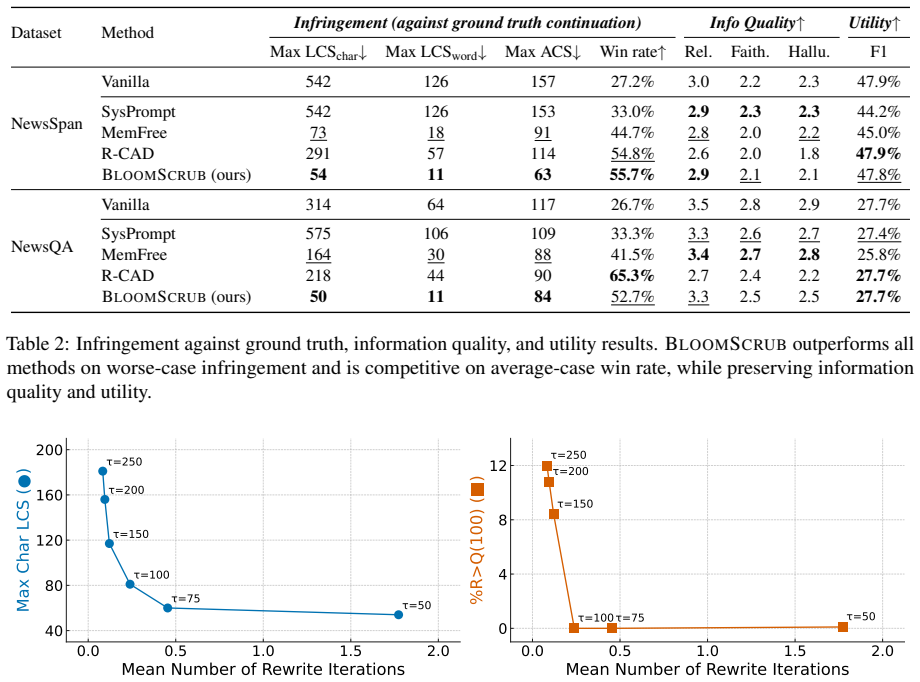
On its own terms, the paper establishes that a lightweight inference-time loop can provide certified protection against worst-case verbatim copying. For a protected corpus $C$ and a length threshold $\tau$, the guarantee is: any final response is either a refusal, or no normalized substring of it longer than $\tau$ appears in $C$. The certificate is carried by the Bloom filter's zero-false-negative property: every character $n$-gram of $C$ is inserted, so any quote of length at least $n=25$ is detected, and the extractor merges consecutive overlapping hits into one long span, catching near-verbatim stitched quotes. The paper's experiments compare BloomScrub with decoding-time baselines and show it produces the lowest maximal character- and word-level LCS, nearly eliminates quotes above 100 characters, and preserves QA F1 and information-quality scores; removing the quote-guidance from rewriting makes risk metrics worse, supporting the claim that explicit quote extraction is load-bearing. With abstention, the method reaches $0.0\%$ on its corpus-level metric $\%R_{>Q}(\tau)$ at $\tau=50$.
Load-bearing premise
The guarantee covers only verbatim substrings of the specific normalized corpus $C$ loaded into the Bloom filter; any paraphrase, synonym substitution, light edit, or quote from a document outside that index is invisible to the detector and outside the certificate.
Editorial extensions
If this is right
- A provider can publish the indexed corpus sketch and the threshold $\tau$, and any auditor can verify compliance by exact matching, turning a claim about copyright risk into a checkable property of the served output stream.
- Updating the protected corpus—for instance, after a new licensing agreement—requires only rebuilding the Bloom filter; no model retraining and no access to model logits is needed.
- Because each rewrite iteration tightens the effective threshold, a single deployment can tune enforcement stringency at inference time to match the legal appetite of the use case.
- The corpus-level metric $\%R_{>Q}(\tau)$ gives future mitigation methods a worst-case benchmark that does not depend on which ground-truth continuation happens to be paired with a prompt.
Reading between the lines
- If certified verbatim removal becomes a standard deployment feature, the practical legal question shifts to what is loaded into the index; the guarantee is only as broad as the corpus $C$, so a provider's indexing choices become a policy decision.
- The same detect-rewrite-abstain loop transfers to any exact-match constraint—personally identifying information, toxic phrases, confidential identifiers—because the certificate depends only on the zero-false-negative filter and the rewrite model, not on copyright semantics.
- A natural next experiment, which the paper does not run, is to replace the Bloom filter with an exact suffix-array index: that would keep the certificate intact and remove the small false-positive cost, with memory as the trade-off.
- The paper's own limitation that paraphrases are out of scope suggests room for a layered guard: a verbatim certificate from this method plus a similarity-based detector for non-literal copying; the two attack different failure modes.
Signed reviews
Editorial analysis
A structured set of objections, weighed in public.
Referee Report
Summary. The paper proposes BLOOMSCRUB, an inference-time mitigation pipeline that interleaves Bloom-filter-based detection of verbatim spans from a copyrighted corpus C with LLM-based rewriting, and optionally replaces the response with a refusal if long spans persist. The formal claim is that, because a Bloom filter has no false negatives, any normalized verbatim substring of length at least n from the indexed corpus is detected, and the iterative loop either rewrites it below a threshold tau or abstains, so emitted responses contain no quote from C longer than tau. The authors evaluate on NewsSpan and NewsQA with a fine-tuned Llama-3.1-8B generator, comparing to SysPrompt, MemFree decoding, and R-CAD on a new corpus-level metric %R>Q(tau) plus reference-based LCS/ACS, information quality, and QA utility. Results show near-zero long-quote rates with small utility loss.
Significance. If the guarantee is stated at the right level of scope, this is a useful and clean result: it gives a verifiable hard constraint on verbatim regurgitation from a fixed, indexed corpus, at inference time, with black-box model access, and it scales with a Bloom filter. The paper's decision to make the evaluation corpus-level rather than reference-bound is a genuine improvement, and the iterative quote-guided rewriting is a simple and practical mechanism. The Limitations section is honest about the method's narrow scope for non-literal copying. The main gap is a mismatch between the formal, corpus-relative certificate and the broad 'certified copyright takedown' language in the title and abstract; tightening this framing is essential before publication.
major comments (3)
- [Abstract; §3.1; §3.2(A)] The certificate is only for normalized verbatim matches against the specific, fully indexed corpus C. Since only n-grams inserted into the Bloom filter can be detected, any quote from a source outside C, and any paraphrase or lightly edited passage whose normalized n-gram sequence is not in C, is outside the guarantee. The abstract's 'worst-case LLM copyright infringement' and 'copyrighted sources' should be qualified throughout to 'the indexed corpus C'; the Limitations section already concedes non-literal copying, but the title and abstract should not imply a broader certificate. I suggest stating the guarantee as a formal theorem with explicit quantifiers: for a fixed normalized corpus C, with probability 1 (no false negatives), every emitted response is either a refusal or contains no substring s of C with |s| > tau.
- [Introduction; Table 2; Figure 2] The Introduction says BLOOMSCRUB provides 'certified copyright takedown—completely eliminating long verbatim quotes from copyrighted sources.' Without abstention, Table 2 and Figure 2 report %R>Q(50) values of 10.9% (NewsSpan) and 5.6% (NewsQA) for BLOOMSCRUB, and %R>Q(100) of 0.0% and 0.1%. Thus 'complete elimination' is only true when the abstention mechanism is enabled, as reported in Table 3. Please revise the claim to explicitly tie elimination to the abstention option, and report both modes consistently in the abstract and introduction.
- [§3.2(B); Algorithm 1] Algorithm 1 checks the abstention condition at line 9 using quotes extracted at line 4, i.e., from the response before the final rewrite. As written, whenever the loop exits because the iteration limit is reached after a rewrite, the system abstains even if that final rewrite removed all long quotes; conversely, the check does not inspect the final y that would actually be returned. This is conservative for the safety guarantee but is inconsistent with the prose in §3.2(B) ('if ... the rewrite model still fails to remove all long verbatim quotes') and inflates the measured abstention cost. Please change the pseudocode to re-run the quote extractor on the final y before the abstention decision, and adjust the loop condition so that imax denotes the maximum number of rewrites (e.g., while i < imax).
minor comments (6)
- [§4.3] The citation for MemFree decoding is to Ippolito et al. (2019), but the described method is from Ippolito et al. (2022); the bibliography contains both, so the citation should be corrected.
- [Figure 6] Figure 6 lacks axis labels and a clear caption for the y-axis, which makes the Levenshtein-distance comparison hard to read.
- [Algorithm 1] Algorithm 1's line 8 contains the fragment 'i + +'; use 'i ← i+1' or 'i = i+1' for clarity.
- [Appendix A] In Appendix A, 'under the pertaining mode' appears to be a typo for 'pretraining mode'; please clarify the fine-tuning setup.
- [Tables 2–4] The empirical comparison would be stronger with standard errors or multiple fine-tuning seeds, since some utility comparisons are essentially null results (e.g., QA F1 47.8 vs 47.9 on NewsSpan) and a single run cannot establish equivalence.
- [§3.2(A)] The normalization used before n-gram insertion (whitespace, punctuation, case) should be defined precisely, since the exact coverage of the certificate depends on this normalization.
Circularity Check
No significant circularity: the certified guarantee is an algorithmic invariant of the Bloom filter's no-false-negative property plus the abstention rule, not a prediction fitted to its own inputs.
full rationale
I walked the derivation chain. The central certificate in §3.2 is an algorithmic invariant, not an empirical prediction: Algorithm 1 loops quote extraction EC(y) via a fixed-width Bloom filter and rewriting until maxlen(q1...qn)<τ, and optionally abstains; because a Bloom filter has zero false negatives, every character n-gram of C present in y is a hit, so every verbatim span of length ≥n is extracted, and any span longer than τ is caught before the loop exits. Thus the claimed 'no quote from C longer than τ' is true by construction whenever the response is not a refusal; this is the definition of the certificate, not a reduction of a prediction to its fitted input. The empirical metric %R>Q(τ) is computed with a separate Bloom filter that likewise has no false negatives, so it cannot manufacture clean outputs; false positives would only over-report risk, making the evaluation conservative. Self-citations to Data Portraits and the NewsSpan dataset are implementation and benchmark citations, and the load-bearing Bloom filter property is cited to Bloom (1970), an external mathematical result. The paper's own Limitations section concedes that non-literal copying and unindexed sources are outside the certificate, which narrows the practical scope of the claim but does not make the derivation circular. Because no fitted parameter is renamed as a prediction, no uniqueness claim is imported from the authors' prior work, and no result is forced by self-citation, there is no circular step.
Assumptions & free parameters
free parameters (5)
- risk threshold tau =
50 or 100 characters
- Bloom filter gram width n =
25 characters
- max rewrite iterations imax =
5
- rewrite prompt template =
template in Appendix B.2
- Bloom filter sizing and hash count =
not reported
assumptions (6)
- standard math A standard Bloom filter has zero false negatives.
- domain assumption Normalization of whitespace, punctuation, and cases captures verbatim copying.
- domain assumption Fine-tuning Llama-3.1-8B on the target corpus creates a realistic memorization-risk testbed.
- domain assumption LLM-as-judge scores for relevance, faithfulness, and hallucination are valid quality measures.
- domain assumption Long verbatim quotes are the worst-case copyright risk worth certifying.
- domain assumption The off-the-shelf rewrite model can remove long quotes without destroying information.
Cite this review
Pith. "Pith review of Certified Mitigation of Worst-Case LLM Copyright Infringement." pith.science (2026). https://pith.science/paper/VYZQZ7TG
@misc{pith2026250416046,
  author       = {Pith},
  title        = {Pith review of: Certified Mitigation of Worst-Case LLM Copyright Infringement},
  year         = {2026},
  howpublished = {\url{https://pith.science/paper/VYZQZ7TG}},
  note         = {Machine review of arXiv:2504.16046}
}
read the original abstract
The exposure of large language models (LLMs) to copyrighted material during pre-training raises concerns about unintentional copyright infringement post deployment. This has driven the development of "copyright takedown" methods, post-training approaches aimed at preventing models from generating content substantially similar to copyrighted ones. While current mitigation approaches are somewhat effective for average-case risks, we demonstrate that they overlook worst-case copyright risks exhibits by the existence of long, verbatim quotes from copyrighted sources. We propose BloomScrub, a remarkably simple yet highly effective inference-time approach that provides certified copyright takedown. Our method repeatedly interleaves quote detection with rewriting techniques to transform potentially infringing segments. By leveraging efficient data sketches (Bloom filters), our approach enables scalable copyright screening even for large-scale real-world corpora. When quotes beyond a length threshold cannot be removed, the system can abstain from responding, offering certified risk reduction. Experimental results show that BloomScrub reduces infringement risk, preserves utility, and accommodates different levels of enforcement stringency with adaptive abstention. Our results suggest that lightweight, inference-time methods can be surprisingly effective for copyright prevention.
Figures


Figures from the paper (2 more)


Reference graph
Works this paper leans on
-
[1]
online" 'onlinestring :=
ENTRY address archivePrefix author booktitle chapter edition editor eid eprint eprinttype howpublished institution journal key month note number organization pages publisher school series title type volume year doi pubmed url lastchecked label extra.label sort.label short.list INTEGERS output.state before.all mid.sentence after.sentence after.block STRING...
-
[2]
write newline
" write newline "" before.all 'output.state := FUNCTION n.dashify 't := "" t empty not t #1 #1 substring "-" = t #1 #2 substring "--" = not "--" * t #2 global.max substring 't := t #1 #1 substring "-" = "-" * t #2 global.max substring 't := while if t #1 #1 substring * t #2 global.max substring 't := if while FUNCTION word.in bbl.in capitalize " " * FUNCT...
-
[3]
Anthropic. 2023. System prompts. https://docs.anthropic.com/en/docs/system-prompts
work page 2023
-
[4]
Jack Bandy and Nicholas Vincent. 2021. https://arxiv.org/abs/2105.05241 Addressing "documentation debt" in machine learning research: A retrospective datasheet for bookcorpus . Preprint, arXiv:2105.05241
arXiv 2021
-
[5]
Stella Biderman, USVSN PRASHANTH, Lintang Sutawika, Hailey Schoelkopf, Quentin Anthony, Shivanshu Purohit, and Edward Raff. 2023. https://proceedings.neurips.cc/paper\_files/paper/2023/file/59404fb89d6194641c69ae99ecdf8f6d-Paper-Conference.pdf Emergent and predictable memorization in large language models . In Advances in Neural Information Processing Sys...
work page 2023
-
[6]
Burton H. Bloom. 1970. https://doi.org/10.1145/362686.362692 Space/time trade-offs in hash coding with allowable errors . Communications of the ACM, 13(7):422–426
arXiv 1970
-
[7]
Nicholas Carlini, Daphne Ippolito, Matthew Jagielski, Katherine Lee, Florian Tramer, and Chiyuan Zhang. 2023. https://arxiv.org/abs/2202.07646 Quantifying memorization across neural language models . In International Conference on Learning Representations ICLR
arXiv 2023
-
[8]
Brown, Dawn Xiaodong Song, \'U lfar Erlingsson, Alina Oprea, and Colin Raffel
Nicholas Carlini, Florian Tram \`e r, Eric Wallace, Matthew Jagielski, Ariel Herbert-Voss, Katherine Lee, Adam Roberts, Tom B. Brown, Dawn Xiaodong Song, \'U lfar Erlingsson, Alina Oprea, and Colin Raffel. 2020. https://arxiv.org/abs/2012.07805 Extracting training data from large language models . In USENIX Security Symposium USENIX
arXiv 2020
Show all 41 references
-
[9]
Kent K Chang, Mackenzie Cramer, Sandeep Soni, and David Bamman. 2023. https://arxiv.org/abs/2305.00118 Speak, Memory: An Archaeology of Books Known to ChatGPT/GPT-4 . In Conference on Empirical Methods in Natural Language Processing EMNLP
2023 arXiv
-
[10]
Tong Chen, Akari Asai, Niloofar Mireshghallah, Sewon Min, James Grimmelmann, Yejin Choi, Hannaneh Hajishirzi, Luke Zettlemoyer, and Pang Wei Koh. 2024. https://arxiv.org/abs/2407.07087 Copybench: Measuring literal and non-literal reproduction of copyright-protected text in lan...
2024 arXiv
-
[11]
Jeffrey Cheng, Marc Marone, Orion Weller, Dawn Lawrie, Daniel Khashabi, and Benjamin Van Durme. 2024. https://arxiv.org/abs/2403.12958 Dated data: Tracing knowledge cutoffs in large language models . In Conference on Language Modeling COLM
2024 arXiv
-
[12]
Guangyao Dou, Zheyuan Liu, Qing Lyu, Kaize Ding, and Eric Wong. 2024. https://arxiv.org/abs/2406.10952 Avoiding copyright infringement via large language model unlearning . Preprint, arXiv:2406.10952
2024 arXiv
-
[13]
Dow Jones & Company
Inc. Dow Jones & Company. 2024. https://www.courtlistener.com/docket/69280523/dow-jones-company-inc-v-perplexity-ai-inc/ Dow jones & company, inc. v. perplexity ai, inc. No. 1:24-cv-07984 (S.D.N.Y. filed Oct. 21, 2024)
2024
-
[14]
Abhimanyu Dubey, Abhinav Jauhri, Abhinav Pandey, Abhishek Kadian, Ahmad Al-Dahle, Aiesha Letman, Akhil Mathur, Alan Schelten, Amy Yang, Angela Fan, Anirudh Goyal, Anthony Hartshorn, Aobo Yang, Archi Mitra, Archie Sravankumar, Artem Korenev, Arthur Hinsvark, Arun Rao, Aston Zha...
2024 arXiv
-
[15]
Ronen Eldan and Mark Russinovich. 2023. https://arxiv.org/abs/2310.02238 Who's harry potter? approximate unlearning in llms . Preprint, arXiv:2310.02238
2023 arXiv
-
[16]
Feist Publications, Inc. v. Rural Tel. Serv. Co. 1991. 499 U.S. 340
1991
-
[17]
Gino Fontana
Avv. Gino Fontana. 2024. https://doi.org/10.1111/jwip.12331 Web scraping: Jurisprudence and legal doctrines . The Journal of World Intellectual Property, n/a(n/a)
2024 doi
-
[18]
Abhimanyu Hans, Yuxin Wen, Neel Jain, John Kirchenbauer, Hamid Kazemi, Prajwal Singhania, Siddharth Singh, Gowthami Somepalli, Jonas Geiping, Abhinav Bhatele, and Tom Goldstein. 2024. https://arxiv.org/abs/2406.10209 Be like a goldfish, don't memorize! mitigating memorization ...
2024 arXiv
-
[19]
Valentin Hartmann, Anshuman Suri, Vincent Bindschaedler, David Evans, Shruti Tople, and Robert West. 2023. https://api.semanticscholar.org/CorpusID:264590727 Sok: Memorization in general-purpose large language models . ArXiv, abs/2310.18362
2023 arXiv
-
[20]
Peter Henderson, Xuechen Li, Dan Jurafsky, Tatsunori Hashimoto, Mark A Lemley, and Percy Liang. 2023. https://arxiv.org/abs/2303.15715 Foundation models and fair use . Journal of Machine Learning Research JMLR , 24(400):1--79
2023 arXiv
-
[21]
Matthew Honnibal and Ines Montani. 2017. spaCy 2 : Natural language understanding with B loom embeddings, convolutional neural networks and incremental parsing. To appear
2017
-
[22]
Hongsheng Hu, Zoran Salcic, Lichao Sun, Gillian Dobbie, Philip S Yu, and Xuyun Zhang. 2022. Membership inference attacks on machine learning: A survey. ACM Computing Surveys (CSUR), 54(11s):1--37
2022
-
[23]
Daphne Ippolito, Reno Kriz, Jo \ a o Sedoc, Maria Kustikova, and Chris Callison-Burch. 2019. Comparison of diverse decoding methods from conditional language models. In Proceedings of the 57th Annual Meeting of the Association for Computational Linguistics, pages 3752--3762
2019
-
[24]
Daphne Ippolito, Florian Tram \`e r, Milad Nasr, Chiyuan Zhang, Matthew Jagielski, Katherine Lee, Christopher A Choquette-Choo, and Nicholas Carlini. 2022. https://arxiv.org/abs/2210.17546 Preventing verbatim memorization in language models gives a false sense of privacy . arX...
2022 arXiv
-
[25]
Antonia Karamolegkou, Jiaang Li, Li Zhou, and Anders Søgaard. 2023. https://arxiv.org/abs/2310.13771 Copyright violations and large language models . Preprint, arXiv:2310.13771
2023 arXiv
-
[26]
Katherine Lee, A Feder Cooper, and James Grimmelmann. 2023. Talkin''bout ai generation: Copyright and the generative-ai supply chain. arXiv preprint arXiv:2309.08133
2023 arXiv
-
[27]
Katherine Lee, Daphne Ippolito, Andrew Nystrom, Chiyuan Zhang, Douglas Eck, Chris Callison-Burch, and Nicholas Carlini. 2022. https://arxiv.org/abs/2107.06499 Deduplicating training data makes language models better . In Annual Meeting of the Association for Computational Ling...
2022 arXiv
-
[28]
Mark A Lemley and Bryan Casey. 2020. Fair learning. Tex. L. Rev., 99:743
2020
-
[29]
Chin-Yew Lin. 2004. https://aclanthology.org/W04-1013/ ROUGE: A Package for Automatic Evaluation of Summaries . In ACL Workshop on Text Summarization Branches Out
2004
-
[30]
Jiacheng Liu, Sewon Min, Luke Zettlemoyer, Yejin Choi, and Hannaneh Hajishirzi. 2024 a . https://openreview.net/forum?id=u2vAyMeLMm Infini-gram: Scaling unbounded n-gram language models to a trillion tokens . In First Conference on Language Modeling
2024
-
[31]
Xiaoze Liu, Ting Sun, Tianyang Xu, Feijie Wu, Cunxiang Wang, Xiaoqian Wang, and Jing Gao. 2024 b . https://arxiv.org/abs/2406.12975 Shield: Evaluation and defense strategies for copyright compliance in llm text generation . Preprint, arXiv:2406.12975
2024 arXiv
-
[32]
Lipton, and J
Pratyush Maini, Zhili Feng, Avi Schwarzschild, Zachary C. Lipton, and J. Zico Kolter. 2024. https://arxiv.org/abs/2401.06121 Tofu: A task of fictitious unlearning for llms . Preprint, arXiv:2401.06121
2024 arXiv
-
[33]
Marc Marone and Benjamin Van Durme . 2023. https://arxiv.org/abs/2303.03919 Data portraits: Recording foundation model training data . arXiv preprint arXiv:2303.03919
2023 arXiv
-
[34]
Matthieu Meeus, Igor Shilov, Manuel Faysse, and Yves-Alexandre de Montjoye. 2024. https://arxiv.org/abs/2402.09363 Copyright traps for large language models . Preprint, arXiv:2402.09363
2024 arXiv
-
[35]
Mosaic Research . 2024. Introducing dbrx: A new state-of-the-art open llm. https://www.databricks.com/blog/introducing-dbrx-new-state-art-open-llm
2024
-
[36]
OpenAI. 2023. https://arxiv.org/abs/2303.08774 GPT-4 technical report
2023 arXiv
-
[37]
Weijia Shi, Xiaochuang Han, Mike Lewis, Yulia Tsvetkov, Luke Zettlemoyer, and Scott Wen tau Yih. 2023. https://arxiv.org/abs/2305.14739 Trusting your evidence: Hallucinate less with context-aware decoding . Preprint, arXiv:2305.14739
2023 arXiv
-
[38]
Adam Trischler, Tong Wang, Xingdi Yuan, Justin Harris, Alessandro Sordoni, Philip Bachman, and Kaheer Suleman. 2016. https://arxiv.org/abs/1611.09830 Newsqa: A machine comprehension dataset . CoRR, abs/1611.09830
2016 arXiv
-
[39]
Smith, Chiyuan Zhang, Luke Zettlemoyer, Kai Li, and Peter Henderson
Boyi Wei, Weijia Shi, Yangsibo Huang, Noah A. Smith, Chiyuan Zhang, Luke Zettlemoyer, Kai Li, and Peter Henderson. 2024. https://arxiv.org/abs/2406.18664 Evaluating copyright takedown methods for language models . Preprint, arXiv:2406.18664
2024 arXiv
-
[40]
Lianmin Zheng, Wei-Lin Chiang, Ying Sheng, Siyuan Zhuang, Zhanghao Wu, Yonghao Zhuang, Zi Lin, Zhuohan Li, Dacheng Li, Eric Xing, et al. 2023. https://arxiv.org/abs/2306.05685 Judging llm-as-a-judge with mt-bench and chatbot arena . In Advances in Neural Information Processing...
2023 arXiv
-
[41]
Yaowei Zheng, Richong Zhang, Junhao Zhang, Yanhan Ye, and Zheyan Luo. 2024. https://doi.org/10.18653/v1/2024.acl-demos.38 L lama F actory: Unified efficient fine-tuning of 100+ language models . In Proceedings of the 62nd Annual Meeting of the Association for Computational Lin...
2024 doi
Reviewed August 16, 2026 · model on record in the stance chip above.
Discussion (0). Continue with ORCID to comment.