Resourcefulness without Resource: Geometric Origins and Robustness
Pith reviewed 2026-07-01 05:11 UTC · model grok-4.3
The pith
Free states alone suffice to create discrimination gaps that no finite assistance can close.
A machine-rendered reading of the paper's core claim, the machinery that carries it, and where it could break.
Core claim
Whenever the set of free measurements is closed, convex, and a strict subset of all measurements, and the set of free states is convex with an interior, a gap-witnessing ensemble can be drawn entirely from the free states; the resulting gap is operationally rigid against any finite-dimensional assistance.
What carries the argument
The convex-geometric construction that selects a free-state ensemble witnessing the restriction gap between free and unrestricted measurements.
If this is right
- Any resource theory whose free measurements and free states satisfy the stated convexity conditions necessarily admits free-state discrimination gaps.
- The single-shot restricted discrimination rate bounds the asymptotic rate for free-state ensembles even with arbitrary finite assistance.
- Resource-carrying ensembles are operationally distinct because their gaps can be erased by memory assistance.
- The mechanism applies uniformly to all known instances of gaps without the corresponding resource.
Where Pith is reading between the lines
- The rigidity result suggests that asymptotic resource theories may need separate accounting for free versus resourceful ensembles in discrimination tasks.
- Similar geometric arguments could be tested for other operational tasks such as state preparation or channel discrimination restricted to free operations.
- The asymmetry might imply that free operations alone cannot simulate the full power of resource-assisted protocols even with unbounded memory in finite dimensions.
Load-bearing premise
No finite-dimensional assistance can asymptotically improve the discrimination rate of a free-state ensemble beyond its single-shot restricted value.
What would settle it
An explicit finite-dimensional catalyst or memory that raises the asymptotic discrimination rate for any chosen free-state gap-witnessing ensemble above the single-shot free-measurement bound.
Figures


read the original abstract
A prevailing intuition holds that quantum protocols using only free states confer no operational advantage. This intuition is contradicted by free-state discrimination gaps in which restricted measurements fail to optimally distinguish even orthogonal free states. Known instances include nonlocality without entanglement and, more recently, nonstabilizerness without magic. We trace these examples to a single convex-geometric mechanism: whenever the set of free measurements is closed, convex, and strict subset the set of all measurements, and the free states is a convex set with an interior, a gap-witnessing ensemble can be drawn entirely from the free states. The resulting gap is operationally rigid: no finite-dimensional assistance -- catalyst or quantum memory -- can asymptotically improve the discrimination rate beyond the single-shot restricted limit. By contrast, non-free ensembles admit memory-assisted attacks that fully erase the gap, exposing a sharp operational asymmetry between free and resource-carrying ensembles.
Editorial analysis
A structured set of objections, weighed in public.
Referee Report
Summary. The manuscript claims that free-state discrimination gaps arise from a single convex-geometric mechanism: when the set of free measurements is closed, convex, and a strict subset of all measurements while the free states form a convex set with nonempty interior, a gap-witnessing ensemble can be chosen entirely from the free states. The resulting gap is operationally rigid—no finite-dimensional assistance (catalyst or quantum memory) can asymptotically improve the restricted discrimination rate beyond the single-shot limit—while non-free ensembles admit memory-assisted attacks that erase the gap. This unifies examples such as nonlocality without entanglement and nonstabilizerness without magic.
Significance. If the derivations hold, the work supplies a unified geometric origin for resourcefulness-without-resource phenomena and establishes a sharp operational asymmetry between free and resource-carrying ensembles. The explicit contrast with memory-assisted erasure for non-free cases is a clear strength.
major comments (1)
- [Operational rigidity / asymptotic analysis (likely the section following the geometric mechanism)] The operational-rigidity claim (abstract and the section deriving asymptotic rates) is load-bearing: the manuscript asserts that convexity and closedness of the free-measurement set suffice to prevent any finite-dimensional catalyst or memory from improving the discrimination rate, yet the intermediate steps—how the dual SDP or the asymptotic rate expression behaves under tensoring with an arbitrary finite-dimensional catalyst—are not supplied in sufficient detail to confirm that convexity alone blocks the attacks that succeed for non-free ensembles.
minor comments (2)
- Clarify the precise definition of 'finite-dimensional assistance' (catalyst vs. memory) and state whether the rigidity result assumes the assistance is drawn from the same free set or is unrestricted.
- Add an explicit statement of the interior-point assumption on the free-state set and confirm it is used in the existence proof for the gap-witnessing ensemble.
Simulated Author's Rebuttal
We thank the referee for their careful reading, positive assessment of the significance of the work, and for identifying the need for greater detail on the operational-rigidity claim. We respond to the single major comment below.
read point-by-point responses
-
Referee: The operational-rigidity claim (abstract and the section deriving asymptotic rates) is load-bearing: the manuscript asserts that convexity and closedness of the free-measurement set suffice to prevent any finite-dimensional catalyst or memory from improving the discrimination rate, yet the intermediate steps—how the dual SDP or the asymptotic rate expression behaves under tensoring with an arbitrary finite-dimensional catalyst—are not supplied in sufficient detail to confirm that convexity alone blocks the attacks that succeed for non-free ensembles.
Authors: We agree that the asymptotic section would benefit from additional explicit steps. The argument proceeds by showing that the dual SDP value for the restricted discrimination problem is invariant under tensoring with any finite-dimensional catalyst when the ensemble consists solely of free states: convexity of the free-measurement set ensures that any product measurement on the extended system can be replaced by a single free measurement whose expectation values match those on the original system, while closedness prevents the limit from exceeding the single-shot value. This blocks the superadditive improvement that memory-assisted attacks achieve for non-free ensembles. We will insert a short lemma deriving the tensor-product behavior of the dual SDP and the resulting asymptotic rate bound. revision: yes
Circularity Check
No circularity; geometric derivation self-contained
full rationale
The paper traces the discrimination gap and its rigidity to a convex-geometric mechanism based on closedness/convexity of free measurements and interior of free states. No equations or claims reduce by construction to fitted inputs, self-definitions, or load-bearing self-citations; the operational rigidity against finite-dimensional assistance is presented as a direct consequence of the stated set properties without intermediate reductions to prior author results or ansatzes. The derivation remains independent of the target claim.
Axiom & Free-Parameter Ledger
axioms (2)
- domain assumption The set of free measurements is closed and convex.
- domain assumption The set of free states is convex with an interior.
Reference graph
Works this paper leans on
-
[1]
Golden state: There exists a state,Φ, such that augmentingSwithΦsaturates the limit:P M(S ⊗ Φ) =P All(S), whereS ⊗Φ :={p i, σi ⊗Φ} N i=1
-
[2]
The first assumption can be understood as existence of a single “golden” state that allows for all possible mea- surements to be performed using free operations
Probabilistic distillation: For anyϵ,˜ϵ >0, there exist a resource stateω /∈ F, a free stateγ∈ F, an integerk, and a probabilistic free operationΛsuch that Λ(ω⊗k) =P k Φ⊗k;∥ω−γ∥ 1 ≤ϵ;P k ≥1−˜ϵ. The first assumption can be understood as existence of a single “golden” state that allows for all possible mea- surements to be performed using free operations. T...
2022
-
[3]
Chitambar and G
E. Chitambar and G. Gour, Quantum resource theories, Reviews of Modern Physics91, 025001 (2019)
2019
-
[4]
C. H. Bennett, D. P. DiVincenzo, C. A. Fuchs, T. Mor, E. Rains, P. W. Shor, J. A. Smolin, and W. K. Woot- ters, Quantum nonlocality without entanglement, Phys- ical Review A59, 1070 (1999)
1999
-
[5]
Groisman and L
B. Groisman and L. Vaidman, Nonlocal variables with product-state eigenstates, Journal of Physics A: Mathe- matical and General34, 6881 (2001)
2001
-
[6]
N.Yu, R.Duan,andM.Ying,FourLocallyIndistinguish- able Ququad-Ququad Orthogonal Maximally Entangled States, Physical Review Letters109, 020506 (2012)
2012
-
[7]
Y.-H. Yang, F. Gao, G.-B. Xu, H.-J. Zuo, Z.-C. Zhang, and Q.-Y. Wen, Characterizing unextendible product 5 bases in qutrit-ququad system, Scientific Reports5, 11963 (2015)
2015
-
[8]
D. P. DiVincenzo, T. Mor, P. W. Shor, J. A. Smolin, and B. M. Terhal, Unextendible product bases, uncom- pletable product bases and bound entanglement, Com- munications in Mathematical Physics238, 379 (2003)
2003
-
[9]
Y.FengandY.Shi,CharacterizingLocallyIndistinguish- able Orthogonal Product States, IEEE Transactions on Information Theory55, 2799 (2009)
2009
-
[10]
Halder, Several nonlocal sets of multipartite pure or- thogonal product states, Physical Review A98, 022303 (2018)
S. Halder, Several nonlocal sets of multipartite pure or- thogonal product states, Physical Review A98, 022303 (2018)
2018
-
[11]
Xu, Q.-Y
G.-B. Xu, Q.-Y. Wen, S.-J. Qin, Y.-H. Yang, and F. Gao, Quantum nonlocality of multipartite orthogonal product states, Physical Review A93, 032341 (2016)
2016
-
[12]
Zhang, K.-J
Z.-C. Zhang, K.-J. Zhang, F. Gao, Q.-Y. Wen, and C. H. Oh, Construction of nonlocal multipartite quan- tum states, Physical Review A95, 052344 (2017)
2017
-
[13]
B. M. Terhal, D. P. DiVincenzo, and D. W. Leung, Hid- ing Bits in Bell states, Physical Review Letters86, 5807 (2001)
2001
-
[14]
Eggeling and R
T. Eggeling and R. F. Werner, Hiding Classical Data in Multipartite Quantum States, Physical Review Letters 89, 097905 (2002)
2002
-
[15]
DiVincenzo, D
D. DiVincenzo, D. Leung, and B. Terhal, Quantum data hiding, IEEE Transactions on Information Theory48, 580–598 (2002)
2002
-
[16]
Hayden, D
P. Hayden, D. Leung, P. W. Shor, and A. Winter, Ran- domizing Quantum States: Constructions and Applica- tions, Communications in Mathematical Physics250, 371–391 (2004)
2004
-
[17]
Aubrun and C
G. Aubrun and C. Lancien, Locally restricted measure- ments on a multipartite quantum system: data hiding is generic, Quantum Information and Computation15, 513 (2015)
2015
-
[18]
H. Kwon, Nonstabilizerness without Magic: Classically Simulatable Quantum States That Are Indistinguish- ablebyClassicallySimulatableQuantumCircuits(2025), arXiv:2509.25790 [quant-ph]
-
[19]
Bae and L
J. Bae and L. Kwek, Quantum state discrimination and its applications, Journal of Physics A: Mathematical and Theoretical48(2015)
2015
-
[20]
Oszmaniec and T
M. Oszmaniec and T. Biswas, Operational relevance of resource theories of quantum measurements, Quantum3, 133 (2019)
2019
-
[21]
Takagi and B
R. Takagi and B. Regula, General Resource Theories in Quantum Mechanics and Beyond: Operational Charac- terization via Discrimination Tasks, Physical Review X 9, 031053 (2019)
2019
-
[22]
Jonathan and M
D. Jonathan and M. Plenio, Entanglement-Assisted Lo- cal Manipulation of Pure Quantum States, Physical Re- view Letters83(1999)
1999
-
[23]
Datta, T
C. Datta, T. Kondra, M. Miller, and A. Streltsov, Catal- ysis of entanglement and other quantum resources, Re- ports on Progress in Physics86(2023)
2023
-
[24]
T. V. Kondra, C. Datta, and A. Streltsov, Catalytic Transformations of Pure Entangled States, Physical Re- view Letters127, 150503 (2021)
2021
-
[25]
A. Philip and A. Streltsov, Robustness of quantum data hiding against entangled catalysts and memory (2025), arXiv:2511.04408 [quant-ph]
-
[26]
Barnett and S
S. Barnett and S. Croke, Quantum state discrimination, Advances in Optics and Photonics1, 238 (2009)
2009
-
[27]
C. W. Helstrom, Quantum detection and estimation the- ory, Journal of Statistical Physics1, 231 (1969)
1969
-
[28]
Boyd and L
S. Boyd and L. Vandenberghe,Convex optimization (Cambridge University Press, 2004)
2004
-
[29]
Werner, Quantum states with Einstein-Podolsky- Rosen correlations admitting a hidden-variable model, Physical review
R. Werner, Quantum states with Einstein-Podolsky- Rosen correlations admitting a hidden-variable model, Physical review. A40, 4277 (1989)
1989
-
[30]
Peres, Separability Criterion for Density Matrices, Physical Review Letters77, 1413–1415 (1996)
A. Peres, Separability Criterion for Density Matrices, Physical Review Letters77, 1413–1415 (1996)
1996
-
[31]
Veitch, S
V. Veitch, S. A. Hamed Mousavian, D. Gottesman, and J. Emerson, The resource theory of stabilizer quantum computation, New Journal of Physics16, 013009 (2014)
2014
-
[32]
Gallego and L
R. Gallego and L. Aolita, Resource Theory of Steering, Physical Review X5, 041008 (2015)
2015
-
[33]
Hayashi, M
M. Hayashi, M. Koashi, K. Matsumoto, F. Morikoshi, andA.Winter,Errorexponentsforentanglementconcen- tration, Journal of Physics A General Physics36(2002)
2002
-
[34]
Skrzypczyk and D
P. Skrzypczyk and D. Cavalcanti,Semidefinite Program- ming in Quantum Information Science(IOP Publishing, 2023)
2023
-
[35]
Albarelli, M
F. Albarelli, M. G. Genoni, M. G. A. Paris, and A. Fer- raro, Resource theory of quantum non-Gaussianity and Wigner negativity, Physical Review A98, 052350 (2018)
2018
-
[36]
Streltsov, G
A. Streltsov, G. Adesso, and M. B. Plenio, Colloquium: Quantum coherence as a resource, Reviews of Modern Physics89, 041003 (2017)
2017
-
[37]
Plávala, General probabilistic theories: An introduc- tion, Physics Reports1033, 1 (2023), general probabilis- tic theories: An introduction
M. Plávala, General probabilistic theories: An introduc- tion, Physics Reports1033, 1 (2023), general probabilis- tic theories: An introduction
2023
-
[38]
Azuma, Weighted sums of certain dependent random variables, Tohoku Mathematical Journal19, 357 (1967)
K. Azuma, Weighted sums of certain dependent random variables, Tohoku Mathematical Journal19, 357 (1967)
1967
-
[39]
Hoeffding, Probability inequalities for sums of bounded random variables, Journal of the American Sta- tistical Association58, 13 (1963)
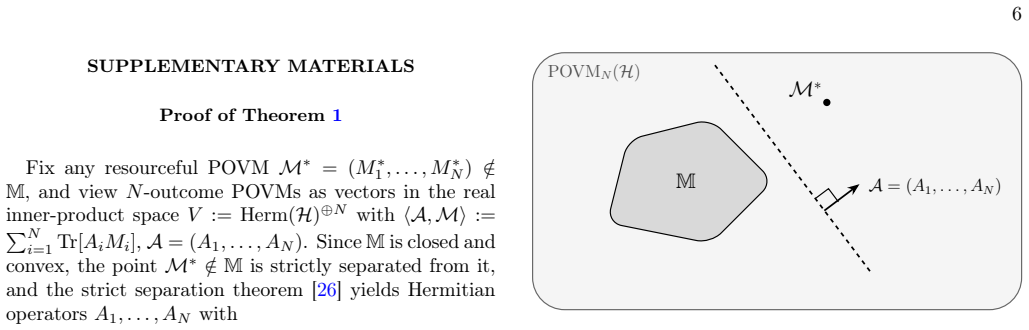
W. Hoeffding, Probability inequalities for sums of bounded random variables, Journal of the American Sta- tistical Association58, 13 (1963). 6 SUPPLEMENT AR Y MA TERIALS Proof of Theorem 1 Fix any resourceful POVMM ∗ = (M ∗ 1 , . . . , M∗ N)/∈ M, and viewN-outcome POVMs as vectors in the real inner-product spaceV:= Herm(H) ⊕N with⟨A,M⟩:=PN i=1Tr[AiMi],A= ...
1963
discussion (0)
Sign in with ORCID, Apple, or X to comment. Anyone can read and Pith papers without signing in.