REVIEW 3 major objections 5 minor 6 cited by
Otter: Generating Tests from Issues to Validate SWE Patches
T0 review · 3 major / 5 minor · reviewed 2026-08-08 · deepseek-v4-flash
Pith's one-line read This paper argues that it is feasible to generate correct tests from a software issue before any fix exists, that the Otter system does so in over a third of benchmark cases, and that these tests can vet patches produced by…
desk verdict Solid empirical systems paper with a genuinely useful new benchmark, but the headline SOTA claim rests on a model-version confound and the ablation design blurs component contributions. read the letter →
The pith
A machine-rendered reading of the paper's core claim, the machinery that carries it, and where it could break.
The reading
What carries the argument
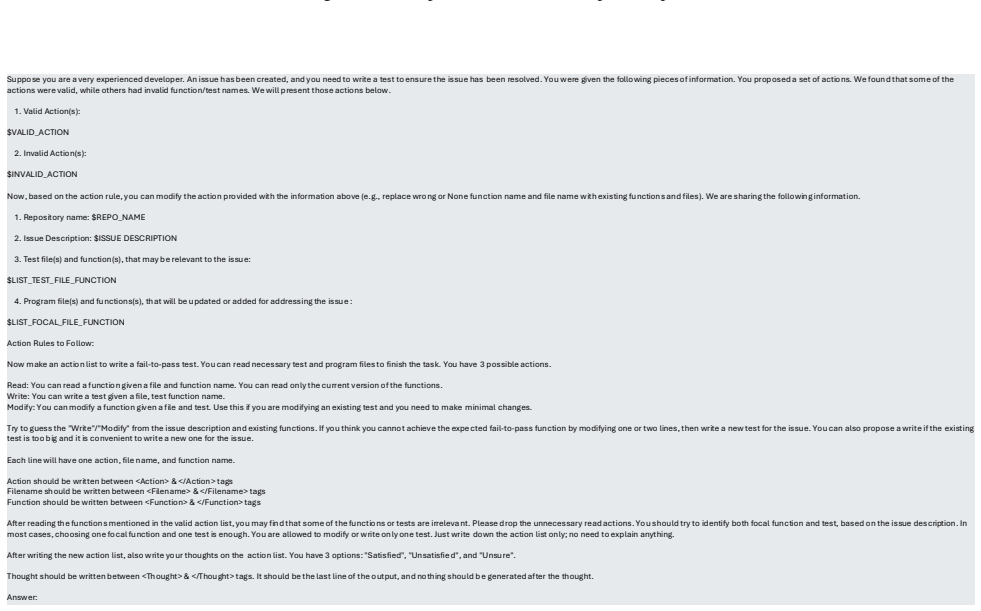
The load-bearing pieces are the self-reflective action planner and the TDD-Bench-Verified scoring harness. The planner first localizes candidate test files and focal files and functions, then asks the LLM to propose a sequence of read, write, or modify actions; a rule-based validator checks every file and function name against the repository, and a reflect-and-improve loop lets the model revise its plan up to five times. The test generator then emits complete test functions, and a rule-based import fixer repairs hallucinated imports using the codebase. The benchmark defines tddScore as the product of a binary fail-to-pass factor and an adequacy factor, where adequacy is the fraction of added and deleted lines of the golden patch covered by the generated tests; this is what lets the paper say a test is correct only when it goes from failing to passing on the real fix.
What would settle it
Run Otter on the 44 SWE-bench Verified instances that TDD-Bench-Verified discarded because their own golden tests do not satisfy fail-to-pass, and compare the fail-to-pass rate; if Otter's rate is much higher there, the benchmark's conditioning on golden-test behavior is hiding part of what Otter can do. Alternatively, take instances where the repository contains a merged alternative fix that passes the golden tests but is not the golden patch, and check whether Otter's generated test passes that alternative patch.
Extended reading notes
Core claim
The central claim is that it is possible, before any code fix exists, to generate tests from an issue description that genuinely reproduce the issue and validate its resolution. The paper supports this with Otter, which combines LLM-guided localization and a self-reflective action planner with rule-based checks and repairs, and evaluates it on TDD-Bench-Verified, where a test counts only if it fails on the old code, passes on the golden post-fix code, and covers the lines the golden patch added or removed. By this metric Otter succeeds on 31.4% of the 449 benchmark instances with one run and 37.0% with the five-prompt Otter++ ensemble, beating the prior state of the art SWE-Agent+, which reached 19.2% on its own SWT-Lite set. The paper also claims the generated tests are useful beyond test generation itself: filtering SWE-agent patches with them lifts precision from 60.8% to 91.9% for the third-ranked SWE-bench Verified system, and to 65-92% across 22 leaderboard systems, at recall of 30-41%.
Load-bearing premise
The benchmark treats the single merged developer patch as the one and only correct fix: a generated test is judged correct only if it fails on the old code, passes on that specific golden new code, and covers that patch's changed lines, so any valid but different fix that would reject the generated test counts as a failure.
Editorial extensions
If this is right
- In a test-driven workflow, a developer facing an open issue can start from an Otter-generated candidate test, which makes the expected behavior explicit before any fix is written.
- For automated repair, Otter-generated tests act as a high-precision filter: 65-92% precision at 30-41% recall across 22 SWE-bench Verified systems, so a human can spend review effort on far fewer candidate patches.
- TDD-Bench-Verified gives the community an execution-based yardstick for test-from-issue generators, replacing similarity or format checks with fail-to-pass behavior and line-coverage scores.
- Because Otter-generated tests follow the repository's existing test framework and can be added to its CI, a merged patch can be checked against the generated test as a permanent regression test.
Reading between the lines
- The benchmark's tie to the golden patch suggests that Otter is likely penalized for writing behavior-level tests that pass on valid alternative fixes but not on the merged implementation, so a test that captures the issue's contract could look like a failure by the benchmark's own lights.
- The ensemble result, where five heterogeneous prompts beat five high-temperature samples, suggests that diversity of context matters more than sampling noise for LLM test generation, a principle worth porting to other code-generation tasks.
- The same fail-to-pass filter could be inverted: when a generated test passes on a candidate patch but fails on the old code, it forms a minimal specification that could be fed back to a patch generator, turning a validator into a ranking signal beyond binary filtering.
- TDD-Bench-Verified's 449 instances come from 12 popular Python repositories, so the 31.4% and 37.0% numbers are an upper bound for what Otter would achieve on less standard codebases or other languages; the action-planning steps are mostly language-agnostic, but the localization and import-fixing rules are Python-specific.
Editorial analysis
A structured set of objections, weighed in public.
Referee Report
Summary. The paper proposes Otter, an LLM-based pipeline that generates tests from an issue description and the old code snapshot, before a patch exists. Otter combines file and function localization, a self-reflective action planner, and rule-based import fixing and validation. Otter++ ensembles five heterogeneous prompts and uses execution logs on the old code to select one candidate. The paper also introduces TDD-Bench-Verified, a 449-instance benchmark derived from SWE-bench Verified, with an execution-based fail-to-pass metric and a changed-line coverage metric. Experiments report 31.4% fail-to-pass for Otter and 37.0% for Otter++ with GPT-4o on TDD-Bench-Verified, 25.4% and 29.0% on SWT-Lite compared to SWE-Agent+'s 19.2%, and a filtering study showing that Otter-generated tests can raise the precision of SWE-agent patches at the cost of recall.
Significance. The benchmark release, the containerized evaluation harness, and the execution-based metric are concrete assets for the test-generation-from-issues community. The study is unusually thorough in its large-scale filtering experiment across 22 SWE-bench Verified leaderboard systems, its contamination analysis, and its cost reporting. If the headline comparison were model-controlled, the paper would represent a clear step forward in a practically relevant task. The main quantitative claims are transparent and reproducible from the released artifacts, but the central state-of-the-art comparison is currently confounded by a model-version difference, and the ablation analysis does not cleanly attribute the named components. These issues are fixable within the scope of a revision.
major comments (3)
- [Section 6.4, Table 3] The comparison against Mündler et al. is confounded: Otter and Otter++ are run with GPT-4o, while all listed baseline approaches, including SWE-Agent+, are run with GPT-4. The paper's own Table 1 shows that model choice alone moves Otter's fail-to-pass rate by 4.5 points on TDD-Bench-Verified (31.4% for GPT-4o vs. 26.9% for Mistral-large), which is the same order of magnitude as the 6.2-point gap over SWE-Agent+ on SWT-Lite. Since every stage of Otter is an LLM call, the stronger base model may account for much or all of the reported advantage. The claim that Otter 'outperforms state-of-the-art systems' is load-bearing for the paper, so the authors should either run Otter with GPT-4 (or run SWE-Agent+ with GPT-4o) or explicitly reframe the result as a system-plus-model comparison rather than a method comparison.
- [Section 6.3, Table 2] The ablation rows labeled 'without Focal Localization*', 'without Test Localization*', and 'without Focal & Test Localization*' are marked as not followed by action planning, so each of those rows differs from the Otter (T1) row in two ways: the planner is removed and a localizer is removed. As a result, the text 'all the components contribute' and the reported percentage losses do not isolate the contribution of the named component. For example, comparing T1 (141) with T3 (115) conflates removing the planner and removing focal localization. The pairwise comparisons among T2, T3, T4, and T5 (which hold the planner fixed) should be the basis for the localization ablation claims, or the authors should run controlled ablations that remove one localizer while keeping the self-reflective planner intact.
- [Section 5.2, Section 5.3, and Section 7] The benchmark metric assumes that the golden developer patch is the unique correct new code. The failToPass definition rewards a generated test only if it fails on cold and passes on the golden new code, and the adequacy metric measures coverage of exactly the lines added and deleted by that patch. If a different valid fix exists that would not pass the generated test, the generated test is counted as correct even though it would reject an acceptable resolution. Additionally, the dataset construction filters out 44 instances whose golden tests do not satisfy the same fail-to-pass or coverage criteria, so the 449-instance evaluation set is conditioned on golden-test behavior. The paper mentions human annotation in SWE-bench Verified but does not state this uniqueness and conditioning limitation in Section 7. The authors should add an explicit discussion of this validity boundary and, ideally, a small manual or synthetic study of whether generated fail-to-pass tests would also accept plausible alternative patches.
minor comments (5)
- [Section 7 and Section 5.3] The Limitations section states that SymPy coverage information was unreliable and therefore coverage was removed from the final tddScore metric for SymPy instances. Since this changes the metric definition for about 15% of the dataset, the statement should be moved into Section 5.3 and repeated in the captions of Tables 1 and 2, where tddScore is compared.
- [Section 6.7] The sentence 'except for one system where the precision increased by 22% to 167%' is confusing, since precision cannot exceed 100%; the authors should specify whether 167% is a relative increase over the original value and clarify the units.
- [Section 6.7, Figure 6] The text reports precision/recall values and the 60.8%-to-91.9% example on what appears to be the 449-instance TDD-Bench-Verified subset, but this is not stated explicitly. The authors should clarify that the filtering results are computed on the 449-instance subset, not on the full SWE-bench Verified leaderboard.
- [Section 6.6] In the paragraph on prompts complementarity, the text says 'using the GPT-4 model' when the experiments in this paper use GPT-4o (gpt-4o-2024-08-06); please correct the model name.
- [Section 6.2, Table 1] The zero-shot baseline is given only the repository name and issue description, whereas Otter is given the full old code snapshot. This is a reasonable baseline, but the discrepancy should be stated in the table caption so readers do not interpret the comparison as an ablation of the full input.
Circularity Check
No significant circularity: Otter's outputs are evaluated against external golden patches, and its selection heuristics use only the problem input (old code), not the target new code.
full rationale
The derivation chain is self-contained. Otter receives only the issue description and the old code snapshot (Section 2), and its generated tests are scored by executing them on the old code and on the golden new-code patch mined from the merged PR (Section 5.1, Figure 3). The golden patch and golden tests are external to Otter's inputs: cnew is explicitly unavailable to genTests, so no output is being constructed from the answer. TDD-Bench-Verified's filtering (Section 5.2) drops instances whose golden tests do not fail-to-pass and do not cover the golden patch; this is benchmark curation, not a fitted input, and it conditions the evaluation set without defining Otter's outputs. Otter++'s final candidate selection uses execution logs on cold, which is part of the problem input, and merely prefers assertion failures over passes or errors; this is a heuristic on the input, not on the hidden new code. The comparison with Mündler et al. (Table 3) uses GPT-4o for Otter and GPT-4 for SWE-Agent+, which is a possible model-version confound and a validity concern, but it is not a circular reduction. There are no load-bearing self-citations: the paper's references are external prior works, and no uniqueness theorem or ansatz is imported from the authors' own prior publications. No equation reduces to another by construction, and no fitted parameter is renamed as a prediction. The golden-patch-as-reference assumption is a benchmark validity limitation, but it applies equally to all compared systems and does not make Otter's reported results circular.
Assumptions & free parameters
free parameters (4)
- max retrieved files (localizer k) =
10
- max plan iterations =
5
- Otter++ ensemble size =
5
- tie-breaking order in Otter++ selection =
Otter, both localizers, test localizer only, focal localizer only, neither
assumptions (4)
- domain assumption The golden developer patch is the unique correct resolution of each issue.
- domain assumption Line coverage of lines added and deleted by the golden patch is an adequate proxy for test usefulness.
- domain assumption The 449 filtered SWE-bench Verified instances are representative of real-world issue-to-test scenarios.
- domain assumption The Python coverage package reports accurate line coverage for the 12 repositories.
Cite this review
Pith. "Pith review of Otter: Generating Tests from Issues to Validate SWE Patches." pith.science (2026). https://pith.science/paper/W7GWPR5E
@misc{pith2026250205368,
  author       = {Pith},
  title        = {Pith review of: Otter: Generating Tests from Issues to Validate SWE Patches},
  year         = {2026},
  howpublished = {\url{https://pith.science/paper/W7GWPR5E}},
  note         = {Machine review of arXiv:2502.05368}
}
read the original abstract
While there has been plenty of work on generating tests from existing code, there has been limited work on generating tests from issues. A correct test must validate the code patch that resolves the issue. This paper focuses on the scenario where that code patch does not yet exist. Doing so supports two major use-cases. First, it supports TDD (test-driven development), the discipline of "test first, write code later" that has well-documented benefits for human software engineers. Second, it also validates SWE (software engineering) agents, which generate code patches for resolving issues. This paper introduces TDD-Bench-Verified, a benchmark for generating tests from issues, and Otter, an LLM-based solution for this task. Otter augments LLMs with rule-based analysis to check and repair their outputs, and introduces a novel self-reflective action planner. Experiments show Otter outperforming state-of-the-art systems for generating tests from issues, in addition to enhancing systems that generate patches from issues. We hope that Otter helps make developers more productive at resolving issues and leads to more robust, well-tested code.
Figures


Figures from the paper (18 more)






Forward citations
Cited by 6 Pith papers
-
Validation Evidence in LLM Repair Agents: How Much of What Passes Actually Tests the Bug?
By replaying each validation command on buggy, candidate, and gold-fix code, this study finds 46% of positive checks do not discriminate the bug, and a reminder alone explains part of the feedback benefit.
-
Semantic Drift in Bug Resolution: How Behavioral Signals Propagate from Reports to Tests and Patches
Behavioral signals in bug reports propagate only partially into tests and fixes; alignment is measurable but representation-dependent, and LLM judges are systematically optimistic versus human ratings.
-
FaultLine: Automated Proof-of-Vulnerability Generation Using LLM Agents
A staged LLM agent that reasons about data flow and branch conditions generated valid proof-of-vulnerability tests for 16 of 100 Java, C, and C++ projects, versus 9 for the CodeAct 2.1 baseline.
-
ExplainBench: Evaluating Code Explanations from Agents
Agent explanation quality can be scored automatically with LLM questionnaires, and this score ranks agents differently from SWE-bench Verified.
-
DiffTestGen: Change-Directed LLM-Based Testing for Exposing Behavioral Differences
Change-directed LLM-based testing with call-graph access information and union-coverage feedback exposes behavioral differences in 78.2% of 463 Python pull requests.
-
Understanding Automated Program Repair Agents Through the Lens of Traceability: An Empirical Study
An empirical study of five LLM-based program repair agents shows they excel on simple fixes but overfit tests and struggle with test generation, regression selection, and advanced tooling.
Reference graph
Works this paper leans on
-
[3]
Write one file name in each line
List of file(s), that will be updated or added for addressing the pull request: $LIST_FILES Please write down the most suitable 10 file names from the list above based on the issue description. Write one file name in each line. Do not add any number or index. Also do not add any explanation. Answer: Figure 14.Prompt (1 of 2) for focal function localizer. ...
-
[6]
You can choose multiple functions from different files but keep the list as short as possible
List of file(s) and function(s), that will be updated or added for addressing the pull request: $LIST_FILE_FUNCTION Please write down the most suitable program files and relevant function names based on the issue description. You can choose multiple functions from different files but keep the list as short as possible. Filename should be written between <...
-
[9]
Write one file name in each line
List of file(s), that will be updated or added for writing fail-to-pass test: $LIST_FILES Please write down the most suitable 10 test file names from the list above based on the issue description. Write one file name in each line. Do not add any number or index. Also do not add any explanation. Answer: Figure 16.Prompt (1 of 2) for test function localizer...
-
[12]
You can choose multiple test from different files but keep the list as short as possible
List of file(s), that will be updated or added for writing fail-to-pass test: $LIST_FILE_FUNCTION Please write down the most suitable test files and relevant function names based on the issue description. You can choose multiple test from different files but keep the list as short as possible. Filename should be written between <Filename> & </Filename> ta...
-
[15]
Test file(s) and function(s), that will be updated or added for testing the pull request : $LIST_TEST_FILE_FUNCTION
-
[16]
Program file(s) and functions(s), that will be updated or added for addressing the issue : $LIST_FOCAL_FILE_FUNCTION Now make an action list to write a fail-to-pass test. You can read necessary test and focal function to finish the task. You canonly perform read actions. Read: You can read a focal function/test given a file. You can read only the current ...
-
[17]
Valid Action(s): $VALID_ACTION
-
[18]
We are sharing the following information
Invalid Action(s): $INVALID_ACTION Now, based on the action rule, you can modify the action provided with the information above (e.g., replace wrong or None fun ction name and file name w ith existing functions and files). We are sharing the following information
Show all 17 references
-
[21]
Test file(s) and function(s), that may be relevant to the issue: $LIST_TEST_FILE_FUNCTION
-
[22]
Write"/"Modify
Program file(s) and functions(s), that will be updated or added for addressing the issue : $LIST_FOCAL_FILE_FUNCTION Action Rules to Follow: Now make an action list to write a fail-to-pass test. You can read necessary test and program files to finish the task. You have 3 possi...
-
[24]
Issue Description: $ISSUE DESCRIPTION
-
[27]
Relevant Function
Name of the function to be modified: $NAME Writing Rule: Write the complete test between the <COMPLETE_FUNC> & </COMPLETE_FUNC> tags. No need to write any explanation or add any class within the tags. Write down the fail-to- pass test. T o keep the indentation intact, start wr...
-
[28]
Repository name: $REPO_NAME
-
[29]
Issue Description: $ISSUE_DESCRIPTION
-
[30]
Relevant Function: $FUNCTION
-
[31]
Test File imports and structure: $FILE_FUNCTION
-
[32]
Please consider class name and inden tation provided in 4 (Test File imports and structure) while proposing the name
Name of the function to be written: $NAME Writing Rule: Please write the name of the prior function, after which the new function will be added. Please consider class name and inden tation provided in 4 (Test File imports and structure) while proposing the name. Prior function...
Reviewed August 8, 2026 · model on record in the stance chip above.
Discussion (0). Continue with ORCID to comment.