REVIEW 2 major objections 2 minor 1 cited by
Plasma instabilities with a 120 kpc scale and spectral index −0.5 fit the GeV cascade of 1ES 0229+200 and, with those parameters fixed, raise the IGMF lower limit to B ≳ 2.7 × 10^{-17} G for a 1° field of view.
Reviewed by Pith at T0; open to challenge. T0 means a machine referee read the full paper against a public rubric. the ladder, T0–T4 →
T0 review · grok-4.5
2026-07-12 23:54 UTC pith:WALSWFDM
load-bearing objection Abstract-only cascade paper that retunes plasma-cooling knobs then freezes them for an IGMF limit; useful incremental CRPropa work, but the two-step procedure is the open risk. the 2 major comments →
The impact of plasma instability cooling on intergalactic magnetic field constraints in GeV cascades for optimized instability cooling parameters
The pith
A machine-rendered reading of the paper's core claim, the machinery that carries it, and where it could break.
Core claim
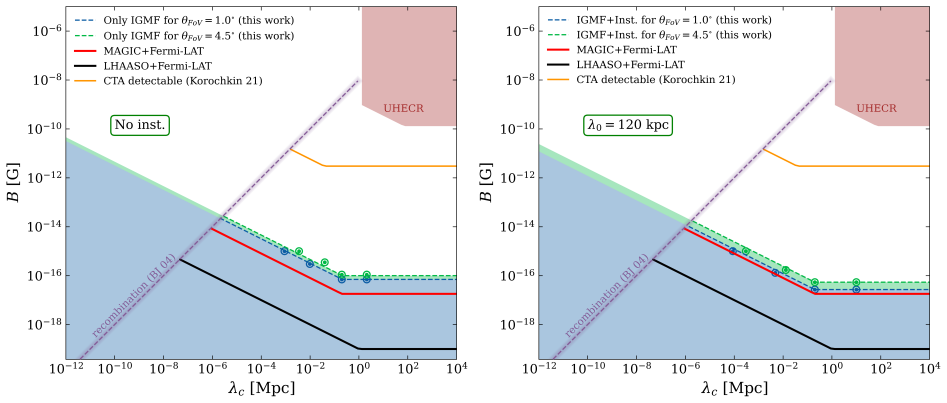
When plasma-instability cooling is parameterized by a length scale of 120 kpc and a spectral index α = −0.5, the model reproduces the Fermi-LAT spectrum of 1ES 0229+200 without magnetic fields; re-introducing the field with those cooling parameters fixed improves the fit and yields a lower bound B ≳ 2.7 imes 10^{-17} G for a 1° field of view.
What carries the argument
A two-parameter phenomenological cooling term (characteristic length ℓ and spectral index α) inserted into CRPropa 3.2 that continuously removes energy from electron-positron pairs before they inverse-Compton scatter; the parameters are first fitted to the zero-field cascade spectrum and then held fixed while the magnetic-field strength is constrained from the residual GeV flux.
Load-bearing premise
The instability parameters that best fit the spectrum when the magnetic field is set to zero remain the correct fixed values once a non-zero field is later introduced.
What would settle it
A joint re-fit of the same Fermi-LAT spectrum of 1ES 0229+200 in which both the instability parameters and the magnetic-field strength are free simultaneously; if the preferred field then falls below ~10^{-17} G or the best-fit length scale moves far from 120 kpc, the reported lower limit is invalidated.
If this is right
- Plasma instabilities with ℓ = 120 kpc and α = −0.5 remain viable and do not erase the cascade signature used for IGMF limits.
- For a 1° observer aperture the IGMF lower bound rises to B ≳ 2.7 imes 10^{-17} G once those cooling parameters are adopted.
- The presence of a non-zero IGMF actually improves the spectral fit relative to pure instability cooling.
- The same two-step procedure can be applied to other hard-spectrum blazars observed by Fermi-LAT to obtain comparable IGMF bounds.
Where Pith is reading between the lines
- Because the cooling parameters were optimized only in the zero-field limit, a simultaneous multi-parameter fit may shift both the preferred length scale and the resulting magnetic-field bound.
- If the characteristic length of 120 kpc is physically linked to the coherence scale of density or temperature fluctuations in voids, the same scale should appear in independent probes of IGM structure.
- Extending the analysis to a larger sample of TeV blazars would test whether the same (ℓ, α) pair remains universal or is source-dependent.
Editorial analysis
A structured set of objections, weighed in public.
Referee Report
Summary. The manuscript studies how plasma-instability cooling of cascade e± pairs affects IGMF constraints from GeV electromagnetic cascades of the blazar 1ES 0229+200. A two-parameter phenomenological instability model (characteristic length scale L and spectral index α) is implemented in CRPropa 3.2. The authors first optimize (L, α) against Fermi-LAT spectral data under the assumption of vanishing IGMF, obtaining L = 120 kpc and α = −0.5. With those parameters held fixed they then incorporate IGMF deflection and finite observer FOV extended-emission constraints, reporting a lower limit B ≳ 2.7 × 10^{-17} G for a 1.0° FOV and stating that the presence of an IGMF improves the fit to the data.
Significance. If the quoted limit is robust under a joint treatment of cooling and magnetic deflection, the work would tighten the interpretation of Fermi-LAT cascade constraints by quantifying the interplay between plasma instabilities and IGMF. Implementation inside the public CRPropa 3.2 framework and the production of a concrete, observationally falsifiable B lower limit are clear strengths. The result would be of interest both for IGMF origin scenarios and for assessing whether instability cooling can partially or fully replace magnetic deflection as an explanation of cascade suppression.
major comments (2)
- [Abstract (two-step analysis)] Abstract (two-step procedure): The central numerical claim B ≳ 2.7 × 10^{-17} G is obtained by first optimizing (L, α) to Fermi-LAT spectra at B = 0 and then freezing those values while scanning B with extended-emission FOV cuts. Because both instability cooling and magnetic deflection remove cascade photons from the observed GeV band and from a finite FOV, the two mechanisms are partially degenerate. Freezing cooling at its B = 0 optimum therefore risks systematically shifting the lower limit relative to a joint fit over (L, α, B). The abstract supplies no joint-likelihood surface, no re-optimization of (L, α) at nonzero B, and no systematic table showing how the quoted limit moves when (L, α) are varied inside their allowed range. Without those checks the numerical value of the limit cannot be regarded as unbiased.
- [Abstract (IGMF fit improvement)] Abstract (fit-improvement claim): The statement that “the fit of the observed data is improved by the presence of an IGMF” is load-bearing for the preference of nonzero B, yet no quantitative figure of merit (Δχ², likelihood-ratio, or equivalent) comparing the best-fit nonzero-B model to the zero-B model under identical cooling parameters is given. A concrete statistical comparison is required to substantiate that claim.
minor comments (2)
- [Abstract] The abstract does not state the coherence length or field morphology assumed for the IGMF, nor the EBL model and source spectral assumptions used in the cascade calculation; these should be made explicit even at abstract level for reproducibility.
- [Abstract / title] The phrase “optimized instability cooling parameters” should be clarified: optimized with respect to which likelihood or χ² and over which energy range of the Fermi-LAT spectrum.
Circularity Check
Two-step procedure fits instability cooling (L, α) to zero-IGMF Fermi-LAT spectra then freezes them to derive the IGMF lower limit on related data
specific steps
-
fitted input called prediction
[Abstract (two-step procedure and results sentences)]
"We first determine the instability parameters that best reproduce the Fermi-LAT observations in the absence of any IGMF. We then use extended-emission observations within the observer's field of view, including the effects of the IGMF, to constrain the IGMF strength in the presence of the corresponding best-fit instability-cooling parameters, based on the Fermi-LAT spectral observations of the blazar 1ES 0229+200. We find that plasma instabilities with a characteristic length scale of 120 kpc and a spectral index of α=-0.5 are consistent with the observed photon spectra. We also find that the"
L = 120 kpc and α = -0.5 are free parameters optimized solely to the Fermi-LAT spectrum under B = 0. Those fitted values are then frozen and used to extract the IGMF lower limit from (partly) the same spectral observations plus FOV data. Because both cooling and magnetic deflection suppress the cascade flux in overlapping ways, the numerical B limit is statistically conditioned on the zero-B cooling optimum rather than arising from a joint or independent determination; the abstract presents the cooling parameters as the enabling intermediate result for the B constraint.
full rationale
From the abstract alone the paper does not claim a first-principles derivation of the cooling length or spectral index; it explicitly optimizes them against Fermi-LAT spectra of 1ES 0229+200 with B = 0, then holds the best-fit values fixed while scanning IGMF strength with the same spectral data plus extended-emission FOV constraints. This is a sequential fit, not a pure self-definition or renaming of a known result, and the extended-emission channel supplies some independent information. Nevertheless the two mechanisms (instability cooling and magnetic deflection) both remove cascade photons from the observed GeV band and finite FOV, so the quoted B ≳ 2.7 × 10^{-17} G is conditioned on the B = 0 optimum of the cooling parameters. The abstract reports no joint re-optimization of (L, α, B) and no systematic variation of the frozen cooling knobs, which is the classic fitted-input-called-prediction pattern at moderate strength. Full text is unavailable, so deeper equation-level reductions cannot be checked; the score therefore remains partial (5) rather than severe. No self-citation, uniqueness-theorem, or ansatz-smuggling circularity is visible in the abstract.
Axiom & Free-Parameter Ledger
free parameters (2)
- instability characteristic length scale L =
120 kpc
- instability spectral index α =
−0.5
axioms (3)
- ad hoc to paper Plasma instability cooling of cascade pairs can be represented by a two-parameter (length scale, spectral index) phenomenological model inside CRPropa.
- domain assumption Standard electromagnetic cascade physics (pair production on EBL, inverse-Compton on CMB/EBL) plus IGMF deflection of e± pairs.
- ad hoc to paper Instability parameters best-fit without IGMF remain valid when IGMF is included (two-step analysis).
Cite this review
Pith. "Pith review of The impact of plasma instability cooling on intergalactic magnetic field constraints in GeV cascades for optimized instability cooling parameters." pith.science (2026). https://pith.science/paper/WALSWFDM
@misc{pith2026260408375,
  author       = {Pith},
  title        = {Pith review of: The impact of plasma instability cooling on intergalactic magnetic field constraints in GeV cascades for optimized instability cooling parameters},
  year         = {2026},
  howpublished = {\url{https://pith.science/paper/WALSWFDM}},
  note         = {Machine review of arXiv:2604.08375}
}
read the original abstract
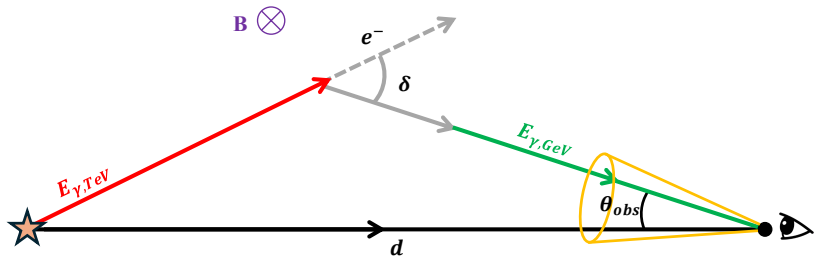
Electromagnetic cascades are initiated by TeV gamma rays propagating through the intergalactic medium (IGM), and they can be used to constrain the weak intergalactic magnetic field (IGMF) in cosmic voids. Primary TeV photons produce electrons and positrons through electromagnetic pair production, which can be deflected out of the line-of-sight to the observer by IGMF. In addition, electron-positron pairs can perturb the IGM, triggering plasma instabilities that can cool down the pairs before they upscatter cosmic background photons to GeV energies via inverse Compton (IC) scattering. In this work, we investigate the influence of plasma instabilities on the cascade spectrum by introducing a parameterized instability model within the publicly available Monte Carlo framework CRPropa 3.2 in the presence of IGMF. We first determine the instability parameters that best reproduce the Fermi-LAT observations in the absence of any IGMF. We then use extended-emission observations within the observer's field of view, including the effects of the IGMF, to constrain the IGMF strength in the presence of the corresponding best-fit instability-cooling parameters, based on the Fermi-LAT spectral observations of the blazar 1ES 0229+200. We find that plasma instabilities with a characteristic length scale of $120$ kpc and a spectral index of $\alpha=-0.5$ are consistent with the observed photon spectra. We also find that the fit of the observed data is improved by the presence of an IGMF: we obtain an IGMF lower limit of $B \gtrsim 2.7 \times 10^{-17}$ G for an observer field of view $1.0^\circ$.
Figures




Forward citations
Cited by 1 Pith paper
-
Turbulent Transport of Galactic Magnetic Fields into Cosmic Voids: Insights from IllustrisTNG
TNG-derived turbulent diffusivity yields a ~7 Mpc present-day magnetic screening length, ~20× prior constant-η estimates, suggesting stronger galactic contribution to void magnetization.
discussion (0)
Sign in with ORCID, Apple, or X to comment. Anyone can read and Pith papers without signing in.