REVIEW 4 major objections 3 minor 19 references
Explaining the Macroeconomic Inertia Puzzle
T0 review · 4 major / 3 minor · reviewed 2026-08-01 · deepseek-v4-flash
Pith's one-line read Standard heterogeneous-agent models can produce consumption inertia without habit formation, by way of a single belief multiplier that governs how much equilibrium amplification distorts expectations.
desk verdict A serious, methodologically novel paper whose empirical semi-structural exercise is the real contribution; the theory is elegant but rests on an assumed misspecification and is not shown to operate at the paper's own estimated parameter values. read the letter →
The pith
A machine-rendered reading of the paper's core claim, the machinery that carries it, and where it could break.
The reading
What carries the argument
The belief multiplier χ = 1 − βω − βωσϕ, which summarizes the net sensitivity of current consumption to expected future income relative to expected future interest rates. In the perpetual-youth formulation it can be rewritten as MPC − (1 − MPC) · EIS · ϕ. When χ is positive and large, the equilibrium feedback of beliefs into output exceeds the direct decay of the shock; the same χ appears in the Kalman update as a misspecification wedge, converting standard belief updating into a self-reinforcing loop that delays the peak response.
What would settle it
Estimate agents' beliefs about the equilibrium feedback channel—for example, by eliciting households' expected income responses to a shock that is amplified by their own spending. If beliefs already incorporate general-equilibrium amplification (so the perceived and actual laws of motion coincide), the theory predicts no inertia; observing strong inertia among such fully informed agents would refute it. Alternatively, a cross-section of economies with different MPCs should show systematically different inertial peaks in consumption responses to common shocks.
Extended reading notes
Core claim
The central claim is that inertia in aggregate consumption is not a failure of heterogeneous-agent structure but a consequence of it. Proposition 1 formalizes the result: if the belief multiplier χ = 1 − βω − βωσϕ exceeds a threshold, output exhibits inertia and the inertial peak lengthens as χ increases. The multiplier is high when the current marginal propensity to consume is high and the intertemporal substitution elasticity is low—precisely the features that distinguish heterogeneous-agent from representative-agent economies. Inertia emerges because agents' perceived law of motion is truncated relative to the true equilibrium law of motion, so the same equilibrium feedback that amplifies
Load-bearing premise
The inertia result depends on agents' perceived law of motion being truncated relative to the actual equilibrium law of motion; if households fully internalized how their beliefs feed back into output, the baseline calibration produces no inertia.
Editorial extensions
If this is right
- Habits, sticky expectations, or other ad hoc frictions are unnecessary to reconcile heterogeneous-agent models with observed consumption inertia.
- Gradual (inertial) Taylor rules and delayed deficit financing are less effective at anchoring expectations, so transmission lags grow.
- The framework predicts that inertia strengthens with household MPC and weakens with more responsive monetary policy, up to a destabilization threshold.
- The semi-structural method offers a way to evaluate any consumption-savings model against impulse responses without committing to a model of expectations.
- Low estimated elasticities of intertemporal substitution (near 0.1) are consistent with the mechanism rather than a puzzle.
Reading between the lines
- The truncation assumption could be micro-founded by bounded memory or state-space complexity limits; if those frictions vary across agents, the model predicts heterogeneity in inertia by household type.
- A direct test: in a laboratory or survey setting, inform agents explicitly that their own spending feeds back into aggregate income; the extrapolation bias documented here should shrink or disappear when they are trained on this feedback.
- The same unobserved-components learning structure could be extended to inflation and investment, potentially generating inertial responses in those aggregates without separate frictions.
Signed reviews
Editorial analysis
A structured set of objections, weighed in public.
Referee Report
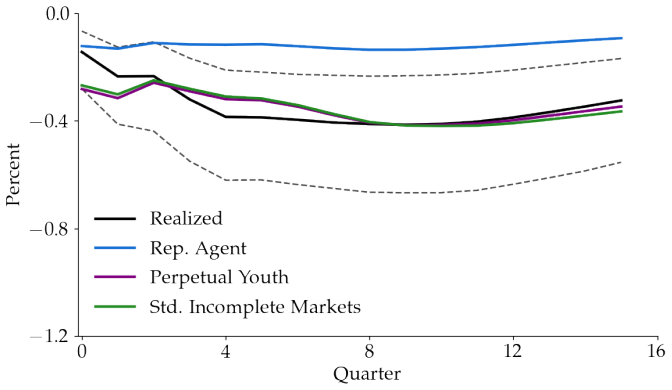
Summary. The paper makes two linked contributions. First, it develops a semi-structural method for evaluating consumption-savings models that uses survey expectations of income and interest rates in place of a model of expectation formation. Applying this to Känzig (2021) oil supply news shocks, the author estimates low EIS values (≈0.08–0.09) and quarterly MPCs of about 4–5% in perpetual-youth and standard incomplete-markets models, and argues these heterogeneous-agent (HA) models reproduce the empirically inertial consumption response, unlike a representative-agent benchmark. Second, it proposes a theory of inertia: agents learn output as an unobserved components process but perceive a truncated law of motion that ignores general-equilibrium feedback. The belief multiplier χ = MPC − (1−MPC)·EIS·φ controls the feedback loop; Proposition 1 states that inertia arises and peaks later when χ exceeds a threshold. The paper then derives policy implications, arguing that inertial Taylor rules and delayed fiscal financing become less effective under this learning friction.
Significance. If the results hold, the paper offers a tractable mechanism for endogenous aggregate consumption inertia without habit persistence, a new rationalization of extrapolation bias in survey expectations, and a novel caution about gradual policy regimes. The methodological contribution—using expectations data directly in sequence-space consumption functions—is valuable and carefully stated, and the paper is unusually transparent about its auxiliary assumptions. The theoretical analysis is formal, with propositions and proofs in the appendices, and the empirical section is explicit about identification and estimation. The main weaknesses are that the central theoretical mechanism is conditional on an assumed misspecification of the perceived law of motion, and that the quantitative connection between the estimated parameters and the theory's inertia region is not established. Both are addressable, but they currently limit the strength of the paper's central claims.
major comments (4)
- [§5.3–5.4, Eqs. (23)–(25), Fig. 13] The inertia result in Proposition 1 is not an emergent property of heterogeneous-agent structure alone; it is driven by the truncated perceived law of motion in Eq. (23). Rational learning, Eq. (25), removes the misspecification wedge and produces no inertia in the baseline calibration (Fig. 13). The paper appeals to complexity or memory constraints but does not derive the specific truncation from those microfoundations. The abstract's claim that the theory works 'without ... any specific model of expectation underreaction' therefore overstates the theoretical finding. I recommend either deriving the truncation as an optimal constraint or explicitly reframing the contribution as showing that HA amplification magnifies a plausibly misspecified PLM, and discussing how the assumed PLM relates to primitive cognitive frictions.
- [§5.3, Table 2, Fig. 11] The quantitative link between the empirical estimates and the theoretical mechanism is missing. With χ = 1 − βω − βωσφ = MPC − (1−MPC)σφ, the Table 2 estimates (EIS ≈ 0.08–0.09, MPC ≈ 0.04–0.05) imply χ is near zero or negative for any realistic Taylor coefficient φ (e.g., φ = 1.5 gives χ ≈ −0.075). Proposition 1 requires χ > X_e > 0. The paper never reports the χ used in Figures 9–11, nor computes X_e for its calibration, and does not show that the estimated parameter region actually produces inertia. Without this check, the theory is not shown to explain the empirical inertia documented in Section 4; that match is obtained by directly feeding survey expectations into the consumption function. A quantitative assessment of χ and X_e at the paper's own estimated parameters is needed.
- [§3.2, §4.2, Assumptions 2c, 5, 6] The empirical claim that HA models can match observed consumption inertia rests heavily on assumptions that are strong and only partially tested. Assumption 2c rules out correlation between expectation heterogeneity and idiosyncratic states; Assumption 5 imposes a shape restriction on the extrapolation of missing horizons; Assumption 6 requires forecaster expectations to be unbiased proxies for household expectations conditional on the instrument. The oil-shock choice is justified, but there is no direct evidence on Assumption 2c or on the household–forecaster mapping for income and interest-rate expectations. Please add robustness checks—for example using household-survey income expectations where available, and a wider range of auxiliary extrapolation models than Table 3—and discuss the likely direction of bias if Assumption 6 fails.
- [§4.5, Eq. (14), Fig. 6] Because the EIS (and ω) are estimated by minimizing the distance between the model-implied and empirical consumption impulse responses, the close visual match in Fig. 6 is partly mechanical. To substantiate the 'consistency with inertia' claim, the paper should report formal fit statistics (R², RMSE, or a test of overidentifying restrictions) and, ideally, a non-nested comparison with the representative-agent benchmark. The robustness table (Table 3) is useful but does not quantify fit, so the reader cannot judge whether the HA models' apparent success is meaningful beyond their flexibility.
minor comments (3)
- [§5.2] The displayed equation beginning 'Y_t ∝ (1−βω−βωσφ)...' is referenced later as 'Equation (22)' but is not numbered in the text. Please number all displayed equations that are referenced.
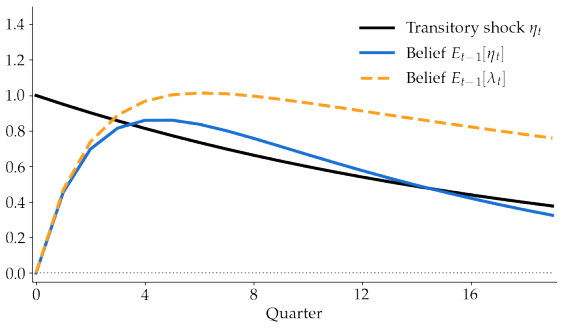
- [§5.3] The timing convention for expectations is confusing: Eq. (21) updates E_t[λ_{t+1}] using information dated t, while Eq. (24) appears to use E_{t−1} in the same role. State the convention explicitly before Proposition 1 to avoid ambiguity.
- [§2] The acronym FIRE is used before it is defined. Define it at first use.
Circularity Check
No significant circularity: the empirical exercise is a conditional consistency/estimation exercise and the theoretical inertia result is an assumption-driven derivation, not a definitional reduction.
full rationale
I walked the derivation chain and found no step in which a claimed prediction or first-principles result reduces by construction to its own inputs. The semi-structural section (Sections 3–4) uses Bluechip survey expectations as data inputs to construct model-implied consumption impulse responses; it then estimates EIS and the perpetual-youth hazard rate by matching those responses to the empirical consumption response. This is standard structural estimation/consistency evaluation rather than an out-of-sample prediction, and the match is not guaranteed by construction because the consumption data are separate from the expectation inputs and the models are overidentified. The theoretical model (Section 5) generates inertia from an explicit, admittedly assumed friction: the perceived law of motion is truncated relative to the actual equilibrium law (Eq. 23 vs. Eq. 22), so the Kalman update contains the χY_t wedge (Eq. 24). Proposition 1 then derives inertia from that wedge; it does not define inertia into existence or rename an input as an output. The paper is transparent that rational learning, where the perceived law nests the actual law, produces no inertia in the baseline calibration (Section 5.4, Figure 13), confirming that the truncation assumption is load-bearing. That is an assumption-dependence/correctness concern, not circularity. There are no load-bearing self-citations or imported uniqueness theorems; the related-work citations (Molavi 2022, Angeletos and Huo 2021, Christiano et al. 2024) are external and acknowledged as similar mechanisms. The skeptic's point about the estimated MPC/EIS not being checked against the Proposition 1 threshold is a quantitative gap, not a circular step. Overall, the paper's derivations are self-contained given their stated assumptions, so the appropriate circularity score is 0.
Assumptions & free parameters
free parameters (5)
- EIS (σ) =
≈0.08–0.11; RA ≈0.00
- Perpetual youth hazard rate (ω) / implied MPC =
MPC ≈0.04–0.05; alternative calibration 0.2
- SIM discount factor (β) =
Calibrated to asset-income ratio 1.4 or MPC 0.2
- Extrapolation auxiliary model parameters (AR(1), AR(2), AR(1)-of-AR(1)) =
Estimated coefficients on Bluechip expectations
- Unobserved components parameters (ρλ, ρη, σλ, ση) =
Chosen in simulations; not estimated
assumptions (8)
- domain assumption Assumption 2c: expectation heterogeneity is independent of idiosyncratic states.
- domain assumption Assumption 5 (shape restriction): the auxiliary extrapolation model is unbiased for far-horizon expectations in the IV sense.
- domain assumption Assumption 6 (measurement error exogeneity): survey expectations equal true household expectations in response to the instrument.
- ad hoc to paper Truncated perceived law of motion: Ỹ_t = λ_t + η_t, ignoring general-equilibrium feedback.
- domain assumption Staggered information: time-t decisions use information from t−1.
- domain assumption Unobserved components model: output is the sum of persistent and transitory AR(1) shocks.
- standard math Linearization and certainty equivalence.
- domain assumption New Keynesian equilibrium block: Calvo pricing, Phillips curve (17), real Taylor rule (18).
Cite this review
Pith. "Pith review of Explaining the Macroeconomic Inertia Puzzle." pith.science (2026). https://pith.science/paper/WCBGSBYR
@misc{pith2026260727548,
  author       = {Pith},
  title        = {Pith review of: Explaining the Macroeconomic Inertia Puzzle},
  year         = {2026},
  howpublished = {\url{https://pith.science/paper/WCBGSBYR}},
  note         = {Machine review of arXiv:2607.27548}
}
read the original abstract
Benchmark macroeconomic models require additional frictions to explain the sluggish response of aggregate variables to sudden shocks or changes in policy. I show that standard heterogeneous agent (HA) models, the Blanchard (1985) perpetual youth and Bewley (1986) incomplete markets models, are consistent with aggregate consumption inertia without the use of habit preferences or any specific model of expectation underreaction to dampen the responsiveness of consumption savings decisions. I instead replicate observed consumption inertia in standard HA models by directly substituting survey expectations of income and interest rates for agents' expectations. I propose a new theory of macroeconomic inertia that rationalizes the observed extrapolation bias in survey expectations by embedding an unobserved components model of expectations into a tractable HA general equilibrium environment. Inertia results when expectations imperfectly account for the equilibrium amplification of shocks, which is large in HA economies. This imperfect inference causes expectations to gradually unanchor as agents repeatedly misattribute large responses of equilibrium outcomes simply to larger shocks. This theory also illustrates a novel drawback to inertial monetary policy rules and the delayed financing of fiscal deficits: Policy regimes that act more gradually experience longer transmission lags due to their decreased effectiveness at anchoring expectations.
Figures


Figures from the paper (19 more)





Reference graph
Works this paper leans on
-
[1]
Overreaction in expectations: Evidence and theory,
Afrouzi, Hassan, Spencer Y Kwon, Augustin Landier, Yueran Ma, and David Thesmar, “Overreaction in expectations: Evidence and theory,”The Quarterly Journal of Economics, 2023,138(3), 1713–1764. Aiyagari, S Rao, “Uninsured idiosyncratic risk and aggregate saving,”The Quarterly Journal of Economics, 1994,109(3), 659–684. Andre, Peter, Carlo Pizzinelli, Chris...
2023
-
[3]
Impulse response estimation by smooth local projections,
Barnichon, Regis and Christian Brownlees, “Impulse response estimation by smooth local projections,”Review of Economics and Statistics, 2019,101(3), 522–530. and Geert Mesters, “Identifying modern macro equations with old shocks,”The Quarterly Journal of Economics, 2020,135(4), 2255–2298. Bastianello, Francesca and Paul Fontanier, “Expectations and learni...
2019
-
[4]
As shown earlier, the over-extrapolation model is able to rationalize the Bluechip expectations impulse responses across variables, time, and horizons. We can simi- larly construct impulse responses implied by a number of other models, treating the realized impulse response as the relevant full-information rational expectations (FIRE) benchmark. 53 (a) Re...
2021
-
[8]
Learning dynamics,
Evans, George W and Seppo Honkapohja, “Learning dynamics,”Handbook of macroeconomics, 1999,1, 449–542. Farmer, Leland E, Emi Nakamura, and J´ on Steinsson, “Learning about the long run,”Journal of Political Economy, 2024,132(10), 000–000. Fuhrer, Jeffrey C, “Habit formation in consumption and its implications for monetary-policy models,”American economic ...
1999
-
[9]
Generalized instrumental variables estimation of nonlinear rational expectations models,
Hansen, Lars Peter and Kenneth J Singleton, “Generalized instrumental variables estimation of nonlinear rational expectations models,”Econometrica: Journal of the Econometric Society, 1982, pp. 1269–1286. Havranek, Tomas, Marek Rusnak, and Anna Sokolova, “Habit formation in consumption: A meta-analysis,”European economic review, 2017,95, 142–167. Huggett,...
1982
-
[10]
The macroeconomic effects of oil supply news: Evidence from OPEC an- nouncements,
K¨ anzig, Diego R, “The macroeconomic effects of oil supply news: Evidence from OPEC an- nouncements,”American Economic Review, 2021,111(4), 1092–1125. Kaplan, Greg and Giovanni L Violante, “The marginal propensity to consume in heteroge- neous agent models,”Annual Review of Economics, 2022,14(1), 747–775. Kosar, Gizem and Cormac O’Dea, “Expectations data...
2021
-
[12]
What are the effects of fiscal policy shocks?,
Mountford, Andrew and Harald Uhlig, “What are the effects of fiscal policy shocks?,”Journal of applied econometrics, 2009,24(6), 960–992. Nagel, Stefan, “Leaning Against Inflation Experiences,” Technical Report
2009
-
[13]
Fitting observed inflation expectations,
49 Negro, Marco Del and Stefano Eusepi, “Fitting observed inflation expectations,”Journal of Economic Dynamics and control, 2011,35(12), 2105–2131. Newey, Whitney K and Daniel McFadden, “Large sample estimation and hypothesis testing,” Handbook of econometrics, 1994,4, 2111–2245. Piazzesi, Monika and Martin Schneider, “Momentum traders in the housing mark...
2011
Show all 19 references
-
[14]
A new measure of monetary shocks: Derivation and implications,
Romer, Christina D and David H Romer, “A new measure of monetary shocks: Derivation and implications,”American economic review, 2004,94(4), 1055–1084. Rozsypal, Filip and Kathrin Schlafmann, “Overpersistence bias in individual income expec- tations and its aggregate implicatio...
2004
-
[15]
Implications of rational inattention,
Sims, Christopher A, “Implications of rational inattention,”Journal of monetary Economics, 2003, 50(3), 665–690. Stock, James H and Mark W Watson, “Disentangling the Channels of the 2007-2009 Reces- sion,” Technical Report, National Bureau of Economic Research
2003
-
[22]
Over-extrapolation
For real disposable income expectations, I use the 55 Consumption-Savings Models Extrapolation Parameter Perpetual Youth Standard Incomplete Markets Rep. agent AR(2) EIS 0.08 0.09 0.00 MPC 0.04 0.05 0.005 AR(1) EIS 0.11 0.07 0.00 MPC 0.05 0.07 0.005 AR(1) of AR(1)s EIS 0.06 0....
2020
-
[79]
Real wage rigidities and the New Keynesian model,
Blanchard, Olivier and Jordi Gal´ ı, “Real wage rigidities and the New Keynesian model,”Jour- nal of money, credit and banking, 2007,39, 35–65. Blanchard, Olivier J, “Debt, deficits, and finite horizons,”Journal of Political Economy, 1985,93, 223–247. Bordalo, Pedro, Nicola Ge...
2007
-
[2001]
Macroeconomic analysis without the rational expectations hypothesis,
, “Macroeconomic analysis without the rational expectations hypothesis,”Annu. Rev. Econ., 2013,5(1), 303–346. Yaari, Menahem E, “Uncertain lifetime, life insurance, and the theory of the consumer,”The Review of Economic Studies, 1965,32(2), 137–150. 50 A Additional impulse res...
2013
-
[2003]
Optimal monetary policy inertia,
Woodford, Michael, “Optimal monetary policy inertia,”The Manchester School, 1999,67, 1–35. , “Imperfect common knowledge and the effects of monetary policy,”
1999
-
[2020]
Sticky expectations and consumption dynamics,
Carroll, Christopher D, Edmund Crawley, Jiri Slacalek, Kiichi Tokuoka, and Matthew N White, “Sticky expectations and consumption dynamics,”American economic journal: macroe- conomics, 2020,12(3), 40–76. Chen, Heng and Yicheng Liu, “Expectation and Confusion: Evidence and Theor...
2020
-
[2022]
Consumption dynamics under information processing constraints,
Luo, Yulei, “Consumption dynamics under information processing constraints,”Review of Eco- nomic dynamics, 2008,11(2), 366–385. Ma´ ckowiak, Bartosz and Mirko Wiederholt, “Business cycle dynamics under rational inat- tention,”The Review of Economic Studies, 2015,82(4), 1502–15...
2008 arXiv
-
[2023]
Business-cycle anatomy,
, Fabrice Collard, and Harris Dellas, “Business-cycle anatomy,”American Economic Review, 2020,110(10), 3030–3070. , Zhen Huo, and Karthik A Sastry, “Imperfect macroeconomic expectations: Evidence and theory,”NBER Macroeconomics Annual, 2021,35(1), 1–86. Auclert, Adrien, Bence ...
2020
-
[2024]
Nominal rigidities and the dynamic effects of a shock to mone- tary policy,
, , and Charles L Evans, “Nominal rigidities and the dynamic effects of a shock to mone- tary policy,”Journal of Political Economy, 2005,113(1), 1–45. Clarida, Richard, Jordi Galı, and Mark Gertler, “Monetary policy rules in practice: Some international evidence,”European econ...
2005
-
[2025]
Consumption commitments and habit formation,
Chetty, Raj and Adam Szeidl, “Consumption commitments and habit formation,”Economet- rica, 2016,84(2), 855–890. Christiano, Lawrence and Yuta Takahashi, “Anchoring Inflation Expectations,” Technical Re- port, Mimeo
2016
Reviewed August 1, 2026 · model on record in the stance chip above.
Discussion (0). Continue with ORCID to comment.