REVIEW 3 major objections 5 minor 64 references
This paper claims that the line-of-sight shear measured in 45 strong gravitational lenses is systematically larger than N-body simulations predict, and that no tested observational feature explains the excess.
Reviewed by Pith at T0; open to challenge. T0 means a machine referee read the full paper against a public rubric. the ladder, T0–T4 →
T0 review · deepseek-v4-flash
2026-08-03 18:25 UTC pith:WDZPJXCI
load-bearing objection Useful extension of the LOS-shear sample to 45 lenses, but the central 'large shears survive octupole' claim is undercut because the octupole fits only succeed for low-to-moderate shear systems, not the ones driving the mean. the 3 major comments →
Line-of-sight shear in SLACS strong lenses II: validation tests with an extended sample
The pith
A machine-rendered reading of the paper's core claim, the machinery that carries it, and where it could break.
Core claim
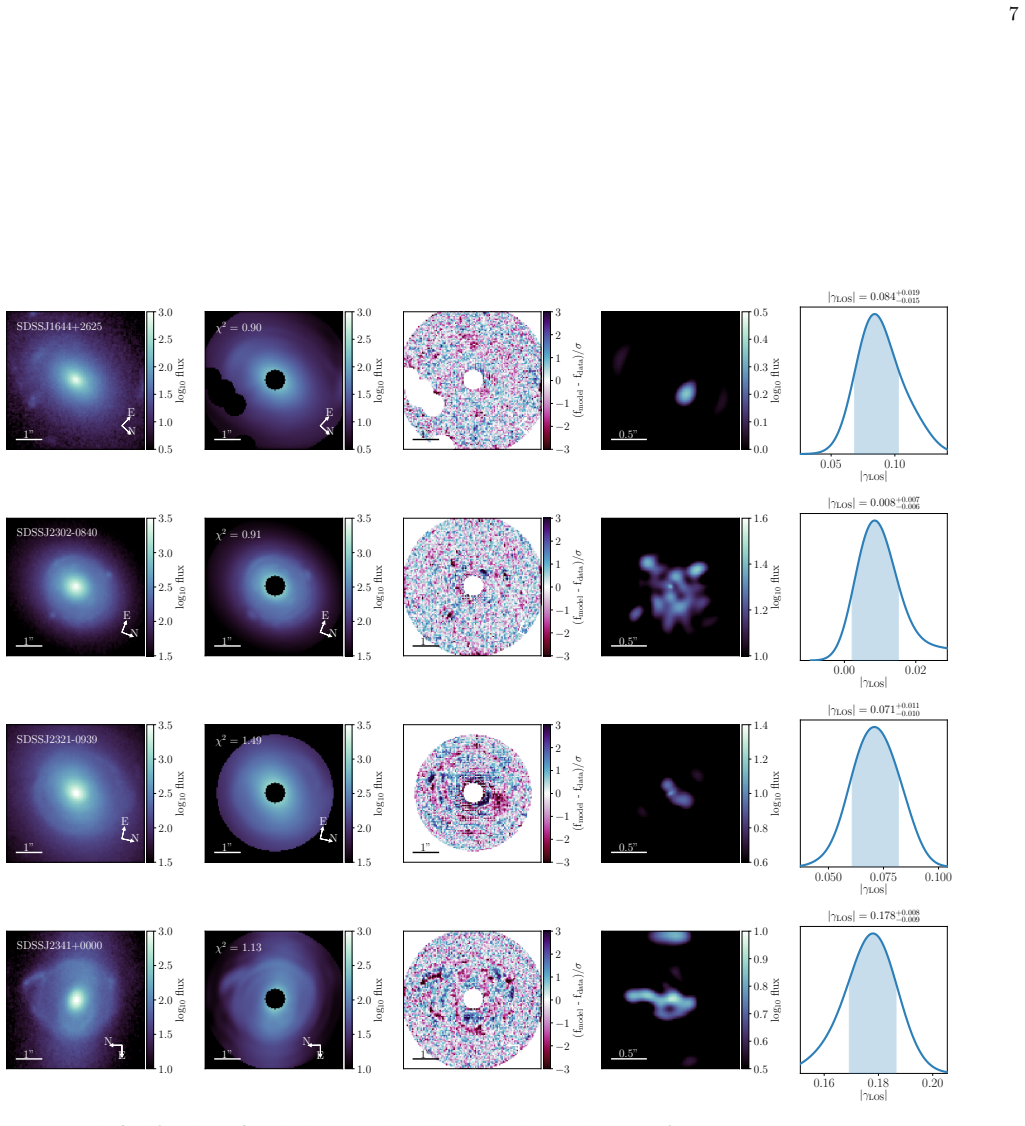
The central claim is that the combination γ_LOS = γ_od + γ_os − γ_ds, as defined by the minimal model, is measurable in individual strong lenses and comes out with magnitudes larger than expected from N-body ray-tracing simulations, with a mean of 0.11 ± 0.024 for the 22 lenses newly modelled here. The paper reports that 12 of these 22 lenses have |γ_LOS| > 0.1, versus only 2 of 23 in the companion paper, and that including an octupole in the lens mass model changes the tension with simulation expectations in only one system (a 7σ decrease there, but the shear remains above the 5σ simulation envelope). Correlations with redshift, sky position, filter, PSF, flux, and SNR are tested; only the
What carries the argument
The minimal line-of-sight shear model, which re-parameterises the lensed source position so that the only shear contribution free of the source-position-transform degeneracy is the combination γ_LOS = γ_od + γ_os − γ_ds. The paper uses this with an elliptical power-law mass profile and a double Sérsic light profile for each lens, then repeats the fit with an octupolar ('boxy'/'disky') distortion added to the mass to test whether unmodelled angular structure is inflating the shear. The octupole test is the central mechanism for ruling out one class of mass-model complexity.
Load-bearing premise
The load-bearing premise is that the fitted |γ_LOS| is a true line-of-sight shear and not a fudge factor absorbing unmodelled angular structure in the main lens; the paper tests one such structure (an octupole) but explicitly leaves other angular complexity, such as isophotal twist, unexplored.
What would settle it
Measure the isophotal position-angle twist of the 22 newly modelled lens galaxies and re-fit each image with a mass model that includes twist as a free parameter. If the large |γ_LOS| values drop below 0.1 while the residuals remain at the noise level, the excess is a mass-model artifact; if they persist, the case for genuinely large line-of-sight shear is strengthened.
If this is right
- If the excess is real, line-of-sight structure along these sightlines is more abundant or more massive than current N-body simulations encode, which would change predictions for strong-lens shear and for time-delay cosmography.
- The minimal LOS shear parameterisation can be applied semi-automatically to a large fraction (45 of 50, or 90%) of selected galaxy-scale strong lenses, so the statistic is not restricted to a handful of systems.
- Since the octupole does not explain the large shears, future lens models must either include additional angular degrees of freedom (isophotal twist, higher multipoles) or accept that the excess is a cosmological signal.
- The absence of correlations with flux, SNR, redshift, and sky location means the excess is unlikely to be a simple observational selection effect, guiding the search toward the mass model.
- The mean shear magnitude across 45 lenses, 0.085 ± 0.019, provides a reference value that any future model or simulation should reproduce.
Where Pith is reading between the lines
- A testable extension would be to re-fit the same lenses with an isophotal-twist or higher-multipole mass model; if the large |γ_LOS| values collapse to the simulation expectation while image residuals stay at the noise level, the excess is a mass-model artifact rather than a cosmological signal.
- If the excess survives such tests, stacking the lenses by line-of-sight galaxy counts or convergence maps from wide surveys should reveal an environmental correlation, since the minimal model's shear is tied to actual line-of-sight structures.
- The marginal F606W-filter correlation (p = 0.042) suggests that even if the PSF comparison shows no difference, resolving power and source-lens separation may mediate how much angular freedom the shear parameter absorbs; a controlled test varying the effective resolution of mock images could settle this.
- The paper's 90% successful-modelling rate implies that the minimal model is not the bottleneck; the bottleneck is deciding how much complexity the data justify, which bears directly on systematic errors in H0 measurements from strong lenses.
Editorial analysis
A structured set of objections, weighed in public.
Referee Report
Summary. This paper extends the authors' previous study of line-of-sight (LOS) shear in SLACS strong lenses by modelling 27 additional systems, successfully fitting 22 with the minimal LOS-shear parameterisation of Fleury et al. (2021). Combining with Paper I, the sample grows to 45 lenses. The headline result is a mean |gamma_LOS| = 0.11 ± 0.024, with a significant fraction of lenses having |gamma_LOS| > 0.1, which the authors argue is unexpectedly large compared to N-body simulation expectations. They test whether an octupolar distortion in the deflector mass reduces the shears, finding no systematic reduction in the eight lenses for which such fits converge. They also investigate correlations with redshift, sky location, filter, PSF, flux, and signal-to-noise ratio, concluding that no observational feature robustly explains the large shears.
Significance. If correct, the result would indicate a genuine discrepancy between measured LOS shears in strong lenses and the predictions of current N-body simulations, with implications for the interpretation of external shear in strong-lens modelling and for using LOS shear as a cosmological probe. The paper is commendable for using a consistent, semi-automated forward-modelling pipeline, making data and code public, and showing posterior distributions and chi-square statistics. However, the central claim is not yet fully supported: the octupole test is only successful for a subset of lenses that excludes the most extreme shears, and the reported mean shear may be affected by the positive-definite nature of |gamma| combined with measurement noise. These issues need to be addressed before the main conclusion can be accepted.
major comments (3)
- [§3.1, Fig. 7, Table 1] The octupole test is only successful for 8 of the 22 lenses, and these are predominantly the low-to-moderate shear systems. The five largest measured shears—SDSSJ0008−0004 (|gamma|=0.295), SDSSJ0044+0113 (0.273), SDSSJ1134+6027 (0.183), SDSSJ1142+1001 (0.184), and SDSSJ1614+4522 (0.199)—are not included in Figure 7. The text states that the octupole inclusion 'often results in pathological problems' for these lenses. Therefore the abstract's claim that large shears persist 'even when an octupolar distortion is included in the lens mass' is not demonstrated for the very systems that drive the mean. Since the LOS shear term can absorb unmodelled angular structure, this is a load-bearing, unresolved degeneracy.
- [§3, mean shear magnitude] The mean |gamma_LOS| = 0.11 ± 0.024 is computed by averaging posterior means of a positive-definite quantity. For low-SNR lenses, the posterior mean of |gamma| is biased high (noise bias), and no null test (e.g., injecting zero-shear images with the same pipeline) or correction for this bias is presented. The mock tests in §3.2.2 compare PSFs only, not the zero-shear recovery distribution. Without such a test, the comparison of the observed mean to N-body expectations is not apples-to-apples, and the 'unexpectedly large' conclusion could be at least partly a measurement artifact.
- [Appendix Table 1 vs. §3] Table 1 lists SDSSJ1538+5817 with |gamma_LOS| = 0.042 ± 0.016 and SDSSJ2347−0005 with 0.146 ± 0.011, but the text in §3 explicitly excludes both lenses from the successful sample ('poor source reconstruction' and 'forward modelling did not produce a convincing source reconstruction'). This is an internal contradiction that affects the sample size and potentially the summary statistics. The table or the text must be corrected.
minor comments (5)
- [§3.2.2 and Abstract] The abstract states that 'none of these features play a statistically significant role', but the text reports a p-value of 0.042 for the filter correlation, which is significant at the 95% level. The authors interpret this as non-physical, but the wording of the abstract is too strong and should be qualified.
- [Fig. 7 caption] The caption says each point shows |gamma_LOS| with the m=4 multipole included, but the colour encodes Δσ. Consider also plotting the minimal-model values for direct comparison, and make the colour scale more explicit.
- [Eq. (7) and Eq. (10)] The sign convention for Im(gamma) in the Jacobian in Eq. (7) appears different from the convention in Eq. (10). Please check that the sign convention is consistent throughout.
- [Table 2] The prior ranges for gamma_od and gamma_LOS are [-0.2,0.2] and [-0.5,0.5] respectively. Since both are shear components, the asymmetry deserves a justification.
- [§1.3] The phrase 'final inmate in the nomenclature zoo' is informal; consider rewording for a journal audience.
Circularity Check
No circular derivation: fitted shear values are compared against an external N-body benchmark, not reconstructed from the fitted values; acknowledged internal-vs-LOS degeneracy is a robustness limitation, not a definitional reduction.
full rationale
The paper's central claim is empirical: the minimal-LOS-shear parameter gamma_LOS is fitted to each lens image, and the resulting values are compared with expectations from the RayGalGroupSims N-body simulations processed in Paper I and Johnson et al. (2025). The expected distribution is not constructed from the same fitted values, so the comparison is not circular in the definitional sense. The minimal-model formalism is derived in Eqs. (9)-(11) within the paper and originates from the externally published Fleury et al. (2021) derivation; no uniqueness theorem from the authors is invoked to exclude alternatives. The octupole test is a model comparison, not a tautology: it fits an additional m=4 multipole and examines whether the inferred shear tension decreases. The incompleteness of this test (only 8 of 22 lenses could be modelled with the octupole, and several of the highest-shear systems, e.g., SDSSJ0008-0004 at gamma=0.295, do not appear in Fig. 7) is a real evidential weakness in the abstract's claim that the excess persists 'even when an octupolar distortion is included.' However, that is a robustness gap, not a circular reduction. The paper itself flags the key degeneracy in Sec. 1.3: 'in practice this might not always be distinguishable from internal contributions,' and in Sec. 3.1 says 'Other types of angular complexity, such as isophotal twistyness, remain as avenues for future exploration.' These passages acknowledge that fitted gamma_LOS may absorb unmodelled angular structure, but they do not make the N-body comparison an identity or rename a fitted parameter as a prediction. Self-citations to Paper I and Hogg et al. (2023) provide external mock and simulation validation; they are not used to define the measured values. The score is therefore 0: the derivation chain, as presented, is self-contained against external benchmarks, with the caveat that the physical interpretation of large fitted shears remains uncertain.
Axiom & Free-Parameter Ledger
free parameters (8)
- γ_LOS1, γ_LOS2 (per-lens line-of-sight shear components) =
posterior means per lens; |γ_LOS| values listed in Appendix Table 1
- γ_od1, γ_od2 (observer–deflector shear components) =
not tabulated
- ω_LOS (rotation term from lens–lens coupling) =
not tabulated
- γ_EPL (power-law slope of the deflector mass) =
prior [1.3, 2.8]
- e1, e2 (deflector ellipticity) =
not tabulated
- Lens-light parameters (Reff, e1, e2, x, y) =
not tabulated
- Source-light parameters (Reff, nS, e1, e2, x, y, shapelet coefficients) =
not tabulated
- a4, φ4 (octupole strength and orientation) =
e.g. a4 = −0.047 ± 0.019 for SDSSJ2341+0000
axioms (7)
- domain assumption Minimal LOS-shear reparameterisation (Eqs. 9–11) correctly captures line-of-sight effects and leaves γ_LOS free of degeneracies
- standard math Reduced shear g = γ/(1−κ) can be approximated by γ
- domain assumption The expected |γ_LOS| distribution from the RayGalGroupSims N-body simulations is the correct benchmark
- domain assumption Elliptical power-law (EPL) mass profile and Sersic light profiles are adequate descriptions of the lenses
- domain assumption TinyTim PSF models accurately represent the HST PSFs
- domain assumption Uniform priors and MCMC convergence imply unbiased posterior estimates
- domain assumption Gaussian shapelets provide a sufficiently flexible source model
read the original abstract
Strong gravitational lensing images are subject to shape distortions due to inhomogeneities along the line of sight. The leading order shape distortion is shear, which, if measurable, will be a complementary cosmological probe to traditional cosmic shear. In Hogg et al. (2025a), we modelled 23 of the SLACS strong lenses, studying the line-of-sight (LOS) shear under a variety of shear and mass model parametrisations. In this work, we successfully model 22 of an additional 27 lenses, extending our sample of LOS shear constraints to 45 in total. We find a mean shear magnitude of $0.11\pm 0.024$, showing that a significant fraction of the lenses modelled in this work possess LOS shears with unexpectedly large magnitudes, $|\gamma_{\rm LOS}| > 0.1$, even when an octupolar distortion is included in the lens mass. We further investigate if factors such as lens and source redshift, filter and PSF, or flux and signal-to-noise ratio in the lensed arcs correlate with shear. We find that none of these features play a statistically significant role in the production of unusually large shear magnitudes.
Figures




Reference graph
Works this paper leans on
-
[1]
author author N. B. \ Hogg , author A. J. \ Shajib , author D. Johnson , \ and\ author J. Larena ,\ @noop \ ( year 2025 a ) ,\ http://arxiv.org/abs/2501.16292 arXiv:2501.16292 [astro-ph.CO] NoStop
Pith/arXiv arXiv 2025
-
[2]
author author A. J. \ Shajib , author G. Vernardos , author T. E. \ Collett , author V. Motta , author D. Sluse , author L. L. R. \ Williams , author P. Saha , author S. Birrer , author C. Spiniello , \ and\ author T. Treu ,\ 10.1007/s11214-024-01105-x journal journal Space Science Reviews \ volume 220 ,\ eid 87 ( year 2024 ) ,\ http://arxiv.org/abs/2210....
Pith/arXiv arXiv 2024
-
[3]
author author J. Prat \ and\ author D. Bacon ,\ @noop \ ( year 2025 ) ,\ http://arxiv.org/abs/2501.07938 arXiv:2501.07938 [astro-ph.CO] NoStop
arXiv 2025
-
[4]
author author M. Jaroszynski \ and\ author Z. Kostrzewa-Rutkowska ,\ 10.1093/mnras/stu096 journal journal Monthly Notices of the Royal Astronomical Society \ volume 439 ,\ pages 2432 ( year 2014 ) ,\ http://arxiv.org/abs/1401.4108 arXiv:1401.4108 [astro-ph.CO] NoStop
Pith/arXiv arXiv 2014
-
[5]
author author C. McCully , author C. R. \ Keeton , author K. C. \ Wong , \ and\ author A. I. \ Zabludoff ,\ 10.3847/1538-4357/836/1/141 journal journal The Astrophysical Journal \ volume 836 ,\ pages 141 ( year 2017 ) ,\ http://arxiv.org/abs/1601.05417 1601.05417 NoStop
Pith/arXiv arXiv 2017
-
[6]
author author D. Johnson , author P. Fleury , author J. Larena , \ and\ author L. Marchetti ,\ 10.1088/1475-7516/2024/10/055 journal journal Journal of Cosmology and Astroparticle Physics \ volume 10 ,\ pages 055 ( year 2024 ) ,\ http://arxiv.org/abs/2405.04194 arXiv:2405.04194 [astro-ph.CO] NoStop
Pith/arXiv arXiv 2024
-
[7]
author author S. Birrer , author C. Welschen , author A. Amara , \ and\ author A. Refregier ,\ 10.1088/1475-7516/2017/04/049 journal journal Journal of Cosmology and Astroparticle Physics \ volume 04 ,\ pages 049 ( year 2017 ) ,\ http://arxiv.org/abs/1610.01599 arXiv:1610.01599 [astro-ph.CO] NoStop
Pith/arXiv arXiv 2017
-
[8]
author author S. Birrer , author A. Refregier , \ and\ author A. Amara ,\ 10.3847/2041-8213/aaa1de journal journal The Astrophysical Journal \ volume 852 ,\ pages L14 ( year 2018 ) ,\ http://arxiv.org/abs/1710.01303 arXiv:1710.01303 [astro-ph.CO] NoStop
Pith/arXiv arXiv 2041
-
[9]
author author P. Fleury , author J. Larena , \ and\ author J.-P. \ Uzan ,\ 10.1088/1475-7516/2021/08/024 journal journal Journal of Cosmology and Astroparticle Physics \ volume 08 ,\ pages 024 ( year 2021 ) ,\ http://arxiv.org/abs/2104.08883 arXiv:2104.08883 [astro-ph.CO] NoStop
Pith/arXiv arXiv 2021
-
[10]
author author M. Kilbinger ,\ 10.1088/0034-4885/78/8/086901 journal journal Reports on Progress in Physics \ volume 78 ,\ pages 086901 ( year 2015 ) ,\ http://arxiv.org/abs/1411.0115 arXiv:1411.0115 [astro-ph.CO] NoStop
Pith/arXiv arXiv 2015
-
[11]
author author A. S. \ Bolton , author S. Burles , author L. V. E. \ Koopmans , author T. Treu , \ and\ author L. A. \ Moustakas ,\ 10.1086/498884 journal journal The Astrophysical Journal \ volume 638 ,\ pages 703 ( year 2006 ) ,\ http://arxiv.org/abs/astro-ph/0511453 arXiv:astro-ph/0511453 [astro-ph] NoStop
Pith/arXiv arXiv 2006
-
[12]
author author A. S. \ Bolton et al. ,\ 10.1086/589327 journal journal The Astrophysical Journal \ volume 682 ,\ pages 964 ( year 2008 ) ,\ http://arxiv.org/abs/0805.1931 arXiv:0805.1931 [astro-ph] NoStop
Pith/arXiv arXiv 2008
-
[13]
author author E. E. \ Falco , author M. V. \ Gorenstein , \ and\ author I. I. \ Shapiro ,\ 10.1086/184422 journal journal The Astrophysical Journal Letters \ volume 289 ,\ pages L1 ( year 1985 ) NoStop
doi:10.1086/184422 1985
-
[14]
author author P. Schneider \ and\ author D. Sluse ,\ 10.1051/0004-6361/201322106 journal journal Astronomy & Astrophysics \ volume 564 ,\ pages A103 ( year 2014 ) ,\ http://arxiv.org/abs/1306.4675 arXiv:1306.4675 [astro-ph.CO] NoStop
Pith/arXiv arXiv 2014
-
[15]
author author D. J. \ Bacon , author A. R. \ Refregier , \ and\ author R. S. \ Ellis ,\ 10.1046/j.1365-8711.2000.03851.x journal journal Monthly Notices of the Royal Astronomical Society \ volume 318 ,\ pages 625 ( year 2000 ) ,\ http://arxiv.org/abs/astro-ph/0003008 arXiv:astro-ph/0003008 NoStop
arXiv 2000
-
[16]
author author N. Kaiser , author G. Wilson , \ and\ author G. A. \ Luppino ,\ @noop \ ( year 2000 ) ,\ http://arxiv.org/abs/astro-ph/0003338 arXiv:astro-ph/0003338 NoStop
Pith/arXiv arXiv 2000
-
[17]
author author L. Van Waerbeke , author Y. Mellier , author T. Erben , author J. C. \ Cuillandre , author F. Bernardeau , author R. Maoli , author E. Bertin , author H. J. \ McCracken , author O. Le F \`e vre , author B. Fort , author M. Dantel-Fort , author B. Jain , \ and\ author P. Schneider ,\ 10.48550/arXiv.astro-ph/0002500 journal journal Astronomy &...
-
[18]
author author D. M. \ Wittman , author J. A. \ Tyson , author D. Kirkman , author I. Dell'Antonio , \ and\ author G. Bernstein ,\ 10.1038/35012001 journal journal Nature \ volume 405 ,\ pages 143 ( year 2000 ) ,\ http://arxiv.org/abs/astro-ph/0003014 arXiv:astro-ph/0003014 NoStop
Pith/arXiv arXiv 2000
-
[19]
author author H. Lin , author S. Dodelson , author H.-J. \ Seo , author M. Soares-Santos , author J. Annis , author J. Hao , author D. Johnston , author J. M. \ Kubo , author R. R. R. \ Reis , \ and\ author M. Simet ,\ 10.1088/0004-637X/761/1/15 journal journal \ volume 761 ,\ eid 15 ( year 2012 ) ,\ http://arxiv.org/abs/1111.6622 arXiv:1111.6622 [astro-p...
Pith/arXiv arXiv 2012
-
[20]
author author M. Kilbinger , author L. Fu , author C. Heymans , author F. Simpson , author J. Benjamin , author T. Erben , author J. Harnois-D \'e raps , author H. Hoekstra , author H. Hildebrandt , author T. D. \ Kitching , author Y. Mellier , author L. Miller , author L. Van Waerbeke , author K. Benabed , author C. Bonnett , author J. Coupon , author M....
Pith/arXiv arXiv 2013
-
[21]
author author K. Kuijken et al. ,\ 10.1093/mnras/stv2140 journal journal Monthly Notices of the Royal Astronomical Society \ volume 454 ,\ pages 3500 ( year 2015 ) ,\ http://arxiv.org/abs/1507.00738 arXiv:1507.00738 [astro-ph.CO] NoStop
Pith/arXiv arXiv 2015
-
[23]
Scognamiglio et al
author author D. Scognamiglio et al. ,\ @noop journal journal Nature Astronomy (in press) \ ( year 2026 ) NoStop
2026
-
[24]
author author A. Amon et al. ( collaboration DES ),\ 10.1103/PhysRevD.105.023514 journal journal Physical Review D \ volume 105 ,\ pages 023514 ( year 2022 ) ,\ http://arxiv.org/abs/2105.13543 arXiv:2105.13543 [astro-ph.CO] NoStop
arXiv 2022
-
[25]
author author L. F. \ Secco et al. ( collaboration DES ),\ 10.1103/PhysRevD.105.023515 journal journal Physical Review D \ volume 105 ,\ pages 023515 ( year 2022 b ) ,\ http://arxiv.org/abs/2105.13544 arXiv:2105.13544 [astro-ph.CO] NoStop
Pith/arXiv arXiv 2022
-
[26]
author author D. Anbajagane , author C. Chang , author A. Drlica-Wagner , author C. Y. \ Tan , author M. Adamow , author R. A. \ Gruendl , author L. F. \ Secco , author Z. Zhang , author M. R. \ Becker , author P. S. \ Ferguson , author N. Chicoine , author K. Herron , author A. Alarcon , author R. Teixeira , author D. Suson , author A. J. \ Shajib , auth...
-
[27]
author author A. Etherington et al. ,\ 10.1093/mnras/stae1375 journal journal Monthly Notices of the Royal Astronomical Society \ volume 531 ,\ pages 3684 ( year 2024 ) ,\ http://arxiv.org/abs/2301.05244 arXiv:2301.05244 [astro-ph.CO] NoStop
Pith/arXiv arXiv 2024
-
[28]
author author N. Tessore \ and\ author R. B. \ Metcalf ,\ 10.1051/0004-6361/201526773 journal journal Astronomy & Astrophysics \ volume 580 ,\ pages A79 ( year 2015 ) ,\ http://arxiv.org/abs/1507.01819 arXiv:1507.01819 [astro-ph.CO] NoStop
Pith/arXiv arXiv 2015
-
[29]
author author N. B. \ Hogg , author P. Fleury , author J. Larena , \ and\ author M. Martinelli ,\ 10.1093/mnras/stad512 journal journal Monthly Notices of the Royal Astronomical Society \ volume 520 ,\ pages 5982 ( year 2023 ) ,\ http://arxiv.org/abs/2210.07210 arXiv:2210.07210 [astro-ph.CO] NoStop
Pith/arXiv arXiv 2023
-
[30]
Bender , author S
author author R. Bender , author S. Doebereiner , \ and\ author C. Moellenhoff ,\ @noop journal journal Astronomy & Astrophysics Supplement \ volume 74 ,\ pages 385 ( year 1988 ) NoStop
1988
-
[31]
author author A. J. \ Shajib , author T. Treu , author S. Birrer , \ and\ author A. Sonnenfeld ,\ 10.1093/mnras/stab536 journal journal Monthly Notices of the Royal Astronomical Society \ volume 503 ,\ pages 2380 ( year 2021 ) ,\ http://arxiv.org/abs/2008.11724 arXiv:2008.11724 [astro-ph.GA] NoStop
Pith/arXiv arXiv 2021
-
[32]
author author R. J. \ Avila , author W. Hack , author M. Cara , author D. Borncamp , author J. Mack , author L. Smith , \ and\ author L. Ubeda ,\ in\ 10.48550/arXiv.1411.5605 booktitle Astronomical Data Analysis Software an Systems XXIV (ADASS XXIV) ,\ series Astronomical Society of the Pacific Conference Series , Vol.\ volume 495 ,\ editor edited by\ edi...
-
[33]
author author J. E. \ Krist , author R. N. \ Hook , \ and\ author F. Stoehr ,\ in\ 10.1117/12.892762 booktitle Optical Modeling and Performance Predictions V ,\ Vol.\ volume 8127 ,\ editor edited by\ editor M. A. \ Kahan ,\ organization International Society for Optics and Photonics \ ( publisher SPIE ,\ year 2011 )\ p.\ pages 81270J NoStop
-
[34]
author author C. Y. \ Tan , author A. J. \ Shajib , author S. Birrer , author A. Sonnenfeld , author T. Treu , author P. Wells , author D. Williams , author E. J. \ Buckley-Geer , author A. Drlica-Wagner , \ and\ author J. Frieman ,\ 10.1093/mnras/stae884 journal journal Monthly Notices of the Royal Astronomical Society \ volume 530 ,\ pages 1474 ( year 2...
Pith/arXiv arXiv 2024
-
[35]
author author A. J. \ Shajib , author N. S. \ Nihal , author C. Y. \ Tan , author V. Sahu , author S. Birrer , author T. Treu , \ and\ author J. Frieman ,\ 10.3847/1538-4357/adf95c journal journal The Astrophysical Journal \ volume 992 ,\ pages 40 ( year 2025 ) ,\ http://arxiv.org/abs/2503.22657 arXiv:2503.22657 [astro-ph.IM] NoStop
Pith/arXiv arXiv 2025
-
[36]
author author S. Birrer \ and\ author A. Amara ,\ https://doi.org/10.1016/j.dark.2018.11.002 journal journal Physics of the Dark Universe \ volume 22 ,\ pages 189 ( year 2018 ) NoStop
-
[37]
author author S. Birrer , author A. J. \ Shajib , author D. Gilman , author A. Galan , author J. Aalbers , author M. Millon , author R. Morgan , author G. Pagano , author J. W. \ Park , author L. Teodori , author N. Tessore , author M. Ueland , author L. V. \ de Vyvere , author S. Wagner-Carena , author E. Wempe , author L. Yang , author X. Ding , author ...
-
[38]
author author J. L. \ S \'e rsic ,\ @noop journal journal Boletin de la Asociacion Argentina de Astronomia La Plata Argentina \ volume 6 ,\ pages 41 ( year 1963 ) NoStop
1963
-
[39]
author author J. L. \ S \'e rsic ,\ @noop title Atlas de Galaxias Australes \ ( year 1968 ) NoStop
1968
-
[40]
author author A. Refregier ,\ 10.1046/j.1365-8711.2003.05901.x journal journal Monthly Notices of the Royal Astronomical Society \ volume 338 ,\ pages 35 ( year 2003 ) ,\ http://arxiv.org/abs/astro-ph/0105178 arXiv:astro-ph/0105178 NoStop
arXiv 2003
-
[41]
author author R. Eberhart \ and\ author J. Kennedy ,\ in\ 10.1109/MHS.1995.494215 booktitle MHS'95. Proceedings of the Sixth International Symposium on Micro Machine and Human Science \ ( year 1995 )\ pp.\ pages 39--43 NoStop
arXiv 1995
-
[42]
author author J. Goodman \ and\ author J. Weare ,\ 10.2140/camcos.2010.5.65 journal journal Communications in Applied Mathematics and Computational Science \ volume 5 ,\ pages 65 ( year 2010 ) NoStop
-
[43]
author author D. Foreman-Mackey , author D. W. \ Hogg , author D. Lang , \ and\ author J. Goodman ,\ 10.1086/670067 journal journal Publications of the Astronomical Society of the Pacific \ volume 125 ,\ pages 306 ( year 2013 ) ,\ http://arxiv.org/abs/1202.3665 arXiv:1202.3665 [astro-ph.IM] NoStop
Pith/arXiv arXiv 2013
-
[44]
author author L. Van de Vyvere , author M. R. \ Gomer , author D. Sluse , author D. Xu , author S. Birrer , author A. Galan , \ and\ author G. Vernardos ,\ 10.1051/0004-6361/202141551 journal journal Astronomy & Astrophysics \ volume 659 ,\ eid A127 ( year 2022 ) ,\ http://arxiv.org/abs/2112.03932 arXiv:2112.03932 [astro-ph.CO] NoStop
Pith/arXiv arXiv 2022
-
[45]
author author D. Johnson , author T. Collett , author T. Li , \ and\ author P. Fleury ,\ 10.1088/1475-7516/2025/08/067 journal journal Journal of Cosmology and Astroparticle Physics \ volume 2025 ,\ pages 067 ( year 2025 ) NoStop
-
[46]
author author M.-A. \ Breton , author Y. Rasera , author A. Taruya , author O. Lacombe , \ and\ author S. Saga ,\ 10.1093/mnras/sty3206 journal journal \ volume 483 ,\ pages 2671 ( year 2019 ) ,\ http://arxiv.org/abs/1803.04294 arXiv:1803.04294 [astro-ph.CO] NoStop
Pith/arXiv arXiv 2019
-
[47]
author author Y. Rasera et al. ,\ 10.1051/0004-6361/202141908 journal journal Astronomy & Astrophysics \ volume 661 ,\ pages A90 ( year 2022 ) ,\ http://arxiv.org/abs/2111.08745 arXiv:2111.08745 [astro-ph.CO] NoStop
Pith/arXiv arXiv 2022
-
[48]
Sprent ,\ @noop title Data Driven Statistical Methods \ ( publisher Chapman & Hall ,\ year 1998 ) NoStop
author author P. Sprent ,\ @noop title Data Driven Statistical Methods \ ( publisher Chapman & Hall ,\ year 1998 ) NoStop
1998
-
[49]
author author J. Nightingale et al. ,\ 10.1093/mnras/staf1253 journal journal Monthly Notices of the Royal Astronomical Society \ volume 543 ,\ pages 203 ( year 2025 ) ,\ http://arxiv.org/abs/2503.08777 arXiv:2503.08777 [astro-ph.GA] NoStop
Pith/arXiv arXiv 2025
-
[50]
author author G. Mahler et al. ,\ 10.1093/mnrasl/slaf088 journal journal Monthly Notices of the Royal Astronomical Society: Letters \ volume 8 ,\ pages L14 ( year 2025 ) ,\ http://arxiv.org/abs/2503.08782 arXiv:2503.08782 [astro-ph.GA] NoStop
arXiv 2025
-
[51]
author author N. B. \ Hogg et al. ,\ @noop journal journal Monthly Notices of the Royal Astronomical Society \ volume 544 ,\ pages 782 ( year 2025 b ) ,\ http://arxiv.org/abs/2503.08785 arXiv:2503.08785 [astro-ph.GA] NoStop
arXiv 2025
-
[52]
author author C. M. \ Casey et al. ,\ 10.3847/1538-4357/acc2bc journal journal The Astrophysical Journal \ volume 954 ,\ pages 31 ( year 2023 ) ,\ http://arxiv.org/abs/2211.07865 arXiv:2211.07865 [astro-ph.GA] NoStop
Pith/arXiv arXiv 2023
-
[53]
Perreault Levasseur , author Y
author author L. Perreault Levasseur , author Y. D. \ Hezaveh , \ and\ author R. H. \ Wechsler ,\ 10.3847/2041-8213/aa9704 journal journal The Astrophysical Journal Letters \ volume 850 ,\ pages L7 ( year 2017 ) ,\ http://arxiv.org/abs/1708.08843 arXiv:1708.08843 [astro-ph.CO] NoStop
Pith/arXiv arXiv 2041
-
[54]
author author A. J. \ Shajib ,\ 10.1093/mnras/stz1796 journal journal Monthly Notices of the Royal Astronomical Society \ volume 488 ,\ pages 1387 ( year 2019 ) ,\ http://arxiv.org/abs/1906.08263 arXiv:1906.08263 [astro-ph.CO] NoStop
Pith/arXiv arXiv 2019
-
[55]
author author S. Wagner-Carena , author J. W. \ Park , author S. Birrer , author P. J. \ Marshall , author A. Roodman , \ and\ author R. H. \ Wechsler ( collaboration LSST Dark Energy Science ),\ 10.3847/1538-4357/abdf59 journal journal The Astrophysical Journal \ volume 909 ,\ pages 187 ( year 2021 ) ,\ http://arxiv.org/abs/2010.13787 arXiv:2010.13787 [a...
Pith/arXiv arXiv 2021
-
[56]
author author A. Galan , author A. Peel , author R. Joseph , author F. Courbin , \ and\ author J. L. \ Starck ,\ 10.1051/0004-6361/202039363 journal journal Astronomy & Astrophysics \ volume 647 ,\ pages A176 ( year 2021 ) ,\ http://arxiv.org/abs/2012.02802 arXiv:2012.02802 [astro-ph.GA] NoStop
Pith/arXiv arXiv 2021
-
[57]
author author G. Vernardos \ and\ author L. V. E. \ Koopmans ,\ 10.1093/mnras/stac1924 journal journal Monthly Notices of the Royal Astronomical Society \ volume 516 ,\ pages 1347 ( year 2022 ) ,\ http://arxiv.org/abs/2202.09378 arXiv:2202.09378 [astro-ph.GA] NoStop
Pith/arXiv arXiv 2022
-
[58]
author author R. Legin , author C. Stone , author A. Adam , author G. M. \ Barco , author A. Coogan , author N. Malkin , author L. Perreault-Levasseur , \ and\ author Y. Hezaveh ,\ @noop \ ( year 2025 ) ,\ http://arxiv.org/abs/2511.19595 arXiv:2511.19595 [astro-ph.GA] NoStop
arXiv 2025
-
[59]
author author S. Mukherjee et al. ,\ 10.1093/mnras/sty1741 journal journal Monthly Notices of the Royal Astronomical Society \ volume 479 ,\ pages 4108 ( year 2018 ) ,\ http://arxiv.org/abs/1802.06629 arXiv:1802.06629 [astro-ph.CO] NoStop
Pith/arXiv arXiv 2018
-
[60]
author author J. Schaye et al. ,\ @noop \ ( year 2025 ) ,\ http://arxiv.org/abs/2508.21126 arXiv:2508.21126 [astro-ph.GA] NoStop
Pith/arXiv arXiv 2025
-
[61]
author author J. A. \ Acevedo Barroso et al. ( collaboration Euclid ),\ @noop \ ( year 2024 ) ,\ http://arxiv.org/abs/2408.06217 arXiv:2408.06217 [astro-ph.GA] NoStop
arXiv 2024
-
[62]
author author M. Walmsley et al. ( collaboration Euclid ),\ @noop \ ( year 2025 ) ,\ http://arxiv.org/abs/2503.15324 arXiv:2503.15324 [astro-ph.GA] NoStop
Pith/arXiv arXiv 2025
-
[63]
author author D. A. \ Green ,\ 10.48550/arXiv.1108.5083 journal journal Bulletin of the Astronomical Society of India \ volume 39 ,\ pages 289 ( year 2011 ) ,\ http://arxiv.org/abs/1108.5083 arXiv:1108.5083 [astro-ph.IM] NoStop
-
[64]
author author K. Thyng , author C. Greene , author R. Hetland , author H. Zimmerle , \ and\ author S. DiMarco ,\ 10.5670/oceanog.2016.66 journal journal Oceanography \ volume 29 ,\ pages 9 ( year 2016 ) NoStop
-
[65]
author author E. van der Velden ,\ 10.21105/joss.02004 journal journal The Journal of Open Source Software \ volume 5 ,\ eid 2004 ( year 2020 ) ,\ http://arxiv.org/abs/2003.01069 arXiv:2003.01069 [eess.IV] NoStop
Pith/arXiv arXiv 2004
discussion (0)
Sign in with ORCID, Apple, or X to comment. Anyone can read and Pith papers without signing in.