Impact of matter effects on the unitarity test of lepton mixing
Pith reviewed 2026-05-21 04:29 UTC · model grok-4.3
The pith
Spectral information from long-baseline neutrino experiments extracts mixing-matrix elements without assuming a parametrization, even after including matter effects, enabling a direct unitarity test.
A machine-rendered reading of the paper's core claim, the machinery that carries it, and where it could break.
Core claim
By decomposing the matter-affected oscillation probabilities into energy-dependent terms and fitting the observed spectra, the elements of the lepton mixing matrix can be obtained without presupposing any particular parametrization; a linear combination of these elements that is identically zero for a unitary matrix can then be formed and tested for consistency with zero using data from T2HK and a future neutrino factory.
What carries the argument
Decomposition of the oscillation probability into sums of mixing-matrix products each multiplied by a coefficient with a unique energy dependence, allowing the products to be extracted as independent coefficients from spectral data.
If this is right
- The CP-conjugate appearance channels at T2HK supply the strongest single-experiment constraint on the unitarity-violating quantity.
- Including the T-conjugate pair at a neutrino factory further tightens the test by providing independent linear combinations of the same matrix elements.
- In a four-generation extension the same fitting procedure yields a non-vanishing value whose magnitude scales with the size of the extra mixing angles.
Where Pith is reading between the lines
- The method could be applied to any future long-baseline setup whose beam energy range spans several oscillation maxima, provided the detector can resolve the spectrum finely enough.
- If the extracted elements are found to satisfy unitarity to high precision, the same data set could be reanalyzed to place limits on non-standard interactions that would otherwise mimic unitarity violation.
Load-bearing premise
The oscillation probabilities remain expressible as linear combinations of a small number of mixing-matrix products whose coefficients have sufficiently different energy dependences even after standard matter effects are included.
What would settle it
A statistically significant non-zero value for the chosen unitarity-violating combination when the full energy spectra of both CP-conjugate and T-conjugate appearance channels are fitted simultaneously.
Figures




read the original abstract
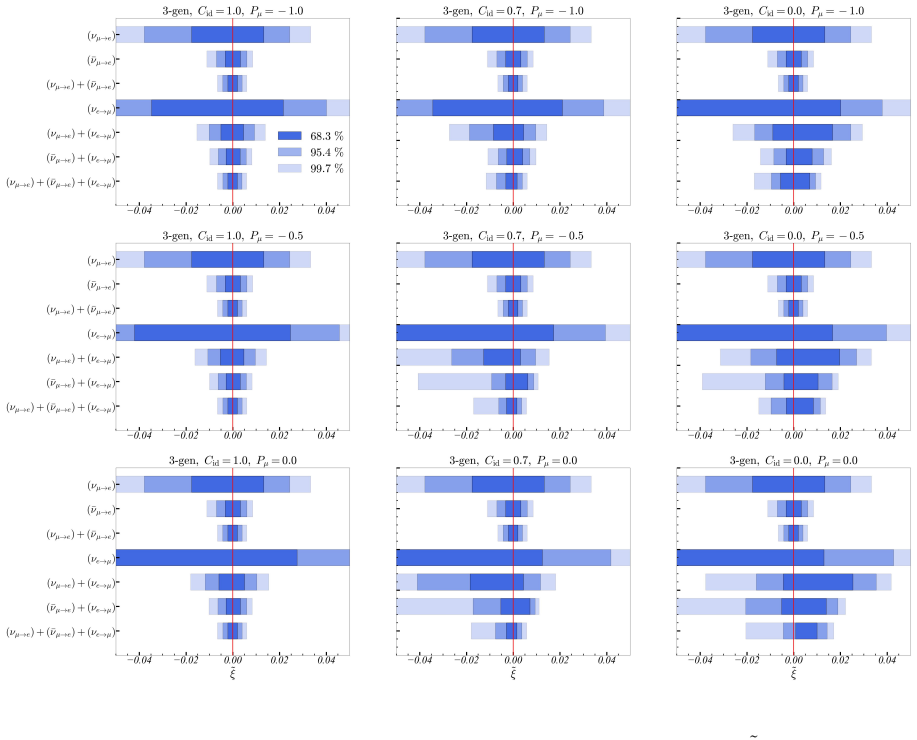
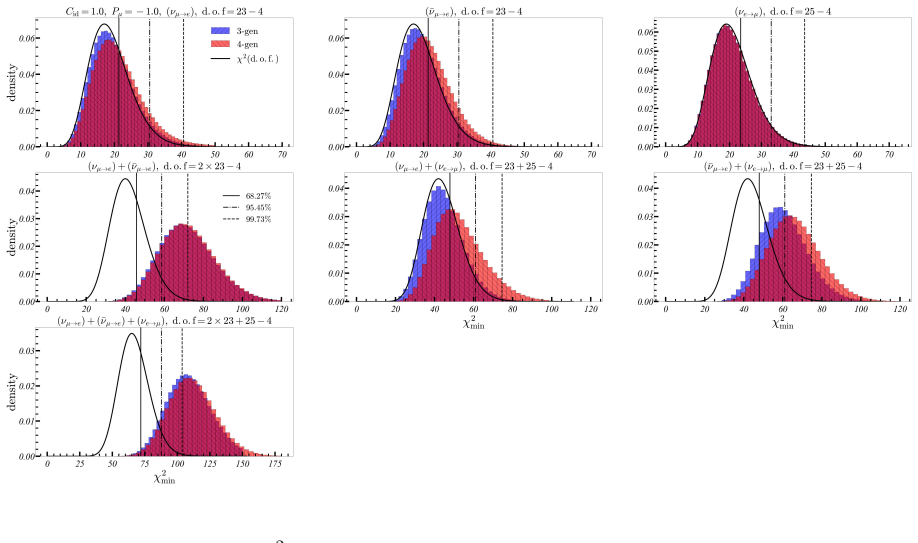
Testing the unitarity of the lepton mixing matrix, in a manner analogous to the unitarity tests of the CKM matrix in the quark sector, is an important step toward probing physics beyond the standard three-generation framework. In long baseline neutrino oscillation experiments, the formula of the oscillation probabilities can be written as a sum of terms with various combinations of the mixing-matrix elements, and their coefficients depend differently on energy. By observing the spectral information of long baseline experiments such as T2HK and a future neutrino factory at J-PARC with a $\nu_e$ beam, the elements of the mixing matrix can be extracted without assuming a specific parametrization of the mixing matrix. We investigate how such an extraction method can be applied to neutrino oscillations by taking into account matter effects, and discuss how one can test unitarity of the mixing matrix in future long baseline experiments. As a concrete example, we examine the unitarity test by using a four-generation model, where we look at a quantity which should be vanishing in a unitary model. Among possible combinations of measurements, the most powerful test can be provided from the energy spectra of the CP-conjugate appearance channels $\nu_\mu \to \nu_e$ and $\bar{\nu}_\mu \to \bar{\nu}_e$ at T2HK, as well as from the T-conjugate pair $\nu_\mu \to \nu_e$ and $\nu_e \to \nu_\mu$ available at neutrino factories.
Editorial analysis
A structured set of objections, weighed in public.
Referee Report
Summary. The manuscript investigates extracting the elements of the lepton mixing matrix from energy spectra in long-baseline experiments (T2HK and a neutrino factory with a νe beam) without assuming a specific parametrization, while incorporating matter effects. It then tests unitarity via a quantity that vanishes for unitary mixing, using a four-generation model as an example. The authors conclude that the most powerful tests come from the CP-conjugate appearance channels (νμ → νe and ν̄μ → ν̄e) at T2HK and the T-conjugate pair (νμ → νe and νe → νμ) at neutrino factories.
Significance. If the extraction procedure remains valid once matter potentials are included, the work supplies a concrete, experiment-specific route to model-independent unitarity tests of the PMNS matrix. This is directly analogous to CKM unitarity tests and would be valuable for constraining or discovering additional neutrino generations or other new physics in upcoming facilities.
major comments (1)
- [Section deriving the oscillation probability formula with matter effects] The central extraction method relies on writing the oscillation probability as a linear combination of terms whose coefficients (functions of the vacuum Uαi) multiply distinct energy-dependent factors. In constant-density matter the effective Hamiltonian is H = (1/(2E))U diag(0,Δm²₂₁,Δm²₃₁,…)U† + diag(V,0,0,…); its eigenvalues λk(E) and eigenvectors become E-dependent. Please show explicitly (in the section deriving the probability formula with matter effects) that the probability can still be decomposed into independent coefficients times separable E-dependent functions, or provide numerical evidence that any resulting degeneracies do not prevent unique extraction of the U elements from realistic spectra.
minor comments (1)
- [Abstract] The abstract states that the formula 'can be written as a sum of terms with various combinations of the mixing-matrix elements' but does not indicate whether this decomposition is performed in vacuum or in matter; a brief clarifying sentence would help readers.
Simulated Author's Rebuttal
We thank the referee for the positive evaluation of our work's significance and for the constructive major comment. We address the point raised below and will strengthen the manuscript accordingly.
read point-by-point responses
-
Referee: [Section deriving the oscillation probability formula with matter effects] The central extraction method relies on writing the oscillation probability as a linear combination of terms whose coefficients (functions of the vacuum Uαi) multiply distinct energy-dependent factors. In constant-density matter the effective Hamiltonian is H = (1/(2E))U diag(0,Δm²₂₁,Δm²₃₁,…)U† + diag(V,0,0,…); its eigenvalues λk(E) and eigenvectors become E-dependent. Please show explicitly (in the section deriving the probability formula with matter effects) that the probability can still be decomposed into independent coefficients times separable E-dependent functions, or provide numerical evidence that any resulting degeneracies do not prevent unique extraction of the U elements from realistic spectra.
Authors: We thank the referee for highlighting this subtlety. In the presence of constant-density matter, the effective eigenvalues and eigenvectors are indeed energy-dependent, so the probability does not factorize in exactly the same manner as in vacuum. In our analysis we incorporated matter effects by numerically evaluating the full oscillation probabilities (via the effective Hamiltonian) for each energy bin while treating the vacuum mixing-matrix elements Uαi as the fit parameters. To confirm that this procedure still permits unique extraction, we will add to the revised manuscript a dedicated numerical study. Using simulated spectra for T2HK and the neutrino factory (including realistic statistics and the matter potential), we will demonstrate that the fitted vacuum U elements recover the input values with no significant degeneracies. This study will be placed immediately after the probability formula section. revision: yes
Circularity Check
No significant circularity; derivation remains self-contained
full rationale
The paper's central method decomposes oscillation probabilities into energy-dependent coefficients to extract mixing-matrix elements without parametrization, then constructs a unitarity test from a vanishing quantity in a four-generation extension. This relies on standard Hamiltonian diagonalization in matter and independent channel combinations (e.g., CP- and T-conjugate spectra), without reducing any load-bearing step to a self-definition, fitted input renamed as prediction, or self-citation chain. The extraction and test are presented as falsifiable against external data and benchmarks, with no quoted equations showing the vanishing quantity defined circularly from the same fit. The skeptic concern about E-dependent frequencies affects correctness but does not create a definitional loop within the paper's logic.
Axiom & Free-Parameter Ledger
axioms (1)
- domain assumption Neutrino oscillation probabilities in matter can be written as sums of terms involving products of mixing-matrix elements with distinct energy-dependent coefficients.
Lean theorems connected to this paper
-
IndisputableMonolith/Cost/FunctionalEquation.leanwashburn_uniqueness_aczel unclear?
unclearRelation between the paper passage and the cited Recognition theorem.
the formula of the oscillation probabilities can be written as a sum of terms with various combinations of the mixing-matrix elements, and their coefficients depend differently on energy... extract... without assuming a specific parametrization... ˜ξ≡C1C3−C2²−C4²/4, ˜η≡1−C5−C6−C7
-
IndisputableMonolith/Foundation/AlexanderDuality.leanalexander_duality_circle_linking unclear?
unclearRelation between the paper passage and the cited Recognition theorem.
Hamiltonian in matter ˜H(±) ≡ U(*) diag(0,ΔE21,ΔE31) U†(T) ± diag(A,0,0)
What do these tags mean?
- matches
- The paper's claim is directly supported by a theorem in the formal canon.
- supports
- The theorem supports part of the paper's argument, but the paper may add assumptions or extra steps.
- extends
- The paper goes beyond the formal theorem; the theorem is a base layer rather than the whole result.
- uses
- The paper appears to rely on the theorem as machinery.
- contradicts
- The paper's claim conflicts with a theorem or certificate in the canon.
- unclear
- Pith found a possible connection, but the passage is too broad, indirect, or ambiguous to say the theorem truly supports the claim.
Reference graph
Works this paper leans on
-
[1]
A new Generation of Standard Solar Models
N. Vinyoles, A. M. Serenelli, F. L. Villante, S. Basu, J. Bergstr¨ om, M. C. Gonzalez-Garcia, M. Maltoni, C. Pe˜ na-Garay, and N. Song, “A new Generation of Standard Solar Models,”Astrophys. J.835no. 2, (2017) 202,arXiv:1611.09867 [astro-ph.SR]. [5]NOvA, M. A. Aceroet al., “First Measurement of Neutrino Oscillation Parameters using Neutrinos and Antineutr...
work page internal anchor Pith review Pith/arXiv arXiv 2017
-
[2]
Complete results for five years of GNO solar neutrino observations
B. T. Cleveland, T. Daily, R. Davis, Jr., J. R. Distel, K. Lande, C. K. Lee, P. S. Wildenhain, and J. Ullman, “Measurement of the solar electron neutrino flux with the Homestake chlorine detector,”Astrophys. J.496(1998) 505–526. [11]GNO, M. Altmannet al., “Complete results for five years of GNO solar neutrino observations,”Phys. Lett. B616(2005) 174–190,a...
work page internal anchor Pith review Pith/arXiv arXiv 1998
-
[3]
Precision measurement of the 7Be solar neutrino interaction rate in Borexino
G. Belliniet al., “Precision measurement of the 7Be solar neutrino interaction rate in Borexino,”Phys. Rev. Lett.107(2011) 141302,arXiv:1104.1816 [hep-ex]. [14]Super-Kamiokande, K. Abeet al., “Solar Neutrino Measurements in Super-Kamiokande-IV,”Phys. Rev. D94no. 5, (2016) 052010,arXiv:1606.07538 [hep-ex]. 28 [15]IceCube, M. G. Aartsenet al., “Measurement ...
work page internal anchor Pith review Pith/arXiv arXiv 2011
-
[4]
Unitarity of the Leptonic Mixing Matrix
S. Antusch, C. Biggio, E. Fernandez-Martinez, M. B. Gavela, and J. Lopez-Pavon, “Unitarity of the Leptonic Mixing Matrix,”JHEP10(2006) 084, arXiv:hep-ph/0607020
work page internal anchor Pith review Pith/arXiv arXiv 2006
-
[5]
Unitarity Tests of the Neutrino Mixing Matrix
X. Qian, C. Zhang, M. Diwan, and P. Vogel, “Unitarity Tests of the Neutrino Mixing Matrix,”arXiv:1308.5700 [hep-ex]
work page internal anchor Pith review Pith/arXiv arXiv
-
[6]
On the description of non-unitary neutrino mixing
F. J. Escrihuela, D. V. Forero, O. G. Miranda, M. Tortola, and J. W. F. Valle, “On the description of nonunitary neutrino mixing,”Phys. Rev. D92no. 5, (2015) 053009, arXiv:1503.08879 [hep-ph]. [Erratum: Phys.Rev.D 93, 119905 (2016)]
work page internal anchor Pith review Pith/arXiv arXiv 2015
-
[7]
Unitarity and the three flavour neutrino mixing matrix
S. Parke and M. Ross-Lonergan, “Unitarity and the three flavor neutrino mixing matrix,”Phys. Rev. D93no. 11, (2016) 113009,arXiv:1508.05095 [hep-ph]. 29
work page internal anchor Pith review Pith/arXiv arXiv 2016
-
[8]
J. Huang and S. Zhou, “Probing unitarity violation of lepton flavor mixing matrix with reactor antineutrinos at JUNO and TAO,”Phys. Lett. B873(2026) 140160, arXiv:2511.15525 [hep-ph]
-
[9]
Probing non-unitarity of the PMNS matrix in P2SO and comparison with DUNE,
S. K. Pusty, S. Roy, M. Ghosh, and R. Mohanta, “Probing non-unitarity of the PMNS matrix in P2SO and comparison with DUNE,”arXiv:2603.01031 [hep-ph]
-
[10]
Connecting Leptonic Unitarity Triangle to Neutrino Oscillation
H.-J. He and X.-J. Xu, “Connecting Leptonic Unitarity Triangle to Neutrino Oscillation,”Phys. Rev. D89no. 7, (2014) 073002,arXiv:1311.4496 [hep-ph]
work page internal anchor Pith review Pith/arXiv arXiv 2014
-
[11]
Updated fit to three neutrino mixing: status of leptonic CP violation
M. C. Gonzalez-Garcia, M. Maltoni, and T. Schwetz, “Updated fit to three neutrino mixing: status of leptonic CP violation,”JHEP11(2014) 052,arXiv:1409.5439 [hep-ph]
work page internal anchor Pith review Pith/arXiv arXiv 2014
-
[12]
H.-J. He and X.-J. Xu, “Connecting the leptonic unitarity triangle to neutrino oscillation with CP violation in the vacuum and in matter,”Phys. Rev. D95no. 3, (2017) 033002,arXiv:1606.04054 [hep-ph]
work page internal anchor Pith review Pith/arXiv arXiv 2017
-
[13]
Updated fit to three neutrino mixing: exploring the accelerator-reactor complementarity
I. Esteban, M. C. Gonzalez-Garcia, M. Maltoni, I. Martinez-Soler, and T. Schwetz, “Updated fit to three neutrino mixing: exploring the accelerator-reactor complementarity,”JHEP01(2017) 087,arXiv:1611.01514 [hep-ph]
work page internal anchor Pith review Pith/arXiv arXiv 2017
-
[14]
S. A. R. Ellis, K. J. Kelly, and S. W. Li, “Leptonic Unitarity Triangles,”Phys. Rev. D 102no. 11, (2020) 115027,arXiv:2004.13719 [hep-ph]
-
[15]
Current and Future Neutrino Oscillation Constraints on Leptonic Unitarity,
S. A. R. Ellis, K. J. Kelly, and S. W. Li, “Current and Future Neutrino Oscillation Constraints on Leptonic Unitarity,”JHEP12(2020) 068,arXiv:2008.01088 [hep-ph]
-
[16]
Geometrical Constraints On Leptonic Unitarity Triangles,
M. Guigue and L. Restrepo, “Geometrical Constraints On Leptonic Unitarity Triangles,”arXiv:2601.18601 [hep-ph]
-
[17]
Unitary Symmetry and Leptonic Decays,
N. Cabibbo, “Unitary Symmetry and Leptonic Decays,”Phys. Rev. Lett.10(1963) 531–533
work page 1963
-
[18]
M. Kobayashi and T. Maskawa, “CP Violation in the Renormalizable Theory of Weak Interaction,”Prog. Theor. Phys.49(1973) 652–657. [37]UTfit, M. Bonaet al., “The Unitarity Triangle Fit in the Standard Model and Hadronic Parameters from Lattice QCD: A Reappraisal after the Measurements of 30 Delta m(s) and BR(B —>tau nu(tau)),”JHEP10(2006) 081, arXiv:hep-ph/0606167
work page internal anchor Pith review Pith/arXiv arXiv 1973
-
[19]
A New Approach to a Global Fit of the CKM Matrix
A. Hocker, H. Lacker, S. Laplace, and F. Le Diberder, “A New approach to a global fit of the CKM matrix,”Eur. Phys. J. C21(2001) 225–259,arXiv:hep-ph/0104062. [39]HFLAV, Y. Amhiset al., “Averages ofb-hadron,c-hadron, andτ-lepton properties as of summer 2016,”Eur. Phys. J. C77no. 12, (2017) 895,arXiv:1612.07233 [hep-ex]
work page internal anchor Pith review Pith/arXiv arXiv 2001
-
[20]
CP Violation and the CKM Matrix: Assessing the Impact of the Asymmetric B Factories
L. Wolfenstein, “Parametrization of the Kobayashi-Maskawa Matrix,”Phys. Rev. Lett. 51(1983) 1945. [41]Particle Data Group, M. Tanabashiet al., “Review of Particle Physics,”Phys. Rev. D98no. 3, (2018) 030001. [42]CKMfitter Group, J. Charles, A. Hocker, H. Lacker, S. Laplace, F. R. Le Diberder, J. Malcles, J. Ocariz, M. Pivk, and L. Roos, “CP violation and ...
work page internal anchor Pith review Pith/arXiv arXiv 1983
-
[21]
A. J. Buras, M. E. Lautenbacher, and G. Ostermaier, “Waiting for the top quark mass, K+ —>pi+ neutrino anti-neutrino, B(s)0 - anti-B(s)0 mixing and CP asymmetries in B decays,”Phys. Rev. D50(1994) 3433–3446,arXiv:hep-ph/9403384
work page internal anchor Pith review Pith/arXiv arXiv 1994
-
[22]
Neutrino Experiments and the Problem of Conservation of Leptonic Charge,
B. Pontecorvo, “Neutrino Experiments and the Problem of Conservation of Leptonic Charge,”Zh. Eksp. Teor. Fiz.53(1967) 1717–1725
work page 1967
-
[23]
Remarks on the unified model of elementary particles,
Z. Maki, M. Nakagawa, and S. Sakata, “Remarks on the unified model of elementary particles,”Prog. Theor. Phys.28(1962) 870–880
work page 1962
-
[24]
Massless Neutrinos in Left-Right Symmetric Models,
D. Wyler and L. Wolfenstein, “Massless Neutrinos in Left-Right Symmetric Models,” Nucl. Phys. B218(1983) 205–214
work page 1983
-
[25]
Lepton Number Violation and Massless Nonorthogonal Neutrinos,
P. Langacker and D. London, “Lepton Number Violation and Massless Nonorthogonal Neutrinos,”Phys. Rev. D38(1988) 907
work page 1988
-
[26]
Low-Energy Phenomenology of Superstring Inspired E(6) Models,
J. L. Hewett and T. G. Rizzo, “Low-Energy Phenomenology of Superstring Inspired E(6) Models,”Phys. Rept.183(1989) 193
work page 1989
-
[27]
Heavy Majorana neutrinos in electron - positron and electron - proton collisions,
W. Buchmuller and C. Greub, “Heavy Majorana neutrinos in electron - positron and electron - proton collisions,”Nucl. Phys. B363(1991) 345–368. 31
work page 1991
-
[28]
Heavy Majorana neutrinos at e p colliders,
G. Ingelman and J. Rathsman, “Heavy Majorana neutrinos at e p colliders,”Z. Phys. C60(1993) 243–254
work page 1993
-
[29]
Unconventional superstring derived E$_{\bf 6}$ models and neutrino phenomenology
E. Nardi, “Unconventional superstring derived E(6) models and neutrino phenomenology,”Phys. Rev. D48(1993) 3277–3287,arXiv:hep-ph/9304266
work page internal anchor Pith review Pith/arXiv arXiv 1993
-
[30]
Phenomenological Consequences of Singlet Neutrinos
L. N. Chang, D. Ng, and J. N. Ng, “Phenomenological consequences of singlet neutrinos,”Phys. Rev. D50(1994) 4589–4601,arXiv:hep-ph/9402259
work page internal anchor Pith review Pith/arXiv arXiv 1994
-
[31]
Non-decoupling of Heavy Neutrinos and Lepton Flavour Violation
D. Tommasini, G. Barenboim, J. Bernabeu, and C. Jarlskog, “Nondecoupling of heavy neutrinos and lepton flavor violation,”Nucl. Phys. B444(1995) 451–467, arXiv:hep-ph/9503228
work page internal anchor Pith review Pith/arXiv arXiv 1995
-
[32]
W. Loinaz, N. Okamura, S. Rayyan, T. Takeuchi, and L. C. R. Wijewardhana, “Quark lepton unification and lepton flavor nonconservation from a TeV scale seesaw neutrino mass texture,”Phys. Rev. D68(2003) 073001,arXiv:hep-ph/0304004
work page internal anchor Pith review Pith/arXiv arXiv 2003
-
[33]
Neutrino Oscillation and CP Violation
J. Sato, “Neutrino oscillation and CP violation,”Nucl. Instrum. Meth. A472(2001) 434–439,arXiv:hep-ph/0008056
work page internal anchor Pith review Pith/arXiv arXiv 2001
-
[34]
Unitarity test of lepton mixing via energy dependence of neutrino oscillation,
R. Kitano, J. Sato, and S. Sugama, “Unitarity test of lepton mixing via energy dependence of neutrino oscillation,”arXiv:2508.20389 [hep-ph]
- [35]
-
[36]
T violation at a future neutrino factory,
R. Kitano, J. Sato, and S. Sugama, “T violation at a future neutrino factory,”JHEP 12(2024) 014,arXiv:2407.05807 [hep-ph]
-
[37]
Exact Formula of Probability and CP Violation for Neutrino Oscillations in Matter
K. Kimura, A. Takamura, and H. Yokomakura, “Exact formula of probability and CP violation for neutrino oscillations in matter,”Phys. Lett. B537(2002) 86–94, arXiv:hep-ph/0203099
work page internal anchor Pith review Pith/arXiv arXiv 2002
-
[38]
K. Kimura, A. Takamura, and H. Yokomakura, “Exact formulas and simple CP dependence of neutrino oscillation probabilities in matter with constant density,”Phys. Rev. D66(2002) 073005,arXiv:hep-ph/0205295
work page internal anchor Pith review Pith/arXiv arXiv 2002
-
[39]
On the exact formula for neutrino oscillation probability by Kimura, Takamura and Yokomakura
O. Yasuda, “On the exact formula for neutrino oscillation probability by Kimura, Takamura and Yokomakura,”arXiv:0704.1531 [hep-ph]. 32
work page internal anchor Pith review Pith/arXiv arXiv
-
[40]
P. F. Harrison and W. G. Scott, “CP and T violation in neutrino oscillations and invariance of Jarlskog’s determinant to matter effects,”Phys. Lett. B476(2000) 349–355,arXiv:hep-ph/9912435
work page internal anchor Pith review Pith/arXiv arXiv 2000
-
[41]
Three neutrino oscillations in matter, CP violation and topological phases,
V. A. Naumov, “Three neutrino oscillations in matter, CP violation and topological phases,”Int. J. Mod. Phys. D1(1992) 379–399
work page 1992
-
[42]
Three neutrino oscillations in matter and topological phases,
V. A. Naumov, “Three neutrino oscillations in matter and topological phases,”Sov. Phys. JETP74(1992) 1–8
work page 1992
-
[43]
C. Jarlskog, “A Basis Independent Formulation of the Connection Between Quark Mass Matrices, CP Violation and Experiment,”Z. Phys. C29(1985) 491–497
work page 1985
-
[44]
C. Jarlskog, “Commutator of the Quark Mass Matrices in the Standard Electroweak Model and a Measure of Maximal CP Nonconservation,”Phys. Rev. Lett.55(1985) 1039
work page 1985
-
[45]
G. H. Golub and V. Pereyra, “The differentiation of pseudo-inverses and nonlinear least squares problems whose variables separate,”SIAM Journal on Numerical Analysis10no. 2, (1973) 413–432
work page 1973
-
[46]
From eV to EeV: Neutrino Cross Sections Across Energy Scales
J. A. Formaggio and G. P. Zeller, “From eV to EeV: Neutrino Cross Sections Across Energy Scales,”Rev. Mod. Phys.84(2012) 1307–1341,arXiv:1305.7513 [hep-ex]
work page internal anchor Pith review Pith/arXiv arXiv 2012
-
[47]
Neutrino Beams from Muon Storage Rings: Characteristics and Physics Potential
S. Geer, “Neutrino beams from muon storage rings: Characteristics and physics potential,”Phys. Rev. D57(1998) 6989–6997,arXiv:hep-ph/9712290. [Erratum: Phys.Rev.D 59, 039903 (1999)]
work page internal anchor Pith review Pith/arXiv arXiv 1998
-
[48]
Long Baseline Neutrino Physics with a Muon Storage Ring Neutrino Source
V. D. Barger, S. Geer, and K. Whisnant, “Long baseline neutrino physics with a muon storage ring neutrino source,”Phys. Rev. D61(2000) 053004,arXiv:hep-ph/9906487
work page internal anchor Pith review Pith/arXiv arXiv 2000
-
[49]
The NEUT neutrino interaction simulation program library,
Y. Hayato and L. Pickering, “The NEUT neutrino interaction simulation program library,”Eur. Phys. J. ST230no. 24, (2021) 4469–4481,arXiv:2106.15809 [hep-ph]
-
[50]
GADZOOKS! Antineutrino Spectroscopy with Large Water Cerenkov Detectors
J. F. Beacom and M. R. Vagins, “GADZOOKS! Anti-neutrino spectroscopy with large water Cherenkov detectors,”Phys. Rev. Lett.93(2004) 171101, arXiv:hep-ph/0309300
work page internal anchor Pith review Pith/arXiv arXiv 2004
-
[51]
A low energy neutrino factory with non-magnetic detectors
P. Huber and T. Schwetz, “A Low energy neutrino factory with non-magnetic detectors,”Phys. Lett. B669(2008) 294–300,arXiv:0805.2019 [hep-ph]. 33 [74]Super-Kamiokande, M. Haradaet al., “Search for Astrophysical Electron Antineutrinos in Super-Kamiokande with 0.01% Gadolinium-loaded Water,”Astrophys. J. Lett.951no. 2, (2023) L27,arXiv:2305.05135 [astro-ph.HE]
work page internal anchor Pith review Pith/arXiv arXiv 2008
-
[52]
R. Akutsu, “A Study of Neutrons Associated with Neutrino and Antineutrino Interactions on the Water Target at the T2K Far Detector,”Ph.D. thesis, University of Tokyo(2019) . [76]Particle Data Group, R. L. Workmanet al., “Review of Particle Physics,”PTEP 2022(2022) 083C01
work page 2019
-
[53]
Updated global analysis of neutrino oscillations in the presence of eV-scale sterile neutrinos
M. Dentler, ´A. Hern´ andez-Cabezudo, J. Kopp, P. A. N. Machado, M. Maltoni, I. Martinez-Soler, and T. Schwetz, “Updated Global Analysis of Neutrino Oscillations in the Presence of eV-Scale Sterile Neutrinos,”JHEP08(2018) 010, arXiv:1803.10661 [hep-ph]
work page internal anchor Pith review Pith/arXiv arXiv 2018
-
[54]
S. Parveen, M. Masud, M. Bishai, and P. Mehta, “Sterile sector impacting the correlations and degeneracies among mixing parameters at the Deep Underground Neutrino Experiment,”JHEP01(2025) 139,arXiv:2409.17878 [hep-ph]. [79]MicroBooNE, P. Abratenkoet al., “Search for light sterile neutrinos with two neutrino beams at MicroBooNE,”Nature648no. 8092, (2025) ...
discussion (0)
Sign in with ORCID, Apple, or X to comment. Anyone can read and Pith papers without signing in.