REVIEW 3 major objections 6 minor 1 cited by
Kondo impurity in an attractive Fermi-Hubbard bath: Equilibrium and dynamics
T0 review · 3 major / 6 minor · reviewed 2026-08-10 · deepseek-v4-flash
Pith's one-line read A self-consistent superconducting gap turns Kondo-impurity transport into four regimes.
desk verdict A serious variational study with real new results, but the claim to explain the experimental conductance anomaly rests on an uncontrolled Hartree step that needs an unbiased numerical check before it can be believed. read the letter →
The pith
A machine-rendered reading of the paper's core claim, the machinery that carries it, and where it could break.
The reading
What carries the argument
The carrier of the argument is the non-Gaussian variational ansatz, a fermionic Gaussian state for the bath multiplied by the disentangling unitary $\hat U_{\mathrm{NGS}} = (1+i\hat\sigma^y_{\mathrm{imp}}\hat P_{\mathrm{bath}})/\sqrt{2}$, with $\hat P_{\mathrm{bath}}$ the bath parity operator. This unitary maps the conserved parity to an impurity spin component, decoupling the impurity and leaving a covariance matrix as the variational parameter. Generalized Wick's theorem turns the attractive Hubbard interaction into Hartree, Fock, and Bogoliubov mean-field terms, so the superconducting gap and the electron-impurity hybridization are renormalized self-consistently while the system evolves in real time.
What would settle it
A direct test would be a time-dependent DMRG simulation in the one-dimensional two-lead geometry at $U=2.0$, $V=0.6$, and $J$ spanning the four regimes, checking for the SC-to-CDW transition and for $G(V)>2e^2/h$; alternatively, an ultracold-atom measurement through a Kondo impurity between two attractively interacting reservoirs should show the enhanced DC conductance and suppressed AC Josephson oscillations.
Extended reading notes
Core claim
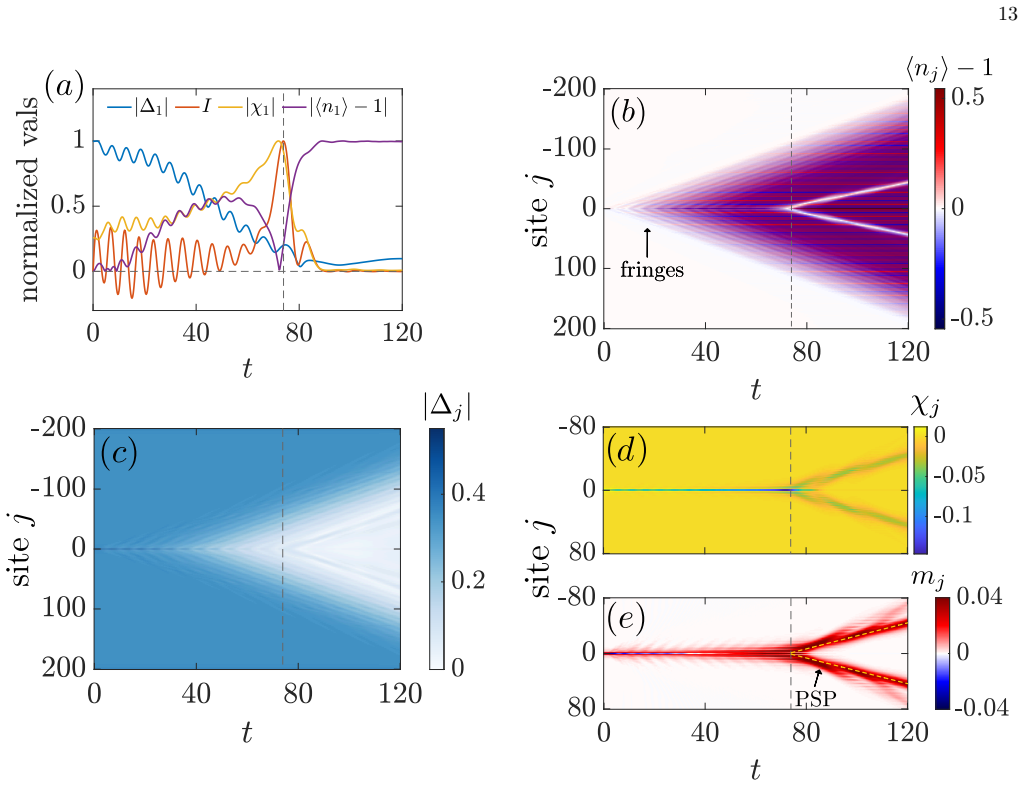
The paper's central claim is that a Kondo impurity coupled to an attractive Fermi-Hubbard bath must be treated with a superconducting order parameter that is renormalized in space and time, and that doing so qualitatively changes the dynamics. In the ground state it recovers the singlet-doublet transition and predicts a $\pi$ phase shift of the superconducting order parameter when Cooper pairs scatter off the Kondo singlet, in both one- and two-dimensional geometries. In the transport setup, a sudden bias voltage yields four regimes: a pure AC Josephson current; a dynamical superconducting-to-CDW transition that locally restores U(1) symmetry and produces a transient Kondo-enhanced current peak; coexistence of AC and DC currents stabilized by partial Kondo screening; and a DC Kondo regime in which the superconducting order enhances conductance. The paper attributes the experimentally anomalous $G(V\ll1)>2e^2/h$ to an interaction-induced chemical potential arising from Hartree charge fluctuations, and the suppression of the AC Josephson current to a reduced phase difference across the impurity.
Load-bearing premise
The predictions rest on the non-Gaussian variational wavefunction faithfully representing the strongly correlated attractive-Hubbard bath over long times; this is checked only against the ground-state transition and noninteracting transport, and one supporting DMRG check is cited to an in-preparation manuscript.
Editorial extensions
If this is right
- The singlet-doublet ground-state transition survives self-consistent treatment, and the superconducting order parameter acquires a $\pi$ phase shift across the Kondo singlet in one dimension.
- A sudden bias voltage can drive a dynamical transition from superconducting to CDW order that locally restores the U(1) symmetry, with a transient Kondo-enhanced current peak at intermediate times.
- Partial Kondo screening away from half-filling stabilizes coexisting AC and DC currents, because the resulting density shift favors superconducting over CDW order.
- In the singlet phase the small-bias DC conductance can exceed $2e^2/h$, while the AC Josephson current is suppressed, matching unexplained experimental observations.
- At non-half-filling the transport phase diagram is predicted to contain only regimes I, III, and IV.
Reading between the lines
- Editorial extension: because the anomalous conductance mechanism runs through Hartree charge fluctuations rather than Kondo physics, the same enhancement should appear in any high-transmission coherent link between two superfluids, not only in Kondo-impurity junctions.
- Editorial extension: the variational manifold is benchmarked only against known limits, so a time-dependent DMRG calculation in one dimension could test whether regimes II and IV survive outside the ansatz.
- Editorial extension: the dynamical SC-to-CDW transition in regime II is a natural setting for symmetry-restoration diagnostics such as the entanglement asymmetry, and might exhibit a quantum Mpemba effect.
- Editorial extension: the directional magnetization pulse emitted in the 2D relaxation dynamics should be directly visible with spin-resolved quantum gas microscopy, and its exponential damping rate gives a measurable proxy for the superconducting gap.
Editorial analysis
A structured set of objections, weighed in public.
Referee Report
Summary. The manuscript studies a spin-1/2 Kondo impurity coupled to an attractive Fermi-Hubbard bath in one and two dimensions, using a non-Gaussian variational ansatz that combines a fermionic Gaussian state with a parity-entangling unitary transformation. After benchmarking the method on the ground-state singlet-doublet transition and on non-interacting transport, it presents three sets of results: (i) spatially resolved SC order and pi-phase shifts in the ground state; (ii) 2D quench dynamics with rapid Kondo-cloud formation and directional magnetization pulses; and (iii) a two-lead transport setup with four dynamical regimes, labelled I-IV, including a proposed microscopic mechanism for the experimentally observed DC conductance above 2e2/h and the suppression of AC Josephson emission. The central claim is that a fully self-consistent treatment of spatial and temporal renormalization of pairing, density, and Kondo correlations changes transport qualitatively and explains those experiments.
Significance. The paper addresses a timely and important problem: understanding superconductor-Kondo junctions beyond the fixed-gap approximation, with direct connections to ultracold-atom experiments. The methodological extension of the non-Gaussian variational approach to symmetry-broken baths is a useful contribution, and the U=0 transport benchmark (G(0)=2e2/h and quadratic nonlinearity) and the ground-state singlet-doublet transition are appropriate validation targets. The proposed four-regime phase diagram, the Hartree-based mechanism for conductance enhancement, and the phase-profile mechanism for AC suppression are concrete and, in principle, falsifiable predictions. However, because the new transport regimes are computed with an approximation whose accuracy for long-time strongly correlated dynamics is uncontrolled, the results are currently better described as variational predictions than as established explanations of the cited experiments. With additional unbiased benchmarks, or with the claims appropriately qualified, the paper could be a strong contribution to the field.
major comments (3)
- [Section III.B to Section VI, Eq. (8)] The four-regime transport phase diagram in Fig. 4 and the detailed claims in Sections VI.A.2 and VI.B.3 are computed entirely with the non-Gaussian variational ansatz of Eq. (8). The error of this ansatz for long-time dynamics of a strongly interacting bath is uncontrolled. The two benchmarks provided are the ground-state singlet-doublet transition (Section IV.B) and non-interacting transport (Section VI.B.1); neither exercises the nonequilibrium density pile-up delta-n(t) of Eq. (24) that underlies the Hartree mechanism, or the SC-to-CDW transition in regime II. I request a direct comparison with an unbiased method (e.g., time-dependent DMRG on the 1D two-lead geometry for smaller L with an extrapolation, or a small-system exact calculation) at representative parameters in regimes II and IV, or, failing that, a clear statement that these regimes and the resulting explanation of Refs. [1,2] are uncontrolled variational predictions rather than established results.
- [Section VI.B.3, Eqs. (23)-(26)] The corrected conductance Gcorrected = Is / V_prime_s in Eq. (26) is not an independent confirmation of the Hartree mechanism, because V_prime_s is constructed from the same Hartree shift that is already present in the mean-field evolution used to obtain Is. The agreement of Gcorrected with the BCS-bath result in Fig. 9(c) is therefore a self-consistency check of the decomposition, not a validation of the variational treatment. To make the claim falsifiable, the authors should report the bare Is(V) or dI/dV, show what happens when only the Hartree term is removed from Eq. (11), state how the DC component is extracted in the presence of the residual AC component, and quantify the averaging error in the steady state.
- [Section IV, Section VIII, Appendix E] In strict one dimension the attractive Hubbard model does not spontaneously break U(1), so the Gaussian ansatz with a finite SC order parameter describes a symmetry-broken (quasi-1D or mean-field) state rather than the exact 1D Luttinger liquid. The pi-phase-shift result of Section IV.C and the regime-II U(1) symmetry restoration of Section VI.A.2 both depend on this broken-symmetry description. The paper defers the DMRG check of the 1D physics to an unpublished manuscript [126], which is not sufficient support for a result stated in the main text. Please either restrict the 1D claims to quasi-1D systems or include the promised DMRG evidence before publication.
minor comments (6)
- [Section VI.B.3] The text says that Figure 10(c) shows that Gcorrected closely aligns with the results for the BCS bath, but the corrected-conductance data are plotted in Fig. 9(c), not Fig. 10(c); the reference should be corrected.
- [Section VI.A.2] The heading 'dynamical CDW to SC transition' is the opposite of the transition described in the text and in Fig. 7, which is a dynamical SC-to-CDW transition; please align the heading with the results.
- [Section VI.B.4] The phase profile and the statement that the SC phase interpolates linearly between bulk values are discussed with references to Fig. 9(a), but the relevant panels are Fig. 10(a,b); please fix the cross-references.
- [Eq. (24)] The notation for the time-dependent densities at the contact points is ambiguous because it is not clear which sign applies to j=-1 and which to j=+1; please write the two formulas explicitly.
- [Fig. 4(b)] The criteria used to draw the boundaries between regimes I, II, and III are not stated; please define them quantitatively (e.g., threshold damping time or AC/DC amplitude ratio) so the phase diagram is reproducible.
- [Section V] No convergence checks (time-step, system size, or initial-state dependence) are reported for the 2D quench dynamics; a brief statement of numerical tolerances would substantially strengthen confidence in the exponential-decay result of Fig. 3(c).
Circularity Check
No circular derivation: the four-regime diagram and the Regime-IV Hartree-shift mechanism are computed outputs, not fitted inputs; only minor self-citations for method validity and a supporting DMRG check prevent a zero score.
-
other
[Section III.A, paragraph after Eq. (4)]
"The validity of this approach has been demonstrated through studies of the ground state and long-time dynamics in quantum impurity problems and superconducting systems [55, 80, 81]."
The non-Gaussian variational ansatz Eq. (8) is the engine for all four transport regimes, and the quoted sentence asserts its validity by citing Refs. [55, 80, 81], which are prior works by the same group (Ashida, Shi, Banuls, Cirac, Demler). This is a self-citation rather than an independent external proof of reliability for the new regimes. It is minor because the paper also provides in-paper benchmarks (U=0 conductance G(0)=2e2/h and quadratic nonlinearity, singlet-doublet transition, AC Josephson scalings) that do not depend on the claimed new regimes.
-
other
[Section VIII (Discussion), fourth paragraph; Ref. [126]]
"as has been numerically verified using DMRG [126]"
Ref. [126] is listed as 'S. Jiang, Z.-Y. Wei and T. Shi, in preparation', an unpublished manuscript by two co-authors of the present paper. The Discussion uses this in-preparation self-citation as the only evidence for the strictly-1D pi-phase-shift statement. This is a missing-support/self-citation flag, but it concerns an extension of the ground-state pi-phase-shift result, not the central four-regime transport claim, so it does not make the main derivation circular.
full rationale
The central claim — four distinct transport regimes and the Regime-IV microscopic explanation of the anomalous DC conductance and AC Josephson suppression — is computed within the non-Gaussian variational ansatz with no free parameters fitted to experimental data. The Hartree-shift mechanism for G(V<<1)>2e2/h is a bookkeeping decomposition of the same mean-field calculation: Eq. (25) defines an effective voltage V' = V + U δn/e from the Hartree term, and Eq. (26) forms Gcorrected = Is/V'_s. The agreement of Gcorrected with the BCS-bath result is an internal consistency check, not a reduction by construction: the enhanced G is a computed output, and the 'correction' removes the identified mechanism rather than imposing the answer. The new dynamical regimes lack exact-numerics benchmarks, but that is a validation gap, not circularity. The only circularity-adjacent elements are the self-citations for the method's validity and for a supporting DMRG check, neither of which is the sole load-bearing premise for the main transport predictions. Score 2 reflects these minor self-citations; the derivation itself is not circular.
Assumptions & free parameters
free parameters (3)
- Kondo coupling J =
scanned from 0.1 to 4
- Attractive Hubbard interaction U =
scanned from 0.5 to 3
- Bias voltage V =
scanned from 0.01 to 1.2
assumptions (4)
- domain assumption The attractive Hubbard model at half-filling possesses global SU(2) pseudo-spin symmetry, so it suffices to study the superconducting sector.
- ad hoc to paper The non-Gaussian variational ansatz U_NGS|+>_imp|psi_GS> accurately describes both the ground state and real-time evolution of the interacting Kondo-SC system.
- standard math The fermionic bath can be represented by Gaussian states and the generalized Wick's theorem applies to the quartic Hubbard interaction.
- domain assumption One-dimensional transport results qualitatively apply to experimentally observed carbon-nanotube Josephson junctions and cold-atom point contacts.
Cite this review
Pith. "Pith review of Kondo impurity in an attractive Fermi-Hubbard bath: Equilibrium and dynamics." pith.science (2026). https://pith.science/paper/WIWK3KFM
@misc{pith2026250105562,
  author       = {Pith},
  title        = {Pith review of: Kondo impurity in an attractive Fermi-Hubbard bath: Equilibrium and dynamics},
  year         = {2026},
  howpublished = {\url{https://pith.science/paper/WIWK3KFM}},
  note         = {Machine review of arXiv:2501.05562}
}
abstract
We investigate theoretically equilibrium and dynamical properties of a Kondo impurity coupled to either 1D or 2D superconductors, modeled by the attractive Fermi-Hubbard model. By employing a non-Gaussian variational approach, we go beyond the approximation of a constant superconducting (SC) gap. We show that dynamical properties of the system can be modified qualitatively, when space and time dependent renormalization of the SC gap and electron-impurity hybridization are included. For the ground state, we find the singlet-doublet phase transition and $\pi$-phase shifts of the SC order parameter. For dynamics, first we consider spin dynamics following an abrupt connection of the polarized impurity to the 2D bath. We find rapid relaxation of impurity polarization and directional emission of a magnetization pulse, which becomes damped as it propagates into the bulk. Then we analyze transport between two SC leads coupled through the impurity at finite bias voltage. Here we go beyond analysis of the steady state to investigate full-time dynamics following an abrupt application of the bias voltage. We uncover four distinct regimes in the transient dynamics and transport properties: (I) the AC Josephson effect regime; (II) dynamical competition between charge-density-wave (CDW) and SC orders with transient Kondo correlations; (III) the coexistence of AC and DC currents facilitated by partial Kondo screening and dynamical stabilization of the SC order; (IV) DC Kondo transport regime modified by the SC order. Regime II exhibits a dynamical transition from SC to CDW order that locally restores the U(1) symmetry. We argue that our findings for regime IV provide a theoretical explanation for the experimentally observed anomalous enhancement of DC conductance and suppression of the AC Josephson current. Finally, we discuss the potential experimental realization with ultracold atoms.
Figures


Figures from the paper (7 more)




Forward citations
Cited by 1 Pith paper
-
Thermodynamics in a split Hilbert space: Quantum impurity at the edge of a one-dimensional superconductor
A Bethe-ansatz analysis yields the impurity entropy across the four phases and predicts entropy overshoots above ln 2 when a midgap YSR bound state is thermally activated.
Reference graph
Works this paper leans on
- [126]
-
[1]
In this case, the Kondo impurity functions as a weak link be- tween the two SC baths
Regime I: AC Josephson effect We first consider the regime where the Kondo inter- action J is much smaller than both th and U . In this case, the Kondo impurity functions as a weak link be- tween the two SC baths. Consequently, under external DC bias voltages, the AC Josephson effect [90] is ob- served, as shown in Fig. 6(a). The current I(t) can be expre...
-
[2]
regime II: dynamical CDW to SC transition As J increases from regime I, the system enters into regime II, with the typical behavior of the current I(t) illustrated by the red curve in Fig. 4(c). Initially, an AC Josephson current is established, which gradually damp- ens with a transient current peak emerging at an inter- mediate time tpeak. Eventually, t...
-
[3]
regime III: stable AC + DC transport By further increasing J, the system enters into regime III, where the typical current is depicted by the yellow curve in Fig. 4(c). The current contains both significant AC and DC components, with the AC component re- maining stable for a longer duration compared to regime II. The evolution of the density distribution ...
-
[4]
The case of non-interacting leads In the case of non-interacting leads ( U = 0), the sys- tem models a Kondo impurity coupled to two normal leads, and its transport properties have been extensively studied both theoretically and experimentally [80, 95– 106]. In Fig. 9(a), we present the time evolution of the current I(t) for various bias voltages V , with...
-
[5]
9(a) and the purple curve in Fig
Adding attractive interaction When electrons are attractively interacting in the leads, the typical behaviors of the current in regime IV are shown in Fig. 9(a) and the purple curve in Fig. 4(c). The SC order in the system leads to both DC and AC components in the current I(t), with the DC conduc- tance G(V ) also shown in Fig. 9(b). Compared to the 15 0 ...
-
[6]
E. Y. Andrei, D. K. Efetov, P. Jarillo-Herrero, A. H. MacDonald, K. F. Mak, T. Senthil, E. Tutuc, A. Yaz- dani, and A. F. Young, The marvels of moir´ e materials, Nature Reviews Materials 6, 201 (2021)
2021
-
[7]
Anomalous enhancement of small-bias DC conductance Here, we examine in detail the anomalous DC conduc- tance G(V ≪ 1) > 2e2/h observed in the case of an interacting bath [cf. Fig. 9(b)]. We compute the DC con- ductance G(V = 0.01) for a small bias V = 0.01. For a fixed J = 2.5, Fig. 9(b) shows an almost linear increase of G(V = 0 .01) with U . We explore ...
Show all 146 references
-
[8]
Suppression of the AC Josephson current in the Kondo singlet regime We now analyze the suppression of the AC Josephson current in regime IV, as shown in Fig. 4(c). According to the theory of the AC Josephson effect, the AC Josephson current scales as IAC(t) ∼ J 2 sin2(δϕ(t)), ...
-
[9]
T. Hata, R. Delagrange, T. Arakawa, S. Lee, R. De- block, H. Bouchiat, K. Kobayashi, and M. Ferrier, En- hanced shot noise of multiple Andreev reflections in a carbon nanotube quantum dot in SU (2) and SU (4) Kondo regimes, Physical review letters 121, 247703 (2018)
2018
-
[10]
Watfa, R
D. Watfa, R. Delagrange, A. Kadlecov´ a, M. Ferrier, A. Kasumov, H. Bouchiat, and R. Deblock, Collapse of the josephson emission in a carbon nanotube junc- tion in the kondo regime, Physical Review Letters 126, 126801 (2021)
2021
-
[11]
Orenstein and A
J. Orenstein and A. Millis, Advances in the physics of high-temperature superconductivity, Science 288, 468 (2000)
2000
-
[12]
S. G. Stewart, Heavy-fermion systems, Reviews of Mod- ern Physics 56, 755 (1984)
1984
-
[13]
Wang and Q
X. Wang and Q. Zhang, Organic quantum materials: A review, SmartMat n/a, e1196
-
[14]
Shiba, Classical spins in superconductors, Progress of theoretical Physics 40, 435 (1968)
H. Shiba, Classical spins in superconductors, Progress of theoretical Physics 40, 435 (1968)
1968
-
[15]
Casalbuoni and G
R. Casalbuoni and G. Nardulli, Inhomogeneous super- conductivity in condensed matter and qcd, Reviews of Modern Physics 76, 263 (2004)
2004
-
[16]
A. I. Buzdin, Proximity effects in superconductor- ferromagnet heterostructures, Reviews of modern physics 77, 935 (2005)
2005
-
[17]
De Franceschi, L
S. De Franceschi, L. Kouwenhoven, C. Sch¨ onenberger, and W. Wernsdorfer, Hybrid superconductor–quantum dot devices, Nature nanotechnology 5, 703 (2010)
2010
-
[18]
Feofanov, V
A. Feofanov, V. Oboznov, V. Bol’Ginov, J. Lisenfeld, S. Poletto, V. Ryazanov, A. Rossolenko, M. Khabipov, D. Balashov, A. Zorin, et al. , Implementation of su- perconductor/ferromagnet/superconductor π-shifters in superconducting digital and quantum circuits, Nature Physics 6,...
2010
-
[19]
A. V. Balatsky, I. Vekhter, and J.-X. Zhu, Impurity- induced states in conventional and unconventional su- perconductors, Reviews of Modern Physics 78, 373 (2006)
2006
-
[20]
B. W. Heinrich, J. I. Pascual, and K. J. Franke, Single magnetic adsorbates on s-wave superconduc- tors, Progress in Surface Science 93, 1 (2018), arXiv:1705.03672
2018 arXiv
-
[21]
Yu, Bound state in superconductors with paramag- netic impurities, Acta Phys
L. Yu, Bound state in superconductors with paramag- netic impurities, Acta Phys. Sin 21, 75 (1965)
1965
-
[22]
Hatter, B
N. Hatter, B. W. Heinrich, M. Ruby, J. I. Pascual, and K. J. Franke, Magnetic anisotropy in shiba bound states across a quantum phase transition, Nature communica- tions 6, 8988 (2015)
2015
-
[23]
A. I. Rusinov, Superconductivity near a paramagnetic impurity, JETP Lett.(USSR) 9 (1969)
1969
-
[24]
A. I. Rusinov, Theory of gapless superconductivity in alloys containing paramagnetic impurities, Sov. Phys. JETP 29, 1101 (1969)
1969
-
[25]
Sakurai, Comment on SupeFconductoll with Mag- netic Impuritie, Progress of Theoretical Physics 44 (1970)
A. Sakurai, Comment on SupeFconductoll with Mag- netic Impuritie, Progress of Theoretical Physics 44 (1970)
1970
-
[26]
M. I. Salkola, A. V. Balatsky, and J. R. Schrieffer, Spec- tral properties of quasiparticle excitations induced by magnetic moments in superconductors, Physical Review B 55, 12648 (1997)
1997
-
[27]
Satori, H
K. Satori, H. Shiba, O. Sakai, and Y. Shimizu, Numer- ical Renormalization Group Study of Magnetic Impuri- ties in Superconductors, Journal of the Physical Society of Japan 61, 3239 (1992)
1992
-
[28]
Yazdani, B
A. Yazdani, B. A. Jones, C. P. Lutz, M. F. Crommie, and D. M. Eigler, Probing the local effects of mag- netic impurities on superconductivity, Science275, 1767 (1997)
1997
-
[29]
K. J. Franke, G. Schulze, and J. I. Pascual, Competition of superconducting phenomena and Kondo screening at the nanoscale, Science 332, 940 (2011)
2011
-
[30]
Tsuchimoto, Z
Y. Tsuchimoto, Z. Sun, E. Togan, S. F¨ alt, W. Wegschei- der, A. Wallraff, K. Ensslin, A. ˙Imamo˘ glu, and M. Kro- ner, Large-bandwidth transduction between an optical single quantum dot molecule and a superconducting res- onator, PRX Quantum 3, 030336 (2022). 20
2022
-
[31]
E. J. Lee, X. Jiang, R. Aguado, C. M. Lieber, S. De Franceschi, et al. , Scaling of subgap excitations in a superconductor-semiconductor nanowire quantum dot, Physical Review B 95, 180502 (2017)
2017
-
[32]
L. P. Kouwenhoven, C. M. Marcus, P. L. McEuen, S. Tarucha, R. M. Westervelt, and N. S. Wingreen, Elec- tron transport in quantum dots, Mesoscopic electron transport , 105 (1997)
1997
-
[33]
T. Meng, J. Klinovaja, S. Hoffman, P. Simon, and D. Loss, Superconducting gap renormalization around two magnetic impurities: From shiba to andreev bound states, Physical Review B 92, 064503 (2015)
2015
-
[34]
K. G. Wilson, The renormalization group: Critical phe- nomena and the Kondo problem, Reviews of Modern Physics 47, 773 (1975)
1975
-
[35]
Andrei, K
N. Andrei, K. Furuya, and J. Lowenstein, Solution of the kondo problem, Reviews of modern physics 55, 331 (1983)
1983
-
[36]
Bulla, T
R. Bulla, T. A. Costi, and T. Pruschke, Numerical renormalization group method for quantum impurity systems, Reviews of Modern Physics 80, 395 (2008)
2008
-
[37]
C. A. B¨ usser, G. B. Martins, and A. E. Feiguin, Lanc- zos transformation for quantum impurity problems in d- dimensional lattices: Application to graphene nanorib- bons, Physical Review B 88, 23 (2013)
2013
-
[38]
Hartke, B
T. Hartke, B. Oreg, N. Jia, and M. Zwierlein, Quantum register of fermion pairs, Nature 601, 537 (2022)
2022
-
[39]
Liang, L
K. Liang, L. Bi, Q. Zhu, H. Zhou, and S. Li, Ultrafast dynamics revealed with time-resolved scanning tunnel- ing microscopy: A review, ACS Applied Optical Mate- rials 1, 924 (2023)
2023
-
[40]
Burkard, T
G. Burkard, T. D. Ladd, A. Pan, J. M. Nichol, and J. R. Petta, Semiconductor spin qubits, Reviews of Modern Physics 95, 025003 (2023)
2023
-
[41]
Avishai, A
Y. Avishai, A. Golub, and A. D. Zaikin, Superconductor-quantum dot-superconductor junc- tion in the kondo regime, Physical Review B 67, 041301 (2003)
2003
-
[42]
R. T. Scalettar, E. Y. Loh, J. E. Gubernatis, A. Moreo, S. R. White, D. J. Scalapino, R. L. Sugar, and E. Dagotto, Phase diagram of the two-dimensional negative-U Hubbard model, Physical review letters 62, 1407 (1989)
1989
-
[43]
Moreo and D
A. Moreo and D. J. Scalapino, Two-dimensional negative-U Hubbard model, Physical Review Letters66, 946 (1991)
1991
-
[44]
Riegger, N
L. Riegger, N. Darkwah Oppong, M. H¨ ofer, D. R. Fer- nandes, I. Bloch, and S. F¨ olling, Localized Magnetic Moments with Tunable Spin Exchange in a Gas of Ul- tracold Fermions, Physical Review Letters 120, 143601 (2018)
2018
-
[45]
Mitra, P
D. Mitra, P. T. Brown, E. Guardado-Sanchez, S. S. Kondov, T. Devakul, D. A. Huse, P. Schauß, and W. S. Bakr, Quantum gas microscopy of an attractive Fermi-Hubbard system, Nature Physics 14, 173 (2018), arXiv:1705.02039
2018 arXiv
-
[46]
Zvyagin and P
A. Zvyagin and P. Schlottmann, Magnetic impurity in the one-dimensional Hubbard model, Physical Review B 56, 300 (1997)
1997
-
[47]
Hartke, B
T. Hartke, B. Oreg, C. Turnbaugh, N. Jia, and M. Zwierlein, Direct observation of nonlocal fermion pairing in an attractive Fermi-Hubbard gas, Science 381, 82 (2023)
2023
-
[48]
Husmann, S
D. Husmann, S. Uchino, S. Krinner, M. Lebrat, T. Gi- amarchi, T. Esslinger, and J.-P. Brantut, Connecting strongly correlated superfluids by a quantum point con- tact, Science 350, 1498 (2015)
2015
-
[49]
Fabritius, J
P. Fabritius, J. Mohan, M. Talebi, S. Wili, W. Zw- erger, M.-Z. Huang, and T. Esslinger, Irreversible en- tropy transport enhanced by fermionic superfluidity, Nature Physics , 1 (2024)
2024
-
[50]
Huang, J
M.-Z. Huang, J. Mohan, A.-M. Visuri, P. Fabritius, M. Talebi, S. Wili, S. Uchino, T. Giamarchi, and T. Esslinger, Superfluid signatures in a dissipative quan- tum point contact, Physical Review Letters130, 200404 (2023)
2023
-
[51]
Costamagna, C
S. Costamagna, C. J. Gazza, M. E. Torio, and J. A. Riera, Anderson impurity in the one-dimensional Hub- bard model for finite-size systems, Physical Review B 74, 195103 (2006)
2006
-
[52]
Bragan¸ ca, M
H. Bragan¸ ca, M. F. Cavalcante, R. G. Pereira, and M. C. O. Aguiar, Quench dynamics and relaxation of a spin coupled to interacting leads, Physical Review B 103, 125152 (2021)
2021
-
[53]
M. F. Cavalcante, R. G. Pereira, and M. C. O. Aguiar, Quench dynamics of the Kondo effect: Transport across an impurity coupled to interacting wires, Physical Re- view B 107, 75110 (2023)
2023
-
[54]
P. Sala, T. Shi, S. K¨ uhn, M. C. Banuls, E. Demler, and J. I. Cirac, Variational study of U (1) and SU (2) lattice gauge theories with Gaussian states in 1+ 1 dimensions, Physical Review D 98, 34505 (2018)
2018
-
[55]
P. A. Bares and K. Grzegorczyk, Hubbard chain with a Kondo impurity, Europhysics Letters 46, 88 (1999)
1999
-
[56]
Hou, X.-q
B.-y. Hou, X.-q. Xi, and R.-h. Yue, Impurity of arbi- trary spin embed in the 1-D Hubbard model with open boundary conditions, Physics Letters A257, 189 (1999)
1999
-
[57]
Georges, G
A. Georges, G. Kotliar, W. Krauth, and M. J. Rozen- berg, Dynamical mean-field theory of strongly corre- lated fermion systems and the limit of infinite dimen- sions, Reviews of Modern Physics 68, 13 (1996)
1996
-
[58]
T. Shi, E. Demler, and J. Ignacio Cirac, Variational study of fermionic and bosonic systems with non- Gaussian states: Theory and applications, Annals of Physics 390, 245 (2018)
2018
-
[59]
T. Soda, T. Matsuura, and Y. Nagaoka, s-d Exchange Interaction in a Superconductor, Progress of Theoretical Physics 38, 551 (1967)
1967
-
[60]
Huang, A
C.-H. Huang, A. M. Lobos, and M. A. Cazalilla, A large- n approach to magnetic impurities in superconductors, arXiv:2408.17281 (2024)
2024 arXiv
-
[61]
C. P. Moca, I. Weymann, M. A. Werner, and G. Zar´ and, Kondo cloud in a superconductor, Physical Review Let- ters 127, 186804 (2021)
2021
-
[62]
Oguri, Fermi-liquid theory for the Anderson model out of equilibrium, Physical Review B 64, 153305 (2001)
A. Oguri, Fermi-liquid theory for the Anderson model out of equilibrium, Physical Review B 64, 153305 (2001)
2001
-
[63]
Ashida, T
Y. Ashida, T. Shi, M. C. Ba˜ nuls, J. I. Cirac, and E. Demler, Solving Quantum Impurity Problems in and out of Equilibrium with the Variational Approach, Physical Review Letters 121, 1 (2018)
2018
-
[64]
Ashida, T
Y. Ashida, T. Shi, R. Schmidt, H. R. Sadeghpour, J. I. Cirac, and E. Demler, Quantum Rydberg Central Spin Model, Physical Review Letters 123, 183001 (2019), arXiv:1905.08523
2019 arXiv
-
[65]
D. C. Langreth, Friedel sum rule for Anderson’s model of localized impurity states, Physical Review 150, 516 (1966)
1966
-
[66]
Fermi-liquid
P. Nozieres, A “Fermi-liquid” description of the Kondo problem at low temperatures, Journal of low temp´ erature physics17, 31 (1974)
1974
-
[67]
M. E. Flatt´ e and J. M. Byers, Local electronic struc- ture of a single magnetic impurity in a superconductor, Physical Review Letters 78, 3761 (1997)
1997
-
[68]
Gonz´ alez-Tudela and J
A. Gonz´ alez-Tudela and J. I. Cirac, Quantum Emit- ters in Two-Dimensional Structured Reservoirs in the Nonperturbative Regime, Phys. Rev. Lett. 119, 143602 (2017)
2017
-
[69]
Windt, M
B. Windt, M. Bello, E. Demler, and J. I. Cirac, Fermionic matter-wave quantum optics with cold-atom impurity models, Physical Review A 109, 023306 (2024)
2024
-
[70]
Cappellini, M
G. Cappellini, M. Mancini, G. Pagano, P. Lombardi, L. Livi, M. S. De Cumis, P. Cancio, M. Pizzocaro, D. Calonico, F. Levi, and Others, Direct observation of coherent interorbital spin-exchange dynamics, Physical review letters 113, 120402 (2014)
2014
-
[71]
Krinner, M
S. Krinner, M. Lebrat, D. Husmann, C. Grenier, J.- P. Brantut, and T. Esslinger, Mapping out spin and particle conductances in a quantum point contact, Pro- ceedings of the National Academy of Sciences 113, 8144 (2016)
2016
-
[72]
J. C. Cuevas, A. Mart ´ ın-Rodero, and A. L. Yeyati, Shot noise and coherent multiple charge transfer in supercon- ducting quantum point contacts, Phys. Rev. Lett. 82, 4086 (1999)
1999
-
[73]
Kan´ asz-Nagy, L
M. Kan´ asz-Nagy, L. Glazman, T. Esslinger, and E. A. Demler, Anomalous conductances in an ultracold quan- 21 tum wire, Physical review letters 117, 255302 (2016)
2016
-
[74]
B. Liu, H. Zhai, and S. Zhang, Anomalous conductance of a strongly interacting fermi gas through a quantum point contact, Physical Review A 95, 013623 (2017)
2017
-
[75]
Uchino and M
S. Uchino and M. Ueda, Anomalous transport in the superfluid fluctuation regime, Physical Review Letters 118, 105303 (2017)
2017
-
[76]
Zhang, Y
R. Zhang, Y. Cheng, P. Zhang, and H. Zhai, Controlling the interaction of ultracold alkaline-earth atoms, Nature Reviews Physics 2, 213 (2020)
2020
-
[77]
Scazza, C
F. Scazza, C. Hofrichter, M. H¨ ofer, P. C. De Groot, I. Bloch, and S. F¨ olling, Observation of two-orbital spin- exchange interactions with ultracold SU (N)-symmetric fermions, Nature Physics 10, 779 (2014)
2014
-
[78]
C. N. Yang and S. C. Zhang, SO(4) symmetry in a Hub- bard model, Modern Physics Letters B 4, 759 (1990)
1990
-
[79]
Hofrichter, L
C. Hofrichter, L. Riegger, F. Scazza, M. H¨ ofer, D. R. Fernandes, I. Bloch, and S. F¨ olling, Direct probing of the Mott crossover in the SU (N) Fermi-Hubbard model, Physical Review X 6, 21030 (2016)
2016
-
[80]
Olshanii, Atomic scattering in the presence of an external confinement and a gas of impenetrable bosons, Physical review letters 81, 938 (1998)
M. Olshanii, Atomic scattering in the presence of an external confinement and a gas of impenetrable bosons, Physical review letters 81, 938 (1998)
1998
-
[81]
Bergeman, M
T. Bergeman, M. G. Moore, and M. Olshanii, Atom- atom scattering under cylindrical harmonic confine- ment: Numerical and analytic studies of the confine- ment induced resonance, Physical review letters 91, 163201 (2003)
2003
-
[82]
T. A. Hilker, G. Salomon, F. Grusdt, A. Omran, M. Boll, E. Demler, I. Bloch, and C. Gross, Reveal- ing hidden antiferromagnetic correlations in doped Hub- bard chains via string correlators, Science 357, 484 (2017)
2017
-
[83]
Bloch, J
I. Bloch, J. Dalibard, and W. Zwerger, Many-body physics with ultracold gases, Rev. Mod. Phys. 80, 885 (2008)
2008
-
[84]
Kondo, Resistance Minimum in Dilute Magnetic Al- loys, Progress of Theoretical Physics 32, 37 (1964)
J. Kondo, Resistance Minimum in Dilute Magnetic Al- loys, Progress of Theoretical Physics 32, 37 (1964)
1964
-
[85]
A. C. Hewson, The Kondo problem to heavy fermions (Cambridge university press, 1997)
1997
-
[86]
Calabrese and J
P. Calabrese and J. Cardy, Entanglement and correla- tion functions following a local quench: a conformal field theory approach, Journal of Statistical Mechanics: The- ory and Experiment 2007, P10004 (2007)
2007
-
[87]
Zhang, Pseudospin symmetry and new collective modes of the Hubbard model, Physical Review Letters 65, 120 (1990)
S. Zhang, Pseudospin symmetry and new collective modes of the Hubbard model, Physical Review Letters 65, 120 (1990)
1990
-
[88]
Ashida, T
Y. Ashida, T. Shi, M. C. Banuls, J. I. Cirac, and E. Demler, Variational principle for quantum impu- rity systems in and out of equilibrium: Application to Kondo problems, Physical Review B 98, 24103 (2018)
2018
-
[89]
Y. Wang, T. Shi, and C.-C. Chen, Fluctuating Nature of Light-Enhanced d-Wave Superconductivity: A Time- Dependent Variational Non-Gaussian Exact Diagonal- ization Study, Phys. Rev. X 11, 41028 (2021)
2021
-
[90]
C. V. Kraus and J. I. Cirac, Generalized Hartree–Fock theory for interacting fermions in lattices: numerical methods, New Journal of Physics 12, 113004 (2010)
2010
-
[91]
Weedbrook, S
C. Weedbrook, S. Pirandola, R. Garcia-Patron, N. J. Cerf, T. C. Ralph, J. H. Shapiro, and S. Lloyd, Gaussian quantum information, Reviews of Modern Physics 84, 621 (2012)
2012
-
[92]
Bardeen, L
J. Bardeen, L. N. Cooper, and J. R. Schrieffer, Theory of Superconductivity, Phys. Rev. 108, 1175 (1957)
1957
-
[93]
Tinkham, Introduction to superconductivity (Courier Corporation, 2004)
M. Tinkham, Introduction to superconductivity (Courier Corporation, 2004)
2004
-
[94]
It is also possible to choose Ψ(0) in the even sector of ˆN when J > Jc. We expect the steady-state transport properties to be qualitatively the same, since for large J > Jc, the impurity can quickly relax and locally form a Kondo singlet, as observed in the 2D quench dynamics...
-
[95]
Paeckel, T
S. Paeckel, T. K¨ ohler, A. Swoboda, S. R. Manmana, U. Schollw¨ ock, and C. Hubig, Time-evolution meth- ods for matrix-product states, Annals of Physics 411, 167998 (2019)
2019
-
[96]
Gonz´ alez-Tudela and J
A. Gonz´ alez-Tudela and J. I. Cirac, Markovian and non- Markovian dynamics of quantum emitters coupled to two-dimensional structured reservoirs, Phys. Rev. A96, 43811 (2017)
2017
-
[97]
T. Shi, S. Fan, and C. Sun, Two-photon transport in a waveguide coupled to a cavity in a two-level system, Physical Review A 84, 063803 (2011)
2011
-
[98]
B. D. Josephson, Possible new effects in superconductive tunnelling, Physics letters 1, 251 (1962)
1962
-
[99]
Pustilnik and L
M. Pustilnik and L. Glazman, Kondo effect in quantum dots, Journal of Physics: Condensed Matter 16, R513 (2004)
2004
-
[100]
Fagotti, M
M. Fagotti, M. Collura, F. H. Essler, and P. Calabrese, Relaxation after quantum quenches in the spin-1 2 heisenberg xxz chain, Physical Review B 89, 125101 (2014)
2014
-
[101]
Piroli, E
L. Piroli, E. Vernier, and P. Calabrese, Exact steady states for quantum quenches in integrable heisenberg spin chains, Physical Review B 94, 054313 (2016)
2016
-
[102]
Bertrand, S
C. Bertrand, S. Florens, O. Parcollet, and X. Wain- tal, Reconstructing nonequilibrium regimes of quantum many-body systems from the analytical structure of perturbative expansions, Physical Review X 9, 041008 (2019)
2019
-
[103]
Pletyukhov and H
M. Pletyukhov and H. Schoeller, Nonequilibrium kondo model: Crossover from weak to strong coupling, Physi- cal Review Letters 108, 260601 (2012)
2012
-
[104]
A. E. Antipov, Q. Dong, and E. Gull, Voltage quench dynamics of a kondo system, Physical Review Letters 116, 036801 (2016)
2016
-
[105]
A. V. Kretinin, H. Shtrikman, D. Goldhaber-Gordon, M. Hanl, A. Weichselbaum, J. von Delft, T. Costi, and D. Mahalu, Spin-1 2 kondo effect in an inas nanowire quantum dot: Unitary limit, conductance scaling, and zeeman splitting, Physical Review B 84, 245316 (2011)
2011
-
[106]
A. V. Kretinin, H. Shtrikman, and D. Mahalu, Universal line shape of the kondo zero-bias anomaly in a quantum dot, Physical Review B 85, 201301 (2012)
2012
-
[107]
Schwarz, I
F. Schwarz, I. Weymann, J. von Delft, and A. We- ichselbaum, Nonequilibrium steady-state transport in quantum impurity models: A thermofield and quantum quench approach using matrix product states, Physical review letters 121, 137702 (2018)
2018
-
[108]
K. A. Al-Hassanieh, A. E. Feiguin, J. A. Riera, C. B¨ usser, and E. Dagotto, Adaptive time-dependent density-matrix renormalization-group technique for cal- culating the conductance of strongly correlated nanos- tructures, Physical Review B 73, 195304 (2006)
2006
-
[109]
Eckel, F
J. Eckel, F. Heidrich-Meisner, S. Jakobs, M. Thorwart, M. Pletyukhov, and R. Egger, Comparative study of theoretical methods for non-equilibrium quantum trans- 22 port, New Journal of Physics 12, 043042 (2010)
2010
-
[110]
Y.-F. Qu, M. Stefanini, T. Shi, T. Esslinger, S. Gopalakrishnan, J. Marino, and E. Demler, Varia- tional approach to the dynamics of dissipative quantum impurity models, arXiv:2411.13638 (2024)
2024 arXiv
-
[111]
Schmidt, P
T. Schmidt, P. Werner, L. M¨ uhlbacher, and A. Komnik, Transient dynamics of the anderson impurity model out of equilibrium, Physical Review B 78, 235110 (2008)
2008
-
[112]
Werner, T
P. Werner, T. Oka, M. Eckstein, and A. J. Millis, Weak-coupling quantum monte carlo calculations on the keldysh contour: Theory and application to the current- voltage characteristics of the anderson model, Physical Review B 81, 035108 (2010)
2010
-
[113]
Thoenniss, M
J. Thoenniss, M. Sonner, A. Lerose, and D. A. Abanin, Efficient method for quantum impurity problems out of equilibrium, Physical Review B 107, L201115 (2023)
2023
-
[114]
N. Ng, G. Park, A. J. Millis, G. K.-L. Chan, and D. R. Reichman, Real-time evolution of anderson impurity models via tensor network influence functionals, Physi- cal Review B 107, 125103 (2023)
2023
-
[115]
Y. V. Nazarov and Y. M. Blanter, Quantum trans- port: introduction to nanoscience (Cambridge univer- sity press, 2009)
2009
-
[116]
Kan´ asz-Nagy, Y
M. Kan´ asz-Nagy, Y. Ashida, T. Shi, C. P. Moca, T. N. Ikeda, S. F¨ olling, J. I. Cirac, G. Zar´ and, and E. A. Dem- ler, Exploring the anisotropic Kondo model in and out of equilibrium with alkaline-earth atoms, Physical Re- view B 97, 1 (2018)
2018
-
[117]
Stefanini, Y.-F
M. Stefanini, Y.-F. Qu, T. Esslinger, S. Gopalakrish- nan, E. Demler, and J. Marino, Dissipative realization of kondo models, arXiv:2406.03527 (2024)
2024 arXiv
-
[118]
Arute, K
F. Arute, K. Arya, R. Babbush, D. Bacon, J. C. Bardin, R. Barends, A. Bengtsson, S. Boixo, M. Broughton, B. B. Buckley, and Others, Observation of separated dy- namics of charge and spin in the fermi-hubbard model, arXiv:2010.07965
2010 arXiv
-
[119]
Konishi, K
H. Konishi, K. Roux, V. Helson, and J.-P. Brantut, Uni- versal pair polaritons in a strongly interacting fermi gas, Nature 596, 509 (2021)
2021
-
[120]
M. Knap, A. Kantian, T. Giamarchi, I. Bloch, M. D. Lukin, and E. Demler, Probing real-space and time- resolved correlation functions with many-body ram- sey interferometry, Physical review letters 111, 147205 (2013)
2013
-
[121]
Vijayan, P
J. Vijayan, P. Sompet, G. Salomon, J. Koepsell, S. Hirthe, A. Bohrdt, F. Grusdt, I. Bloch, and C. Gross, Time-resolved observation of spin-charge deconfinement in fermionic Hubbard chains, Science (New York, N.Y.) 367, 186 (2020)
2020
-
[122]
P. A. Murthy and S. Jochim, Direct imaging of the or- der parameter of an atomic superfluid using matterwave optics, arXiv:1911.10824
1911 arXiv
-
[123]
Luick, L
N. Luick, L. Sobirey, M. Bohlen, V. P. Singh, L. Mathey, T. Lompe, and H. Moritz, An ideal Josephson junction in an ultracold two-dimensional Fermi gas, Science 369, 89 (2020)
2020
-
[124]
J. J. Garc ´ ıa-Ripoll, E. Solano, and M. A. Martin- Delgado, Quantum simulation of Anderson and Kondo lattices with superconducting qubits, Physical Review B 77, 24522 (2008)
2008
-
[125]
Reiner, M
J.-M. Reiner, M. Marthaler, J. Braum¨ uller, M. Weides, and G. Sch¨ on, Emulating the one-dimensional Fermi- Hubbard model by a double chain of qubits, Physical Review A 94, 32338 (2016)
2016
-
[127]
Sakai, Y
O. Sakai, Y. Shimizu, H. Shiba, and K. Satori, Numer- ical Renormalization Group Study of Magnetic Impuri- ties in Superconductors. II. Dynamical Excitation Spec- tra and Spatial Variation of the Order Parameter, Jour- nal of the Physical Society of Japan 62, 3181 (1993)
1993
-
[128]
Shapiro, Josephson currents in superconducting tun- neling: The effect of microwaves and other observations, Physical Review Letters 11, 80 (1963)
S. Shapiro, Josephson currents in superconducting tun- neling: The effect of microwaves and other observations, Physical Review Letters 11, 80 (1963)
1963
-
[129]
F. Ares, S. Murciano, and P. Calabrese, Entanglement asymmetry as a probe of symmetry breaking, Nature Communications 14, 2036 (2023)
2023
-
[130]
L. K. Joshi, J. Franke, A. Rath, F. Ares, S. Murciano, F. Kranzl, R. Blatt, P. Zoller, B. Vermersch, P. Cal- abrese, et al. , Observing the quantum mpemba effect in quantum simulations, Physical Review Letters 133, 010402 (2024)
2024
-
[131]
Aharony Shapira, Y
S. Aharony Shapira, Y. Shapira, J. Markov, G. Teza, N. Akerman, O. Raz, and R. Ozeri, Inverse mpemba ef- fect demonstrated on a single trapped ion qubit, Phys- ical Review Letters 133, 010403 (2024)
2024
-
[132]
Prada, P
E. Prada, P. San-Jose, M. W. de Moor, A. Geresdi, E. J. Lee, J. Klinovaja, D. Loss, J. Nyg ˚ ard, R. Aguado, and L. P. Kouwenhoven, From andreev to majorana bound states in hybrid superconductor–semiconductor nanowires, Nature Reviews Physics 2, 575 (2020)
2020
-
[133]
F. H. L. Essler, H. Frahm, F. G¨ ohmann, A. Kl¨ umper, and V. E. Korepin, The one-dimensional Hubbard model (Cambridge University Press, 2005)
2005
-
[135]
N. Y. Yao, C. P. Moca, I. Weymann, J. D. Sau, M. D. Lukin, E. A. Demler, and G. Zar´ and, Phase diagram and excitations of a Shiba molecule, Physical Review B 90, 241108 (2014)
2014
-
[136]
N. Y. Yao, L. I. Glazman, E. A. Demler, M. D. Lukin, and J. D. Sau, Enhanced antiferromagnetic exchange between magnetic impurities in a superconducting host, Physical Review Letters 113, 87202 (2014)
2014
-
[137]
Huang, A
C.-H. Huang, A. Skurativska, F. S. Bergeret, and M. A. Cazalilla, Probing magnetic and triplet correlations in spin-split superconductors with magnetic impurities, Phys. Rev. Res. 6, 033022 (2024)
2024
-
[138]
T. Shi, E. Demler, and J. I. Cirac, Variational Approach for Many-Body Systems at Finite Temperature, Physi- cal Review Letters 125, 180602 (2020)
2020
-
[139]
D. G. Cahill, W. K. Ford, K. E. Goodson, G. D. Ma- han, A. Majumdar, H. J. Maris, R. Merlin, and S. R. Phillpot, Nanoscale thermal transport, Journal of ap- plied physics 93, 793 (2003)
2003
-
[140]
C. P. Moca, C. Hajd´ u, B. D´ ora, and G. Zar´ and, Spectral properties of fractionalized shiba states, arXiv:2412.14627 (2024)
2024
-
[141]
T. Shi, J. I. Cirac, and E. Demler, Ultrafast molecu- lar dynamics in terahertz-stm experiments: Theoreti- cal analysis using the anderson-holstein model, Physical Review Research 2, 033379 (2020). 23 Appendix A: SU(2) pseudo-spin symmetry of the system The attractive Hubbard ...
2020
-
[142]
The expectation value of an oper- ator O with respect to various ansatz states is defined as ⟨ΨNGS|O|ΨNGS⟩ ≡ ⟨O⟩NGS, (B1) ⟨ΨGS|O|ΨGS⟩ ≡ ⟨O⟩GS, ⟨ΨGS|(imp⟨+|O|+⟩imp)|ΨGS⟩ ≡ ⟨O⟩imp GS
V ariational Time-Evolution Equations First, we define some notations to simplify the descrip- tions in this section. The expectation value of an oper- ator O with respect to various ansatz states is defined as ⟨ΨNGS|O|ΨNGS⟩ ≡ ⟨O⟩NGS, (B1) ⟨ΨGS|O|ΨGS⟩ ≡ ⟨O⟩GS, ⟨ΨGS|(imp⟨+|O|+⟩...
-
[143]
General formalism Consider multiple conserved quantities, O1, ..., On, that commute with the Hamiltonian H, i.e., [ Oj, H] = 0 for all j
Imaginary time evolution with conserved quantities a. General formalism Consider multiple conserved quantities, O1, ..., On, that commute with the Hamiltonian H, i.e., [ Oj, H] = 0 for all j. To enforce their conservation during imagi- nary time evolution, one can introduce ti...
-
[144]
(10) for the real-time dynamics, we employ a technique simi- lar to that used in Ref
Real-time evolution with conserved quantities To enhance the numerical stability of solving Eq. (10) for the real-time dynamics, we employ a technique simi- lar to that used in Ref. [133], introducing a penalty term HΛ = Λ ˆS2, where Λ is chosen to be much larger than all ener...
-
[145]
The ground state of the two-lead case In this section, we provide an analytical explanation for the π phase shift of the SC order parameter observed in the doublet phase ground state when the impurity is coupled to two 1D leads [cf. Fig. 5]. For our purposes, it suffices to co...
-
[146]
Crossing from regime I to III [cf. Fig. 4(b)] by increasing the bias voltage V As demonstrated in section VI A, charge transport in the doublet phase exhibits three distinct regimes, gov- erned by variations in the Kondo coupling J. In regime I, the AC Josephson effect is obse...
-
[400]
(b) The steady-state DC conductance G(V ) as a function of V
(a) The current I(t) for various bias voltages V = 0 .1, 0.4, 0.8 (colors from lighter to darker) for both non-interacting (U = 0, red curves) and attractively interacting ( U = 2, blue curves) baths, with Kondo coupling J = 2. (b) The steady-state DC conductance G(V ) as a fu...
Reviewed August 10, 2026 · model on record in the stance chip above.
Discussion (0). Continue with ORCID to comment.