The Maximum Density of a Collisionally-Produced Planet is A Function of its Mass and Orbital Period
Pith reviewed 2026-06-26 22:28 UTC · model grok-4.3
The pith
The maximum density of a collisionally-produced planet depends on its mass and orbital period.
A machine-rendered reading of the paper's core claim, the machinery that carries it, and where it could break.
Core claim
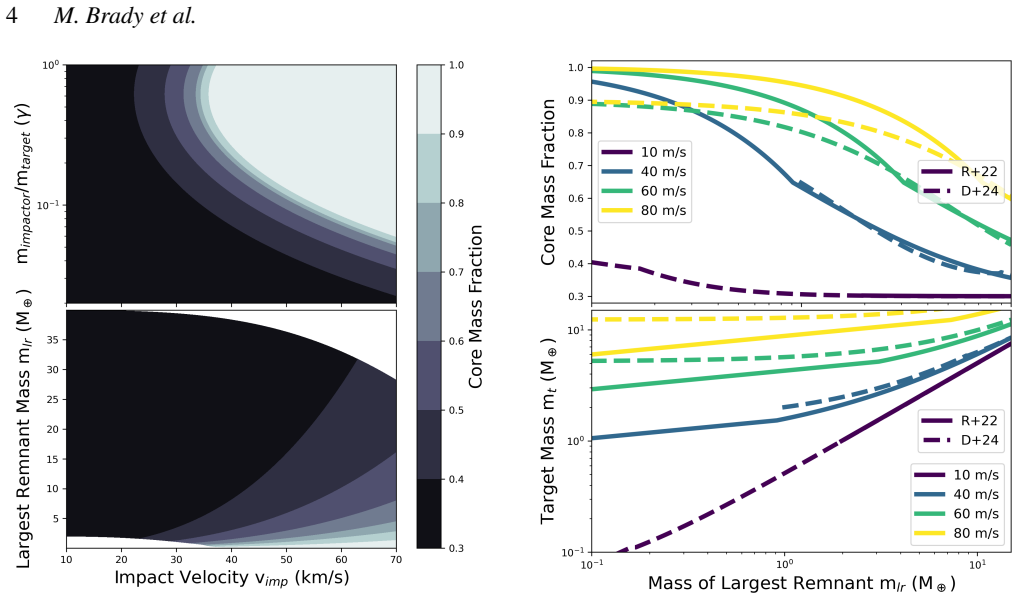
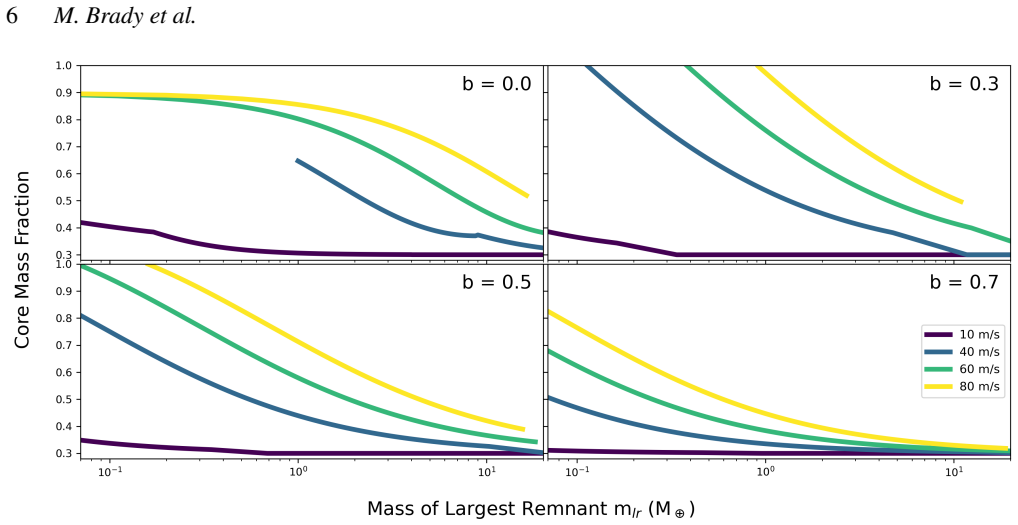
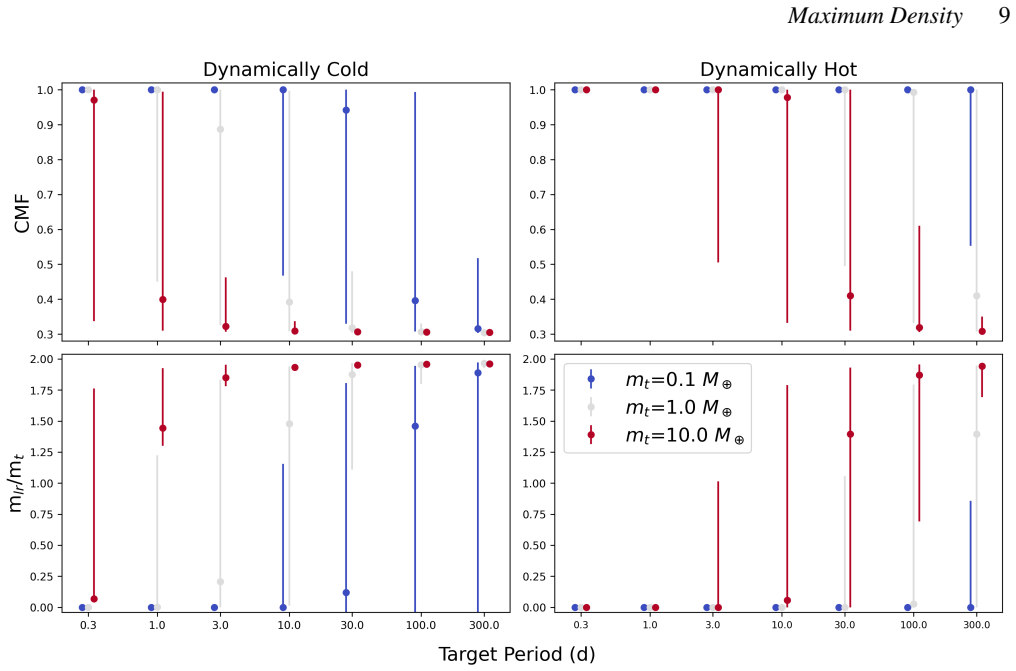
By merging SPH collision outcomes with velocity distributions set by orbital period and mass, the authors show that the maximum core mass fraction achievable through collisions is a decreasing function of both mass and period. Consequently, collisionally produced planets with Mercury-like or higher densities become more probable at lower masses and shorter periods, with GJ 367b emerging as the clearest observed example.
What carries the argument
The mapping from planet mass and orbital period to maximum core mass fraction, obtained by combining SPH impact simulations with collision-velocity models.
If this is right
- Collisionally-produced super-Mercuries should be both more common and denser at low masses and short orbital periods.
- The mass-period-density correlation provides an observable test for identifying which high-density exoplanets formed through collisions.
- GJ 367b remains the strongest known candidate for collisional formation under this framework.
- As the census of short-period low-mass planets grows, the predicted trend can be checked directly against observed core mass fractions.
Where Pith is reading between the lines
- The same scaling may help explain the specific density of solar-system Mercury once its formation conditions are inserted into the relation.
- Population-level statistics of density versus period could separate collisional formation from other high-density mechanisms without needing individual impact reconstructions.
- Extending the velocity models to different stellar types would predict how the super-Mercury occurrence rate changes around stars of varying mass.
Load-bearing premise
The published SPH simulations and the models used for collision velocities correctly represent the actual collisions that occur among real planetesimals.
What would settle it
Discovery of a planet with a very high core mass fraction at large mass and long orbital period, or the absence of high-density planets at low mass and short period in a sufficiently large sample.
Figures





read the original abstract
There are many different theoretical explanations for the formation of high-density Mercury-like planets, but concrete evidence for any of these formation mechanisms remains elusive. A popular explanation for dense planets is the collisional hypothesis, which states that iron-rich planets can be formed as the products of high-energy, mantle-stripping impacts. Planetesimal collision simulations predict that higher-velocity collisions can form higher-density planets. Motivated by the characteristics of the high-density, short-period (P=0.3d) GJ 367b, we study the results of previously-published smoothed-particle hydrodynamics (SPH) simulations on exoplanet collisions, combining these with models describing the likely collision velocities of these objects, to investigate the relationship between the core mass fractions (CMFs) of exoplanets, their masses, and their orbital periods. We predict that collisionally-produced super-Mercuries should be more common (and more dense) at low masses and short orbital periods. This correlation may enable us to pinpoint the formation mechanism of super-Mercuries as the population of observed targets grows. Afterwards, we connect our hypothesis to the observed Mercury-like population of high-density exoplanets, and find that GJ\,367\,b is the best exoplanetary candidate for collisional formation.
Editorial analysis
A structured set of objections, weighed in public.
Referee Report
Summary. The manuscript combines results from previously-published SPH simulations of exoplanet collisions with models of likely collision velocities to derive a relationship between core mass fraction (CMF), planet mass, and orbital period. It predicts that collisionally-produced super-Mercuries should be more common and denser at low masses and short orbital periods, and identifies GJ 367b as the best observed candidate for collisional formation among high-density exoplanets.
Significance. If the mapping from the SPH grid and velocity models to real populations is accurate, the work supplies a population-level, falsifiable prediction that could help distinguish collisional mantle-stripping from other formation channels for dense planets as the sample of observed super-Mercuries grows.
major comments (2)
- [Abstract] Abstract: the central prediction that CMF increases toward low mass and short period rests on post-processing existing SPH tables with a velocity model; the manuscript provides no explicit check that the published SPH grid (mass ratio, impact parameter, velocity) is dense enough to support reliable interpolation or extrapolation into the super-Mercury regime (M ≲ 1 M⊕, P ≲ 1 d).
- [Abstract] Abstract: the velocity model is assumed to reproduce encounter speeds experienced by embryos at short periods without large systematic bias from disk damping or stellar tides; no quantitative test or justification for this assumption in the relevant regime is supplied, yet it is load-bearing for the short-period part of the claimed correlation.
Simulated Author's Rebuttal
We thank the referee for their constructive feedback. We address each major comment below.
read point-by-point responses
-
Referee: [Abstract] Abstract: the central prediction that CMF increases toward low mass and short period rests on post-processing existing SPH tables with a velocity model; the manuscript provides no explicit check that the published SPH grid (mass ratio, impact parameter, velocity) is dense enough to support reliable interpolation or extrapolation into the super-Mercury regime (M ≲ 1 M⊕, P ≲ 1 d).
Authors: We agree that an explicit assessment of grid coverage would strengthen the paper. The SPH simulations drawn from the literature cover the parameter space needed for the regimes under consideration. In the revised manuscript we will add a dedicated paragraph (or short appendix) that maps the super-Mercury conditions onto the published grid points and confirms that interpolation, rather than extrapolation, is used throughout. revision: yes
-
Referee: [Abstract] Abstract: the velocity model is assumed to reproduce encounter speeds experienced by embryos at short periods without large systematic bias from disk damping or stellar tides; no quantitative test or justification for this assumption in the relevant regime is supplied, yet it is load-bearing for the short-period part of the claimed correlation.
Authors: The velocity prescription is taken from published N-body work that already incorporates disk damping. We accept that the manuscript would benefit from a clearer statement of the model's domain of applicability at P ≲ 1 d. We will expand the relevant methods paragraph to include additional supporting references and a brief discussion of the assumptions, while noting the absence of a new quantitative validation specific to this regime. revision: partial
Circularity Check
No significant circularity; prediction combines external SPH tables with velocity models as independent inputs.
full rationale
The derivation chain post-processes previously-published SPH collision results with separate analytic models of impact velocity versus semi-major axis to obtain a CMF-mass-period correlation. No internal equations define the output in terms of itself, no fitted parameters are relabeled as predictions, and no load-bearing uniqueness theorem or ansatz is imported via self-citation. The abstract explicitly frames the inputs as external prior work, satisfying the criteria for a self-contained, non-circular analysis.
Axiom & Free-Parameter Ledger
axioms (2)
- domain assumption Published SPH simulations of mantle-stripping collisions produce core mass fractions representative of real outcomes.
- domain assumption Models of likely collision velocities apply across the relevant mass and period range for super-Mercuries.
Reference graph
Works this paper leans on
-
[1]
A compositional link between rocky exoplanets and their host stars. Science , keywords =. doi:10.1126/science.abg8794 , archivePrefix =. 2102.12444 , primaryClass =
-
[2]
, year = 1999, month = nov, volume =
On the Character and Consequences of Large Impacts in the Late Stage of Terrestrial Planet Formation. , year = 1999, month = nov, volume =. doi:10.1006/icar.1999.6201 , adsurl =
-
[3]
The mass, gravity field, and ephemeris of Mercury. , keywords =. doi:10.1016/0019-1035(87)90033-9 , adsurl =
-
[4]
The HD 137496 system: A dense, hot super-Mercury and a cold Jupiter. , keywords =. doi:10.1051/0004-6361/202141520 , archivePrefix =. 2111.08764 , primaryClass =
-
[5]
Collisional stripping of Mercury's mantle. , keywords =. doi:10.1016/0019-1035(88)90118-2 , adsurl =
-
[6]
Mercury , year = 2008, editor =
The Origin of Mercury. Mercury , year = 2008, editor =. doi:10.1007/978-0-387-77539-5_2 , adsurl =
-
[7]
The Curie line in protoplanetary disks and the formation of Mercury-like planets. , keywords =. doi:10.1051/0004-6361/202245106 , archivePrefix =. 2301.12910 , primaryClass =
-
[8]
A giant impact as the likely origin of different twins in the Kepler-107 exoplanet system
A giant impact as the likely origin of different twins in the Kepler-107 exoplanet system. Nature Astronomy , keywords =. doi:10.1038/s41550-018-0684-9 , archivePrefix =. 1902.01316 , primaryClass =
work page internal anchor Pith review Pith/arXiv arXiv doi:10.1038/s41550-018-0684-9 1902
-
[9]
No excess of cold Jupiters in small planet systems
Cold Jupiters and improved masses in 38 Kepler and K2 small planet systems from 3661 HARPS-N radial velocities. No excess of cold Jupiters in small planet systems. , keywords =. doi:10.1051/0004-6361/202346211 , archivePrefix =. 2304.05773 , primaryClass =
-
[10]
The Compositions of Rocky Planets in Close-in Orbits Tend to Be Earth-like. , keywords =. doi:10.3847/1538-3881/ade677 , archivePrefix =. 2410.00213 , primaryClass =
-
[11]
The Inclination Distribution of the Kuiper Belt. , keywords =. doi:10.1086/320391 , adsurl =
-
[12]
Can metal-rich worlds form by giant impacts?. , keywords =. doi:10.1051/0004-6361/202450128 , archivePrefix =. 2408.15340 , primaryClass =
-
[13]
Compositional evolution during rocky protoplanet accretion
Compositional Evolution during Rocky Protoplanet Accretion. , keywords =. doi:10.1088/0004-637X/813/1/72 , archivePrefix =. 1509.07504 , primaryClass =
work page internal anchor Pith review Pith/arXiv arXiv doi:10.1088/0004-637x/813/1/72
-
[14]
Formation of super-Mercuries via giant impacts. , keywords =. doi:10.1093/mnras/stae644 , archivePrefix =. 2403.03831 , primaryClass =
-
[15]
, year = 2024, month = oct, volume =
Exploring the catastrophic regime: thermodynamics and disintegration in head-on planetary collisions. , year = 2024, month = oct, volume =. doi:10.1093/mnras/stae2134 , adsurl =
-
[16]
Equilibrium condensation from chondritic porous IDP enriched vapor: Implications for Mercury and enstatite chondrite origins. , keywords =. doi:10.1016/j.pss.2011.07.017 , archivePrefix =. 2307.15763 , primaryClass =
-
[17]
The Elusive Origin of Mercury. Mercury. The View after MESSENGER , year = 2018, editor =. doi:10.1017/9781316650684.019 , adsurl =
-
[18]
The Planetary Science Journal , keywords =
A New Database of Giant Impacts over a Wide Range of Masses and with Material Strength: A First Analysis of Outcomes. The Planetary Science Journal , keywords =. doi:10.3847/PSJ/ad2178 , archivePrefix =. 2401.17356 , primaryClass =
-
[19]
Explaining mercury via a single giant impact is highly unlikely. , keywords =. doi:10.1093/mnras/stac2183 , archivePrefix =. 2207.14774 , primaryClass =
-
[20]
Formation of Mercury by a grazing giant collision involving similar-mass bodies. Nature Astronomy , keywords =. doi:10.1038/s41550-025-02582-y , archivePrefix =. 2503.02826 , primaryClass =
-
[21]
doi:10.5281/zenodo.580821 , url =
BJ Fulton and Erik Petigura , title =. doi:10.5281/zenodo.580821 , url =
-
[22]
RadVel: The Radial Velocity Modeling Toolkit
RadVel: The Radial Velocity Modeling Toolkit. , keywords =. doi:10.1088/1538-3873/aaaaa8 , archivePrefix =. 1801.01947 , primaryClass =
work page internal anchor Pith review Pith/arXiv arXiv doi:10.1088/1538-3873/aaaaa8
-
[23]
The Astrophysical Journal Letters , author =
Company for the Ultra-high Density, Ultra-short Period Sub-Earth GJ 367 b: Discovery of Two Additional Low-mass Planets at 11.5 and 34 Days. , keywords =. doi:10.3847/2041-8213/ace0c7 , archivePrefix =. 2307.09181 , primaryClass =
-
[24]
Journal of Geophysical Research (Planets) , keywords =
The curious case of Mercury's internal structure. Journal of Geophysical Research (Planets) , keywords =. doi:10.1002/jgre.20091 , adsurl =
-
[25]
Planet Occurrence within 0.25 AU of Solar-type Stars from Kepler
Planet Occurrence within 0.25 AU of Solar-type Stars from Kepler. , keywords =. doi:10.1088/0067-0049/201/2/15 , archivePrefix =. 1103.2541 , primaryClass =
work page internal anchor Pith review Pith/arXiv arXiv doi:10.1088/0067-0049/201/2/15
-
[26]
Nucleation and growth of iron pebbles explains the formation of iron-rich planets akin to Mercury. , keywords =. doi:10.1051/0004-6361/202243480 , archivePrefix =. 2204.04241 , primaryClass =
-
[27]
Seeding the Formation of Mercurys: An Iron-sensitive Bouncing Barrier in Disk Magnetic Fields
Seeding the Formation of Mercurys: An Iron-sensitive Bouncing Barrier in Disk Magnetic Fields. , keywords =. doi:10.3847/1538-4357/aaec78 , archivePrefix =. 1812.05338 , primaryClass =
work page internal anchor Pith review Pith/arXiv arXiv doi:10.3847/1538-4357/aaec78
-
[28]
The Planetary Science Journal , keywords =
Composition and Size Dependent Sorting in Preplanetary Growth: Seeding the Formation of Mercury-like Planets. The Planetary Science Journal , keywords =. doi:10.3847/PSJ/ab93c4 , archivePrefix =. 2006.13692 , primaryClass =
-
[29]
Collisions between Gravity-dominated Bodies. I. Outcome Regimes and Scaling Laws. , keywords =. doi:10.1088/0004-637X/745/1/79 , archivePrefix =. 1106.6084 , primaryClass =
work page internal anchor Pith review Pith/arXiv arXiv doi:10.1088/0004-637x/745/1/79
-
[30]
Alleviating the transit timing variation bias in transit surveys. II. RIVERS: Twin resonant Earth-sized planets around Kepler-1972 recovered from a Kepler false positive. , keywords =. doi:10.1051/0004-6361/202142822 , archivePrefix =. 2201.11459 , primaryClass =
-
[31]
Orbital eccentricity and inclination distribution of main-belt asteroids-The Statistical model revisited. , keywords =. doi:10.1016/j.icarus.2023.115650 , adsurl =
-
[32]
Protostars and Planets III , year = 1993, editor =
Growth of Planets from Planetesimals. Protostars and Planets III , year = 1993, editor =
1993
-
[33]
Forming super-Mercuries: Role of stellar abundances. , keywords =. doi:10.1051/0004-6361/202346021 , archivePrefix =. 2303.11948 , primaryClass =
-
[34]
Collisional Stripping and Disruption of Super-Earths
Collisional Stripping and Disruption of Super-Earths. , keywords =. doi:10.1088/0004-637X/700/2/L118 , archivePrefix =. 0907.0234 , primaryClass =
work page internal anchor Pith review Pith/arXiv arXiv doi:10.1088/0004-637x/700/2/l118
-
[35]
Minimum Radii of Super-Earths: Constraints from Giant Impacts
Minimum Radii of Super-Earths: Constraints from Giant Impacts. , keywords =. doi:10.1088/2041-8205/712/1/L73 , archivePrefix =. 1003.0451 , primaryClass =
work page internal anchor Pith review Pith/arXiv arXiv doi:10.1088/2041-8205/712/1/l73 2041
-
[36]
Masses, Radii, and Orbits of Small Kepler Planets: The Transition from Gaseous to Rocky Planets
Masses, Radii, and Orbits of Small Kepler Planets: The Transition from Gaseous to Rocky Planets. , keywords =. doi:10.1088/0067-0049/210/2/20 , archivePrefix =. 1401.4195 , primaryClass =
work page internal anchor Pith review Pith/arXiv arXiv doi:10.1088/0067-0049/210/2/20
-
[37]
Hunter, J. D. , Title =. Computing in Science & Engineering , Volume =
-
[38]
Kuiper Belt-like Hot and Cold Populations of Planetesimal Inclinations in the Pictoris Belt Revealed by ALMA. , keywords =. doi:10.3847/1538-3881/ab06c0 , archivePrefix =. 1902.04081 , primaryClass =
work page internal anchor Pith review Pith/arXiv arXiv doi:10.3847/1538-3881/ab06c0 1902
-
[39]
Very high-density planets: a possible remnant of gas giants. Philosophical Transactions of the Royal Society of London Series A , year = 2014, month = mar, volume =. doi:10.1098/rsta.2013.0164 , adsurl =
-
[40]
Realistic gravitational focusing of meteoroid streams. , keywords =. doi:10.1093/mnras/staa719 , archivePrefix =. 2003.05458 , primaryClass =
-
[41]
Charles R. Harris and K. Jarrod Millman and St. Array programming with. 2020 , month = sep, journal =. doi:10.1038/s41586-020-2649-2 , publisher =
-
[42]
Radioactive Elements on Mercury s Surface from MESSENGER: Implications for the Planet s Formation and Evolution. Science , keywords =. doi:10.1126/science.1211576 , adsurl =
-
[43]
EPSC-DPS Joint Meeting 2011 , year = 2011, volume =
Mercury's mean radius and shape from radio occultations. EPSC-DPS Joint Meeting 2011 , year = 2011, volume =
2011
-
[44]
WASP-107b's Density Is Even Lower: A Case Study for the Physics of Planetary Gas Envelope Accretion and Orbital Migration. , keywords =. doi:10.3847/1538-3881/abcd3c , archivePrefix =. 2011.13444 , primaryClass =
-
[45]
2024, ApJL, 974, L10, doi: 10.3847/2041-8213/ad6f00
JWST/NIRISS Reveals the Water-rich ``Steam World'' Atmosphere of GJ 9827 d. , keywords =. doi:10.3847/2041-8213/ad6f00 , archivePrefix =. 2410.03527 , primaryClass =
-
[46]
Chemical fingerprints of formation in rocky super-Earths' data. , keywords =. doi:10.1093/mnras/staa2615 , archivePrefix =. 2010.06480 , primaryClass =
-
[47]
Observation uncertainty effects on the precision of interior planetary parameters. , keywords =. doi:10.1093/mnras/stae993 , archivePrefix =. 2405.03860 , primaryClass =
-
[48]
Evidence of 1:1 slope between rocky Super-Earths and their host stars. arXiv e-prints , keywords =. doi:10.48550/arXiv.2511.17717 , archivePrefix =. 2511.17717 , primaryClass =
-
[49]
doi:10.5281/zenodo.3509134 , url=
The pandas development team , title =. doi:10.5281/zenodo.3509134 , url =
-
[50]
Forming iron-rich planets with giant impacts. , keywords =. doi:10.1093/mnras/stac1853 , archivePrefix =. 2204.04925 , primaryClass =
-
[51]
Keplerian Orbit Elements -> Cartesian State Vectors , howpublished =
-
[52]
The Planetary Science Journal , keywords =
The Solar Wind Prevents Reaccretion of Debris after Mercury's Giant Impact. The Planetary Science Journal , keywords =. doi:10.3847/PSJ/ab781f , archivePrefix =. 2002.07847 , primaryClass =
-
[53]
RV-exoplanet eccentricities: Good, Beta, and Best. , keywords =. doi:10.1093/mnras/staf502 , archivePrefix =. 2503.20385 , primaryClass =
-
[54]
Velocity-Dependent Catastrophic Disruption Criteria for Planetesimals. , keywords =. doi:10.1088/0004-637X/691/2/L133 , adsurl =
-
[55]
Internal Structure of Massive Terrestrial Planets
Internal structure of massive terrestrial planets. , keywords =. doi:10.1016/j.icarus.2005.11.021 , archivePrefix =. astro-ph/0511150 , primaryClass =
work page internal anchor Pith review Pith/arXiv arXiv doi:10.1016/j.icarus.2005.11.021 2005
-
[56]
and Haberland, Matt and Reddy, Tyler and Cournapeau, David and Burovski, Evgeni and Peterson, Pearu and Weckesser, Warren and Bright, Jonathan and
Virtanen, Pauli and Gommers, Ralf and Oliphant, Travis E. and Haberland, Matt and Reddy, Tyler and Cournapeau, David and Burovski, Evgeni and Peterson, Pearu and Weckesser, Warren and Bright, Jonathan and. Nature Methods , year =
-
[57]
A low mass for Mars from Jupiter's early gas-driven migration
A low mass for Mars from Jupiter's early gas-driven migration. , keywords =. doi:10.1038/nature10201 , archivePrefix =. 1201.5177 , primaryClass =
work page internal anchor Pith review Pith/arXiv arXiv doi:10.1038/nature10201
-
[58]
Mass-Radius Relation for Rocky Planets based on PREM
Mass-Radius Relation for Rocky Planets Based on PREM. , keywords =. doi:10.3847/0004-637X/819/2/127 , archivePrefix =. 1512.08827 , primaryClass =
work page internal anchor Pith review Pith/arXiv arXiv doi:10.3847/0004-637x/819/2/127
discussion (0)
Sign in with ORCID, Apple, or X to comment. Anyone can read and Pith papers without signing in.