A K-band Kinetic Inductance Parametric Amplifier Near the Quantum Limit
Pith reviewed 2026-06-27 18:43 UTC · model grok-4.3
The pith
A niobium nitride kinetic inductance parametric amplifier operates at 23 GHz with up to 40 dB gain and added noise of at most 1.4 quanta.
A machine-rendered reading of the paper's core claim, the machinery that carries it, and where it could break.
Core claim
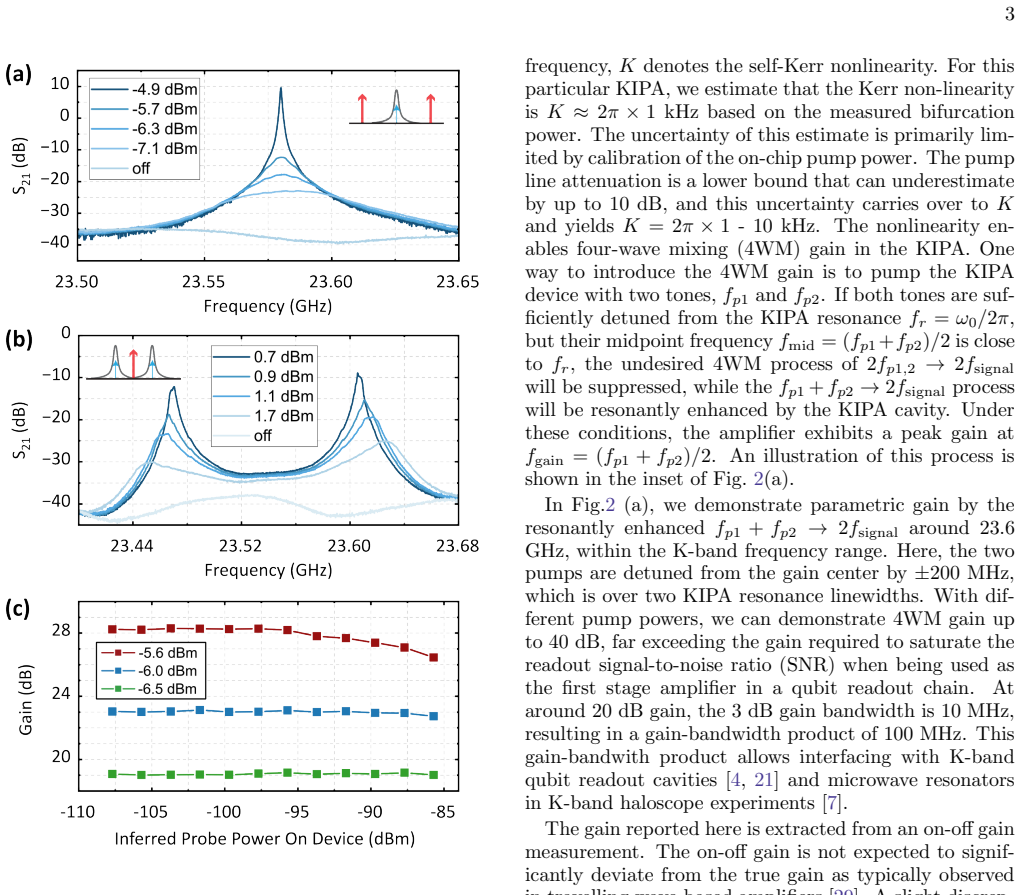
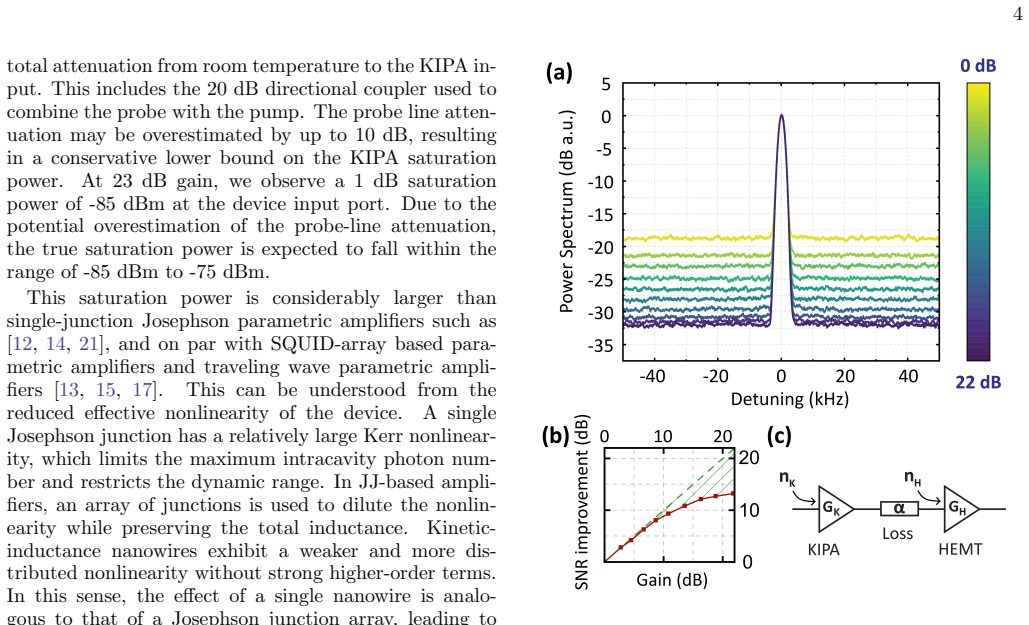
The central claim is that a kinetic-inductance parametric amplifier based on NbN thin films achieves phase-preserving amplification at 23 GHz with maximum gain of 40 dB, 100 MHz gain-bandwidth product, 1 dB compression at -85 dBm input power when operated at 23 dB gain, and added noise no greater than 1.4 quanta, with the large superconducting gap of NbN allowing extension to still higher frequencies.
What carries the argument
The nonlinear kinetic inductance of the NbN thin film, which supplies the parametric gain mechanism in a junction-free circuit.
If this is right
- The architecture supports high-fidelity readout of millimeter-wave superconducting qubits.
- It enables axion searches over an expanded mass window.
- The same NbN-based design can be scaled to operating frequencies above the K-band.
Where Pith is reading between the lines
- Junction-free operation may simplify fabrication and improve yield compared with Josephson-junction amplifiers.
- Higher-frequency capability could allow quantum circuits to function at warmer cryogenic temperatures than current few-GHz systems.
- The approach may be combined with other thin-film NbN components for integrated high-frequency quantum processors.
Load-bearing premise
The measured noise and saturation values accurately capture the device's intrinsic quantum-limited performance without hidden calibration offsets or systematics.
What would settle it
A calibrated noise measurement at 23 GHz that finds added noise clearly exceeding 1.4 quanta under the reported operating conditions would show the near-quantum-limit claim does not hold.
Figures

read the original abstract
Advancing superconducting quantum devices to higher operating frequencies broadens their functionality and enables operation at elevated temperatures, but it also requires near-quantum-limited amplifiers beyond the few-gigahertz regime. Here we present a junction-free, kinetic-inductance parametric amplifier based on thin-film niobium nitride (NbN) operating at 23 GHz in the microwave K-band, achieving a gain up to 40 dB, a 100 MHz gain-bandwidth product, a 1 dB saturation input power of -85 dBm with 23 dB gain, and added noise no greater than 1.4 quanta for phase-preserving amplification. Leveraging the large superconducting gap of NbN, this architecture can be extended to even higher frequencies, supporting applications such as high-fidelity readout of millimeter-wave superconducting qubits and axion searches over an expanded mass window.
Editorial analysis
A structured set of objections, weighed in public.
Referee Report
Summary. The manuscript presents a junction-free kinetic-inductance parametric amplifier fabricated from thin-film NbN and operated at 23 GHz. It reports a peak gain of 40 dB, a 100 MHz gain-bandwidth product, a 1 dB saturation input power of -85 dBm at 23 dB gain, and an added noise of at most 1.4 quanta under phase-preserving amplification. The work emphasizes the use of NbN’s large superconducting gap to reach K-band frequencies.
Significance. Demonstration of near-quantum-limited parametric amplification at 23 GHz would extend the frequency range of high-fidelity readout and axion searches beyond the conventional few-GHz regime. The junction-free NbN architecture offers a scalable route to still higher frequencies if the reported metrics are confirmed.
major comments (1)
- [Abstract] Abstract: the central claim that the amplifier adds no more than 1.4 quanta is presented without any supporting data, methods, error bars, or calibration chain. Extraction of added noise requires quantitative subtraction of input noise, passive losses, HEMT noise, and cable attenuations; none of these factors or their uncertainties are reported, rendering the 1.4-quantum bound unverifiable from the given text.
Simulated Author's Rebuttal
We thank the referee for their careful reading and constructive feedback. We address the single major comment below.
read point-by-point responses
-
Referee: [Abstract] Abstract: the central claim that the amplifier adds no more than 1.4 quanta is presented without any supporting data, methods, error bars, or calibration chain. Extraction of added noise requires quantitative subtraction of input noise, passive losses, HEMT noise, and cable attenuations; none of these factors or their uncertainties are reported, rendering the 1.4-quantum bound unverifiable from the given text.
Authors: The abstract summarizes the principal results; the full calibration chain—including quantitative subtraction of input noise, passive losses, HEMT noise, and cable attenuations, together with uncertainties and error bars—is presented in the Methods and Results sections of the manuscript. We therefore consider the 1.4-quantum bound verifiable from the complete text. To improve clarity we will nevertheless revise the abstract to include a concise reference to the calibration procedure. revision: yes
Circularity Check
No circularity: experimental metrics are direct measurements, not derived quantities
full rationale
The paper reports measured performance of a fabricated NbN kinetic-inductance parametric amplifier at 23 GHz, with gain, bandwidth, saturation power, and added-noise figures obtained from laboratory characterization. No derivation chain, equations, fitted parameters presented as predictions, or self-citation load-bearing steps appear in the abstract or described content; the central claims are empirical results whose validity is independent of any internal redefinition or renaming. This is the expected outcome for an experimental device paper whose headline numbers rest on external calibration and measurement rather than on any self-referential theoretical construction.
Axiom & Free-Parameter Ledger
Reference graph
Works this paper leans on
-
[1]
M. H. Devoret and R. J. Schoelkopf, Science339, 1169 (2013)
2013
-
[2]
Blais, A
A. Blais, A. L. Grimsmo, S. M. Girvin, and A. Wallraff, 6 Reviews of Modern Physics93, 025005 (2021)
2021
-
[3]
Krantz, M
P. Krantz, M. Kjaergaard, F. Yan, T. P. Orlando, S. Gus- tavsson, and W. D. Oliver, Applied Physics Reviews6, 021318 (2019)
2019
-
[4]
Anferov, S
A. Anferov, S. P. Harvey, F. Wan, J. Simon, and D. I. Schuster, PRX Quantum5, 030347 (2024)
2024
-
[5]
Anferov, F
A. Anferov, F. Wan, S. P. Harvey, J. Simon, and D. I. Schuster, PRX Quantum6, 020336 (2025)
2025
-
[6]
Quiskamp, B
A. Quiskamp, B. T. McAllister, P. Altin, E. N. Ivanov, M. Goryachev, and M. E. Tobar, Science Advances8, eabq3765 (2022)
2022
-
[7]
Quiskamp, B
A. Quiskamp, B. T. McAllister, P. Altin, E. N. Ivanov, M. Goryachev, and M. E. Tobar, Physical Review Letters 132, 031601 (2024)
2024
-
[8]
Ballesteros, J
G. Ballesteros, J. Redondo, A. Ringwald, and C. Tamarit, Physical Review Letters118, 071802 (2017)
2017
-
[9]
A. A. Clerk, M. H. Devoret, S. M. Girvin, F. Marquardt, and R. J. Schoelkopf, Reviews of Modern Physics82, 1155 (2010)
2010
-
[10]
Roy and M
A. Roy and M. Devoret, Comptes Rendus. Physique17, 740 (2016)
2016
-
[11]
M. A. Castellanos-Beltran, K. D. Irwin, G. C. Hilton, L. R. Vale, and K. W. Lehnert, Nature Physics4, 929 (2008)
2008
-
[12]
Bergeal, F
N. Bergeal, F. Schackert, M. Metcalfe, R. Vijay, V. E. Manucharyan, L. Frunzio, D. E. Prober, R. J. Schoelkopf, S. M. Girvin, and M. H. Devoret, Nature465, 64 (2010)
2010
-
[13]
Macklin, K
C. Macklin, K. O’Brien, D. Hover, M. E. Schwartz, V. Bolkhovsky, X. Zhang, W. D. Oliver, and I. Siddiqi, Science350, 307 (2015)
2015
-
[14]
Narla, K
A. Narla, K. M. Sliwa, M. Hatridge, S. Shankar, L. Frun- zio, R. J. Schoelkopf, and M. H. Devoret, Applied Physics Letters104, 232605 (2014)
2014
-
[15]
Kwende, T
R. Kwende, T. White, and O. Naaman, Applied Physics Letters122, 224001 (2023)
2023
-
[16]
Joshi, S
V. Joshi, S. Hazra, A. Ding, A. Miano, W. Dai, G. Umasankar, A. Kottandavida, G. Liu, L. Frunzio, and M. Devoret, Physical Review Applied24, 044003 (2025)
2025
-
[17]
A. Ranadive, B. Fazliji, G. Le Gal, G. Cappelli, G. But- seraen, E. Bonet, E. Eyraud, S. B¨ ohling, L. Planat, A. Metelmann, and N. Roch, Nature Electronics (2025), 10.1038/s41928-025-01489-w
-
[18]
Tinkham, Introduction to Superconductivity, 2nd ed
M. Tinkham, Introduction to Superconductivity, 2nd ed. (Dover Publications, 2004)
2004
-
[19]
Anferov, A
A. Anferov, A. Suleymanzade, A. Oriani, J. Simon, and D. I. Schuster, Physical Review Applied13, 024056 (2020)
2020
-
[20]
S. Shu, N. Klimovich, B. H. Eom, A. D. Beyer, R. B. Thakur, H. G. Leduc, and P. K. Day, Physical Review Research3, 023184 (2021)
2021
-
[21]
Z. Hao, J. Cochran, Y.-C. Chang, H. Cole, and S. Shankar, Applied Physics Letters128(2026)
2026
-
[22]
Ho Eom, P
B. Ho Eom, P. K. Day, H. G. LeDuc, and J. Zmuidzinas, Nature Physics8, 623 (2012)
2012
-
[23]
Malnou, M
M. Malnou, M. Vissers, J. Wheeler, J. Aumentado, J. Hubmayr, J. Ullom, and J. Gao, PRX Quantum2, 010302 (2021)
2021
-
[24]
Malnou, J
M. Malnou, J. Aumentado, M. Vissers, J. Wheeler, J. Hubmayr, J. Ullom, and J. Gao, Physical Review Applied17, 044009 (2022)
2022
-
[25]
D. J. Parker, M. Savytskyi, W. Vine, A. Laucht, T. Duty, A. Morello, A. L. Grimsmo, and J. J. Pla, Physical Re- view Applied17, 034064 (2022)
2022
-
[26]
W. Vine, M. Savytskyi, A. Vaartjes, A. Kringhøj, D. Parker, J. Slack-Smith, T. Schenkel, K. Mølmer, J. C. McCallum, B. C. Johnson, A. Morello, and J. J. Pla, Science Advances9, eadg1593 (2023)
2023
-
[27]
M. Xu, R. Cheng, Y. Wu, G. Liu, and H. X. Tang, PRX Quantum4, 010322 (2023)
2023
-
[28]
Faramarzi, R
F. Faramarzi, R. Stephenson, S. Sypkens, B. H. Eom, H. LeDuc, and P. Day, APL Quantum1, 036107 (2024)
2024
-
[29]
L. Howe, A. Giachero, M. Vissers, P. Campana, J. Wheeler, J. Gao, J. Austermann, J. Hubmayr, A. Nuc- ciotti, and J. Ullom, Phys. Rev. Appl.25, 044027 (2026)
2026
-
[30]
Vaartjes, A
A. Vaartjes, A. Kringhøj, W. Vine, T. Day, A. Morello, and J. J. Pla, Nature Communications15, 4229 (2024)
2024
-
[31]
Cheng, S
R. Cheng, S. Wang, and H. X. Tang, Applied Physics Letters115, 241101 (2019)
2019
-
[32]
M. Xu, X. Han, W. Fu, C.-L. Zou, and H. X. Tang, Applied Physics Letters114, 192601 (2019)
2019
-
[33]
Y. Wu, C. Wang, D. Wang, M. Xu, Y. Zhou, and H. X. Tang, Phys. Rev. Appl.24, 024015 (2025)
2025
-
[34]
V. V. Sivak, S. Shankar, G. Liu, J. Aumentado, and M. H. Devoret, Phys. Rev. Appl.13, 024014 (2020)
2020
-
[35]
A K-BAND KINETIC INDUCT ANCE P ARAMETRIC AMPLIFIER NEAR THE QUANTUM LIMIT
M. Xu, Y. Wu, W. Dai, and H. X. Tang, Applied Physics Letters125, 024001 (2024). 7 SUPPLEMENT AL MA TERIAL FOR “A K-BAND KINETIC INDUCT ANCE P ARAMETRIC AMPLIFIER NEAR THE QUANTUM LIMIT” I. ESTIMA TED LOSS BETWEEN KIP A DEVICE AND HEMT Component Device Package Directional Coupler Isolator Superconducting Cable Connectors T otal Number 1 1 1 1 2 Nominal Lo...
2024
discussion (0)
Sign in with ORCID, Apple, or X to comment. Anyone can read and Pith papers without signing in.