Graviton Floor
Pith reviewed 2026-06-26 17:04 UTC · model grok-4.3
The pith
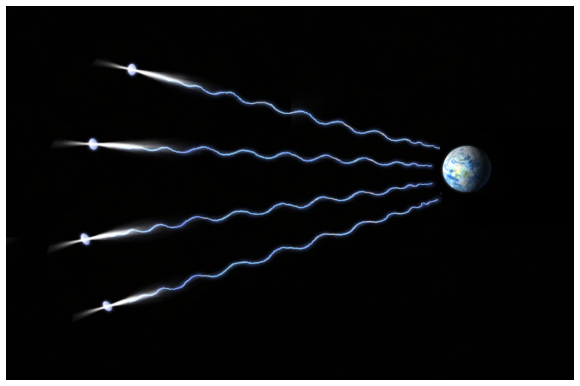
The cosmic photon background converts into a graviton background primarily in blazar jets, establishing a floor for high-frequency gravitational wave detectors.
A machine-rendered reading of the paper's core claim, the machinery that carries it, and where it could break.
Core claim
The paper finds that the graviton background produced by photon conversion in the presence of background magnetic fields is dominated by the contribution from blazar jets. This graviton background constitutes a graviton floor for high-frequency gravitational wave detectors searching for new physics, analogous to the neutrino floor.
What carries the argument
Photon-to-graviton conversion in background magnetic fields within blazar jets, which generates the dominant graviton background.
Load-bearing premise
The strength and coherence of magnetic fields in blazar jets, along with the spectrum of the photon background, are as modeled; weaker or less ordered fields would reduce the graviton production below detectable levels.
What would settle it
A measurement showing the high-frequency gravitational wave background significantly below the predicted level from blazar jet conversions, or direct observations indicating much weaker magnetic fields in blazars than assumed.
Figures


read the original abstract
It has been observed that the Universe is permeated by the cosmic photon background, ranging from radio waves to gamma rays. We investigate the conversion of the photon background into gravitons in the presence of background magnetic fields in the Milky Way Galaxy and in blazar jets. We find that the resulting graviton background is dominated by the contribution generated in blazar jets. Importantly, this graviton background constitutes a graviton floor for high-frequency gravitational wave detectors searching for new physics, analogous to the neutrino floor.
Editorial analysis
A structured set of objections, weighed in public.
Referee Report
Summary. The manuscript investigates photon-to-graviton conversion of the cosmic photon background in the presence of magnetic fields in the Milky Way and blazar jets. It concludes that the resulting graviton background is dominated by the blazar-jet contribution and that this background sets a fundamental 'graviton floor' for high-frequency gravitational-wave detectors, analogous to the neutrino floor.
Significance. If the central calculation is robust, the result would be significant for high-frequency GW detector design and data interpretation, establishing an astrophysical background limit that must be accounted for when searching for new physics. The neutrino-floor analogy is conceptually useful provided the dominance claim survives variation of the input parameters.
major comments (2)
- [Abstract] Abstract: the claim of blazar-jet dominance (and therefore the existence of a detectable graviton floor) rests on the adopted magnetic-field amplitudes, coherence lengths, and photon spectrum in the rate integral. The manuscript must show that the blazar term remains dominant when these quantities are varied within observationally allowed ranges; if weaker or more turbulent fields are used, the floor may fall below both Galactic contributions and detector thresholds.
- [Calculation section (implied by abstract)] The conversion probability scales with (B_perp * L_coh)^2; without explicit equations, integration limits, or error estimates for the blazar term, it is impossible to assess whether the reported dominance is a genuine prediction or an artifact of the chosen fiducial values.
Simulated Author's Rebuttal
We thank the referee for their careful review and constructive comments. We address the major points below and will revise the manuscript to improve transparency and robustness.
read point-by-point responses
-
Referee: [Abstract] Abstract: the claim of blazar-jet dominance (and therefore the existence of a detectable graviton floor) rests on the adopted magnetic-field amplitudes, coherence lengths, and photon spectrum in the rate integral. The manuscript must show that the blazar term remains dominant when these quantities are varied within observationally allowed ranges; if weaker or more turbulent fields are used, the floor may fall below both Galactic contributions and detector thresholds.
Authors: We agree that the dominance claim requires explicit verification against parameter variations. In the revised manuscript we will add a parameter-variation study (or appendix) scanning magnetic-field amplitudes, coherence lengths, and photon spectra over observationally allowed ranges, demonstrating whether blazar-jet dominance persists or identifying the boundary conditions under which it holds. revision: yes
-
Referee: [Calculation section (implied by abstract)] The conversion probability scales with (B_perp * L_coh)^2; without explicit equations, integration limits, or error estimates for the blazar term, it is impossible to assess whether the reported dominance is a genuine prediction or an artifact of the chosen fiducial values.
Authors: We acknowledge the need for greater calculational transparency. The revised version will include the explicit conversion-probability formula (showing the (B_perp L_coh)^2 scaling), the precise integration limits applied to the blazar-jet contribution, and quantitative error estimates or uncertainty ranges for the resulting graviton background. revision: yes
Circularity Check
No circularity: result follows from explicit integration over external inputs
full rationale
The abstract states that graviton production is computed from photon conversion in Galactic and blazar magnetic fields, with the blazar term dominating the integrated flux. No equation, parameter fit, or self-citation is shown that would make the final graviton spectrum equivalent to its inputs by construction. The dominance statement is a direct numerical outcome of the adopted B-field amplitudes, coherence lengths, and photon number densities; altering those inputs changes the result, so the derivation remains independent of the target claim.
Axiom & Free-Parameter Ledger
Reference graph
Works this paper leans on
-
[1]
L. M. Widrow, Rev. Mod. Phys.74, 775 (2002), arXiv:astro-ph/0207240
Pith/arXiv arXiv 2002
-
[2]
M. E. Gertsenshtein, Sov. Phys. JETP14, 84 (1962). 12
1962
-
[3]
Raffelt and L
G. Raffelt and L. Stodolsky, Phys. Rev. D37, 1237 (1988)
1988
-
[4]
M. S. Pshirkov and D. Baskaran, Phys. Rev. D80, 042002 (2009), arXiv:0903.4160 [gr-qc]
Pith/arXiv arXiv 2009
-
[5]
A. D. Dolgov and D. Ejlli, JCAP12, 003 (2012), arXiv:1211.0500 [gr-qc]
Pith/arXiv arXiv 2012
-
[6]
V. Domcke and C. Garcia-Cely, Phys. Rev. Lett.126, 021104 (2021), arXiv:2006.01161 [astro- ph.CO]
arXiv 2021
-
[7]
S. Ramazanov, R. Samanta, G. Trenkler, and F. R. Urban, JCAP06, 019 (2023), arXiv:2304.11222 [astro-ph.HE]
arXiv 2023
-
[8]
T. Liu, J. Ren, and C. Zhang, Phys. Rev. Lett.132, 131402 (2024), arXiv:2305.01832 [hep-ph]
arXiv 2024
-
[9]
A. Ito, K. Kohri, and K. Nakayama, Phys. Rev. D109, 063026 (2024), arXiv:2305.13984 [gr-qc]
arXiv 2024
-
[10]
A. Ito, K. Kohri, and K. Nakayama, PTEP2024, 023E03 (2024), arXiv:2309.14765 [gr-qc]
arXiv 2024
- [11]
-
[12]
Y. He, S. K. Giri, R. Sharma, S. Mtchedlidze, and I. Georgiev, JCAP05, 051 (2024), arXiv:2312.17636 [astro-ph.CO]
arXiv 2024
- [13]
-
[14]
J. I. McDonald and S. A. R. Ellis, Phys. Rev. D110, 103003 (2024), arXiv:2406.18634 [hep- ph]
arXiv 2024
-
[15]
A. Kushwaha and R. K. Jain, Phys. Rev. D112, L021301 (2025), arXiv:2502.12517 [astro- ph.CO]
arXiv 2025
-
[16]
J.-K. Li, W. Hong, and T.-J. Zhang, Astrophys. J.985, 137 (2025), arXiv:2504.13115 [astro- ph.CO]
arXiv 2025
-
[17]
Amaralet al., (2026), arXiv:2603.24645 [astro-ph.IM]
D. Amaralet al., (2026), arXiv:2603.24645 [astro-ph.IM]
arXiv 2026
- [18]
- [19]
-
[20]
R. Hill, K. W. Masui, and D. Scott, Appl. Spectrosc.72, 663 (2018), arXiv:1802.03694 [astro- ph.CO]
Pith/arXiv arXiv 2018
-
[21]
Chen, Phys
P. Chen, Phys. Rev. Lett.74, 634 (1995), [Erratum: Phys.Rev.Lett. 74, 3091 (1995)]
1995
-
[22]
A. N. Cillis and D. D. Harari, Phys. Rev. D54, 4757 (1996), arXiv:astro-ph/9609200
Pith/arXiv arXiv 1996
-
[23]
P. Chen and T. Suyama, Phys. Rev. D88, 123521 (2013), arXiv:1309.0537 [astro-ph.CO]. 13
Pith/arXiv arXiv 2013
- [24]
-
[25]
Magnetic Fields in the Milky Way
M. Haverkorn, (2014), 10.1007/978-3-662-44625-6 17, arXiv:1406.0283 [astro-ph.GA]
work page internal anchor Pith review Pith/arXiv arXiv doi:10.1007/978-3-662-44625-6 2014
-
[26]
Boulangeret al., JCAP08, 049 (2018), arXiv:1805.02496 [astro-ph.GA]
F. Boulangeret al., JCAP08, 049 (2018), arXiv:1805.02496 [astro-ph.GA]
Pith/arXiv arXiv 2018
-
[27]
M. Haverkorn, B. M. Gaensler, N. M. McClure-Griffiths, J. M. Dickey, and A. J. Green, Astrophys. J.609, 776 (2004), arXiv:astro-ph/0403655
Pith/arXiv arXiv 2004
-
[28]
M. Iacobelliet al., Astron. Astrophys.558, A72 (2013), arXiv:1308.2804 [astro-ph.GA]
Pith/arXiv arXiv 2013
-
[29]
M. Haverkorn, J. C. Brown, B. M. Gaensler, and N. M. McClure-Griffiths, Astrophys. J.680, 362 (2008), arXiv:0802.2740 [astro-ph]
Pith/arXiv arXiv 2008
-
[30]
J. Fan, H. Xiao, W. Yang, L. Zhang, A. A. Strigachev, R. S. Bachev, and J. Yang, The Astrophysical Journal Supplement Series268, 23 (2023)
2023
-
[31]
N. Aggarwalet al., Living Rev. Rel.28, 10 (2025), arXiv:2501.11723 [gr-qc]
arXiv 2025
-
[32]
A. Ito, T. Ikeda, K. Miuchi, and J. Soda, Eur. Phys. J. C80, 179 (2020), arXiv:1903.04843 [gr-qc]
arXiv 2020
- [33]
- [34]
- [35]
- [36]
- [37]
-
[38]
T. Bringmann, V. Domcke, E. Fuchs, and J. Kopp, Phys. Rev. D108, L061303 (2023), arXiv:2304.10579 [hep-ph]
arXiv 2023
- [39]
-
[40]
A. Ito, R. Kitano, W. Nakano, and R. Takai, JCAP05, 039 (2026), arXiv:2512.19053 [gr-qc]
Pith/arXiv arXiv 2026
-
[41]
J. Billard, L. Strigari, and E. Figueroa-Feliciano, Phys. Rev. D89, 023524 (2014), arXiv:1307.5458 [hep-ph]
Pith/arXiv arXiv 2014
-
[42]
C. A. J. O’Hare, Phys. Rev. Lett.127, 251802 (2021), arXiv:2109.03116 [hep-ph]
arXiv 2021
-
[43]
A. Kartavtsev, G. Raffelt, and H. Vogel, JCAP01, 024 (2017), arXiv:1611.04526 [astro- ph.HE]
Pith/arXiv arXiv 2017
-
[44]
J. M. Cordes and T. J. W. Lazio, (2002), arXiv:astro-ph/0207156. 14
Pith/arXiv arXiv 2002
-
[45]
A. P. Marscher and S. G. Jorstad, Galaxies9, 27 (2021), arXiv:2105.00094 [astro-ph.HE]
arXiv 2021
-
[46]
F. Tavecchio, L. Maraschi, and G. Ghisellini, Astrophys. J.509, 608 (1998), arXiv:astro- ph/9809051
arXiv 1998
-
[47]
V. S. Paliya, L. Marcotulli, M. Ajello, M. Joshi, S. Sahayanathan, A. R. Rao, and D. Hart- mann, Astrophys. J.851, 33 (2017), arXiv:1711.01292 [astro-ph.HE]
Pith/arXiv arXiv 2017
-
[48]
Cerruti, Galaxies8, 72 (2020), arXiv:2012.13302 [astro-ph.HE]
M. Cerruti, Galaxies8, 72 (2020), arXiv:2012.13302 [astro-ph.HE]
arXiv 2020
-
[49]
Nasa/ipac extragalactic database,
C. I. of Technology, “Nasa/ipac extragalactic database,”
-
[50]
A. Ringwald, J. Sch¨ utte-Engel, and C. Tamarit, JCAP03, 054 (2021), arXiv:2011.04731 [hep-ph]
arXiv 2021
-
[51]
Y. S. Furuta, M. Karˇ ciauskas, K. Kohri, and A. S´ aez, (2025), arXiv:2511.23182 [astro-ph.CO]
arXiv 2025
- [52]
-
[53]
C. Garc´ ıa-Cely and A. Ringwald, Phys. Rev. Lett.135, 061001 (2025), arXiv:2407.18297 [hep-ph]
arXiv 2025
-
[54]
B. J. Carr, K. Kohri, Y. Sendouda, and J. Yokoyama, Phys. Rev. D81, 104019 (2010), arXiv:0912.5297 [astro-ph.CO]
Pith/arXiv arXiv 2010
-
[55]
M. Sasaki, T. Suyama, T. Tanaka, and S. Yokoyama, Class. Quant. Grav.35, 063001 (2018), arXiv:1801.05235 [astro-ph.CO]
Pith/arXiv arXiv 2018
-
[56]
B. Carr, K. Kohri, Y. Sendouda, and J. Yokoyama, Rept. Prog. Phys.84, 116902 (2021), arXiv:2002.12778 [astro-ph.CO]
Pith/arXiv arXiv 2021
-
[57]
S. Wang, Y.-F. Wang, Q.-G. Huang, and T. G. F. Li, Phys. Rev. Lett.120, 191102 (2018), arXiv:1610.08725 [astro-ph.CO]
Pith/arXiv arXiv 2018
-
[58]
S. Wang, T. Terada, and K. Kohri, Phys. Rev. D99, 103531 (2019), [Erratum: Phys.Rev.D 101, 069901 (2020)], arXiv:1903.05924 [astro-ph.CO]
arXiv 2019
-
[59]
G. Franciolini, A. Maharana, and F. Muia, Phys. Rev. D106, 103520 (2022), arXiv:2205.02153 [astro-ph.CO]
arXiv 2022
- [60]
- [61]
- [62]
-
[63]
A. Chaudhuri, K. Kohri, and V. Thoss, JCAP11, 057 (2025), arXiv:2506.20717 [astro-ph.CO]
arXiv 2025
-
[64]
Y. Ema, R. Jinno, and K. Nakayama, JCAP09, 015 (2020), arXiv:2006.09972 [astro-ph.CO]
arXiv 2020
-
[65]
J. M. Cline and Y. Xu, (2026), arXiv:2605.16201 [hep-ph]
Pith/arXiv arXiv 2026
-
[66]
V. A. Acciariet al.(MAGIC), Astron. Astrophys.670, A145 (2023), arXiv:2210.03321 [astro- ph.HE]
arXiv 2023
-
[67]
K. Jedamzik and A. Saveliev, Phys. Rev. Lett.123, 021301 (2019), arXiv:1804.06115 [astro- ph.CO]
Pith/arXiv arXiv 2019
-
[68]
P. A. R. Adeet al.(Planck), Astron. Astrophys.594, A19 (2016), arXiv:1502.01594 [astro- ph.CO]
Pith/arXiv arXiv 2016
-
[69]
D. Paoletti, J. Chluba, F. Finelli, and J. A. Rubi˜ no-Martin, Mon. Not. Roy. Astron. Soc. 517, 3916 (2022), arXiv:2204.06302 [astro-ph.CO]
arXiv 2022
-
[70]
M. S. Pshirkov, P. G. Tinyakov, and F. R. Urban, Phys. Rev. Lett.116, 191302 (2016), arXiv:1504.06546 [astro-ph.CO]. 16
Pith/arXiv arXiv 2016
discussion (0)
Sign in with ORCID, Apple, or X to comment. Anyone can read and Pith papers without signing in.