REVIEW 5 major objections 5 minor 73 references
USRNet: Unified Scene Recovery Network for Enhancing Traffic Imaging under Multiple Adverse Weather Conditions
T0 review · 5 major / 5 minor · reviewed 2026-08-08 · deepseek-v4-flash
Pith's one-line read The paper claims that one network can restore images degraded by haze, rain, snow, or their mixtures better than prior unified restorers, and that the cleaned images measurably improve object detection for traffic scenes.
desk verdict A credible all-in-one restoration baseline whose SOTA claims exceed what its own tables and evaluation protocol support. read the letter →
The pith
A machine-rendered reading of the paper's core claim, the machinery that carries it, and where it could break.
The reading
What carries the argument
The key mechanism is the node independent learning mechanism (NILM). During training, NILM creates a separate lightweight sub-model node for each degradation type (haze, rain, snow, haze plus rain, and haze plus snow); during inference, those nodes are applied sequentially to the features produced by the scene encoder, each contributing its own type-specific restoration. The scene encoder's dual residual (D-Res) blocks use standard and dilated convolutions plus a fixed Laplacian kernel to separate high-frequency edge features from low-frequency structure, and the hybrid loss (L1, contrastive, and Laplacian edge losses) steers the training. Together these parts let a single model handle both single and mixed degradations.
What would settle it
Train and evaluate USRNet on a held-out synthetic mixed-weather set built by applying haze first and rain or snow streaks second, or on real paired traffic images with clear reference frames; if its PSNR/SSIM and detection gains over MvKSR and TransWeather disappear or reverse, the mixed-degradation superiority claim is specific to the paper's degradation ordering rather than to mixed weather generally.
Extended reading notes
Core claim
The paper's central claim is that USRNet, a single network, restores images degraded by haze, rain, snow, or mixed haze-rain and haze-snow more accurately than existing single-scene and multi-scene restoration methods, and that its restored images improve object detection in traffic-related scenes. The load-bearing idea is NILM: each degradation type receives a dedicated training node, and at inference the nodes operate in sequence on the scene encoder's features, so the model can separate and remove layered degradations without over-restoring any one type. The edge decoder, supported by dilated convolutions and a fixed Laplacian operator inside the dual residual blocks, is what the paper credits with preserving the sharp boundaries that both visual quality and detection accuracy depend on.
Load-bearing premise
The load-bearing premise is that images made by adding rain or snow streaks before applying haze are representative of real mixed weather, so if real weather combines those effects in a different order or way, the benchmark gains may not transfer to actual traffic cameras.
Editorial extensions
If this is right
- On RESIDE dehazing, USRNet reports PSNR 24.739 and SSIM 0.907, above all listed comparison methods in Table 2.
- On the mixed-degradation CDD-11 benchmark, USRNet reports PSNR 30.756 and SSIM 0.964, the best among AirNet, TransWeather, WeatherDiff, WGWSNet, and MvKSR in Table 5.
- Restored images from USRNet improve YOLOv10 average precision on degraded VOC images to 0.891, above the best competitor MvKSR at 0.885 and closer to the 0.922 clean-image ceiling in Table 8.
- At 1920x1080 the network restores an image in about 0.01 seconds, which the paper says can meet the real-time needs of traffic imaging.
- The one-to-one versus all-in-one ablation in Table 6 shows that running all NILM nodes jointly does not substantially degrade per-task PSNR/SSIM, supporting the unified-model design.
Reading between the lines
- Editorial inference: if NILM's per-degradation nodes are the main source of the gain, other all-in-one restorers could adopt the same node-splitting pattern and add new weather types by appending a node instead of retraining the whole model.
- Editorial inference: the fixed sequential order of nodes at inference is a design choice; a natural testable extension is to learn the node order or add a gating network that selects the relevant nodes for a given input.
- Editorial inference: because all reported quantitative evidence comes from synthetic degradations, the practical traffic-imaging claim would be stronger with paired real traffic-camera data, which the paper does not provide.
- Editorial inference: the detection gain is measured on VOC images with synthetic sandstorm-like degradation, so testing on real weather-degraded traffic video with a detector trained on clear frames would tell whether the restoration improvement survives actual deployment.
Editorial analysis
A structured set of objections, weighed in public.
Referee Report
Summary. The paper proposes USRNet, a unified scene recovery network for restoring images degraded by haze, rain, snow, and mixed degradations in traffic imaging settings. The architecture combines a scene encoder built from dual residual blocks, a node independent learning mechanism (NILM) with per-degradation training nodes, an edge decoder, and a scene restorer. Training is driven by a hybrid loss intended to combine MAE, contrastive, and Laplacian edge terms (Eqs. 15, 17–20). The authors report quantitative comparisons on RESIDE, Rain100L, CSD, and CDD-11, a qualitative real-world comparison, and a YOLOv10 detection experiment. The headline claim is that USRNet surpasses existing methods in handling complex and mixed degradations.
Significance. If the quantitative results hold, USRNet would be a practically useful single-model solution for multi-weather restoration, with the strongest reported margins on the mixed-degradation CDD-11 benchmark and an attractive inference time of 0.01 s for 1080p images. The paper's strengths include comparisons against a broad set of single- and multi-scene methods, evaluation with multiple full-reference and no-reference metrics, and a promised code release. However, the evidence for real-world mixed-weather applicability is currently indirect, and several load-bearing claims—the hybrid loss formulation, the GCA ablation, and uniform superiority across all metrics—are not supported by the manuscript as written.
major comments (5)
- [Section 4.4.2, Eq. (20)] The stated hybrid loss is not the objective actually optimized. The paper defines the Laplacian edge loss L_e in Eq. (15) and lists edge loss among the highlights, but Eq. (20) defines the optimization as argmin over γ₁L_MAE + γ₂L_c, omitting L_e entirely. Either the edge loss is not used in training, in which case the contribution claims about the edge decoder and edge preservation need to be revised, or Eq. (20) is incomplete and must include the edge term with its weight. This is a load-bearing inconsistency because the edge decoder is one of the paper's main architectural contributions.
- [Section 4.2.2 and Section 5.4] The paper claims in Section 4.2.2 that "The effect of GCA was verified in subsection 5.4," but Section 5.4 contains no GCA ablation. Table 6 compares one-to-one versus all-in-one node inference, and Table 7 ablates components of the dual residual block (standard convolution, dilated convolution, and the Laplacian operator); neither experiment isolates the global context attention module. Please provide with/without GCA results on CDD-11 and correct the cross-reference, or remove the claim that GCA was verified.
- [Section 5.2.4 and Table 5] The statement that USRNet "consistently outperforms competitors across all metrics" in Section 5.2.4 is contradicted by Table 5: WeatherDiff achieves a better (lower) NIQE of 2.624 versus USRNet's 3.354, and a better PIQE of 6.700 versus 7.638. Similarly, Table 3 on Rain100L shows DualGCN with higher PSNR (34.961 vs. 34.778) and SSIM (0.966 vs. 0.961) than USRNet. Please qualify the superiority claims to the specific metrics and datasets for which USRNet is actually best, and discuss the no-reference mixed-degradation results.
- [Section 5.1.3 and Table 1] The baseline comparison protocol is underspecified. The manuscript does not state whether the compared methods (AirNet, TransW, MvKSR, WGWSNet, etc.) were retrained on the same training data as USRNet, whether released checkpoints were used, or whether any hyperparameter tuning was performed for each benchmark. Since Table 1 indicates that CDD-11 is part of USRNet's training set, it is possible that Table 5 compares a model trained on mixed-degradation data against competitors that were not. Please specify the training and evaluation protocol for each method and dataset, or the fairness of the mixed-degradation comparison cannot be assessed.
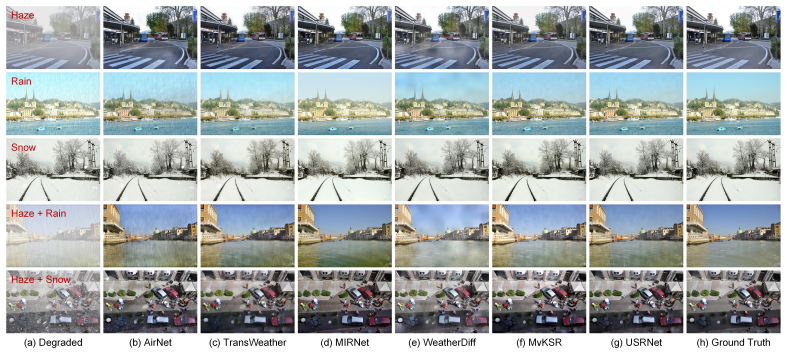
- [Section 5.3, Section 5.5, and Eq. (4)] The mixed-degradation evaluation is based entirely on the synthetic generation model of Eq. (4), and the same benchmark (CDD-11) is used for both training and testing (Table 1), with CDD-11 originating from the authors' prior work [11]. The real-world analysis in Section 5.3 is qualitative only, and the detection experiment in Table 8 uses synthetic sandstorm VOC images rather than real captured mixed-weather traffic frames. Consequently, the abstract's claim that USRNet improves the accuracy and reliability of visual systems in real traffic scenarios is not yet supported by independent real-world evidence. Please add a cross-dataset synthetic test with a different composition order or parameters, or provide quantitative real-world evaluation (e.g., no-reference quality plus detection on captured weather images), or explicitly restrict the claims to synthetic benchmarks.
minor comments (5)
- [Eq. (6)] The partial derivative notation is malformed: the equation shows σ²F/σx² where it should read ∂²F/∂x²; please correct this typesetting issue.
- [Section 4.3] The module is called the "edge decoder" in the architecture overview in Fig. 2 and elsewhere, but the section title is "Edge Detector"; please use one name consistently throughout.
- [Table 6] The caption and table body do not define what the rows labeled "One-to-One" and "All-in-One" correspond to; please add row labels or a legend so the reader can see which configuration each row represents.
- [Section 4.4.2] Notation is inconsistent between the node notation ψ_Ni in Eqs. (11)–(12) and N_i in Eq. (17); please also clarify whether the node parameters θ_i are trained independently and then composed at inference, or trained jointly with shared parameters θ_s.
- [References] Reference [11] has the bibliographic detail "Proc. ECCV, 2024, pp. 0–1"; the page range appears to be a placeholder and should be completed.
Circularity Check
The mixed-degradation claim leans on the authors' own CDD-11 benchmark, synthesized from the paper's own Eq. (4) model, and NILM's sequential inference order is imported from the same group's prior work; single-degradation results remain independently grounded.
-
self citation load bearing
[Section 5.1.1 (Datasets and Experimental Platform) and Table 1; Abstract claim of superiority on complex degradations]
"Additionally, to enhance the generalization capabilities across diverse scenarios, we incorporate the composite degradation dataset (CDD-11) [11] into our training set. ... CDD-11 for multi-scene degradation (including haze, rain, snow, haze + rain, haze + snow)."
The paper's headline claim of superiority on complex/mixed degradations is evaluated on CDD-11, which is introduced in the authors' own prior work [11] (Guo, Gao, Lu, Liu, He, with overlapping authorship). Table 1 shows the same CDD-11 source supplies both 5915 training images and 1000 test images, and the mixed-degradation synthesis is the paper's Eq. (4): streaks are added first, then atmospheric scattering is applied. The test distribution is therefore generated by the same composite model that the architecture is designed to invert, with NILM nodes called in the imaging-model order. The 'surpasses existing methods on complex mixed degradation' result is thus partly self-referential rather than independent external validation.
-
ansatz smuggled in via citation
[Section 4.2.1, NILM inference phase (Eq. 12)]
"In the testing phase, all nodes will be called sequentially according to the imaging model mentioned in literature [11], so as to be more robust to various random image restoration requirements."
The sequential calling order is taken from the authors' own OneRestore paper [11] rather than derived or tested against alternatives. This order matches the paper's own generative model in Eq. (4), where additive rain/snow streaks precede haze. Thus the mixed-degradation inference strategy is an ansatz imported from the same research group and then evaluated on CDD-11, which was generated with the same composite model. The architecture's ability to 'jointly restore complex mixed degraded images' is therefore built on the same prior assumption, not on an independent first-principles derivation.
full rationale
This is a deep-learning system paper, so most of its content (architecture, losses, ablations) is not a derivation chain that could be circular in the mathematical sense. The dehazing, deraining, and desnowing results are evaluated on independent external benchmarks (RESIDE, Rain100L, CSD) and therefore give genuine external support for the single-degradation parts of the claim. The circularity risk is concentrated on the mixed-degradation claim. The only quantitative mixed-degradation benchmark, CDD-11, is introduced in the authors' own prior work [11]; Table 1 shows the same source provides both training and test images; and the synthesis is the paper's own Eq. (4). NILM's inference phase also invokes [11] for the sequential calling order, so the architecture's mixed-degradation handling is built on the same composition assumption that generates the test data. This makes the headline 'superior in complex mixed degradations' partially self-referential. The real-world section is qualitative only and provides no paired ground truth or detection numbers, so it does not break this circularity. Overall score 4: the central single-degradation claim has independent content, but the distinctive mixed-degradation claim leans on the authors' own dataset and prior model order.
Assumptions & free parameters
free parameters (4)
- gamma1 (MAE loss weight) =
0.85
- gamma2 (contrastive loss weight) =
0.15
- Number of NILM nodes =
5
- Learning rate schedule =
0.001, decay by 0.1 every 40 epochs
assumptions (5)
- domain assumption Atmospheric scattering model (Eq. 1) describes haze degradation.
- domain assumption Rain and snow degrade images by additive streak layers (Eqs. 2-3).
- ad hoc to paper Mixed degradation is haze applied after additive streaks (Eq. 4).
- ad hoc to paper Sequential composition of NILM nodes remains effective for arbitrary degradation mixes (Eq. 12).
- standard math Laplacian edge loss and VGG19 contrastive distances are valid quality signals.
Cite this review
Pith. "Pith review of USRNet: Unified Scene Recovery Network for Enhancing Traffic Imaging under Multiple Adverse Weather Conditions." pith.science (2026). https://pith.science/paper/WS3PPWR4
@misc{pith2026250207372,
  author       = {Pith},
  title        = {Pith review of: USRNet: Unified Scene Recovery Network for Enhancing Traffic Imaging under Multiple Adverse Weather Conditions},
  year         = {2026},
  howpublished = {\url{https://pith.science/paper/WS3PPWR4}},
  note         = {Machine review of arXiv:2502.07372}
}
read the original abstract
Advancements in computer vision technology have facilitated the extensive deployment of intelligent transportation systems and visual surveillance systems across various applications, including autonomous driving, public safety, and environmental monitoring. However, adverse weather conditions such as haze, rain, snow, and more complex mixed degradation can significantly degrade image quality. The degradation compromises the accuracy and reliability of these systems across various scenarios. To tackle the challenge of developing adaptable models for scene restoration, we introduce the unified scene recovery network (USRNet), capable of handling multiple types of image degradation. The USRNet features a sophisticated architecture consisting of a scene encoder, an attention-driven node independent learning mechanism (NILM), an edge decoder, and a scene restoration module. The scene encoder, powered by advanced residual blocks, extracts deep features from degraded images in a progressive manner, ensuring thorough encoding of degradation information. To enhance the USRNet's adaptability in diverse weather conditions, we introduce NILM, which enables the network to learn and respond to different scenarios with precision, thereby increasing its robustness. The edge decoder is designed to extract edge features with precision, which is essential for maintaining image sharpness. Experimental results demonstrate that USRNet surpasses existing methods in handling complex imaging degradations, thereby improving the accuracy and reliability of visual systems across diverse scenarios. The code resources for this work can be accessed in https://github.com/LouisYxLu/USRNet.
Figures


Figures from the paper (9 more)




Reference graph
Works this paper leans on
-
[11]
Y. Guo, Y. Gao, Y. Lu, R. W. Liu, S. He, Onerestore: A universal restoration framework for composite degradation, in: Proc. ECCV, 2024, pp. 0–1
work page 2024
-
[1]
S. Wan, S. Ding, C. Chen, Edge computing enabled video segmentation for real-time traffic monitoring in internet of vehicles, Pattern Recognit. 121 (2022) 108146
work page 2022
-
[2]
R. W. Liu, Y. Lu, Y. Guo, W. Ren, F. Zhu, Y. Lv, Aioenet: All-in-one low-visibility enhancement to improve visual perception for intelligent marine vehicles under severe weather conditions, IEEE Trans. Intell. Veh. (2023)
work page 2023
-
[3]
A. A. Husain, T. Maity, R. K. Yadav, Vehicle detection in intelligent transport system under a hazy environment: a survey, IET Image Proc. 14 (1) (2020) 1–10
work page 2020
-
[4]
K. He, J. Sun, X. Tang, Single image haze removal using dark channel prior, IEEE Trans. Pattern Anal. Mach. Intell. 33 (12) (2010) 2341–2353
work page 2010
-
[5]
Z. Chen, Z. He, Z.-M. Lu, Dea-net: Single image dehazing based on detail-enhanced convolution and content-guided attention, IEEE Trans. Image Process. (2024)
work page 2024
-
[6]
X. Fu, J. Huang, X. Ding, Y. Liao, J. Paisley, Clearing the skies: A deep network architecture for single-image rain removal, IEEE Trans. Image Process. 26 (6) (2017) 2944–2956
work page 2017
- [7]
Show all 73 references
-
[8]
Y. Zhu, T. Wang, X. Fu, X. Yang, X. Guo, J. Dai, Y. Qiao, X. Hu, Learning weather- general and weather-specific features for image restoration under multiple adverse weather conditions, in: Proc. IEEE CVPR, 2023, pp. 21747–21758
2023
-
[9]
H. Liu, A. Zhang, W. Zhu, B. Fu, B. Ding, S. Xiong, Residual deformable convolution for better image de-weathering, Pattern Recognit. 147 (2024) 110093
2024
-
[10]
W. Xu, D. Yang, Y. Gao, Y. Lu, J. Zhang, Y. Guo, Mvksr: Multi-view knowledge- guided scene recovery for hazy and rainy degradation, IEEE Trans. Instrum. Meas. (2024)
2024
-
[12]
X. Fu, P. Zhuang, Y. Huang, Y. Liao, X.-P. Zhang, X. Ding, A retinex-based enhanc- ing approach for single underwater image, in: Proc. IEEE ICIP, 2014, pp. 4572–4576
2014
-
[13]
W. Ren, S. Liu, H. Zhang, J. Pan, X. Cao, M.-H. Yang, Single image dehazing via multi-scale convolutional neural networks, in: Proc. ECCV, 2016, pp. 154–169. 27
2016
-
[14]
Y. Song, Z. He, H. Qian, X. Du, Vision transformers for single image dehazing, IEEE Trans. Image Process. 32 (2023) 1927–1941
2023
-
[15]
Y. Guo, Y. Gao, W. Liu, Y. Lu, J. Qu, S. He, W. Ren, Scanet: Self-paced semi- curricular attention network for non-homogeneous image dehazing, in: Proc. IEEE CVPR W, 2023, pp. 1884–1893
2023
-
[16]
J. Liu, S. Wang, C. Chen, Q. Hou, Dfp-net: An unsupervised dual-branch frequency- domain processing framework for single image dehazing, Eng. Appl. Artif. Intell. 136 (2024) 109012
2024
-
[17]
J. Xu, W. Zhao, P. Liu, X. Tang, Removing rain and snow in a single image using guided filter, in: Proc. IEEE CSAE, 2012, pp. 304–307
2012
-
[18]
Y. Wang, S. Liu, C. Chen, B. Zeng, A hierarchical approach for rain or snow removing in a single color image, IEEE Trans. Image Process. 26 (8) (2017) 3936–3950
2017
-
[19]
Y. Quan, X. Tan, Y. Huang, Y. Xu, H. Ji, Image desnowing via deep invertible separation, IEEE Trans. Circuits Syst. Video Technol. 33 (7) (2023) 3133–3144
2023
-
[20]
F. Yang, J. Ren, Z. Lu, J. Zhang, Q. Zhang, Rain-component-aware capsule-gan for single image de-raining, Pattern Recognit. 123 (2022) 108377
2022
-
[21]
L. Liu, L. Xie, X. Zhang, S. Yuan, X. Chen, W. Zhou, H. Li, Q. Tian, Tape: Task- agnostic prior embedding for image restoration, in: Proc. ECCV, Springer, 2022, pp. 447–464
2022
-
[22]
Y. Guo, J. Chen, X. Ren, A. Wang, W. Wang, Joint raindrop and haze removal from a single image, IEEE Trans. Image Process. 29 (2020) 9508–9519
2020
-
[23]
Cheng, J
X. Cheng, J. Zhou, J. Song, X. Zhao, A highway traffic image enhancement algorithm based on improved gan in complex weather conditions, IEEE Trans. Intell. Transp. Syst. 24 (8) (2023) 8716–8726
2023
-
[24]
H. Chen, Y. Wang, T. Guo, C. Xu, Y. Deng, Z. Liu, S. Ma, C. Xu, C. Xu, W. Gao, Pre-trained image processing transformer, in: Proc. IEEE CVPR, 2021, pp. 12299– 12310
2021
-
[25]
¨Ozdenizci, R
O. ¨Ozdenizci, R. Legenstein, Restoring vision in adverse weather conditions with patch-based denoising diffusion models, IEEE Trans. Pattern Anal. Mach. Intell. (Jan. 2023)
2023
-
[26]
T. Ye, S. Chen, W. Chai, Z. Xing, J. Qin, G. Lin, L. Zhu, Learning diffusion texture priors for image restoration, in: Proc. IEEE CVPR, 2024, pp. 2524–2534
2024
-
[27]
J. Lin, Z. Zhang, Y. Wei, D. Ren, D. Jiang, Q. Tian, W. Zuo, Improving image restoration through removing degradations in textual representations, in: Proc. IEEE CVPR, 2024, pp. 2866–2878. 28
2024
-
[28]
Fattal, Dehazing using color-lines, ACM Trans
R. Fattal, Dehazing using color-lines, ACM Trans. Graphics 34 (1) (2014) 1–14
2014
-
[29]
J. Liu, R. W. Liu, J. Sun, T. Zeng, Rank-one prior: Real-time scene recovery, IEEE Trans. Pattern Anal. Mach. Intell. 45 (7) (2022) 8845–8860
2022
-
[30]
Kandhway, An adaptive low-light image enhancement using canonical correlation analysis, IEEE Trans
P. Kandhway, An adaptive low-light image enhancement using canonical correlation analysis, IEEE Trans. Ind. Inf. (2023)
2023
-
[31]
Z. Zhu, D. Zhang, Z. Wang, S. Feng, P. Duan, Spectral dual-channel encoding for image dehazing, IEEE Trans. Circuits Syst. Video Technol. (2023)
2023
-
[32]
C. Zhao, W. Cai, C. Hu, Z. Yuan, Cycle contrastive adversarial learning with struc- tural consistency for unsupervised high-quality image deraining transformer, Neural Networks (2024) 106428
2024
-
[33]
Y. Yang, Y. Zhang, Z. Cui, H. Zhao, T. Ouyang, Single image deraining using scale constraint iterative update network, Expert Syst. Appl. 236 (2024) 121339
2024
-
[34]
Zhang, R
K. Zhang, R. Li, Y. Yu, W. Luo, C. Li, Deep dense multi-scale network for snow removal using semantic and depth priors, IEEE Trans. Image Process. 30 (2021) 7419–7431
2021
-
[35]
Chen, H.-Y
W.-T. Chen, H.-Y. Fang, J.-J. Ding, C.-C. Tsai, S.-Y. Kuo, Jstasr: Joint size and transparency-aware snow removal algorithm based on modified partial convolution and veiling effect removal, in: Proc. ECCV, Springer, 2020, pp. 754–770
2020
-
[36]
Chen, H.-Y
W.-T. Chen, H.-Y. Fang, C.-L. Hsieh, C.-C. Tsai, I. Chen, J.-J. Ding, S.-Y. Kuo, et al., All snow removed: Single image desnowing algorithm using hierarchical dual- tree complex wavelet representation and contradict channel loss, in: Proc. IEEE ICCV, 2021, pp. 4196–4205
2021
-
[37]
Y. Gou, B. Li, Z. Liu, S. Yang, X. Peng, Clearer: Multi-scale neural architecture search for image restoration, NeurIPS 33 (2020) 17129–17140
2020
-
[38]
S. W. Zamir, A. Arora, S. Khan, M. Hayat, F. S. Khan, M.-H. Yang, L. Shao, Multi- stage progressive image restoration, in: Proc. IEEE CVPR, 2021, pp. 14821–14831
2021
-
[39]
R. Li, R. T. Tan, L.-F. Cheong, All in one bad weather removal using architectural search, in: Proc. IEEE CVPR, 2020, pp. 3175–3185
2020
-
[40]
B. Li, X. Liu, P. Hu, Z. Wu, J. Lv, X. Peng, All-in-one image restoration for unknown corruption, in: Proc. IEEE CVPR, 2022, pp. 17452–17462
2022
-
[41]
P. W. Patil, S. Gupta, S. Rana, S. Venkatesh, S. Murala, Multi-weather image restora- tion via domain translation, in: Proc. IEEE ICCV, 2023, pp. 21696–21705
2023
-
[42]
W. Fang, C. Wang, Z. Li, A. Grau, T. Lai, J. Chen, Taenet: transencoder-based all-in-one image enhancement with depth awareness, Appl. Intell. (2024) 1–22. 29
2024
-
[43]
R. W. Liu, Y. Lu, Y. Gao, Y. Guo, W. Ren, F. Zhu, F.-Y. Wang, Real-time multi- scene visibility enhancement for promoting navigational safety of vessels under com- plex weather conditions, IEEE Trans. Intell. Transp. Syst. (2024)
2024
-
[44]
H. Gao, J. Yang, Y. Zhang, N. Wang, J. Yang, D. Dang, Prompt-based ingredient- oriented all-in-one image restoration, IEEE Trans. Circuits Syst. Video Technol. (2024)
2024
-
[45]
Z. Wang, X. Cun, J. Bao, W. Zhou, J. Liu, H. Li, Uformer: A general u-shaped transformer for image restoration, in: Proc. IEEE CVPR, 2022, pp. 17683–17693
2022
-
[46]
Y. Ai, H. Huang, X. Zhou, J. Wang, R. He, Multimodal prompt perceiver: Empower adaptiveness generalizability and fidelity for all-in-one image restoration, in: Proc. IEEE CVPR, 2024, pp. 25432–25444
2024
-
[47]
Li, L.-F
R. Li, L.-F. Cheong, R. T. Tan, Heavy rain image restoration: Integrating physics model and conditional adversarial learning, in: Proc. IEEE CVPR, 2019, pp. 1633– 1642
2019
-
[48]
Zhang, Y
Z. Zhang, Y. Wei, H. Zhang, Y. Yang, S. Yan, M. Wang, Data-driven single image deraining: A comprehensive review and new perspectives, Pattern Recognit. 143 (2023) 109740
2023
-
[49]
B. Li, W. Ren, D. Fu, D. Tao, D. Feng, W. Zeng, Z. Wang, Benchmarking single-image dehazing and beyond, IEEE Trans. Image Process. 28 (1) (2018) 492–505
2018
-
[50]
W. Yang, R. T. Tan, J. Feng, Z. Guo, S. Yan, J. Liu, Joint rain detection and removal from a single image with contextualized deep networks, IEEE Trans. Pattern Anal. Mach. Intell. 42 (6) (2019) 1377–1393
2019
-
[51]
H. Wu, Y. Qu, S. Lin, J. Zhou, R. Qiao, Z. Zhang, Y. Xie, L. Ma, Contrastive learning for compact single image dehazing, in: Proc. IEEE CVPR, 2021, pp. 10551–10560
2021
-
[52]
B. Li, X. Peng, Z. Wang, J. Xu, D. Feng, Aod-net: All-in-one dehazing network, in: Proc. IEEE ICCV, 2017, pp. 4770–4778
2017
-
[53]
X. Qin, Z. Wang, Y. Bai, X. Xie, H. Jia, Ffa-net: Feature fusion attention network for single image dehazing, in: Proc. AAAI, 2020, pp. 11908–11915
2020
-
[54]
J. M. J. Valanarasu, R. Yasarla, V. M. Patel, Transweather: Transformer-based restoration of images degraded by adverse weather conditions, in: Proc. IEEE CVPR, 2022, pp. 2353–2363
2022
-
[55]
S. W. Zamir, A. Arora, S. Khan, M. Hayat, F. S. Khan, M.-H. Yang, L. Shao, Learning enriched features for fast image restoration and enhancement, IEEE Trans. Pattern Anal. Mach. Intell. 45 (2) (2022) 1934–1948. 30
2022
-
[56]
X. Fu, J. Huang, D. Zeng, Y. Huang, X. Ding, J. Paisley, Removing rain from single images via a deep detail network, in: Proc. IEEE CVPR, 2017, pp. 3855–3863
2017
-
[57]
Zhang, V
H. Zhang, V. M. Patel, Density-aware single image de-raining using a multi-stream dense network, in: Proc. IEEE CVPR, 2018, pp. 695–704
2018
-
[58]
X. Fu, B. Liang, Y. Huang, X. Ding, J. Paisley, Lightweight pyramid networks for image deraining, IEEE Trans. Neur. Net. Lear. 31 (6) (2019) 1794–1807
2019
-
[59]
W. Ran, Y. Yang, H. Lu, Single image rain removal boosting via directional gradient, in: Proc. IEEE ICME, 2020, pp. 1–6
2020
-
[60]
X. Fu, Q. Qi, Z.-J. Zha, Y. Zhu, X. Ding, Rain streak removal via dual graph convo- lutional network, in: Proc. AAAI, 2021, pp. 1352–1360
2021
-
[61]
Z. Wang, A. C. Bovik, H. R. Sheikh, E. P. Simoncelli, Image quality assessment: from error visibility to structural similarity, IEEE Trans. Image Process. 13 (4) (2004) 600– 612
2004
-
[62]
Zhang, L
L. Zhang, L. Zhang, X. Mou, D. Zhang, Fsim: A feature similarity index for image quality assessment, IEEE Trans. Image Process. 20 (8) (2011) 2378–2386
2011
-
[63]
Zhang, Y
L. Zhang, Y. Shen, H. Li, Vsi: A visual saliency-induced index for perceptual image quality assessment, IEEE Trans. Image Process. 23 (10) (2014) 4270–4281
2014
-
[64]
completely blind
A. Mittal, R. Soundararajan, A. C. Bovik, Making a “completely blind” image quality analyzer, IEEE Signal Proc. Let. 20 (3) (2012) 209–212
2012
-
[65]
Venkatanath, D
N. Venkatanath, D. Praneeth, M. C. Bh, S. S. Channappayya, S. S. Medasani, Blind image quality evaluation using perception based features, in: Proc. NCC, 2015, pp. 1–6
2015
-
[66]
Zhang, D
Y. Zhang, D. Li, X. Shi, D. He, K. Song, X. Wang, H. Qin, H. Li, Kbnet: Kernel basis network for image restoration, arXiv preprint arXiv:2303.02881 (2023)
2023 arXiv
-
[67]
L. Yu, B. Wang, J. He, G.-S. Xia, W. Yang, Single image deraining with continuous rain density estimation, IEEE Trans. Multimedia 25 (2021) 443–456
2021
-
[68]
Liang, S
Y. Liang, S. Anwar, Y. Liu, Drt: A lightweight single image deraining recursive transformer, in: Proc. IEEE CVPR, 2022, pp. 589–598
2022
-
[69]
S. Chen, T. Ye, Y. Liu, E. Chen, J. Shi, J. Zhou, Snowformer: Scale-aware transformer via context interaction for single image desnowing, arXiv preprint arXiv:2208.09703 (Aug. 2022)
2022 arXiv
-
[70]
Kulkarni, S
A. Kulkarni, S. S. Phutke, S. Murala, Unified transformer network for multi-weather image restoration, in: Proc. ECCV, Springer, 2023, pp. 344–360. 31
2023
-
[71]
Y. Cui, W. Ren, X. Cao, A. Knoll, Focal network for image restoration, in: Proc. IEEE CVPR, 2023, pp. 13001–13011
2023
-
[72]
S. W. Zamir, A. Arora, S. Khan, M. Hayat, F. S. Khan, M.-H. Yang, L. Shao, Learning enriched features for real image restoration and enhancement, in: Proc. ECCV, 2020, pp. 492–511
2020
-
[73]
A. Wang, H. Chen, L. Liu, K. Chen, Z. Lin, J. Han, G. Ding, Yolov10: Real-time end-to-end object detection, arXiv preprint arXiv:2405.14458 (2024). 32
2024 arXiv
Reviewed August 8, 2026 · model on record in the stance chip above.
Discussion (0). Continue with ORCID to comment.