REVIEW 1 major objections 6 minor 1 cited by
Sporadic Dips from Extended Debris Transiting the Metal-Rich White Dwarf SBSS 1232+563
T0 review · 1 major / 6 minor · reviewed 2026-08-10 · deepseek-v4-flash
Pith's one-line read A long-quiet white dwarf was occulted by debris for roughly eight months, dimming by more than 40 percent, with a candidate 14.842-hour debris orbital period detected afterward.
desk verdict Strong observational discovery of sporadic deep debris transits at a polluted white dwarf; the headline '8-month transit' is an assumption through a solar occultation gap rather than a measured continuous duration. read the letter →
The pith
A machine-rendered reading of the paper's core claim, the machinery that carries it, and where it could break.
The reading
What carries the argument
The central mechanism is occultation by an extended, inhomogeneous debris cloud orbiting the white dwarf. The load-bearing evidence is a 25-year multi-survey photometric baseline that places the 2023 event in context and exposes years of quiescence. TESS photometry supplies a candidate 14.842-hour orbital period through a harmonic-rich periodogram whose non-sinusoidal shape is read as the signature of transiting debris rather than a stellar spot. Color measurements in and out of transit favor gray, wavelength-independent extinction, and in-transit minutes-long variability indicates clumpy structure within the cloud.
What would settle it
Continuous, high-cadence photometry during and after the next deep dimming, or archival observations that cover the solar gap of the 2023 event, would settle whether the star stayed dim for the full eight months; detecting a dip that recurs at 14.842 hours would confirm the candidate debris orbital period, while its absence across many orbits would refute it.
Extended reading notes
Core claim
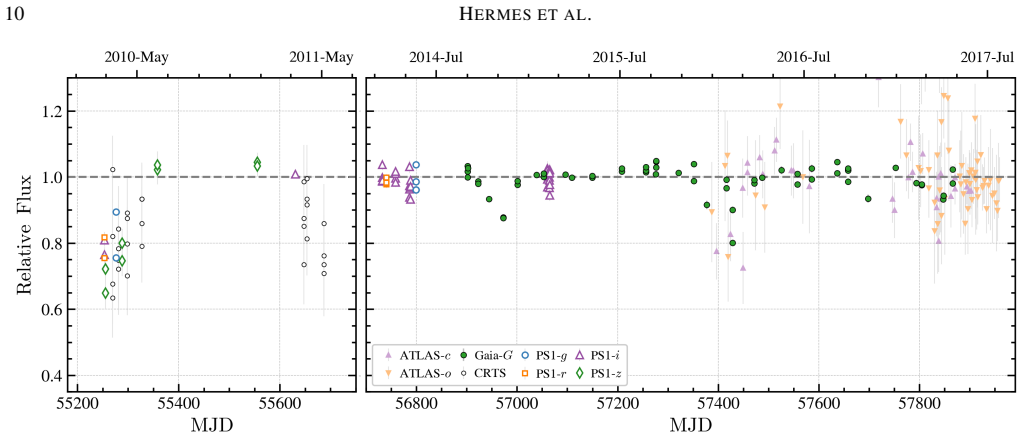
At its core, the paper establishes that the metal-polluted white dwarf SBSS 1232+563 is a transiting debris system rather than merely a candidate one. The evidence is a 25-year relative-flux light curve assembled from archival surveys: after more than five years within a few percent of constant flux, the star entered what the paper interprets as a roughly eight-month dimming in 2023 that reached greater than 40 percent depth, and smaller extended dips are visible around 2010 and 2016. TESS sector 75 photometry shows a coherent 14.842-hour fundamental with at least five harmonics, which the paper identifies as the likely dominant debris orbital period, plus a non-harmonic 95.8416-minute signal; sector 76 shows an 8.57-minute signal of uncertain origin. High-speed ground-based photometry taken inside the 2023 transit shows more than three times more short-timescale variability than out-of-transit runs, and spectra taken at different transit depths over two decades show no significant abundance changes. The paper therefore concludes that debris transits around white dwarfs can be sporadic, with years of quiescence between large-amplitude transits.
Load-bearing premise
The load-bearing assumption is that the star remained in transit throughout the solar gap, because the data cannot distinguish one 8-month event from two shorter dips separated by an unseen recovery.
Editorial extensions
If this is right
- Transit occurrence rates for white-dwarf debris inferred from short-baseline surveys will be underestimates, because this system can sit at constant flux for more than five years between deep events.
- If the 14.842-hour TESS signal is the debris orbital period, it becomes the fifth measured orbital period for transiting debris at a white dwarf, spanning from about 4.5 hours to about 107 days.
- The duration and depth of the 2023 event imply an extremely extended occulting structure, most naturally a debris cloud on a highly eccentric orbit with a large apastron.
- The enhanced minutes-to-hours variability observed only during transit indicates that the debris is inhomogeneous, with clumps that block the stellar disk unevenly.
- The long quiescence motivates continued all-sky monitoring and suggests that new wide-field surveys with decade-long baselines should find more such systems.
Reading between the lines
- Editorial inference: the 8-month duration is not directly observed through the solar gap; if the star left transit while unobservable, the 2023 event would split into two separate deep dips and the extremely extended debris inference would weaken.
- Editorial inference: reconciling a coherent 14.842-hour periodicity with a dimming that lasts many months is not automatic; a single clump on a 14.8-hour orbit cannot block the star for eight months, so the structure must be a large, possibly radially or azimuthally extended debris complex, and a dynamical model of such a structure is a natural next test.
- Editorial inference: the stability of the photospheric abundances across transit depths, if it holds under higher-resolution in-transit spectroscopy, would argue that the transiting material is not adding significant fresh metal absorption and is consistent with gray, optically thin debris rather than dense circumstellar gas.
Editorial analysis
A structured set of objections, weighed in public.
Referee Report
Summary. The paper analyzes roughly 25 years of survey and targeted photometry of the metal-polluted white dwarf SBSS 1232+563, reporting sporadic deep dips, most notably a >40% dimming around 2023 that the authors interpret as an 8-month-long transit by extended debris. It adds high-speed photometry from McDonald Observatory showing enhanced short-term variability in transit, TESS photometry revealing a candidate 14.842-hr periodic signal with harmonics, and six epochs of low-resolution spectroscopy showing no abundance changes. The paper concludes that debris transits at white dwarfs can be sporadic, with many years of inactivity before large-amplitude dimming events.
Significance. If the duration of the 2023 event holds, this is the longest and deepest debris transit observed at a white dwarf and provides strong evidence that such transits can be sporadic after multi-year quiescent intervals. The observational case is built on multiple independent surveys and multicolor follow-up, and the paper is appropriately cautious in its interpretation of the TESS periodicities. The main caveat is that the continuous 8-month duration is an assumption across a solar-occultation gap, which weakens the headline claim unless explicitly acknowledged.
major comments (1)
- [Abstract; Section 5, first paragraph; Figure 1 caption] The headline '8-months-long' event is presented as a measured property in the Abstract and in Section 5 ('roughly 8-months-long, nearly 50% deep transit'), but the photometry only brackets the event: a deep state is seen in 2023 April–May and again in August, with a solar-occultation gap in between. Figure 1's own caption states the duration 'assuming the object remained in transit while it was not visible behind the Sun.' If the source left transit during the gap, the event could split into two or more shorter dips, and the inference of an extremely extended debris structure in Section 5 loses its quantitative support. Please rewrite the Abstract and Section 5 to state the duration explicitly as a lower limit or as contingent on an unverified continuity assumption, and reconcile the depth claim ('>40%' in the Abstract versus 'nearly 50%' in Section 5) with the actual deepest measured points.
minor comments (6)
- [Section 2, CRTS paragraph] In the CRTS paragraph, the median is computed from only the 20 epochs after MJD 56100 because earlier epochs 'appear to be taken in transit,' and those earlier epochs are then used as evidence of dips. Since the choice of baseline makes dips appear by construction, this is partly circular. Please report the number of pre-56100 epochs and demonstrate that the dips are not an artifact of the chosen baseline, ideally by comparing with an absolute flux reference.
- [Section 5, paragraph on recurrence] The statement that these events 'recur roughly every 6-8 years' is weakly supported by the sparse PS1 and Gaia epochs in Figure 5; please quantify the number of in-dip epochs and their significance relative to the photometric scatter.
- [Abstract and Section 5] The depth of the 2023 event is given as both '>40% drop' (Abstract) and 'nearly 50% deep' (Section 5). Please use a single consistent value or explicitly state the range of measured depths.
- [Section 3.2 and Abstract] The 14.842-hr TESS signal is detected in only one of six TESS sectors and is not seen in earlier TESS, ZTF, ATLAS, or McDonald data. While the paper acknowledges this later in Section 3.2, the Abstract's phrase 'suggests a coherent 14.842-hr signal' could be read as a persistent period. Please clarify in the Abstract that this is a candidate, possibly transient signal.
- [Section 4, final paragraph] The conclusion that abundances show 'no evidence of significant changes' rests in part on the low-S/N DBSP spectrum taken in transit (S/N = 17.9 with many upper limits in Table 4). Consider rephrasing to 'no significant changes detected within the sensitivity of the available spectra.'
- [Figure 1] The figure would benefit from a shaded or labeled region marking the solar-occultation gap between the 2023 April–May and August observations, so that the assumed nature of the continuous transit is immediately visible to the reader.
Circularity Check
Minor self-referential CRTS baseline selection; the central sporadic-transit detection is otherwise independent and not circular.
-
self definitional
[Section 2, CRTS paragraph]
"We only include the 20 epochs after 56100 MJD to calculate the median CRTS magnitude, as most of the previous epochs appear to be taken in transit."
The CRTS evidence for early dimming is displayed relative to a median computed only from epochs selected because they were judged not to be in transit. The pre-selected 'in-transit' epochs are therefore faint relative to a baseline that was defined by excluding them, so the depth of those older dips is partly constructed by the same classification the figure is used to demonstrate. The effect is local to the CRTS panel and is not load-bearing for the central claim: the 2023 >40% event and the PS1 2010/Gaia 2016 dips are normalized to their own survey medians, and the ZTF/ATLAS baseline independently establishes years of quiescence.
full rationale
The paper's central result is a direct observational measurement: survey photometry shows deep, sporadic dimming, with the strongest 2023 event visible in ZTF, ATLAS, LCOGT, and McDonald data. No fitted model parameter is fed back to generate the transit claim; the TESS 14.842-hr signal is found with a periodogram, bootstrap false-alarm levels, and TESS-localize source association, not by assuming the transit period. Numerous author-team citations (Hermes 2018, Guidry 2021/2024, Steen 2024, Badenas-Agusti 2024) supply methods, candidate selection, or supporting disk variability, but the discovery claim rests on independent public photometry (ZTF, ATLAS, PS1, Gaia, TESS) and new follow-up. The one mildly self-referential step is the CRTS median constructed from post-MJD-56100 epochs after earlier epochs were labeled in transit; this can inflate the displayed depth of those older dips, but it does not affect the independently corroborated 2023 event or the PS1/Gaia dips. The 8-month continuous duration is an assumption across a solar-occultation gap, explicitly stated in the Figure 1 caption; that is a robustness/interpretation caveat, not a circular derivation. Accordingly the paper shows no significant circularity beyond the minor baseline-selection issue.
Assumptions & free parameters
assumptions (5)
- domain assumption The adopted atmospheric parameters for SBSS 1232+563 (Teff = 11,787 K, log g = 8.30, from Coutu et al. 2019) are accurate enough that abundance determinations are unbiased.
- domain assumption The star remained in continuous transit during the unobserved solar-occultation gap of the 2023 event.
- domain assumption The dimming mechanism is occultation or extinction by debris rather than intrinsic luminosity variability of the white dwarf.
- domain assumption The TESS Sector 75 periodicities are intrinsic to SBSS 1232+563 and are transient in nature, which would explain their absence from ZTF, ATLAS, and McDonald data.
- standard math Lomb-Scargle periodograms with 10,000-shuffle bootstrap false-alarm probabilities and TESS-localize vetting correctly model the noise statistics.
Cite this review
Pith. "Pith review of Sporadic Dips from Extended Debris Transiting the Metal-Rich White Dwarf SBSS 1232+563." pith.science (2026). https://pith.science/paper/WSZ7ZCAS
@misc{pith2026250102050,
  author       = {Pith},
  title        = {Pith review of: Sporadic Dips from Extended Debris Transiting the Metal-Rich White Dwarf SBSS 1232+563},
  year         = {2026},
  howpublished = {\url{https://pith.science/paper/WSZ7ZCAS}},
  note         = {Machine review of arXiv:2501.02050}
}
read the original abstract
We present the discovery of deep but sporadic transits in the flux of SBSS 1232+563, a metal-rich white dwarf polluted by disrupted exoplanetary debris. Nearly 25 years of photometry from multiple sky surveys reveal evidence of occasional dimming of the white dwarf, most notably evident in an 8-months-long event in 2023 that caused a >40% drop in flux from the star. In-transit follow-up shows additional short-timescale (minutes- to hours-long) dimming events. TESS photometry suggests a coherent 14.842-hr signal that could represent the dominant orbital period of debris. Six low-resolution spectra collected at various transit depths over two decades show no evidence of significant changes in the observed elemental abundances. SBSS 1232+563 demonstrates that debris transits around white dwarfs can be sporadic, with many years of inactivity before large-amplitude dimming events.
Figures


Figures from the paper (2 more)

Forward citations
Cited by 1 Pith paper
-
A ZTF Search for Circumstellar Debris Transits in White Dwarfs: Six New Candidates, one with Gas Disk Emission, identified in a Novel Metric Space
Six new white dwarf debris-transit candidates are reported, including WD J1013-0427, the first with reddening during transit and with both a dusty and a gaseous debris disk.
Reference graph
Works this paper leans on
-
[1]
2019, arXiv e-prints, arXiv:1902.05569, doi: 10.48550/arXiv.1902.05569
Akeson, R., Armus, L., Bachelet, E., et al. 2019, arXiv e-prints, arXiv:1902.05569, doi: 10.48550/arXiv.1902.05569
-
[2]
Alonso, R., Rappaport, S., Deeg, H. J., & Palle, E. 2016, A&A, 589, L6, doi: 10.1051/0004-6361/201628511 Astropy Collaboration, Robitaille, T. P., Tollerud, E. J., et al. 2013, A&A, 558, A33, doi: 10.1051/0004-6361/201322068 Astropy Collaboration, Price-Whelan, A. M., Sip˝ocz, B. M., et al. 2018, AJ, 156, 123, doi: 10.3847/1538-3881/aabc4f
-
[3]
Aungwerojwit, A., G¨ansicke, B. T., Dhillon, V . S., et al. 2024, MNRAS, 530, 117, doi: 10.1093/mnras/stae750
-
[4]
2024, MNRAS, 529, 1688, doi: 10.1093/mnras/stae421
Badenas-Agusti, M., Via˜na, J., Vanderburg, A., et al. 2024, MNRAS, 529, 1688, doi: 10.1093/mnras/stae421
-
[5]
Barber, S. D., Kilic, M., Brown, W. R., & Gianninas, A. 2014, ApJ, 786, 77, doi: 10.1088/0004-637X/786/2/77
-
[6]
Bell, K. J., C´orsico, A. H., Bischoff-Kim, A., et al. 2019, A&A, 632, A42, doi: 10.1051/0004-6361/201936340
-
[7]
Bhatti, W., Bouma, L. G., & Wallace, J. 2018,Astrobase, 0.3.8, Zenodo, doi: 10.5281/zenodo.1185231
-
[8]
Bicay, M. D., Stepanian, J. A., Chavushyan, V . H., et al. 2000, A&AS, 147, 169, doi: 10.1051/aas:2000295
Show all 75 references
-
[9]
S., Schlegel, D
Bolton, A. S., Schlegel, D. J., Aubourg, ´E., et al. 2012, AJ, 144, 144, doi: 10.1088/0004-6256/144/5/144
2012 doi
-
[10]
G., Bonsor, A., & Malamud, U
Brouwers, M. G., Bonsor, A., & Malamud, U. 2022, MNRAS, 509, 2404, doi: 10.1093/mnras/stab3009
2022 doi
-
[11]
G., Buchan, A
Brouwers, M. G., Buchan, A. M., Bonsor, A., et al. 2023, MNRAS, 519, 2663, doi: 10.1093/mnras/stac3317
2023 doi
-
[12]
W., Farihi, J., Redfield, S., et al
Cauley, P. W., Farihi, J., Redfield, S., et al. 2018, ApJL, 852, L22, doi: 10.3847/2041-8213/aaa3d9
2018 doi
- [13]
-
[14]
2019, ApJ, 885, 74, doi: 10.3847/1538-4357/ab46b9
Coutu, S., Dufour, P., Bergeron, P., et al. 2019, ApJ, 885, 74, doi: 10.3847/1538-4357/ab46b9
2019 doi
-
[15]
H., Hoard, D
Debes, J. H., Hoard, D. W., Wachter, S., Leisawitz, D. T., & Cohen, M. 2011, ApJS, 197, 38, doi: 10.1088/0067-0049/197/2/38
2011 doi
-
[16]
J., Djorgovski, S
Drake, A. J., Djorgovski, S. G., Mahabal, A., et al. 2009, ApJ, 696, 870, doi: 10.1088/0004-637X/696/1/870
2009 doi
-
[17]
J., Catelan, M., Djorgovski, S
Drake, A. J., Catelan, M., Djorgovski, S. G., et al. 2013, ApJ, 763, 32, doi: 10.1088/0004-637X/763/1/32
2013 doi
-
[18]
2012, ApJ, 749, 6, doi: 10.1088/0004-637X/749/1/6
Dufour, P., Kilic, M., Fontaine, G., et al. 2012, ApJ, 749, 6, doi: 10.1088/0004-637X/749/1/6
2012 doi
-
[19]
J., Liebert, J., Harris, H
Eisenstein, D. J., Liebert, J., Harris, H. C., et al. 2006, ApJS, 167, 40, doi: 10.1086/507110
2006 doi
-
[20]
2023, A&A, 674, A13, doi: 10.1051/0004-6361/202244242
Eyer, L., Audard, M., Holl, B., et al. 2023, A&A, 674, A13, doi: 10.1051/0004-6361/202244242
2023 doi
-
[21]
2016, NewAR, 71, 9, doi: 10.1016/j.newar.2016.03.001
Farihi, J. 2016, NewAR, 71, 9, doi: 10.1016/j.newar.2016.03.001
2016 doi
-
[22]
T., & Koester, D
Farihi, J., G¨ansicke, B. T., & Koester, D. 2013, Science, 342, 218, doi: 10.1126/science.1239447
2013 doi
-
[23]
J., Marsh, T
Farihi, J., Hermes, J. J., Marsh, T. R., et al. 2022, MNRAS, 511, 1647, doi: 10.1093/mnras/stab3475
2022 doi
-
[24]
M., Brasseur, C
Ginsburg, A., Sip˝ocz, B. M., Brasseur, C. E., et al. 2019, AJ, 157, 98, doi: 10.3847/1538-3881/aafc33
2019 doi
-
[25]
A., Hermes, J
Guidry, J. A., Hermes, J. J., De, K., et al. 2024, ApJ, 972, 126, doi: 10.3847/1538-4357/ad5be7
2024 doi
-
[26]
A., Vanderbosch, Z
Guidry, J. A., Vanderbosch, Z. P., Hermes, J. J., et al. 2021, ApJ, 912, 125, doi: 10.3847/1538-4357/abee68
2021 doi
-
[27]
Han, T., & Brandt, T. D. 2023, AJ, 165, 71, doi: 10.3847/1538-3881/acaaa7
2023 doi
-
[28]
R., Millman, K
Harris, C. R., Millman, K. J., van der Walt, S. J., et al. 2020, Nature, 585, 357, doi: 10.1038/s41586-020-2649-2
2020 doi
-
[29]
2021, ApJ, 911, 108, doi: 10.3847/1538-4357/abe9bd
Hawkins, K., Zeimann, G., Sneden, C., et al. 2021, ApJ, 911, 108, doi: 10.3847/1538-4357/abe9bd
2021 doi
-
[30]
A., Boudreaux, E
Hermes, J., Corcoran, K. A., Boudreaux, E. M., et al. 2018, A Method to Select Variable White Dwarfs from Gaia DR2, 21st European White Dwarf Workshop, Zenodo, doi: 10.5281/zenodo.4088554
2018 doi
-
[31]
J., Kawaler, S
Hermes, J. J., Kawaler, S. D., Bischoff-Kim, A., et al. 2017a, ApJ, 835, 277, doi: 10.3847/1538-4357/835/2/277
-
[32]
J., G¨ansicke, B
Hermes, J. J., G¨ansicke, B. T., Kawaler, S. D., et al. 2017b, ApJS, 232, 23, doi: 10.3847/1538-4365/aa8bb5
-
[33]
E., & Bell, K
Higgins, M. E., & Bell, K. J. 2023, AJ, 165, 141, doi: 10.3847/1538-3881/acb20c
2023 doi
- [34]
-
[35]
A., Kiker, T
Hillenbrand, L. A., Kiker, T. J., Gee, M., et al. 2022, AJ, 163, 263, doi: 10.3847/1538-3881/ac62d8
2022 doi
-
[36]
Hunter, J. D. 2007, Computing in Science & Engineering, 9, 90, doi: 10.1109/MCSE.2007.55 Ivezi´c, ˇZ., Kahn, S. M., Tyson, J. A., et al. 2019, ApJ, 873, 111, doi: 10.3847/1538-4357/ab042c TRANSITS OF THE WHITE DWARF SBSS 1232+563 13
2007 doi
-
[37]
T., et al
Izquierdo, P., Rodr´ıguez-Gil, P., G¨ansicke, B. T., et al. 2018, MNRAS, 481, 703, doi: 10.1093/mnras/sty2315
2018 doi
-
[38]
M., Twicken, J
Jenkins, J. M., Twicken, J. D., McCauliff, S., et al. 2016, in Society of Photo-Optical Instrumentation Engineers (SPIE) Conference
2016
-
[39]
9913, Software and Cyberinfrastructure for Astronomy IV , ed
Series, V ol. 9913, Software and Cyberinfrastructure for Astronomy IV , ed. G. Chiozzi & J. C. Guzman, 99133E, doi: 10.1117/12.2233418
-
[40]
O., & Winget, D
Kanaan, A., Kepler, S. O., & Winget, D. E. 2002, A&A, 389, 896, doi: 10.1051/0004-6361:20020485
2002 doi
-
[41]
2010, ApJ, 709, 950, doi: 10.1088/0004-637X/709/2/950
Klein, B., Jura, M., Koester, D., Zuckerman, B., & Melis, C. 2010, ApJ, 709, 950, doi: 10.1088/0004-637X/709/2/950
2010 doi
-
[42]
2005, Communications in Asteroseismology, 146, 53, doi: 10.1553/cia146s53
Lenz, P., & Breger, M. 2005, Communications in Asteroseismology, 146, 53, doi: 10.1553/cia146s53
2005 doi
-
[43]
M., et al
Mainzer, A., Bauer, J., Cutri, R. M., et al. 2014, ApJ, 792, 30, doi: 10.1088/0004-637X/792/1/30
2014 doi
-
[44]
J., G¨ansicke, B
Manser, C. J., G¨ansicke, B. T., Marsh, T. R., et al. 2016, MNRAS, 455, 4467, doi: 10.1093/mnras/stv2603
2016 doi
-
[45]
J., G¨ansicke, B
Manser, C. J., G¨ansicke, B. T., Eggl, S., et al. 2019, Science, 364, 66, doi: 10.1126/science.aat5330
2019 doi
-
[46]
J., Laher, R
Masci, F. J., Laher, R. R., Rusholme, B., et al. 2019, PASP, 131, 018003, doi: 10.1088/1538-3873/aae8ac
2019 doi
-
[47]
M., Caselden, D., Schlafly, E
Meisner, A. M., Caselden, D., Schlafly, E. F., & Kiwy, F. 2023, AJ, 165, 36, doi: 10.3847/1538-3881/aca2ab
2023 doi
-
[48]
B., & Ingargiola, A
Newville, M., Stensitzki, T., Allen, D. B., & Ingargiola, A. 2014, LMFIT: Non-Linear Least-Square Minimization and Curve-Fitting for Python, 0.8.0, Zenodo, doi: 10.5281/zenodo.11813
2014 doi
- [49]
-
[50]
B., Cohen, J
Oke, J. B., Cohen, J. G., Carr, M., et al. 1995, PASP, 107, 375, doi: 10.1086/133562 pandas development team, T. 2020, pandas-dev/pandas: Pandas, latest, Zenodo, doi: 10.5281/zenodo.3509134
1995 doi
-
[51]
1986, ApJS, 61, 177, doi: 10.1086/191111
Paquette, C., Pelletier, C., Fontaine, G., & Michaud, G. 1986, ApJS, 61, 177, doi: 10.1086/191111
1986 doi
-
[52]
Perley, D. A. 2019, PASP, 131, 084503, doi: 10.1088/1538-3873/ab215d
2019 doi
-
[53]
2020, The Journal of Open Source Software, 5, 2308, doi: 10.21105/joss.02308
Prochaska, J., Hennawi, J., Westfall, K., et al. 2020, The Journal of Open Source Software, 5, 2308, doi: 10.21105/joss.02308
2020 doi
-
[54]
T., Koester, D., et al
Raddi, R., G¨ansicke, B. T., Koester, D., et al. 2015, MNRAS, 450, 2083, doi: 10.1093/mnras/stv701
2015 doi
-
[55]
R., Winn, J
Ricker, G. R., Winn, J. N., Vanderspek, R., et al. 2015, Journal of Astronomical Telescopes, Instruments, and Systems, 1, 014003, doi: 10.1117/1.JATIS.1.1.014003
2015 doi
-
[56]
2024, MNRAS, 533, 1756, doi: 10.1093/mnras/stae1859
Robert, A., Farihi, J., Van Eylen, V ., et al. 2024, MNRAS, 533, 1756, doi: 10.1093/mnras/stae1859
2024 doi
-
[57]
2010, in Society of Photo-Optical Instrumentation Engineers (SPIE) Conference
Rockosi, C., Stover, R., Kibrick, R., et al. 2010, in Society of Photo-Optical Instrumentation Engineers (SPIE) Conference
2010
-
[58]
7735, Ground-based and Airborne Instrumentation for Astronomy III, ed
Series, V ol. 7735, Ground-based and Airborne Instrumentation for Astronomy III, ed. I. S. McLean, S. K. Ramsay, & H. Takami, 77350R, doi: 10.1117/12.856818
-
[59]
M., Tucker, M
Rowan, D. M., Tucker, M. A., Shappee, B. J., & Hermes, J. J. 2019, MNRAS, 486, 4574, doi: 10.1093/mnras/stz1116 Schr¨oder, K. P., & Smith, R. C. 2008, MNRAS, 386, 155, doi: 10.1111/j.1365-2966.2008.13022.x
2019
-
[60]
J., Guidry, J
Steen, M., Hermes, J. J., Guidry, J. A., et al. 2024, ApJ, 967, 166, doi: 10.3847/1538-4357/ad3e60
2024 doi
-
[61]
Stellingwerf, R. F. 1978, ApJ, 224, 953, doi: 10.1086/156444
1978 doi
-
[62]
G., & Parsons, S
Swan, A., Farihi, J., Wilson, T. G., & Parsons, S. G. 2020, MNRAS, 496, 5233, doi: 10.1093/mnras/staa1688
2020 doi
-
[63]
J., Farihi, J., et al
Swan, A., Kenyon, S. J., Farihi, J., et al. 2021, MNRAS, 506, 432, doi: 10.1093/mnras/stab1738
2021 doi
-
[64]
W., Lemson, G., et al
Taghizadeh-Popp, M., Kim, J. W., Lemson, G., et al. 2020, Astronomy and Computing, 33, 100412, doi: 10.1016/j.ascom.2020.100412
2020
-
[65]
E., & Mullally, F
Thompson, S. E., & Mullally, F. 2009, in Journal of Physics Conference Series, V ol. 172, Journal of Physics Conference Series (IOP), 012081, doi: 10.1088/1742-6596/172/1/012081
2009 doi
-
[66]
L., Stubbs, C
Tonry, J. L., Stubbs, C. W., Lykke, K. R., et al. 2012, ApJ, 750, 99, doi: 10.1088/0004-637X/750/2/99
2012 doi
-
[67]
L., Denneau, L., Heinze, A
Tonry, J. L., Denneau, L., Heinze, A. N., et al. 2018, PASP, 130, 064505, doi: 10.1088/1538-3873/aabadf van Sluijs, L., & Van Eylen, V . 2018, MNRAS, 474, 4603, doi: 10.1093/mnras/stx3068
2018 doi
-
[68]
2023, zvanderbosch/phot2lc: phot2lc v1.7.8 release, v1.7.8, Zenodo, doi: 10.5281/zenodo.8169807
Vanderbosch, Z. 2023, zvanderbosch/phot2lc: phot2lc v1.7.8 release, v1.7.8, Zenodo, doi: 10.5281/zenodo.8169807
2023 doi
-
[69]
J., Dennihy, E., et al
Vanderbosch, Z., Hermes, J. J., Dennihy, E., et al. 2020, ApJ, 897, 171, doi: 10.3847/1538-4357/ab9649
2020 doi
-
[70]
P., Rappaport, S., Guidry, J
Vanderbosch, Z. P., Rappaport, S., Guidry, J. A., et al. 2021, ApJ, 917, 41, doi: 10.3847/1538-4357/ac0822
2021 doi
-
[71]
A., Rappaport, S., et al
Vanderburg, A., Johnson, J. A., Rappaport, S., et al. 2015, Nature, 526, 546, doi: 10.1038/nature15527
2015 doi
-
[72]
2016, Royal Society Open Science, 3, 150571, doi: 10.1098/rsos.150571
Veras, D. 2016, Royal Society Open Science, 3, 150571, doi: 10.1098/rsos.150571
2016 doi
-
[73]
E., et al
Virtanen, P., Gommers, R., Oliphant, T. E., et al. 2020, Nature Methods, 17, 261, doi: 10.1038/s41592-019-0686-2
2020 doi
-
[74]
J., Hermes, J
Wilson, D. J., Hermes, J. J., & G¨ansicke, B. T. 2020, ApJL, 897, L31, doi: 10.3847/2041-8213/ab9d7b
2020 doi
-
[75]
2019, AJ, 158, 242, doi: 10.3847/1538-3881/ab4cee
Xu, S., Dufour, P., Klein, B., et al. 2019, AJ, 158, 242, doi: 10.3847/1538-3881/ab4cee
2019 doi
Reviewed August 10, 2026 · model on record in the stance chip above.
Discussion (0). Continue with ORCID to comment.