A Methodology to Quantify Interscale Energy Transfer at Solid Boundaries
Pith reviewed 2026-06-26 06:44 UTC · model grok-4.3
The pith
Coarse-graining combined with volume-penalization quantifies linear interscale energy transfer at solid boundaries.
A machine-rendered reading of the paper's core claim, the machinery that carries it, and where it could break.
Core claim
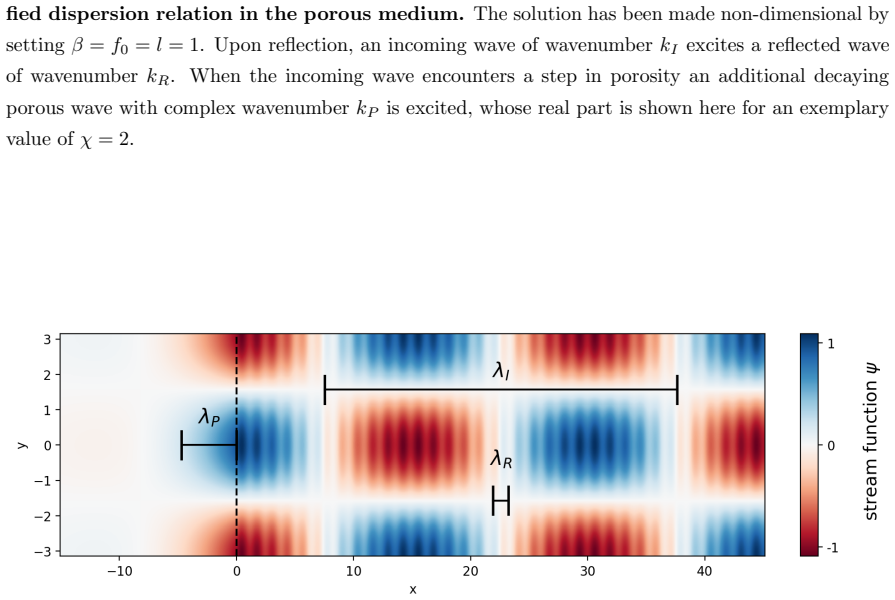
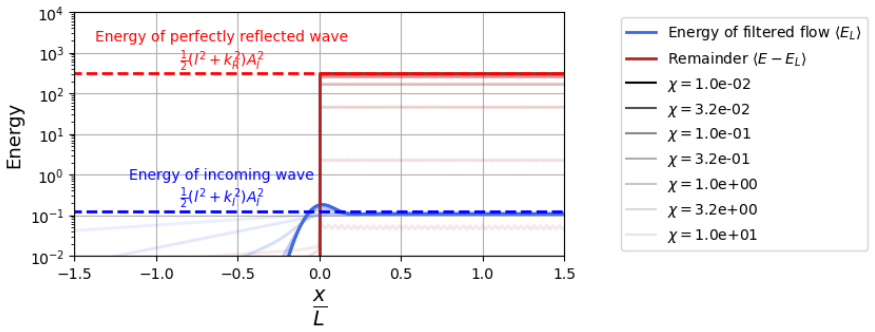
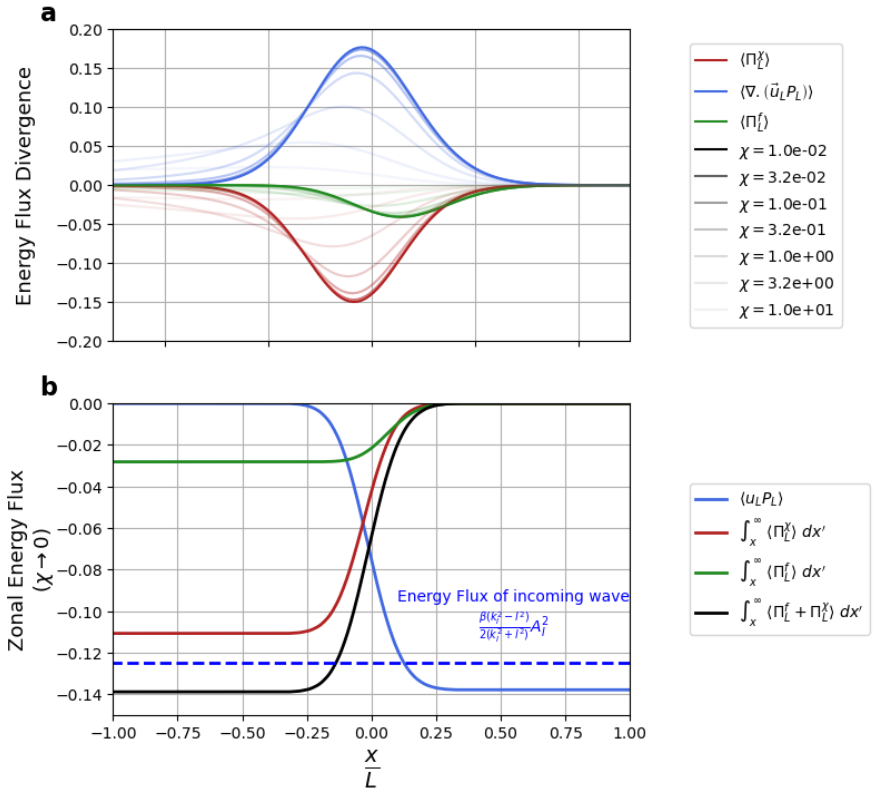
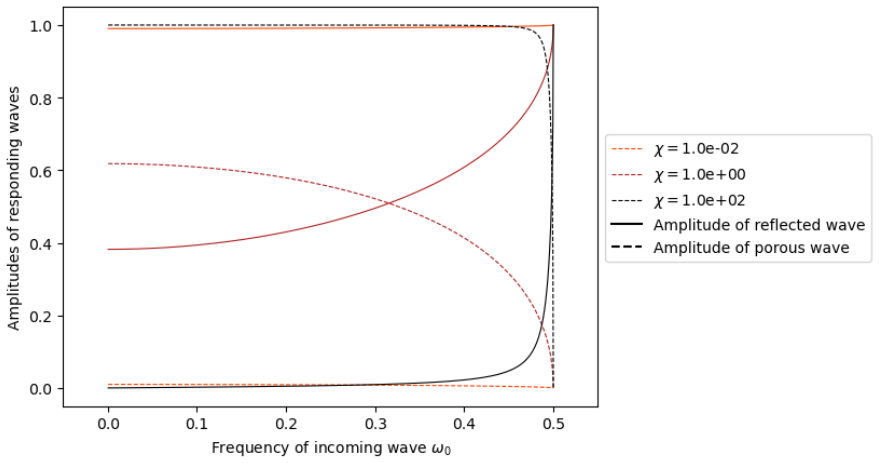
The novel filtering methodology combining coarse-graining with volume-penalization is able to quantify the linear energy transfer that may occur during the formation of oceanic boundary layers or Rossby wave reflections, illustrated by the down-scale energy transfer during a Rossby wave reflection off a western boundary.
What carries the argument
The filtering methodology that combines coarse-graining with volume-penalization to isolate linear interscale energy transfers at boundaries.
If this is right
- The method can quantify linear transfers during oceanic boundary layer formation.
- It captures down-scale energy transfer in Rossby wave reflections at western boundaries.
- The framework supports analysis of multi-scale energetics across bounded geophysical fluid flows.
Where Pith is reading between the lines
- The same combination might apply to other boundary types such as no-slip walls in engineering flows.
- It could be tested in numerical simulations to separate linear boundary effects from nonlinear cascade terms.
- Extension to three-dimensional cases would show whether the linear transfer remains dominant near complex topography.
Load-bearing premise
The combination of coarse-graining and volume-penalization isolates the linear component of interscale energy transfer without introducing spurious contributions from the penalization term or from the choice of filter scale.
What would settle it
Apply the method to a controlled test flow with a known analytical linear transfer rate at a boundary and check whether the output matches the known rate without added artifacts from the penalization.
Figures

read the original abstract
Far away from solid boundaries, energy can be transferred between different flow scales due to the non-linear self-advection of velocity. This energy transfer can be quantified using well-established Fourier diagnostics or filtering methods. However, these diagnostic tools fail to provide a physical representation of the linear energy transfer that may occur during the formation of oceanic boundary layers or Rossby wave reflections. In this document, I outline a novel filtering methodology that is able to quantify this linear energy transfer by combining coarse-graining with volume-penalization. Its utility is illustrated by quantifying the down-scale energy transfer occuring during a Rossby wave reflection off a western boundary. The conceptual framework developed here is thought to be broadly applicable to the study of multi-scale energetics of bounded geophysical fluid flows.
Editorial analysis
A structured set of objections, weighed in public.
Referee Report
Summary. The paper outlines a novel filtering methodology that combines coarse-graining with volume-penalization to quantify linear interscale energy transfer at solid boundaries, where standard Fourier or filtering diagnostics fail. Its utility is illustrated by an application to down-scale energy transfer during Rossby wave reflection off a western boundary, with the framework claimed to be broadly applicable to multi-scale energetics of bounded geophysical flows.
Significance. If the method can be shown to isolate the linear transfer term without contamination, it would address a recognized gap in boundary-layer energetics diagnostics for ocean and atmospheric models. The approach builds on established coarse-graining ideas but adapts them to penalized domains; however, the current manuscript supplies no equations, tests, or error analysis to establish this isolation.
major comments (3)
- [Methodology (energy-budget derivation)] The abstract and manuscript description supply neither the explicit form of the filtered kinetic-energy budget that includes the volume-penalization body-force term nor the subsequent decomposition into linear and nonlinear interscale transfers. Without this derivation it is impossible to verify that the penalization does not generate additional linear contributions that would be misattributed to the boundary-induced transfer.
- [Numerical illustration (Rossby-wave reflection)] No numerical validation, convergence tests with respect to filter scale, or comparison against an analytically known linear-transfer case is reported. The single Rossby-wave example therefore provides no evidence that spurious terms arising from the penalization are absent or have been subtracted.
- [Introduction and abstract] The central claim that the combined coarse-graining/penalization procedure isolates only the linear component rests on an untested assumption that the filtered penalization term contributes neither linear nor nonlinear interscale fluxes; this assumption is load-bearing for the entire methodology.
minor comments (1)
- [Abstract] The abstract is written in future tense ('I outline') and supplies no quantitative result or equation, which is atypical for a methods paper and makes the scope of the contribution difficult to assess from the front matter alone.
Simulated Author's Rebuttal
We thank the referee for the detailed and constructive report. The comments correctly identify that the current presentation of the derivation and supporting tests is insufficient to fully substantiate the isolation of the linear transfer term. We will revise the manuscript accordingly to address these points.
read point-by-point responses
-
Referee: [Methodology (energy-budget derivation)] The abstract and manuscript description supply neither the explicit form of the filtered kinetic-energy budget that includes the volume-penalization body-force term nor the subsequent decomposition into linear and nonlinear interscale transfers. Without this derivation it is impossible to verify that the penalization does not generate additional linear contributions that would be misattributed to the boundary-induced transfer.
Authors: We agree that the explicit filtered kinetic-energy budget and its decomposition must be shown. The revised manuscript will include the full derivation starting from the penalized Navier-Stokes equations, applying the coarse-graining filter, and separating the resulting interscale transfer into linear and nonlinear contributions. This will make clear that the penalization body force enters only the linear term at the boundary and does not contaminate the nonlinear flux. revision: yes
-
Referee: [Numerical illustration (Rossby-wave reflection)] No numerical validation, convergence tests with respect to filter scale, or comparison against an analytically known linear-transfer case is reported. The single Rossby-wave example therefore provides no evidence that spurious terms arising from the penalization are absent or have been subtracted.
Authors: The referee is correct that the present numerical example is only illustrative. In the revision we will add (i) a convergence study varying the filter scale, (ii) an error analysis quantifying residual penalization contributions, and (iii) a comparison against a known analytic linear-transfer problem (e.g., a simple boundary-forced linear wave) to demonstrate that the extracted term matches the expected linear transfer without spurious nonlinear contamination. revision: yes
-
Referee: [Introduction and abstract] The central claim that the combined coarse-graining/penalization procedure isolates only the linear component rests on an untested assumption that the filtered penalization term contributes neither linear nor nonlinear interscale fluxes; this assumption is load-bearing for the entire methodology.
Authors: We accept that the current text presents the isolation property as an assumption rather than a demonstrated result. The revised version will derive the filtered penalization term explicitly and prove that, under the standard volume-penalization formulation, it contributes exclusively to the linear interscale transfer at the boundary while the nonlinear term remains unaffected. This derivation will replace the previous assumption with a mathematical statement. revision: yes
Circularity Check
No circularity: methodology proposal introduces new diagnostic without reducing to input definitions or self-citations
full rationale
The paper presents a methodological framework that combines coarse-graining with volume-penalization to quantify linear interscale energy transfer at solid boundaries. No equations, fitted parameters, or self-citation chains appear in the provided abstract or description that would make any reported transfer or result equivalent to its inputs by construction. The central claim is the introduction and illustration of a novel diagnostic tool rather than a derivation that loops back to prior fits or definitions. This qualifies as self-contained against external benchmarks, as the approach is proposed as new and illustrated with an example application (Rossby wave reflection) without statistical forcing or tautological renaming of known results.
Axiom & Free-Parameter Ledger
axioms (1)
- standard math Standard incompressible Navier-Stokes filtering and Fourier diagnostics remain valid away from boundaries.
Reference graph
Works this paper leans on
-
[1]
Physical Review Fluids , volume=
Gyre turbulence: Anomalous dissipation in a two-dimensional ocean model , author=. Physical Review Fluids , volume=. 2024 , publisher=
2024
-
[2]
Effects of slip boundary conditions on Rayleigh-B
Kuo, L-S and Chen, P-H , journal=. Effects of slip boundary conditions on Rayleigh-B. 2009 , publisher=
2009
-
[3]
Journal of Fluid Mechanics , volume=
A formally exact wall-boundary condition in large eddy simulations using volume filtering , author=. Journal of Fluid Mechanics , volume=. 2025 , publisher=
2025
-
[4]
2006 , publisher=
Large eddy simulation for incompressible flows: an introduction , author=. 2006 , publisher=
2006
-
[5]
Journal of Physical Oceanography , volume=
Mapping the energy cascade in the North Atlantic Ocean: The coarse-graining approach , author=. Journal of Physical Oceanography , volume=
-
[6]
Physical review letters , volume=
Decaying two-dimensional turbulence in a circular container , author=. Physical review letters , volume=. 2005 , publisher=
2005
-
[7]
Journal of Computational Physics , volume=
Numerical simulation of fluid--structure interaction with the volume penalization method , author=. Journal of Computational Physics , volume=. 2015 , publisher=
2015
-
[8]
2013 , publisher=
Geophysical fluid dynamics , author=. 2013 , publisher=
2013
-
[9]
1996 , publisher=
Turbulence: the legacy of AN Kolmogorov , author=. 1996 , publisher=
1996
-
[10]
Eos, Transactions American Geophysical Union , volume=
The westward intensification of wind-driven ocean currents , author=. Eos, Transactions American Geophysical Union , volume=. 1948 , publisher=
1948
-
[11]
Proceedings of the National Academy of Sciences , volume=
Network approach to patterns in stratocumulus clouds , author=. Proceedings of the National Academy of Sciences , volume=. 2017 , publisher=
2017
-
[12]
Contribution of Working Group I to the Fifth Assessment Report of the Intergovernmental Panel on Climate Change , author=
Climate change 2013: the physical science basis. Contribution of Working Group I to the Fifth Assessment Report of the Intergovernmental Panel on Climate Change , author=. K., Tignor, M., Allen, SK, Boschung, J., Nauels, A., Xia, Y., Bex, V., and Midgley, PM, Cambridge University Press, Cambridge, UK , volume=
2013
-
[13]
Physical Review Letters , volume=
Energy Dissipating Structures Produced by Walls in Two-Dimensional Flows at Vanishing Viscosity , author=. Physical Review Letters , volume=. 2011 , publisher=
2011
-
[14]
Geophysical Monograph Series , volume=
Gulf Stream separation in numerical ocean models , author=. Geophysical Monograph Series , volume=. 2008 , publisher=
2008
-
[15]
Scientific reports , volume=
A comparison of no-slip, stress-free and inviscid models of rapidly rotating fluid in a spherical shell , author=. Scientific reports , volume=. 2016 , publisher=
2016
-
[16]
Transition to the ultimate regime in two-dimensional Rayleigh-B
Zhu, Xiaojue and Mathai, Varghese and Stevens, Richard JAM and Verzicco, Roberto and Lohse, Detlef , journal=. Transition to the ultimate regime in two-dimensional Rayleigh-B. 2018 , publisher=
2018
-
[17]
Scientific Reports , volume=
Dissipation of mesoscale eddies at a western boundary via a direct energy cascade , author=. Scientific Reports , volume=. 2022 , publisher=
2022
-
[18]
Journal of Physical Oceanography , volume=
Direct evidence of an oceanic inverse kinetic energy cascade from satellite altimetry , author=. Journal of Physical Oceanography , volume=
-
[19]
Annual Review of Fluid Mechanics , volume=
High--Reynolds number wall turbulence , author=. Annual Review of Fluid Mechanics , volume=. 2011 , publisher=
2011
-
[20]
Direct evidence of an oceanic inverse kinetic energy cascade from satellite altimetry
Robert B Scott and Faming Wang. Direct evidence of an oceanic inverse kinetic energy cascade from satellite altimetry. Journal of Physical Oceanography , 35(9):1650--1666, 2005
2005
-
[21]
Large eddy simulation for incompressible flows: an introduction
Pierre Sagaut. Large eddy simulation for incompressible flows: an introduction . Springer, 2006
2006
-
[22]
The westward intensification of wind-driven ocean currents
Henry Stommel. The westward intensification of wind-driven ocean currents. Eos, Transactions American Geophysical Union , 29(2):202--206, 1948
1948
-
[23]
Geophysical fluid dynamics
Joseph Pedlosky. Geophysical fluid dynamics . Springer Science & Business Media, 2013
2013
-
[24]
Mapping the energy cascade in the north atlantic ocean: The coarse-graining approach
Hussein Aluie, Matthew Hecht, and Geoffrey K Vallis. Mapping the energy cascade in the north atlantic ocean: The coarse-graining approach. Journal of Physical Oceanography , 48(2):225--244, 2018
2018
-
[25]
A formally exact wall-boundary condition in large eddy simulations using volume filtering
Max Hausmann and Berend Van Wachem. A formally exact wall-boundary condition in large eddy simulations using volume filtering. Journal of Fluid Mechanics , 1022:R4, 2025
2025
-
[26]
Numerical simulation of fluid--structure interaction with the volume penalization method
Thomas Engels, Dmitry Kolomenskiy, Kai Schneider, and J \"o rn Sesterhenn. Numerical simulation of fluid--structure interaction with the volume penalization method. Journal of Computational Physics , 281:96--115, 2015
2015
-
[27]
Decaying two-dimensional turbulence in a circular container
Kai Schneider and Marie Farge. Decaying two-dimensional turbulence in a circular container. Physical review letters , 95(24):244502, 2005
2005
-
[28]
Gyre turbulence: Anomalous dissipation in a two-dimensional ocean model
Lennard Miller, Bruno Deremble, and Antoine Venaille. Gyre turbulence: Anomalous dissipation in a two-dimensional ocean model. Physical Review Fluids , 9(5):L051801, 2024
2024
-
[29]
Dissipation of mesoscale eddies at a western boundary via a direct energy cascade
D Gwyn Evans, Eleanor Frajka-Williams, and Alberto C Naveira Garabato. Dissipation of mesoscale eddies at a western boundary via a direct energy cascade. Scientific Reports , 12(1):887, 2022
2022
-
[30]
Gulf stream separation in numerical ocean models
E Chassignet and D Marshall. Gulf stream separation in numerical ocean models. Geophysical Monograph Series , 177, 2008
2008
discussion (0)
Sign in with ORCID, Apple, or X to comment. Anyone can read and Pith papers without signing in.