Influence of the KK graviton decay into hh on the triple Higgs measurement at LHC
Pith reviewed 2026-06-30 03:52 UTC · model grok-4.3
The pith
KK graviton decays into Higgs pairs can account for the ATLAS excess in the triple Higgs search near 1 TeV.
A machine-rendered reading of the paper's core claim, the machinery that carries it, and where it could break.
Core claim
Evidence for two candidates at 380 GeV and 700 GeV implies two further resonances at 1000 GeV and 1300 GeV. Their decays into hh pairs match the excess reported by ATLAS in the triple Higgs search. Local cross sections therefore lie clearly above standard expectations even for large values of the coupling modifier kl. The low-background mass region gives good prospects for confirmation with RUN3 data, which in turn could reinterpret the kl excess as evidence for the full resonance series.
What carries the argument
The hh decays of the two predicted resonances at 1000 and 1300 GeV, which add to the rate measured in the triple Higgs channel.
If this is right
- The observed excess in the ATLAS triple Higgs search aligns with the hh decay rates expected from the higher-mass resonances.
- Local cross sections in the excess region exceed standard model predictions even for large values of kl.
- The low-background character of the mass region gives good prospects for discovery or exclusion with RUN3 data.
- Confirmation would allow the excess in the kl measurement to be read as evidence for the resonance series rather than a pure coupling shift.
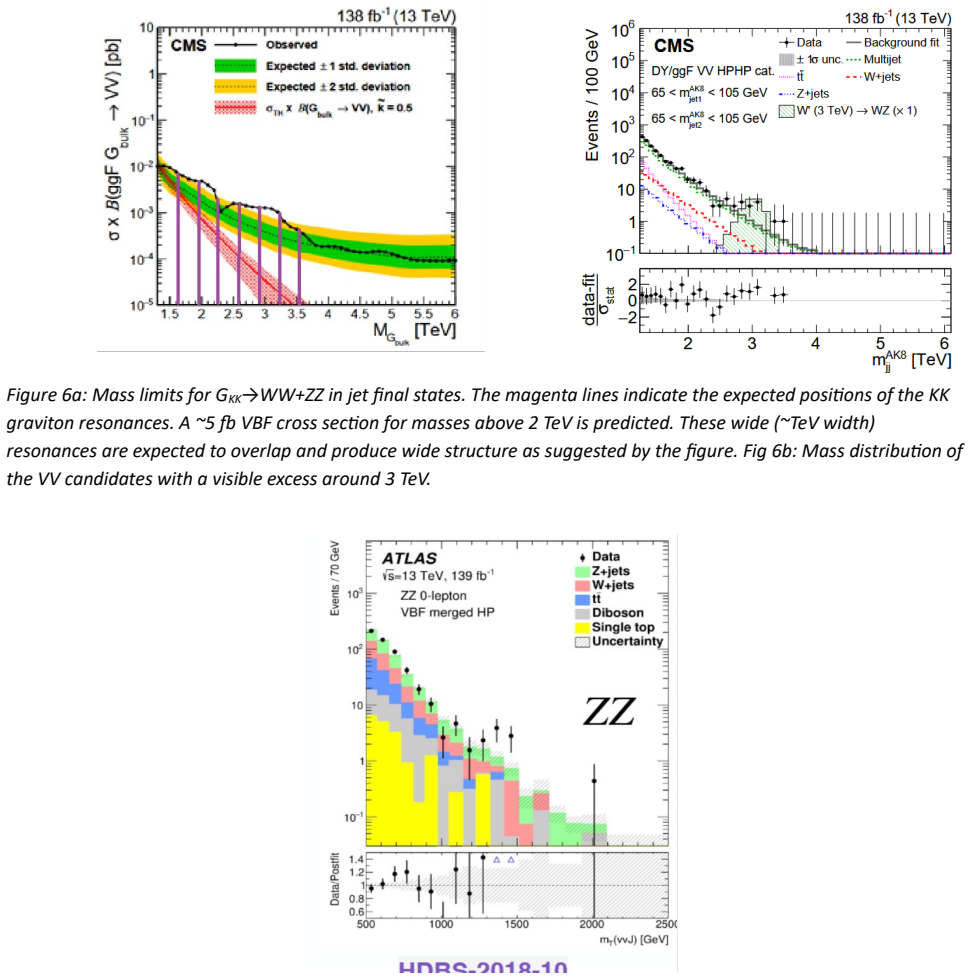
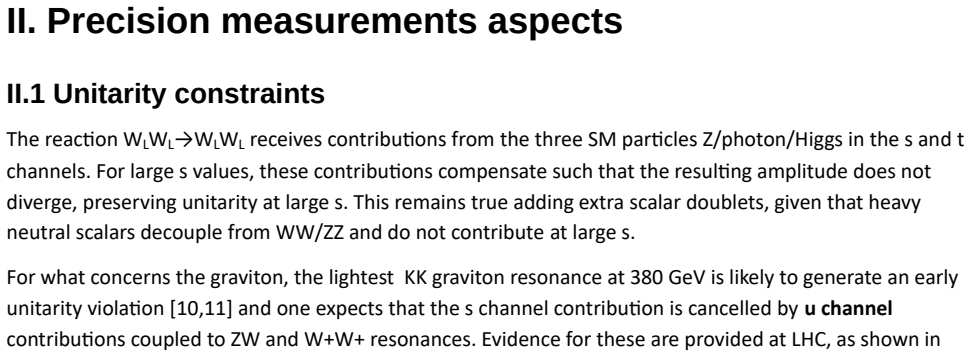
- Further signals are expected in searches for heavy resonances decaying to ZZ or WW in semi-leptonic and fully hadronic final states.
Where Pith is reading between the lines
- The same resonance pattern could be tested by comparing the size of the excess across different Higgs-pair final states.
- If the two predicted masses are both present, their relative rates would provide a direct check on the spacing of the series.
- An absence of corresponding signals in precision observables would require additional assumptions to keep the interpretation consistent.
- RUN3 data could separate a resonant contribution from a uniform modification of the triple Higgs vertex by examining the shape of the excess.
Load-bearing premise
The parameters fitted to the 380 and 700 GeV candidates correctly predict both the existence and the hh decay rates of the resonances at 1000 and 1300 GeV.
What would settle it
Absence of the predicted resonances or of the matching excess in the hh channel (or in ZZ/WW searches) once RUN3 luminosity is collected would show that the lower-mass candidates do not generate the higher-mass states with the claimed hh branching fractions.
Figures


read the original abstract
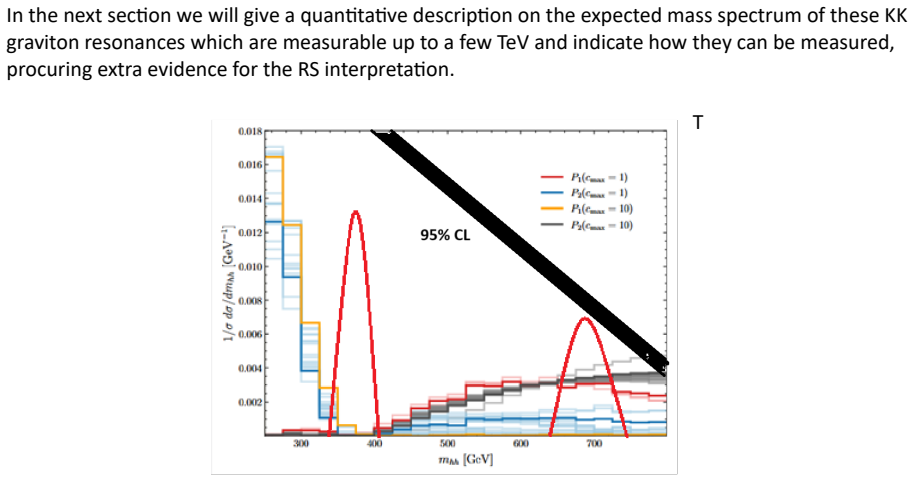
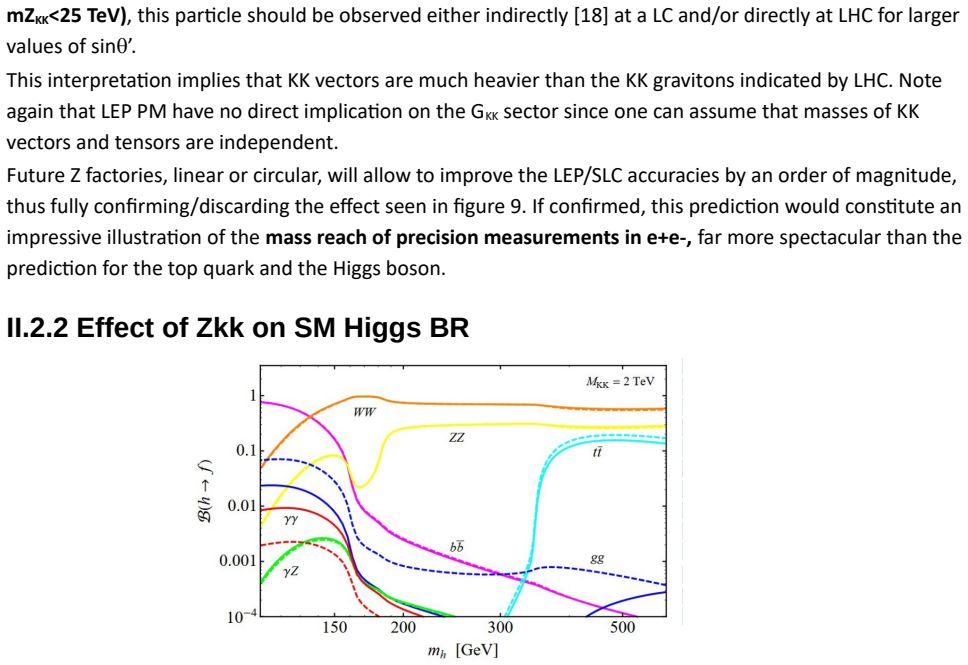
Evidence for two KK graviton candidates has been previously reported at 380 GeV and 700 GeV. Following a Randall Sundrum interpretation, two extra resonances should appear at 1000 GeV and 1300 GeV. Recently ATLAS, in its search for triple Higgs coupling, has reported an excess in that mass region in conformity with this prediction. Local cross sections are therefore clearly in excess of the standard predictions even for large values of kl. While still marginally significant, this effect appears in a mass region with low background which allows to expect good prospects of discovery with RUN3 data. Such a result could therefore allow to interpret an excess in the measurement of kl and confirm the existence of a series of KK graviton resonances observable at LHC. Other opportunities seem to appear in searches for heavy resonances decaying into ZZ/WW in semi-leptonic and fully hadronic modes. Indirect evidences for the RS model coming from precision measurements are also presented.
Editorial analysis
A structured set of objections, weighed in public.
Referee Report
Summary. The manuscript claims that prior reports of KK graviton candidates at 380 GeV and 700 GeV, interpreted in the Randall-Sundrum model, imply additional resonances at 1000 GeV and 1300 GeV. It asserts that a recent ATLAS excess in the triple-Higgs search appears in this mass region in conformity with the prediction, implying that local cross sections exceed Standard Model expectations even for large values of the trilinear coupling modifier kl. The note discusses prospects for confirmation with RUN3 data, other resonance search channels, and indirect RS-model evidence from precision measurements.
Significance. If the claimed quantitative match between the extrapolated RS-model predictions and the ATLAS hh excess were demonstrated, the result would link an apparent deviation in the triple-Higgs measurement to a specific new-physics scenario and motivate targeted follow-up searches. The absence of any explicit cross-section calculation, partial-width derivation, or statistical comparison in the manuscript, however, prevents the claim from being evaluated on its own terms.
major comments (2)
- Abstract: the assertion that the ATLAS excess is 'in conformity with this prediction' and that 'local cross sections are therefore clearly in excess of the standard predictions even for large values of kl' is unsupported by any derivation of the relevant warp factor, gluon/Higgs couplings, partial widths to hh, or resulting differential cross sections; no numerical comparison to the reported excess or to SM expectations is supplied.
- Abstract: the 1000 GeV and 1300 GeV masses are obtained solely by scaling the authors' own prior 380 GeV and 700 GeV candidates within the same RS-model fit; the manuscript therefore provides no independent test of the model's predictive power for the hh channel at these higher masses.
minor comments (1)
- The symbol kl is used without explicit definition or reference to its relation to the trilinear Higgs coupling modifier; a brief clarification would aid readability.
Simulated Author's Rebuttal
We thank the referee for the careful reading and constructive comments on our manuscript. The points raised concern the level of supporting detail for the claims in the abstract. We respond to each major comment below, indicating revisions where appropriate.
read point-by-point responses
-
Referee: Abstract: the assertion that the ATLAS excess is 'in conformity with this prediction' and that 'local cross sections are therefore clearly in excess of the standard predictions even for large values of kl' is unsupported by any derivation of the relevant warp factor, gluon/Higgs couplings, partial widths to hh, or resulting differential cross sections; no numerical comparison to the reported excess or to SM expectations is supplied.
Authors: We agree that the present concise note does not contain explicit new derivations of the warp factor, couplings, partial widths, or differential cross sections. These quantities were calculated and reported in our prior publications on the 380 GeV and 700 GeV candidates. The current manuscript is intended to highlight the mass-region consistency with the ATLAS triple-Higgs excess. In revision we will add a short section summarizing the relevant RS parameters (warp factor and couplings) from the earlier work and a qualitative discussion of the implied hh signal strength relative to the reported ATLAS excess. A full numerical comparison remains limited by the non-public nature of the complete ATLAS dataset. revision: partial
-
Referee: Abstract: the 1000 GeV and 1300 GeV masses are obtained solely by scaling the authors' own prior 380 GeV and 700 GeV candidates within the same RS-model fit; the manuscript therefore provides no independent test of the model's predictive power for the hh channel at these higher masses.
Authors: The 1000 GeV and 1300 GeV values follow from the RS model spectrum once the warp factor is fixed by the lower-mass resonances; the KK graviton masses are determined by the zeros of the appropriate Bessel functions and therefore constitute a definite model prediction rather than a new fit. The ATLAS excess appearing in the predicted mass window provides a test of that prediction. We acknowledge that a quantitative cross-section comparison (addressed in the first comment) would strengthen the presentation, and we will incorporate the requested summary of parameters in the revision. The scaling itself is model-driven and not arbitrary. revision: partial
Circularity Check
Masses and hh rates at 1000/1300 GeV reduce to scaling of authors' own prior 380/700 GeV fits
specific steps
-
fitted input called prediction
[abstract]
"Evidence for two KK graviton candidates has been previously reported at 380 GeV and 700 GeV. Following a Randall Sundrum interpretation, two extra resonances should appear at 1000 GeV and 1300 GeV. Recently ATLAS, in its search for triple Higgs coupling, has reported an excess in that mass region in conformity with this prediction."
The 1000 and 1300 GeV masses (and implied hh rates) are obtained by scaling the authors' own prior 380 and 700 GeV candidates inside the RS framework. The 'prediction' and the claim of conformity with the ATLAS excess therefore reduce to a re-expression of quantities already fitted by the same group, with no new first-principles calculation supplied.
-
self citation load bearing
[abstract]
"Evidence for two KK graviton candidates has been previously reported at 380 GeV and 700 GeV. Following a Randall Sundrum interpretation, two extra resonances should appear at 1000 GeV and 1300 GeV."
The load-bearing premise that the RS parameters fitted to the authors' prior candidates correctly predict both the existence and hh decay rates of the higher resonances is justified only by self-citation to that earlier work; the present note invokes the interpretation without re-deriving the relevant parameters or widths.
full rationale
The paper's central claim—that ATLAS hh excess conforms to a prediction of new KK graviton resonances and their decay rates—rests on applying RS model parameters fitted to the authors' earlier 380 and 700 GeV candidates. No independent derivation of the warp factor, couplings, or partial widths appears in the present text; the new masses and cross-section expectations are therefore a direct re-expression of the prior fitted inputs. This matches the fitted-input-called-prediction pattern and renders the quantitative match to ATLAS data non-independent.
Axiom & Free-Parameter Ledger
free parameters (1)
- kl
axioms (1)
- domain assumption The Randall-Sundrum warped geometry produces a tower of KK graviton resonances whose masses are fixed by the warp factor once the lowest two are identified.
invented entities (1)
-
KK graviton resonances at 1000 and 1300 GeV
no independent evidence
Reference graph
Works this paper leans on
-
[1]
Leney(Southern Methodist U.)(Sep 26, 2024) Published in: Ann.Rev.Nucl.Part.Sci
New resonances at LHC Alain Le Yaouanc(IJCLab, Orsay), François Richard(IJCLab, Orsay e-Print: 2506.094 Recent oral presentations: • 3rd ECFA workshop on e+e- Higgs, Electroweak and Top Factories e-Print: 2408.12178 • LCWS 2025 Valencia https://agenda.linearcollider.org/event/10594/sessions/5644/#20251021 • IRN Terascale workshop in Orsay, April 2026 http...
arXiv 2025
-
[2]
Warped Gravitons at the LHC and Beyond K. Agashe (Syracuse), H. Davoudiasl (Brookhaven), G. Perez (Stony Brook), A. Soni (Brookhaven)(July, 2007)Published in: Phys.Rev. D76:036006,2007, e-print: hep-ph/0701186 [5]Combination of Searches for Resonant Higgs Boson Pair Production Using pp Collisions at sqrt(s)=13 TeV with the ATLAS Detector ATLAS Collaborati...
Pith/arXiv arXiv 2007
-
[3]
Search for charged Higgs bosons produced in vector boson fusion processes and decaying into vector boson pairs in proton–proton collisions at sqrt(s)=13 TeV CMS Collaboration Albert M Sirunyan(Yerevan Phys. Inst.) et al. (Apr 10, 2021) Published in: Eur.Phys.J.C 81 (2021) 8, 723 e-Print: 2104.04762 [14]The Custodial Randall-Sundrum Model: From Precision T...
arXiv 2021
discussion (0)
Sign in with ORCID, Apple, or X to comment. Anyone can read and Pith papers without signing in.