Exploring effective charge in electromigration using machine learning
Pith reviewed 2026-05-25 11:02 UTC · model grok-4.3
The pith
Machine learning models effective charge z* in electromigration as a linear function of elemental properties
A machine-rendered reading of the paper's core claim, the machinery that carries it, and where it could break.
Core claim
The effective charge z* can be modeled as a linear function of elemental properties using machine learning approaches, with 5-fold leave-out-alloy-group cross-validation yielding RMSE/σ of 0.37 ± 0.01 and R² of 0.86, plus limited but potentially useful predictive ability when extrapolating to z* of totally new alloys.
What carries the argument
Linear regression model relating z* to elemental properties, fitted via machine learning
Load-bearing premise
The effective charge for new alloys follows the same linear relationships with elemental properties observed in the training set of measured alloys
What would settle it
A measured z* value for a new alloy that lies well outside the model's predicted range would disprove the extrapolation claim
Figures


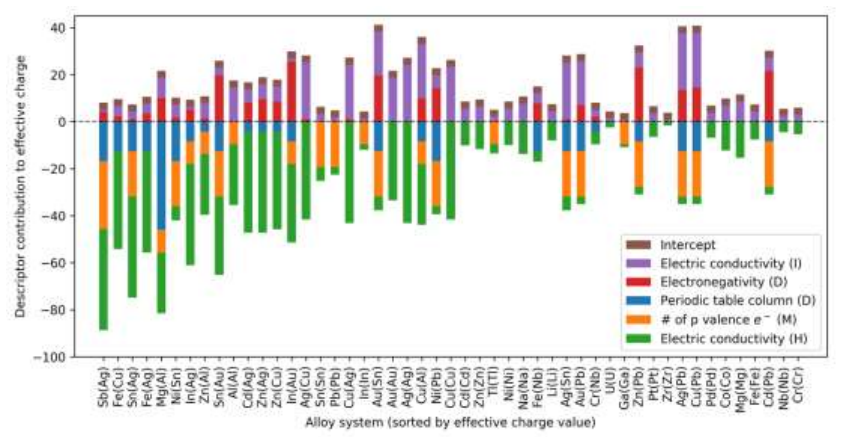

read the original abstract
The effective charge of an element is a parameter characterizing the electromgration effect, which can determine the reliability of interconnection in electronic technologies. In this work, machine learning approaches were employed to model the effective charge (z*) as a linear function of physically meaningful elemental properties. Average 5-fold (leave-out-alloy-group) cross-validation yielded root-mean-square-error divided by whole data set standard deviation (RMSE/$\sigma$) values of 0.37 $\pm$ 0.01 (0.22 $\pm$ 0.18), respectively, and $R^2$ values of 0.86. Extrapolation to z* of totally new alloys showed limited but potentially useful predictive ability. The model was used in predicting z* for technologically relevant host-impurity pairs.
Editorial analysis
A structured set of objections, weighed in public.
Referee Report
Summary. The manuscript applies linear regression to model the effective charge z* in electromigration as a linear function of physically meaningful elemental properties for host-impurity pairs. It reports average 5-fold leave-out-alloy-group cross-validation results of RMSE/σ = 0.37 ± 0.01 and R² = 0.86, claims limited but potentially useful extrapolation to new alloys, and applies the model to technologically relevant pairs.
Significance. If the reported cross-validation performance holds under a leakage-free protocol, the work offers a practical, feature-based route to estimate z* without new experiments, which could aid reliability predictions in microelectronics. The choice of physically interpretable inputs and the leave-out-group CV protocol are strengths that reduce some overfitting risk compared to random splits.
major comments (2)
- [Abstract] Abstract (cross-validation and extrapolation paragraphs): The leave-out-alloy-group 5-fold CV is presented as testing extrapolation to 'totally new alloys,' yet the manuscript does not specify whether the alloy groups are constructed to ensure that no host or impurity element appears in both training and test folds. Shared elemental features across groups would allow the linear model to see the same property vectors during training, undermining the independence required for the reported R² = 0.86 and the extrapolation claim.
- [Abstract] Abstract (model description): The central claim that z* is modeled 'as a linear function of physically meaningful elemental properties' is load-bearing for the extrapolation results, but the manuscript provides no explicit list of the selected features, their physical justification, or evidence that the linear form was not chosen after inspecting the data; this makes it difficult to assess whether the RMSE/σ = 0.37 reflects genuine predictive power or post-hoc fitting.
minor comments (2)
- [Abstract] The abstract reports two RMSE/σ values (0.37 ± 0.01 and 0.22 ± 0.18) without clarifying what the second value represents; this notation should be defined in the methods or results section.
- No table or figure is referenced in the provided abstract that shows the actual feature coefficients or the list of host-impurity pairs used; adding such a table would improve reproducibility.
Simulated Author's Rebuttal
We thank the referee for the careful review and constructive comments. We respond to each major comment below and will revise the manuscript to improve clarity and address the concerns.
read point-by-point responses
-
Referee: [Abstract] Abstract (cross-validation and extrapolation paragraphs): The leave-out-alloy-group 5-fold CV is presented as testing extrapolation to 'totally new alloys,' yet the manuscript does not specify whether the alloy groups are constructed to ensure that no host or impurity element appears in both training and test folds. Shared elemental features across groups would allow the linear model to see the same property vectors during training, undermining the independence required for the reported R² = 0.86 and the extrapolation claim.
Authors: The leave-out-alloy-group CV partitioned the data by unique host-impurity pairs, holding out all entries for each group in a given fold. We agree the manuscript does not explicitly describe whether this construction eliminates overlap of individual elements (hosts or impurities) between folds. In our dataset, some elements do appear in multiple pairs, allowing partial feature overlap. This is a valid point that weakens the 'totally new alloys' phrasing. We will revise the methods and abstract to specify the grouping procedure, report the extent of element overlap, and moderate the extrapolation language to match what the protocol actually tests. revision: yes
-
Referee: [Abstract] Abstract (model description): The central claim that z* is modeled 'as a linear function of physically meaningful elemental properties' is load-bearing for the extrapolation results, but the manuscript provides no explicit list of the selected features, their physical justification, or evidence that the linear form was not chosen after inspecting the data; this makes it difficult to assess whether the RMSE/σ = 0.37 reflects genuine predictive power or post-hoc fitting.
Authors: Feature selection was performed prior to any model fitting or CV, drawing on established physical factors known to influence electromigration (atomic size mismatch, electronegativity difference, valence electron count, and melting point). The linear form was chosen a priori for interpretability with the limited data available. We will add to the revised manuscript an explicit table listing all features with their physical motivations and a statement confirming the pre-specified nature of the model and features. revision: yes
Circularity Check
No significant circularity in empirical ML fit with group CV
full rationale
The paper fits a linear model of z* to elemental properties and reports performance via explicit 5-fold leave-out-alloy-group cross-validation plus limited extrapolation tests. This is a standard supervised learning workflow in which held-out groups supply the validation metric; the reported RMSE/σ and R² are therefore not equivalent to the training inputs by construction. No self-definitional equations, fitted-input-renamed-as-prediction, or load-bearing self-citation chains appear in the provided text. The central claim remains an empirical correlation whose validity rests on the independence of the CV splits rather than on any internal reduction.
Axiom & Free-Parameter Ledger
free parameters (1)
- linear regression coefficients
axioms (1)
- domain assumption Effective charge z* is adequately described by a linear combination of elemental properties
Reference graph
Works this paper leans on
-
[1]
Figures Data: Fig X.csv and Fig SX.csv contain all the data used to make Figure X and Figure SX in the manuscript and the SI, respectively
-
[2]
Original data sets: The complete databases used in the study, including all effective charges and all descriptors for all the alloy and pure metal system s is titled “Dataset(used)”. The complete initially developed database is titled “Dataset(whole)”. The text file titled “Reference_dataset” on Figshare lists the references used to obtain the database of...
-
[3]
K.N. Tu, Y. Liu and M. Li: Effect of Joule heating and current crowding on electromigration in mobile technology. Applied Physics Reviews 4, 011101 (2017)
work page 2017
-
[4]
H.B. Huntington and A.R. Grone: Current-induced marker motion in gold wires. Journal of Physics and Chemistry of Solids 20, 76 (1961)
work page 1961
-
[5]
C. Bosvieux and J. Friedel: Sur l'electrolyse des alliages metalliques. Journal of Physics and Chemistry of Solids 23, 123 (1962)
work page 1962
-
[6]
Blech: Electromigration in thin aluminum films on titanium nitride
I.A. Blech: Electromigration in thin aluminum films on titanium nitride. Journal of Applied Physics 47, 1203 (1976)
work page 1976
- [7]
-
[8]
Sorbello: Theory of electromigration
R.S. Sorbello: Theory of electromigration. Solid State Physics 51, 159 (1997). 30
work page 1997
- [9]
-
[10]
J. Shi and H.B. Huntington: Electromigration of gold and silver in single crystal tin. J. Phys. Chem. Solids 48, 693 (1987)
work page 1987
-
[11]
J. van Ek, J.P. Dekker and A. Lodder: Electromigration of substitutional impurities in metals: Theory and application in Al and Cu. Phys. Rev. B: Condens. Matter 52, 8794 (1995)
work page 1995
- [12]
-
[13]
J.P. Dekker and A. Lodder: Calculated electromigration wind force in face- centered-cubic and body-centered-cubic metals. Journal of Applied Physics 84, 1958 (1998)
work page 1958
- [14]
-
[15]
Lodder: Direct Force Controversy in Electromigration Exit
A. Lodder: Direct Force Controversy in Electromigration Exit. Defect and Diffusion Forum 261-262, 77 (2007). 31
work page 2007
-
[16]
A. Agrawal and A. Choudhary: Perspective: Materials informatics and big data: Realization of the “fourth paradigm” of science in materials science. APL Materials 4, 053208 (2016)
work page 2016
-
[17]
R. Ramprasad, R. Batra, G. Pilania, A. Mannodi-Kanakkithodi and C. Kim: Machine learning in materials informatics: recent applications and prospects. npj Comput. Mater. 3, 54 (2017)
work page 2017
-
[18]
L. Ward, A. Agrawal, A. Choudhary and C. Wolverton: A general-purpose machine learning framework for predicting properties of inorganic materials. npj Comput. Mater. 2, 16028 (2016)
work page 2016
-
[19]
W. Li, R. Jacobs and D. Morgan: Predicting the thermodynamic stability of perovskite oxides using machine learning models. Comput. Mater. Sci. 150, 454 (2018)
work page 2018
-
[20]
D.M. Dimiduk, E.A. Holm and S.R. Niezgoda: Perspectives on the Impact of Machine Learning, Deep Learning, and Artificial Intelligence on Materials, Processes, and Structures Engineering. Integrating Materials and Manufacturing Innovation 7, 157 (2018)
work page 2018
-
[21]
H. Wu, A. Lorenson, B. Anderson, L. Witteman, H. Wu, B. Meredig and D. Morgan: Robust FCC solute diffusion predictions from ab-initio machine learning methods. Comput. Mater. Sci. 134, 160 (2017). 32
work page 2017
- [22]
-
[23]
M. De Jong, W. Chen, R. Notestine, K. Persson, G. Ceder, A. Jain, M. Asta and A.J.S.r. Gamst: A statistical learning framework for materials science: application to elastic moduli of k-nary inorganic polycrystalline compounds. Sci. Rep. 6, 34256 (2016)
work page 2016
-
[24]
T. Mueller, A.G. Kusne and R. Ramprasad: Machine learning in materials science: Recent progress and emerging applications. Rev. Comput. Chem. 29, 186 (2016)
work page 2016
-
[25]
F. Pedregosa, Ga, #235, l. Varoquaux, A. Gramfort, V. Michel, B. Thirion, O. Grisel, M. Blondel, P. Prettenhofer, R. Weiss, V. Dubourg, J. Vanderplas, A. Passos, D. Cournapeau, M. Brucher, M. Perrot, #201 and d. Duchesnay: Scikit-learn: Machine Learning in Python. J. Mach. Learn. Res. 12, 2825 (2011)
work page 2011
- [26]
-
[27]
Raschka: MLxtend: Providing machine learning and data science utilities and extensions to Python's scientific computing stack. J. Open Source Softw. 3 (2018)
work page 2018
-
[28]
G. DiGiacomo, P. Peressini and R. Rutledge: Diffusion coefficient and electromigration velocity of copper in thin silver films. J. Appl. Phys. 45, 1626 (1974)
work page 1974
-
[29]
C.W. Park and R.W. Vook: Electromigration-resistant Cu-Pd alloy films. Thin Solid Films 226, 238 (1993)
work page 1993
- [30]
-
[31]
H.M. Gilder and D. Lazarus: Effect of High Electronic Current Density on the Motion of Au195 and Sb125 in Gold. Phys. Rev. 145, 507 (1966)
work page 1966
-
[32]
N. Bekiaris, Z. Wu, H. Ren, M. Naik, J.H. Park, M. Lee, T.H. Ha, W. Hou, J.R. Bakke, M. Gage, Y. Wang and J. Tang: Cobalt fill for advanced interconnects, in 2017 IEEE International Interconnect Technology Conference (IITC) (2017), pp. 1
work page 2017
discussion (0)
Sign in with ORCID, Apple, or X to comment. Anyone can read and Pith papers without signing in.