REVIEW 3 major objections 6 minor 2 cited by
Entailed Between the Lines: Incorporating Implication into NLI
T0 review · 3 major / 6 minor · reviewed 2026-08-10 · deepseek-v4-flash
Pith's one-line read This paper claims that fine-tuning on a new implied-entailment dataset teaches NLI models to recognize entailments that are implied rather than explicit, and that the skill transfers across datasets and domains.
desk verdict INLI is a useful, well-built resource for implicit inference, but its 'implied entailment' label is broader than strict entailment; the paper should re-scope that claim. read the letter →
The pith
A machine-rendered reading of the paper's core claim, the machinery that carries it, and where it could break.
The reading
What carries the argument
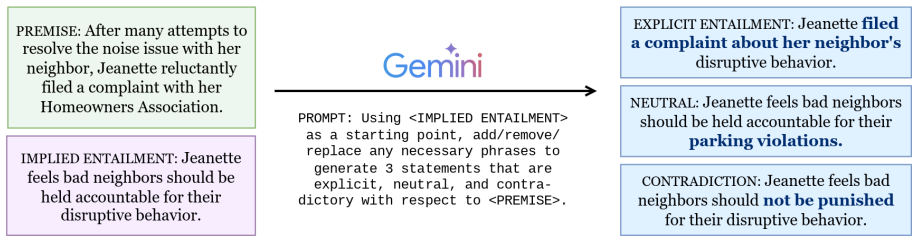
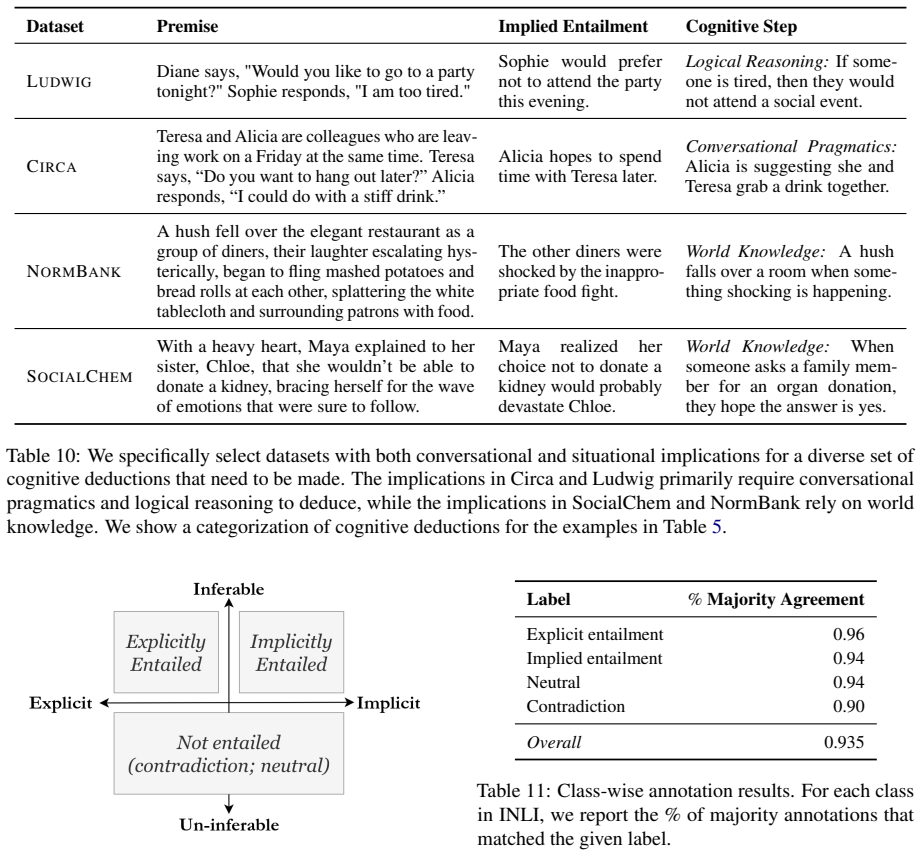
The central object is the four-way label taxonomy and the INLI dataset built on it. An implied entailment is defined as a hypothesis that is entailed by the premise only through an extra cognitive step—logical reasoning, world knowledge, conversational pragmatics, or figurative language—in contrast to an explicit entailment that follows directly from lexical and syntactic form. The mechanism that carries the argument is a two-stage generation pipeline: structured implicature frames from four source datasets (indirect-answer dialogues and social-norm situations) are converted into premise–implied-entailment pairs by prompting an LLM, and the same LLM then writes explicit, neutral, and contradictory alternatives from each implied entailment, with paraphrasing to suppress superficial cues. A T5-XXL fine-tuned on INLI serves both as the implicitness detector that quantifies implied entailments in existing benchmarks and as the learner whose accuracy and generalization figures are reported.
What would settle it
Take a random sample of INLI's implied entailments and have annotators apply a strict logical-entailment standard that forbids defeasible social inference, then measure how many premises actually guarantee their hypotheses; a large failure rate would show the dataset trains plausibility judgment rather than entailment.
Extended reading notes
Core claim
On its own terms, the paper claims that today's NLI models fail at implication not because the reasoning is inherently hard but because standard benchmarks rarely contain it: a T5-XXL trained on INLI classifies only 3.68–15.66% of entailments in SNLI, MNLI, ANLI, and WANLI as implied, and models fine-tuned on those datasets score roughly 0.50–0.71 on implied entailments in INLI while scoring 0.905–0.983 on explicit ones. The paper's central discovery is that this deficit is trainable: fine-tuning a T5-XXL on INLI reaches 0.885 implied-entailment accuracy, and the skill transfers to unseen datasets and domains, sometimes outperforming few-shot prompted large language models on held-out subsets. It also reports that adding INLI to standard NLI training preserves or slightly improves accuracy on all four standard benchmarks, with ANLI improving most.
Load-bearing premise
The load-bearing premise is that the hypotheses labeled 'implied entailment' really are entailed by their premises, with the paper's definition of entailment broadened to include extra cognitive steps; if those inferences are instead merely plausible, culturally expected, or defeasible, the INLI task measures plausibility rather than entailment.
Editorial extensions
If this is right
- Existing NLI benchmarks under-represent implied entailment, so their high accuracy numbers overstate how well models understand what is entailed rather than merely stated.
- Fine-tuning on INLI raises implied-entailment accuracy from near chance for standard-benchmark-trained models to 0.885 for T5-XXL, showing the deficit is trainable.
- INLI-trained models generalize across domains and to held-out source datasets, indicating implication understanding transfers beyond the training distribution.
- Combining INLI with standard NLI training preserves standard benchmark accuracy and slightly improves ANLI, so the added capability does not come at the expense of traditional entailment.
Reading between the lines
- Editorial inference: because many INLI implied entailments are defeasible social or pragmatic inferences (e.g., inferring shock from a hush falling over a restaurant), the dataset probably measures a broad inferable plausibility rather than strict logical entailment; a separate strict-entailment evaluation would clarify what models actually learn.
- Editorial inference: the generalization evidence covers only conversational and situational domains, so extending INLI to formal, medical, or legal text would test whether the implicitness signal is genuinely general or domain-specific.
- Editorial inference: the low implied-entailment percentages reported for existing benchmarks come from a classifier trained on INLI's own label definition, so the exact figures would shift under a different operationalization of implicitness; the qualitative finding of under-representation is likely to survive.
- Editorial inference: if the effect holds, INLI-style training could improve downstream applications that depend on implicit meaning, such as summarization evaluation, citation generation, and mental-health or creative-writing support, by making models distinguish what is said from what is meant.
Editorial analysis
A structured set of objections, weighed in public.
Referee Report
Summary. This paper introduces the task of 'implied entailment' as a four-way refinement of NLI, distinguishing explicit entailment, implied entailment, neutral, and contradiction. The authors construct the INLI dataset (40k hypothesis-premise pairs) by prompting Gemini-Pro to convert implicature frames from four existing resources (LUDWIG, CIRCA, NORM BANK, SOCIAL CHEM) into premises and implied hypotheses, and to generate alternative hypotheses. They show that T5 models fine-tuned on INLI outperform prompted LLMs, that existing NLI benchmarks contain few examples classified as implied entailment by a T5 classifier trained on INLI, that fine-tuning on INLI does not degrade performance on standard NLI benchmarks, and that models generalize across INLI's source-dataset splits. Human validation of 200 INLI pairs and of the implicitness classifier is reported.
Significance. If the task definition is accepted, the paper makes a useful methodological contribution: a reproducible pipeline for creating a multi-label NLI-style benchmark, publicly released code and prompts, and a systematic comparison of fine-tuned and prompted models. The idea of separating implicit from explicit entailment is practically relevant for downstream applications. However, the central claim is currently weakened by the gap between the formal definition of implied entailment and the operational annotation instructions, and by the synthetic, same-pipeline nature of the generalization results. The paper deserves consideration after the scope and evidence are tightened.
major comments (3)
- [Section 2 / Table 1 caption / Appendix B] The formal definition says an implied entailment is 'fully entailed in the premise,' but the annotation instructions operationalize inferability as 'able to be reasonably inferred' and the generation prompt defines an implicature as 'a statement that can be inferred from the passage.' These are not equivalent: the NORM BANK example in Table 10 ('A hush fell over the elegant restaurant...' -> 'The other diners were shocked by the inappropriate food fight') is cancellable, since a continuation like '...yet the diners continued chatting, unbothered' is consistent with the premise. The Limitations section itself concedes that 'the implied entailment may follow for some readers, but not all.' Because the abstract and title claim that models learn to recognize 'implied entailments' as entailments, the paper needs to either (a) demonstrate that a large majority of INLI implied labels are non-defeasible under a concrete cancellability test (e.g., using blocking continuations judged by human annotators, along the lines of Rudinger et al., 2020), or (b) re-scope the contribution to 'implicit textual inference' and adjust all claims accordingly. As written, the benchmark may largely measure plausible social/pragmatic inference rather than NLI entailment.
- [Section 3.1 / Table 2] The statistic that existing NLI benchmarks contain few implied entailments is produced by a classifier fine-tuned on INLI, so the estimate is not independent of the authors' own definition and generation pipeline. The human validation in Appendix A.1 is based on only 80 examples (20 per benchmark), which is too small to establish the classifier's accuracy separately for each benchmark or to rule out systematic label bias. I recommend reporting human annotations on a larger stratified sample from each benchmark, or at least providing confidence intervals for the percentages in Table 2.
- [Section 5.3 / Table 8] The generalization experiments are all evaluated on held-out subsets of INLI, which were generated with the same Gemini-Pro pipeline and the same definition of 'implied entailment.' This supports generalization across the four seed datasets, but not the abstract's broader claim of generalizing 'across datasets and domains' in the sense of independent human-created resources. To support that claim, the authors should evaluate on at least one genuinely independent benchmark with implicit-inference annotations (e.g., an existing implicature or defeasible-inference dataset) or on human-written premises not produced by their pipeline. The retention results in Table 7 show that standard NLI performance does not collapse, but they do not demonstrate transfer of implication understanding.
minor comments (6)
- [Table 3] Please clarify whether the reported 'entailment accuracy' is on a binary entailment/not-entailment task or on the full four-way task; the text is ambiguous.
- [Appendix E.3] The prompts use the labels 'Implicature' and 'Explicature' while the rest of the paper uses 'implied entailment' and 'explicit entailment'; this terminological inconsistency should be reconciled to avoid confusing readers and model instructions.
- [Appendix A.3] The word 'famliy' should be 'family.'
- [Table 11] Since the validation set contains only 200 examples, class-wise majority agreement percentages are based on roughly 50 examples per label; this should be acknowledged when comparing with the model-accuracy upper bound mentioned in Section 5.1.
- [Tables 3, 6, 7, 8] No standard deviations or repeated runs are reported for the fine-tuned models; adding at least a few seeds would make the main comparisons more robust.
- [Section 4.2] The claim that paraphrasing addresses stylistic artifacts would be stronger with a small human evaluation of whether the paraphrases preserve label validity; currently the hypothesis-only baseline in Appendix D is the only evidence.
Circularity Check
No significant circularity: INLI construction, held-out evaluations, and human validation make the central claims self-contained.
full rationale
The paper's derivation chain is: define implied entailment, construct INLI from existing implicature frames, benchmark LLMs on INLI, then fine-tune on INLI and evaluate on held-out INLI subsets and standard NLI benchmarks. None of these steps substitutes an input for an output. The dataset labels are the target variable, not a parameter fitted to the evaluation. Fine-tuning results compare models trained on standard NLI benchmarks against models trained on INLI, with performance measured on a held-out INLI test set, which is a standard non-circular evaluation. The Table 2 motivation statistic is produced by an implicitness classifier trained on INLI, but the model is then applied to unseen benchmark entailments, and the paper reports human validation with 92% agreement and Cohen's kappa 0.768 on a balanced 80-example sample; the result is an empirical estimate rather than a forced consequence of the training data. The generalization experiments in Table 8 are within INLI's own pipeline, which limits external-domain claims but does not make the measurement circular because the held-out subsets were not used for training. The limitations section acknowledges that implied entailment labels may not follow for all readers and that the dataset is not fully human-vetted; these are construct-validity concerns about whether the task measures entailment versus plausible inference, not circularity of the derivation. Self-citations, such as Hosseini et al. 2024b for learning-rate choices, are incidental and not load-bearing.
Assumptions & free parameters
assumptions (5)
- domain assumption Standard 3-way NLI label definitions (entailment, neutral, contradiction) are used as ground truth.
- ad hoc to paper Implied entailment is defined as entailed and implicit, requiring an additional cognitive step.
- domain assumption Source implicature datasets (LUDWIG, CIRCA, NORM BANK, SOCIAL CHEM) contain valid implicature frames.
- domain assumption Gemini-Pro generations are valid enough to serve as training labels for INLI.
- domain assumption The implicitness classifier trained on INLI generalizes to existing NLI benchmarks.
Cite this review
Pith. "Pith review of Entailed Between the Lines: Incorporating Implication into NLI." pith.science (2026). https://pith.science/paper/WWZIRSHH
@misc{pith2026250107719,
  author       = {Pith},
  title        = {Pith review of: Entailed Between the Lines: Incorporating Implication into NLI},
  year         = {2026},
  howpublished = {\url{https://pith.science/paper/WWZIRSHH}},
  note         = {Machine review of arXiv:2501.07719}
}
read the original abstract
Much of human communication depends on implication, conveying meaning beyond literal words to express a wider range of thoughts, intentions, and feelings. For models to better understand and facilitate human communication, they must be responsive to the text's implicit meaning. We focus on Natural Language Inference (NLI), a core tool for many language tasks, and find that state-of-the-art NLI models and datasets struggle to recognize a range of cases where entailment is implied, rather than explicit from the text. We formalize implied entailment as an extension of the NLI task and introduce the Implied NLI dataset (INLI) to help today's LLMs both recognize a broader variety of implied entailments and to distinguish between implicit and explicit entailment. We show how LLMs fine-tuned on INLI understand implied entailment and can generalize this understanding across datasets and domains.
Figures


Figures from the paper (1 more)
Forward citations
Cited by 2 Pith papers
-
On Reference (In-)Determinacy in Natural Language Inference
RefNLI exposes a reference determinacy bias in NLI models that causes high false contradiction and entailment rates when verifying claims against retrieved evidence.
-
Reference-Free Evaluation of Reasoning in Open-Ended Question Answering
An NLI-hypergraph audit with deterministic AND–OR search labels LLM reasoning segments as supported, unsupported, or orphaned, improving balanced F1 over LLM-as-judge on a new 40-case clinical benchmark.
Reference graph
Works this paper leans on
-
[1]
Antonio Valerio Miceli Barone, Barry Haddow, Ulrich Germann, and Rico Sennrich. 2017. http://arxiv.org/abs/1707.09920 Regularization techniques for fine-tuning in neural machine translation . CoRR, abs/1707.09920
work page Pith review arXiv 2017
-
[2]
Chandra Bhagavatula, Ronan Le Bras, Chaitanya Malaviya, Keisuke Sakaguchi, Ari Holtzman, Hannah Rashkin, Doug Downey, Scott Wen tau Yih, and Yejin Choi. 2020. http://arxiv.org/abs/1908.05739 Abductive commonsense reasoning
arXiv 2020
-
[3]
Yonatan Bisk, Rowan Zellers, Ronan Le Bras, Jianfeng Gao, and Yejin Choi. 2019. http://arxiv.org/abs/1911.11641 Piqa: Reasoning about physical commonsense in natural language
arXiv 2019
-
[4]
Samuel R Bowman, Gabor Angeli, Christopher Potts, and Christopher D Manning. 2015. A large annotated corpus for learning natural language inference. arXiv preprint arXiv:1508.05326
arXiv 2015
-
[5]
U.S. Census Bureau. 2011. https://web.archive.org/web/20110103145240/http://www.census.gov/genealogy/names/names_files.html 2011 census . U.S. Department of Commerce
-
[6]
Cathrine Damgaard, Paulina Toborek, Trine Eriksen, and Barbara Plank. 2021. https://doi.org/10.18653/v1/2021.codi-main.1 `` I ' ll be there for you '' : The one with understanding indirect answers . In Proceedings of the 2nd Workshop on Computational Approaches to Discourse, pages 1--11, Punta Cana, Dominican Republic and Online. Association for Computati...
-
[7]
Maxwell Forbes, Jena D Hwang, Vered Shwartz, Maarten Sap, and Yejin Choi. 2020. Social chemistry 101: Learning to reason about social and moral norms. arXiv preprint arXiv:2011.00620
arXiv 2020
-
[8]
Zhao, Ni Lao, Hongrae Lee, Da-Cheng Juan, and Kelvin Guu
Luyu Gao, Zhuyun Dai, Panupong Pasupat, Anthony Chen, Arun Tejasvi Chaganty, Yicheng Fan, Vincent Y. Zhao, Ni Lao, Hongrae Lee, Da-Cheng Juan, and Kelvin Guu. 2023. http://arxiv.org/abs/2210.08726 Rarr: Researching and revising what language models say, using language models
arXiv 2023
Show all 47 references
-
[9]
Elizabeth Jasmi George and Radhika Mamidi. 2020. Conversational implicatures in english dialogue: Annotated dataset. Procedia Computer Science, 171:2316--2323
2020
-
[10]
Deepanway Ghosal, Pengfei Hong, Siqi Shen, Navonil Majumder, Rada Mihalcea, and Soujanya Poria. 2021. http://arxiv.org/abs/2106.00510 Cider: Commonsense inference for dialogue explanation and reasoning
2021 arXiv
-
[11]
Paul Grice. 1991. Studies in the Way of Words. Harvard University Press
1991
-
[12]
Siri Gullestad and Bj rn Killingmo. 2019. The theory and practice of psychoanalytic therapy: Listening for the subtext. Routledge
2019
-
[13]
Shreya Havaldar, Matthew Pressimone, Eric Wong, and Lyle Ungar. 2023. http://arxiv.org/abs/2310.07135 Comparing styles across languages
2023 arXiv
-
[14]
Mohammad Javad Hosseini, Yang Gao, Tim Baumgärtner, Alex Fabrikant, and Reinald Kim Amplayo. 2024 a . http://arxiv.org/abs/2406.19803 Scalable and domain-general abstractive proposition segmentation
2024 arXiv
-
[15]
Mohammad Javad Hosseini, Andrey Petrov, Alex Fabrikant, and Annie Louis. 2024 b . A synthetic data approach for domain generalization of nli models. arXiv preprint arXiv:2402.12368
2024 arXiv
-
[16]
Mohammad Javad Hosseini, Filip Radlinski, Silvia Pareti, and Annie Louis. 2023. http://arxiv.org/abs/2212.10933 Resolving indirect referring expressions for entity selection
2023 arXiv
-
[17]
Paloma Jeretic, Alex Warstadt, Suvrat Bhooshan, and Adina Williams. 2020. Are natural language inference models imppressive? learning implicature and presupposition. arXiv preprint arXiv:2004.03066
2020 arXiv
-
[18]
Donghoon Kim, Yigang Pan, and Heung Soo Park. 1998. High-versus low-context culture: A comparison of chinese, korean, and american cultures. Psychology & Marketing, 15(6):507--521
1998
-
[19]
is the pope catholic?
Zae Myung Kim, David E. Taylor, and Dongyeop Kang. 2023. http://arxiv.org/abs/2305.13826 "is the pope catholic?" applying chain-of-thought reasoning to understanding conversational implicatures
2023 arXiv
-
[20]
Kalpesh Krishna, Yixiao Song, Marzena Karpinska, John Wieting, and Mohit Iyyer. 2024. Paraphrasing evades detectors of ai-generated text, but retrieval is an effective defense. Advances in Neural Information Processing Systems, 36
2024
-
[21]
Lampinen, Ishita Dasgupta, Stephanie C
Andrew K. Lampinen, Ishita Dasgupta, Stephanie C. Y. Chan, Kory Matthewson, Michael Henry Tessler, Antonia Creswell, James L. McClelland, Jane X. Wang, and Felix Hill. 2022. http://arxiv.org/abs/2204.02329 Can language models learn from explanations in context?
2022 arXiv
-
[22]
Smith, and Yejin Choi
Alisa Liu, Swabha Swayamdipta, Noah A. Smith, and Yejin Choi. 2022. https://api.semanticscholar.org/CorpusID:246016339 Wanli: Worker and ai collaboration for natural language inference dataset creation . In Conference on Empirical Methods in Natural Language Processing
2022
-
[23]
i'd rather just go to bed
Annie Louis, Dan Roth, and Filip Radlinski. 2020. " i'd rather just go to bed": Understanding indirect answers. arXiv preprint arXiv:2010.03450
2020 arXiv
-
[24]
Andrei Moldovan. 2019. Can entailments be implicatures? Philosophical Insights into Pragmatics, pages 43--62
2019
-
[25]
Yixin Nie, Adina Williams, Emily Dinan, Mohit Bansal, Jason Weston, and Douwe Kiela. 2020. http://arxiv.org/abs/1910.14599 Adversarial nli: A new benchmark for natural language understanding
2020 arXiv
-
[26]
Adam Poliak, Jason Naradowsky, Aparajita Haldar, Rachel Rudinger, and Benjamin Van Durme. 2018. http://arxiv.org/abs/1805.01042 Hypothesis only baselines in natural language inference
2018 arXiv
-
[27]
Zhuang Qiu, Xufeng Duan, and Zhenguang Cai. 2023. https://aclanthology.org/2023.naloma-1.3 Does C hat GPT resemble humans in processing implicatures? In Proceedings of the 4th Natural Logic Meets Machine Learning Workshop, pages 25--34, Nancy, France. Association for Computati...
2023
-
[28]
Colin Raffel, Noam Shazeer, Adam Roberts, Katherine Lee, Sharan Narang, Michael Matena, Yanqi Zhou, Wei Li, and Peter J Liu. 2020. Exploring the limits of transfer learning with a unified text-to-text transformer. Journal of machine learning research, 21(140):1--67
2020
-
[29]
Sunny Rai, Khushang Jilesh Zaveri, Shreya Havaldar, Soumna Nema, Lyle Ungar, and Sharath Chandra Guntuku. 2024. http://arxiv.org/abs/2402.11333 Social norms in cinema: A cross-cultural analysis of shame, pride and prejudice
2024 arXiv
-
[30]
Hwang, Chandra Bhagavatula, Maxwell Forbes, Ronan Le Bras, Noah A
Rachel Rudinger, Vered Shwartz, Jena D. Hwang, Chandra Bhagavatula, Maxwell Forbes, Ronan Le Bras, Noah A. Smith, and Yejin Choi. 2020. https://doi.org/10.18653/v1/2020.findings-emnlp.418 Thinking like a skeptic: Defeasible inference in natural language . In Findings of the As...
2020 doi
-
[31]
Vinu Sankar Sadasivan, Aounon Kumar, Sriram Balasubramanian, Wenxiao Wang, and Soheil Feizi. 2024. http://arxiv.org/abs/2303.11156 Can ai-generated text be reliably detected?
2024 arXiv
-
[32]
Maarten Sap, Saadia Gabriel, Lianhui Qin, Dan Jurafsky, Noah A Smith, and Yejin Choi. 2019. Social bias frames: Reasoning about social and power implications of language. arXiv preprint arXiv:1911.03891
2019 arXiv
-
[33]
Sperber and D
D. Sperber and D. Wilson. 1986. Relevance: Communication and Cognition. Language and thought series. Harvard University Press
1986
-
[34]
Kevin Stowe, Prasetya Utama, and Iryna Gurevych. 2022. https://doi.org/10.18653/v1/2022.acl-long.369 IMPLI : Investigating NLI models ' performance on figurative language . In Proceedings of the 60th Annual Meeting of the Association for Computational Linguistics (Volume 1: Lo...
2022 doi
-
[35]
Junya Takayama, Tomoyuki Kajiwara, and Yuki Arase. 2021. https://doi.org/10.18653/v1/2021.findings-emnlp.170 DIRECT : Direct and indirect responses in conversational text corpus . In Findings of the Association for Computational Linguistics: EMNLP 2021, pages 1980--1989, Punta...
2021 doi
-
[36]
Haoran Wang and Kai Shu. 2023. http://arxiv.org/abs/2310.05253 Explainable claim verification via knowledge-grounded reasoning with large language models
2023 arXiv
-
[37]
Adina Williams, Nikita Nangia, and Samuel Bowman. 2018. https://doi.org/10.18653/v1/N18-1101 A broad-coverage challenge corpus for sentence understanding through inference . In Proceedings of the 2018 Conference of the North A merican Chapter of the Association for Computation...
2018 doi
-
[39]
Shisen Yue, Siyuan Song, Xinyuan Cheng, and Hai Hu. 2024 b . http://arxiv.org/abs/2404.19509 Do large language models understand conversational implicature -- a case study with a chinese sitcom
2024 arXiv
-
[40]
Rowan Zellers, Ari Holtzman, Yonatan Bisk, Ali Farhadi, and Yejin Choi. 2019. http://arxiv.org/abs/1905.07830 Hellaswag: Can a machine really finish your sentence?
2019 arXiv
-
[41]
Fengzhu Zeng and Wei Gao. 2024. Justilm: Few-shot justification generation for explainable fact-checking of real-world claims. Transactions of the Association for Computational Linguistics, 12:334--354
2024
-
[42]
Sheng Zhang, Rachel Rudinger, Kevin Duh, and Benjamin Van Durme. 2017. https://doi.org/10.1162/tacl_a_00068 Ordinal Common-sense Inference . Transactions of the Association for Computational Linguistics, 5:379--395
2017 doi
-
[43]
Yuwei Zhang, Siffi Singh, Sailik Sengupta, Igor Shalyminov, Hang Su, Hwanjun Song, and Saab Mansour. 2024. http://arxiv.org/abs/2403.04314 Can your model tell a negation from an implicature? unravelling challenges with intent encoders
2024 arXiv
-
[44]
Zilong Zheng, Shuwen Qiu, Lifeng Fan, Yixin Zhu, and Song-Chun Zhu. 2021. Grice: A grammar-based dataset for recovering implicature and conversational reasoning. In Findings of the Association for Computational Linguistics: ACL-IJCNLP 2021, pages 2074--2085
2021
-
[45]
Xuhui Zhou, Hao Zhu, Akhila Yerukola, Thomas Davidson, Jena D Hwang, Swabha Swayamdipta, and Maarten Sap. 2023. Cobra frames: Contextual reasoning about effects and harms of offensive statements. arXiv preprint arXiv:2306.01985
2023 arXiv
-
[46]
Caleb Ziems, Jane Dwivedi-Yu, Yi-Chia Wang, Alon Halevy, and Diyi Yang. 2023. Normbank: A knowledge bank of situational social norms. arXiv preprint arXiv:2305.17008
2023 arXiv
-
[47]
URL: " 'urlintro :=
ENTRY address author booktitle chapter edition editor howpublished institution journal key month note number organization pages publisher school series title type volume year eprint doi pubmed url lastchecked label extra.label sort.label short.list INTEGERS output.state before...
-
[48]
write newline
" write newline "" before.all 'output.state := FUNCTION n.dashify 't := "" t empty not t #1 #1 substring "-" = t #1 #2 substring "--" = not "--" * t #2 global.max substring 't := t #1 #1 substring "-" = "-" * t #2 global.max substring 't := while if t #1 #1 substring * t #2 gl...
Reviewed August 10, 2026 · model on record in the stance chip above.
Discussion (0). Continue with ORCID to comment.