Raw-Hit Muon Tomography: A Measurement-Domain Formulation for Cosmic-Ray Muon Imaging
Pith reviewed 2026-06-26 15:15 UTC · model grok-4.3
The pith
Raw-Hit Muon Tomography formulates cosmic muon imaging directly on detector hits using a Student-t likelihood from Fermi-Eyges residuals and a Bethe-Bloch line integral for momentum loss.
A machine-rendered reading of the paper's core claim, the machinery that carries it, and where it could break.
Core claim
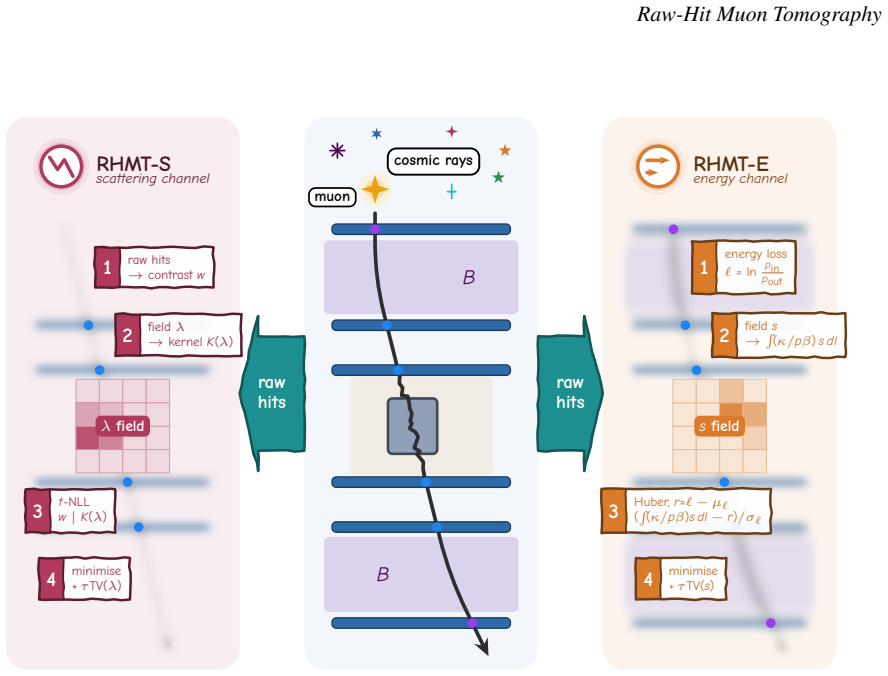
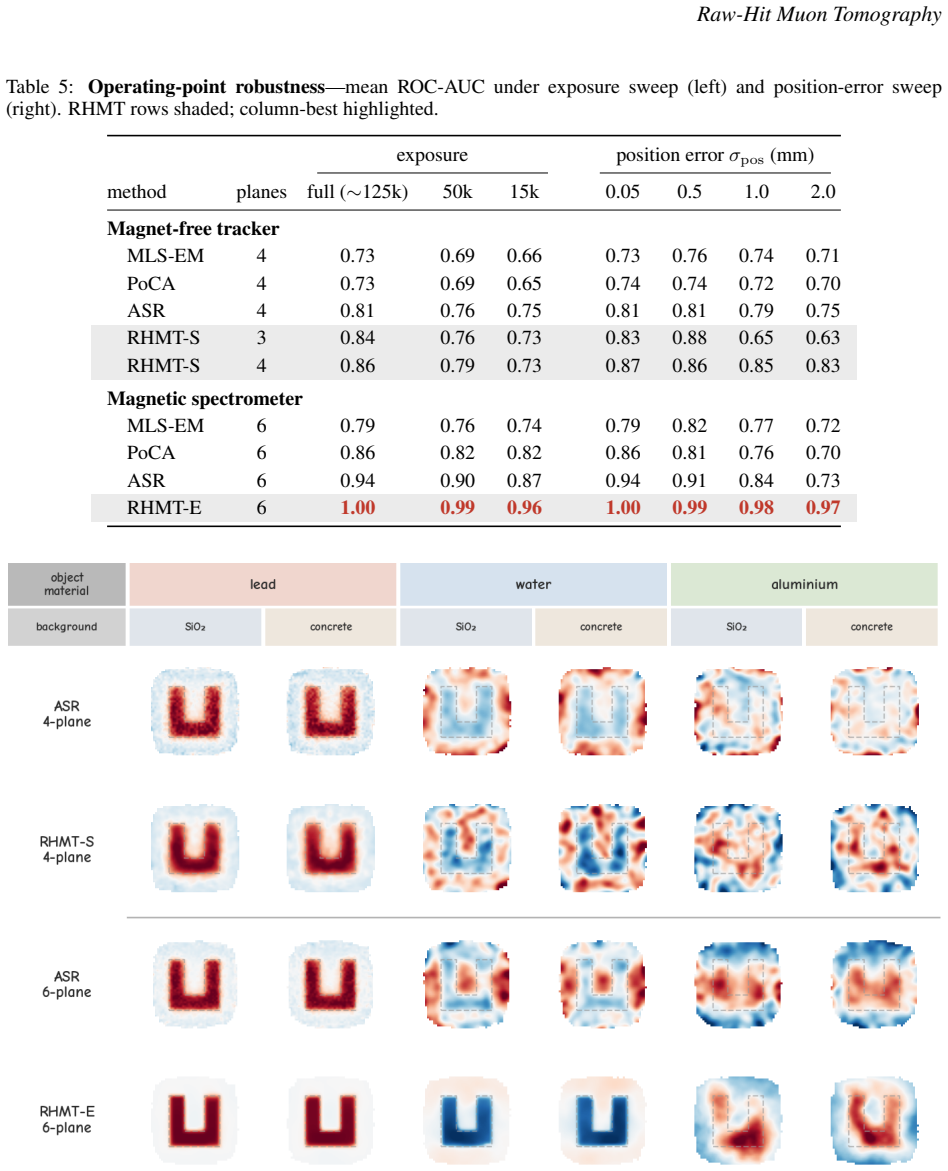
Raw-Hit Muon Tomography (RHMT) formulates the inverse problem in the measurement domain by projecting out the unknown straight track from detector hits and evaluating the residual contrast with a Fermi-Eyges covariance; marginalizing the unknown scattering scale produces a blank-calibrated Student-t-type likelihood for RHMT-S, while RHMT-E separately estimates log momentum loss in a six-plane spectrometer as a line integral of electron density contrast. In controlled Geant4 benchmarks this yields mean ROC-AUC values of 0.84-0.86 compared with 0.81 for angular-scattering reconstruction baselines, and supplies independent contrast for materials where scattering is weak.
What carries the argument
Raw-Hit Muon Tomography (RHMT) operating directly on detector hits, with RHMT-S using Fermi-Eyges covariance after track projection and marginalization to a Student-t likelihood, and RHMT-E using six-plane spectrometer fits to Bethe-Bloch line integrals of momentum loss.
If this is right
- Material discrimination improves when the full set of hit coordinates is retained rather than collapsed to a single scattering angle per muon.
- Energy-loss contrast becomes available as an orthogonal channel for low-Z materials where scattering contrast is weak.
- The Student-t likelihood after marginalization supplies automatic calibration against empty regions without separate background runs.
- Performance gains appear in the sparse-hit regime typical of four- to six-plane cosmic-muon setups.
Where Pith is reading between the lines
- The formulation could be combined with existing track-fitting pipelines to add a second contrast map without extra hardware.
- Real-world deployment would require checking whether the marginalization step remains stable when hit resolutions vary across detector planes.
- The same measurement-domain approach might extend to other charged-particle imaging modalities that record only a few plane crossings.
Load-bearing premise
The Geant4 simulation faithfully reproduces real detector hit resolutions, material interactions, and particle responses so that the reported ROC-AUC gains translate to physical data.
What would settle it
A side-by-side comparison of ROC-AUC values obtained from the same material targets imaged with a physical detector versus the Geant4 benchmark values of 0.84-0.86.
Figures
read the original abstract
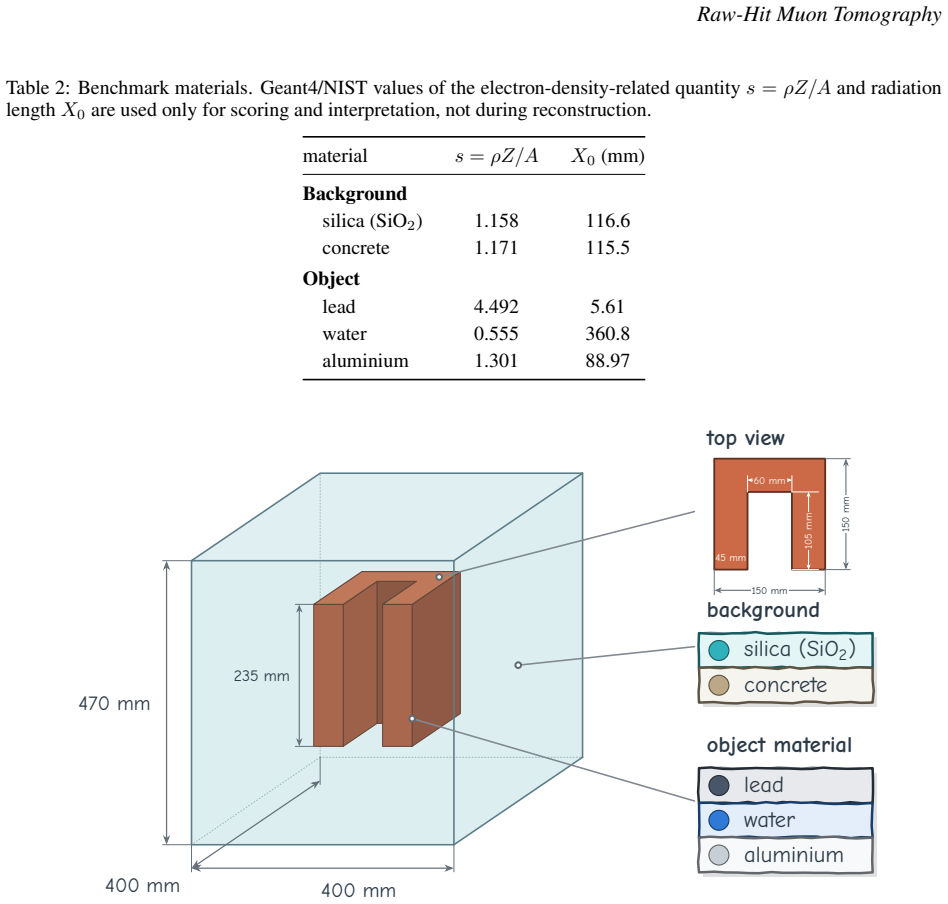
Cosmic-ray muon tomography records only a few detector-plane crossings per particle, while material information enters through stochastic scattering and energy loss along the path. Most pipelines first compress these hits to a per-muon scattering summary and assign a nominal momentum, moving the inverse problem away from the raw measurements. We introduce Raw-Hit Muon Tomography (RHMT), a measurement-domain formulation built directly on detector hits. RHMT-S projects out the unknown straight track and evaluates the remaining hit contrast with a Fermi--Eyges covariance; marginalizing the unknown scattering scale gives a blank-calibrated Student-$t$-type likelihood. RHMT-E fits the hits in a six-plane magnetic spectrometer to estimate each muon's log momentum loss and models it as a Bethe--Bloch line integral of the electron-density-related contrast $\rho Z/A$. In a controlled Geant4 benchmark, RHMT-S improves the mean ROC-AUC over four-plane scattering baselines ($0.84$--$0.86$ versus $0.81$ for ASR), and RHMT-E provides a separate energy-loss contrast for aluminium, where scattering contrast is weak.
Editorial analysis
A structured set of objections, weighed in public.
Referee Report
Summary. The paper introduces Raw-Hit Muon Tomography (RHMT), a measurement-domain formulation for cosmic-ray muon imaging that operates directly on detector hits rather than compressed per-muon summaries. RHMT-S projects out the unknown straight track, applies a Fermi-Eyges covariance to the residual hit contrast, and marginalizes an unknown scattering scale to obtain a Student-t-type likelihood. RHMT-E fits hits in a six-plane magnetic spectrometer to estimate log momentum loss modeled via a Bethe-Bloch line integral of the electron-density contrast ho Z/A. In a controlled Geant4 benchmark the manuscript reports that RHMT-S improves mean ROC-AUC to 0.84-0.86 versus 0.81 for an ASR four-plane scattering baseline, while RHMT-E supplies additional contrast for aluminum where scattering contrast is weak.
Significance. If the benchmark results are robust, the measurement-domain construction with explicit marginalization of the scattering scale offers a calibrated likelihood that avoids early compression of the data and supplies an independent energy-loss channel. This is a methodological strength that could improve discrimination in low-plane-count or low-contrast regimes. The use of standard Fermi-Eyges and Bethe-Bloch models together with the reported numerical gains over an established baseline constitutes a concrete, falsifiable advance.
major comments (1)
- [Geant4 benchmark] Geant4 benchmark section: the reported mean ROC-AUC improvement (0.84-0.86 versus 0.81) is presented without error bars, the number of simulated events, exclusion criteria, or a statistical test of the difference; these omissions are load-bearing for the central empirical claim.
minor comments (2)
- [Abstract] Abstract: the description of the six-plane spectrometer for RHMT-E would benefit from an explicit statement of the field strength and plane spacing to allow immediate comparison with existing spectrometers.
- [Methods] Notation: the symbol for the electron-density contrast ho Z/A is introduced in the abstract but its precise definition and units should be restated at first use in the methods to avoid ambiguity.
Simulated Author's Rebuttal
We thank the referee for the positive assessment of the RHMT formulation and for identifying the need for additional statistical rigor in the Geant4 benchmark. We address the single major comment below.
read point-by-point responses
-
Referee: [Geant4 benchmark] Geant4 benchmark section: the reported mean ROC-AUC improvement (0.84-0.86 versus 0.81) is presented without error bars, the number of simulated events, exclusion criteria, or a statistical test of the difference; these omissions are load-bearing for the central empirical claim.
Authors: We agree that these details are necessary to substantiate the central empirical claim. The manuscript as submitted reports only the mean ROC-AUC values. In the revised version we will (i) report error bars on the ROC-AUC means (standard error across independent simulation runs or bootstrap resampling), (ii) state the total number of simulated muon events and the number retained after any quality cuts, (iii) describe the exclusion criteria applied to tracks, and (iv) include a statistical test (e.g., paired Wilcoxon signed-rank test on per-run AUCs) together with the resulting p-value for the observed improvement over the ASR baseline. revision: yes
Circularity Check
No significant circularity detected
full rationale
The paper introduces RHMT-S and RHMT-E as new measurement-domain likelihood constructions (Fermi-Eyges covariance after track projection with marginal Student-t; Bethe-Bloch line integral on fitted log-momentum loss). Performance is reported as empirical ROC-AUC gains inside a controlled Geant4 benchmark (0.84-0.86 vs 0.81 baseline). No step reduces by definition to a fitted input, no self-citation chain is load-bearing, and no ansatz or uniqueness claim is smuggled in. The benchmark numbers are external to the internal equations and do not collapse to them by construction.
Axiom & Free-Parameter Ledger
free parameters (1)
- unknown scattering scale
axioms (2)
- domain assumption Fermi-Eyges covariance accurately describes hit contrast after projecting out the straight track
- domain assumption Bethe-Bloch formula gives the line integral of electron-density contrast from log momentum loss
Reference graph
Works this paper leans on
-
[1]
Agostinelli et al
S. Agostinelli et al. GEANT4—a simulation toolkit.Nuclear Instruments and Methods in Physics Research A, 506(3):250–303, 2003
2003
-
[2]
Jean-Marco Alameddine, Felix Sattler, Maurice Stephan, and Sarah Barnes. Gradient-descent-based reconstruc- tion for muon tomography based on automatic differentiation in PyTorch.arXiv preprint arXiv:2511.05226, 2025
arXiv 2025
-
[3]
Alvarez, Jared A
Luis W. Alvarez, Jared A. Anderson, F. El Bedwei, James Burkhard, Ahmed Fakhry, Adib Girgis, Amr Goneid, Fikhry Hassan, Dennis Iverson, Gerald Lynch, Zenab Miligy, Ali Hilmy Moussa, Mohammed Sharkawi, and Lauren Yazolino. Search for hidden chambers in the pyramids.Science, 167(3919):832–839, 1970
1970
-
[4]
Atmospheric muons as an imaging tool
Lorenzo Bonechi, Raffaello D’Alessandro, and Andrea Giammanco. Atmospheric muons as an imaging tool. Reviews in Physics, 5:100038, 2020
2020
-
[5]
Bonomi, P
G. Bonomi, P. Checchia, M. D’Errico, D. Pagano, and G. Saracino. Applications of cosmic-ray muons.Progress in Particle and Nuclear Physics, 112:103768, 2020
2020
-
[6]
Borozdin, Gary E
Konstantin N. Borozdin, Gary E. Hogan, Christopher Morris, William C. Priedhorsky, Alexander Saun- ders, Larry J. Schultz, and Margaret E. Teasdale. Radiographic imaging with cosmic-ray muons.Nature, 422(6929):277–277, 2003
2003
-
[7]
A. P. Dempster, N. M. Laird, and D. B. Rubin. Maximum likelihood from incomplete data via the EM algorithm. Journal of the Royal Statistical Society: Series B (Methodological), 39(1):1–22, 1977
1977
-
[8]
Multiple scattering with energy loss.Physical Review, 74(10):1534–1535, 1948
Leonard Eyges. Multiple scattering with energy loss.Physical Review, 74(10):1534–1535, 1948
1948
-
[9]
A. Sh. Georgadze. Rapid cargo verification with cosmic ray muon scattering and absorption tomography.Journal of Instrumentation, 19(10):P10033, 2024. 9 Raw-Hit Muon Tomography
2024
-
[10]
Differentiable uncalibrated imaging
Sidharth Gupta, Konik Kothari, Valentin Debarnot, and Ivan Dokmani ´c. Differentiable uncalibrated imaging. IEEE Transactions on Computational Imaging, 10:1–16, 2024
2024
-
[11]
Hagmann, D
C. Hagmann, D. Lange, and D. Wright. Cosmic-ray shower generator (CRY) for Monte Carlo transport codes. In2007 IEEE Nuclear Science Symposium Conference Record, volume 2, pages 1143–1146, 2007
2007
-
[12]
Highland
Virgil L. Highland. Some practical remarks on multiple scattering.Nuclear Instruments and Methods, 129(2):497–499, 1975
1975
-
[13]
Peter J. Huber. Robust estimation of a location parameter.The Annals of Mathematical Statistics, 35(1):73–101, 1964
1964
-
[14]
Jonkmans, V
G. Jonkmans, V . N. P. Anghel, C. Jewett, and M. Thompson. Nuclear waste imaging and spent fuel verification by muon tomography.Annals of Nuclear Energy, 53:267–273, 2013
2013
-
[15]
Kellman, Emrah Bostan, Nicole Repina, and Laura Waller
Michael R. Kellman, Emrah Bostan, Nicole Repina, and Laura Waller. Physics-based learned design: Optimized coded-illumination for quantitative phase imaging.IEEE Transactions on Computational Imaging, 5(3):344– 353, 2019
2019
-
[16]
Diederik P. Kingma and Jimmy Ba. Adam: A method for stochastic optimization. In3rd International Confer- ence on Learning Representations (ICLR), San Diego, CA, USA, 2015. arXiv:1412.6980
Pith/arXiv arXiv 2015
-
[17]
Lange, Roderick J
Kenneth L. Lange, Roderick J. A. Little, and Jeremy M. G. Taylor. Robust statistical modeling using thet distribution.Journal of the American Statistical Association, 84(408):881–896, 1989
1989
-
[18]
Image reconstruction techniques in muography: A review of algorithms and physical principles.Journal of Applied Physics, 138:041101, 2025
Siyuan Luo, Chuntian Feng, Guoqiang Zeng, Shengyang Feng, Mao Shen, Xuankai Huang, Lizhi Wang, Shuhao Zhao, Xuecheng Du, Song Feng, Min Xiao, Zhiyi Liu, and Xiaodong Wang. Image reconstruction techniques in muography: A review of algorithms and physical principles.Journal of Applied Physics, 138:041101, 2025
2025
-
[19]
G. R. Lynch and O. I. Dahl. Approximations to multiple Coulomb scattering.Nuclear Instruments and Methods in Physics Research B, 58:6–10, 1991
1991
-
[20]
Moli `ere
G. Moli `ere. Theorie der Streuung schneller geladener Teilchen II: Mehrfach- und Vielfachstreuung.Zeitschrift f¨ur Naturforschung A, 3(2):78–97, 1948
1948
-
[21]
Discovery of a big void in Khufu’s Pyramid by observation of cosmic-ray muons
Kunihiro Morishima, Mitsuaki Kuno, Akira Nishio, Nobuko Kitagawa, Yuta Manabe, Masaki Moto, Fumihiko Takasaki, Hirofumi Fujii, Kotaro Satoh, Hideyo Kodama, Kohei Hayashi, Shigeru Odaka, S ´ebastien Procureur, David Atti´e, Simon Bouteille, Denis Calvet, Christopher Filosa, Patrick Magnier, Irakli Mandjavidze, Marc Ri- allot, Benoit Marini, Pierre Gable, Y...
2017
-
[22]
C. L. Morris, C. C. Alexander, J. D. Bacon, K. N. Borozdin, D. J. Clark, R. Chartrand, C. J. Espinoza, A. M. Fraser, M. C. Galassi, J. A. Green, J. S. Gonzales, J. J. Gomez, N. W. Hengartner, G. E. Hogan, A. V . Klimenko, M. F. Makela, P. McGaughey, J. J. Medina, F. E. Pazuchanics, W. C. Priedhorsky, J. C. Ramsey, A. Saunders, R. C. Schirato, L. J. Schult...
2008
-
[23]
A new method for structural diagnostics with muon tomography and deep learning.Journal of Instrumentation, 20(6):P06034, 2025
Lorenzo Pezzotti, Davide Cifarelli, Daniele Corradetti, Jos ´e Paulo Costa, Giorgio Gabrielli, Lorenzo Galante, Antonio Gallerati, Ivan Gnesi, Andrea Jouve, and Alessio Marrani. A new method for structural diagnostics with muon tomography and deep learning.Journal of Instrumentation, 20(6):P06034, 2025
2025
-
[24]
Priedhorsky, Konstantin N
William C. Priedhorsky, Konstantin N. Borozdin, Gary E. Hogan, Christopher Morris, Alexander Saunders, Larry J. Schultz, and Margaret E. Teasdale. Detection of high-zobjects using multiple scattering of cosmic ray muons.Review of Scientific Instruments, 74(10):4294–4297, 2003
2003
-
[25]
Muon imaging: Principles, technologies and applications.Nuclear Instruments and Meth- ods in Physics Research A, 878:169–179, 2018
S ´ebastien Procureur. Muon imaging: Principles, technologies and applications.Nuclear Instruments and Meth- ods in Physics Research A, 878:169–179, 2018
2018
-
[26]
Millimeter-resolution cosmic-ray imaging via projection-shifted muon transmission tomography
Zibo Qin, Rongfeng Zhang, Pei Yu, Cheng-en Liu, Liangwen Chen, Feng Zhang, Zaihong Yang, Qite Li, and Qiang Li. Millimeter-resolution cosmic-ray imaging via projection-shifted muon transmission tomography. arXiv preprint arXiv:2512.19747, 2025
arXiv 2025
-
[27]
Rudin, Stanley Osher, and Emad Fatemi
Leonid I. Rudin, Stanley Osher, and Emad Fatemi. Nonlinear total variation based noise removal algorithms. Physica D: Nonlinear Phenomena, 60(1-4):259–268, 1992
1992
-
[28]
Santonico and R
R. Santonico and R. Cardarelli. Development of resistive plate counters.Nuclear Instruments and Methods, 187:377–380, 1981. 10 Raw-Hit Muon Tomography
1981
-
[29]
Schultz, Gary S
Larry J. Schultz, Gary S. Blanpied, Konstantin N. Borozdin, Andrew M. Fraser, Nicolas W. Hengartner, Alexei V . Klimenko, Christopher L. Morris, Chris Orum, and Michael J. Sossong. Statistical reconstruction for cosmic ray muon tomography.IEEE Transactions on Image Processing, 16(8):1985–1993, 2007
1985
-
[30]
Schultz, Konstantin N
Larry J. Schultz, Konstantin N. Borozdin, John J. Gomez, Gary E. Hogan, J. A. McGill, Christopher L. Morris, William C. Priedhorsky, Alexander Saunders, and Margaret E. Teasdale. Image reconstruction and materialz discrimination via cosmic ray muon radiography.Nuclear Instruments and Methods in Physics Research A, 519(3):687–694, 2004
2004
-
[31]
Stapleton, J
M. Stapleton, J. Burns, S. Quillin, and C. Steer. Angle statistics reconstruction: a robust reconstruction algorithm for muon scattering tomography.Journal of Instrumentation, 9(11):P11019, 2014
2014
-
[32]
Giles C. Strong, Maxime Lagrange, Aitor Orio, Anna Bordignon, Florian Bury, Tommaso Dorigo, Andrea Gi- ammanco, Mariam Heikal, Jan Kieseler, Max Lamparth, Pablo Mart´ınez Ru´ız del ´Arbol, Federico Nardi, Pietro Vischia, and Haitham Zaraket. TomOpt: differential optimisation for task- and constraint-aware design of par- ticle detectors in the context of m...
2024
-
[33]
Hiroyuki K. M. Tanaka, Toshiyuki Nakano, Satoru Takahashi, Jun Yoshida, Hiroshi Ohshima, Tokumitsu Maekawa, Hiroshi Watanabe, and Kimio Niwa. Imaging the conduit size of the dome with cosmic-ray muons: The structure beneath Showa-Shinzan Lava Dome, Japan.Geophysical Research Letters, 34(22):L22311, 2007
2007
-
[34]
Reshma Ughade and Stylianos Chatzidakis.µTRec: A muon trajectory reconstruction algorithm for enhanced scattering tomography.Journal of Applied Physics, 138(6):064909, 2025
2025
-
[35]
Reshma Ughade and Stylianos Chatzidakis. Non-intrusive monitoring of sealed microreactor cores using physics-informed muon scattering tomography with momentum measurements.arXiv preprint arXiv:2603.05712, 2026
arXiv 2026
-
[36]
Haochen Wang, Pei Yu, Liangwen Chen, Weibo He, Yu Zhang, Yuhong Yu, Xueheng Zhang, Lei Yang, and Zhiyu Sun. U-Net based image enhancement for short-time muon scattering tomography.arXiv preprint arXiv:2602.07060, 2026
arXiv 2026
-
[37]
On scale mixtures of normal distributions.Biometrika, 74(3):646–648, 1987
Mike West. On scale mixtures of normal distributions.Biometrika, 74(3):646–648, 1987
1987
-
[38]
R. L. Workman et al. Review of Particle Physics.Progress of Theoretical and Experimental Physics, 2022(8):083C01, 2022
2022
-
[39]
Zimmermann, Christoph Kolbitsch, Patrick Schuenke, and Andreas Kofler
Felix F. Zimmermann, Christoph Kolbitsch, Patrick Schuenke, and Andreas Kofler. PINQI: An end-to-end physics-informed approach to learned quantitative MRI reconstruction.IEEE Transactions on Computational Imaging, 10:628–639, 2024. 11 Raw-Hit Muon Tomography APPENDIX A Scattering-channel derivation This appendix derives the scattering observable used in S...
2024
-
[40]
A, B) to get the contrastw i (RHMT-S) or the log-loss residualr i (RHMT-E) and the chord
fit each muon’s hits (Apps. A, B) to get the contrastw i (RHMT-S) or the log-loss residualr i (RHMT-E) and the chord
-
[41]
sample the field trilinearly along the chord at the quadrature nodes, giving a per-muon linear operator
-
[42]
(4) or (6)] by Adam [16] gradient descent
minimise the penalised objective [Eq. (4) or (6)] by Adam [16] gradient descent
-
[43]
mask voxels crossed by fewer thanmin covchords and column-project to the scoring grid. Every nuisance width is fixed beforehand on an object-free blank by the same pipeline:(gref , ν)maximise (11) on the blank contrasts, andµ ℓ(x, y, p), σℓ(p)are the per-momentum-bin Huber location and scale (Lemma 1). Nothing is fit on the object. D Simulation and benchm...
discussion (0)
Sign in with ORCID, Apple, or X to comment. Anyone can read and Pith papers without signing in.