REVIEW 2 minor 20 references
Low-Cost Labels, Reliable Choices: Rollout-Calibrated Hyper-Heuristics for Job Shop Scheduling
T0 review · 0 major / 2 minor · reviewed 2026-06-30 · grok-4.3
Pith's one-line read A gated selector with regret-normalized rollout labels and KNN uncertainty makes reliable dispatching-rule switches in job-shop hyper-heuristics while keeping label cost low.
desk verdict The paper integrates rollout labels, KNN uncertainty, and a gated margin into a selector that keeps learned JSSP hyper-heuristics close to strong fixed rules while cutting random performance by an order of magnitude. read the letter →
The pith
A machine-rendered reading of the paper's core claim, the machinery that carries it, and where it could break.
The reading
What carries the argument
The gated selector that uses regret-normalized rollout labels together with a contextual KNN uncertainty estimate and switches only when predicted improvement exceeds an uncertainty-adjusted margin.
What would settle it
On a new collection of synthetic JSSP instances the gated selector records a mean RPD higher than that of the single best fixed dispatching rule.
Extended reading notes
Core claim
On synthetic JSSP instances the gated selector that combines regret-normalized rollout labels, contextual KNN uncertainty, and an uncertainty-adjusted switching margin achieves the lowest mean RPD among learned selectors, remains close to the performance of the best fixed dispatching rule, and reduces the mean RPD of Random-HH by more than an order of magnitude.
Load-bearing premise
Regret-normalized rollout labels combined with contextual KNN uncertainty produce credible estimates of when switching away from the default rule is reliably better.
Editorial extensions
If this is right
- The gated selector records the lowest mean RPD among all learned selectors tested.
- Its performance stays close to that of the best fixed dispatching rule.
- It reduces Random-HH mean RPD by more than an order of magnitude.
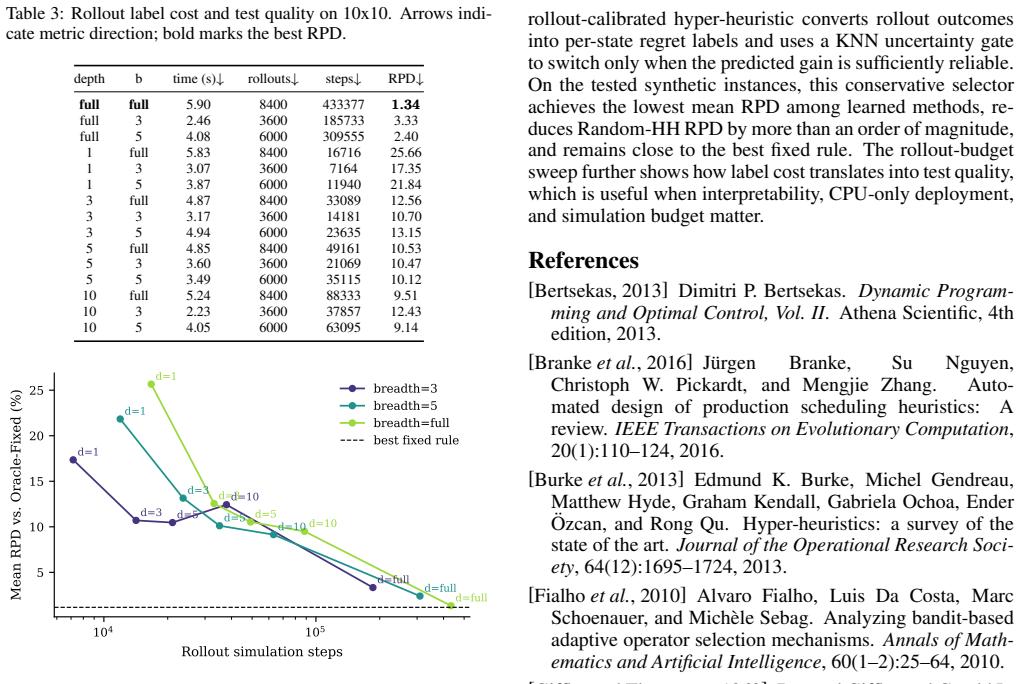
- Varying rollout depth and breadth reveals a measurable cost-quality trade-off in label generation.
Reading between the lines
- The same regret-normalized labeling and gated selection could be applied to other constructive scheduling domains that rely on dispatching rules.
- Lower label cost might allow the selector to be retrained more frequently as new jobs arrive.
- The uncertainty gate could be replaced by other cheap estimators without changing the overall reliability argument.
Editorial analysis
A structured set of objections, weighed in public.
Referee Report
Summary. The manuscript introduces a gated selector for learning-assisted hyper-heuristics in the Job Shop Scheduling Problem (JSSP). It generates low-cost labels via regret-normalized rollouts of dispatching rules from partial schedules, augments them with a contextual KNN uncertainty estimate in feature space, and applies a gate that switches from a default rule only when the predicted improvement exceeds an uncertainty-adjusted margin. Rollout depth and breadth are varied to explore cost-quality trade-offs. On synthetic JSSP instances the gated selector reports the lowest mean relative percentage deviation (RPD) among learned selectors, remains close to the best fixed dispatching rule, and reduces the mean RPD of a random hyper-heuristic by more than an order of magnitude.
Significance. If the reported ordering holds under the experimental protocol, the work supplies a concrete, interpretable mechanism that simultaneously lowers label-generation cost and guards against unreliable rule switches. The combination of regret normalization, KNN uncertainty, and margin gating is a practical contribution to reliable constructive hyper-heuristics for scheduling, where full search is often prohibitive.
minor comments (2)
- [Abstract] The abstract states that the gated selector 'remains close to the best fixed dispatching rule,' but does not name which fixed rule is used as the default or report its RPD value; adding this baseline explicitly in the results section would strengthen the comparison.
- [§4] Instance-generation details (distribution parameters, number of jobs/machines, number of replicates) are referenced only as 'synthetic JSSP instances'; a brief description or pointer to the exact generator in §4 would improve reproducibility.
Simulated Author's Rebuttal
We thank the referee for the positive summary of the manuscript, the recognition of its practical contribution to reliable constructive hyper-heuristics, and the recommendation for minor revision. No major comments were raised in the report.
Circularity Check
No significant circularity; empirical claims rest on external synthetic benchmarks
full rationale
The paper presents a constructive hyper-heuristic selector for JSSP that combines regret-normalized rollout labels, contextual KNN uncertainty, and an uncertainty-adjusted gate. All reported results are aggregate performance metrics (mean RPD) obtained by running the constructed selector on held-out synthetic instances. No equations, fitted parameters renamed as predictions, self-definitional loops, or load-bearing self-citations appear in the derivation chain; the ordering among methods is an external experimental outcome rather than a quantity forced by the construction itself.
Assumptions & free parameters
Cite this review
Pith. "Pith review of Low-Cost Labels, Reliable Choices: Rollout-Calibrated Hyper-Heuristics for Job Shop Scheduling." pith.science (2026). https://pith.science/paper/WZ2DALR3
@misc{pith2026260523957,
  author       = {Pith},
  title        = {Pith review of: Low-Cost Labels, Reliable Choices: Rollout-Calibrated Hyper-Heuristics for Job Shop Scheduling},
  year         = {2026},
  howpublished = {\url{https://pith.science/paper/WZ2DALR3}},
  note         = {Machine review of arXiv:2605.23957}
}
read the original abstract
Learning-assisted hyper-heuristics can select among dispatching rules while preserving the feasibility and interpretability of constructive Job Shop Scheduling Problem (JSSP) heuristics. Their main computational cost lies in label generation rather than model fitting, since each supervised label usually requires rolling out candidate rules from a partial schedule. We study this label-cost problem together with a reliability problem: a learned selector should not switch away from a strong default rule unless the predicted gain is credible. The proposed selector uses regret-normalized rollout labels, a contextual KNN uncertainty estimate, and a gate that acts only when the predicted improvement exceeds an uncertainty-adjusted margin. We also vary rollout depth and breadth to measure the cost-quality trade-off. On synthetic JSSP instances, the gated selector achieves the lowest mean RPD among learned selectors, remains close to the best fixed dispatching rule, and reduces Random-HH mean RPD by more than an order of magnitude.
Figures


Figures from the paper (1 more)
Reference graph
Works this paper leans on
-
[1]
Bertsekas.Dynamic Program- ming and Optimal Control, Vol
[Bertsekas, 2013] Dimitri P. Bertsekas.Dynamic Program- ming and Optimal Control, Vol. II. Athena Scientific, 4th edition,
work page 2013
-
[2]
[Brankeet al., 2016 ] J¨urgen Branke, Su Nguyen, Christoph W. Pickardt, and Mengjie Zhang. Auto- mated design of production scheduling heuristics: A review.IEEE Transactions on Evolutionary Computation, 20(1):110–124,
work page 2016
-
[3]
Burke, Michel Gendreau, Matthew Hyde, Graham Kendall, Gabriela Ochoa, Ender ¨Ozcan, and Rong Qu
[Burkeet al., 2013 ] Edmund K. Burke, Michel Gendreau, Matthew Hyde, Graham Kendall, Gabriela Ochoa, Ender ¨Ozcan, and Rong Qu. Hyper-heuristics: a survey of the state of the art.Journal of the Operational Research Soci- ety, 64(12):1695–1724,
work page 2013
-
[4]
[Fialhoet al., 2010 ] Alvaro Fialho, Luis Da Costa, Marc Schoenauer, and Mich`ele Sebag. Analyzing bandit-based adaptive operator selection mechanisms.Annals of Math- ematics and Artificial Intelligence, 60(1–2):25–64,
work page 2010
- [5]
-
[6]
[Holthaus and Rajendran, 1997] Oliver Holthaus and Chan- drasekharan Rajendran. Efficient dispatching rules for scheduling in a job shop.International Journal of Pro- duction Economics, 48(1):87–105,
work page 1997
-
[7]
[Horn and Bischl, 2016] Daniel Horn and Bernd Bischl. Multi-objective parameter configuration of machine learn- ing algorithms using model-based optimization. In2016 IEEE Symposium Series on Computational Intelligence (SSCI), pages 1–8. IEEE,
work page 2016
-
[8]
[Ingimundardottir and Runarsson, 2018] Helga Ingimundar- dottir and Thomas Philip Runarsson. Discovering dis- patching rules from data using imitation learning: A case study for the job-shop problem.Journal of Scheduling, 21(4):413–428,
work page 2018
Show all 20 references
-
[9]
Learning dispatching rules using random for- est in flexible job shop scheduling problems.International Journal of Production Research, 57(10):3290–3310,
[Junet al., 2019 ] Sungbum Jun, Seokcheon Lee, and Hy- onho Chun. Learning dispatching rules using random for- est in flexible job shop scheduling problems.International Journal of Production Research, 57(10):3290–3310,
2019
-
[10]
POMO: Policy optimization with multiple optima for reinforcement learning
[Kwonet al., 2020 ] Yeong-Dae Kwon, Jinho Choo, By- oungjip Kim, Iljoo Yoon, Youngjune Gwon, and Seungjai Min. POMO: Policy optimization with multiple optima for reinforcement learning. InAdvances in Neural Informa- tion Processing Systems, volume 33, pages 21188–21198,
2020
-
[11]
ASKSSA-CNN-BiLSTM: A novel time se- ries forecasting model for stock price prediction based on an enhanced sparrow search algorithm
[Liet al., 2026 ] Zikun Li, Wenxuan Zhu, Ran Zhang, Yanzhao Gu, Jinhong Song, Yanxiao Li, Yapeng Wang, Yifu Zhao, Qingyang Xu, Zhiwen Wang, Xu Yang, and Junhao Wei. ASKSSA-CNN-BiLSTM: A novel time se- ries forecasting model for stock price prediction based on an enhanced sparr...
2026
-
[12]
Evolution of heuristics: Towards efficient auto- matic algorithm design using large language model
[Liuet al., 2024 ] Fei Liu, Tong Xialiang, Mingxuan Yuan, Xi Lin, Fu Luo, Zhenkun Wang, Zhichao Lu, and Qingfu Zhang. Evolution of heuristics: Towards efficient auto- matic algorithm design using large language model. In Proceedings of the 41st International Conference on Ma- ...
2024
-
[13]
MRBMO: An enhanced red-billed blue magpie optimization algorithm for solving numerical optimization challenges.Symmetry, 17(8):1295,
[Luet al., 2025 ] Baili Lu, Zhanxi Xie, Junhao Wei, Yanzhao Gu, Yuzheng Yan, Zikun Li, Shirou Pan, Ngai Cheong, Ying Chen, and Ruishen Zhou. MRBMO: An enhanced red-billed blue magpie optimization algorithm for solving numerical optimization challenges.Symmetry, 17(8):1295,
2025
-
[14]
[ ¨Ozcanet al., 2010 ] Ender ¨Ozcan, Mustafa Mısır, Gabriela Ochoa, and Edmund K. Burke. A reinforcement learning – great-deluge hyper-heuristic for examination timetabling. International Journal of Applied Metaheuristic Comput- ing, 1(1):39–59,
2010
-
[15]
[Panwalkar and Iskander, 1977] S. S. Panwalkar and Wafik Iskander. A survey of scheduling rules.Operations Re- search, 25(1):45–61,
1977
-
[16]
ScheduleNet: Learn to solve multi-agent scheduling problems with reinforcement learning.arXiv preprint arXiv:2106.03051,
[Parket al., 2021 ] Junyoung Park, Sanjar Bakhtiyar, and Jinkyoo Park. ScheduleNet: Learn to solve multi-agent scheduling problems with reinforcement learning.arXiv preprint arXiv:2106.03051,
2021
-
[17]
Pawan Kumar, Emilien Dupont, Francisco J
[Romera-Paredeset al., 2024 ] Bernardino Romera-Paredes, Mohammadamin Barekatain, Alexander Novikov, Matej Balog, M. Pawan Kumar, Emilien Dupont, Francisco J. R. Ruiz, Jordan S. Ellenberg, Pengming Wang, Omar Fawzi, Pushmeet Kohli, and Alhussein Fawzi. Mathematical dis- coveri...
2024
-
[18]
TSWOA: An enhanced WOA with triangular walk and spiral flight for engineering design optimization
[Weiet al., 2025 ] Junhao Wei, Yanzhao Gu, Yuzheng Yan, Yapeng Wang, Zikun Li, Baili Lu, Shirou Pan, and Ngai Cheong. TSWOA: An enhanced WOA with triangular walk and spiral flight for engineering design optimization. In2025 8th International Conference on Advanced Al- gorithms...
2025
-
[19]
ReEvo: Large language models as hyper-heuristics with reflective evolution
[Yeet al., 2024 ] Haoran Ye, Jiarui Wang, Zhiguang Cao, Federico Berto, Chuanbo Hua, Haeyeon Kim, Jinkyoo Park, and Guojie Song. ReEvo: Large language models as hyper-heuristics with reflective evolution. InAdvances in Neural Information Processing Systems, volume 37, pages 43...
2024
-
[20]
Learning to dispatch for job shop scheduling via deep reinforcement learning
[Zhanget al., 2020 ] Cong Zhang, Wen Song, Zhiguang Cao, Jie Zhang, Puay Siew Tan, and Xu Chi. Learning to dispatch for job shop scheduling via deep reinforcement learning. InAdvances in Neural Information Processing Systems, volume 33, pages 1621–1632, 2020
2020
Reviewed June 30, 2026 · model on record in the stance chip above.
Discussion (0). Continue with ORCID to comment.