REVIEW 4 major objections 7 minor 1 cited by
Minimally dissipative multi-bit logical operations
T0 review · 4 major / 7 minor · reviewed 2026-08-06 · deepseek-v4-flash
Pith's one-line read Multi-bit logical gates have minimal-work formulas and near-optimal controllers.
desk verdict Worth reading: clean OT reformulation of multi-bit gates, core algebra solid, but Eq. (6) is only a rigorous lower bound in 2D until achievability is proved. read the letter →
The pith
A machine-rendered reading of the paper's core claim, the machinery that carries it, and where it could break.
The reading
What carries the argument
The load-bearing object is the variational work functional $$W^G = \inf_{\rho_\tau\in\mathcal{P}^G}\left[T D_{\mathrm{KL}}(\rho_\tau\|\rho_0) + \frac{$W_2^{2}$(\rho_\tau,\rho_0)}{\tau}\right],$$ in which the Wasserstein term accounts for the cost of moving probability mass in finite time and the Kullback-Leibler term accounts for the information-theoretic cost of erasure. The computational machinery is the entropically regularized version of this objective, written as a minimization over couplings with gate constraints imposed on one marginal; alternating dual updates yield the optimal regularized coupling, and the optimal protocol is the Wasserstein geodesic obtained from that coupling, with a learned score correction $s_\theta \simeq \nabla \log \rho_t^*$ added to keep the stochastic dynamics on the geodesic.
What would settle it
Drive a colloidal particle with the NAND controller (38) in an optical feedback trap, measure the mean dissipated heat via (39) over the protocol duration $\tau$, and compare with $W^{\mathrm{NAND}}$ from (6); observed heat reliably below the predicted value would falsify the claim that (6) gives the minimum work, while agreement would support it. A cheaper numerical check is to solve the full stochastic optimal control problem for a non-factorized two-bit source and verify that the infimum in (6) is actually attained.
Extended reading notes
Core claim
The paper's central claim is that the minimum work for a two-bit gate can be written as $$W^G = \inf_{\rho_\tau \in \mathcal{P}^G}\left[T D_{\mathrm{KL}}(\rho_\tau\|\rho_0) + \$tau^{{-1}}$ $W_2^{2}$(\rho_\tau,\rho_0)\right],$$ where the constraint set $\mathcal{P}^G$ encodes complete erasure, partial erasure, or NAND as a condition on the final probability mass in the four quadrants. From this formulation the paper proves that the minimal work is nonincreasing as the protocol time grows, that partial-erasure work increases as the allowed error shrinks, and that for factorized sources $W^{2BE}(\rho_0^x\rho_0^y)=W^{1BE}(\rho_0^x)+W^{1BE}(\rho_0^y)$, so joint two-bit erasure cannot beat separate one-bit erasures. The paper then recasts the constrained minimization as a regularized unbalanced optimal transport problem, derives converging dual updates whose solutions give the optimal coupling, and shows that the optimal dynamics is the constant-speed Wasserstein geodesic generated by that coupling. The proposed controller augments the geodesic flow with an approximate score term to counteract thermal diffusion; numerical Langevin simulations show dissipated heat that agrees closely with the static optimal prediction for NAND.
Load-bearing premise
The paper's energy quantities are taken to be the actual minimum work of a physical driving protocol, which requires the thermodynamic speed-limit bound to be tight and the score-corrected controller (38) to be realizable; in two dimensions this tightness is demonstrated numerically, not proved.
Editorial extensions
If this is right
- For any gate, the minimal work $W^G(\tau)$ is nonincreasing in protocol duration: faster operation cannot cost less energy at fixed accuracy.
- For partial erasure, the minimal work increases monotonically as the permitted residual probability $\epsilon$ decreases, formalizing the intuitive speed-accuracy-dissipation trade-off.
- For factorized source distributions, joint erasure of two bits costs exactly the sum of the two one-bit erasure costs, so the finite-time Landauer limit cannot be beaten by operating in two dimensions.
- Entropic regularization overestimates the true minimal work by at most $\epsilon(H(\pi^G)-H(\pi_\epsilon))$, which vanishes linearly as $\epsilon\to 0$, giving controllable precision.
- The flow-matching plus score-correction controller follows the Wasserstein geodesic and numerically achieves dissipated heat close to the static optimum, providing a concrete route to experimental implementation.
Reading between the lines
- If the speed-limit bound is not tight for non-factorized two-bit sources, the paper's $W^G$ values should be read as lower bounds on dissipation rather than achievable work minima; a direct stochastic optimal control comparison would settle this.
- The failure of the factorized theorem for partial erasure suggests that correlated initial states or correlated targets could in principle lower multi-bit erasure cost below the sum of independent costs, a possibility the paper leaves open.
- The same regularization-plus-flow-matching pipeline should extend to $n$-bit gates in $n$ dimensions and to non-binary symbols, since the gate constraints are defined purely by quadrant geometry and mass constraints.
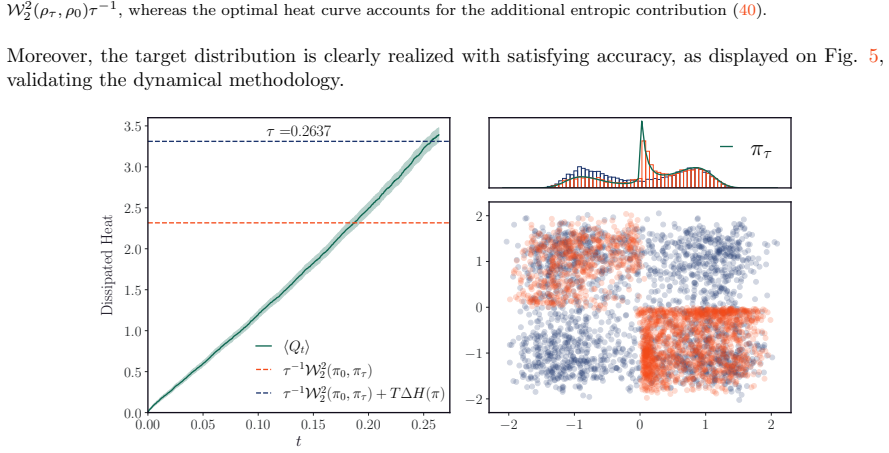
- An experimental test is to implement the controller (38) with an optical feedback trap and compare the measured mean dissipated heat against the static prediction (40), including the entropy-change term $T[H(\rho_\tau)-H(\rho_0)]$.
Editorial analysis
A structured set of objections, weighed in public.
Referee Report
Summary. The paper proposes a variational optimal-transport formulation for finite-time thermodynamic costs of two-bit logical operations (complete erasure, partial erasure, and NAND). For a two-dimensional overdamped Langevin system with full control, the minimal work for a gate G is written as W^G = inf over admissible target distributions of [T DKL(ρτ||ρ0) + τ^{-1} W2^2(ρτ,ρ0)]. From this formulation the authors derive Landauer-type quasistatic bounds, monotonicity trade-offs in speed and accuracy, and a factorization theorem stating that for product source distributions complete two-bit erasure costs exactly the sum of two one-bit erasures. They then introduce an entropically regularized unbalanced optimal transport problem with explicit Sinkhorn-type dual updates, and combine the resulting coupling with flow-matching and score-matching techniques to construct approximate dynamical controllers. Numerical sections validate the method against a one-dimensional partial-erasure benchmark and demonstrate near-optimal NAND gate dynamics.
Significance. If the variational identification is accepted, the paper gives a clean geometric framework that extends finite-time Landauer bounds beyond one dimension to genuinely multi-bit gates, which previous methods could not handle. The factorization theorem (18) is a sharp, falsifiable statement about the impossibility of beating two independent one-bit erasures for factorized sources, and the regularized unbalanced OT formulation with explicit updates is a practical algorithmic contribution. The proposed controller construction connects optimal transport theory with generative modeling in a way that could enable experimental implementation with feedback traps. The paper also provides closed-form Landauer bounds in Table 1 and a self-consistent numerical check of the factorization theorem, which add to its credibility.
major comments (4)
- [§1.2, Eq. (6)] The identification of W^G as the 'minimum work' requires equality in the speed limit (3), which the text calls 'tight' but does not prove in two dimensions. The achievability is only implicit in the controller construction of Section 3.1, where the Wasserstein geodesic plus an exact score correction is asserted to realize the optimal gate. Please state and prove, or explicitly attribute, the Benamou-Brenier/Aurell-type theorem that for overdamped Langevin dynamics with full control the minimal dissipation between ρ0 and ρτ is exactly T DKL(ρτ||ρ0) + τ^{-1}W2^2(ρτ,ρ0), and that the controller (35)-(38) attains it. This matters because the quantitative claims in Fig. 3 and the trade-offs (9) and (12) concern achievable work, not merely lower bounds.
- [Appendix B, Eqs. (41)-(42)] The proof that W_{≤ϵ}^{2BE} = W_ϵ^{2BE} relies on the assertion that W_{≤ϵ}^{2BE} is 'strictly decreasing as a function of ϵ', which is stated without proof. Since this equality is used to establish the accuracy trade-off (12), please supply a proof (for example, by noting that the unconstrained minimizer ρ0 lies outside P_{≤ϵ}^{2BE} for ϵ < 1/2 and using strict convexity of the objective, or by an explicit construction). As written, the argument has a gap at exactly the point that supports a central claim.
- [Appendix C and end of §1.2] The main text says 'we prove in Appendix C that it is actually not the case' that the factorized erasure theorem extends to partial erasure, but Appendix C does not contain a proof: it gives numerical evidence (Fig. 6b) and an informal argument that the optimal target is not a product distribution. Please either supply a genuine proof of non-factorizability or rephrase the claim as a numerical observation. This is a missing-support issue that should be corrected.
- [§3.2, Figs. 4-5] The dynamical validation of the NAND controller reports what appears to be a single realization, with no error bars, no comparison against an independent optimizer, and no released code. Since the paper claims 'near-optimal dissipation' and practical implementability, please add statistical information (e.g., multiple seeds or trajectories, sample-to-sample variability), a convergence check of the learned flow and score, or a statement of the number of independent Langevin trajectories used. This is not a correctness issue for the theory, but the current numerical evidence is presented more strongly than it supports.
minor comments (7)
- [Introduction] There is a duplicated sentence: 'To carry out this task, we extend recent work from the computational optimal transport literature [9], and generative modeling techniques [10, 11], we subsequently propose an algorithmic route...' appears twice, with the second occurrence incomplete. Please remove the duplication.
- [Eq. (3)] The units of the Wasserstein term τ^{-1}W2^2 should be clarified. Since T appears explicitly in the DKL term, state that the friction coefficient is set to unity and/or that the Langevin equation is written in units where D=T, so that τ^{-1}W2^2 has energy units. Otherwise the notation may confuse readers about the physical dimensions of the bound.
- [Appendix D.1, Eq. (52)] The expression for p*[u] contains malformed notation: 'exp(-1 ⟨[log(α) - log(⟨ρ0e^{u/T}, 1⟩)⟩])' is not a well-formed formula. Please rewrite the constraint-enforcing factor cleanly; the surrounding derivation is difficult to follow as printed.
- [§2.1, Eq. (25)] The excess-energy bound W^G_ϵ - W^G ≤ ϵ(H(π^G) - H(π^ϵ)) assumes finiteness of both entropies; the text mentions this later, but it should be stated at the point of use to avoid a hidden assumption.
- [§2.1 and Appendix B] The symbol ϵ is used both for the constraint slack in P2BE_ϵ and for the entropic regularization parameter in W^G_ϵ. Please disambiguate these two uses (for example, by using a different symbol for the regularization parameter) to avoid confusion in Section 2 and the appendices.
- [Fig. 2a caption] The caption refers to 'W^{BE}_{1/4} - LB_{1/4}' without defining the subscript 1/4 (presumably the allowed error fraction ϵ = 1/4). Please define it in the caption.
- [§3.1] The text says the OTFM flow field f* minimizes (36) and that the score-corrected controller (38) follows a Wasserstein geodesic. It may be worth noting explicitly that the total drift f* + T∇log ρ_t is not itself the optimal transport velocity field, as the score term compensates for diffusion; this would help readers parse the construction.
Circularity Check
No significant circularity: the gate work values are explicit variational definitions built on an external speed limit, and the paper's self-citations are not load-bearing.
full rationale
The central quantity W^G is introduced explicitly as a variational infimum in Eqs. (5)-(6), combining T DKL(ρτ||ρ0) with τ^{-1} W_2^2(ρτ,ρ0). This functional is not fitted to the results it is used to predict; it is a definitional reformulation of the thermodynamic speed limit cited from the independent work of Vu and Saito [5]. The speed-accuracy trade-offs in Eqs. (8)-(13) follow directly from positivity of the two terms and from set inclusion among the constraint sets, and are not obtained by matching data or by invoking the authors' own prior results. The factorized erasure theorem (18) is derived by decomposing the KL divergence into marginal and mutual-information terms and by constructing a product driving force that saturates the resulting lower bound; again no fitted parameter or self-citation enters. Numerical validation is performed against the external shooting-method benchmark of Proesmans et al. [21] (Fig. 2a) and against the paper's own proved factorized theorem (Fig. 2b). The authors' self-citations [6] and [27] appear in the introduction and in the controller-design section, where they are used to motivate the flow-matching/score-matching construction, but they are not used to establish the work values, the Landauer bounds, or the trade-offs. The controller section is presented as an extension of an existing framework, and its dissipation is checked numerically against the static optimal-transport functional (Figs. 4-5). The main weakness identified by a skeptical reading—achievability/tightness of the speed limit in two dimensions for partial erasure and NAND—is an evidence or correctness concern, not a circular reduction: the paper proves convergence of the regularized solver and demonstrates near-optimal dynamical behavior numerically, but does not supply a rigorous 2D attainability proof. This does not make the derivation circular, because the claimed minimum-work quantity is defined, not fitted, and the missing tightness is an external mathematical property rather than an input secretly equal to the output. Overall, the derivation chain is self-contained against external benchmarks and the self-citations are not load-bearing; the appropriate circularity score is low.
Assumptions & free parameters
free parameters (2)
- Entropic regularization parameter ε =
10^-2 (2D gates), 5×10^-3 (1D validation)
- Score-smoothing parameter for dynamical controller =
Gaussian sigma between 0.1 and 1, 'depending on τ'
assumptions (5)
- domain assumption Thermodynamic speed limit: W ≥ T DKL(ρτ||ρ0) + W_2^2(ρτ,ρ0)/τ (Eq. 3), and its tightness for the 2D gates.
- domain assumption Overdamped Langevin dynamics (1) with unit mobility, temperature T, and full control of the instantaneous distribution.
- ad hoc to paper Strict monotonicity of W^{2BE}_{≤ε} in ε.
- domain assumption Factorized source distribution ρ0(X) = ρx0(x)ρy0(y) for the erasure theorem (18).
- standard math Convex-duality framework and convergence of the Sinkhorn-type iterations (28).
Cite this review
Pith. "Pith review of Minimally dissipative multi-bit logical operations." pith.science (2026). https://pith.science/paper/WZF73XMV
@misc{pith2026250624021,
  author       = {Pith},
  title        = {Pith review of: Minimally dissipative multi-bit logical operations},
  year         = {2026},
  howpublished = {\url{https://pith.science/paper/WZF73XMV}},
  note         = {Machine review of arXiv:2506.24021}
}
read the original abstract
Modern computing architectures are vastly more energy-dissipative than fundamental thermodynamic limits suggest, motivating the search for principled approaches to low-dissipation logical operations. We formulate multi-bit logical gates (bit erasure, NAND) as optimal transport problems, extending beyond classical one-dimensional bit erasure to scenarios where existing methods fail. Using entropically regularized unbalanced optimal transport, we derive tractable solutions and establish general energy-speed-accuracy trade-offs that demonstrate that faster, more accurate operations necessarily dissipate more energy. Furthermore, we demonstrate that the Landauer limits cannot be trivially overcome in higher dimensional geometries. We develop practical algorithms combining optimal transport with generative modeling techniques to construct dynamical controllers that follow Wasserstein geodesics. These protocols achieve near-optimal dissipation and can, in principle, be implemented in realistic experimentally set-ups. The framework bridges fundamental thermodynamic limits with scalable computational design for energy-efficient information processing.
Figures


Figures from the paper (1 more)
Forward citations
Cited by 1 Pith paper
-
A Blueprint for Equilibrium-Based Differentiable Continuous-Variable Thermodynamic Computing
Tunable energy landscapes whose thermal averages equal sigmoid, softmax, and matrix-vector products can, in principle, form the basis of a low-energy analog computer, with a superconducting double-well device as a fir...
Reference graph
Works this paper leans on
-
[1]
Irreversibility and Heat Generation in the Computing Process
R Landauer. Irreversibility and Heat Generation in the Computing Process. IBM J. Res. Dev., 5(3):183–191, July 1961. doi: 10.1147/rd.53.0183. URL http://ieeexplore.ieee.org/ document/5392446/. 19
-
[2]
Optimal Protocols and Optimal Transport in Stochastic Thermodynamics
Erik Aurell, Carlos Mej ´ ıa-Monasterio, and Paolo Muratore-Ginanneschi. Optimal Protocols and Optimal Transport in Stochastic Thermodynamics. Physical Review Letters , 106(25):250601, June 2011. ISSN 0031-9007, 1079-7114. doi: 10.1103/PhysRevLett.106.250601. URL https: //link.aps.org/doi/10.1103/PhysRevLett.106.250601
-
[3]
Finite-time landauer principle
Karel Proesmans, Jannik Ehrich, and John Bechhoefer. Finite-time landauer principle. Phys. Rev. Lett., 125:100602, Sep 2020. doi: 10.1103/PhysRevLett.125.100602. URL https://link. aps.org/doi/10.1103/PhysRevLett.125.100602
-
[4]
Langevin Equation and Thermodynamics
Ken Sekimoto. Langevin Equation and Thermodynamics. Prog. Theor. Phys. Supplement , 130: 17–27, January 1998. doi: 10.1143/PTPS.130.17. URL https://academic.oup.com/ptps/ article-lookup/doi/10.1143/PTPS.130.17
-
[5]
Tan Van Vu and Keiji Saito. Thermodynamic unification of optimal transport: Thermodynamic uncertainty relation, minimum dissipation, and thermodynamic speed limits. Phys. Rev. X , 13: 011013, Feb 2023. doi: 10.1103/PhysRevX.13.011013. URL https://link.aps.org/doi/10. 1103/PhysRevX.13.011013
-
[6]
J´ er´ emie Klinger and Grant M. Rotskoff. Universal energy-speed-accuracy trade-offs in driven nonequilibrium systems. Phys. Rev. E, 111:014114, Jan 2025. doi: 10.1103/PhysRevE.111.014114. URL https://link.aps.org/doi/10.1103/PhysRevE.111.014114
-
[7]
A computational fluid mechanics solution to the Monge- Kantorovich mass transfer problem
Jean-David Benamou and Yann Brenier. A computational fluid mechanics solution to the Monge- Kantorovich mass transfer problem. Numerische Mathematik, 84(3):375–393, January 2000. ISSN 0029-599X, 0945-3245. doi: 10.1007/s002110050002. URL http://link.springer.com/10. 1007/s002110050002
-
[8]
Refined Second Law of Thermodynamics for Fast Random Processes
Erik Aurell, Krzysztof Gawedzki, Carlos Mej ´ ıa-Monasterio, Roya Mohayaee, and Paolo Muratore- Ginanneschi. Refined Second Law of Thermodynamics for Fast Random Processes. Journal of Statistical Physics , 147(3):487–505, May 2012. ISSN 0022-4715, 1572-9613. doi: 10.1007/ s10955-012-0478-x. URL http://link.springer.com/10.1007/s10955-012-0478-x
Show all 50 references
-
[9]
Chizat, G
L. Chizat, G. Peyr´ e, B. Schmitzer, and F. Vialard. Scaling algorithms for unbalanced optimal transport problems. Math. Comp. , 87, 2018. doi: https://doi.org/10.1090/mcom/3303. URL https://www.ams.org/journals/mcom/2018-87-314/S0025-5718-2018-03303-8/
2018 doi
-
[10]
Estimation of Non-Normalized Statistical Models by Score Matching
Aapo Hyv¨ arinen. Estimation of Non-Normalized Statistical Models by Score Matching. Journal of Machine Learning Research , 6(24):695–709, 2005. ISSN 1533-7928. URL http://jmlr.org/ papers/v6/hyvarinen05a.html
2005
-
[11]
Kingma, Abhishek Kumar, Stefano Ermon, and Ben Poole
Yang Song, Jascha Sohl-Dickstein, Diederik P. Kingma, Abhishek Kumar, Stefano Ermon, and Ben Poole. Score-Based Generative Modeling through Stochastic Differential Equations. February
-
[12]
High-precision test of Landauer’s prin- ciple in a feedback trap
Yonggun Jun, Momˇ cilo Gavrilov, and John Bechhoefer. High-precision test of Landauer’s prin- ciple in a feedback trap. Phys. Rev. Lett. , 113(19):190601, 2014. doi: 10.1103/PhysRevLett.113. 190601. URL https://link.aps.org/doi/10.1103/PhysRevLett.113.190601
2014 doi
-
[13]
Zulkowski and Michael R
Patrick R. Zulkowski and Michael R. DeWeese. Optimal finite-time erasure of a classical bit. Phys. Rev. E , 89:052140, May 2014. doi: 10.1103/PhysRevE.89.052140. URL https://link. aps.org/doi/10.1103/PhysRevE.89.052140
2014 doi
-
[14]
Thermodynamic metrics and optimal paths
David A Sivak and Gavin E Crooks. Thermodynamic metrics and optimal paths. Phys. Rev. Lett., 108(19):190602, May 2012. doi: 10.1103/PhysRevLett.108.190602. URL http://link. aps.org/doi/10.1103/PhysRevLett.108.190602. 20
2012 doi
-
[15]
Memory erasure in small systems
Raoul Dillenschneider and Eric Lutz. Memory erasure in small systems. Phys. Rev. Lett. , 102: 210601, May 2009. doi: 10.1103/PhysRevLett.102.210601. URL https://link.aps.org/doi/ 10.1103/PhysRevLett.102.210601
2009 doi
-
[16]
Experimental verification of Landauer’s principle linking information and thermody- namics
Antoine B´ erut, Artak Arakelyan, Artyom Petrosyan, Sergio Ciliberto, Raoul Dillenschneider, and Eric Lutz. Experimental verification of Landauer’s principle linking information and thermody- namics. Nature, 483(7388):187–189, March 2012. ISSN 1476-4687. doi: 10.1038/nature108...
2012 doi
-
[17]
Erasure without work in an asymmetric double-well potential
Mom ˇ cilo Gavrilov and John Bechhoefer. Erasure without work in an asymmetric double-well potential. Phys. Rev. Lett. , 117:200601, Nov 2016. doi: 10.1103/PhysRevLett.117.200601. URL https://link.aps.org/doi/10.1103/PhysRevLett.117.200601
2016 doi
-
[18]
Boyd, Ayoti Patra, Christopher Jarzynski, and James P
Alexander B. Boyd, Ayoti Patra, Christopher Jarzynski, and James P. Crutchfield. Shortcuts to Thermodynamic Computing: The Cost of Fast and Faithful Information Processing. Journal of Statistical Physics , 187(2):17, March 2022. ISSN 1572-9613. doi: 10.1007/s10955-022-02871-0....
2022 doi
-
[19]
Number 58 in Graduate Studies in Mathemat- ics
C´ edric Villani.Topics in Optimal Transportation. Number 58 in Graduate Studies in Mathemat- ics. American Mathematical Society, Providence, Rhode Island, 2003. ISBN 0-8218-3312-X
2003
-
[20]
The Variational Formulation of the Fokker– Planck Equation
Richard Jordan, David Kinderlehrer, and Felix Otto. The Variational Formulation of the Fokker– Planck Equation. SIAM Journal on Mathematical Analysis , 29(1):1–17, January 1998. ISSN 0036-1410, 1095-7154. doi: 10.1137/S0036141096303359. URL http://epubs.siam.org/doi/ 10.1137/S...
1998 doi
-
[21]
Optimal finite-time bit erasure under full control
Karel Proesmans, Jannik Ehrich, and John Bechhoefer. Optimal finite-time bit erasure under full control. Phys. Rev. E , 102:032105, Sep 2020. doi: 10.1103/PhysRevE.102.032105. URL https://link.aps.org/doi/10.1103/PhysRevE.102.032105
2020 doi
-
[22]
Experi- mentally achieving minimal dissipation via thermodynamically optimal transport, 2025
Shingo Oikawa, Yohei Nakayama, Sosuke Ito, Takahiro Sagawa, and Shoichi Toyabe. Experi- mentally achieving minimal dissipation via thermodynamically optimal transport, 2025. URL https://arxiv.org/abs/2503.01200
2025
-
[23]
Speed limit for a highly irreversible process and tight finite-time landauer’s bound
Jae Sung Lee, Sangyun Lee, Hyukjoon Kwon, and Hyunggyu Park. Speed limit for a highly irreversible process and tight finite-time landauer’s bound. Phys. Rev. Lett. , 129:120603, Sep
-
[24]
From quantum speed limits to energy-efficient quantum gates
Maxwell Aifer and Sebastian Deffner. From quantum speed limits to energy-efficient quantum gates. New Journal of Physics , 24:055002, 2022. URL https://iopscience.iop.org/article/ 10.1088/1367-2630/ac6821
2022 doi
-
[25]
URL https://link.aps.org/doi/10.1103/ PhysRevLett.129.120603
doi: 10.1103/PhysRevLett.129.120603. URL https://link.aps.org/doi/10.1103/ PhysRevLett.129.120603
-
[26]
Improving and generalizing flow-based generative models with minibatch optimal transport, October 2023
Alexander Tong, Nikolay Malkin, Guillaume Huguet, Yanlei Zhang, Jarrid Rector-Brooks, Kilian Fatras, Guy Wolf, and Yoshua Bengio. Improving and generalizing flow-based generative models with minibatch optimal transport, October 2023. URL http://arxiv.org/abs/2302.00482. arXiv:...
2023 arXiv
-
[27]
Computational optimal transport: With applications to data science
Gabriel Peyr´ e and Marco Cuturi. Computational optimal transport: With applications to data science. Foundations and Trends in Machine Learning , 11(5-6):355–607, 2019. ISSN 1935-8237. doi: 10.1561/2200000073. URL http://dx.doi.org/10.1561/2200000073
2019 doi
-
[28]
Flow Straight and Fast: Learning to Generate and Transfer Data with Rectified Flow
Xingchao Liu, Chengyue Gong, and Qiang Liu. Flow Straight and Fast: Learning to Generate and Transfer Data with Rectified Flow. September 2022. URL https://openreview.net/forum? id=XVjTT1nw5z
2022
-
[29]
Rotskoff
Shriram Chennakesavalu and Grant M. Rotskoff. Unified, Geometric Framework for Nonequi- librium Protocol Optimization. Physical Review Letters , 130(10):107101, March 2023. doi: 10.1103/PhysRevLett.130.107101. URL https://link.aps.org/doi/10.1103/PhysRevLett. 130.107101. Publi...
2023 doi
-
[30]
Yaron Lipman, Ricky T. Q. Chen, Heli Ben-Hamu, Maximilian Nickel, and Matthew Le. Flow Matching for Generative Modeling. September 2022. URL https://openreview.net/forum? id=PqvMRDCJT9t
2022
-
[31]
Albergo, Nicholas M
Michael S. Albergo, Nicholas M. Boffi, and Eric Vanden-Eijnden. Stochastic Interpolants: A Unifying Framework for Flows and Diffusions, March 2023. URL http://arxiv.org/abs/2303. 08797. arXiv:2303.08797 [cond-mat]
2023 arXiv
-
[32]
Sinkhorn distances: Lightspeed computation of optimal trans- port
Marco Cuturi. Sinkhorn distances: Lightspeed computation of optimal trans- port. In C. J. C. Burges, L. Bottou, M. Welling, Z. Ghahramani, and K. Q. Weinberger, editors, Advances in neural information processing systems 26 , pages 2292–2300. Curran Associates, Inc., 2013. URL ...
2013
-
[33]
Pratt, Kyle J
Christian Z. Pratt, Kyle J. Ray, and James P. Crutchfield. Controlled erasure as a building block for universal thermodynamically robust superconducting computing. Chaos: An Interdisciplinary Journal of Nonlinear Science, 35(4):043112, April 2025. ISSN 1054-1500. doi: 10.1063/...
2025 doi
-
[34]
Stochastic Energetics, volume 799 of Lecture Notes in Physics
Ken Sekimoto. Stochastic Energetics, volume 799 of Lecture Notes in Physics . Springer, Berlin, Heidelberg, 2010. ISBN 978-3-642-05410-5 978-3-642-05411-2. doi: 10.1007/978-3-642-05411-2. URL https://link.springer.com/10.1007/978-3-642-05411-2
2010 doi
-
[35]
Flow Network based Generative Models for Non-Iterative Diverse Candidate Genera- tion
Emmanuel Bengio, Moksh Jain, Maksym Korablyov, Doina Precup, and Yoshua Ben- gio. Flow Network based Generative Models for Non-Iterative Diverse Candidate Genera- tion. arXiv:2106.04399 [cs] , June 2021. URL http://arxiv.org/abs/2106.04399. arXiv: 2106.04399
2021 arXiv
-
[36]
Riechers, Alexander B
Paul M. Riechers, Alexander B. Boyd, Gregory W. Wimsatt, and James P. Crutchfield. Bal- ancing error and dissipation in computing. Phys. Rev. Res. , 2:033524, Sep 2020. doi: 10.1103/ PhysRevResearch.2.033524. URL https://link.aps.org/doi/10.1103/PhysRevResearch.2. 033524
2020 doi
-
[37]
Number 338 in Grundlehren der mathematischen Wissenschaften
C´ edric Villani.Optimal transport: old and new . Number 338 in Grundlehren der mathematischen Wissenschaften. Springer, Berlin, 2009. ISBN 978-3-540-71049-3. URL dx.doi.org/10.1007/ 978-3-540-71050-9
2009
-
[38]
Benamou, Y
J.-D. Benamou, Y. Brenier, and K. Guittet. The Monge–Kantorovitch mass transfer and its computational fluid mechanics formulation. International Journal for Numerical Meth- ods in Fluids , 40(1-2):21–30, 2002. ISSN 1097-0363. doi: 10.1002/fld.264. URL https: //onlinelibrary.wi...
2002 doi
-
[39]
David H. Wolpert. The stochastic thermodynamics of computation. Journal of Physics A: Mathematical and Theoretical, 52:193001, 2019. URL https://iopscience.iop.org/article/ 10.1088/1751-8121/ab0850
2019 doi
-
[40]
Semidual Regularized Optimal Transport
Marco Cuturi and Gabriel Peyr´ e. Semidual Regularized Optimal Transport. SIAM Review, 60 (4):941–965, January 2018. ISSN 0036-1445, 1095-7200. doi: 10/gfqjxq. URL https://epubs. siam.org/doi/10.1137/18M1208654
2018 doi
-
[41]
Convergence of entropic schemes for optimal transport and gradient flows
Guillaume Carlier, Vincent Duval, Gabriel Peyr´ e, and Bernhard Schmitzer. Convergence of entropic schemes for optimal transport and gradient flows. SIAM Journal on Mathematical Analysis, 49(2):1385–1418, 2017. doi: 10.1137/15M1050264. URL https://doi.org/10.1137/ 15M1050264. 22
2017 doi
-
[42]
Optimal Entropy-Transport problems and a new Hellinger–Kantorovich distance between positive measures
Matthias Liero, Alexander Mielke, and Giuseppe Savar´ e. Optimal Entropy-Transport problems and a new Hellinger–Kantorovich distance between positive measures. Inventiones mathematicae, 211(3):969–1117, March 2018. ISSN 1432-1297. doi: 10.1007/s00222-017-0759-8. URL https: //d...
2018 doi
-
[43]
A relationship between arbitrary positive matrices and doubly stochastic matrices
Richard Sinkhorn. A relationship between arbitrary positive matrices and doubly stochastic matrices. The Annals of Mathematical Statistics , 35(2):876–879, 1964. URL https://www. jstor.org/stable/2238545
1964
-
[44]
A deterministic strongly polynomial algorithm for matrix scaling and approximate permanents
Nathan Linial, Alex Samorodnitsky, and Avi Wigderson. A deterministic strongly polynomial algorithm for matrix scaling and approximate permanents. In Proceedings of the Thirtieth Annual ACM Symposium on Theory of Computing , STOC ’98, pages 644–652. ACM, 1998. URL https: //lin...
1998 doi
-
[45]
R. T. Rockafellar. Duality and stability in extremum problems involving convex functions. Pacific Journal of Mathematics , 21(1):167–187, 1967. URL https://msp.org/pjm/1967/21-1/p13. xhtml
1967
-
[46]
Optimal Transport for Applied Mathematicians – Calculus of Variations, PDEs and Modeling
Filippo Santambrogio. Optimal Transport for Applied Mathematicians – Calculus of Variations, PDEs and Modeling. page 356
-
[47]
Philip A. Knight. The sinkhorn–knopp algorithm: Convergence and applications. SIAM Journal on Matrix Analysis and Applications , 30(1):261–275, 2008. doi: 10.1137/060659624. URL https: //doi.org/10.1137/060659624
2008 doi
-
[48]
Denoising diffusion probabilistic mod- els
Jonathan Ho, Ajay Jain, and Pieter Abbeel. Denoising diffusion probabilistic mod- els. In Hugo Larochelle, Marc’Aurelio Ranzato, Raia Hadsell, Maria-Florina Balcan, and Hsuan-Tien Lin, editors, Advances in neural information processing systems 33: An- nual conference on neural...
2020
-
[49]
Ricky T. Q. Chen, Yulia Rubanova, Jesse Bettencourt, and David K Duvenaud. Neural ordi- nary differential equations. In S. Bengio, H. Wallach, H. Larochelle, K. Grauman, N. Cesa- Bianchi, and R. Garnett, editors, Advances in neural information processing systems, volume 31. Cu...
2018
-
[2022]
URL https://openreview.net/forum?id=PxTIG12RRHS
Reviewed August 6, 2026 · model on record in the stance chip above.
Discussion (0). Continue with ORCID to comment.