REVIEW 3 major objections 5 minor 242 references
A Blueprint for Equilibrium-Based Differentiable Continuous-Variable Thermodynamic Computing
T0 review · 3 major / 5 minor · reviewed 2026-08-01 · deepseek-v4-flash
Pith's one-line read Thermal equilibrium of a tunable physical system can be programmed to run machine-learning operations, with gradients read from measured covariances — a path to computing near the Landauer limit.
desk verdict A checkable theoretical blueprint for thermodynamic ML primitives; the hardware prototype is real but its validation does not yet confirm the Langevin model. read the letter →
The pith
A machine-rendered reading of the paper's core claim, the machinery that carries it, and where it could break.
The reading
What carries the argument
The load-bearing object is the Gibbs distribution as the exact steady state of the underdamped Langevin equation: fluctuation-dissipation-matched damping and noise guarantee that the equilibrium of any physically built potential U_θ is the Boltzmann weight e^(−βU_θ), however complicated the landscape. Riding on it are the potential 'gadgets' that translate ML operations into energy landscapes (double-well → sigmoid, simplex-constrained wells → softmax, tilted Gaussians → matrix-vector products and sums), the covariance gradient identity ∂E[y]/∂θ = −Cov(y, ∂E_θ/∂θ) that converts backpropagation into a sampling task, and the factor-graph rule that composes gadgets into larger models. On the ex
What would settle it
Measure escape energy E_esc versus temperature on a device whose parameters C, L, I_c are pinned down by direct spectroscopy of the neuron itself, not inferred from resonator fits. If the low-temperature plateau still corresponds to ~193 mK rather than the predicted T_cross of 46-76 mK, or the thermal slope still falls short of k_B/h = 20.8 GHz/K, the single-resistor Langevin description of the device is falsified. A complementary numerical check: simulate the circuit with temperature-dependent quasiparticle resistance and see whether any parameter set within the stated uncertainties reproduce
Extended reading notes
Core claim
The central claim: equilibrium physics is a sufficient substrate for differentiable machine learning. Underdamped Langevin dynamics (Eq. 8) has the Gibbs distribution π_θ(x) ∝ e^(−βU_θ(x)) as its steady state, so a tunable potential U_θ turns hardware into an energy-based model whose samples come from the physics itself. Specific potentials make thermal expectations equal the sigmoid (Eq. 21), softmax (Eq. 29), matrix-vector products (Eq. 27), and addition (Eq. 28); the identity ∂E[y]/∂θ = −Cov(y, ∂E_θ/∂θ) (Eq. 34) turns training into covariance estimation. These blocks compose as factor graphs into mixture models, HMMs, continuous Ising machines, and a thermodynamic transformer. A fabricate
Load-bearing premise
The load-bearing premise is that the fabricated superconducting neuron is exactly the idealized underdamped Langevin system, with a single parallel resistance modeling both loss and noise so that escape obeys the Arrhenius law with E_esc = k_B T; the paper's own Fig. 13(c) shows a low-temperature plateau equivalent to ~193 mK against a predicted crossover of 46-76 mK and a thermal slope of ~12 GHz/K against k_B/h = 20.8 GHz/K, discrepancies the authors attribute to the very l
Editorial extensions
If this is right
- If equilibrium sampling is as programmable as claimed, energy-based models become trainable on hardware that draws each sample in roughly one thermalization time, removing the sampling bottleneck that makes EBMs intractable digitally.
- Gradient training of a computation graph reduces to estimating a cross-covariance per parameter block — a native analog operation — so backpropagation can be implemented without digital differentiation.
- Precision becomes a continuously tunable knob: error scales as N^(−1/2) in sample count, with relative error uniform across magnitudes, unlike floating-point's fixed mantissa.
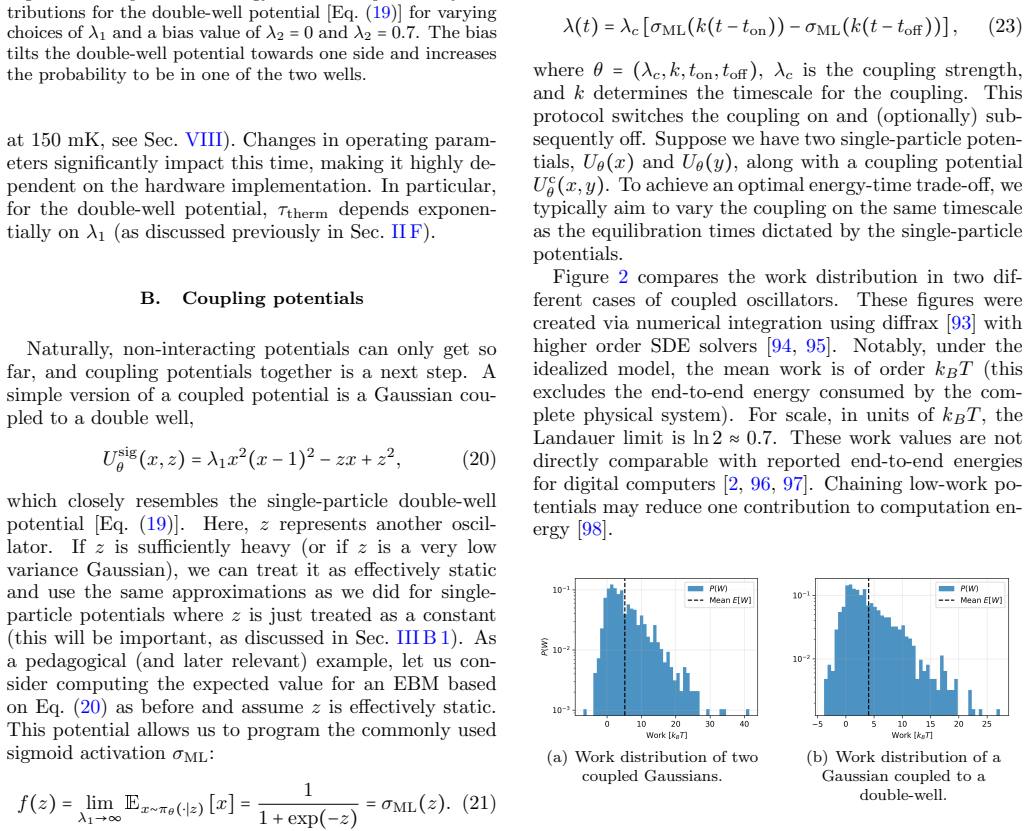
- Idealized work per coupling operation is of order k_B T (against a Landauer floor of ln 2·k_B T), the paper's quantitative argument that thermodynamic ML could run orders of magnitude below digital energy per operation.
- The same primitives compose as factor graphs, so any model expressible as a probabilistic graphical model — transformers, HMMs, mixtures — inherits the paradigm.
Reading between the lines
- The energy projections exclude cryogenic cooling, control electronics, and calibration overhead; if those dominate, as they do in today's superconducting systems, the practical energy advantage over digital hardware remains open even if the equilibrium-computation claim is correct.
- The covariance-gradient identity is substrate-agnostic: any fluctuating physical system whose steady state is Boltzmann — optomechanical, CMOS, photonic — could run the same training rule, so the blueprint's core could outlive superconducting hardware.
- The roughly 3x low-temperature escape-energy excess is directly testable: independent characterization of C, L, and I_c by neuron spectroscopy would separate a wrong device model from wrong fitted parameters — a decisive experiment the current data cannot yet adjudicate.
- A natural next test is whether the sub-k_B/h slope above crossover (12 vs 20.8 GHz/K) is caused by temperature-dependent quasiparticle resistance; a device with a normal-metal shunt of known resistance would make the damping model checkable.
Editorial analysis
A structured set of objections, weighed in public.
Referee Report
Summary. The paper proposes a framework for energy-based thermodynamic computing based on sampling from the equilibrium distribution of underdamped Langevin dynamics. It introduces elemental potentials whose thermal expectations approximate sigmoid (Eq. 21), softmax (Eq. 29), matrix-vector products (Eq. 27), and addition (Eq. 28), and derives a covariance-based gradient estimator for parameter gradients (Eq. 34). The framework is then embedded in factor graphs, extended to on-chip self-learning via a Born-Oppenheimer force, and illustrated with numerical demos (PGM, GMM, HMM, continuous Ising, thermoformer). A superconducting double-well 'thermodynamic neuron' is presented as a preliminary experimental realization, with escape-rate measurements intended to confirm the Kramers/Arrhenius prediction E_esc = k_B T (Sec. VIII).
Significance. The theoretical core of the paper is largely sound and useful: the potential constructions are explicit and concrete, the gradient identity of Eq. (34) is derived from first principles and is potentially hardware-friendly, and the factor-graph assembly is a coherent organizing principle. The numerical demonstrations are illustrative, and the framework makes falsifiable predictions for thermal expectations that could be tested in simulation or hardware. However, the experimental section, which is the paper's claim of a hardware proof-of-principle, does not quantitatively validate the thermal-activation model: the data in Fig. 13(c) show a low-temperature plateau corresponding to ~193 mK against a predicted T_cross of 46–76 mK, and a high-temperature slope of ~12 GHz/K against the expected k_B/h = 20.8 GHz/K. The authors' own explanation relies on parameter uncertainty and unmodeled quasiparticle damping, but no independent calibration is provided. Thus the hardware claim is not established, while the framework-level derivations stand.
major comments (3)
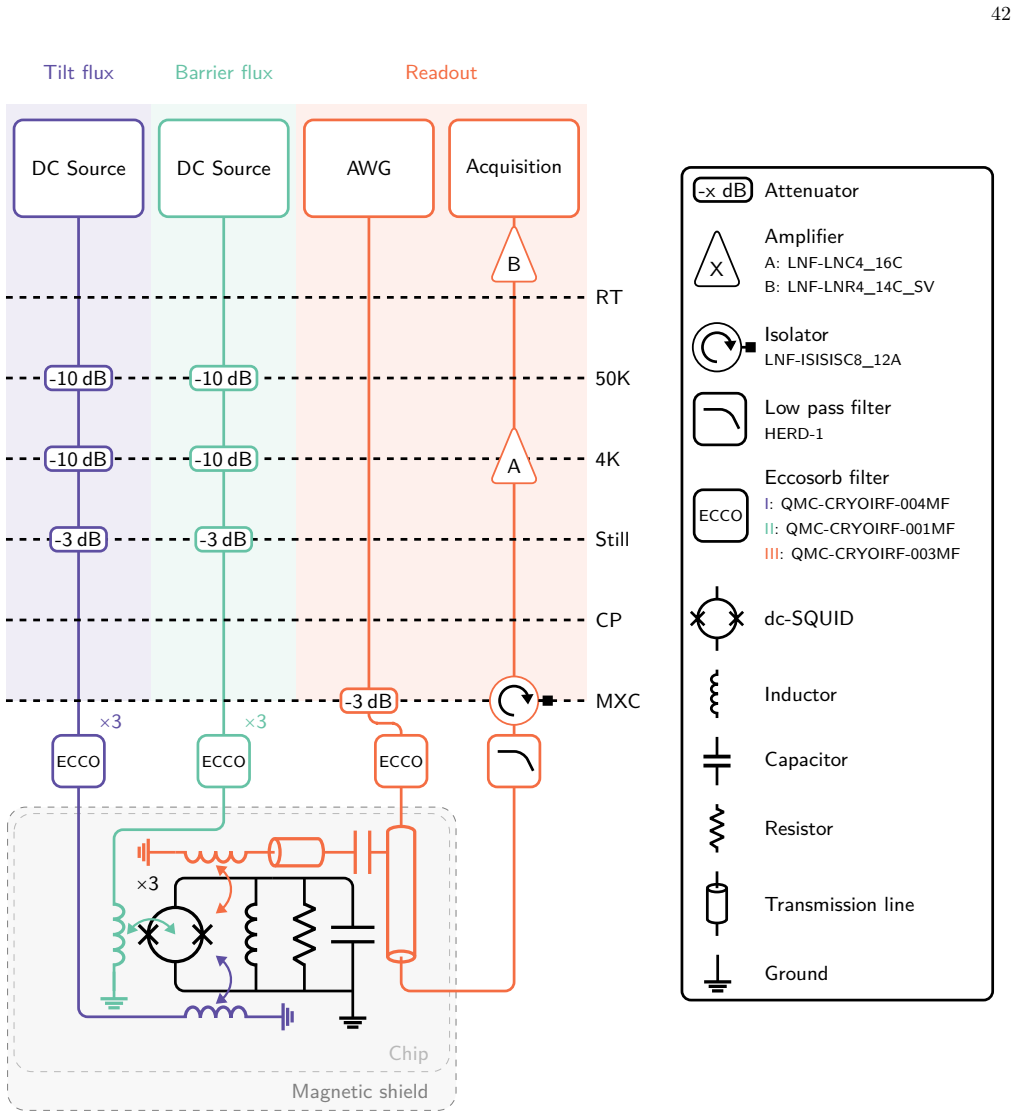
- [Sec. VIII C, Fig. 13(c), Eqs. (60)-(62)] The escape-energy data do not confirm the claimed thermal-activation regime. The low-temperature plateau E_esc/h = 4.02 GHz corresponds to ~193 mK, while T_cross estimated from Eq. (60) is 46–76 mK; the slope above 100 mK is ~12 GHz/K versus k_B/h = 20.8 GHz/K. The authors attribute this to 'very large uncertainty' in C, L, I_c and to quasiparticle damping. However, the same fitted parameters determine the ω_b used in T_cross and the ω_p and ΔU used in the Arrhenius fit of Eq. (65), so the comparison is not an independent test. With binary readout only and no direct measurement of R(T) or the thermodynamic neuron's own frequency, the experiment cannot distinguish a wrong device model from wrong fitted parameters.
- [Sec. VIII C, Eq. (60), Appendix H] The identification of the low-temperature plateau with k_B T_cross is asserted without derivation. For macroscopic quantum tunneling, the escape rate is not generally of the Arrhenius form with E_esc = k_B T_cross; the effective activation energy depends on the action and damping. Moreover, the missing data between 60 and 100 mK (Appendix J) means the crossover region is never directly measured, so the transition from plateau to linear rise is inferred, not observed. A conclusive test requires resolving the crossover or fitting the full escape-rate expression with independently calibrated parameters.
- [Sec. VIII B 2, Appendix H] The extraction of E_esc via Eq. (65) relies on ω_p and ΔU computed from the Hamiltonian fit. According to Appendix H, the fit uses 10 free parameters after fixing C and is performed only against readout resonator frequencies, not against the thermodynamic neuron's dynamics. The authors state the fit has 'very large uncertainty' in C, L, I_c, yet they do not propagate this uncertainty into E_esc or report confidence intervals for the slopes in Fig. 13(b). The claim that the measured slope is 40% below k_B/h is therefore not statistically grounded. Please propagate the fit covariance into E_esc and provide an independent estimate of ω_p and ΔU.
minor comments (5)
- [Eq. (59)] The displayed Hamiltonian is corrupted by stray tokens ("⌟⟨⟨⟪rl⟫l⟩⟩...") and is unreadable. The equation must be reset to the intended expression.
- [Sec. VII E, Eq. (58)] The variance potential is described as computing the variance of z, but the formula involves auxiliary x_i and y with the term (x_i - (z_i - μ))^2. The role of these auxiliary variables and the domain of validity should be clarified, especially since the text states this potential is not meant to be an equilibrium realization.
- [References] Several core components are cited only as pending patent applications by the same authors (e.g., Refs. [100-102], [114-115], [134], [147-149], [189], [202-203], [205]). For a journal publication, please provide public references or full technical descriptions in the text so that reviewers and readers can verify these components.
- [General] No code or data repository is provided for the numerical experiments (PGM, GMM, HMM, Ising, thermoformer) or for the experimental escape-rate data. The manuscript would be stronger if the authors released code/data, or at least provided the raw fit parameters and uncertainties for the key figures.
- [Sec. VII, Fig. 9] The tokens-per-joule projections exclude cryogenic cooling, control electronics, and calibration overhead, as stated in the text. The comparison with H100 GPUs in Fig. 9 should be interpreted with care; a clear caveat in the caption would prevent over-generalization.
Circularity Check
No significant circularity: the Gibbs steady state, potential constructions, and covariance-gradient identity are derived in-text or from standard external results; the experimental discrepancy is an acknowledged validation limitation, not a constructional fit.
full rationale
The paper's claimed derivation chain is self-contained. The steady-state Gibbs distribution of the underdamped Langevin equation (Eqs. 8-11) is the standard Klein-Kramers equilibrium solution, cited to Risken, so it does not reduce to the paper's own inputs. The sigmoid, matrix-vector, addition, and softmax operations (Eqs. 21, 27-29) are obtained by writing potentials whose hard-constraint equilibrium expectations are these functions; these are constructions, not fitted parameters, and the numerical checks use fixed stated potentials. The gradient rule Eq. (34) is derived in full in Sec. IV A from the quotient rule. The experimental section fits C, L, and I_c to the readout-resonator spectrum (Appendix H), then compares the extracted escape energy to the independently stated k_B T and T_cross predictions; the mismatches (low-temperature plateau ~193 mK vs T_cross 46-76 mK; slope ~12 GHz/K vs k_B/h = 20.8 GHz/K) are explicitly reported and attributed to the 'very large uncertainty' of Hamiltonian parameters and unmodeled quasiparticle damping. That is a validation weakness - the experiment cannot currently distinguish wrong device model from wrong fitted parameters - but it is not circular, because E_esc is not used to define the model parameters. Citations to the authors' pending patent applications (e.g., relay oscillators [100,101], mean-field propagation [114,115], natural-gradient readout [147], thermodynamic neuron [205]) name hardware components but are not load-bearing for the mathematical derivations, which are either given in the body or explicitly described as speculative. No load-bearing step reduces by definition to its input; therefore no circularity step is exhibited.
Assumptions & free parameters
free parameters (5)
- Hamiltonian fit parameters (C, L, L1,2, Ic, chi, M) =
C=120 fF (fixed), L=750 pH, L1,2=50 pH, Ic=0.997 uA, chi=0.0104, M=24.7 pH
- lambda_1, lambda_2 potential strengths =
lambda=10 for softmax convergence plots; lambda=1.0 for thermoformer; lambda_c=100 for work simulations
- Hardware projection parameters =
100 fF, 100 pH, 20 kOhm/100 Ohm, 150 mK/50 mK
- Escape-energy extraction fits =
A, B, tau in Eq. (64) per relaxation curve; slope of ln(Gamma/omega_p) vs Delta-U per temperature
- Damping prefactor a_t (Eq. 62) =
regime-dependent: |omega_b|/eta, 1, or proportional to eta*sqrt(C*Delta-U/k_B T)
assumptions (7)
- standard math Equilibrium of the Fokker-Planck equation for underdamped Langevin dynamics is the Gibbs distribution (Sec. II C, Eqs. 10-11)
- standard math Fluctuation-dissipation: noise amplitude sqrt(2*gamma_i/beta) in Eq. (8)
- standard math Kramers/Arrhenius escape law Eq. (62) with k_B T << Delta-U validity and regime-dependent prefactor a_t
- domain assumption Born-Oppenheimer timescale separation for slow parameter dynamics (Sec. VI, Eqs. 44-45)
- domain assumption Device is described by underdamped Langevin dynamics with a single effective parallel resistance R for loss and noise (Sec. VIII A, Eq. 61)
- domain assumption The simplified Hamiltonian Eq. (59) captures the potential landscape
- domain assumption Samples used in expectation estimates are effectively independent
invented entities (3)
-
Thermodynamic neuron
independent evidence
-
Estimation (relay) oscillators
-
Born-Oppenheimer parameter oscillators (self-learning)
Cite this review
Pith. "Pith review of A Blueprint for Equilibrium-Based Differentiable Continuous-Variable Thermodynamic Computing." pith.science (2026). https://pith.science/paper/HOLYO5WR
@misc{pith2026260716183,
  author       = {Pith},
  title        = {Pith review of: A Blueprint for Equilibrium-Based Differentiable Continuous-Variable Thermodynamic Computing},
  year         = {2026},
  howpublished = {\url{https://pith.science/paper/HOLYO5WR}},
  note         = {Machine review of arXiv:2607.16183}
}
read the original abstract
To address the escalating energy and latency demands of machine-learning workloads, we introduce a blueprint for an energy-efficient and fast thermodynamic computing stack that leverages stochastic analog processes in physical hardware. In this work, we focus on energy-based thermodynamic computing where the stochastic process is well described by Langevin dynamics with tunable energy potentials. The implementation of such potentials in physical hardware enables us to generate and sample from basic parameterized energy-based models. We demonstrate how to construct and train popular classes of machine learning models based on these hardware-native energy-based models, using the framework of probabilistic graphical models. We analyze the runtime and energy consumption of different models in this thermodynamic paradigm based on theoretical considerations and numerical studies. As a preliminary experimental realization of such hardware, we present our stochastic analog superconducting circuits driven by thermal noise. Together, these results outline a path toward energy-efficient thermodynamic hardware for probabilistic machine learning.
Figures


Figures from the paper (17 more)


Reference graph
Works this paper leans on
-
[1]
de Vries, The growing energy footprint of artificial intelligence, Joule7, 2191 (2023)
A. de Vries, The growing energy footprint of artificial intelligence, Joule7, 2191 (2023)
2023
-
[2]
Reuther, P
A. Reuther, P. Michaleas, M. Jones, V. Gadepally, S. Samsi, and J. Kepner, Ai and ml accelerator survey and trends, in2022 IEEE High Performance Extreme Computing Conference (HPEC)(IEEE, 2022) pp. 1–10
2022
-
[3]
Luccioni, Y
S. Luccioni, Y. Jernite, and E. Strubell, Power hungry processing: Watts driving the cost of ai deployment?, in The 2024 ACM Conference on Fairness, Accountability, and Transparency(2024) pp. 85–99
2024
-
[4]
Masanet, A
E. Masanet, A. Shehabi, N. Lei, S. Smith, and J. Koomey, Recalibrating global data center energy-use estimates, Science367, 984 (2020)
2020
-
[5]
M. Mohseni, A. Scherer, K. G. Johnson, O. Wertheim, M. Otten, N. A. Aadit, K. M. Bresniker, K. Y. Cam- sari, B. Chapman, S. Chatterjee,et al., How to build a quantum supercomputer: Scaling challenges and oppor- tunities, arXiv preprint arXiv:2411.10406 (2024)
arXiv 2024
-
[6]
N. P. De Leon, K. M. Itoh, D. Kim, K. K. Mehta, T. E. Northup, H. Paik, B. Palmer, N. Samarth, S. Sangtawesin, and D. W. Steuerman, Materials chal- lenges and opportunities for quantum computing hard- ware, Science372, eabb2823 (2021)
2021
-
[7]
Wendin, Quantum information processing with su- perconducting circuits: a review, Reports on Progress in Physics80, 106001 (2017)
G. Wendin, Quantum information processing with su- perconducting circuits: a review, Reports on Progress in Physics80, 106001 (2017)
2017
-
[8]
D. H. Wolpert, The stochastic thermodynamics of com- putation, Journal of Physics A: Mathematical and The- oretical52, 193001 (2019)
2019
Show all 242 references
-
[9]
D. H. Wolpert, J. Korbel, C. W. Lynn, F. Tasnim, J. A. Grochow, G. Karde¸ s, J. B. Aimone, V. Balasubrama- nian, E. De Giuli, D. Doty,et al., Is stochastic thermo- dynamics the key to understanding the energy costs of computation?, Proceedings of the National Academy of Scienc...
2024
-
[10]
Hooker, The hardware lottery, Communications of the ACM64, 58 (2021)
S. Hooker, The hardware lottery, Communications of the ACM64, 58 (2021)
2021
-
[11]
Conte, E
T. Conte, E. DeBenedictis, N. Ganesh, T. Hylton, J. P. Strachan, R. S. Williams, A. Alemi, L. Altenberg, G. Crooks, J. Crutchfield,et al., Thermodynamic com- 25 puting, arXiv preprint arXiv:1911.01968 (2019)
1911 arXiv
-
[12]
Langevin, Sur la th´ eorie du mouvement brownien (1908)
P. Langevin, Sur la th´ eorie du mouvement brownien (1908)
1908
-
[13]
G. E. Crooks,Excursions in Statistical Dynamics, Ph.D. thesis, University of California at Berkeley, Berkeley, California, United States of America (1999)
1999
-
[14]
A. A. Golubov, M. Y. Kupriyanov, and E. Il’Ichev, The current-phase relation in josephson junctions, Reviews of modern physics76, 411 (2004)
2004
-
[15]
Saira, M
O.-P. Saira, M. H. Matheny, R. Katti, W. Fon, G. Wim- satt, J. P. Crutchfield, S. Han, and M. L. Roukes, Nonequilibrium thermodynamics of erasure with su- perconducting flux logic, Physical Review Research2, 013249 (2020), publisher: American Physical Society
2020
-
[16]
Huembeli, J
P. Huembeli, J. M. Arrazola, N. Killoran, M. Mohseni, and P. Wittek, The physics of energy-based models, Quantum Machine Intelligence4, 1 (2022)
2022
-
[17]
Lockwood, F
O. Lockwood, F. Sch¨ afer, and P. Huembeli, Energy Based Models with Deep Neural Networks: A Review (2025), work in progress
2025
-
[18]
LeCun, S
Y. LeCun, S. Chopra, R. Hadsell, M. Ranzato, F. Huang,et al., A tutorial on energy-based learning, Predicting structured data1(2006)
2006
-
[19]
Du and I
Y. Du and I. Mordatch, Implicit generation and model- ing with energy based models, Advances in Neural In- formation Processing Systems32(2019)
2019
-
[20]
Song and D
Y. Song and D. P. Kingma, How to train your energy- based models, arXiv preprint arXiv:2101.03288 (2021)
2021 arXiv
-
[21]
Jelinˇ ciˇ c, O
A. Jelinˇ ciˇ c, O. Lockwood, A. Garlapati, G. Verdon, and T. McCourt, An efficient probabilistic hardware architecture for diffusion-like models, arXiv preprint arXiv:2510.23972 (2025)
2025
-
[22]
W. Moy, I. Ahmed, P.-w. Chiu, J. Moy, S. S. Sapatnekar, and C. H. Kim, A 1,968-node coupled ring oscillator circuit for combinatorial optimization problem solving, Nature Electronics5, 310 (2022)
2022
-
[23]
Inagaki, Y
T. Inagaki, Y. Haribara, K. Igarashi, T. Sonobe, S. Ta- mate, T. Honjo, A. Marandi, P. L. McMahon, T. Umeki, K. Enbutsu,et al., A coherent ising machine for 2000- node optimization problems, Science354, 603 (2016)
2000
-
[24]
Mohseni, P
N. Mohseni, P. L. McMahon, and T. Byrnes, Ising ma- chines as hardware solvers of combinatorial optimization problems, Nature Reviews Physics4, 363 (2022)
2022
-
[25]
N. A. Aadit, A. Grimaldi, M. Carpentieri, L. Theogara- jan, J. M. Martinis, G. Finocchio, and K. Y. Camsari, Massively parallel probabilistic computing with sparse ising machines, Nature Electronics5, 460 (2022)
2022
-
[26]
N. S. Singh, K. Kobayashi, Q. Cao, K. Selcuk, T. Hu, S. Niazi, N. A. Aadit, S. Kanai, H. Ohno, S. Fukami, et al., Cmos plus stochastic nanomagnets enabling het- erogeneous computers for probabilistic inference and learning, Nature Communications15, 2685 (2024)
2024
-
[27]
Laydevant, D
J. Laydevant, D. Markovi´ c, and J. Grollier, Training an ising machine with equilibrium propagation, Nature Communications15, 3671 (2024)
2024
-
[28]
J. Chou, S. Bramhavar, S. Ghosh, and W. Herzog, Ana- log coupled oscillator based weighted ising machine, Sci- entific reports9, 14786 (2019)
2019
-
[29]
K. Y. Camsari, R. Faria, B. M. Sutton, and S. Datta, Stochastic p-bits for invertible logic, Physical Review X 7, 031014 (2017)
2017
-
[30]
K. Y. Camsari, B. M. Sutton, and S. Datta, P-bits for probabilistic spin logic, Applied Physics Reviews6 (2019)
2019
-
[31]
Kaiser and S
J. Kaiser and S. Datta, Probabilistic computing with p-bits, Applied Physics Letters119(2021)
2021
-
[32]
Chowdhury, A
S. Chowdhury, A. Grimaldi, N. A. Aadit, S. Niazi, M. Mohseni, S. Kanai, H. Ohno, S. Fukami, L. Theog- arajan, G. Finocchio,et al., A full-stack view of proba- bilistic computing with p-bits: devices, architectures, and algorithms, IEEE Journal on Exploratory Solid- State Compu...
2023
-
[33]
Niazi, S
S. Niazi, S. Chowdhury, N. A. Aadit, M. Mohseni, Y. Qin, and K. Y. Camsari, Training deep boltzmann networks with sparse ising machines, Nature Electronics , 1 (2024)
2024
-
[34]
Freitas, G
N. Freitas, G. Massarelli, J. Rothschild, D. Keane, E. Dawe, S. Hwang, A. Garlapati, and T. McCourt, Taming nonequilibrium thermal fluctuations in sub- threshold cmos circuits (2026)
2026
-
[35]
M. W. Johnson, M. H. Amin, S. Gildert, T. Lanting, F. Hamze, N. Dickson, R. Harris, A. J. Berkley, J. Jo- hansson, P. Bunyk,et al., Quantum annealing with manufactured spins, Nature473, 194 (2011)
2011
-
[36]
A. D. King, S. Suzuki, J. Raymond, A. Zucca, T. Lant- ing, F. Altomare, A. J. Berkley, S. Ejtemaee, E. Hoskin- son, S. Huang,et al., Coherent quantum annealing in a programmable 2,000 qubit ising chain, Nature Physics 18, 1324 (2022)
2022
-
[37]
A. D. King, J. Raymond, T. Lanting, R. Harris, A. Zucca, F. Altomare, A. J. Berkley, K. Boothby, S. Ejtemaee, C. Enderud,et al., Quantum critical dy- namics in a 5,000-qubit programmable spin glass, Na- ture617, 61 (2023)
2023
-
[38]
J. M. Shainline, S. M. Buckley, R. P. Mirin, and S. W. Nam, Superconducting optoelectronic circuits for neuro- morphic computing, Physical Review Applied7, 034013 (2017)
2017
-
[39]
Kumar, U
A. Kumar, U. S. Goteti, E. Cubukcu, R. C. Dynes, and D. Kuzum, Evaluation of fluxon synapse device based on superconducting loops for energy efficient neuromor- phic computing, Frontiers in Neuroscience19, 1511371 (2025)
2025
-
[40]
Kudithipudi, C
D. Kudithipudi, C. Schuman, C. M. Vineyard, T. Pan- dit, C. Merkel, R. Kubendran, J. B. Aimone, G. Or- chard, C. Mayr, R. Benosman,et al., Neuromorphic computing at scale, Nature637, 801 (2025)
2025
-
[41]
J. B. Aimone, Neuromorphic computing: A theoretical framework for time, space, and energy scaling, arXiv preprint arXiv:2507.17886 (2025)
2025
-
[42]
P. J. Coles, C. Szczepanski, D. Melanson, K. Donatella, A. J. Martinez, and F. Sbahi, Thermodynamic ai and the fluctuation frontier, in2023 IEEE International Conference on Rebooting Computing (ICRC)(IEEE,
-
[43]
Aifer, K
M. Aifer, K. Donatella, M. H. Gordon, S. Duffield, T. Ahle, D. Simpson, G. Crooks, and P. J. Coles, Ther- modynamic linear algebra, npj Unconventional Com- puting1, 13 (2024)
2024
-
[44]
Melanson, M
D. Melanson, M. A. Khater, M. Aifer, K. Donatella, M. H. Gordon, T. Ahle, G. Crooks, A. J. Mar- tinez, F. Sbahi, and P. J. Coles, Thermodynamic computing system for ai applications, arXiv preprint arXiv:2312.04836 (2023)
2023 arXiv
-
[45]
Aifer, S
M. Aifer, S. Duffield, K. Donatella, D. Melanson, P. Klett, Z. Belateche, G. Crooks, A. J. Martinez, and P. J. Coles, Thermodynamic bayesian inference, arXiv preprint arXiv:2410.01793 (2024). 26
2024 arXiv
-
[46]
Donatella, S
K. Donatella, S. Duffield, M. Aifer, D. Melanson, G. Crooks, and P. J. Coles, Thermodynamic natu- ral gradient descent, arXiv preprint arXiv:2405.13817 (2024)
2024 arXiv
-
[47]
Osadchy, M
M. Osadchy, M. Miller, and Y. Cun, Synergistic face de- tection and pose estimation with energy-based models, Advances in neural information processing systems17 (2004)
2004
-
[48]
Ranzato, C
M. Ranzato, C. Poultney, S. Chopra, and Y. Cun, Effi- cient learning of sparse representations with an energy- based model, Advances in neural information processing systems19(2006)
2006
-
[49]
S. Zhai, Y. Cheng, W. Lu, and Z. Zhang, Deep struc- tured energy based models for anomaly detection, in International conference on machine learning(PMLR,
-
[50]
N. Liu, S. Li, Y. Du, A. Torralba, and J. B. Tenenbaum, Compositional visual generation with composable diffu- sion models, inEuropean Conference on Computer Vi- sion(Springer, 2022) pp. 423–439
2022
-
[51]
G. E. Hinton, Training products of experts by mini- mizing contrastive divergence, Neural computation14, 1771 (2002)
2002
-
[52]
M. A. Carreira-Perpinan and G. Hinton, On contrastive divergence learning, inInternational workshop on artifi- cial intelligence and statistics(PMLR, 2005) pp. 33–40
2005
-
[53]
Bengio and O
Y. Bengio and O. Delalleau, Justifying and generalizing contrastive divergence, Neural computation21, 1601 (2009)
2009
-
[54]
Sutskever and T
I. Sutskever and T. Tieleman, On the convergence prop- erties of contrastive divergence, inProceedings of the thirteenth international conference on artificial intelli- gence and statistics(JMLR Workshop and Conference Proceedings, 2010) pp. 789–795
2010
-
[55]
Y. Song, J. Sohl-Dickstein, D. P. Kingma, A. Kumar, S. Ermon, and B. Poole, Score-based generative mod- eling through stochastic differential equations, arXiv preprint arXiv:2011.13456 (2020)
2011 arXiv
-
[56]
Cheng and P
X. Cheng and P. Bartlett, Convergence of langevin mcmc in kl-divergence, inAlgorithmic Learning Theory (PMLR, 2018) pp. 186–211
2018
-
[57]
Cheng, N
X. Cheng, N. S. Chatterji, P. L. Bartlett, and M. I. Jor- dan, Underdamped langevin mcmc: A non-asymptotic analysis, inConference on learning theory(PMLR,
-
[58]
Zhang, X
R. Zhang, X. Liu, and Q. Liu, A langevin-like sampler for discrete distributions, inInternational Conference on Machine Learning(PMLR, 2022) pp. 26375–26396
2022
-
[59]
H. Sun, H. Dai, B. Dai, H. Zhou, and D. Schuur- mans, Discrete langevin samplers via wasserstein gra- dient flow, inInternational Conference on Artificial In- telligence and Statistics(PMLR, 2023) pp. 6290–6313
2023
-
[60]
G. O. Roberts and R. L. Tweedie, Exponential conver- gence of Langevin distributions and their discrete ap- proximations, Bernoulli2, 341 (1996)
1996
-
[61]
Balakrishnan, Fluctuation-dissipation theorems from the generalised langevin equation, Pramana12, 301 (1979)
V. Balakrishnan, Fluctuation-dissipation theorems from the generalised langevin equation, Pramana12, 301 (1979)
1979
-
[62]
S¨ arkk¨ a and A
S. S¨ arkk¨ a and A. Solin,Applied stochastic differential equations, Vol. 10 (Cambridge University Press, 2019)
2019
-
[63]
Risken,The Fokker-Planck Equation: Methods of So- lution and Applications, second edition ed., edited by H
H. Risken,The Fokker-Planck Equation: Methods of So- lution and Applications, second edition ed., edited by H. Haken (Springer, Berlin, 1989)
1989
-
[64]
C. H. Bennett, The thermodynamics of computation—a review, International Journal of Theoretical Physics21, 905 (1982)
1982
-
[65]
J. A. Vaccaro and S. M. Barnett, Information erasure without an energy cost, Proceedings of the Royal Soci- ety A: Mathematical, Physical and Engineering Sciences 467, 1770 (2011)
2011
-
[66]
Fredkin and T
E. Fredkin and T. Toffoli, Conservative logic, Interna- tional Journal of theoretical physics21, 219 (1982)
1982
-
[67]
S. Shankar, Energy estimates across layers of comput- ing: from devices to large-scale applications in machine learning for natural language processing, scientific com- puting, and cryptocurrency mining, in2023 IEEE High Performance Extreme Computing Conference (HPEC) (IEEE, 2...
2023
-
[68]
Nakazato and S
M. Nakazato and S. Ito, Geometrical aspects of en- tropy production in stochastic thermodynamics based on wasserstein distance, Physical Review Research3, 043093 (2021)
2021
-
[69]
Reilly and S
M. Reilly and S. Lloyd, Physical complexity and black hole quantum computers, inJournal of Physics: Con- ference Series, Vol. 3017 (IOP Publishing, 2025) p. 012010
2025
-
[70]
Lahiri, J
S. Lahiri, J. Sohl-Dickstein, and S. Ganguli, A universal tradeoff between power, precision and speed in phys- ical communication, arXiv preprint arXiv:1603.07758 (2016)
2016 arXiv
-
[71]
Ito, Stochastic thermodynamic interpretation of in- formation geometry, Physical review letters121, 030605 (2018)
S. Ito, Stochastic thermodynamic interpretation of in- formation geometry, Physical review letters121, 030605 (2018)
2018
-
[72]
Ito and A
S. Ito and A. Dechant, Stochastic time evolution, infor- mation geometry, and the cram´ er-rao bound, Physical Review X10, 021056 (2020)
2020
-
[73]
Ito, Geometric thermodynamics for the fokker–planck equation: stochastic thermodynamic links between in- formation geometry and optimal transport, Information Geometry7, 441 (2024)
S. Ito, Geometric thermodynamics for the fokker–planck equation: stochastic thermodynamic links between in- formation geometry and optimal transport, Information Geometry7, 441 (2024)
2024
-
[74]
Hnybida and S
J. Hnybida and S. Verret, Minimal-dissipation learning for energy-based models, arXiv preprint arXiv:2510.03137 (2025)
2025 arXiv
-
[75]
Villaniet al.,Optimal transport: old and new, Vol
C. Villaniet al.,Optimal transport: old and new, Vol. 338 (Springer, 2009)
2009
-
[76]
Klinger and G
J. Klinger and G. M. Rotskoff, Minimally dissi- pative multi-bit logical operations, arXiv preprint arXiv:2506.24021 (2025)
2025 arXiv
-
[77]
Rolandi, P
A. Rolandi, P. Abiuso, P. Lipka-Bartosik, M. Aifer, P. J. Coles, and M. Perarnau-Llobet, Energy-time-accuracy tradeoffs in thermodynamic computing, arXiv preprint arXiv:2601.04358 (2026)
2026
-
[78]
H. A. Kramers, Brownian motion in a field of force and the diffusion model of chemical reactions, physica7, 284 (1940)
1940
-
[79]
B¨ uttiker, E
M. B¨ uttiker, E. Harris, and R. Landauer, Thermal ac- tivation in extremely underdamped josephson-junction circuits, Physical Review B28, 1268 (1983)
1983
-
[80]
Risken and K
H. Risken and K. Voigtlaender, Eigenvalues and eigen- functions of the fokker-planck equation for the ex- tremely underdamped brownian motion in a double-well potential, Journal of statistical physics41, 825 (1985)
1985
-
[81]
Sekimoto, Stochastic energetics (2010)
K. Sekimoto, Stochastic energetics (2010)
2010
-
[82]
K. J. Ray and J. P. Crutchfield, Gigahertz sub-landauer momentum computing, Physical Review Applied19, 014049 (2023)
2023
-
[83]
Wimsatt, O.-P
G. Wimsatt, O.-P. Saira, A. B. Boyd, M. H. Math- eny, S. Han, M. L. Roukes, and J. P. Crutchfield, Har- 27 nessing fluctuations in thermodynamic computing via time-reversal symmetries, Physical Review Research3, 033115 (2021)
2021
-
[84]
Jarzynski, Equalities and inequalities: Irreversibility and the second law of thermodynamics at the nanoscale, inTime: Poincar´ e Seminar 2010(Springer, 2012) pp
C. Jarzynski, Equalities and inequalities: Irreversibility and the second law of thermodynamics at the nanoscale, inTime: Poincar´ e Seminar 2010(Springer, 2012) pp. 145–172
2010
-
[85]
Shiraishi, An introduction to stochastic thermody- namics, Fundamental Theories of Physics
N. Shiraishi, An introduction to stochastic thermody- namics, Fundamental Theories of Physics. Springer, Sin- gapore (2023)
2023
-
[86]
Vaikuntanathan and C
S. Vaikuntanathan and C. Jarzynski, Escorted free en- ergy simulations, The Journal of chemical physics134 (2011)
2011
-
[87]
S. Park, F. Khalili-Araghi, E. Tajkhorshid, and K. Schulten, Free energy calculation from steered molec- ular dynamics simulations using jarzynski’s equality, The Journal of chemical physics119, 3559 (2003)
2003
-
[88]
Whitelam and C
S. Whitelam and C. Casert, Thermodynamic comput- ing out of equilibrium, arXiv preprint arXiv:2412.17183 (2024)
2024
-
[89]
Sch¨ afer, M
F. Sch¨ afer, M. A. Bastarrachea-Magnani, A. U. Lode, L. d. F. de Parny, and A. Buchleitner, Spectral struc- ture and many-body dynamics of ultracold bosons in a double-well, Entropy22, 382 (2020)
2020
-
[90]
Borah, B
S. Borah, B. Sarma, M. Kewming, G. J. Milburn, and J. Twamley, Measurement-based feedback quantum control with deep reinforcement learning for a double- well nonlinear potential, Physical review letters127, 190403 (2021)
2021
-
[91]
Q. Wu, L. Mancino, M. Carlesso, M. A. Ciampini, L. Magrini, N. Kiesel, and M. Paternostro, Nonequi- librium quantum thermodynamics of a particle trapped in a controllable time-varying potential, PRX Quantum 3, 010322 (2022)
2022
-
[92]
Virtanen, R
P. Virtanen, R. Gommers, T. E. Oliphant, M. Haber- land, T. Reddy, D. Cournapeau, E. Burovski, P. Peter- son, W. Weckesser, J. Bright,et al., Scipy 1.0: funda- mental algorithms for scientific computing in python, Nature methods17, 261 (2020)
2020
-
[93]
Kidger,On Neural Differential Equations, Ph.D
P. Kidger,On Neural Differential Equations, Ph.D. the- sis, University of Oxford (2021)
2021
-
[94]
Foster, G
J. Foster, G. dos Reis, and C. Strange, High order split- ting methods for sdes satisfying a commutativity condi- tion, arXiv:2210.17543 (2023)
2023 arXiv
-
[95]
Foster, T
J. Foster, T. Lyons, and H. Oberhauser, The shifted ode method for underdamped langevin mcmc, arXiv preprint arXiv:2101.03446 (2021)
2021 arXiv
-
[96]
J. Choi, M. Dukhan, X. Liu, and R. Vuduc, Algorith- mic time, energy, and power on candidate hpc compute building blocks, in2014 IEEE 28th international paral- lel and distributed processing symposium(IEEE, 2014) pp. 447–457
2014
-
[97]
Garc ´ ıa-Mart ´ ın, C
E. Garc ´ ıa-Mart ´ ın, C. F. Rodrigues, G. Riley, and H. Grahn, Estimation of energy consumption in machine learning, Journal of Parallel and Distributed Computing 134, 75 (2019)
2019
-
[98]
Whitelam, Training thermodynamic computers by gradient descent, arXiv preprint arXiv:2509.15324 (2025)
S. Whitelam, Training thermodynamic computers by gradient descent, arXiv preprint arXiv:2509.15324 (2025)
2025
-
[99]
Borle and S
A. Borle and S. J. Lomonaco, Analyzing the quan- tum annealing approach for solving linear least squares problems, inInternational Workshop on Algorithms and Computation(Springer, 2018) pp. 289–301
2018
-
[100]
Chamberland and G
C. Chamberland and G. Verdon-Akzam, Thermody- namic computing relay gadget, US Patent Application Publication US 2025/0284867 A1 (2025), Assignee: Ex- tropic Corp. Status: pending
2025
-
[101]
Chamberland and G
C. Chamberland and G. Verdon-Akzam, Thermody- namic computing relay gadget for multi-well potentials, US Patent Application Publication US 2025/0373202 A1 (2025), Assignee: Extropic Corp. Status: pending
2025
-
[102]
Chamberland and G
C. Chamberland and G. Verdon-Akzam, Thermody- namic computing system configured to implement trans- former based architecture, US Patent Application Pub- lication US 2025/0284949 A1 (2025), Assignee: Extropic Corp. Status: pending
2025
-
[103]
M. M. H. Sajeeb, N. A. Aadit, S. Chowdhury, T. Wu, C. Smith, D. Chinmay, A. Raut, K. Y. Camsari, C. Delacour, and T. Srimani, Scalable connectivity for ising machines: Dense to sparse, Physical Review Ap- plied24, 014005 (2025)
2025
-
[104]
Agrawal, A
A. Agrawal, A. Panwar, J. Mohan, N. Kwatra, B. S. Gulavani, and R. Ramjee, Sarathi: Efficient llm in- ference by piggybacking decodes with chunked prefills, arXiv preprint arXiv:2308.16369 (2023)
2023 arXiv
-
[105]
Z. Yuan, Y. Shang, Y. Zhou, Z. Dong, Z. Zhou, C. Xue, B. Wu, Z. Li, Q. Gu, Y. J. Lee,et al., Llm infer- ence unveiled: Survey and roofline model insights, arXiv preprint arXiv:2402.16363 (2024)
2024 arXiv
-
[106]
Bolte and E
J. Bolte and E. Pauwels, A mathematical model for au- tomatic differentiation in machine learning, Advances in Neural Information Processing Systems33, 10809 (2020)
2020
-
[107]
LeCun, D
Y. LeCun, D. Touresky, G. Hinton, and T. Sejnowski, A theoretical framework for back-propagation, inProceed- ings of the 1988 connectionist models summer school, Vol. 1 (1988) pp. 21–28
1988
-
[108]
A. G. Baydin, B. A. Pearlmutter, A. A. Radul, and J. M. Siskind, Automatic differentiation in machine learning: a survey, Journal of machine learning research18, 1 (2018)
2018
-
[109]
C. C. Margossian, A review of automatic differentiation and its efficient implementation, Wiley interdisciplinary reviews: data mining and knowledge discovery9, e1305 (2019)
2019
-
[110]
Sch¨ afer, M
F. Sch¨ afer, M. Tarek, L. White, and C. Rackauckas, Ab- stractdifferentiation. jl: Backend-agnostic differentiable programming in julia, arXiv preprint arXiv:2109.12449 (2021)
2021 arXiv
-
[111]
W. S. Moses, V. Churavy, L. Paehler, J. H¨ uckelheim, S. H. K. Narayanan, M. Schanen, and J. Doerfert, Reverse-mode automatic differentiation and optimiza- tion of gpu kernels via enzyme, inProceedings of the international conference for high performance comput- ing, networkin...
2021
-
[112]
G. Arya, M. Schauer, F. Sch¨ afer, and C. Rackauckas, Automatic differentiation of programs with discrete ran- domness, Advances in Neural Information Processing Systems35, 10435 (2022)
2022
-
[113]
G. Arya, R. Seyer, F. Sch¨ afer, K. Chandra, A. K. Lew, M. Huot, V. K. Mansinghka, J. Ragan- Kelley, C. Rackauckas, and M. Schauer, Differentiat- ing metropolis-hastings to optimize intractable densi- ties, arXiv preprint arXiv:2306.07961 (2023)
2023 arXiv
-
[114]
Chamberland and G
C. Chamberland and G. Verdon-Akzam, Thermody- namic computing mean-field forwards and backwards propagation, US Patent Application Publication US 2025/0284959 A1 (2025), Assignee: Extropic Corp. Sta- 28 tus: pending
2025
-
[115]
Chamberland and G
C. Chamberland and G. Verdon-Akzam, Thermo- dynamic computing mean-field forwards and back- wards propagation, PCT Application Publication WO 2025/189010 A8 (2025), Assignee: Extropic Corp. Sta- tus: pending
2025
-
[116]
Scellier and Y
B. Scellier and Y. Bengio, Equilibrium propagation: Bridging the gap between energy-based models and backpropagation, Frontiers in computational neuro- science11, 24 (2017)
2017
-
[117]
Kendall, R
J. Kendall, R. Pantone, K. Manickavasagam, Y. Ben- gio, and B. Scellier, Training end-to-end analog neural networks with equilibrium propagation, arXiv preprint arXiv:2006.01981 (2020)
2006 arXiv
-
[118]
Stern, D
M. Stern, D. Hexner, J. W. Rocks, and A. J. Liu, Su- pervised learning in physical networks: From machine learning to learning machines, Physical Review X11, 021045 (2021)
2021
-
[119]
Fortunato, M
M. Fortunato, M. G. Azar, B. Piot, J. Menick, I. Os- band, A. Graves, V. Mnih, R. Munos, D. Hassabis, O. Pietquin, C. Blundell, and S. Legg, Noisy net- works for exploration, CoRRabs/1706.10295(2017), 1706.10295
2017 arXiv
-
[120]
Plappert, R
M. Plappert, R. Houthooft, P. Dhariwal, S. Sidor, R. Y. Chen, X. Chen, T. Asfour, P. Abbeel, and M. Andrychowicz, Parameter space noise for explo- ration, arXiv preprint arXiv:1706.01905 (2017)
2017 arXiv
-
[121]
Eberhard, J
O. Eberhard, J. Hollenstein, C. Pinneri, and G. Martius, Pink noise is all you need: Colored noise exploration in deep reinforcement learning, inThe Eleventh Interna- tional Conference on Learning Representations(2023)
2023
-
[122]
Gal and Z
Y. Gal and Z. Ghahramani, Dropout as a bayesian ap- proximation: Representing model uncertainty in deep learning, ininternational conference on machine learn- ing(PMLR, 2016) pp. 1050–1059
2016
-
[123]
Y. Gal, J. Hron, and A. Kendall, Concrete dropout, Advances in neural information processing systems30 (2017)
2017
-
[124]
Lockwood and M
O. Lockwood and M. Si, A review of uncertainty for deep reinforcement learning, inProceedings of the AAAI Conference on Artificial Intelligence and Interactive Digital Entertainment, Vol. 18 (2022) pp. 155–162
2022
-
[125]
Srivastava, G
N. Srivastava, G. Hinton, A. Krizhevsky, I. Sutskever, and R. Salakhutdinov, Dropout: a simple way to pre- vent neural networks from overfitting, The journal of machine learning research15, 1929 (2014)
1929
-
[126]
D. P. Kingma, T. Salimans, and M. Welling, Varia- tional dropout and the local reparameterization trick, Advances in neural information processing systems28 (2015)
2015
-
[127]
X. Shen, X. Tian, T. Liu, F. Xu, and D. Tao, Continu- ous dropout, IEEE transactions on neural networks and learning systems29, 3926 (2017)
2017
-
[128]
Molchanov, A
D. Molchanov, A. Ashukha, and D. Vetrov, Variational dropout sparsifies deep neural networks, inInterna- tional conference on machine learning(PMLR, 2017) pp. 2498–2507
2017
-
[129]
Koller, Probabilistic graphical models: Principles and techniques (2009)
D. Koller, Probabilistic graphical models: Principles and techniques (2009)
2009
-
[130]
Loeliger, An introduction to factor graphs, IEEE Signal Processing Magazine21, 28 (2004)
H.-A. Loeliger, An introduction to factor graphs, IEEE Signal Processing Magazine21, 28 (2004)
2004
-
[131]
B. A. Cipra, An introduction to the ising model, The American Mathematical Monthly94, 937 (1987)
1987
-
[132]
Drton and M
M. Drton and M. H. Maathuis, Structure learning in graphical modeling, Annual Review of Statistics and Its Application4, 365 (2017)
2017
-
[133]
Du and L
Y. Du and L. Kaelbling, Compositional generative mod- eling: A single model is not all you need, arXiv preprint arXiv:2402.01103 (2024)
2024 arXiv
-
[134]
Chamberland and G
C. Chamberland and G. Verdon-Akzam, Gibbs sam- pling methods using thermodynamic computing, US Patent Application Publication US 2025/0284562 A1 (2025), Assignee: Extropic Corp. Status: pending
2025
-
[135]
C. P. Robert, G. Casella, and G. Casella,Monte Carlo statistical methods, Vol. 2 (Springer, 1999)
1999
-
[136]
C. M. De Sa, C. Zhang, K. Olukotun, and C. R´ e, Rapidly mixing gibbs sampling for a class of factor graphs using hierarchy width, Advances in neural in- formation processing systems28(2015)
2015
-
[137]
Gonzalez, Y
J. Gonzalez, Y. Low, A. Gretton, and C. Guestrin, Par- allel gibbs sampling: From colored fields to thin junc- tion trees, inProceedings of the Fourteenth Interna- tional Conference on Artificial Intelligence and Statis- tics(JMLR Workshop and Conference Proceedings,
-
[138]
Terenin, D
A. Terenin, D. Simpson, and D. Draper, Asynchronous gibbs sampling, inInternational Conference on Artifi- cial Intelligence and Statistics(PMLR, 2020) pp. 144– 154
2020
-
[139]
Daskalakis, N
C. Daskalakis, N. Dikkala, and S. Jayanti, Hogwild!- gibbs can be panaccurate, Advances in Neural Informa- tion Processing Systems31(2018)
2018
-
[140]
J. S. Yedidia, W. Freeman, and Y. Weiss, Generalized belief propagation, Advances in neural information pro- cessing systems13(2000)
2000
-
[141]
C. M. Bishop, Latent variable models, inLearning in graphical models(Springer, 1998) pp. 371–403
1998
-
[142]
de Bos and M
D. de Bos and M. Serra-Garcia, Learning in a multifield coherent ising machine (2025), arXiv:2502.12020 [cond- mat.mes-hall]
2025
-
[143]
Lloyd, Thermodynamics+ natural selection= bayesian inference, arXiv preprint arXiv:2511.17641 (2025)
S. Lloyd, Thermodynamics+ natural selection= bayesian inference, arXiv preprint arXiv:2511.17641 (2025)
2025
-
[144]
B¨ osch, G
C. B¨ osch, G. Roeder, M. Serra-Garcia, and R. P. Adams, Local learning rules for out-of-equilibrium phys- ical generative models, arXiv preprint arXiv:2506.19136 (2025)
2025 arXiv
-
[145]
Lopez-Pastor and F
V. Lopez-Pastor and F. Marquardt, Self-learning ma- chines based on hamiltonian echo backpropagation, Physical Review X13, 031020 (2023)
2023
-
[146]
Martens, New insights and perspectives on the natu- ral gradient method, Journal of Machine Learning Re- search21, 1 (2020)
J. Martens, New insights and perspectives on the natu- ral gradient method, Journal of Machine Learning Re- search21, 1 (2020)
2020
-
[147]
Chamberland and G
C. Chamberland and G. Verdon-Akzam, Thermody- namic computing system configured to use natural gra- dient descent techniques to determine updated weights and biases, US Patent Application Publication US 2025/0238670 A1 (2025), Assignee: Extropic Corp. Sta- tus: pending
2025
-
[148]
Chamberland and G
C. Chamberland and G. Verdon-Akzam, Thermody- namic computing system configured to update weights and biases based on gradient values obtained by re- lay oscillators, US Patent Application Publication US 2025/0390737 A1 (2025), Assignee: Extropic Corp. Sta- tus: pending
2025
-
[149]
Chamberland and G
C. Chamberland and G. Verdon-Akzam, Self-learning thermodynamic computing system, US Patent Applica- tion Publication US 2025/0165761 A1 (2025), Assignee: 29 Extropic Corp. Status: pending
2025
-
[150]
Vaswani, N
A. Vaswani, N. Shazeer, N. Parmar, J. Uszkoreit, L. Jones, A. N. Gomez, L. Kaiser, and I. Polosukhin, At- tention is all you need, CoRRabs/1706.03762(2017), 1706.03762
2017 arXiv
-
[151]
Bradbury, R
J. Bradbury, R. Frostig, P. Hawkins, M. J. Johnson, C. Leary, D. Maclaurin, G. Necula, A. Paszke, J. Van- derPlas, S. Wanderman-Milne, and Q. Zhang, JAX: composable transformations of Python+NumPy pro- grams (2018)
2018
-
[152]
Babuschkin, K
DeepMind, I. Babuschkin, K. Baumli, A. Bell, S. Bhu- patiraju, J. Bruce, P. Buchlovsky, D. Budden, T. Cai, A. Clark, I. Danihelka, A. Dedieu, C. Fantacci, J. God- win, C. Jones, R. Hemsley, T. Hennigan, M. Hessel, S. Hou, S. Kapturowski, T. Keck, I. Kemaev, M. King, M. Kunesch...
2020
-
[153]
Kidger and C
P. Kidger and C. Garcia, Equinox: neural networks in JAX via callable PyTrees and filtered transformations, Differentiable Programming workshop at Neural Infor- mation Processing Systems 2021 (2021)
2021
-
[154]
Bickson, Gaussian belief propagation: Theory and aplication, arXiv preprint arXiv:0811.2518 (2008)
D. Bickson, Gaussian belief propagation: Theory and aplication, arXiv preprint arXiv:0811.2518 (2008)
2008 arXiv
-
[155]
Su and Y.-C
Q. Su and Y.-C. Wu, On convergence conditions of gaus- sian belief propagation, IEEE Transactions on Signal Processing63, 1144 (2015)
2015
-
[156]
Ortiz, T
J. Ortiz, T. Evans, and A. J. Davison, A visual intro- duction to gaussian belief propagation, arXiv preprint arXiv:2107.02308 (2021)
2021 arXiv
-
[157]
V. G. Satorras and M. Welling, Neural enhanced be- lief propagation on factor graphs, inInternational Con- ference on Artificial Intelligence and Statistics(PMLR,
-
[158]
Liang and F
M. Liang and F. Meyer, Neural enhanced belief propa- gation for cooperative localization, in2021 IEEE Sta- tistical Signal Processing Workshop (SSP)(IEEE, 2021) pp. 326–330
2021
-
[159]
Patwardhan, R
A. Patwardhan, R. Murai, and A. J. Davison, Distribut- ing collaborative multi-robot planning with gaussian be- lief propagation, IEEE Robotics and Automation Let- ters8, 552 (2022)
2022
-
[160]
Ortiz,Gaussian belief propagation for real-time decen- tralised inference, Ph.D
J. Ortiz,Gaussian belief propagation for real-time decen- tralised inference, Ph.D. thesis, Imperial College London (2023)
2023
-
[161]
Liang and F
M. Liang and F. Meyer, Neural enhanced belief propa- gation for multiobject tracking, IEEE Transactions on Signal Processing (2023)
2023
-
[162]
Dandi, L
Y. Dandi, L. Stephan, F. Krzakala, B. Loureiro, and L. Zdeborov´ a, Universality laws for gaussian mixtures in generalized linear models, Advances in Neural Infor- mation Processing Systems36(2024)
2024
-
[163]
Shi and M
H. Shi and M. Drton, On universal inference in gaus- sian mixture models, arXiv preprint arXiv:2407.19361 (2024)
2024 arXiv
-
[164]
Lockwood, distreqx: Distributions and bijectors in jax,https://github.com/lockwo/distreqx(2024)
O. Lockwood, distreqx: Distributions and bijectors in jax,https://github.com/lockwo/distreqx(2024)
2024
-
[165]
L. R. Rabiner, A tutorial on hidden markov models and selected applications in speech recognition, Proceedings of the IEEE77, 257 (1989)
1989
-
[166]
S. R. Eddy, What is a hidden markov model?, Nature biotechnology22, 1315 (2004)
2004
-
[167]
Krogh, M
A. Krogh, M. Brown, I. S. Mian, K. Sj¨ olander, and D. Haussler, Hidden markov models in computational biology: Applications to protein modeling, Journal of molecular biology235, 1501 (1994)
1994
-
[168]
R. S. Mamon and R. J. Elliott,Hidden Markov models in finance, Vol. 4 (Springer, 2007)
2007
-
[169]
J. He, G. Neubig, and T. Berg-Kirkpatrick, Unsu- pervised learning of syntactic structure with invert- ible neural projections, arXiv preprint arXiv:1808.09111 (2018)
2018 arXiv
-
[170]
D. Liu, A. Honor´ e, S. Chatterjee, and L. K. Ras- mussen, Powering hidden markov model by neural net- work based generative models, CoRRabs/1910.05744 (2019), 1910.05744
1910 arXiv
-
[171]
Ghosh, A
A. Ghosh, A. Honor´ e, D. Liu, G. E. Henter, and S. Chat- terjee, Normalizing flow based hidden markov models for classification of speech phones with explainability, arXiv preprint arXiv:2107.00730 (2021)
2021 arXiv
-
[172]
Azeraf, E
E. Azeraf, E. Monfrini, E. Vignon, and W. Pieczynski, Introducing the hidden neural markov chain framework, arXiv preprint arXiv:2102.11038 (2021)
2021 arXiv
-
[173]
Gangloff, K
H. Gangloff, K. Morales, and Y. Petetin, A general parametrization framework for pairwise markov models: An application to unsupervised image segmentation, in 2021 IEEE 31st International Workshop on Machine Learning for Signal Processing (MLSP)(IEEE, 2021) pp. 1–6
2021
-
[174]
Gangloff, K
H. Gangloff, K. Morales, and Y. Petetin, Deep param- eterizations of pairwise and triplet markov models for unsupervised classification of sequential data, Compu- tational Statistics & Data Analysis180, 107663 (2023)
2023
-
[175]
S. W. Linderman, P. Chang, G. Harper-Donnelly, A. Kara, X. Li, G. Duran-Martin, and K. Murphy, Dy- namax: A Python package for probabilistic state space modeling with JAX (2025)
2025
-
[176]
S. G. Brush, History of the lenz-ising model, Reviews of modern physics39, 883 (1967)
1967
-
[177]
Patel, L
S. Patel, L. Chen, P. Canoza, and S. Salahuddin, Ising model optimization problems on a fpga accel- erated restricted boltzmann machine, arXiv preprint arXiv:2008.04436 (2020)
2008 arXiv
-
[178]
D. H. Ackley, G. E. Hinton, and T. J. Sejnowski, A learning algorithm for boltzmann machines, Cognitive science9, 147 (1985)
1985
-
[179]
Nikhar, S
S. Nikhar, S. Kannan, N. A. Aadit, S. Chowdhury, and K. Y. Camsari, All-to-all reconfigurability with sparse and higher-order ising machines, Nature Communica- tions15, 8977 (2024)
2024
-
[180]
Bresler, Efficiently learning ising models on arbitrary graphs, inProceedings of the forty-seventh annual ACM symposium on Theory of computing(2015) pp
G. Bresler, Efficiently learning ising models on arbitrary graphs, inProceedings of the forty-seventh annual ACM symposium on Theory of computing(2015) pp. 771–782
2015
-
[181]
A. Y. Lokhov, M. Vuffray, S. Misra, and M. Chertkov, Optimal structure and parameter learning of ising mod- els, Science advances4, e1700791 (2018)
2018
-
[182]
Salakhutdinov and G
R. Salakhutdinov and G. Hinton, Deep boltzmann ma- chines, inArtificial intelligence and statistics(PMLR,
-
[183]
Dunn and Y
B. Dunn and Y. Roudi, Learning and inference in a nonequilibrium ising model with hidden nodes, Physi- cal Review E—Statistical, Nonlinear, and Soft Matter Physics87, 022127 (2013)
2013
-
[184]
Nussbaum and J
F. Nussbaum and J. Giesen, Ising models with latent conditional gaussian variables, inAlgorithmic Learning 30 Theory(PMLR, 2019) pp. 669–681
2019
-
[185]
Nishikawa and H
K.-i. Nishikawa and H. Nakano, A continuous ising model exhibiting phase transitions of first or second or- der, Progress of Theoretical Physics56, 773 (1976)
1976
-
[186]
van Beijeren and G
H. van Beijeren and G. S. Sylvester, Phase transitions for continuous-spin ising ferromagnets, Journal of Func- tional Analysis28, 145 (1978)
1978
-
[187]
Bayong and H
E. Bayong and H. Diep, Effect of long-range interactions on the critical behavior of the continuous ising model, Physical Review B59, 11919 (1999)
1999
-
[188]
Ramachandran, B
P. Ramachandran, B. Zoph, and Q. V. Le, Searching for activation functions, arXiv preprint arXiv:1710.05941 (2017)
2017 arXiv
-
[189]
Chamberland and G
C. Chamberland and G. Verdon-Akzam, Thermody- namic computing swish gadget, US Patent Application US 18/937,670 (2024), Assignee: Extropic Corp. Filed: Nov. 5, 2024. Status: pending; yet to be published
2024
-
[190]
Radford, J
A. Radford, J. Wu, R. Child, D. Luan, D. Amodei, I. Sutskever,et al., Language models are unsupervised multitask learners, OpenAI blog1, 9 (2019)
2019
-
[191]
J. L. Ba, J. R. Kiros, and G. E. Hinton, Layer normal- ization (2016), arXiv:1607.06450 [stat.ML]
2016 arXiv
-
[192]
Xiong, Y
R. Xiong, Y. Yang, D. He, K. Zheng, S. Zheng, C. Xing, H. Zhang, Y. Lan, L. Wang, and T. Liu, On layer nor- malization in the transformer architecture, inInterna- tional Conference on Machine Learning(PMLR, 2020) pp. 10524–10533
2020
-
[193]
J. Zhu, X. Chen, K. He, Y. LeCun, and Z. Liu, Trans- formers without normalization, inProceedings of the Computer Vision and Pattern Recognition Conference (2025) pp. 14901–14911
2025
-
[194]
M. Chen, T. Lu, J. Zhu, M. Sun, and Z. Liu, Stronger normalization-free transformers (2025), arXiv:2512.10938 [cs.LG]
2025
-
[195]
Leroux, P.-P
N. Leroux, P.-P. Manea, C. Sudarshan, J. Finkbeiner, S. Siegel, J. P. Strachan, and E. Neftci, Analog in- memory computing attention mechanism for fast and energy-efficient large language models, Nature Compu- tational Science5, 813 (2025)
2025
-
[196]
K. He, X. Zhang, S. Ren, and J. Sun, Deep residual learning for image recognition, inProceedings of the IEEE conference on computer vision and pattern recog- nition(2016) pp. 770–778
2016
-
[197]
T. Lin, Y. Wang, X. Liu, and X. Qiu, A survey of trans- formers, AI open3, 111 (2022)
2022
-
[198]
A. Khan, Z. Rauf, A. Sohail, A. R. Khan, H. Asif, A. Asif, and U. Farooq, A survey of the vision trans- formers and their cnn-transformer based variants, Arti- ficial Intelligence Review56, 2917 (2023)
2023
-
[199]
E. Min, R. Chen, Y. Bian, T. Xu, K. Zhao, W. Huang, P. Zhao, J. Huang, S. Ananiadou, and Y. Rong, Trans- former for graphs: An overview from architecture per- spective, arXiv preprint arXiv:2202.08455 (2022)
2022 arXiv
-
[200]
Shazeer, A
N. Shazeer, A. Mirhoseini, K. Maziarz, A. Davis, Q. Le, G. Hinton, and J. Dean, Outrageously large neural networks: The sparsely-gated mixture-of-experts layer, arXiv preprint arXiv:1701.06538 (2017)
2017 arXiv
-
[201]
Fedus, B
W. Fedus, B. Zoph, and N. Shazeer, Switch transform- ers: Scaling to trillion parameter models with simple and efficient sparsity, Journal of Machine Learning Re- search23, 1 (2022)
2022
-
[202]
Chamberland and G
C. Chamberland and G. Verdon-Akzam, Mixture of ex- perts energy based model gadget, US Patent Applica- tion Publication US 2025/0284998 A1 (2025), Assignee: Extropic Corp. Status: pending
2025
-
[203]
Chamberland and G
C. Chamberland and G. Verdon-Akzam, Selection of ex- perts energy based model gadget, US Patent Applica- tion Publication US 2025/0284999 A1 (2025), Assignee: Extropic Corp. Status: pending
2025
-
[204]
Dubey, A
A. Dubey, A. Jauhri, A. Pandey, A. Kadian, A. Al- Dahle, A. Letman, A. Mathur, A. Schelten, A. Yang, A. Fan,et al., The llama 3 herd of models, arXiv preprint arXiv:2407.21783 (2024)
2024 arXiv
-
[205]
Chamberland and G
C. Chamberland and G. Verdon-Akzam, Superconduct- ing thermodynamic neuron, US Patent Application Publication US 2025/0284924 A1 (2025), Assignee: Ex- tropic Corp. Status: pending
2025
-
[206]
K. Y. Camsari, S. Salahuddin, and S. Datta, Implement- ing p-bits with embedded mtj, IEEE Electron Device Letters38, 1767 (2017)
2017
-
[207]
Freitas, J.-C
N. Freitas, J.-C. Delvenne, and M. Esposito, Stochas- tic thermodynamics of nonlinear electronic circuits: A realistic framework for computing around k t, Physical Review X11, 031064 (2021)
2021
-
[208]
S. Yang, A. Grimaldi, Y. Bao, E. Raimondo, J. Si, G. Finocchio, and H. Yang, 250 magnetic tun- nel junctions-based probabilistic ising machine, arXiv preprint arXiv:2506.14590 (2025)
2025 arXiv
-
[209]
H. Rhee, G. Kim, H. Song, W. Park, D. H. Kim, J. H. In, Y. Lee, and K. M. Kim, Probabilistic computing with nbox metal-insulator transition-based self-oscillatory pbit, Nature communications14, 7199 (2023)
2023
-
[210]
B. D. Josephson, Possible new effects in superconductive tunnelling, Physics Letters1, 251 (1962)
1962
-
[211]
B. D. Josephson, The discovery of tunnelling supercur- rents, Reviews of Modern Physics46, 251 (1974), pub- lisher: American Physical Society
1974
-
[212]
Quintana,Superconducting flux qubits for high- connectivity quantum annealing without lossy di- electrics, Ph.D., UC Santa Barbara, Santa Barbara, California, USA (2017)
C. Quintana,Superconducting flux qubits for high- connectivity quantum annealing without lossy di- electrics, Ph.D., UC Santa Barbara, Santa Barbara, California, USA (2017)
2017
-
[213]
Harris, J
R. Harris, J. Johansson, A. J. Berkley, M. W. Johnson, T. Lanting, S. Han, P. Bunyk, E. Ladizinsky, T. Oh, I. Perminov, E. Tolkacheva, S. Uchaikin, E. M. Chapple, C. Enderud, C. Rich, M. Thom, J. Wang, B. Wilson, and G. Rose, Experimental demonstration of a robust and scalable...
2010
-
[214]
Novikov, R
S. Novikov, R. Hinkey, S. Disseler, J. I. Basham, T. Al- bash, A. Risinger, D. Ferguson, D. A. Lidar, and K. M. Zick, Exploring More-Coherent Quantum Anneal- ing (2018), arXiv:1809.04485
2018 arXiv
-
[215]
Khezri, J
M. Khezri, J. A. Grover, J. I. Basham, S. M. Dis- seler, H. Chen, S. Novikov, K. M. Zick, and D. A. Lidar, Anneal-path correction in flux qubits (2021), arXiv:2002.11217
2021 arXiv
-
[216]
S. Han, J. Lapointe, and J. E. Lukens, Effect of a two- dimensional potential on the rate of thermally induced escape over the potential barrier, Physical Review B46, 6338 (1992), publisher: American Physical Society
1992
-
[217]
C. Z. Pratt, K. J. Ray, and J. P. Crutchfield, Extract- ing equations of motion from superconducting circuits, Physical Review Research7, 013014 (2025), publisher: American Physical Society
2025
-
[218]
Grabert and U
H. Grabert and U. Weiss, Crossover from Thermal Hop- ping to Quantum Tunneling, Physical Review Letters 53, 1787 (1984), publisher: American Physical Society
1984
-
[219]
Hanggi, H
P. Hanggi, H. Grabert, G.-L. Ingold, and U. Weiss, 31 Quantum Theory of Activated Events in Presence of Long-Time Memory, Physical Review Letters55, 761 (1985), publisher: American Physical Society
1985
-
[220]
M. H. Devoret, J. M. Martinis, and J. Clarke, Mea- surements of Macroscopic Quantum Tunneling out of the Zero-Voltage State of a Current-Biased Josephson Junction, Physical Review Letters55, 1908 (1985), pub- lisher: American Physical Society
1908
-
[221]
S.-X. Li, Y. Yu, Y. Zhang, W. Qiu, S. Han, and Z. Wang, Quantitative Study of Macroscopic Quantum Tunneling in a dc SQUID: A System with Two Degrees of Freedom, Physical Review Letters89, 098301 (2002), publisher: American Physical Society
2002
-
[222]
Massarotti, L
D. Massarotti, L. Longobardi, L. Galletti, D. Stor- naiuolo, D. Montemurro, G. Pepe, G. Rotoli, A. Barone, and F. Tafuri, Escape dynamics in moderately damped Josephson junctions (Review Article), Low Tempera- ture Physics38, 263 (2012)
2012
-
[223]
Affleck, Quantum-Statistical Metastability, Physical Review Letters46, 388 (1981), publisher: American Physical Society
I. Affleck, Quantum-Statistical Metastability, Physical Review Letters46, 388 (1981), publisher: American Physical Society
1981
-
[224]
J. M. Martinis, M. H. Devoret, and J. Clarke, Experi- mental tests for the quantum behavior of a macroscopic degree of freedom: The phase difference across a Joseph- son junction, Physical Review B35, 4682 (1987), pub- lisher: American Physical Society
1987
-
[225]
Anferov, K.-H
A. Anferov, K.-H. Lee, F. Zhao, J. Simon, and D. I. Schuster, Improved coherence in optically defined nio- bium trilayer-junction qubits, Physical Review Applied 21, 024047 (2024), publisher: American Physical Soci- ety
2024
-
[226]
S. Han, J. Lapointe, and J. E. Lukens, Thermal acti- vation in a two-dimensional potential, Physical Review Letters63, 1712 (1989), publisher: American Physical Society
1989
-
[227]
Shalf, The future of computing beyond moore’s law, Philosophical Transactions of the Royal Society A378, 20190061 (2020)
J. Shalf, The future of computing beyond moore’s law, Philosophical Transactions of the Royal Society A378, 20190061 (2020)
2020
-
[228]
Van Damme, S
J. Van Damme, S. Massar, R. Acharya, T. Ivanov, D. Perez Lozano, Y. Canvel, M. Demarets, D. Van- goidsenhoven, Y. Hermans, J. G. Lai, A. M. Vadiraj, M. Mongillo, D. Wan, J. De Boeck, A. Potoˇ cnik, and K. De Greve, Advanced CMOS manufacturing of su- perconducting qubits on 300...
2024
-
[229]
Rosenberg, D
D. Rosenberg, D. Kim, R. Das, D. Yost, S. Gustavs- son, D. Hover, P. Krantz, A. Melville, L. Racz, G. O. Samach, S. J. Weber, F. Yan, J. L. Yoder, A. J. Ker- man, and W. D. Oliver, 3D integrated superconducting qubits, npj Quantum Information3, 1 (2017), publisher: Nature Publ...
2017
-
[230]
D. R. W. Yost, M. E. Schwartz, J. Mallek, D. Rosen- berg, C. Stull, J. L. Yoder, G. Calusine, M. Cook, R. Das, A. L. Day, E. B. Golden, D. K. Kim, A. Melville, B. M. Niedzielski, W. Woods, A. J. Kerman, and W. D. Oliver, Solid-state qubits integrated with superconduct- ing thr...
2020
-
[231]
J. L. Mallek, D.-R. W. Yost, D. Rosenberg, J. L. Yo- der, G. Calusine, M. Cook, R. Das, A. Day, E. Golden, D. K. Kim, J. Knecht, B. M. Niedzielski, M. Schwartz, A. Sevi, C. Stull, W. Woods, A. J. Kerman, and W. D. Oliver, Fabrication of superconducting through-silicon vias (20...
2021 arXiv
-
[232]
Vahidpour, W
M. Vahidpour, W. O’Brien, J. T. Whyland, J. Ange- les, J. Marshall, D. Scarabelli, G. Crossman, K. Yadav, Y. Mohan, C. Bui, V. Rawat, R. Renzas, N. Vodrahalli, A. Bestwick, and C. Rigetti, Superconducting Through- Silicon Vias for Quantum Integrated Circuits (2017), arXiv:1708.02226
2017 arXiv
-
[233]
Acharya, S
R. Acharya, S. Brebels, A. Grill, J. Verjauw, T. Ivanov, D. P. Lozano, D. Wan, J. Van Damme, A. M. Vadi- raj, M. Mongillo, B. Govoreanu, J. Craninckx, I. P. Radu, K. De Greve, G. Gielen, F. Catthoor, and A. Potoˇ cnik, Multiplexed superconducting qubit con- trol at millikelvin...
2023
-
[234]
Gupta, P
V. Gupta, P. Winkel, N. Thakur, P. v. Vlaanderen, Y. Wang, S. Ganjam, L. Frunzio, and R. J. Schoelkopf, Low loss lumped-element inductors made from granular aluminum (2024), arXiv:2411.12611 [quant-ph]
2024 arXiv
-
[235]
Strandberg, A
I. Strandberg, A. M. Eriksson, B. Royer, M. Kervinen, and S. Gasparinetti, Digital Homodyne and Heterodyne Detection for Stationary Bosonic Modes, Physical Re- view Letters133, 063601 (2024), publisher: American Physical Society
2024
-
[236]
H. Paik, F. Strauch, R. Ramos, A. Berkley, H. Xu, S. Dutta, P. Johnson, A. Dragt, J. Anderson, C. Lobb, et al., Cooper-pair box as a variable capacitor, IEEE transactions on applied superconductivity15, 884 (2005)
2005
-
[237]
Whitelam, Generative thermodynamic computing, arXiv preprint arXiv:2506.15121 (2025)
S. Whitelam, Generative thermodynamic computing, arXiv preprint arXiv:2506.15121 (2025)
2025
-
[238]
Liu and D
Y.-H. Liu and D. Poulin, Neural belief-propagation de- coders for quantum error-correcting codes, Physical re- view letters122, 200501 (2019)
2019
-
[239]
Old and M
J. Old and M. Rispler, Generalized belief propagation algorithms for decoding of surface codes, Quantum7, 1037 (2023)
2023
-
[240]
X. Dai, D. Tennant, R. Trappen, A. Martinez, D. Melanson, M. Yurtalan, Y. Tang, S. Novikov, J. Grover, S. Disseler, J. Basham, R. Das, D. Kim, A. Melville, B. Niedzielski, S. Weber, J. Yoder, D. Li- dar, and A. Lupascu, Calibration of Flux Crosstalk in Large-Scale Flux-Tunable...
2021
-
[241]
Potts, P
A. Potts, P. R. Routley, G. J. Parker, J. J. Baum- berg, and P. A. J. de Groot, Novel fabrication methods for submicrometer Josephson junction qubits, Journal of Materials Science: Materials in Electronics12, 289 (2001)
2001
-
[242]
Muthusubramanian, P
N. Muthusubramanian, P. Duivestein, C. Zachariadis, M. Finkel, S. L. M. v. d. Meer, H. M. Veen, M. W. Beekman, T. Stavenga, A. Bruno, and L. DiCarlo, Wafer-scale uniformity of Dolan-bridge and bridgeless Manhattan-style Josephson junctions for superconduct- ing quantum process...
2023 arXiv
Reviewed August 1, 2026 · model on record in the stance chip above.
Discussion (0). Sign in to comment.