REVIEW 3 major objections 4 minor 2 cited by
The impact of medium-width bands on the selection, and subsequent luminosity function measurements, of high-z galaxies
T0 review · 3 major / 4 minor · reviewed 2026-08-07 · deepseek-v4-flash
Pith's one-line read This paper shows that at 10-sigma significance JWST broad bands alone select z>7.5 galaxies with 80%+ completeness and under 4% contamination, while medium bands add about 10% completeness and only deeper blue bands fully suppress low-z…
desk verdict A careful, survey-design-useful study whose headline contamination number is a simulation estimate, not an empirical measurement. read the letter →
The pith
A machine-rendered reading of the paper's core claim, the machinery that carries it, and where it could break.
The reading
What carries the argument
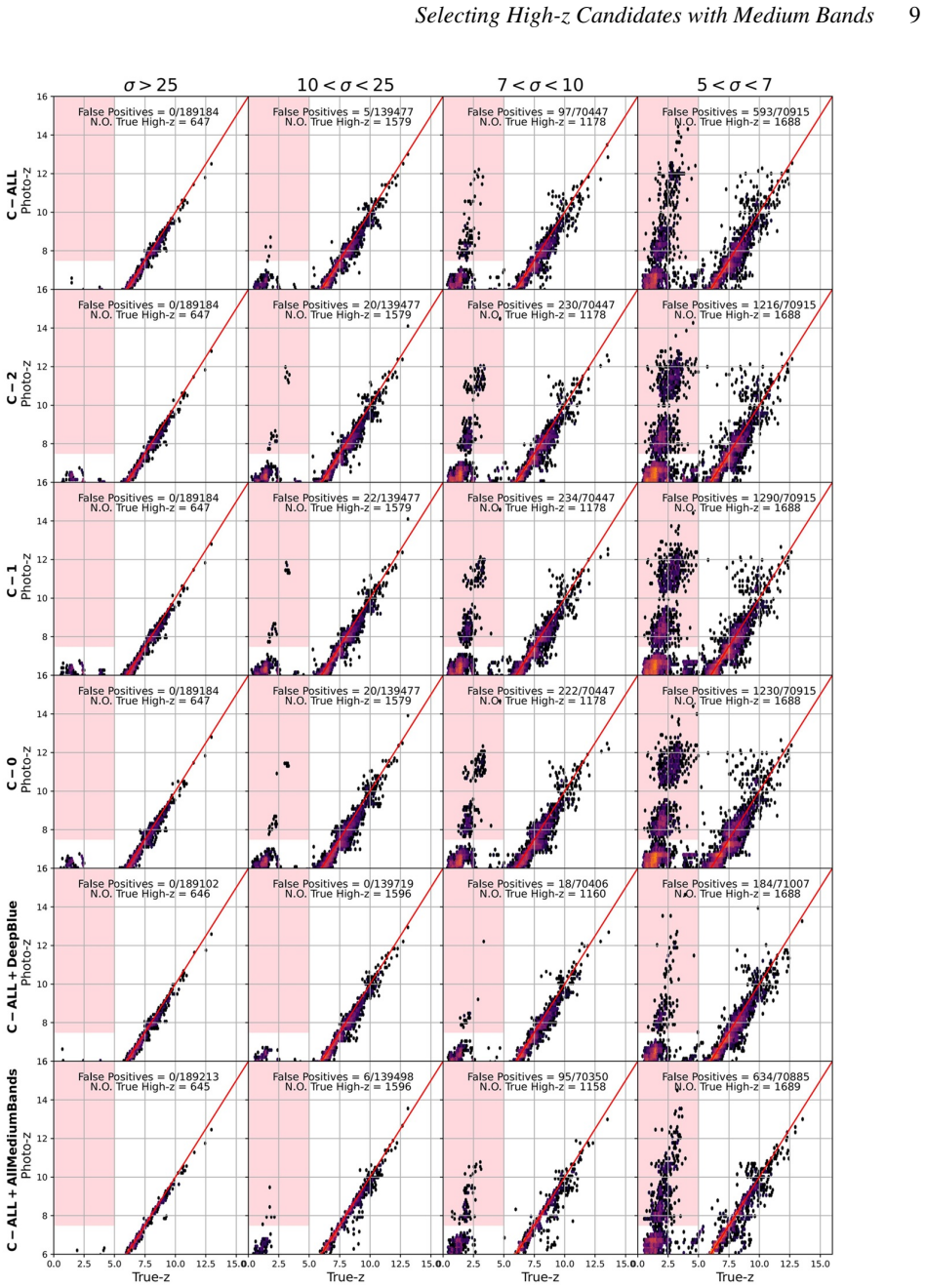
The controlling instrument is the JADES Origins Field itself: a single NIRCam pointing with 14 co-equal photometric bands (broad F090W through F444W plus medium F162M through F410M) reaching AB magnitudes of roughly 29.8-30.35, which lets the authors rerun one selection pipeline under different band combinations rather than comparing across surveys. The pipeline combines SExtractor photometry with EAZY photometric redshifts run twice, once allowing z up to 25 and once capped at z=6, so every candidate is scored by the chi-squared difference between its high-z solution and its best low-z Balmer-break alternative. Completeness and contamination are quantified by repeating the same experiments on JAGUAR semi-analytic mock catalogues (with z>11.5 sources up-weighted by a factor of 10 to match observed number densities) and by degrading the real images to probe the low signal-to-noise regime. The failure mode that carries the argument is the Balmer-Lyman break degeneracy: at z about 2-4.5, H-beta and O[III] emission falling inside broad filters can replicate the blue slope of a Lyman-break galaxy, a confusion that medium bands resolve only when they happen to straddle those lines.
What would settle it
Spectroscopically measure the handful of sources that enter the high-z sample only when the JOF images are degraded: if most turn out to be genuinely at z>7.5, the claimed 20-38% contamination in the 5-8.5-sigma regime is an overestimate caused by incorrect full-depth photo-z labels, whereas confirmation of z<6 solutions would validate both the contamination rates and the Balmer-Lyman degeneracy mechanism.
Extended reading notes
Core claim
The paper's central claim, stated in its conclusions, is that broad-band-only JWST imaging is already sufficient to select z>7.5 galaxies with high completeness (80%+ at 10-sigma) and low contamination (under 4%), and that the role of medium-width bands is real but secondary: the first medium band recovers about 10% of 8<z<10 sources whose photo-z's are systematically underestimated by strong emission lines boosting F444W, while contamination from z about 1.5-4.5 Balmer-break interlopers falls only when multiple medium bands cover the expected line positions. A parallel finding is that the measured faint end of the UV luminosity function at 8.5<z<13.5 is consistent whether or not medium bands are used, and agrees with earlier JWST results showing high number densities of moderately faint galaxies around M_UV about -18. The paper also demonstrates, by artificially degrading the JOF imaging by factors of 2-8, that the 5-8.5-sigma regime is where Balmer-Lyman degeneracy sets in: real degraded data yield 20-38% contamination there, slightly above the JAGUAR simulation-based expectations.
Load-bearing premise
The load-bearing premise is that the photometric redshifts computed from the full 14-band, full-depth images are correct when used to label sources newly selected in the degraded images as contaminants; if those faint full-depth photo-z's are wrong, the 20-38% contamination rates measured in the 5-8.5-sigma regime would be biased.
Editorial extensions
If this is right
- Broad-band-only surveys at JWST depth can build high-z galaxy samples that are more than 80% complete and less than 4% contaminated at 10-sigma and brighter, so large-area statistical studies do not need medium bands to be reliable.
- Adding the first medium-width band (for example F410M) recovers about 10% of 8<z<10 galaxies by correcting systematically underestimated photometric redshifts, but contamination only drops when several medium bands jointly probe the emission lines of low-z interlopers.
- In the 5-8.5-sigma regime, Balmer-Lyman degeneracy produces 20-38% contamination in degraded real data, so ultra-faint high-z candidates near the detection limit must be treated as provisional unless spectroscopy or line-constraining bands are available.
- Deepening the blue bands F090W and F115W by about 0.4 magnitudes is at least as effective at suppressing contamination as adding more medium bands, and NIRCam can acquire that blue depth in parallel with redder medium bands.
- UV luminosity function measurements at 8.5<z<13.5 are insensitive to the choice of band set once completeness and contamination are corrected, supporting the high number densities of M_UV about -18 galaxies reported by other JWST deep fields.
Reading between the lines
- If the blue-depth conclusion generalizes, the optimal survey design for high-z science is not simply more medium bands but a rebalancing of exposure time toward F090W and F115W; this is a testable prescription that future JWST observing programmes could adopt and evaluate.
- The Appendix A template-swap results imply that the measured contamination floor is also a statement about the current SED template set; as templates improve for young, blue, strong-line emitters, the same 5-8.5-sigma sources may re-classify without any new observations.
- The JAGUAR-based completeness curves suggest that faint-end UV luminosity function slopes measured from a single deep pointing carry a completeness-correction uncertainty of order 10-15% per bin, comparable to Poisson error in the faintest bins; propagating band-set choice into the Schechter alpha error budget across several independent fields would quantify this directly.
Editorial analysis
A structured set of objections, weighed in public.
Referee Report
Summary. This paper uses the JADES Origins Field (JOF), a single NIRCam pointing with 14 broad- and medium-width bands, to assess how the inclusion or removal of medium-width photometric bands affects the selection completeness and contamination of high-redshift (z > 7.5) galaxy samples. The authors run the same band-removal experiments on real JOF data and on mock catalogues from the JAGUAR semi-analytic model, and they also degrade the real imaging by factors of 2, 4, and 8 to mimic shallower surveys. They report that at 10-sigma and above, completeness is high (80%+) and contamination low (<4%) even without medium bands, that medium bands increase completeness by about 10% but multiple medium bands are required to reduce contamination, that Balmer-Lyman degeneracies become common at 5-7 sigma, and that deeper blue broad bands (F090W/F115W) are important for reducing contamination. They then measure the UV luminosity function at 8.5 < z < 13.5 and find number densities consistent with other JWST studies. An appendix investigates the effect of changing the SED template set.
Significance. If the results hold, this is a useful empirical and simulation-based assessment of JWST filter-set choices for high-z surveys, with direct implications for survey design (e.g., the recommendation to invest in blue broad-band depth). The paper's strengths include the use of a uniquely deep 14-band field, a systematic comparison of band-removal and image-degradation experiments, an explicit external validation of photo-zs against 20 spectroscopic redshifts (19/20 consistent), a test of template-set dependence (Appendix A), and the public release of custom wisp templates and data products. The central qualitative result that medium bands help most in the 5-8 sigma regime and that blue broad-band depth is key is well supported by the real-data and simulation experiments. However, the headline quantitative claim of 'contamination low (<4%) at 10-sigma+ even without medium bands' relies entirely on the JAGUAR simulation, whose contaminant population has not been empirically calibrated, and the only real-data contamination measurement (20-38% at 5-8.5 sigma) is based on very small numbers.
major comments (3)
- [§5.2] The claim that contamination is 'low (<4%) at 10-sigma+ even without medium bands' is derived from the JAGUAR simulation, but the JAGUAR contaminant population (low-z Balmer break and strong-line galaxies) is pre-JWST and has not been calibrated against the interlopers actually found in JWST samples. The up-weighting factor of 10 for z>11.5 sources corrects only the known under-density of true high-z galaxies; it does not correct any missing contaminant SEDs. The real-data contamination measurement in §5.2 gives 20-38% at 5-8.5 sigma and is described as 'slightly higher than initially anticipated' — a direction that does not support treating the simulated 10-sigma contamination rate as a reliable upper limit. Please provide an explicit calibration check of the JAGUAR contaminant SEDs against JWST spectroscopic samples, or reframe the 10-sigma contamination claim as a model-dependent prediction with clearly stated caveats.
- [§5.2] The real-data contamination rates of 20-38% are based on only 12, 3, and 3 newly selected sources in the three degradation steps. The associated Poisson uncertainties are large (e.g., 6/12 has a 95% confidence interval of roughly 25-75%), yet the text presents these as a quantitative check on the simulation. Also, the calculation assumes that the full-depth photo-zs are correct for these sources; if any of the faint full-depth photo-zs are wrong, the measured contamination rate would be biased. Please report confidence intervals and explicitly discuss the robustness of the 20-38% estimate to the full-depth photo-z assumption.
- [§6] The completeness and contamination corrections applied to the real JOF UV luminosity function are taken from the JAGUAR simulation, so any systematic error in the simulated contamination rate propagates directly into the faint-end LF. Given the concern raised in §4.2.2 about uncalibrated contaminant SEDs, the agreement between LF measurements using different band combinations (C-ALL vs C-0/C-1/C-2) does not by itself validate the corrections, because all catalogues use the same JAGUAR-based corrections. Please test the sensitivity of the LF to an alternative contamination correction (e.g., one scaled to the real-data 20-38% rate), or explicitly state that the LF results inherit the simulation's contamination assumptions.
minor comments (4)
- [§5.2] The sentence 'contamination is slightly higher than expected at 20-38%, through it is measured using a small number of sources' contains a typo: 'through' should be 'though'.
- [§2] The text says 'In Feburary of 2024' — 'Feburary' should be 'February'.
- [§3.2] The phrase 'more statistically probable' in Section 3.2(v) is informal; consider 'statistically preferred' or 'more probable under the model'.
- [§4.2.2] The completeness curves in Figure 8 show scatter of up to 4 percentage points across realisations; please state in the caption or text whether the quoted completeness values (e.g., 80% at 10-sigma) are the mean, median, or a single realisation.
Circularity Check
No circular derivation: the completeness/contamination claims are simulation predictions checked against degraded real data and external surveys; self-citations are methodological, not load-bearing.
full rationale
The central claims are not circular by construction. The photo-z pipeline is validated against 20 spectroscopic redshifts (19/20 consistent, Section 3.1), and the completeness/contamination numbers in Conclusions (i) come from JAGUAR mock catalogues run through the same selection pipeline with randomized photometric scatter repeated five times (Section 4.2), not from fitting any parameter to the quantity being predicted. The factor-10 up-weighting of z>11.5 galaxies (Section 4.2.2) is an explicit correction for a stated under-density of true high-z galaxies relative to external observations, and it does not fix the contamination fraction by definition; indeed, the paper's real-data degraded-image experiment reports 20-38% contamination at 5-8.5 sigma, higher than the JAGUAR expectation, which shows the simulation prediction is falsifiable within the paper. The main stated assumption, 'Under the assumption that the photo-z is correct when using the full depth available' (Section 5.2), could bias the real-data contamination rates, but it is an empirical limitation rather than a circular reduction: the full-depth photometry is independent of the degraded photometry used for the selection under test. Self-citations to Adams et al. (2024) are used for the completeness-correction method and as one comparison dataset, but the LF results are also compared with independent surveys (e.g. Leung et al. 2023; Perez-Gonzalez et al. 2023; Donnan et al. 2024; Finkelstein et al. 2024; McLeod et al. 2024), so no load-bearing claim rests solely on a same-author citation. The paper therefore contains no step where a prediction reduces to its own input by definition or by fit.
Assumptions & free parameters
free parameters (3)
- z>11.5 up-weighting factor in contamination calculations =
10
- Completeness and contamination cuts for LF inclusion =
30% / 30%
- z=12.5 LF shape parameters =
alpha=-2.1, M*=-21, beta=-4.6
assumptions (5)
- domain assumption JAGUAR semi-analytic model produces realistic galaxy colors in JWST photometric bands.
- domain assumption EAZY template sets (FSPS default plus Larson et al. 2023 sets) adequately span high-z and low-z galaxy SEDs.
- domain assumption Full-depth, 14-band photo-zs are correct when labeling contaminants in degraded data.
- standard math Madau (1995) IGM absorption and Calzetti et al. (2000) dust attenuation are appropriate for high-z SED fitting.
- standard math Spectroscopic redshifts used for photo-z validation are correct.
Cite this review
Pith. "Pith review of The impact of medium-width bands on the selection, and subsequent luminosity function measurements, of high-z galaxies." pith.science (2026). https://pith.science/paper/X275DDSJ
@misc{pith2026250210282,
  author       = {Pith},
  title        = {Pith review of: The impact of medium-width bands on the selection, and subsequent luminosity function measurements, of high-z galaxies},
  year         = {2026},
  howpublished = {\url{https://pith.science/paper/X275DDSJ}},
  note         = {Machine review of arXiv:2502.10282}
}
abstract
New, ultra-deep medium-width photometric coverage with JWST's NIRCam instrument provides the potential for much improved photo-z reliability at high redshifts. In this study, we conduct a systematic analysis of the JADES Origins Field, which contains 14 broad- and medium-width near-infrared bands, to assess the benefits of medium band photometry on high-z completeness and contamination rates. Using imaging reaching AB mag $29.8-30.35$ depth, we test how high-z selections differ when images are artificially degraded or bands are removed. In parallel, the same experiments are conducted on simulated catalogues from the JAGUAR semi-analytic model to examine if observations can be replicated. We find sample completeness is high ($80\%+$) and contamination low ($<4\%$) when in the $10\sigma+$ regime, even without the use of any medium-width bands. The addition of medium-width bands leads to increases in completeness ($\sim10\%$) but multiple bands are required to improve contamination rates due to the small redshift ranges over which they probe strong emission lines. Incidents of Balmer-Lyman degeneracy increase in the $5-7\sigma$ regime and this can be replicated in both simulated catalogues and degraded real data. We measure the faint-end of the UV LF at $8.5<z<13.5$, finding high number densities that agree with previous JWST observations. Overall, medium bands are effective at increasing completeness and reducing contamination, but investment in achieving comparable depths in the blue ($<1.5\mu$m) as achieved in the red is also found to be key to fully reducing contamination from high-z samples.
Figures


Figures from the paper (8 more)




Forward citations
Cited by 2 Pith papers
-
Central Concentration and Escape of Ionizing Photons in Galaxies at the Epoch of Reionization
At z~7, low-mass galaxies show compact, recently bursty star formation, with the steepest UV slopes and highest inferred ionizing-photon escape fractions in their inner regions.
-
Exploring Cosmic Dawn with PANORAMIC I: The Bright End of the UVLF at $z\sim9 -17$
Bright galaxy number densities at z~10 match previous JWST results, but are lower at z~13, and the new z~17 upper limits imply a drop of at least a factor ~50 in UV luminosity density from z~10 to z~17.
Reference graph
Works this paper leans on
-
[1]
write newline
" write newline "" before.all 'output.state := FUNCTION fin.entry write newline FUNCTION new.block output.state before.all = 'skip after.block 'output.state := if FUNCTION new.sentence output.state after.block = 'skip output.state before.all = 'skip after.sentence 'output.state := if if FUNCTION not #0 #1 if FUNCTION and 'skip pop #0 if FUNCTION or pop #1...
-
[2]
Adams N. J., et al., 2024, @doi [ ] 10.3847/1538-4357/ad2a7b , https://ui.adsabs.harvard.edu/abs/2024ApJ...965..169A 965, 169
-
[3]
Arrabal Haro P., et al., 2023, @doi [ ] 10.1038/s41586-023-06521-7 , https://ui.adsabs.harvard.edu/abs/2023Natur.622..707A 622, 707
-
[4]
Asada Y., et al., 2024, arXiv preprint arXiv:2410.21543
arXiv 2024
-
[5]
Astropy Collaboration et al., 2013, @doi [ ] 10.1051/0004-6361/201322068 , https://ui.adsabs.harvard.edu/abs/2013A&A...558A..33A 558, A33
-
[6]
Astropy Collaboration et al., 2018, @doi [ ] 10.3847/1538-3881/aabc4f , https://ui.adsabs.harvard.edu/abs/2018AJ....156..123A 156, 123
-
[7]
Astropy Collaboration et al., 2022, @doi [ ] 10.3847/1538-4357/ac7c74 , https://ui.adsabs.harvard.edu/abs/2022ApJ...935..167A 935, 167
-
[8]
Austin D., et al., 2024, @doi [arXiv e-prints] 10.48550/arXiv.2404.10751 , https://ui.adsabs.harvard.edu/abs/2024arXiv240410751A p. arXiv:2404.10751
Show all 107 references
-
[9]
B., et al., 2023, @doi [ ] 10.3847/2041-8213/acbb08 , https://ui.adsabs.harvard.edu/abs/2023ApJ...946L..12B 946, L12
Bagley M. B., et al., 2023, @doi [ ] 10.3847/2041-8213/acbb08 , https://ui.adsabs.harvard.edu/abs/2023ApJ...946L..12B 946, L12
2023 doi
-
[10]
B., et al., 2024, @doi [ ] 10.3847/2041-8213/ad2f31 , https://ui.adsabs.harvard.edu/abs/2024ApJ...965L...6B 965, L6
Bagley M. B., et al., 2024, @doi [ ] 10.3847/2041-8213/ad2f31 , https://ui.adsabs.harvard.edu/abs/2024ApJ...965L...6B 965, L6
2024 doi
-
[11]
Balestra I., et al., 2010, @doi [ ] 10.1051/0004-6361/200913626 , https://ui.adsabs.harvard.edu/abs/2010A&A...512A..12B 512, A12
2010 doi
- [12]
-
[13]
S., Silk J., 2015, @doi [ ] 10.1088/0004-637X/799/1/32 , https://ui.adsabs.harvard.edu/abs/2015ApJ...799...32B 799, 32
Behroozi P. S., Silk J., 2015, @doi [ ] 10.1088/0004-637X/799/1/32 , https://ui.adsabs.harvard.edu/abs/2015ApJ...799...32B 799, 32
2015 doi
-
[14]
H., Hearin A
Behroozi P., Wechsler R. H., Hearin A. P., Conroy C., 2019, @doi [ ] 10.1093/mnras/stz1182 , https://ui.adsabs.harvard.edu/abs/2019MNRAS.488.3143B 488, 3143
2019 doi
-
[15]
J., et al., 2021, @doi [ ] 10.3847/1538-3881/abf83e , https://ui.adsabs.harvard.edu/abs/2021AJ....162...47B 162, 47
Bouwens R. J., et al., 2021, @doi [ ] 10.3847/1538-3881/abf83e , https://ui.adsabs.harvard.edu/abs/2021AJ....162...47B 162, 47
2021 doi
-
[16]
J., et al., 2022, @doi [ ] 10.3847/1538-4357/ac5a4a , https://ui.adsabs.harvard.edu/abs/2022ApJ...931..160B 931, 160
Bouwens R. J., et al., 2022, @doi [ ] 10.3847/1538-4357/ac5a4a , https://ui.adsabs.harvard.edu/abs/2022ApJ...931..160B 931, 160
2022 doi
-
[17]
Bradley L., et al., 2022, astropy/photutils: 1.5.0, @doi 10.5281/zenodo.6825092 , https://doi.org/10.5281/zenodo.6825092
2022 doi
-
[18]
B., van Dokkum P
Brammer G. B., van Dokkum P. G., Coppi P., 2008, @doi [ ] 10.1086/591786 , https://ui.adsabs.harvard.edu/abs/2008ApJ...686.1503B 686, 1503
2008 doi
-
[19]
J., et al., 2024, @doi [ ] 10.1051/0004-6361/202347094 , https://ui.adsabs.harvard.edu/abs/2024A&A...690A.288B 690, A288
Bunker A. J., et al., 2024, @doi [ ] 10.1051/0004-6361/202347094 , https://ui.adsabs.harvard.edu/abs/2024A&A...690A.288B 690, A288
2024 doi
-
[20]
C., Kinney A
Calzetti D., Armus L., Bohlin R. C., Kinney A. L., Koornneef J., Storchi-Bergmann T., 2000, @doi [ ] 10.1086/308692 , https://ui.adsabs.harvard.edu/abs/2000ApJ...533..682C 533, 682
2000 doi
-
[21]
Carniani S., et al., 2024, @doi [ ] 10.1038/s41586-024-07860-9 , https://ui.adsabs.harvard.edu/abs/2024Natur.633..318C 633, 318
2024 doi
-
[22]
Carniani S., et al., 2025, @doi [ ] 10.1051/0004-6361/202452451 , https://ui.adsabs.harvard.edu/abs/2025A&A...696A..87C 696, A87
2025 doi
-
[23]
Castellano M., et al., 2022, @doi [ ] 10.3847/2041-8213/ac94d0 , https://ui.adsabs.harvard.edu/abs/2022ApJ...938L..15C 938, L15
2022 doi
-
[24]
arXiv:2504.05893
Castellano M., et al., 2025, @doi [arXiv e-prints] 10.48550/arXiv.2504.05893 , https://ui.adsabs.harvard.edu/abs/2025arXiv250405893C p. arXiv:2504.05893
2025 doi
-
[25]
L., Shao A., Senthil Kumar G., 2024, @doi [arXiv e-prints] 10.48550/arXiv.2412.01893 , https://ui.adsabs.harvard.edu/abs/2024arXiv241201893C p
Clausen T., Steinhardt C. L., Shao A., Senthil Kumar G., 2024, @doi [arXiv e-prints] 10.48550/arXiv.2412.01893 , https://ui.adsabs.harvard.edu/abs/2024arXiv241201893C p. arXiv:2412.01893
-
[26]
Coe D., et al., 2012, @doi [ ] 10.1088/0004-637X/757/1/22 , https://ui.adsabs.harvard.edu/abs/2012ApJ...757...22C 757, 22
2012 doi
- [27]
-
[28]
C., et al., 2012, @doi [ ] 10.1111/j.1365-2966.2012.21524.x , https://ui.adsabs.harvard.edu/abs/2012MNRAS.425.2116C 425, 2116
Cooper M. C., et al., 2012, @doi [ ] 10.1111/j.1365-2966.2012.21524.x , https://ui.adsabs.harvard.edu/abs/2012MNRAS.425.2116C 425, 2116
2012
-
[29]
Curtis-Lake E., et al., 2023, @doi [Nature Astronomy] 10.1038/s41550-023-01918-w , https://ui.adsabs.harvard.edu/abs/2023NatAs...7..622C 7, 622
2023 doi
- [30]
- [31]
-
[32]
Dayal P., et al., 2022, @doi [ ] 10.1093/mnras/stac537 , https://ui.adsabs.harvard.edu/abs/2022MNRAS.512..989D 512, 989
2022 doi
-
[33]
T., et al., 2023, @doi [ ] 10.1093/mnras/stac3472 , https://ui.adsabs.harvard.edu/abs/2023MNRAS.518.6011D 518, 6011
Donnan C. T., et al., 2023, @doi [ ] 10.1093/mnras/stac3472 , https://ui.adsabs.harvard.edu/abs/2023MNRAS.518.6011D 518, 6011
2023 doi
-
[34]
T., et al., 2024, @doi [ ] 10.1093/mnras/stae2037 , https://ui.adsabs.harvard.edu/abs/2024MNRAS.533.3222D 533, 3222
Donnan C. T., et al., 2024, @doi [ ] 10.1093/mnras/stae2037 , https://ui.adsabs.harvard.edu/abs/2024MNRAS.533.3222D 533, 3222
2024 doi
-
[35]
T., Dunlop J
Donnan C. T., Dunlop J. S., McLure R. J., McLeod D. J., Cullen F., 2025, arXiv e-prints, https://ui.adsabs.harvard.edu/abs/2025arXiv250103217D p. arXiv:2501.03217
2025 arXiv
- [36]
-
[38]
J., et al., 2023c, @doi [arXiv e-prints] 10.48550/arXiv.2310.12340 , https://ui.adsabs.harvard.edu/abs/2023arXiv231012340E p
Eisenstein D. J., et al., 2023c, @doi [arXiv e-prints] 10.48550/arXiv.2310.12340 , https://ui.adsabs.harvard.edu/abs/2023arXiv231012340E p. arXiv:2310.12340
-
[39]
Ferrara A., Pallottini A., Dayal P., 2023, @doi [ ] 10.1093/mnras/stad1095 , https://ui.adsabs.harvard.edu/abs/2023MNRAS.522.3986F 522, 3986
2023 doi
-
[40]
L., Bagley M
Finkelstein S. L., Bagley M. B., 2022, arXiv e-prints, https://ui.adsabs.harvard.edu/abs/2022arXiv220702233F p. arXiv:2207.02233
2022 arXiv
-
[41]
L., et al., 2024, @doi [ ] 10.3847/2041-8213/ad4495 , https://ui.adsabs.harvard.edu/abs/2024ApJ...969L...2F 969, L2
Finkelstein S. L., et al., 2024, @doi [ ] 10.3847/2041-8213/ad4495 , https://ui.adsabs.harvard.edu/abs/2024ApJ...969L...2F 969, L2
2024 doi
-
[42]
Gaia Collaboration et al., 2023, @doi [ ] 10.1051/0004-6361/202243940 , https://ui.adsabs.harvard.edu/abs/2023A&A...674A...1G 674, A1
2023 doi
- [43]
-
[44]
Garilli B., et al., 2021, @doi [ ] 10.1051/0004-6361/202040059 , https://ui.adsabs.harvard.edu/abs/2021A&A...647A.150G 647, A150
2021 doi
-
[45]
E., Matsuura S., Perrin M
Giardino G., et al., 2022, in Coyle L. E., Matsuura S., Perrin M. D., eds, Society of Photo-Optical Instrumentation Engineers (SPIE) Conference Series Vol. 12180, Space Telescopes and Instrumentation 2022: Optical, Infrared, and Millimeter Wave. p. 121800X ( @eprint arXiv 2208...
2022 arXiv
-
[46]
N., et al., 2020, @doi [ ] 10.3847/1538-4357/ab7dc3 , https://ui.adsabs.harvard.edu/abs/2020ApJ...892..125H 892, 125
Hainline K. N., et al., 2020, @doi [ ] 10.3847/1538-4357/ab7dc3 , https://ui.adsabs.harvard.edu/abs/2020ApJ...892..125H 892, 125
2020 doi
-
[47]
N., et al., 2024, @doi [ ] 10.3847/1538-4357/ad1ee4 , https://ui.adsabs.harvard.edu/abs/2024ApJ...964...71H 964, 71
Hainline K. N., et al., 2024, @doi [ ] 10.3847/1538-4357/ad1ee4 , https://ui.adsabs.harvard.edu/abs/2024ApJ...964...71H 964, 71
2024 doi
-
[48]
Harikane Y., et al., 2022, @doi [ ] 10.3847/1538-4357/ac53a9 , https://ui.adsabs.harvard.edu/abs/2022ApJ...929....1H 929, 1
2022 doi
-
[49]
Harikane Y., et al., 2023, @doi [ ] 10.3847/1538-4365/acaaa9 , https://ui.adsabs.harvard.edu/abs/2023ApJS..265....5H 265, 5
2023 doi
-
[50]
Harvey T., et al., 2025, @doi [ ] 10.3847/1538-4357/ad8c29 , https://ui.adsabs.harvard.edu/abs/2025ApJ...978...89H 978, 89
2025 doi
- [51]
-
[52]
L., Mack J., Avila R., Martlin C., Cohen Y., Bajaj V., 2021, in American Astronomical Society Meeting Abstracts
Hoffmann S. L., Mack J., Avila R., Martlin C., Cohen Y., Bajaj V., 2021, in American Astronomical Society Meeting Abstracts. p. 216.02
2021
-
[53]
W., et al., 2024, @doi [ ] 10.1093/mnras/stae316 , https://ui.adsabs.harvard.edu/abs/2024MNRAS.529.1067H 529, 1067
Holwerda B. W., et al., 2024, @doi [ ] 10.1093/mnras/stae316 , https://ui.adsabs.harvard.edu/abs/2024MNRAS.529.1067H 529, 1067
2024 doi
-
[54]
D., 2007, @doi [Computing in Science & Engineering] 10.1109/MCSE.2007.55 , 9, 90
Hunter J. D., 2007, @doi [Computing in Science & Engineering] 10.1109/MCSE.2007.55 , 9, 90
2007 doi
-
[55]
K., Shimizu I., Iwata I., Tanaka M., 2014, @doi [ ] 10.1093/mnras/stu936 , https://ui.adsabs.harvard.edu/abs/2014MNRAS.442.1805I 442, 1805
Inoue A. K., Shimizu I., Iwata I., Tanaka M., 2014, @doi [ ] 10.1093/mnras/stu936 , https://ui.adsabs.harvard.edu/abs/2014MNRAS.442.1805I 442, 1805
2014 doi
-
[56]
Kannan R., Garaldi E., Smith A., Pakmor R., Springel V., Vogelsberger M., Hernquist L., 2022, @doi [ ] 10.1093/mnras/stab3710 , https://ui.adsabs.harvard.edu/abs/2022MNRAS.511.4005K 511, 4005
2022 doi
-
[57]
B., et al., 2020, @doi [ ] 10.1051/0004-6361/202037450 , https://ui.adsabs.harvard.edu/abs/2020A&A...640A..67K 640, A67
Kauffmann O. B., et al., 2020, @doi [ ] 10.1051/0004-6361/202037450 , https://ui.adsabs.harvard.edu/abs/2020A&A...640A..67K 640, A67
2020 doi
-
[58]
arXiv:2401.09981
Kokorev V., et al., 2024, arXiv e-prints, https://ui.adsabs.harvard.edu/abs/2024arXiv240109981K p. arXiv:2401.09981
2024 arXiv
-
[59]
Labb \'e I., et al., 2023, @doi [Nature] 10.1038/s41586-023-05786-2 , 616, 266
2023 doi
-
[60]
L., et al., 2023, @doi [ ] 10.3847/1538-4357/acfed4 , https://ui.adsabs.harvard.edu/abs/2023ApJ...958..141L 958, 141
Larson R. L., et al., 2023, @doi [ ] 10.3847/1538-4357/acfed4 , https://ui.adsabs.harvard.edu/abs/2023ApJ...958..141L 958, 141
2023 doi
-
[61]
Le F \`e vre O., et al., 2015, @doi [ ] 10.1051/0004-6361/201423829 , https://ui.adsabs.harvard.edu/abs/2015A&A...576A..79L 576, A79
2015 doi
-
[62]
LeF\` e vre O., et al., 2013, @doi [ ] 10.1051/0004-6361/201322179 , 559, A14
2013 doi
-
[63]
Leung G. C. K., et al., 2023, @doi [ ] 10.3847/2041-8213/acf365 , https://ui.adsabs.harvard.edu/abs/2023ApJ...954L..46L 954, L46
2023 doi
-
[64]
Levenberg K., 1944, Quarterly of Applied Mathematics, 2, 164
1944
-
[65]
Madau P., 1995, @doi [ ] 10.1086/175332 , https://ui.adsabs.harvard.edu/abs/1995ApJ...441...18M 441, 18
1995 doi
-
[66]
Madau P., Dickinson M., 2014, @doi [ ] 10.1146/annurev-astro-081811-125615 , https://ui.adsabs.harvard.edu/abs/2014ARA&A..52..415M 52, 415
2014 doi
-
[67]
S., et al., 2021, @doi [ ] 10.3847/1538-4357/ac141d , https://ui.adsabs.harvard.edu/abs/2021ApJ...920...85M 920, 85
Marley M. S., et al., 2021, @doi [ ] 10.3847/1538-4357/ac141d , https://ui.adsabs.harvard.edu/abs/2021ApJ...920...85M 920, 85
2021 doi
-
[68]
W., 1963, Journal of the Society for Industrial and Applied Mathematics, 11, 431
Marquardt D. W., 1963, Journal of the Society for Industrial and Applied Mathematics, 11, 431
1963
-
[69]
A., et al., 2022, @doi [ ] 10.1093/mnras/stac2111 , https://ui.adsabs.harvard.edu/abs/2022MNRAS.516.1047M 516, 1047
Marshall M. A., et al., 2022, @doi [ ] 10.1093/mnras/stac2111 , https://ui.adsabs.harvard.edu/abs/2022MNRAS.516.1047M 516, 1047
2022 doi
-
[70]
Mascia S., et al., 2024, @doi [ ] 10.1051/0004-6361/202450493 , https://ui.adsabs.harvard.edu/abs/2024A&A...690A...2M 690, A2
2024 doi
-
[71]
Matthee J., et al., 2023, arXiv preprint arXiv:2306.05448
2023 arXiv
-
[72]
J., et al., 2024, @doi [ ] 10.1093/mnras/stad3471 , https://ui.adsabs.harvard.edu/abs/2024MNRAS.527.5004M 527, 5004
McLeod D. J., et al., 2024, @doi [ ] 10.1093/mnras/stad3471 , https://ui.adsabs.harvard.edu/abs/2024MNRAS.527.5004M 527, 5004
2024 doi
-
[73]
Merlin E., et al., 2021, @doi [ ] 10.1051/0004-6361/202140310 , https://ui.adsabs.harvard.edu/abs/2021A&A...649A..22M 649, A22
2021 doi
-
[74]
A., Barrufet L., Boogaard L
Meyer R. A., Barrufet L., Boogaard L. A., Naidu R. P., Oesch P. A., Walter F., 2024, @doi [ ] 10.1051/0004-6361/202348306 , https://ui.adsabs.harvard.edu/abs/2024A&A...681L...3M 681, L3
2024 doi
-
[75]
G., et al., 2016, @doi [ ] 10.3847/0067-0049/225/2/27 , https://ui.adsabs.harvard.edu/abs/2016ApJS..225...27M 225, 27
Momcheva I. G., et al., 2016, @doi [ ] 10.3847/0067-0049/225/2/27 , https://ui.adsabs.harvard.edu/abs/2016ApJS..225...27M 225, 27
2016 doi
-
[76]
M., et al., 2015, @doi [ ] 10.1088/0004-6256/149/6/178 , https://ui.adsabs.harvard.edu/abs/2015AJ....149..178M 149, 178
Morris A. M., et al., 2015, @doi [ ] 10.1088/0004-6256/149/6/178 , https://ui.adsabs.harvard.edu/abs/2015AJ....149..178M 149, 178
2015 doi
-
[77]
A., et al., 2013, @doi [ ] 10.1088/0004-637X/773/1/75 , https://ui.adsabs.harvard.edu/abs/2013ApJ...773...75O 773, 75
Oesch P. A., et al., 2013, @doi [ ] 10.1088/0004-637X/773/1/75 , https://ui.adsabs.harvard.edu/abs/2013ApJ...773...75O 773, 75
2013 doi
-
[78]
A., Bouwens R
Oesch P. A., Bouwens R. J., Illingworth G. D., Labb \'e I., Stefanon M., 2018, @doi [ ] 10.3847/1538-4357/aab03f , https://ui.adsabs.harvard.edu/abs/2018ApJ...855..105O 855, 105
2018 doi
-
[79]
A., et al., 2023, @doi [ ] 10.1093/mnras/stad2411 , https://ui.adsabs.harvard.edu/abs/2023MNRAS.525.2864O 525, 2864
Oesch P. A., et al., 2023, @doi [ ] 10.1093/mnras/stad2411 , https://ui.adsabs.harvard.edu/abs/2023MNRAS.525.2864O 525, 2864
2023 doi
-
[80]
G., et al., 2023, @doi [ ] 10.3847/2041-8213/acd9d0 , https://ui.adsabs.harvard.edu/abs/2023ApJ...951L...1P 951, L1
P \'e rez-Gonz \'a lez P. G., et al., 2023, @doi [ ] 10.3847/2041-8213/acd9d0 , https://ui.adsabs.harvard.edu/abs/2023ApJ...951L...1P 951, L1
2023 doi
-
[81]
D., Soummer R., Elliott E
Perrin M. D., Soummer R., Elliott E. M., Lallo M. D., Sivaramakrishnan A., 2012, in Clampin M. C., Fazio G. G., MacEwen H. A., Oschmann Jacobus M. J., eds, Society of Photo-Optical Instrumentation Engineers (SPIE) Conference Series Vol. 8442, Space Telescopes and Instrumentati...
2012 doi
-
[82]
D., Sivaramakrishnan A., Lajoie C.-P., Elliott E., Pueyo L., Ravindranath S., Albert L., 2014, in Oschmann Jacobus M
Perrin M. D., Sivaramakrishnan A., Lajoie C.-P., Elliott E., Pueyo L., Ravindranath S., Albert L., 2014, in Oschmann Jacobus M. J., Clampin M., Fazio G. G., MacEwen H. A., eds, Society of Photo-Optical Instrumentation Engineers (SPIE) Conference Series Vol. 9143, Space Telesco...
2014 doi
- [83]
-
[84]
D., et al., 2007, @doi [ ] 10.1051/0004-6361:20065358 , https://ui.adsabs.harvard.edu/abs/2007A&A...465.1099R 465, 1099
Ravikumar C. D., et al., 2007, @doi [ ] 10.1051/0004-6361:20065358 , https://ui.adsabs.harvard.edu/abs/2007A&A...465.1099R 465, 1099
2007 doi
-
[85]
J., et al., 2023, @doi [ ] 10.3847/1538-4365/acf44d , https://ui.adsabs.harvard.edu/abs/2023ApJS..269...16R 269, 16
Rieke M. J., et al., 2023, @doi [ ] 10.3847/1538-4365/acf44d , https://ui.adsabs.harvard.edu/abs/2023ApJS..269...16R 269, 16
2023 doi
-
[86]
Robertson B., et al., 2024, @doi [ ] 10.3847/1538-4357/ad463d , https://ui.adsabs.harvard.edu/abs/2024ApJ...970...31R 970, 31
2024 doi
-
[87]
Robotham A. S. G., D'Silva J. C. J., Windhorst R. A., Jansen R. A., Summers J., Driver S. P., Wilmer C. N. A., Bellstedt S., 2023, @doi [ ] 10.1088/1538-3873/acea42 , https://ui.adsabs.harvard.edu/abs/2023PASP..135h5003R 135, 085003
2023 doi
-
[88]
Schechter P., 1976, @doi [ ] 10.1086/154079 , https://ui.adsabs.harvard.edu/abs/1976ApJ...203..297S 203, 297
1976 doi
- [89]
-
[90]
A., et al., 2024, @doi [ ] 10.3847/1538-4357/ad75fe , https://ui.adsabs.harvard.edu/abs/2024ApJ...976..101S 976, 101
Suess K. A., et al., 2024, @doi [ ] 10.3847/1538-4357/ad75fe , https://ui.adsabs.harvard.edu/abs/2024ApJ...976..101S 976, 101
2024 doi
-
[91]
P., et al., 2004, @doi [ ] 10.1086/424707 , https://ui.adsabs.harvard.edu/abs/2004ApJS..155..271S 155, 271
Szokoly G. P., et al., 2004, @doi [ ] 10.1086/424707 , https://ui.adsabs.harvard.edu/abs/2004ApJS..155..271S 155, 271
2004 doi
-
[92]
C., Furlanetto S
Trapp A. C., Furlanetto S. R., 2020, @doi [ ] 10.1093/mnras/staa2828 , https://ui.adsabs.harvard.edu/abs/2020MNRAS.499.2401T 499, 2401
2020 doi
-
[93]
Treu T., et al., 2022, @doi [ ] 10.3847/1538-4357/ac8158 , https://ui.adsabs.harvard.edu/abs/2022ApJ...935..110T 935, 110
2022 doi
-
[94]
Ulm K., 1990, @doi [American Journal of Epidemiology] 10.1093/oxfordjournals.aje.a115507 , 131, 373
1990 doi
-
[95]
Vanzella E., et al., 2008, @doi [ ] 10.1051/0004-6361:20078332 , https://ui.adsabs.harvard.edu/abs/2008A&A...478...83V 478, 83
2008 doi
-
[96]
Virtanen P., et al., 2020, @doi [Nature Methods] 10.1038/s41592-019-0686-2 , https://rdcu.be/b08Wh 17, 261
2020 doi
-
[97]
Wang B., et al., 2023, @doi [ ] 10.3847/2041-8213/acfe07 , https://ui.adsabs.harvard.edu/abs/2023ApJ...957L..34W 957, L34
2023 doi
-
[98]
R., et al., 2024, @doi [ ] 10.3847/1538-4365/ad07e0 , https://ui.adsabs.harvard.edu/abs/2024ApJS..270....7W 270, 7
Weaver J. R., et al., 2024, @doi [ ] 10.3847/1538-4365/ad07e0 , https://ui.adsabs.harvard.edu/abs/2024ApJS..270....7W 270, 7
2024 doi
-
[99]
E., et al., 2019, @doi [ ] 10.3847/1538-4365/ab3853 , https://ui.adsabs.harvard.edu/abs/2019ApJS..244...16W 244, 16
Whitaker K. E., et al., 2019, @doi [ ] 10.3847/1538-4365/ab3853 , https://ui.adsabs.harvard.edu/abs/2019ApJS..244...16W 244, 16
2019 doi
-
[100]
arXiv:2501.00984
Whitler L., et al., 2025, @doi [arXiv e-prints] 10.48550/arXiv.2501.00984 , https://ui.adsabs.harvard.edu/abs/2025arXiv250100984W p. arXiv:2501.00984
2025 doi
- [101]
-
[102]
C., et al., 2018, @doi [ ] 10.3847/1538-4365/aabcbb , https://ui.adsabs.harvard.edu/abs/2018ApJS..236...33W 236, 33
Williams C. C., et al., 2018, @doi [ ] 10.3847/1538-4365/aabcbb , https://ui.adsabs.harvard.edu/abs/2018ApJS..236...33W 236, 33
2018 doi
-
[103]
C., et al., 2023, @doi [ ] 10.3847/1538-4365/acf130 , https://ui.adsabs.harvard.edu/abs/2023ApJS..268...64W 268, 64
Williams C. C., et al., 2023, @doi [ ] 10.3847/1538-4365/acf130 , https://ui.adsabs.harvard.edu/abs/2023ApJS..268...64W 268, 64
2023 doi
-
[104]
J., et al., 2024, @doi [ ] 10.3847/1538-4357/ad35bc , https://ui.adsabs.harvard.edu/abs/2024ApJ...966...74W 966, 74
Willott C. J., et al., 2024, @doi [ ] 10.3847/1538-4357/ad35bc , https://ui.adsabs.harvard.edu/abs/2024ApJ...966...74W 966, 74
2024 doi
-
[105]
A., et al., 2023, @doi [ ] 10.3847/1538-3881/aca163 , https://ui.adsabs.harvard.edu/abs/2023AJ....165...13W 165, 13
Windhorst R. A., et al., 2023, @doi [ ] 10.3847/1538-3881/aca163 , https://ui.adsabs.harvard.edu/abs/2023AJ....165...13W 165, 13
2023 doi
-
[106]
Yung L. Y. A., Somerville R. S., Finkelstein S. L., Wilkins S. M., Gardner J. P., 2024, @doi [ ] 10.1093/mnras/stad3484 , https://ui.adsabs.harvard.edu/abs/2024MNRAS.527.5929Y 527, 5929
2024 doi
-
[107]
A., et al., 2023, @doi [ ] 10.3847/2041-8213/acacfe , https://ui.adsabs.harvard.edu/abs/2023ApJ...943L...9Z 943, L9
Zavala J. A., et al., 2023, @doi [ ] 10.3847/2041-8213/acacfe , https://ui.adsabs.harvard.edu/abs/2023ApJ...943L...9Z 943, L9
2023 doi
-
[108]
de Graaff A., et al., 2024, arXiv preprint arXiv:2409.05948
2024 arXiv
Reviewed August 7, 2026 · model on record in the stance chip above.
Discussion (0). Continue with ORCID to comment.