REVIEW 4 major objections 4 minor 276 references
Smoothed particle magnetohydrodynamics for simulations of galaxy and cosmic structure formation
T0 review · 4 major / 4 minor · reviewed 2026-08-10 · deepseek-v4-flash
Pith's one-line read This paper introduces a smoothed particle magnetohydrodynamics (SPMHD) formulation in the SWIFT code, and reports the first coupling of the EAGLE galaxy formation model to an MHD solver, with tests spanning a proto-stellar jet, a cluster…
desk verdict Solid SPMHD methods paper with honest validation, but the production-stability claim rests on an under-analyzed RMS beta estimator that can fail in exactly the low-beta clumps it is meant to protect. read the letter →
The pith
A machine-rendered reading of the paper's core claim, the machinery that carries it, and where it could break.
The reading
What carries the argument
The load-bearing object is the SPMHD evolution system in SWIFT, expressed in a density-energy conservative form and paired with the SPHENIX discontinuity-capturing terms. Three mechanisms carry the stability argument: (i) a tensile-instability correction that subtracts a fraction of the monopole force, with the fraction set by the new estimator $\beta_{\rm loc} = \sqrt{\sum_j \beta_j^2 / \sum_j 1}$ (an unweighted RMS over neighbours, equation 47); (ii) a constrained hyperbolic/parabolic divergence-cleaning scalar whose cleaning speed is $c_h = v_{\rm sig}/2$ and whose damping rate has $\sigma_p = 1$ for critical damping; and (iii) artificial resistivity with signal velocity equal to the Alfvén speed and switch $\alpha_{\rm AR}=\min(\alpha_{\rm max}, h\|\nabla\mathbf{B}\|/\|\mathbf{B}\|)$, which is invariant under field rescaling. The design goal is that each term acts only where needed, limiting spurious dissipation while keeping particles stable in the disordered arrangements produced by sub-grid feedback.
What would settle it
Reproduce the EAGLE disk-galaxy application twice, once with the RMS plasma beta estimate (equation 47) and once with the naive per-particle beta (equation 46) driving the tensile-instability correction; the paper's claim predicts the naive version produces violent particle accelerations or ejections in feedback-disordered regions while the RMS version stays stable.
Extended reading notes
Core claim
The paper's central claim is that a conservative density-energy SPMHD scheme, augmented with three adaptive regularisation ingredients, is stable, accurate, and computationally efficient enough for production galaxy-formation simulations. The ingredients are a tensile-instability correction modulated by an unweighted root-mean-square of neighbouring plasma betas rather than the particle's own $\beta$; a constrained mixed hyperbolic/parabolic divergence-cleaning scheme with cleaning speed set to half the pairwise signal velocity and critical damping at $\sigma_p=1$; and artificial resistivity with the Alfvén speed as signal velocity and a Tricco-Price shock indicator that is invariant under $\mathbf{B}\to\lambda\mathbf{B}$. With all hyperparameters fixed across the test suite, the method reproduces standard laboratory MHD experiments, launches a jet from a forming proto-stellar core, amplifies a magnetic field in a massive galaxy cluster, and evolves magnetic fields in a Milky Way-like disk galaxy, constituting the first reported EAGLE-MHD simulation.
Load-bearing premise
The load-bearing premise is that the new RMS-based local plasma beta estimate reliably tells the tensile-instability correction where to act, because if it fires in disordered, feedback-driven particle configurations the correction becomes a spurious repulsive force and the scheme becomes unstable.
Editorial extensions
If this is right
- A galaxy-formation simulation with full sub-grid physics can now carry a magnetic field, so EAGLE-style runs gain a magnetised baseline for disk, cluster, and proto-stellar studies.
- Because hyperparameters stay fixed across the entire test suite, the scheme's published configuration is a directly usable production setup rather than a per-problem tuned one.
- The same solver handles laboratory shocks, jets, cluster dynamos, and disks, so a single code path can cover cosmological and object-scale MHD without switching methods.
- Second-order convergence on smooth Alfvén waves and beyond-second-order convergence on Ohmic diffusion tests mean resolution studies with this scheme improve accuracy predictably.
- The reported cluster and disk runs provide concrete magnetic field strengths and topologies that future cosmological MHD simulations can be compared against.
Reading between the lines
- We infer that the RMS plasma beta estimator, being less sensitive to disordered particle neighbourhoods, could also suppress spurious tensile corrections in other meshless MHD solvers that struggle with sub-grid feedback, though the paper only tests it in SWIFT.
- A testable extension not explored in the paper is to compare long-term magnetic energy growth in cluster runs with and without the divergence cleaner's energy-conserving terms; the paper's energy accounting implies that growth should come from physical dynamo action rather than cleaning artefacts.
- Because the divergence-cleaning speed is chosen as half the local signal speed rather than the fast magnetosonic speed, the scheme may be cheaper in cosmological boxes; a direct benchmark against the more common choice would quantify that gain.
- The first EAGLE-MHD disk result suggests that magnetic fields can now be included as a standard module in future large-volume cosmological campaigns, with the main open question being the trade-off in computational cost as resolution and box size grow.
Editorial analysis
A structured set of objections, weighed in public.
Referee Report
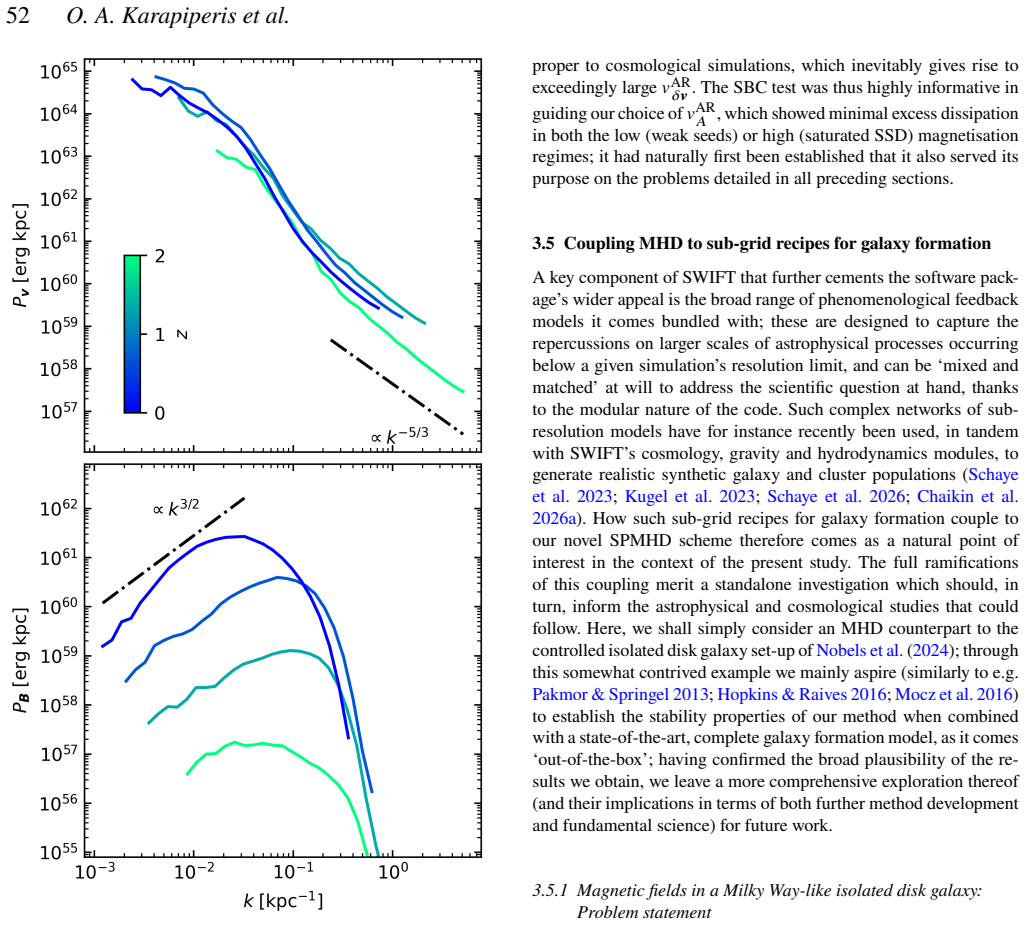
Summary. The manuscript presents a new smoothed particle magnetohrodynamics (SPMHD) formulation implemented in the open-source SWIFT code. The scheme is built on the SPHENIX density-energy SPH solver and adds a direct-induction ideal MHD discretisation, a tensile-instability correction with a novel RMS-based local plasma-beta estimator (Eq. 47), a constrained hyperbolic/parabolic divergence-cleaning scheme, artificial resistivity with an Alfvén-speed signal, Ohmic diffusion, and a cosmological comoving formulation. The authors validate the method on a comprehensive suite of standard tests: Alfvén wave convergence, MHD shock tubes, Orszag-Tang vortex, magnetic rotor, blast wave, Kelvin-Helmholtz and cloud-wind interaction, plus non-ideal diffusion tests. They announce three astrophysical applications (proto-stellar jet launching, galaxy-cluster dynamo, and a Milky Way-like disk with the EAGLE model) as the final part of the test suite. The full text provided to the referee, however, breaks off in Section 3.2.3 and does not contain Sections 3.3–3.5; the announced production-scale applications are therefore not accessible for assessment.
Significance. If the claims hold, this is a valuable contribution: the scheme is implemented in a modern, massively parallel, open-source code; the hyperparameters are kept fixed across the test suite; the validation set is broad and mostly quantitative; and the Alfvén-wave and non-ideal diffusion tests show second-order or better convergence. A successful coupling of the EAGLE galaxy-formation model to an MHD solver would be a first and would open the door to production magnetised galaxy-formation simulations. The central production-stability claim, however, rests on a new regularisation ingredient whose failure mode is not isolated by the presented tests, and the evidence that would demonstrate the claim in the target regime is in the missing Sections 3.3–3.5. The manuscript is therefore scientifically promising but, in its current provided form, does not yet support the headline application-level claims.
major comments (4)
- [Sections 3.3–3.5] The abstract and introduction announce three production-scale applications, culminating in 'the first reported coupling of the EAGLE galaxy formation model to a magnetohydrodynamics solver', but the provided manuscript text ends in the middle of Section 3.2.3 and never presents Sections 3.3, 3.4, or 3.5. The central claim of production viability, and specifically the stable operation of Eq. (47) in full-physics runs with sub-grid feedback, is therefore currently unsupported by any presented evidence. This is not a stylistic issue: the announced applications are the load-bearing demonstration that the method works in the regime for which it was designed. The revision must include these sections, with quantitative diagnostics (e.g., stability over time, divergence-error statistics, clumping checks) rather than only field maps.
- [Section 3.1.2, Eq. (44)–(45)] The Alfvén-wave test text states that the chosen parameters 'translate into a β < 1' and that the test assesses the tensile-instability correction in the strong-field regime. With the stated parameters, P = 0.1, B = 0.1, and μ0 = 1, the plasma beta is β = 2μ0P/B^2 = 20, not β < 1. The test therefore does not exercise the β < 2 branch of the switch λ(β_loc) in Eq. (44), and the claim that the scheme is 'robust to particle clumping in the strong field regime' is not demonstrated by this experiment. Either the parameters must be changed so that the low-β branch is actually probed, or the text must be corrected to state that the test covers only the β > 10 regime of λ.
- [Section 2.3.3, Eq. (47)] The RMS-based estimator β_loc (Eq. 47) is an unweighted average over all neighbours and is not the local plasma beta that appears in the stability criterion (43). In a magnetically dominated clump (β_i < 1) embedded in a high-β ambient medium, the RMS over the neighbourhood can be ≫ 1, setting λ = 0 in Eq. (44) and switching off the tensile-instability correction precisely where the linear-stability condition requires it to be active. The authors motivate Eq. (47) by 'extensive experimentation' and by improved behaviour in disordered, feedback-stirred particle arrangements, but no analysis or targeted test is provided for the regime where the RMS and the particle-local beta disagree. The existing validation tests do not isolate this case: the shock tubes and blast wave use ordered or nearly ordered lattices, and the Alfvén wave (as noted above) actually runs at β = 20. The manuscript needs a targeted disordered two-phase test — e.g., a low-β clump in a high-β ambient medium with a randomised or feedback-like particle distribution — or a quantitative study of the β_loc distribution in the application runs. Without this, the central production-stability claim rests on an empirical assertion.
- [Section 2.3.6, Eqs. (74)–(75)] The new time-step conditions introduced for B and ψ are not written as well-defined mathematical expressions. Eq. (74) divides a vector by an expression ending in a dot, and Eq. (75) contains a similar dangling '·' in the denominator; it is unclear what vector or scalar operation is intended. This matters because the authors state in Section 3 that these conditions are disabled by default in the presented tests, but the conditions are part of the method description and will be used by adopters. The equations need to be made explicit, including the definition of the norm or componentwise operation.
minor comments (4)
- [Section 3.1.8] In the description of the Kelvin-Helmholtz set-up, the text says the central region's physical attributes 'are denoted by the subscript O'; this should be the subscript C (and similarly in the following sentence).
- [Section 3.1.9, Fig. 17 caption] The caption lists the strong-field run as 'β = 250' in the fourth and fifth rows; from the body text and the simulation description, this should be β = 25.
- [Section 3.2.2] The text refers repeatedly to 'Karapiperis & Schaller (2025)' and 'Shchutskyi et al. (2025)' for validation of cosmological non-ideal MHD and dynamo benchmarks, but these are not presented in this manuscript; since the provided text also omits the application sections, the reader cannot verify the claimed cross-validation.
- [General] The manuscript is unusually long and some figure captions repeat the full setup parameters verbatim from the text; shortening the captions and moving the fully detailed setup data to a table would improve readability.
Circularity Check
Two openly calibrated hyperparameters appear in the same tests used as their own validation, but the core derivation and the bulk of the benchmark suite are externally anchored; no load-bearing circularity.
-
fitted input called prediction
[Section 3.1.4, 'MHD shock tubes'; Eq. (63)]
"Keeping the calibration of SPHENIX's shock-capturing scheme unchanged and employing the defaults suggested by Borrow et al. (2022), we ran variations of the Brio & Wu (1988) shock tube to settle on an optimal value for αARmax, the global normalisation parameter entering our artificial resistivity implementation."
αARmax is the free amplitude of the artificial resistivity term (Eq. 63), and the Brio-Wu shock tube is the exact test on which it was tuned. The same test is then presented in the same section as a validation ('Numerical predictions obtained with SWIFT ... agree well with the reference'). The agreement on that one experiment is therefore partly by construction: the free parameter was chosen to make that experiment agree. This is a calibration rather than an independent prediction, and it is limited in scope because all other tests in the suite use the same fixed value and are compared against independent references (ATHENA runs, analytic solutions, or ODE reference solutions).
full rationale
The core derivation is not circular: the SPMHD equations of motion (37)-(38), the non-ideal Ohmic terms (40)-(41), the tensile-instability correction (45), and the divergence-cleaning pair (51)-(52) follow from a Lagrangian/action principle and standard SPH discretizations, with no target outcome used as an input. The two openly declared calibration choices — σ_p in Eq. (54) tuned on the monopole-advection run, and αARmax in Eq. (63) tuned on the Brio-Wu shock tube — are the only places where an input is chosen to make a specific test agree; the paper is transparent about both, explicitly identifying the Brio-Wu test as the calibration standard. Consequently, the agreement shown on those two tests is partly by construction, but it is not a claimed physical prediction and it does not carry the central stability/accuracy claim, which rests on fixed-parameter comparisons to external ATHENA results (Orszag-Tang vortex, rotor), the analytic circularly polarized Alfvén wave, the diffusive Gaussian pulse solutions, the diffusive Alfvén-wave dispersion relations, and the C-shock ODE reference. The RMS β-loc estimator (47) is an empirically motivated ansatz ('after extensive experimentation'), not a derived or predicted quantity; whether it can suppress the tensile-instability correction in low-β clumps inside disordered two-phase media is a legitimate robustness/correctness question, not a circularity. Companion self-citations (Karapiperis & Schaller 2025; Shchutskyi et al. 2025) are auxiliary and not load-bearing: the in-paper benchmarks stand on independent evidence. Overall the derivation chain is self-contained, with only a minor, local calibration coupling in the validation narrative.
Assumptions & free parameters
free parameters (2)
- sigma_p =
1
- alpha_ARmax =
0.1
assumptions (7)
- domain assumption The ideal MHD equations (30)-(33) plus Ohmic diffusion (39) are the correct continuum limit.
- standard math Discrete equations from an SPH action minimization (Lagrangian (36)) yield conservative and stable discretizations.
- domain assumption The tensile instability correction of Børve et al. (2001) with the switch (44) from Price et al. (2018) is a valid way to control clumping.
- standard math The constrained hyperbolic/parabolic divergence cleaning of Tricco & Price (2012) conserves energy and keeps divergence errors bounded.
- ad hoc to paper The RMS-based plasma beta estimate (47) is a robust indicator of tensile instability onset in disordered particle fields.
- domain assumption The comoving variable transformation (80)-(82) preserves the structure of the MHD equations and gives consistent wave speeds.
- domain assumption The EAGLE galaxy formation sub-grid model (Schaye et al. 2015) is an appropriate background for MHD coupling.
Cite this review
Pith. "Pith review of Smoothed particle magnetohydrodynamics for simulations of galaxy and cosmic structure formation." pith.science (2026). https://pith.science/paper/X4LCYJ5R
@misc{pith2026260806978,
  author       = {Pith},
  title        = {Pith review of: Smoothed particle magnetohydrodynamics for simulations of galaxy and cosmic structure formation},
  year         = {2026},
  howpublished = {\url{https://pith.science/paper/X4LCYJ5R}},
  note         = {Machine review of arXiv:2608.06978}
}
read the original abstract
We introduce a novel formulation of cosmological smoothed particle magnetohydrodynamics (SPMHD), designed to model magnetic field physics in a vast array of nonlinear astrophysical systems, and which we have implemented in the highly-parallel, entirely modular, and open-source simulation code SWIFT. Our numerical scheme is designed to offer optimal performance at a minimal computational cost, keep a low memory footprint, and most notably couple robustly to effective sub-resolution recipes of galaxy formation. This is achieved through expressing our evolution equations in a density-energy conservative form, and augmenting them with discontinuity-capturing terms tailored to high dynamic range simulations, which are further modulated by adaptive switches that drastically improve coupling to sub-grid models and limit spurious dissipation. We moreover present novel suggestions for the two major regularisation techniques used in modern SPMHD, namely a tensile instability correction and mixed hyperbolic/parabolic divergence-cleaning scheme, to ensure code stability in highly dynamical scenarios. We evaluate the performance of our method on a series of problems of increasing complexity, culminating in three astrophysical applications which have historically proven challenging for mesh-less methods: we study jet launching from a forming proto-stellar core, dynamo amplification in a massive galaxy cluster and magnetic field evolution in a Milky Way-like disk galaxy; the latter constitutes the first reported coupling of the EAGLE galaxy formation model to a magnetohydrodynamics solver. Keeping model hyperparameters fixed across our test suite to provide a transparent picture of our method's capabilities in production, we demonstrate sound performance and convergence with resolution on standard `laboratory' numerical experiments, as well as competitive capabilities in realistic applications.
Figures


Figures from the paper (29 more)




Reference graph
Works this paper leans on
-
[1]
Evidence for Strong Extragalactic Magnetic Fields from Fermi Observations of TeV Blazars. Science , keywords =. doi:10.1126/science.1184192 , archivePrefix =. 1006.3504 , primaryClass =
-
[2]
Reports on Progress in Physics , keywords =
On the origin of cosmic magnetic fields. Reports on Progress in Physics , keywords =. doi:10.1088/0034-4885/71/4/046901 , archivePrefix =. 0707.2783 , primaryClass =
-
[3]
The First Magnetic Fields. , keywords =. doi:10.1007/s11214-011-9833-5 , archivePrefix =. 1109.4052 , primaryClass =
-
[4]
The Cosmological Impact of Luminous TeV Blazars. I. Implications of Plasma Instabilities for the Intergalactic Magnetic Field and Extragalactic Gamma-Ray Background. , keywords =. doi:10.1088/0004-637X/752/1/22 , archivePrefix =. 1106.5494 , primaryClass =
-
[5]
Magnetic Fields of Nondegenerate Stars. , keywords =. doi:10.1146/annurev-astro-082708-101833 , archivePrefix =. 0904.1938 , primaryClass =
arXiv 1938
-
[6]
Classical and Quantum Gravity , keywords =
In the realm of the Hubble tension-a review of solutions. Classical and Quantum Gravity , keywords =. doi:10.1088/1361-6382/ac086d , archivePrefix =. 2103.01183 , primaryClass =
-
[7]
Relieving the Hubble Tension with Primordial Magnetic Fields. , keywords =. doi:10.1103/PhysRevLett.125.181302 , archivePrefix =. 2004.09487 , primaryClass =
arXiv 2004
-
[8]
Reviews of Modern Physics , keywords =
Instability, turbulence, and enhanced transport in accretion disks. Reviews of Modern Physics , keywords =. doi:10.1103/RevModPhys.70.1 , adsurl =
Show all 276 references
-
[9]
, keywords =
Electromagnetic extraction of energy from Kerr black holes. , keywords =. doi:10.1093/mnras/179.3.433 , adsurl =
-
[10]
, year = 1970, month = aug, volume =
A Numerical Example of the Collapse of a Rotating Magnetized Star. , year = 1970, month = aug, volume =. doi:10.1086/150558 , adsurl =
1970 doi
-
[11]
II: Self-consistent Stationary Picture
The Accretion of Matter by a Collapsing Star in the Presence of a Magnetic Field. II: Self-consistent Stationary Picture. , keywords =. doi:10.1007/BF01225967 , adsurl =
-
[12]
, keywords =
The Magnetohydrodynamic Rotational Model of Supernova Explosion. , keywords =. doi:10.1007/BF00646184 , adsurl =
-
[13]
Physics of the Interstellar and Intergalactic Medium
-
[14]
, keywords =
H I in the galaxy. , keywords =. doi:10.1146/annurev.aa.28.090190.001243 , adsurl =
-
[15]
, year = 1966, month = sep, volume =
The Dynamical State of the Interstellar Gas and Field. , year = 1966, month = sep, volume =. doi:10.1086/148828 , adsurl =
1966 doi
-
[16]
, keywords =
Inefficient star formation through turbulence, magnetic fields and feedback. , keywords =. doi:10.1093/mnras/stv941 , archivePrefix =. 1504.03690 , primaryClass =
-
[17]
, keywords =
The Star Formation Rate of Turbulent Magnetized Clouds: Comparing Theory, Simulations, and Observations. , keywords =. doi:10.1088/0004-637X/761/2/156 , archivePrefix =. 1209.2856 , primaryClass =
-
[18]
Magnetic Driving of Relativistic Outflows in Active Galactic Nuclei. I. Interpretation of Parsec-Scale Accelerations. , keywords =. doi:10.1086/382670 , archivePrefix =. astro-ph/0310747 , primaryClass =
-
[19]
, keywords =
Magnetic field evolution in tidal disruption events. , keywords =. doi:10.1093/mnras/stx1210 , archivePrefix =. 1611.09853 , primaryClass =
-
[20]
, keywords =
Simulations of Magnetic Fields in Tidally Disrupted Stars. , keywords =. doi:10.3847/2041-8213/834/2/L19 , archivePrefix =. 1609.08160 , primaryClass =
-
[21]
Science , keywords =
A Possible Relativistic Jetted Outburst from a Massive Black Hole Fed by a Tidally Disrupted Star. Science , keywords =. doi:10.1126/science.1207150 , archivePrefix =. 1104.3257 , primaryClass =
-
[22]
, keywords =
Millisecond pulsars with extremely strong magnetic fields as a cosmological source of -ray bursts. , keywords =. doi:10.1038/357472a0 , adsurl =
-
[23]
Science , keywords =
Producing Ultrastrong Magnetic Fields in Neutron Star Mergers. Science , keywords =. doi:10.1126/science.1125201 , archivePrefix =. astro-ph/0603845 , primaryClass =
-
[24]
Nature Astronomy , keywords =
Detection of microgauss coherent magnetic fields in a galaxy five billion years ago. Nature Astronomy , keywords =. doi:10.1038/s41550-017-0218-x , archivePrefix =. 1708.07844 , primaryClass =
-
[25]
Planets, Stars and Stellar Systems
Magnetic Fields in Galaxies. Planets, Stars and Stellar Systems. Volume 5: Galactic Structure and Stellar Populations , year = 2013, editor =. doi:10.1007/978-94-007-5612-0_13 , adsurl =
2013 doi
-
[26]
, keywords =
Diffuse Radio Emission from Galaxy Clusters. , keywords =. doi:10.1007/s11214-019-0584-z , archivePrefix =. 1901.04496 , primaryClass =
1901 arXiv
-
[27]
, keywords =
The Astrophysics of Ultrahigh-Energy Cosmic Rays. , keywords =. doi:10.1146/annurev-astro-081710-102620 , archivePrefix =. 1101.4256 , primaryClass =
-
[28]
Computer Physics Communications , keywords =
Hydromagnetic turbulence in computer simulations. Computer Physics Communications , keywords =. doi:10.1016/S0010-4655(02)00334-X , archivePrefix =. astro-ph/0111569 , primaryClass =
-
[29]
Advances in Nonlinear Dynamics , year = 2003, editor =
Computational aspects of astrophysical MHD and turbulence. Advances in Nonlinear Dynamics , year = 2003, editor =. doi:10.1201/9780203493137.ch9 , adsurl =
2003 doi
-
[30]
The Journal of Open Source Software , keywords =
The Pencil Code, a modular MPI code for partial differential equations and particles: multipurpose and multiuser-maintained. The Journal of Open Source Software , keywords =. doi:10.21105/joss.02807 , archivePrefix =. 2009.08231 , primaryClass =
2009 arXiv
-
[31]
Computer Physics Communications , year = 1997, month = apr, volume =
A nested grid refinement technique for magnetohydrodynamical flows. Computer Physics Communications , year = 1997, month = apr, volume =. doi:10.1016/S0010-4655(96)00163-4 , adsurl =
1997 doi
-
[32]
Computer Physics Communications , keywords =
The NIRVANA code: Parallel computational MHD with adaptive mesh refinement. Computer Physics Communications , keywords =. doi:10.1016/j.cpc.2008.02.017 , adsurl =
2008 doi
- [33]
-
[34]
, keywords =
The Athena++ Adaptive Mesh Refinement Framework: Design and Magnetohydrodynamic Solvers. , keywords =. doi:10.3847/1538-4365/ab929b , archivePrefix =. 2005.06651 , primaryClass =
2005 arXiv
-
[35]
, keywords =
ENZO: An Adaptive Mesh Refinement Code for Astrophysics. , keywords =. doi:10.1088/0067-0049/211/2/19 , archivePrefix =. 1307.2265 , primaryClass =
-
[36]
, keywords =
FLASH: An Adaptive Mesh Hydrodynamics Code for Modeling Astrophysical Thermonuclear Flashes. , keywords =. doi:10.1086/317361 , adsurl =
-
[37]
, keywords =
HARM: A Numerical Scheme for General Relativistic Magnetohydrodynamics. , keywords =. doi:10.1086/374594 , archivePrefix =. astro-ph/0301509 , primaryClass =
-
[38]
, keywords =
PLUTO: A Numerical Code for Computational Astrophysics. , keywords =. doi:10.1086/513316 , archivePrefix =. astro-ph/0701854 , primaryClass =
-
[39]
Journal of Computational Physics , keywords =
Kinematic dynamos using constrained transport with high order Godunov schemes and adaptive mesh refinement. Journal of Computational Physics , keywords =. doi:10.1016/j.jcp.2006.01.042 , archivePrefix =. astro-ph/0601715 , primaryClass =
2006 arXiv
-
[40]
A new high resolution code called RAMSES
Cosmological hydrodynamics with adaptive mesh refinement. A new high resolution code called RAMSES. , keywords =. doi:10.1051/0004-6361:20011817 , archivePrefix =. astro-ph/0111367 , primaryClass =
-
[41]
, keywords =
GADGET: a code for collisionless and gasdynamical cosmological simulations. , keywords =. doi:10.1016/S1384-1076(01)00042-2 , archivePrefix =. astro-ph/0003162 , primaryClass =
-
[42]
Journal of Computational Physics , keywords =
The Effect of Nonzero B on the numerical solution of the magnetohydrodynamic equations. Journal of Computational Physics , keywords =. doi:10.1016/0021-9991(80)90079-0 , adsurl =
-
[43]
An Approximate Riemann Solver for Magnetohydrodynamics
Powell, Kenneth G. An Approximate Riemann Solver for Magnetohydrodynamics. Upwind and High-Resolution Schemes. 1997. doi:10.1007/978-3-642-60543-7_23
1997 doi
-
[44]
, keywords =
Simulation of Magnetohydrodynamic Flows: A Constrained Transport Model. , keywords =. doi:10.1086/166684 , adsurl =
-
[45]
, keywords =
A constrained transport scheme for MHD on unstructured static and moving meshes. , keywords =. doi:10.1093/mnras/stu865 , archivePrefix =. 1402.5963 , primaryClass =
-
[46]
, keywords =
A moving mesh unstaggered constrained transport scheme for magnetohydrodynamics. , keywords =. doi:10.1093/mnras/stw2004 , archivePrefix =. 1606.02310 , primaryClass =
-
[47]
, keywords =
Cosmological Adaptive Mesh Refinement Magnetohydrodynamics with Enzo. , keywords =. doi:10.1088/0067-0049/186/2/308 , archivePrefix =. 0902.2594 , primaryClass =
-
[48]
Journal of Computational Physics , keywords =
A second-order unsplit Godunov scheme for cell-centered MHD: The CTU-GLM scheme. Journal of Computational Physics , keywords =. doi:10.1016/j.jcp.2009.11.026 , archivePrefix =. 0911.3410 , primaryClass =
2009 arXiv
-
[49]
, keywords =
A Comparison between Divergence-Cleaning and Staggered-Mesh Formulations for Numerical Magnetohydrodynamics. , keywords =. doi:10.1086/381051 , archivePrefix =. astro-ph/0310728 , primaryClass =
-
[50]
Waagan and C
K. Waagan and C. Federrath and C. Klingenberg , keywords =. A robust numerical scheme for highly compressible magnetohydrodynamics: Nonlinear stability, implementation and tests , journal =. 2011 , issn =. doi:https://doi.org/10.1016/j.jcp.2011.01.026 , url =
2011 doi
-
[51]
Journal of Computational Physics , keywords =
High-order conservative finite difference GLM-MHD schemes for cell-centered MHD. Journal of Computational Physics , keywords =. doi:10.1016/j.jcp.2010.04.013 , archivePrefix =. 1001.2832 , primaryClass =
2010 arXiv
-
[52]
, keywords =
Fluid modeling of magnetized plasmas. , keywords =. doi:10.1007/BF00218230 , adsurl =
-
[53]
Journal of Computational Physics , year = 1999, month = mar, volume =
A Staggered Mesh Algorithm Using High Order Godunov Fluxes to Ensure Solenoidal Magnetic Fields in Magnetohydrodynamic Simulations. Journal of Computational Physics , year = 1999, month = mar, volume =. doi:10.1006/jcph.1998.6153 , adsurl =
1999
-
[54]
Classical and Quantum Gravity , keywords =
Relativistic MHD with adaptive mesh refinement. Classical and Quantum Gravity , keywords =. doi:10.1088/0264-9381/23/22/025 , archivePrefix =. gr-qc/0605102 , primaryClass =
-
[55]
, keywords =
Self-Gravitational Magnetohydrodynamics with Adaptive Mesh Refinement for Protostellar Collapse. , keywords =. doi:10.1093/pasj/59.5.905 , archivePrefix =. astro-ph/0609105 , primaryClass =
-
[56]
, keywords =
The PLUTO Code for Adaptive Mesh Computations in Astrophysical Fluid Dynamics. , keywords =. doi:10.1088/0067-0049/198/1/7 , archivePrefix =. 1110.0740 , primaryClass =
-
[57]
Journal of Computational Physics , year = 2012, month = feb, volume =
Parallel, grid-adaptive approaches for relativistic hydro and magnetohydrodynamics. Journal of Computational Physics , year = 2012, month = feb, volume =. doi:10.1016/j.jcp.2011.01.020 , adsurl =
2012 doi
-
[58]
Journal of Computational Physics , year = 2000, month = jul, volume =
Divergence Correction Techniques for Maxwell Solvers Based on a Hyperbolic Model. Journal of Computational Physics , year = 2000, month = jul, volume =. doi:10.1006/jcph.2000.6507 , adsurl =
-
[59]
Philosophical Transactions of the Royal Society of London Series I , year = 1865, month = jan, volume =
A Dynamical Theory of the Electromagnetic Field. Philosophical Transactions of the Royal Society of London Series I , year = 1865, month = jan, volume =. doi:10.1098/rstl.1865.0008 , adsurl =
-
[60]
On the forces, stresses, and fluxes of energy in the electromagnetic field
XI. On the forces, stresses, and fluxes of energy in the electromagnetic field. Philosophical Transactions of the Royal Society of London Series A , year = 1892, month = dec, volume =. doi:10.1098/rsta.1892.0011 , adsurl =
-
[61]
Journal of Computational Physics , keywords =
Divergence-Free Adaptive Mesh Refinement for Magnetohydrodynamics. Journal of Computational Physics , keywords =. doi:10.1006/jcph.2001.6917 , archivePrefix =. astro-ph/0112150 , primaryClass =
2001
-
[62]
Frontiers in Astronomy and Space Sciences , keywords =
Smoothed particle magnetohydrodynamics. Frontiers in Astronomy and Space Sciences , keywords =. doi:10.3389/fspas.2023.1288219 , archivePrefix =. 2311.13666 , primaryClass =
2023
-
[63]
, keywords =
Improving divergence cleaning in cosmological SPMHD simulations. , keywords =. doi:10.1093/mnras/stag1121 , archivePrefix =. 2511.19615 , primaryClass =
-
[64]
, keywords =
Astrophysical smooth particle hydrodynamics. , keywords =. doi:10.1016/j.newar.2009.08.007 , archivePrefix =. 0903.5075 , primaryClass =
2009 arXiv
-
[65]
Reports on Progress in Physics , year = 2005, month = aug, volume =
Smoothed particle hydrodynamics. Reports on Progress in Physics , year = 2005, month = aug, volume =. doi:10.1088/0034-4885/68/8/R01 , adsurl =
2005 doi
-
[66]
, keywords =
A constrained-gradient method to control divergence errors in numerical MHD. , keywords =. doi:10.1093/mnras/stw1578 , archivePrefix =. 1509.07877 , primaryClass =
- [69]
-
[70]
Journal of Computational Physics , year = 1995, month = jan, volume =
Smoothed Particle Hydrodynamics Stability Analysis. Journal of Computational Physics , year = 1995, month = jan, volume =. doi:10.1006/jcph.1995.1010 , adsurl =
1995
-
[71]
, year = 1994, month = jan, volume =
Smooth Particle Magnetohydrodynamics (Invited review). , year = 1994, month = jan, volume =
1994
-
[72]
, keywords =
The influence of magnetic fields on star formation. , keywords =. doi:10.1017/S1323358000020567 , adsurl =
-
[73]
Journal of Computational Physics , keywords =
Minimizing dispersive errors in smoothed particle magnetohydrodynamics for strongly magnetized medium. Journal of Computational Physics , keywords =. doi:10.1016/j.jcp.2015.09.022 , archivePrefix =. 1509.04369 , primaryClass =
2015 arXiv
-
[74]
American Journal of Physics , year = 1970, month = apr, volume =
Euler Potentials. American Journal of Physics , year = 1970, month = apr, volume =. doi:10.1119/1.1976373 , adsurl =
1970 doi
-
[75]
Reviews of Geophysics and Space Physics , keywords =
Representation of magnetic fields in space. Reviews of Geophysics and Space Physics , keywords =. doi:10.1029/RG014i002p00199 , adsurl =
-
[78]
Journal of Computational Physics , keywords =
A vector potential implementation for smoothed particle magnetohydrodynamics. Journal of Computational Physics , keywords =. doi:10.1016/j.jcp.2014.11.011 , archivePrefix =. 1411.3290 , primaryClass =
2014 arXiv
- [79]
-
[80]
, keywords =
Magnetorotational instability with smoothed particle hydrodynamics. , keywords =. doi:10.1051/0004-6361/202141206 , archivePrefix =. 2105.01091 , primaryClass =
-
[81]
, keywords =
A comparison between grid and particle methods on the small-scale dynamo in magnetized supersonic turbulence. , keywords =. doi:10.1093/mnras/stw1280 , archivePrefix =. 1605.08662 , primaryClass =
-
[82]
, keywords =
Effects of Ohmic and ambipolar diffusion on formation and evolution of first cores, protostars, and circumstellar discs. , keywords =. doi:10.1093/mnras/stv1290 , archivePrefix =. 1503.04901 , primaryClass =
-
[83]
, keywords =
The properties of clusters, and the orientation of magnetic fields relative to filaments, in magnetohydrodynamic simulations of colliding clouds. , keywords =. doi:10.1093/mnras/stab150 , archivePrefix =. 2101.07637 , primaryClass =
-
[84]
Nature Reviews Physics , keywords =
Cosmological simulations of galaxy formation. Nature Reviews Physics , keywords =. doi:10.1038/s42254-019-0127-2 , archivePrefix =. 1909.07976 , primaryClass =
1909 arXiv
-
[85]
, keywords =
Hydrodynamical Simulations of the Galaxy Population: Enduring Successes and Outstanding Challenges. , keywords =. doi:10.1146/annurev-astro-041923-043618 , archivePrefix =. 2309.17075 , primaryClass =
-
[86]
, keywords =
Theoretical Challenges in Galaxy Formation. , keywords =. doi:10.1146/annurev-astro-081913-040019 , archivePrefix =. 1612.06891 , primaryClass =
-
[87]
, keywords =
Radiative cooling rates, ion fractions, molecule abundances, and line emissivities including self-shielding and both local and metagalactic radiation fields. , keywords =. doi:10.1093/mnras/staa2172 , archivePrefix =. 2006.14322 , primaryClass =
2006 arXiv
-
[89]
, keywords =
A hybrid active galactic nucleus feedback model with spinning black holes, winds and jets. , keywords =. doi:10.1093/mnras/stag324 , archivePrefix =. 2509.05179 , primaryClass =
-
[90]
, keywords =
Spin-driven jet feedback in idealized simulations of galaxy groups and clusters. , keywords =. doi:10.1093/mnras/stac2278 , archivePrefix =. 2206.06402 , primaryClass =
-
[91]
, keywords =
The multiphase circumgalactic medium traced by low metal ions in EAGLE zoom simulations. , keywords =. doi:10.1093/mnras/sty2281 , archivePrefix =. 1709.07577 , primaryClass =
- [92]
-
[93]
, keywords =
The FLAMINGO project: galaxy clusters in comparison to X-ray observations. , keywords =. doi:10.1093/mnras/stae1436 , archivePrefix =. 2312.08277 , primaryClass =
-
[94]
, keywords =
Relativistic SZ temperatures and hydrostatic mass bias for massive clusters in the FLAMINGO simulations. , keywords =. doi:10.1093/mnras/stae1991 , archivePrefix =. 2404.08539 , primaryClass =
-
[95]
, keywords =
Modelling the evolution and influence of dust in cosmological simulations that include the cold phase of the interstellar medium. , keywords =. doi:10.1093/mnras/staf2040 , archivePrefix =. 2505.13056 , primaryClass =
-
[96]
, keywords =
The interplay between AGN feedback and precipitation of the intracluster medium in simulations of galaxy groups and clusters. , keywords =. doi:10.1093/mnras/stac2061 , archivePrefix =. 2204.02205 , primaryClass =
-
[97]
, keywords =
Gradient Particle Magnetohydrodynamics: A Lagrangian Particle Code for Astrophysical Magnetohydrodynamics. , keywords =. doi:10.1086/377296 , archivePrefix =. astro-ph/0107454 , primaryClass =
-
[98]
Phurbas: An Adaptive, Lagrangian, Meshless, Magnetohydrodynamics Code. I. Algorithm. , keywords =. doi:10.1088/0067-0049/200/1/6 , archivePrefix =. 1110.0835 , primaryClass =
-
[99]
Phurbas: An Adaptive, Lagrangian, Meshless, Magnetohydrodynamics Code. II. Implementation and Tests. , keywords =. doi:10.1088/0067-0049/200/1/7 , archivePrefix =. 1110.0836 , primaryClass =
-
[101]
Numerical Modeling of Space Plasma Flows (ASTRONUM2012) , year = 2013, editor =
Hyperbolic Divergence Cleaning Method for Godunov Smoothed Particle Magnetohydrodynamics. Numerical Modeling of Space Plasma Flows (ASTRONUM2012) , year = 2013, editor =
2013
-
[102]
, keywords =
SWIFT: A modern highly-parallel gravity and smoothed particle hydrodynamics solver for astrophysical and cosmological applications. , keywords =. doi:10.1093/mnras/stae922 , archivePrefix =. 2305.13380 , primaryClass =
- [103]
-
[104]
Proceedings of the Platform for Advanced Scientific Computing Conference , year = 2016, month = jun, eid =
SWIFT: Using Task-Based Parallelism, Fully Asynchronous Communication, and Graph Partition-Based Domain Decomposition for Strong Scaling on more than 100,000 Cores. Proceedings of the Platform for Advanced Scientific Computing Conference , year = 2016, month = jun, eid =. doi:...
2016
-
[105]
, keywords =
Cosmological smoothed particle hydrodynamics simulations: the entropy equation. , keywords =. doi:10.1046/j.1365-8711.2002.05445.x , archivePrefix =. astro-ph/0111016 , primaryClass =
2002
-
[106]
, keywords =
Gasoline2: a modern smoothed particle hydrodynamics code. , keywords =. doi:10.1093/mnras/stx1643 , archivePrefix =. 1707.03824 , primaryClass =
-
[107]
, keywords =
Phantom: A Smoothed Particle Hydrodynamics and Magnetohydrodynamics Code for Astrophysics. , keywords =. doi:10.1017/pasa.2018.25 , archivePrefix =. 1702.03930 , primaryClass =
2018 arXiv
-
[108]
, keywords =
SPHENIX: smoothed particle hydrodynamics for the next generation of galaxy formation simulations. , keywords =. doi:10.1093/mnras/stab3166 , archivePrefix =. 2012.03974 , primaryClass =
2012 arXiv
- [109]
-
[111]
, keywords =
A new class of accurate, mesh-free hydrodynamic simulation methods. , keywords =. doi:10.1093/mnras/stv195 , archivePrefix =. 1409.7395 , primaryClass =
-
[112]
Journal of Computational Physics , keywords =
A Fast Algorithm for Particle Simulations. Journal of Computational Physics , keywords =. doi:10.1016/0021-9991(87)90140-9 , adsurl =
-
[113]
, keywords =
Performance characteristics of TreePM codes. , keywords =. doi:10.1016/S1384-1076(03)00056-3 , archivePrefix =. astro-ph/0212129 , primaryClass =
-
[114]
, keywords =
The EAGLE project: simulating the evolution and assembly of galaxies and their environments. , keywords =. doi:10.1093/mnras/stu2058 , archivePrefix =. 1407.7040 , primaryClass =
-
[115]
, keywords =
The dynamical and chemical evolution of dwarf spheroidal galaxies with GEAR. , keywords =. doi:10.1051/0004-6361/201117402 , archivePrefix =. 1109.0989 , primaryClass =
-
[116]
The Journal of Open Source Software , keywords =
swiftsimio: A Python library for reading SWIFT data. The Journal of Open Source Software , keywords =. doi:10.21105/joss.02430 , adsurl =
-
[117]
, keywords =
A numerical approach to the testing of the fission hypothesis. , keywords =. doi:10.1086/112164 , adsurl =
-
[118]
, keywords =
Smoothed particle hydrodynamics: theory and application to non-spherical stars. , keywords =. doi:10.1093/mnras/181.3.375 , adsurl =
-
[119]
, keywords =
Inconsistencies arising from the coupling of galaxy formation sub-grid models to pressure-smoothed particle hydrodynamics. , keywords =. doi:10.1093/mnras/stab1423 , archivePrefix =. 2011.11641 , primaryClass =
2011 arXiv
-
[120]
Journal of Computational Physics , keywords =
Smoothed particle hydrodynamics and magnetohydrodynamics. Journal of Computational Physics , keywords =. doi:10.1016/j.jcp.2010.12.011 , archivePrefix =. 1012.1885 , primaryClass =
2010 arXiv
-
[122]
, keywords =
A refined particle method for astrophysical problems. , keywords =
-
[123]
Advances in Computational Mathematics , year=
Wendland, Holger , title=. Advances in Computational Mathematics , year=. doi:10.1007/BF02123482 , url=
-
[124]
, keywords =
Accurate, meshless methods for magnetohydrodynamics. , keywords =. doi:10.1093/mnras/stv2180 , archivePrefix =. 1505.02783 , primaryClass =
-
[125]
, keywords =
Smoothed particle magnetohydrodynamics with the geometric density average force expression. , keywords =. doi:10.1051/0004-6361/201936739 , archivePrefix =. 1909.09650 , primaryClass =
1909 arXiv
-
[126]
Synchrotron emission from the local cosmic web
Simulating the LOcal Web (SLOW): III. Synchrotron emission from the local cosmic web. , keywords =. doi:10.1051/0004-6361/202348339 , archivePrefix =. 2310.13734 , primaryClass =
-
[128]
, keywords =
Variable Smoothing Lengths and Energy Conservation in Smoothed Particle Hydrodynamics. , keywords =. doi:10.1093/mnras/270.1.1 , archivePrefix =. astro-ph/9406053 , primaryClass =
-
[129]
, keywords =
A general class of Lagrangian smoothed particle hydrodynamics methods and implications for fluid mixing problems. , keywords =. doi:10.1093/mnras/sts210 , archivePrefix =. 1206.5006 , primaryClass =
-
[130]
, keywords =
Smoothed particle hydrodynamics. , keywords =. doi:10.1146/annurev.aa.30.090192.002551 , adsurl =
-
[132]
Journal of Computational Physics , year = 1997, month = jul, volume =
Ultrarelativistic SPH. Journal of Computational Physics , year = 1997, month = jul, volume =. doi:10.1006/jcph.1997.5708 , adsurl =
1997
-
[133]
Journal of Computational Physics , keywords =
Modelling discontinuities and Kelvin Helmholtz instabilities in SPH. Journal of Computational Physics , keywords =. doi:10.1016/j.jcp.2008.08.011 , archivePrefix =. 0709.2772 , primaryClass =
2008 arXiv
-
[134]
, keywords =
SPMHD simulations of structure formation. , keywords =. doi:10.1093/mnras/sty400 , archivePrefix =. 1811.08861 , primaryClass =
-
[135]
, keywords =
A numerical method for three-dimensional simulations of collapsing, isothermal, magnetic gas clouds. , keywords =. doi:10.1093/mnras/216.4.883 , adsurl =
-
[137]
Variational principles and variable smoothing-length terms
Smoothed Particle Magnetohydrodynamics - II. Variational principles and variable smoothing-length terms. , keywords =. doi:10.1111/j.1365-2966.2004.07346.x , archivePrefix =. astro-ph/0310790 , primaryClass =
2004
-
[139]
Journal of Computational Physics , keywords =
Constrained hyperbolic divergence cleaning for smoothed particle magnetohydrodynamics. Journal of Computational Physics , keywords =. doi:10.1016/j.jcp.2012.06.039 , archivePrefix =. 1206.6159 , primaryClass =
2012 arXiv
-
[140]
, keywords =
A switch to reduce resistivity in smoothed particle magnetohydrodynamics. , keywords =. doi:10.1093/mnras/stt1776 , archivePrefix =. 1309.5437 , primaryClass =
-
[141]
Journal of Computational Physics , keywords =
Constrained hyperbolic divergence cleaning in smoothed particle magnetohydrodynamics with variable cleaning speeds. Journal of Computational Physics , keywords =. doi:10.1016/j.jcp.2016.06.053 , archivePrefix =. 1607.02394 , primaryClass =
2016 arXiv
-
[142]
Journal of Computational Physics , year = 2000, month = may, volume =
A Positive Conservative Method for Magnetohydrodynamics Based on HLL and Roe Methods. Journal of Computational Physics , year = 2000, month = may, volume =. doi:10.1006/jcph.2000.6479 , adsurl =
-
[143]
Journal of Computational Physics , year = 2001, month = sep, volume =
A Note on Magnetic Monopoles and the One-Dimensional MHD Riemann Problem. Journal of Computational Physics , year = 2001, month = sep, volume =. doi:10.1006/jcph.2001.6815 , adsurl =
2001
-
[145]
, keywords =
Incorporating Ambipolar and Ohmic Diffusion in the AMR MHD Code RAMSES. , keywords =. doi:10.1088/0067-0049/201/2/24 , archivePrefix =. 1206.2476 , primaryClass =
-
[146]
, keywords =
Non-ideal magnetohydrodynamics on a moving mesh. , keywords =. doi:10.1093/mnras/sty397 , archivePrefix =. 1710.10265 , primaryClass =
-
[147]
, keywords =
Non-ideal magnetohydrodynamics on a moving mesh II: Hall effect. , keywords =. doi:10.1093/mnras/stad3769 , archivePrefix =. 2309.15907 , primaryClass =
-
[148]
, keywords =
An explicit scheme for ohmic dissipation with smoothed particle magnetohydrodynamics. , keywords =. doi:10.1093/mnras/stt1205 , archivePrefix =. 1305.4436 , primaryClass =
-
[149]
, keywords =
Ambipolar diffusion in smoothed particle magnetohydrodynamics. , keywords =. doi:10.1093/mnras/stu1524 , archivePrefix =. 1408.1807 , primaryClass =
-
[151]
, keywords =
A method of calculating radiative heat diffusion in particle simulations. , keywords =. doi:10.1017/S1323358000018117 , adsurl =
-
[152]
Journal of Computational Physics , year = 2000, month = apr, volume =
SPH without a Tensile Instability. Journal of Computational Physics , year = 2000, month = apr, volume =. doi:10.1006/jcph.2000.6439 , adsurl =
2000
- [153]
-
[154]
Journal of Computational Physics , year = 1997, month = sep, volume =
A Switch to Reduce SPH Viscosity. Journal of Computational Physics , year = 1997, month = sep, volume =. doi:10.1006/jcph.1997.5690 , adsurl =
1997
-
[155]
Analysis of Smoothed Particle Hydrodynamics with Applications
Morris, J P. Analysis of Smoothed Particle Hydrodynamics with Applications
-
[156]
, keywords =
Regularized Smoothed Particle Hydrodynamics: A New Approach to Simulating Magnetohydrodynamic Shocks. , keywords =. doi:10.1086/323228 , adsurl =
-
[157]
, keywords =
Two-dimensional MHD Smoothed Particle Hydrodynamics Stability Analysis. , keywords =. doi:10.1086/421520 , adsurl =
-
[158]
, keywords =
Multidimensional MHD Shock Tests of Regularized Smoothed Particle Hydrodynamics. , keywords =. doi:10.1086/508454 , adsurl =
-
[160]
Journal of Computational Physics , year = 1999, month = sep, volume =
A Solution-Adaptive Upwind Scheme for Ideal Magnetohydrodynamics. Journal of Computational Physics , year = 1999, month = sep, volume =. doi:10.1006/jcph.1999.6299 , adsurl =
1999
-
[161]
, keywords =
Simulating galaxy formation with the IllustrisTNG model. , keywords =. doi:10.1093/mnras/stx2656 , archivePrefix =. 1703.02970 , primaryClass =
-
[163]
II - Implementation
On the theory of semi-implicit projection methods for viscous incompressible flow and its implementation via a finite element method that also introduces a nearly consistent mass matrix. II - Implementation. International Journal for Numerical Methods in Fluids , keywords =. d...
-
[164]
, keywords =
On the origin of magnetic fields in stars. , keywords =. doi:10.1093/mnras/sty2438 , archivePrefix =. 1809.01234 , primaryClass =
-
[165]
, keywords =
Numerical dependencies of the galactic dynamo in isolated galaxies with SPH. , keywords =. doi:10.1051/0004-6361/202244753 , archivePrefix =. 2208.07889 , primaryClass =
-
[166]
Computer ``Experiments'' on Classical Fluids. I. Thermodynamical Properties of Lennard-Jones Molecules. Physical Review , year = 1967, month = jul, volume =. doi:10.1103/PhysRev.159.98 , adsurl =
1967 doi
-
[167]
, keywords =
TREESPH: A Unification of SPH with the Hierarchical Tree Method. , keywords =. doi:10.1086/191344 , adsurl =
-
[168]
Journal of Computational Physics , year = 2002, month = jan, volume =
Hyperbolic Divergence Cleaning for the MHD Equations. Journal of Computational Physics , year = 2002, month = jan, volume =. doi:10.1006/jcph.2001.6961 , adsurl =
2002
- [170]
-
[171]
, keywords =
The cosmological simulation code GADGET-2. , keywords =. doi:10.1111/j.1365-2966.2005.09655.x , archivePrefix =. astro-ph/0505010 , primaryClass =
2005
-
[172]
Journal of Computational Physics , year = 1997, month = sep, volume =
SPH and Riemann Solvers. Journal of Computational Physics , year = 1997, month = sep, volume =. doi:10.1006/jcph.1997.5732 , adsurl =
1997
-
[173]
, keywords =
Can non-ideal magnetohydrodynamics solve the magnetic braking catastrophe?. , keywords =. doi:10.1093/mnras/stw013 , archivePrefix =. 1512.01597 , primaryClass =
-
[174]
Communications in Numerical Methods in Engineering , volume =
Alexiades, Vasilios and Amiez, Geneviève and Gremaud, Pierre-Alain , title =. Communications in Numerical Methods in Engineering , volume =. doi:https://doi.org/10.1002/(SICI)1099-0887(199601)12:1<31::AID-CNM950>3.0.CO;2-5 , url =. https://onlinelibrary.wiley.com/doi/pdf/10.10...
-
[175]
Hall-effect-Controlled Gas Dynamics in Protoplanetary Disks. I. Wind Solutions at the Inner Disk. , keywords =. doi:10.1088/0004-637X/791/2/137 , archivePrefix =. 1402.7102 , primaryClass =
-
[176]
, keywords =
A Necessary Condition for Individual Time Steps in SPH Simulations. , keywords =. doi:10.1088/0004-637X/697/2/L99 , archivePrefix =. 0808.0773 , primaryClass =
-
[178]
, keywords =
Cosmic structure growth and dark energy. , keywords =. doi:10.1046/j.1365-2966.2003.07112.x , archivePrefix =. astro-ph/0305286 , primaryClass =
2003
-
[179]
The large-scale structure of the universe
-
[180]
, keywords =
Large-scale magnetic fields from hydromagnetic turbulence in the very early universe. , keywords =. doi:10.1103/PhysRevD.54.1291 , archivePrefix =. astro-ph/9602031 , primaryClass =
-
[181]
, keywords =
Simulations of magnetic fields in isolated disc galaxies. , keywords =. doi:10.1093/mnras/stt428 , archivePrefix =. 1212.1452 , primaryClass =
-
[182]
, keywords =
CosmoMHD: A Cosmological Magnetohydrodynamics Code. , keywords =. doi:10.1086/521302 , archivePrefix =. astro-ph/0611863 , primaryClass =
-
[183]
Cosmological simulations
A small-scale dynamo in feedback-dominated galaxies - III. Cosmological simulations. , keywords =. doi:10.1093/mnras/stx2276 , archivePrefix =. 1708.01486 , primaryClass =
-
[184]
, keywords =
Athena: A New Code for Astrophysical MHD. , keywords =. doi:10.1086/588755 , archivePrefix =. 0804.0402 , primaryClass =
-
[185]
Introduction to solid state physics
-
[186]
Journal of Computational Physics , year = 2000, month = jul, volume =
The B=0 Constraint in Shock-Capturing Magnetohydrodynamics Codes. Journal of Computational Physics , year = 2000, month = jul, volume =. doi:10.1006/jcph.2000.6519 , adsurl =
2000
-
[187]
Journal of Computational Physics , keywords =
An unsplit Godunov method for ideal MHD via constrained transport in three dimensions. Journal of Computational Physics , keywords =. doi:10.1016/j.jcp.2007.12.017 , archivePrefix =. 0712.2634 , primaryClass =
2007 arXiv
-
[188]
Journal of Computational Physics , keywords =
An unsplit Godunov method for ideal MHD via constrained transport. Journal of Computational Physics , keywords =. doi:10.1016/j.jcp.2004.11.016 , archivePrefix =. astro-ph/0501557 , primaryClass =
2004 arXiv
-
[190]
Journal of Computational Physics , keywords =
An Upwind Differencing Scheme for the Equations of Ideal Magnetohydrodynamics. Journal of Computational Physics , keywords =. doi:10.1016/0021-9991(88)90120-9 , adsurl =
-
[191]
A Survey of Several Finite Difference Methods for Systems of Nonlinear Hyperbolic Conservation Laws
Review. A Survey of Several Finite Difference Methods for Systems of Nonlinear Hyperbolic Conservation Laws. Journal of Computational Physics , keywords =. doi:10.1016/0021-9991(78)90023-2 , adsurl =
-
[192]
Journal of Computational Physics , keywords =
An Approximate Riemann Solver for Ideal Magnetohydrodynamics. Journal of Computational Physics , keywords =. doi:10.1006/jcph.1994.1069 , adsurl =
1994
-
[193]
, keywords =
Numerical Magnetohydrodynamics in Astrophysics: Algorithm and Tests for One-dimensional Flow. , keywords =. doi:10.1086/175437 , archivePrefix =. astro-ph/9404074 , primaryClass =
-
[194]
, keywords =
Total Variation Diminishing Scheme for Adiabatic and Isothermal Magnetohydrodynamics. , keywords =. doi:10.1086/313093 , adsurl =
-
[195]
Journal of Plasma Physics , year = 2016, month = jun, volume =
Astrophysical fluid dynamics. Journal of Plasma Physics , year = 2016, month = jun, volume =. doi:10.1017/S0022377816000489 , adsurl =
2016 doi
-
[196]
Computer Physics Communications , year = 2014, month = mar, volume =
GRADSPMHD: A parallel MHD code based on the SPH formalism. Computer Physics Communications , year = 2014, month = mar, volume =. doi:10.1016/j.cpc.2013.11.006 , adsurl =
2014 doi
-
[197]
Journal of Computational Physics , year = 1996, month = jun, volume =
Shock-Capturing Approach and Nonevolutionary Solutions in Magnetohydrodynamics. Journal of Computational Physics , year = 1996, month = jun, volume =. doi:10.1006/jcph.1996.0121 , adsurl =
1996
-
[198]
ZEUS-2D: A Radiation Magnetohydrodynamics Code for Astrophysical Flows in Two Space Dimensions. II. The Magnetohydrodynamic Algorithms and Tests. , keywords =. doi:10.1086/191681 , adsurl =
-
[199]
, keywords =
Magnetic braking of an aligned rotator during star formation - an exact, time-dependent solution. , keywords =. doi:10.1086/157936 , adsurl =
-
[200]
, keywords =
High-Order Upwind Schemes for Multidimensional Magnetohydrodynamics. , keywords =. doi:10.1086/308344 , archivePrefix =. astro-ph/9910086 , primaryClass =
-
[201]
Journal of Fluid Mechanics , keywords =
Small-scale structure of two-dimensional magnetohydrodynamic turbulence. Journal of Fluid Mechanics , keywords =. doi:10.1017/S002211207900210X , adsurl =
-
[202]
Journal of Computational Physics , year = 1998, month = may, volume =
A Simple Finite Difference Scheme for Multidimensional Magnetohydrodynamical Equations. Journal of Computational Physics , year = 1998, month = may, volume =. doi:10.1006/jcph.1998.5944 , adsurl =
1998
-
[203]
, keywords =
A Divergence-free Upwind Code for Multidimensional Magnetohydrodynamic Flows. , keywords =. doi:10.1086/306481 , archivePrefix =. astro-ph/9807228 , primaryClass =
-
[204]
Journal of Computational Physics , year = 1999, month = apr, volume =
A High-Order WENO Finite Difference Scheme for the Equations of Ideal Magnetohydrodynamics. Journal of Computational Physics , year = 1999, month = apr, volume =. doi:10.1006/jcph.1999.6207 , adsurl =
1999
-
[205]
Evolution of the Orszag-Tang vortex system in a compressible medium. I. Initial average subsonic flow. Physics of Fluids B , keywords =. doi:10.1063/1.859081 , adsurl =
-
[206]
Evolution of the Orszag-Tang vortex system in a compressible medium. II. Supersonic flow. Physics of Fluids B , keywords =. doi:10.1063/1.859953 , adsurl =
-
[207]
SIAM Journal on Scientific Computing , year = 1994, month = mar, volume =
A Higher-Order Godunov Method for Multidimensional Ideal Magnetohydrodynamics. SIAM Journal on Scientific Computing , year = 1994, month = mar, volume =. doi:10.1137/0915019 , adsurl =
1994 doi
-
[208]
, keywords =
A divergence-cleaning scheme for cosmological SPMHD simulations. , keywords =. doi:10.1093/mnras/sts018 , archivePrefix =. 1205.4169 , primaryClass =
-
[209]
Physics of Fluids B , keywords =
Inertial ranges and resistive instabilities in two-dimensional magnetohydrodynamic turbulence. Physics of Fluids B , keywords =. doi:10.1063/1.859051 , adsurl =
-
[210]
, keywords =
Numerical Magnetohydrodynamics in Astrophysics: Algorithm and Tests for Multidimensional Flow. , keywords =. doi:10.1086/176347 , archivePrefix =. astro-ph/9505073 , primaryClass =
-
[211]
Numerical Methods in Fluid Dynamics , year = 1995, editor =
On oscillations due to shock capturing in unsteady flows. Numerical Methods in Fluid Dynamics , year = 1995, editor =. doi:10.1007/3-540-59280-6_153 , adsurl =
1995 doi
-
[212]
Journal of Computational Physics , year = 1994, month = dec, volume =
Extension of the Piecewise Parabolic Method to Multidimensional Ideal Magnetohydrodynamics. Journal of Computational Physics , year = 1994, month = dec, volume =. doi:10.1006/jcph.1994.1212 , adsurl =
1994
- [213]
-
[215]
, keywords =
Cosmological simulations of the growth of supermassive black holes and feedback from active galactic nuclei: method and tests. , keywords =. doi:10.1111/j.1365-2966.2009.15043.x , archivePrefix =. 0904.2572 , primaryClass =
2009
-
[216]
, keywords =
A high order Godunov scheme with constrained transport and adaptive mesh refinement for astrophysical magnetohydrodynamics. , keywords =. doi:10.1051/0004-6361:20065371 , archivePrefix =. astro-ph/0607230 , primaryClass =
-
[219]
Hydrodynamic and hydromagnetic stability
-
[220]
, keywords =
Momentum transfer across shear flows in smoothed particle hydrodynamic simulations of galaxy formation. , keywords =. doi:10.1046/j.1365-8711.2003.06948.x , archivePrefix =. astro-ph/0306568 , primaryClass =
2003
-
[222]
, keywords =
Smoothed Particle Hydrodynamics in Astrophysics. , keywords =. doi:10.1146/annurev-astro-081309-130914 , archivePrefix =. 1109.2219 , primaryClass =
-
[223]
, keywords =
Particle hydrodynamics with tessellation techniques. , keywords =. doi:10.1111/j.1365-2966.2010.16892.x , archivePrefix =. 0912.0629 , primaryClass =
2010
-
[224]
, keywords =
Hydrodynamic capabilities of an SPH code incorporating an artificial conductivity term with a gravity-based signal velocity. , keywords =. doi:10.1051/0004-6361/201219715 , archivePrefix =. 1207.6980 , primaryClass =
-
[225]
, keywords =
Calibrating an updated smoothed particle hydrodynamics scheme within gcd+. , keywords =. doi:10.1093/mnras/sts161 , archivePrefix =. 0902.4002 , primaryClass =
-
[226]
, keywords =
A Density-independent Formulation of Smoothed Particle Hydrodynamics. , keywords =. doi:10.1088/0004-637X/768/1/44 , archivePrefix =. 1202.4277 , primaryClass =
-
[227]
, keywords =
A Simple, Entropy-based Dissipation Trigger for SPH. , keywords =. doi:10.3847/1538-4357/ab9a2e , archivePrefix =. 1912.01095 , primaryClass =
1912 arXiv
-
[228]
, keywords =
The Lagrangian hydrodynamics code MAGMA2. , keywords =. doi:10.1093/mnras/staa2591 , archivePrefix =. 1911.13093 , primaryClass =
1911 arXiv
-
[229]
, keywords =
The Kelvin-Helmholtz instability and smoothed particle hydrodynamics. , keywords =. doi:10.1093/mnras/stz2042 , archivePrefix =. 1907.03935 , primaryClass =
1907 arXiv
-
[230]
, keywords =
A validated non-linear Kelvin-Helmholtz benchmark for numerical hydrodynamics. , keywords =. doi:10.1093/mnras/stv2564 , archivePrefix =. 1509.03630 , primaryClass =
-
[231]
, keywords =
Nonlocal stability analysis of the MHD Kelvin-Helmholtz instability in a compressible plasma. , keywords =. doi:10.1029/JA087iA09p07431 , adsurl =
-
[232]
, keywords =
The Magnetohydrodynamic Kelvin-Helmholtz Instability: A Two-dimensional Numerical Study. , keywords =. doi:10.1086/177009 , archivePrefix =. astro-ph/9510115 , primaryClass =
-
[233]
, keywords =
On the Nonlinear Evolution of Magnetohydrodynamic Kelvin-Helmholtz Instabilities. , keywords =. doi:10.1086/176691 , adsurl =
-
[234]
Journal of Plasma Physics , keywords =
Growth and saturation of the Kelvin-Helmholtz instability with parallel and antiparallel magnetic fields. Journal of Plasma Physics , keywords =. doi:10.1017/S0022377898007223 , archivePrefix =. astro-ph/9901166 , primaryClass =
-
[236]
, keywords =
A theory of the interstellar medium: three components regulated by supernova explosions in an inhomogeneous substrate. , keywords =. doi:10.1086/155667 , adsurl =
-
[237]
, keywords =
The Circumgalactic Medium. , keywords =. doi:10.1146/annurev-astro-091916-055240 , archivePrefix =. 1709.09180 , primaryClass =
-
[238]
, keywords =
Turbulent mixing layers in the interstellar and intracluster medium. , keywords =
-
[239]
, keywords =
Shock-driven implosion of interstellar gas clouds and star formation. , keywords =. doi:10.1086/154516 , adsurl =
-
[240]
, keywords =
The dynamical destruction of shocked gas clouds. , keywords =. doi:10.1093/mnras/201.4.833 , adsurl =
-
[241]
, keywords =
Dynamical Instabilities in Two-Phase Media and the Minimum Masses of Stellar Systems. , keywords =. doi:10.1086/172540 , adsurl =
-
[242]
On the Hydrodynamic Interaction of Shock Waves with Interstellar Clouds. I. Nonradiative Shocks in Small Clouds. , keywords =. doi:10.1086/173554 , adsurl =
-
[243]
On the Hydrodynamic Interaction of Shock Waves with Interstellar Clouds. II. The Effect of Smooth Cloud Boundaries on Cloud Destruction and Cloud Turbulence. , keywords =. doi:10.1086/501530 , archivePrefix =. astro-ph/0511016 , primaryClass =
-
[244]
, keywords =
The Three-dimensional Interaction of a Supernova Remnant with an Interstellar Cloud. , keywords =. doi:10.1086/186361 , adsurl =
-
[245]
, keywords =
The Hydrodynamics of Shock-Cloud Interactions in Three Dimensions. , keywords =. doi:10.1086/176475 , adsurl =
-
[246]
, keywords =
Sensitivity of non-radiative cloud-wind interactions to the hydrodynamic solver. , keywords =. doi:10.1093/mnras/stad1243 , archivePrefix =. 2203.13915 , primaryClass =
-
[247]
Shock Interactions with Magnetized Interstellar Clouds. I. Steady Shocks Hitting Nonradiative Clouds. , keywords =. doi:10.1086/174685 , adsurl =
-
[248]
, keywords =
The Magnetohydrodynamics of Supersonic Gas Clouds: MHD Cosmic Bullets and Wind-swept Clumps. , keywords =. doi:10.1086/178151 , archivePrefix =. astro-ph/9606106 , primaryClass =
-
[249]
, keywords =
Three-dimensional Magnetohydrodynamic Numerical Simulations of Cloud-Wind Interactions. , keywords =. doi:10.1086/317130 , adsurl =
-
[250]
, keywords =
The Magnetohydrodynamics of Shock-Cloud Interaction in Three Dimensions. , keywords =. doi:10.1086/587775 , archivePrefix =. 0802.2708 , primaryClass =
-
[251]
, keywords =
Draping of Cluster Magnetic Fields over Bullets and Bubbles Morphology and Dynamic Effects. , keywords =. doi:10.1086/529371 , archivePrefix =. 0711.0213 , primaryClass =
-
[252]
, keywords =
Magnetohydrodynamic Shock-Clump Evolution with Self-contained Magnetic Fields. , keywords =. doi:10.1088/0004-637X/774/2/133 , archivePrefix =. 1307.3316 , primaryClass =
-
[253]
, keywords =
Magnetized gas clouds can survive acceleration by a hot wind. , keywords =. doi:10.1093/mnras/stv355 , archivePrefix =. 1409.6719 , primaryClass =
-
[254]
, keywords =
The physics of multiphase gas flows: fragmentation of a radiatively cooling gas cloud in a hot wind. , keywords =. doi:10.1093/mnras/sty3063 , archivePrefix =. 1807.07971 , primaryClass =
-
[255]
, keywords =
Interaction of a cold cloud with a hot wind: the regimes of cloud growth and destruction and the impact of magnetic fields. , keywords =. doi:10.1093/mnras/staa3177 , archivePrefix =. 2008.09118 , primaryClass =
2008 arXiv
-
[256]
, keywords =
The COS-Halos Survey: Physical Conditions and Baryonic Mass in the Low-redshift Circumgalactic Medium. , keywords =. doi:10.1088/0004-637X/792/1/8 , archivePrefix =. 1403.0947 , primaryClass =
-
[257]
, keywords =
SPHGal: smoothed particle hydrodynamics with improved accuracy for galaxy simulations. , keywords =. doi:10.1093/mnras/stu1187 , archivePrefix =. 1402.1788 , primaryClass =
- [258]
-
[259]
, keywords =
The growth and entrainment of cold gas in a hot wind. , keywords =. doi:10.1093/mnrasl/sly131 , archivePrefix =. 1806.02728 , primaryClass =
-
[260]
, keywords =
Smoothed dissipative particle dynamics. , keywords =. doi:10.1103/PhysRevE.67.026705 , adsurl =
-
[261]
, keywords =
Numerical tests of cosmological Alfv \'e n waves with Ohmic diffusion. , keywords =. doi:10.1093/mnras/staf969 , archivePrefix =. 2506.10684 , primaryClass =
-
[262]
, keywords =
Kinematic dynamos and resolution limits for smoothed particle magnetohydrodynamics. , keywords =. doi:10.1093/mnras/staf1180 , archivePrefix =. 2505.13305 , primaryClass =
-
[263]
, keywords =
Exact shearing box solutions of magnetohydrodynamic flows with resistivity, viscosity and cooling. , keywords =. doi:10.1111/j.1365-2966.2007.12270.x , archivePrefix =. 0709.1388 , primaryClass =
2007
-
[264]
, keywords =
Interstellar shock waves with magnetic precursors. , keywords =. doi:10.1086/158416 , adsurl =
-
[265]
, keywords =
Instability in oblique C-type shocks. , keywords =. doi:10.1093/mnras/251.1.119 , adsurl =
-
[266]
, keywords =
Theory of interstellar shocks. , keywords =. doi:10.1146/annurev.aa.31.090193.002105 , adsurl =
-
[267]
, keywords =
Incorporation of Ambipolar Diffusion into the ZEUS Magnetohydrodynamics Code. , keywords =. doi:10.1086/175477 , adsurl =
-
[268]
, keywords =
Simulating hydromagnetic processes in star formation: introducing ambipolar diffusion into an adaptive mesh refinement code. , keywords =. doi:10.1111/j.1365-2966.2008.14026.x , archivePrefix =. 0810.0299 , primaryClass =
2008
-
[269]
, keywords =
An Explicit Scheme for Incorporating Ambipolar Diffusion in a Magnetohydrodynamics Code. , keywords =. doi:10.1088/0067-0049/181/2/413 , archivePrefix =. 0812.3748 , primaryClass =
-
[270]
, keywords =
Effect of Ambipolar Diffusion on the Nonlinear Evolution of Magnetorotational Instability in Weakly Ionized Disks. , keywords =. doi:10.1088/0004-637X/736/2/144 , archivePrefix =. 1103.1380 , primaryClass =
-
[271]
Journal of Computational Physics , year = 1999, month = nov, volume =
A Fast Adaptive Multipole Algorithm in Three Dimensions. Journal of Computational Physics , year = 1999, month = nov, volume =. doi:10.1006/jcph.1999.6355 , adsurl =
1999
-
[272]
, keywords =
A Very Fast and Momentum-conserving Tree Code. , keywords =. doi:10.1086/312724 , archivePrefix =. astro-ph/0003209 , primaryClass =
-
[273]
Journal of Computational Physics , keywords =
A Hierarchical <E10>O</E10>(N) Force Calculation Algorithm. Journal of Computational Physics , keywords =. doi:10.1006/jcph.2002.7026 , archivePrefix =. astro-ph/0202512 , primaryClass =
2002
-
[274]
Computational Astrophysics and Cosmology , keywords =
A fast multipole method for stellar dynamics. Computational Astrophysics and Cosmology , keywords =. doi:10.1186/s40668-014-0001-7 , archivePrefix =. 1405.2255 , primaryClass =
-
[275]
, keywords =
A hierarchical O(N log N) force-calculation algorithm. , keywords =. doi:10.1038/324446a0 , adsurl =
-
[276]
Computer simulation using particles
-
[277]
, keywords =
An energy-conserving formalism for adaptive gravitational force softening in smoothed particle hydrodynamics and N-body codes. , keywords =. doi:10.1111/j.1365-2966.2006.11241.x , archivePrefix =. astro-ph/0610872 , primaryClass =
2006
-
[278]
, keywords =
The FLAMINGO project: cosmological hydrodynamical simulations for large-scale structure and galaxy cluster surveys. , keywords =. doi:10.1093/mnras/stad2419 , archivePrefix =. 2306.04024 , primaryClass =
-
[279]
, keywords =
The COLIBRE project: cosmological hydrodynamical simulations of galaxy formation and evolution. , keywords =. doi:10.1093/mnras/stag375 , archivePrefix =. 2508.21126 , primaryClass =
- [280]
-
[281]
, keywords =
Magnetic field in a young circumbinary disk. , keywords =. doi:10.1051/0004-6361/201832935 , archivePrefix =. 1805.00494 , primaryClass =
-
[282]
, keywords =
Highly Ordered and Pinched Magnetic Fields in the Class 0 Protobinary System L1448 IRS 2. , keywords =. doi:10.3847/1538-4357/ab24c8 , archivePrefix =. 1805.07348 , primaryClass =
-
[283]
, keywords =
Multi-scale Dust Polarization and Spiral-like Stokes-I Residual in the Class I Protostellar System TMC-1A. , keywords =. doi:10.3847/1538-4357/ac15f3 , archivePrefix =. 2107.10646 , primaryClass =
-
[284]
Angular-momentum budget, gravitational self-regulation, and numerical convergence
Formation and evolution of protostellar accretion discs - I. Angular-momentum budget, gravitational self-regulation, and numerical convergence. , keywords =. doi:10.1093/mnras/stab314 , archivePrefix =. 2101.00131 , primaryClass =
-
[285]
, keywords =
The impact of non-ideal magnetohydrodynamic processes on discs, outflows, counter-rotation, and magnetic walls during the early stages of star formation. , keywords =. doi:10.1093/mnras/stab2296 , archivePrefix =. 2108.02787 , primaryClass =
-
[286]
, year = 1956, month = jan, volume =
Star formation in magnetic dust clouds. , year = 1956, month = jan, volume =. doi:10.1093/mnras/116.5.503 , adsurl =
1956 doi
-
[287]
Physics Today , year = 1957, month = jan, volume =
Magnetohydrodynamics. Physics Today , year = 1957, month = jan, volume =. doi:10.1063/1.3060498 , adsurl =
1957 doi
-
[288]
I - Formulation and conditions for efficient dissipation
Dissipation of magnetic fields in very dense interstellar clouds. I - Formulation and conditions for efficient dissipation. , keywords =. doi:10.1093/mnras/218.4.663 , adsurl =
-
[289]
, keywords =
Note on the collapse of magnetic interstellar clouds. , keywords =. doi:10.1086/154835 , adsurl =
-
[290]
, keywords =
Magnetic flux loss from interstellar clouds. , keywords =. doi:10.1093/mnras/243.1.103 , adsurl =
-
[291]
Accretion and disc evolution
Magnetic fields during the early stages of massive star formation - I. Accretion and disc evolution. , keywords =. doi:10.1111/j.1365-2966.2011.19320.x , archivePrefix =. 1106.4485 , primaryClass =
2011
-
[292]
A generalized outflow criterion
Magnetic fields during the early stages of massive star formation - II. A generalized outflow criterion. , keywords =. doi:10.1111/j.1365-2966.2012.20610.x , archivePrefix =. 1109.4379 , primaryClass =
2012
-
[293]
, keywords =
Collapse-Driven Outflow in Star-Forming Molecular Cores. , keywords =. doi:10.1086/311504 , archivePrefix =. astro-ph/9806085 , primaryClass =
-
[294]
, keywords =
The Evolution of the Angular Momentum Distribution during Star Formation. , keywords =. doi:10.1086/312417 , archivePrefix =. astro-ph/9911166 , primaryClass =
-
[295]
, keywords =
Collapse of Rotating Magnetized Molecular Cloud Cores and Mass Outflows. , keywords =. doi:10.1086/341133 , archivePrefix =. astro-ph/0105527 , primaryClass =
-
[296]
Magnetic processes in a collapsing dense core. I. Accretion and ejection. , keywords =. doi:10.1051/0004-6361:20078309 , archivePrefix =. 0709.2886 , primaryClass =
-
[297]
, keywords =
Protostellar outflows with smoothed particle magnetohydrodynamics. , keywords =. doi:10.1111/j.1745-3933.2011.01120.x , archivePrefix =. 1108.1040 , primaryClass =
2011
-
[298]
, keywords =
Smoothed particle magnetohydrodynamic simulations of protostellar outflows with misaligned magnetic field and rotation axes. , keywords =. doi:10.1093/mnras/stv957 , archivePrefix =. 1504.08322 , primaryClass =
-
[299]
, keywords =
The dependence of protostar formation on the geometry and strength of the initial magnetic field. , keywords =. doi:10.1093/mnras/stx271 , archivePrefix =. 1701.08741 , primaryClass =
-
[300]
, keywords =
Outflows and Jets from Collapsing Magnetized Cloud Cores. , keywords =. doi:10.1086/500496 , archivePrefix =. astro-ph/0508374 , primaryClass =
Reviewed August 10, 2026 · model on record in the stance chip above.
Discussion (0). Continue with ORCID to comment.