REVIEW 3 major objections 6 minor 61 references
Sequential PatchCore: Anomaly Detection for Surface Inspection using Synthetic Impurities
T0 review · 3 major / 6 minor · reviewed 2026-08-10 · deepseek-v4-flash
Pith's one-line read Procedurally generated water stains, included in synthetic pre-training and followed by fine-tuning on real images, make a coreset anomaly detector more precise on metal surfaces than real-only training.
desk verdict Useful engineering contribution with a plausible core claim, but single-run results and unreported parameters leave the headline F1 advantage not yet established. read the letter →
The pith
A machine-rendered reading of the paper's core claim, the machinery that carries it, and where it could break.
The reading
What carries the argument
Two mechanisms carry the argument. First, Sequential PatchCore: instead of collecting every patch feature from every training image and then reducing the full set to a fixed-size coreset, which costs $\mathcal{O}(NP)$ memory, the algorithm starts with an empty coreset and adds patch features one at a time; once full, a new patch replaces one of the closest pair in the coreset only if its distance to the coreset exceeds the smallest in-coreset distance, so the coreset keeps expanding the nominal zone while staying uniformly covered. This makes training on $2448 \times 2050$ images fit in 12 GB GPU memory and allows coresets built on different datasets to be melded quickly. Second, the procedural water-stain generator: a circle whose radius is perturbed by Perlin noise, with reflectance modified by an exponential radial decay controlled by $\alpha$ and $\gamma$, and stain centers distributed by jittered sampling with cell size $G$; the same routine emits pixel-precise stain masks. These stains are the test vehicle for the paper's claim that impurities matter in synthetic data for surface inspection.
What would settle it
Take a fixed real test image with a water stain, extract the same patch features used by Sequential PatchCore, and compare each real stain patch's nearest-neighbor distance to the SynthWS coreset versus the Synth coreset. If the SynthWS coreset does not make real stain patches closer to normal than the Synth coreset does, the claimed robustness gain from synthetic stains fails. A second check: vary the unreported stain parameters and repeat; if any visually realistic setting destroys the gain, the specific stain model is not what carries the result.
Extended reading notes
Core claim
The central claim is that a coreset anomaly model pre-trained on synthetic data containing photorealistic water stains, and then fine-tuned on real defect-free images, outperforms one trained solely on real images: pixel F1 rises from 47.0 with real-only training to 52.9 with synthetic stained pre-training plus fine-tuning, and precision rises from 35.7 to 50.3. The explanation offered is that synthetic stains occupy the region of normal-looking patches that would otherwise appear anomalous, and fine-tuning then rearranges that region to close the domain gap between synthetic and real surfaces. The paper also claims that procedurally generating stains—Perlin-perturbed circular shapes with exponential reflectance decay, placed by jittered sampling—is sufficient to produce this effect, and that a coreset can be built sequentially and melded across dataset versions as a fast form of transfer learning.
Load-bearing premise
The entire transfer result rests on the assumption that the procedurally generated water stains look enough like real water stains to the detection model that conclusions about real performance are valid; the paper checks this only visually.
Editorial extensions
If this is right
- Synthetic impurity generation is a useful axis for anomaly detection: including water stains in pre-training and then fine-tuning on real data yields higher precision and F1 than real-only training on the tested aluminum plates.
- Sequential coreset construction removes the memory bottleneck of PatchCore for high-resolution images, making training possible on a single 12 GB GPU and enabling data augmentation over multiple epochs.
- Coreset melding offers a fast, parallel form of transfer learning: train coresets on different datasets or devices, then merge them, achieving results comparable to fine-tuning in less time.
- Including water stains in synthetic data lowers the model's pixel-wise recall on real water stains from 23.5 to 11.6 after fine-tuning, meaning fewer stain pixels are flagged as defects, though this comes at some cost to defect recall unless fine-tuning is applied.
- Defect-wise recall, which counts how many defect instances are detected at least once, stays high (roughly 95–100 percent) even when pixel-wise recall is low, so industrial users should track instance-level detection rather than pixel F1 alone.
Reading between the lines
- If the pattern generalizes to fingerprints and stickers—the other two impurities pictured in the paper—the same procedural recipe could build calibration sets of harmless lookalikes, letting manufacturers tune false-positive thresholds before real data arrives; the paper only demonstrates this for water stains.
- The algorithm's replacement rule, swapping a new patch for one member of the closest in-coreset pair, resembles a greedy approximation to uniform coverage of the normal-patch distribution; a theoretical analysis of its approximation behavior and convergence would show whether the multi-epoch early stopping is necessary or an artifact.
- Because the stain parameters are never reported, a parameter sweep over radius, Perlin frequency and amplitude, decay, intensity, and cell size would reveal which visual properties actually create robustness, and whether the reported gains are stable or brittle.
- The defect-wise recall metric could be lifted directly into other industrial anomaly benchmarks, since pixel-perfect annotations are often impossible; adopting it would make published numbers more comparable across inspection tasks.
Signed reviews
Editorial analysis
A structured set of objections, weighed in public.
Referee Report
Summary. The paper introduces a procedural water-stain generator for synthetic metal-surface inspection data, a sequential coreset construction variant of PatchCore intended to reduce the memory footprint when training on high-resolution images, and a dual real/synthetic dataset of aluminum plates. It evaluates pixel-wise and defect-wise anomaly segmentation under training on real data, synthetic data, and synthetic data with water stains, with and without domain randomization, data augmentation, finetuning, and coreset melding. The central claim is that pre-training a coreset on synthetic data with water stains and then finetuning on real data improves precision and F1 score over training on real data alone, while reducing sensitivity to real water stains.
Significance. If established, the paper's central claim is practically valuable: it offers a low-cost synthetic pretraining route for industrial surface inspection and a concrete procedural model for a common impurity class. The dual dataset is released publicly, the water-stain generator in Sec. III is simple and plausible, and the proposed defect-wise recall is a sensible complement to pixel-wise metrics in an industrial setting. The sequential coreset construction, if properly characterized, would address a real memory bottleneck in PatchCore for high-resolution inspection images. However, the quantitative evidence in Table II currently comes from a single run on one small test split, and the complexity claim in Sec. IV is not credible as written, so the support for the headline conclusions is weaker than the narrative suggests. The paper is a candidate for acceptance after substantial revision and additional experiments.
major comments (3)
- [Sec. V-A, V-B, Table II] All results in Table II are reported as single values from one run on a single small test split (1 clean and 6 defective plates, Sec. V-A), with the anomaly threshold selected by maximizing F1 on a single validation plate. Since Sequential PatchCore's coreset composition depends on the training-set order (Sec. IV) and the threshold is estimated from one plate, the headline gap (SynthWS ft F1,PX = 52.9 vs. Real = 47.0) could be within run-to-run or split-to-split variability. Please report means and standard deviations over multiple runs with different data orderings and random seeds, or otherwise justify why the single split is representative. This is the load-bearing evidence for the central claim.
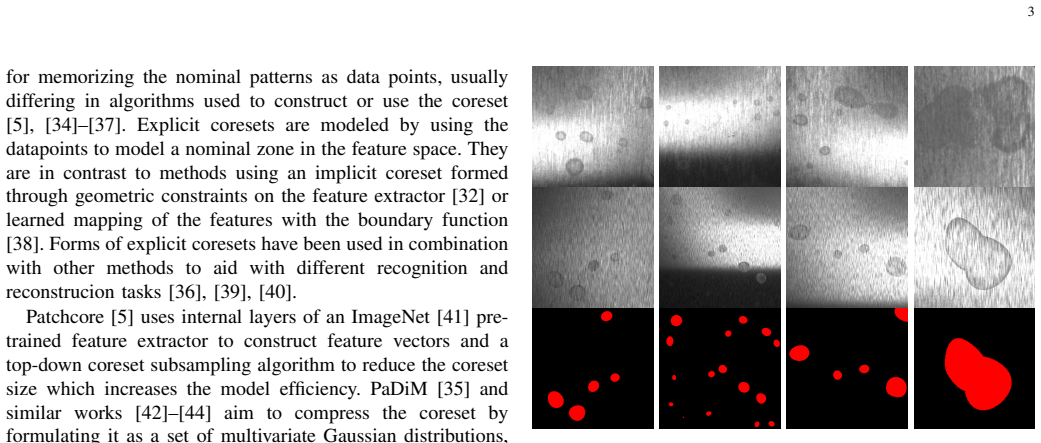
- [Sec. III, Algorithm 1] The water-stain generator parameters -- radius r, Perlin frequency f, amplitude A, reflectance decay gamma, intensity alpha, and cell size G -- are never reported in the paper or appendices. The realism claim that synthetic water stains are sufficiently similar to real stains to reduce model sensitivity is supported only by visual comparison in Fig. 2. Because the SynthWS-versus-Synth comparison is the core evidence for the usefulness of synthetic impurities, the absence of these values prevents independent reproduction and verification that the generated stains lie in the intended morphological and optical regime. Please provide the exact parameter values or ranges used for the 80 SynthWS samples, and ideally a quantitative comparison of stain morphology statistics between synthetic and real stains.
- [Sec. IV] The complexity statement 'reducing its complexity from O(NP) to O(|M|! N P)' is not a reduction: the factorial term is larger than NP for any nontrivial coreset size, and no derivation is given. The described algorithm appears to require per-patch work proportional to the coreset size and distance-matrix updates, but the actual complexity is not defined. Additionally, Sec. V reports no runtime or memory measurements comparing Sequential PatchCore with original PatchCore, so the memory-bottleneck claim is not experimentally supported. Please correct the complexity expression, define the per-patch update cost precisely, and include at least one memory and/or runtime comparison on the same data.
minor comments (6)
- [Sec. IV] The notation 'OpN Pq' should be 'O(NP)' throughout; the current typesetting is confusing.
- [Sec. V-C] There is a typo: 'finetunning' should be 'finetuning'.
- [Sec. VII] In the Conclusion, 'the the model trained on water stains' contains a duplicated article; please correct.
- [Appendix C] In the Fig. 5 caption, 'backgorund' should be 'background'.
- [Sec. V-B] The phrase 'The original deviation of 4' is ambiguous; specify that it refers to the standard deviation of the Gaussian blur kernel, as this is not clear from the text.
- [Sec. V-A] The sample size '10cm x 12cm' uses a caret character and lacks spaces; also, 'Nvidia TITAN V graphical processing card' should be rephrased as 'Nvidia TITAN V GPU'.
Circularity Check
No significant circularity: the central claims are evaluated on a held-out real test split, and no prediction reduces to its input by construction.
full rationale
The paper's derivation chain is empirical rather than self-referential. Synthetic water stains are generated by the procedural model in Algorithm 1 with parameters that are not reported and are not fitted to the test metrics. Coresets are built from training images, anomaly thresholds are selected by maximizing F1 on a separate validation plate, and all reported pixel-wise and defect-wise scores come from a held-out test split. The finetuning experiments follow a standard transfer-learning protocol: a coreset built on synthetic data is updated with the real training set, then evaluated on real test data. This does not reduce to the fitted threshold or to the synthetic generation parameters. The paper does cite the authors' own earlier rendering pipeline for synthetic image generation, and the realism of the water-stain model is partly supported by visual comparison, but the load-bearing conclusions are not forced by those citations: the benefit of synthetic pre-training is tested by comparing water-stain and defect recall on real images after synthetic training, which is an externally grounded evaluation. No equation in the paper defines a predicted quantity in terms of the same quantity's measured values, and no uniqueness theorem is invoked to rule out alternatives. The main weaknesses, such as the single small test split, absence of error bars, unreported generator parameters, and the fact that finetuned models contain both synthetic and real data, are experimental and reproducibility concerns rather than circularity.
Assumptions & free parameters
free parameters (4)
- Water stain model parameters (radius r, Perlin frequency f, amplitude A, reflectance decay gamma, intensity alpha… =
not reported; manually set
- Surface texture model parameters (parallel texture model from Bosnar et al.) =
custom parameters manually set
- PatchCore coreset and evaluation hyperparameters =
coreset size 2048, k=1, MobileNetv3-large layers 3 and 4, pool kernel 2, blur sigma 2, kernel 16, chunk size 2048, 5…
- Data augmentation and domain randomization schedule =
brightness, contrast, flip, Gaussian blur, noise, random masking, light rotation by 90 degrees, light scale x2
assumptions (5)
- domain assumption ImageNet pre-trained features transfer to flat metal surface anomaly detection.
- domain assumption The physically-based rendering pipeline of Bosnar et al. reproduces the real inspection context closely enough for sim-to-real transfer.
- ad hoc to paper Perlin noise with jittered sampling is a sufficient generative model for water stains on metal.
- domain assumption Bump defects are inherently ambiguously annotated, so pixel-wise labels are unreliable.
- domain assumption Maximizing F1 on a single validation plate sets a valid operating threshold for the test set.
Cite this review
Pith. "Pith review of Sequential PatchCore: Anomaly Detection for Surface Inspection using Synthetic Impurities." pith.science (2026). https://pith.science/paper/X5MDSZ7L
@misc{pith2026250109579,
  author       = {Pith},
  title        = {Pith review of: Sequential PatchCore: Anomaly Detection for Surface Inspection using Synthetic Impurities},
  year         = {2026},
  howpublished = {\url{https://pith.science/paper/X5MDSZ7L}},
  note         = {Machine review of arXiv:2501.09579}
}
read the original abstract
The appearance of surface impurities (e.g., water stains, fingerprints, stickers) is an often-mentioned issue that causes degradation of automated visual inspection systems. At the same time, synthetic data generation techniques for visual surface inspection have focused primarily on generating perfect examples and defects, disregarding impurities. This study highlights the importance of considering impurities when generating synthetic data. We introduce a procedural method to include photorealistic water stains in synthetic data. The synthetic datasets are generated to correspond to real datasets and are further used to train an anomaly detection model and investigate the influence of water stains. The high-resolution images used for surface inspection lead to memory bottlenecks during anomaly detection training. To address this, we introduce Sequential PatchCore - a method to build coresets sequentially and make training on large images using consumer-grade hardware tractable. This allows us to perform transfer learning using coresets pre-trained on different dataset versions. Our results show the benefits of using synthetic data for pre-training an explicit coreset anomaly model and the extended performance benefits of finetuning the coreset using real data. We observed how the impurities and labelling ambiguity lower the model performance and have additionally reported the defect-wise recall to provide an industrially relevant perspective on model performance.
Figures


Figures from the paper (1 more)

Reference graph
Works this paper leans on
-
[2]
R. Kohli and K. L. Mittal, Developments in surface contamination and cleaning: Applications of cleaning techniques . 2018. 8
work page 2018
-
[3]
Synthetically gen- erated images for industrial anomaly detection,
M. Wagenstetter, P. Gospodnetic, L. Bosnar, J. Fulir, D. Kreul, H. Rush- meier, T. Aicher, A. Hellmich, and S. Ihlenfeldt, “Synthetically gen- erated images for industrial anomaly detection,” in Proceedings of IEEE International Conference on Emerging Technologies and Factory Automation, 2024
work page 2024
-
[4]
Bosnar, Procedural Modeling and Image Synthesis for Virtual Surface Inspection Planning
L. Bosnar, Procedural Modeling and Image Synthesis for Virtual Surface Inspection Planning . doctoralthesis, Rheinland-Pf ¨alzische Technische Universit¨at Kaiserslautern-Landau, 2024
work page 2024
-
[5]
Towards total recall in industrial anomaly detection,
K. Roth, L. Pemula, J. Zepeda, B. Sch ¨olkopf, T. Brox, and P. Gehler, “Towards total recall in industrial anomaly detection,” in 2022 IEEE/CVF Conference on Computer Vision and Pattern Recognition (CVPR), pp. 14298–14308, 2022
work page 2022
-
[6]
Simulation of microstructures and machine learning,
K. Schladitz, C. Redenbach, T. Barisin, C. Jung, N. Jeziorski, L. Bosnar, J. Fulir, and P. Gospodnetic, “Simulation of microstructures and machine learning,” in CMDS14, (Paris), Springer Proceedings in Mathematics and Statistics, 2023
work page 2023
-
[7]
J. Aust, A. Mitrovic, and D. Pons, “Assessment of the effect of cleanliness on the visual inspection of aircraft engine blades: An eye tracking study,” Sensors, vol. 21, no. 18, 2021
work page 2021
-
[8]
B. Ramalingam, V .-H. Manuel, M. R. Elara, A. Vengadesh, A. K. Lakshmanan, M. Ilyas, and T. J. Y . James, “Visual inspection of the aircraft surface using a teleoperated reconfigurable climbing robot and enhanced deep learning technique,” International Journal of Aerospace Engineering, vol. 2019, no. 1, p. 5137139, 2019
work page 2019
-
[9]
D. Daeschel, Y . Singh Rana, L. Chen, S. Cai, R. Dando, and A. B. Snyder, “Visual inspection of surface sanitation: Defining the conditions that enhance the human threshold for detection of food residues,” Food Control, vol. 149, p. 109691, 2023
work page 2023
Show all 61 references
-
[10]
Defect-gan: High-fidelity defect synthesis for automated defect inspection,
G. Zhang, K. Cui, T. Y . Hung, and S. Lu, “Defect-gan: High-fidelity defect synthesis for automated defect inspection,” 2021
2021
-
[11]
Dg-gan: A high quality defect image generation method for defect detection,
X. He, Z. Luo, Q. Li, H. Chen, and F. Li, “Dg-gan: A high quality defect image generation method for defect detection,” Sensors, vol. 23, 2023
2023
-
[12]
Diversified and multi-class controllable industrial defect synthesis for data augmentation and transfer,
J. Wei, F. Shen, C. Lv, Z. Zhang, F. Zhang, and H. Yang, “Diversified and multi-class controllable industrial defect synthesis for data augmentation and transfer,” vol. 2023-June, 2023
2023
-
[13]
Cut: A controllable, universal, and training-free visual anomaly generation framework,
H. Sun, Y . Cao, and O. Fink, “Cut: A controllable, universal, and training-free visual anomaly generation framework,” 2024
2024
-
[14]
Synthetic data for defect segmentation on complex metal surfaces,
J. Fulir, L. Bosnar, H. Hagen, and P. Gospodneti ´c, “Synthetic data for defect segmentation on complex metal surfaces,” vol. 2023-June, 2023
2023
-
[15]
Cad2render: A modular toolkit for gpu-accelerated photorealistic synthetic data generation for the manufacturing industry,
S. Moonen, B. Vanherle, J. D. Hoog, T. Bourgana, A. Bey-Temsamani, and N. Michiels, “Cad2render: A modular toolkit for gpu-accelerated photorealistic synthetic data generation for the manufacturing industry,” in Proceedings - 2023 IEEE/CVF Winter Conference on Applications of ...
2023
-
[16]
Image synthesis pipeline for surface inspection,
L. Bosnar, D. Saric, S. Dutta, T. Weibel, M. Rauhut, H. Hagen, and P. Gospodnetic, “Image synthesis pipeline for surface inspection,” 2020
2020
-
[17]
Towards sim-to-real industrial parts classification with syn- thetic dataset,
X. Zhu, T. Bilal, P. M ˚artensson, L. Hanson, M. Bj ¨orkman, and A. Maki, “Towards sim-to-real industrial parts classification with syn- thetic dataset,” in Proceedings of the IEEE/CVF Conference on Com- puter Vision and Pattern Recognition (CVPR) Workshops , pp. 4454– 4463, June 2023
2023
-
[18]
Imperfection for realistic image synthesis,
W. Becket and N. I. Badler, “Imperfection for realistic image synthesis,” The Journal of Visualization and Computer Animation , vol. 1, 1990
1990
-
[19]
Rusting and corroding simulation taking into account chemical reaction processes,
T. Ishikawa, K. Kamata, Y . Takeshima, and M. Kakimoto, “Rusting and corroding simulation taking into account chemical reaction processes,” 2016
2016
-
[20]
Simulation of textile stains,
Y . Zheng, Y . Chen, G. Fei, J. Dorsey, and E. Wu, “Simulation of textile stains,” IEEE Transactions on Visualization and Computer Graphics , vol. 25, 2019
2019
-
[21]
Image synthesizer.,
K. Perlin, “Image synthesizer.,” Computer Graphics (ACM) , vol. 19, 1985
1985
-
[22]
A geometry dependent texture generation framework for simulating surface imperfections,
T.-T. Wong, W.-Y . Ng, and P.-A. Heng, “A geometry dependent texture generation framework for simulating surface imperfections,” in Render- ing Techniques ’97 (J. Dorsey and P. Slusallek, eds.), (Vienna), pp. 139– 150, Springer Vienna, 1997
1997
-
[23]
Rendering imperfections: Dust, scratches, aging,...,
M. Schw ¨arzler, “Rendering imperfections: Dust, scratches, aging,...,” 7 2007
2007
-
[24]
Realistic image synthesis of surface scratches and grooves,
C. Bosch, “Realistic image synthesis of surface scratches and grooves,” 7 2007
2007
-
[25]
Example based procedural distribution tool,
A. Nord, “Example based procedural distribution tool,” 2014
2014
-
[26]
Procedural defect modeling for virtual surface inspection environments,
L. Bosnar, H. Hagen, and P. Gospodnetic, “Procedural defect modeling for virtual surface inspection environments,” IEEE Computer Graphics and Applications, vol. 43, 2023
2023
-
[27]
Steel surface defect recognition: A survey,
X. Wen, J. Shan, Y . He, and K. Song, “Steel surface defect recognition: A survey,” Coatings, vol. 13, no. 1, 2023
2023
-
[28]
Surface defect detection methods for industrial products: A review,
Y . Chen, Y . Ding, F. Zhao, E. Zhang, Z. Wu, and L. Shao, “Surface defect detection methods for industrial products: A review,” Applied Sciences, vol. 11, no. 16, 2021
2021
-
[29]
A review on modern defect detection models using dcnns – deep convolutional neural net- works,
A.-A. Tulbure, A.-A. Tulbure, and E.-H. Dulf, “A review on modern defect detection models using dcnns – deep convolutional neural net- works,” Journal of Advanced Research , vol. 35, pp. 33–48, 2022
2022
-
[30]
Deep industrial image anomaly detection: A survey,
J. Liu, G. Xie, J. Wang, S. Li, C. Wang, F. Zheng, and Y . Jin, “Deep industrial image anomaly detection: A survey,” 2023
2023
-
[31]
Dream: Efficient dataset distillation by representative matching,
Y . Liu, J. Gu, K. Wang, Z. Zhu, W. Jiang, and Y . You, “Dream: Efficient dataset distillation by representative matching,” in Proceedings of the IEEE/CVF International Conference on Computer Vision (ICCV) , pp. 17314–17324, October 2023
2023
-
[32]
Patch svdd: Patch-level svdd for anomaly detection and segmentation,
J. Yi and S. Yoon, “Patch svdd: Patch-level svdd for anomaly detection and segmentation,” in Proceedings of the Asian Conference on Computer Vision (ACCV), November 2020
2020
-
[33]
Deep learning for unsupervised anomaly localization in industrial images: A survey,
X. Tao, X. Gong, X. Zhang, S. Yan, and C. Adak, “Deep learning for unsupervised anomaly localization in industrial images: A survey,” IEEE Transactions on Instrumentation and Measurement , vol. 71, pp. 1–21, 2022
2022
-
[34]
Sub-image anomaly detection with deep pyramid correspondences,
N. Cohen and Y . Hoshen, “Sub-image anomaly detection with deep pyramid correspondences,” CoRR, vol. abs/2005.02357, 2020
2005 arXiv
-
[35]
Padim: a patch dis- tribution modeling framework for anomaly detection and localization,
T. Defard, A. Setkov, A. Loesch, and R. Audigier, “Padim: a patch dis- tribution modeling framework for anomaly detection and localization,” CoRR, vol. abs/2011.08785, 2020
2011 arXiv
-
[36]
Memorizing normality to detect anomaly: Memory- augmented deep autoencoder for unsupervised anomaly detection,
D. Gong, L. Liu, V . Le, B. Saha, M. R. Mansour, S. Venkatesh, and A. v. d. Hengel, “Memorizing normality to detect anomaly: Memory- augmented deep autoencoder for unsupervised anomaly detection,” in Proceedings of the IEEE/CVF International Conference on Computer Vision (ICCV...
2019
-
[37]
Prototypical residual networks for anomaly detection and localization,
H. Zhang, Z. Wu, Z. Wang, Z. Chen, and Y .-G. Jiang, “Prototypical residual networks for anomaly detection and localization,” in Proceed- ings of the IEEE/CVF Conference on Computer Vision and Pattern Recognition (CVPR), pp. 16281–16291, June 2023
2023
-
[38]
Simplenet: A simple network for image anomaly detection and localization,
Z. Liu, Y . Zhou, Y . Xu, and Z. Wang, “Simplenet: A simple network for image anomaly detection and localization,” in 2023 IEEE/CVF Confer- ence on Computer Vision and Pattern Recognition (CVPR) , pp. 20402– 20411, 2023
2023
-
[39]
Divide- and-assemble: Learning block-wise memory for unsupervised anomaly detection,
J. Hou, Y . Zhang, Q. Zhong, D. Xie, S. Pu, and H. Zhou, “Divide- and-assemble: Learning block-wise memory for unsupervised anomaly detection,” in 2021 IEEE/CVF International Conference on Computer Vision (ICCV), pp. 8771–8780, 2021
2021
-
[40]
Small-GAN: Speeding up GAN training using core-sets,
S. Sinha, H. Zhang, A. Goyal, Y . Bengio, H. Larochelle, and A. Odena, “Small-GAN: Speeding up GAN training using core-sets,” in Proceed- ings of the 37th International Conference on Machine Learning (H. D. III and A. Singh, eds.), vol. 119 of Proceedings of Machine Learning R...
2020
-
[41]
Imagenet: A large-scale hierarchical image database,
J. Deng, W. Dong, R. Socher, L.-J. Li, K. Li, and L. Fei-Fei, “Imagenet: A large-scale hierarchical image database,” in 2009 IEEE Conference on Computer Vision and Pattern Recognition , pp. 248–255, 2009
2009
-
[42]
Industrial image anomaly localization based on gaussian clustering of pretrained feature,
Q. Wan, L. Gao, X. Li, and L. Wen, “Industrial image anomaly localization based on gaussian clustering of pretrained feature,” IEEE Transactions on Industrial Electronics , vol. 69, no. 6, pp. 6182–6192, 2022
2022
-
[43]
Modeling the distribution of normal data in pre-trained deep features for anomaly detection,
O. Rippel, P. Mertens, and D. Merhof, “Modeling the distribution of normal data in pre-trained deep features for anomaly detection,” CoRR, vol. abs/2005.14140, 2020
2005 arXiv
-
[44]
Towards continual adaptation in industrial anomaly detec- tion,
W. Li, J. Zhan, J. Wang, B. Xia, B.-B. Gao, J. Liu, C. Wang, and F. Zheng, “Towards continual adaptation in industrial anomaly detec- tion,” in Proceedings of the 30th ACM International Conference on Multimedia, MM ’22, (New York, NY , USA), p. 2871–2880, Association for Compu...
2022
-
[45]
Enhancing anomaly detection performance and acceleration,
R. Saiku, J. Sato, T. Yamada, and K. Ito, “Enhancing anomaly detection performance and acceleration,” IEEJ Journal of Industry Applications , vol. 11, 07 2022
2022
-
[46]
Target before shooting: Accurate anomaly detection and localization under one mil- lisecond via cascade patch retrieval,
H. Li, J. Hu, B. Li, H. Chen, Y . Zheng, and C. Shen, “Target before shooting: Accurate anomaly detection and localization under one mil- lisecond via cascade patch retrieval,” 2023
2023
-
[47]
Fapm: Fast adaptive patch memory for real-time industrial anomaly detection,
D. Kim, C. Park, S. Cho, and S. Lee, “Fapm: Fast adaptive patch memory for real-time industrial anomaly detection,” in ICASSP 2023 - 2023 IEEE International Conference on Acoustics, Speech and Signal Processing (ICASSP), pp. 1–5, 2023
2023
-
[48]
Prior normality prompt transformer for multi-class industrial image anomaly detection,
H. Yao, Y . Cao, W. Luo, W. Zhang, W. Yu, and W. Shen, “Prior normality prompt transformer for multi-class industrial image anomaly detection,” 2024
2024
-
[49]
Efficient textile anomaly detection via memory guided distillation network,
J. Yang, H. Wang, Z. Song, F. Guo, and H. Yue, “Efficient textile anomaly detection via memory guided distillation network,” Journal of Intelligent Manufacturing, Jul 2024. 9
2024
-
[50]
Anomalydino: Boosting patch-based few-shot anomaly detection with dinov2,
S. Damm, M. Laszkiewicz, J. Lederer, and A. Fischer, “Anomalydino: Boosting patch-based few-shot anomaly detection with dinov2,” 2024
2024
-
[51]
Pushing the limits of fewshot anomaly detection in industry vision: Graphcore,
G. Xie, J. Wang, J. Liu, F. Zheng, and Y . Jin, “Pushing the limits of fewshot anomaly detection in industry vision: Graphcore,” 2023
2023
-
[52]
Cfa: Coupled-hypersphere-based fea- ture adaptation for target-oriented anomaly localization,
S. Lee, S. Lee, and B. C. Song, “Cfa: Coupled-hypersphere-based fea- ture adaptation for target-oriented anomaly localization,” IEEE Access, vol. 10, pp. 78446–78454, 2022
2022
-
[53]
D. S. Ebert, F. K. Musgrave, D. Peachey, K. Perlin, and S. Worley, Texturing and Modeling: A Procedural Approach . Morgan Kaufmann Publishers Inc., 3rd ed., 2002
2002
-
[54]
Labelme: Image polygonal annotation with Python
K. Wada, “Labelme: Image polygonal annotation with Python.”
-
[55]
Texture synthesis for surface inspection,
L. Bosnar, M. Rauhut, H. Hagen, and P. Gospodnetic, “Texture synthesis for surface inspection,” 2022
2022
-
[56]
Anomalib: A deep learning library for anomaly detection,
S. Akcay, D. Ameln, A. Vaidya, B. Lakshmanan, N. Ahuja, and U. Genc, “Anomalib: A deep learning library for anomaly detection,” in 2022 IEEE International Conference on Image Processing (ICIP) , pp. 1706– 1710, IEEE, 2022
2022
-
[57]
Searching for mobilenetv3,
A. Howard, M. Sandler, G. Chu, L.-C. Chen, B. Chen, M. Tan, W. Wang, Y . Zhu, R. Pang, V . Vasudevan, Q. V . Le, and H. Adam, “Searching for mobilenetv3,” in Proceedings of the IEEE/CVF International Conference on Computer Vision (ICCV) , October 2019
2019
-
[58]
Wide residual networks,
S. Zagoruyko and N. Komodakis, “Wide residual networks,” CoRR, vol. abs/1605.07146, 2016
2016 arXiv
-
[59]
Deep residual learning for image recognition,
K. He, X. Zhang, S. Ren, and J. Sun, “Deep residual learning for image recognition,” in 2016 IEEE Conference on Computer Vision and Pattern Recognition (CVPR), pp. 770–778, 2016
2016
-
[60]
Very deep convolutional networks for large-scale image recognition,
K. Simonyan and A. Zisserman, “Very deep convolutional networks for large-scale image recognition,” in 3rd International Conference on Learning Representations, ICLR 2015, San Diego, CA, USA, May 7-9, 2015, Conference Track Proceedings (Y . Bengio and Y . LeCun, eds.), 2015
2015
-
[61]
A survey on unsupervised anomaly detection algorithms for industrial images,
Y . Cui, Z. Liu, and S. Lian, “A survey on unsupervised anomaly detection algorithms for industrial images,” IEEE Access , vol. 11, pp. 55297–55315, 2023
2023
-
[62]
A survey on federated learning systems: Vision, hype and reality for data privacy and protection,
Q. Li, Z. Wen, Z. Wu, S. Hu, N. Wang, Y . Li, X. Liu, and B. He, “A survey on federated learning systems: Vision, hype and reality for data privacy and protection,” IEEE Transactions on Knowledge and Data Engineering, vol. 35, p. 3347–3366, Apr. 2023. 10 APPENDIX A EXAMPLES FR...
2023
Reviewed August 10, 2026 · model on record in the stance chip above.
Discussion (0). Continue with ORCID to comment.