Finite-range EFT for the E1 strength distribution of {}⁶He
Pith reviewed 2026-07-01 02:19 UTC · model grok-4.3
The pith
Finite-range Halo EFT yields an E1 strength distribution for ⁶He that agrees with data at NLO.
A machine-rendered reading of the paper's core claim, the machinery that carries it, and where it could break.
Core claim
We solve for the ⁶He bound state in this finite-range EFT up to next-to-leading order (NLO) in the Halo EFT power counting and calculate the ground-state E1 strength distribution of ⁶He at this order. The shape of the resulting distribution agrees with that obtained in the dimer formalism of the EFT, but finite-range EFT does not require the use of a non-standard wave function normalization condition. We also calculate the root-mean-square charge radius of ⁶He and find 2.06 ± 0.35 fm at LO and 2.00 ± 0.09 fm at NLO, in agreement with experimental data. To calculate the full E1 strength distribution final-state interactions must be incorporated. We approximate the full-three-body scattering o
What carries the argument
Separable interactions with Yamaguchi-like form factors inside a finite-range Halo EFT that keeps the three-body Hilbert space standard while reproducing the dimer-formalism E1 distribution.
If this is right
- The E1 strength distribution at NLO matches experimental data inside theory uncertainties.
- The root-mean-square charge radius is 2.06 ± 0.35 fm at LO and 2.00 ± 0.09 fm at NLO, consistent with measured values.
- The finite-range approach produces the same distribution shape as the dimer formalism without needing a non-standard normalization condition.
- Final-state interactions are adequately captured by the successive Møller-operator approximation for this observable.
Where Pith is reading between the lines
- The same finite-range construction could be applied to other p-wave halo systems where multiple effective-range parameters appear at leading order.
- Higher-precision E1 data near the peak would directly test whether the NLO truncation error estimate is realistic.
- The method supplies a practical route to other electromagnetic observables once the Møller approximation is validated for the present case.
Load-bearing premise
Approximating the full three-body scattering operator by single Møller operators and then by products of up to three Møller operators is sufficient to incorporate final-state interactions for the E1 strength distribution.
What would settle it
A measurement of the ⁶He E1 strength distribution whose central values fall outside the NLO theory uncertainty band while the experimental errors remain smaller than that band.
Figures

read the original abstract
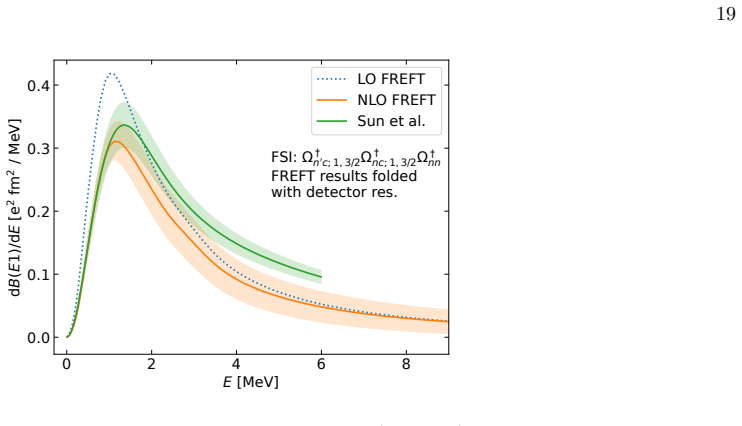
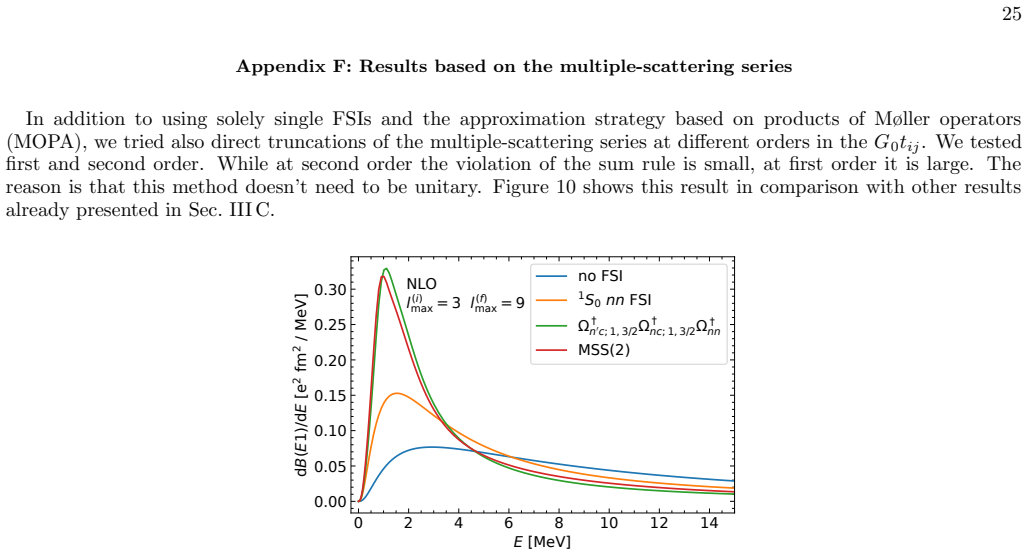
Halo effective field theory (Halo EFT) is a powerful tool to describe halo nuclei and predict low-energy observables with quantified uncertainties. However, in the case that there is a leading-order interaction determined by two or more effective-range parameters, such as the $^2P_{3/2}$ $n\alpha$ interaction in $^6$He, the standard implementation in the dimer formalism leads to an energy-dependent interaction. This complicates the construction of a Hilbert space of states, especially beyond the two-body problem. As an alternative, we propose the use of a finite-range formulation of Halo EFT, which avoids these complications. For definiteness, we use separable interactions with Yamaguchi-like form factors, but other choices are possible. We solve for the ${}^6$He bound state in this finite-range EFT up to next-to-leading order (NLO) in the Halo EFT power counting and calculate the ground-state $E1$ strength distribution of $^6$He at this order. The shape of the resulting distribution agrees with that obtained in the dimer formalism of the EFT, but finite-range EFT does not require the use of a non-standard wave function normalization condition. We also calculate the root-mean-square charge radius of $^6$He and find $2.06 \pm 0.35$~fm at LO and $2.00 \pm 0.09$~fm at NLO, in agreement with experimental data. To calculate the full $E1$ strength distribution final-state interactions must be incorporated. We approximate the full-three-body scattering operator first by single M{\o}ller operators and then by products of up to three M{\o}ller operators. The resulting NLO $E1$ strength distribution agrees with the experimental data within theory uncertainties.
Editorial analysis
A structured set of objections, weighed in public.
Referee Report
Summary. The manuscript introduces a finite-range Halo EFT formulation with separable Yamaguchi-like form factors for the n-α interaction in ⁶He, avoiding energy-dependent interactions of the standard dimer approach. It solves the three-body bound state up to NLO, computes the rms charge radius (2.06 ± 0.35 fm at LO and 2.00 ± 0.09 fm at NLO), and obtains the E1 strength distribution by approximating the three-body scattering operator via single Møller operators followed by products of up to three such operators, reporting that the NLO distribution agrees with data within theory uncertainties.
Significance. If the FSI approximation holds, the work supplies a consistent Hilbert-space treatment for Halo EFT systems with multiple effective-range parameters and delivers quantified-uncertainty predictions for both the charge radius and E1 distribution. The radius results match experiment at both orders; the finite-range construction itself removes the need for non-standard wave-function normalization.
major comments (2)
- [E1 strength distribution and final-state interactions] The headline claim that the NLO E1 strength distribution agrees with data within uncertainties rests on the replacement of the full three-body scattering operator by single Møller operators and then by products of up to three Møller operators. No convergence test or comparison against an exact three-body solution is supplied in the relevant energy window, which directly affects the shape and uncertainty band of the reported distribution.
- [Two-body input and parameter determination] The Yamaguchi range parameters are free parameters fixed from two-body data; the manuscript must show explicitly how their variation propagates into the three-body E1 distribution at NLO and whether the quoted theory uncertainties already incorporate this variation, because the central agreement claim depends on it.
minor comments (2)
- [Notation and operator definitions] Clarify the precise definition and normalization of the Møller operators when they are multiplied (up to three) so that the truncation error can be assessed by the reader.
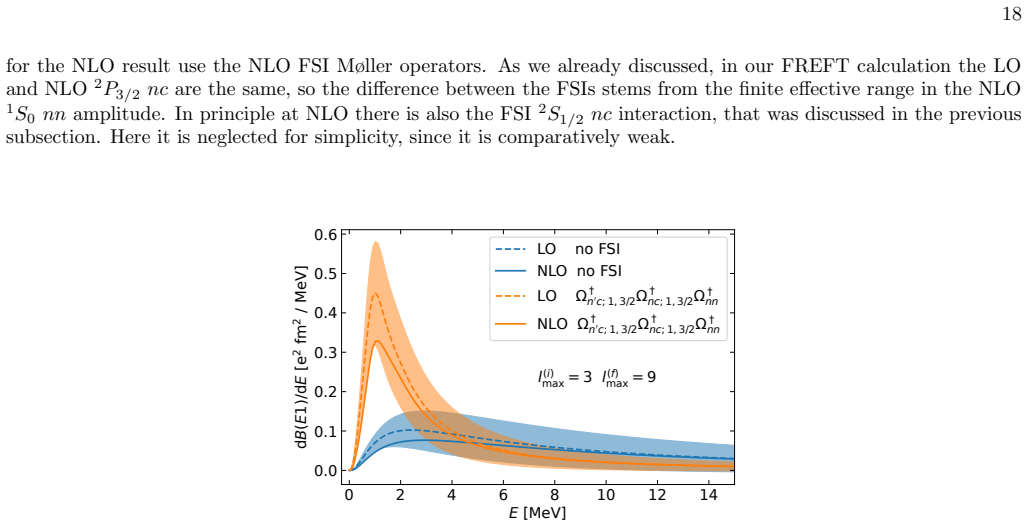
- [Figures] The E1 distribution figure should display both LO and NLO curves together with their respective uncertainty bands for direct visual comparison.
Simulated Author's Rebuttal
We thank the referee for their careful reading and insightful comments on our manuscript. We address each major comment below and indicate where revisions will be made to strengthen the presentation.
read point-by-point responses
-
Referee: [E1 strength distribution and final-state interactions] The headline claim that the NLO E1 strength distribution agrees with data within uncertainties rests on the replacement of the full three-body scattering operator by single Møller operators and then by products of up to three Møller operators. No convergence test or comparison against an exact three-body solution is supplied in the relevant energy window, which directly affects the shape and uncertainty band of the reported distribution.
Authors: We agree that the FSI treatment is an approximation and that a direct convergence test against an exact three-body solution would be desirable. The approximation is chosen because the low-energy dynamics are dominated by two-body rescattering, and the resulting distribution is consistent with the shape obtained in the dimer formalism. We will revise the manuscript to include an expanded discussion of the expected accuracy of the Møller-operator truncation, its relation to the EFT power counting, and a qualitative estimate of the residual uncertainty it introduces into the band. A full exact three-body scattering solution lies outside the scope of the present work. revision: partial
-
Referee: [Two-body input and parameter determination] The Yamaguchi range parameters are free parameters fixed from two-body data; the manuscript must show explicitly how their variation propagates into the three-body E1 distribution at NLO and whether the quoted theory uncertainties already incorporate this variation, because the central agreement claim depends on it.
Authors: The Yamaguchi range parameters are fixed to two-body phase shifts and are not varied in the quoted uncertainty bands, which reflect only the EFT truncation error. We will add an explicit sensitivity study in the revised manuscript that varies the range parameters within their two-body uncertainties and shows the resulting spread in the NLO E1 distribution. This will be compared to the existing EFT error estimate to confirm that the agreement with data remains robust. revision: yes
Circularity Check
No circularity: finite-range Halo EFT uses independent two-body inputs to predict three-body observables
full rationale
The paper defines a finite-range separable interaction in Halo EFT, fixes its parameters from two-body n-α scattering data, solves the three-body bound state at LO/NLO, and computes the E1 distribution after an explicit (non-self-referential) truncation of the scattering operator to products of Møller operators. None of these steps redefines the output in terms of itself or renames a fit as a prediction; the final agreement with data is a genuine test of the framework. No load-bearing self-citation or uniqueness theorem imported from the authors' prior work is required for the central claims.
Axiom & Free-Parameter Ledger
free parameters (1)
- Yamaguchi form-factor range parameters
axioms (1)
- domain assumption Halo EFT power counting remains valid for the finite-range formulation
Reference graph
Works this paper leans on
-
[1]
We perform a truncation in the included partial-wave states for the initial state (multiindex Ωi) and for the final state (multiindex Ω f)
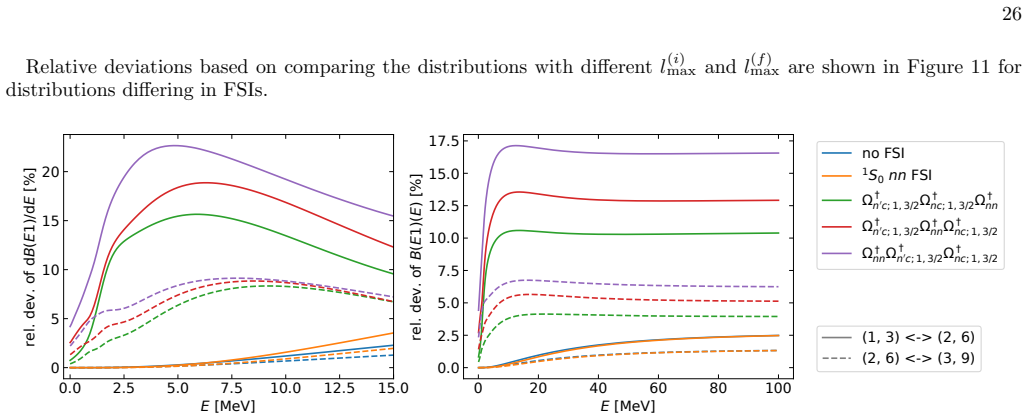
The strategy for the computation of the FSI explained above provides a way to evaluate theE1 matrix element c⟨p, q; Ωf |˜ΩME1,µPΩi |Ψ⟩. We perform a truncation in the included partial-wave states for the initial state (multiindex Ωi) and for the final state (multiindex Ω f). The condition for the initial states isl i ≤l (i) max ∧λ i ≤l (i) max, whereby l(...
-
[2]
The unitarity piece of thenα 2P3/2 amplitude
-
[3]
The effective range term of thenn 1S0 amplitude
-
[4]
shape parameter
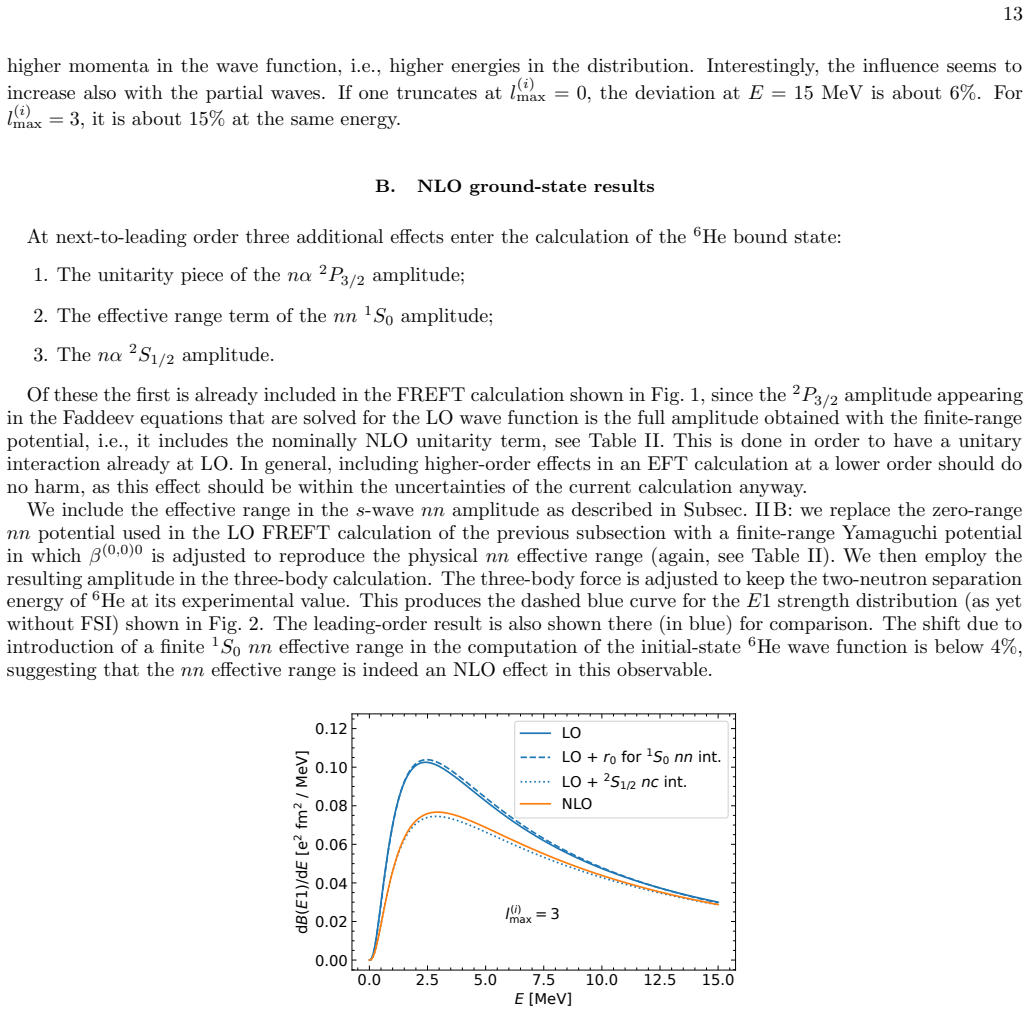
Thenα 2S1/2 amplitude. Of these the first is already included in the FREFT calculation shown in Fig. 1, since the2P3/2 amplitude appearing in the Faddeev equations that are solved for the LO wave function is the full amplitude obtained with the finite-range potential, i.e., it includes the nominally NLO unitarity term, see Table II. This is done in order ...
2022
-
[5]
M. V. Zhukov, B. V. Danilin, D. V. Fedorov, J. M. Bang, I. J. Thompson, and J. S. Vaagen, Phys. Rept.231, 151 (1993)
1993
-
[6]
P. G. Hansen, A. S. Jensen, and B. Jonson, Ann. Rev. Nucl. Part. Sci.45, 591 (1995)
1995
-
[7]
Jonson, Physics Reports389, 1 (2004)
B. Jonson, Physics Reports389, 1 (2004)
2004
-
[8]
K. Riisager, Phys. ScriptaT152, 014001 (2013), arXiv:1208.6415 [nucl-ex]
Pith/arXiv arXiv 2013
-
[9]
C. A. Bertulani, H.-W. Hammer, and U. van Kolck, Nucl. Phys. A712, 37 (2002), arXiv:nucl-th/0205063
Pith/arXiv arXiv 2002
-
[10]
P. F. Bedaque, H.-W. Hammer, and U. van Kolck, Phys. Lett. B569, 159 (2003), arXiv:nucl-th/0304007
Pith/arXiv arXiv 2003
-
[11]
H.-W. Hammer, C. Ji, and D. R. Phillips, J. Phys. G44, 103002 (2017), arXiv:1702.08605 [nucl-th]
Pith/arXiv arXiv 2017
- [12]
-
[13]
Hammer, Theory of Halo Nuclei, inHandbook of Nuclear Physics, edited by I
H.-W. Hammer, Theory of Halo Nuclei, inHandbook of Nuclear Physics, edited by I. Tanihata, H. Toki, and T. Kajino (2022) pp. 1–30, arXiv:2203.13074 [nucl-th]
arXiv 2022
-
[14]
B. H. J. McKellar and C. M. McKay, Austral. J. Phys.36, 607 (1983)
1983
-
[15]
Form´ anek, R
J. Form´ anek, R. J. Lombard, and J. Mareˇ s, Czechoslovak Journal of Physics54, 289 (2004)
2004
-
[16]
C. Ji, C. Elster, and D. R. Phillips, Phys. Rev. C90, 044004 (2014), arXiv:1405.2394 [nucl-th]
Pith/arXiv arXiv 2014
-
[17]
M. G¨ obel, H.-W. Hammer, C. Ji, and D. R. Phillips, Few Body Syst.60, 61 (2019), arXiv:1904.07182 [nucl-th]
arXiv 2019
-
[18]
Yamaguchi, Phys
Y. Yamaguchi, Phys. Rev.95, 1628 (1954)
1954
-
[19]
S. R. Beane and R. C. Farrell, Few Body Syst.63, 45 (2022), arXiv:2112.05800 [nucl-th]
arXiv 2022
-
[20]
R. Peng, S. Lyu, S. K¨ onig, and B. Long, Phys. Rev. C105, 054002 (2022), arXiv:2112.00947 [nucl-th]
arXiv 2022
-
[21]
R. V. Reid, Jr., Annals Phys.50, 411 (1968)
1968
-
[22]
Yukawa, Proc
H. Yukawa, Proc. Phys. Math. Soc. Jap.17, 48 (1935)
1935
-
[23]
Weinberg, Phys
S. Weinberg, Phys. Lett. B251, 288 (1990)
1990
-
[24]
Weinberg, Nucl
S. Weinberg, Nucl. Phys. B363, 3 (1991)
1991
-
[25]
V. G. J. Stoks, R. A. M. Klomp, M. C. M. Rentmeester, and J. J. de Swart, Phys. Rev. C48, 792 (1993)
1993
-
[26]
E. Epelbaum, H.-W. Hammer, and U.-G. Meissner, Rev. Mod. Phys.81, 1773 (2009), arXiv:0811.1338 [nucl-th]
Pith/arXiv arXiv 2009
-
[27]
D. R. Phillips, Ann. Rev. Nucl. Part. Sci.66, 421 (2016). 27
2016
-
[28]
R. Machleidt and F. Sammarruca, Prog. Part. Nucl. Phys.137, 104117 (2024), arXiv:2402.14032 [nucl-th]
arXiv 2024
-
[29]
L. Contessi, M. Sch¨ afer, and U. van Kolck, Phys. Rev. A109, 022814 (2024), arXiv:2310.15760 [physics.atm-clus]
arXiv 2024
-
[30]
L. Contessi, M. Pavon Valderrama, and U. van Kolck, Phys. Lett. B856, 138903 (2024), arXiv:2403.16596 [nucl-th]
arXiv 2024
-
[31]
A. Kievsky, L. Girlanda, M. Gattobigio, and M. Viviani, Ann. Rev. Nucl. Part. Sci.71, 465 (2021), arXiv:2102.13504 [nucl-th]
arXiv 2021
-
[32]
Q. Li, S. Lyu, C. Ji, and B. Long, Phys. Rev. C108, 024002 (2023), arXiv:2303.17292 [nucl-th]
arXiv 2023
-
[33]
E. C. Pinilla, W. Leidemann, G. Orlandini, and P. Descouvemont, Phys. Rev. C112, 024003 (2025), arXiv:2409.03074 [nucl-th]
arXiv 2025
-
[34]
C. A. Bertulani, Phys. Rev. C108, 054602 (2023), arXiv:2307.01660 [nucl-th]
arXiv 2023
-
[35]
Hebach, P
H. Hebach, P. Henneberg, and H. K¨ ummel, Phys. Lett. B24, 134 (1967)
1967
-
[36]
Ghovanlou and D
A. Ghovanlou and D. R. Lehman, Phys. Rev. C9, 1730 (1974)
1974
-
[37]
L. V. Chulkov, B. V. Danilin, A. A. Korsheninnikov, and M. V. Zhukov, Nucl. Phys. A533, 428 (1991)
1991
-
[38]
M. D. Higgins and C. H. Greene, Phys. Rev. C111, 014001 (2025), arXiv:2407.17668 [nucl-th]
arXiv 2025
-
[39]
Aumannet al., Phys
T. Aumannet al., Phys. Rev. C59, 1252 (1999)
1999
-
[40]
Wanget al., Phys
J. Wanget al., Phys. Rev. C65, 034306 (2002)
2002
-
[41]
Y. L. Sunet al., Phys. Lett. B814, 136072 (2021)
2021
-
[42]
A. Cobis, D. V. Fedorov, and A. S. Jensen, Phys. Rev. C58, 1403 (1998), arXiv:nucl-th/9804057
Pith/arXiv arXiv 1998
-
[43]
C. Forssen, V. Efros, and M. Zhukov, Nucl. Phys. A697, 639 (2002), arXiv:nucl-th/0108021
Pith/arXiv arXiv 2002
-
[44]
L. V. Grigorenko, N. B. Shulgina, and M. V. Zhukov, Phys. Rev. C102, 014611 (2020), arXiv:2003.10701 [nucl-th]
arXiv 2020
-
[45]
Kikuchi, K
Y. Kikuchi, K. Kato, T. Myo, M. Takashina, and K. Ikeda, Phys. Rev. C81, 044308 (2010)
2010
-
[46]
T. Nakamura, K. Hagino, and Y. Kondo, Dineutron clusters (2026), arXiv:2606.28950 [nucl-ex]
Pith/arXiv arXiv 2026
-
[47]
M. G¨ obel, B. Acharya, H.-W. Hammer, and D. R. Phillips, Phys. Rev. C107, 014617 (2023), arXiv:2207.14281 [nucl-th]
arXiv 2023
-
[48]
G¨ obel,Structure and breakup reactions of neutron halo nuclei, Ph.D
M. G¨ obel,Structure and breakup reactions of neutron halo nuclei, Ph.D. thesis, Darmstadt, Tech. U. (2024)
2024
-
[49]
Yamaguchi and Y
Y. Yamaguchi and Y. Yamaguchi, Phys. Rev.95, 1635 (1954)
1954
-
[50]
M. G¨ obel, T. Aumann, C. A. Bertulani, T. Frederico, H.-W. Hammer, and D. R. Phillips, Phys. Rev. C104, 024001 (2021), arXiv:2103.03224 [nucl-th]
arXiv 2021
-
[51]
D. E. Gonzalez Trotteret al., Phys. Rev. Lett.83, 3788 (1999)
1999
-
[52]
D. E. Gonzalez Trotteret al., Phys. Rev. C73, 034001 (2006)
2006
-
[53]
M. A. Preston and R. K. Bhaduri,Structure Of The Nucleus(Addison-Wesley, 1975)
1975
-
[54]
R. A. Arndt, D. D. Long, and L. D. Roper, Nucl. Phys. A209, 429 (1973)
1973
-
[55]
M. Brodeuret al., Phys. Rev. Lett.108, 052504 (2012), arXiv:1107.1684 [nucl-ex]
Pith/arXiv arXiv 2012
-
[56]
E. Ryberg, C. Forss´ en, and L. Platter, Few Body Syst.58, 143 (2017), arXiv:1701.08576 [nucl-th]
Pith/arXiv arXiv 2017
-
[57]
J. J. Krauthet al., Nature589, 527 (2021)
2021
-
[58]
Navaset al.(Particle Data Group), Phys
S. Navaset al.(Particle Data Group), Phys. Rev. D110, 030001 (2024)
2024
-
[59]
Taylor,Scattering Theory: The Quantum Theory of Nonrelativistic Collisions(Dover Publications, [1972] 2006)
J. Taylor,Scattering Theory: The Quantum Theory of Nonrelativistic Collisions(Dover Publications, [1972] 2006)
1972
-
[60]
Thapaliya, C
A. Thapaliya, C. Ji, and D. R. Phillips, EPJ Web Conf.113, 08018 (2016)
2016
-
[61]
E. P. Wigner, Phys. Rev.98, 145 (1955)
1955
-
[62]
H.-W. Hammer and D. Lee, Phys. Lett. B681, 500 (2009), arXiv:0907.1763 [nucl-th]
Pith/arXiv arXiv 2009
-
[63]
P. F. Bedaque, G. Rupak, H. W. Griesshammer, and H.-W. Hammer, Nucl. Phys. A714, 589 (2003), arXiv:nucl-th/0207034
Pith/arXiv arXiv 2003
-
[64]
D. A. Varshalovich, A. N. Moskalev, and V. K. Khersonskii,Quantum Theory Of Angular Momentum(World Scientific Publishing Company, 1988)
1988
discussion (0)
Sign in with ORCID, Apple, or X to comment. Anyone can read and Pith papers without signing in.