Pushing the Primordial Frontier: Exact Linear Solutions in Multifield Inflation
Pith reviewed 2026-06-26 23:11 UTC · model grok-4.3
The pith
Exact analytic solutions govern linear dynamics of curvature and isocurvature perturbations in two-field inflation for arbitrary coupling.
A machine-rendered reading of the paper's core claim, the machinery that carries it, and where it could break.
Core claim
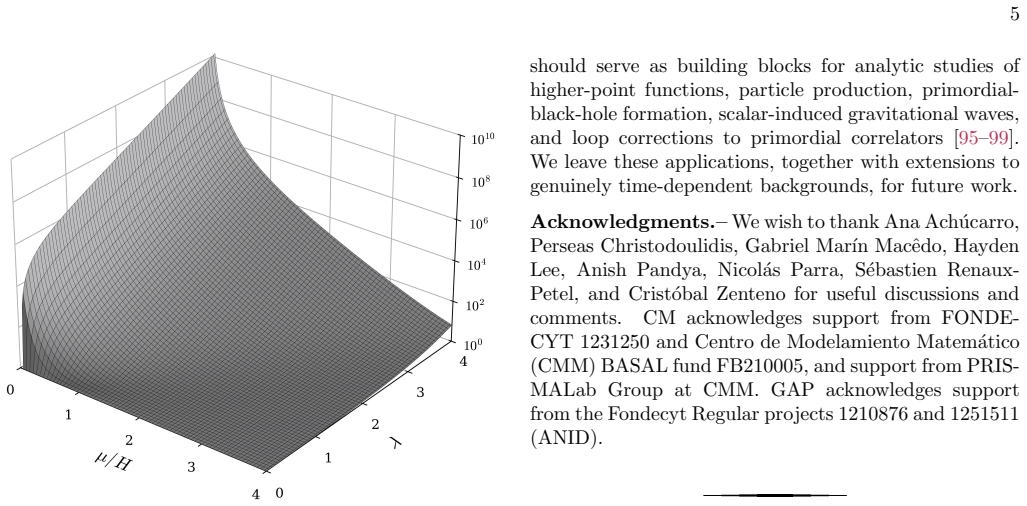
The authors present exact analytic solutions for the linear dynamics of a two-field inflationary system in which the primordial curvature perturbation is coupled to an isocurvature perturbation of entropy mass. The solutions are valid for arbitrary values of the mass and the dimensionless interaction strength within a quasi-de Sitter background. As a first application they obtain the amplitude of the primordial power spectrum in closed form, yielding an expression that interpolates between the weakly coupled, strongly coupled, light-field, and heavy-field regimes.
What carries the argument
Exact closed-form solutions to the coupled linear mode equations for the curvature and isocurvature perturbations.
If this is right
- The power spectrum amplitude follows from a single expression valid in every coupling and mass regime.
- Analytic calculations of non-Gaussianity, particle production, and loop corrections become possible without further approximations.
- Rapid-turn inflation scenarios can be studied with full analytic control over the linear stage.
Where Pith is reading between the lines
- The closed-form solutions could supply templates for isocurvature contributions when fitting CMB data.
- They open a route to analytic estimates of higher-order statistics in potentials that realize strong turning.
- Numerical checks in backgrounds that deviate mildly from de Sitter would test how far the quasi-de Sitter assumption can stretch.
Load-bearing premise
The background expansion must stay close to de Sitter and the perturbations must remain small enough that linear theory applies.
What would settle it
A direct numerical integration of the perturbation equations for chosen values of the mass and coupling, compared to the claimed closed-form power spectrum to test for any mismatch.
Figures

read the original abstract
We present exact analytic solutions for the linear dynamics of a two-field inflationary system in which the primordial curvature perturbation $\zeta$ is coupled to an isocurvature perturbation $\sigma$ of entropy mass $\mu$. The solutions are valid for arbitrary values of $\mu$ and the dimensionless interaction strength $\lambda$, within a quasi-de Sitter background. They therefore provide analytic control over the strongly coupled regime in which $\zeta$ interacts with light isocurvature fields, commonly associated with rapid-turn inflation. As a first application, we derive the amplitude of the primordial power spectrum in closed form, obtaining an expression that interpolates between the weakly coupled, strongly coupled, light-field, and heavy-field regimes. These results open the way to analytic studies of multifield observables beyond the power spectrum, including non-Gaussianity, particle production, and loop corrections.
Editorial analysis
A structured set of objections, weighed in public.
Referee Report
Summary. The manuscript claims to derive exact analytic solutions for the linear dynamics of a two-field inflationary system, with the curvature perturbation ζ coupled to an isocurvature perturbation σ of entropy mass μ and dimensionless interaction strength λ, on a quasi-de Sitter background. The solutions are obtained by reducing the coupled perturbation equations to a solvable fourth-order ODE whose characteristic equation yields the mode functions, valid for arbitrary μ and λ. As an application, a closed-form expression for the amplitude of the primordial power spectrum is derived that interpolates between the weakly coupled, strongly coupled, light-field, and heavy-field regimes.
Significance. If the exact solutions and closed-form spectrum hold without hidden restrictions, the work would provide valuable analytic control over the strongly coupled regime in multifield inflation, including rapid-turn models. The explicit derivation via the fourth-order ODE and the parameter-free interpolation of the power spectrum amplitude represent a concrete advance that could enable further analytic studies of non-Gaussianity and loop corrections. The absence of ad-hoc parameters or fitted inputs in the central derivation is a notable strength.
major comments (2)
- [§3.2, Eq. (18)] §3.2, Eq. (18): The reduction of the coupled system to the fourth-order ODE is presented as exact, but the quasi-de Sitter approximation for the background scale factor is used without a quantitative error estimate in the superhorizon limit; this approximation is load-bearing for the claimed validity at arbitrary μ.
- [§4.1, Eq. (27)] §4.1, Eq. (27): The closed-form power spectrum amplitude is stated to interpolate between regimes, but the superhorizon freezing assumption for the isocurvature mode when μ is small is not verified against the full time-dependent solution, which could affect the ζ spectrum extraction.
minor comments (2)
- [§2] The notation for the interaction term λ is introduced without an explicit definition of its relation to the potential derivatives; a brief equation linking it to the background would improve clarity.
- [Figure 2] Figure 2 caption does not specify the numerical values of μ and λ used for the comparison curves; adding these would aid reproducibility.
Simulated Author's Rebuttal
We thank the referee for their positive assessment and constructive comments. We respond to each major comment below.
read point-by-point responses
-
Referee: [§3.2, Eq. (18)] The reduction of the coupled system to the fourth-order ODE is presented as exact, but the quasi-de Sitter approximation for the background scale factor is used without a quantitative error estimate in the superhorizon limit; this approximation is load-bearing for the claimed validity at arbitrary μ.
Authors: The quasi-de Sitter background is the standard leading-order approximation in inflationary perturbation theory, with corrections suppressed by the slow-roll parameters. We agree that an explicit quantitative error estimate would strengthen the presentation for arbitrary μ. We will add a derivation of the leading error term in the superhorizon limit to §3.2 in the revised manuscript. revision: yes
-
Referee: [§4.1, Eq. (27)] The closed-form power spectrum amplitude is stated to interpolate between regimes, but the superhorizon freezing assumption for the isocurvature mode when μ is small is not verified against the full time-dependent solution, which could affect the ζ spectrum extraction.
Authors: The closed-form spectrum follows directly from the exact time-dependent mode functions of the fourth-order ODE; no separate freezing assumption is imposed beyond the analytic solution itself. The interpolation for small μ is a direct consequence of those solutions. We will add a brief numerical cross-check of the superhorizon isocurvature evolution against the original coupled system in an appendix. revision: partial
Circularity Check
No significant circularity; derivation self-contained
full rationale
The manuscript reduces the coupled linear perturbation equations for ζ and σ to a solvable fourth-order ODE whose characteristic equation directly supplies the mode functions for arbitrary μ and λ. The closed-form power-spectrum amplitude follows from the superhorizon limit of those modes. No parameter is fitted and then relabeled as a prediction, no self-citation supplies a load-bearing uniqueness theorem, and the quasi-de Sitter assumption is stated explicitly rather than smuggled in. The central results are therefore independent of the inputs they are derived from.
Axiom & Free-Parameter Ledger
axioms (1)
- domain assumption The inflationary background is quasi-de Sitter.
Reference graph
Works this paper leans on
-
[1]
The Inflationary Universe: A Possible Solu- tion to the Horizon and Flatness Problems,
A. H. Guth, “The Inflationary Universe: A Possible Solu- tion to the Horizon and Flatness Problems,” Phys. Rev. D23, 347-356 (1981)
1981
-
[2]
A New Type of Isotropic Cosmo- logical Models Without Singularity,
A. A. Starobinsky, “A New Type of Isotropic Cosmo- logical Models Without Singularity,” Phys. Lett. B91, 99-102 (1980)
1980
-
[3]
A New Inflationary Universe Scenario: A Possible Solution of the Horizon, Flatness, Homogene- ity, Isotropy and Primordial Monopole Problems,
A. D. Linde, “A New Inflationary Universe Scenario: A Possible Solution of the Horizon, Flatness, Homogene- ity, Isotropy and Primordial Monopole Problems,” Phys. Lett. B108, 389-393 (1982)
1982
-
[4]
Cosmology for Grand Unified Theories with Radiatively Induced Symmetry Breaking,
A. Albrecht and P. J. Steinhardt, “Cosmology for Grand Unified Theories with Radiatively Induced Symmetry Breaking,” Phys. Rev. Lett.48, 1220-1223 (1982)
1982
-
[5]
Inflation: Theory and Observations,
A. Ach´ ucarro, M. Biagetti, M. Braglia, G. Cabass, R. Caldwell, E. Castorina, X. Chen, W. Coulton, R. Flauger and J. Fumagalli,et al.“Inflation: Theory and Observations,” [arXiv:2203.08128 [astro-ph.CO]]
-
[6]
Candidates for the In- flaton Field in Superstring Models,
P. Bin´ etruy and M. K. Gaillard, “Candidates for the In- flaton Field in Superstring Models,” Phys. Rev. D34, 3069-3083 (1986)
1986
-
[7]
T. Banks, M. Berkooz, S. H. Shenker, G. W. Moore and P. J. Steinhardt, “Modular cosmology,” Phys. Rev. D52, 3548-3562 (1995) [arXiv:hep-th/9503114 [hep-th]]
Pith/arXiv arXiv 1995
-
[8]
Challenges for super- string cosmology,
R. Brustein and P. J. Steinhardt, “Challenges for super- string cosmology,” Phys. Lett. B302, 196-201 (1993) [arXiv:hep-th/9212049 [hep-th]]
Pith/arXiv arXiv 1993
-
[9]
Towards inflation in string theory,
S. Kachru, R. Kallosh, A. D. Linde, J. M. Maldacena, L. P. McAllister and S. P. Trivedi, “Towards inflation in string theory,” JCAP10, 013 (2003) [arXiv:hep- th/0308055 [hep-th]]
arXiv 2003
-
[10]
J. J. Blanco-Pillado, C. P. Burgess, J. M. Cline, C. Es- coda, M. Gomez-Reino, R. Kallosh, A. D. Linde and F. Quevedo, “Racetrack inflation,” JHEP11, 063 (2004) [arXiv:hep-th/0406230 [hep-th]]
Pith/arXiv arXiv 2004
-
[11]
Racetrack inflation and assisted moduli stabilisation,
Z. Lalak, G. G. Ross and S. Sarkar, “Racetrack inflation and assisted moduli stabilisation,” Nucl. Phys. B766, 1-20 (2007) [arXiv:hep-th/0503178 [hep-th]]
Pith/arXiv arXiv 2007
-
[12]
S. Dimopoulos, S. Kachru, J. McGreevy and J. G. Wacker, “N-flation,” JCAP08, 003 (2008) [arXiv:hep-th/0507205 [hep-th]]
Pith/arXiv arXiv 2008
-
[13]
J. P. Conlon and F. Quevedo, “Kahler moduli inflation,” 6 JHEP01, 146 (2006) [arXiv:hep-th/0509012 [hep-th]]
Pith/arXiv arXiv 2006
-
[14]
Roulette inflation with Kahler moduli and their axions,
J. R. Bond, L. Kofman, S. Prokushkin and P. M. Vau- drevange, “Roulette inflation with Kahler moduli and their axions,” Phys. Rev. D75, 123511 (2007) [arXiv:hep-th/0612197 [hep-th]]
Pith/arXiv arXiv 2007
-
[15]
Axion inflation in type II string theory,
T. W. Grimm, “Axion inflation in type II string theory,” Phys. Rev. D77, 126007 (2008) [arXiv:0710.3883 [hep- th]]
Pith/arXiv arXiv 2008
-
[16]
Constraints on mod- ular inflation in supergravity and string theory,
L. Covi, M. Gomez-Reino, C. Gross, J. Louis, G. A. Palma and C. A. Scrucca, “Constraints on mod- ular inflation in supergravity and string theory,” JHEP 08, 055 (2008) [arXiv:0805.3290 [hep-th]]
Pith/arXiv arXiv 2008
-
[17]
No-Scale Supergravity Realization of the Starobinsky Model of Inflation,
J. Ellis, D. V. Nanopoulos and K. A. Olive, “No-Scale Supergravity Realization of the Starobinsky Model of Inflation,” Phys. Rev. Lett.111, 111301 (2013) [er- ratum: Phys. Rev. Lett.111, no.12, 129902 (2013)] [arXiv:1305.1247 [hep-th]]
Pith/arXiv arXiv 2013
-
[18]
Cosmo- logical Attractors and Initial Conditions for Inflation,
J. J. M. Carrasco, R. Kallosh and A. Linde, “Cosmo- logical Attractors and Initial Conditions for Inflation,” Phys. Rev. D92, no.6, 063519 (2015) [arXiv:1506.00936 [hep-th]]
Pith/arXiv arXiv 2015
-
[19]
Sound Speed of Primordial Fluctuations in Supergravity Inflation,
A. Hetz and G. A. Palma, “Sound Speed of Primordial Fluctuations in Supergravity Inflation,” Phys. Rev. Lett. 117, no.10, 101301 (2016) [arXiv:1601.05457 [hep-th]]
Pith/arXiv arXiv 2016
-
[20]
Features of heavy physics in the CMB power spectrum,
A. Ach´ ucarro, J. O. Gong, S. Hardeman, G. A. Palma and S. P. Patil, “Features of heavy physics in the CMB power spectrum,” JCAP01, 030 (2011) [arXiv:1010.3693 [hep-ph]]
Pith/arXiv arXiv 2011
-
[21]
Influence of heavy modes on perturbations in multiple field inflation,
X. Gao, D. Langlois and S. Mizuno, “Influence of heavy modes on perturbations in multiple field inflation,” JCAP10, 040 (2012) [arXiv:1205.5275 [hep-th]]
Pith/arXiv arXiv 2012
-
[22]
Correlating features in the primordial spectra,
A. Ach´ ucarro, J. O. Gong, G. A. Palma and S. P. Patil, “Correlating features in the primordial spectra,” Phys. Rev. D87, 121301 (2013) [arXiv:1211.5619 [astro- ph.CO]]
Pith/arXiv arXiv 2013
-
[23]
X. Gao, D. Langlois and S. Mizuno, “Oscillatory fea- tures in the curvature power spectrum after a sudden turn of the inflationary trajectory,” JCAP10, 023 (2013) [arXiv:1306.5680 [hep-th]]
Pith/arXiv arXiv 2013
-
[24]
Primordial spectra from sudden turning trajectory,
T. Noumi and M. Yamaguchi, “Primordial spectra from sudden turning trajectory,” JCAP12, 038 (2013) [arXiv:1307.7110 [hep-th]]
Pith/arXiv arXiv 2013
-
[25]
A. Ach´ ucarro, V. Atal, P. Ortiz and J. Torrado, “Lo- calized correlated features in the CMB power spectrum and primordial bispectrum from a transient reduction in the speed of sound,” Phys. Rev. D89, 103006 (2014) [arXiv:1311.2552 [astro-ph.CO]]
Pith/arXiv arXiv 2014
-
[26]
Combined fea- tures in the primordial spectra induced by a sudden turn in two-field DBI inflation,
S. Mizuno, R. Saito and D. Langlois, “Combined fea- tures in the primordial spectra induced by a sudden turn in two-field DBI inflation,” JCAP11, 032 (2014) [arXiv:1405.4257 [hep-th]]
Pith/arXiv arXiv 2014
-
[27]
A. Ach´ ucarro, V. Atal, B. Hu, P. Ortiz and J. Tor- rado, “Inflation with moderately sharp features in the speed of sound: Generalized slow roll and in-in formal- ism for power spectrum and bispectrum,” Phys. Rev. D 90, 023511 (2014) [arXiv:1404.7522 [astro-ph.CO]]
Pith/arXiv arXiv 2014
-
[28]
Towards general patterns of features in multi-field inflation,
X. Gao and J. O. Gong, “Towards general patterns of features in multi-field inflation,” JHEP08, 115 (2015) [arXiv:1506.08894 [astro-ph.CO]]
Pith/arXiv arXiv 2015
-
[29]
The effect of multiple features on the power spec- trum in two-field inflation,
K. Boutivas, I. Dalianis, G. P. Kodaxis and N. Tetradis, “The effect of multiple features on the power spec- trum in two-field inflation,” JCAP08, 021 (2022) [arXiv:2203.15605 [astro-ph.CO]]
arXiv 2022
-
[30]
Primordial non-Gaussianities from multiple-field inflation,
D. Seery and J. E. Lidsey, “Primordial non-Gaussianities from multiple-field inflation,” JCAP09, 011 (2005) [arXiv:astro-ph/0506056 [astro-ph]]
Pith/arXiv arXiv 2005
-
[31]
Large non-Gaussianity in multiple-field inflation,
G. I. Rigopoulos, E. P. S. Shellard and B. J. W. van Tent, “Large non-Gaussianity in multiple-field inflation,” Phys. Rev. D73, 083522 (2006) [arXiv:astro-ph/0506704 [astro-ph]]
Pith/arXiv arXiv 2006
-
[32]
Non-Gaussianities in two- field inflation,
F. Vernizzi and D. Wands, “Non-Gaussianities in two- field inflation,” JCAP05, 019 (2006) [arXiv:astro- ph/0603799 [astro-ph]]
arXiv 2006
-
[33]
Conditions for large non-Gaussianity in two-field slow-roll inflation,
C. T. Byrnes, K.-Y. Choi and L. M. H. Hall, “Conditions for large non-Gaussianity in two-field slow-roll inflation,” JCAP10, 008 (2008) [arXiv:0807.1101 [astro-ph]]
Pith/arXiv arXiv 2008
-
[34]
S. Garcia-Saenz and S. Renaux-Petel, “Flattened non- Gaussianities from the effective field theory of inflation with imaginary speed of sound,” JCAP11, 005 (2018) [arXiv:1805.12563 [hep-th]]
Pith/arXiv arXiv 2018
-
[35]
Reconstructing the Inflationary Landscape with Cosmological Data,
X. Chen, G. A. Palma, B. Scheihing Hitschfeld and S. Sypsas, “Reconstructing the Inflationary Landscape with Cosmological Data,” Phys. Rev. Lett.121, no.16, 161302 (2018) [arXiv:1806.05202 [astro-ph.CO]]
Pith/arXiv arXiv 2018
-
[36]
Hyper-Non-Gaussianities in Inflation with Strongly Nongeodesic Motion,
J. Fumagalli, S. Garcia-Saenz, L. Pinol, S. Renaux-Petel and J. Ronayne, “Hyper-Non-Gaussianities in Inflation with Strongly Nongeodesic Motion,” Phys. Rev. Lett. 123, no.20, 201302 (2019) [arXiv:1902.03221 [hep-th]]
arXiv 2019
-
[37]
Mild Non-Gaussianities under Perturbative Control from Rapid-Turn Inflation Models,
T. Bjorkmo, R. Z. Ferreira and M. C. D. Marsh, “Mild Non-Gaussianities under Perturbative Control from Rapid-Turn Inflation Models,” JCAP12, 036 (2019) [arXiv:1908.11316 [hep-th]]
arXiv 2019
-
[38]
Revisit- ing non-Gaussianity in multifield inflation with curved field space,
S. Garcia-Saenz, L. Pinol and S. Renaux-Petel, “Revisit- ing non-Gaussianity in multifield inflation with curved field space,” JHEP01, 073 (2020) [arXiv:1907.10403 [hep-th]]
arXiv 2020
-
[39]
The hand-made tail: non-perturbative tails from multi- field inflation,
A. Ach´ ucarro, S. Cespedes, A. C. Davis and G. A. Palma, “The hand-made tail: non-perturbative tails from multi- field inflation,” JHEP05, 052 (2022) [arXiv:2112.14712 [hep-th]]
arXiv 2022
-
[40]
Bootstrapping multi-field inflation: non-Gaussianities from light scalars revisited,
D. G. Wang, G. L. Pimentel and A. Ach´ ucarro, “Bootstrapping multi-field inflation: non-Gaussianities from light scalars revisited,” JCAP05, 043 (2023) [arXiv:2212.14035 [astro-ph.CO]]
arXiv 2023
-
[41]
Non- Gaussianity in rapid-turn multi-field inflation,
O. Iarygina, M. C. D. Marsh and G. Salinas, “Non- Gaussianity in rapid-turn multi-field inflation,” JCAP 03, 014 (2024) [arXiv:2303.14156 [astro-ph.CO]]
arXiv 2024
-
[42]
Universal Non- Gaussian Signatures from Transient Instabilities,
S. Aoki, D. Roest and D. Werth, “Universal Non- Gaussian Signatures from Transient Instabilities,” [arXiv:2604.01035 [astro-ph.CO]]
-
[43]
Curvature and isocurvature perturbations in two-field inflation,
Z. Lalak, D. Langlois, S. Pokorski and K. Turzy´ nski, “Curvature and isocurvature perturbations in two-field inflation,” JCAP07, 014 (2007) [arXiv:0704.0212 [hep- th]]
Pith/arXiv arXiv 2007
-
[44]
Effective Field Theory and De- coupling in Multi-field Inflation: An Illustrative Case Study,
G. Shiu and J. Xu, “Effective Field Theory and De- coupling in Multi-field Inflation: An Illustrative Case Study,” Phys. Rev. D84, 103509 (2011) [arXiv:1108.0981 [hep-th]]
Pith/arXiv arXiv 2011
-
[45]
The effects of a fast-turning trajectory in multiple-field in- flation,
M. Konieczka, R. H. Ribeiro and K. Turzy´ nski, “The effects of a fast-turning trajectory in multiple-field in- flation,” JCAP07, 030 (2014) [arXiv:1401.6163 [astro- ph.CO]]
Pith/arXiv arXiv 2014
-
[46]
Orbital Inflation: in- flating along an angular isometry of field space,
A. Ach´ ucarro and Y. Welling, “Orbital Inflation: in- flating along an angular isometry of field space,” [arXiv:1907.02020 [hep-th]]
Pith/arXiv arXiv 1907
-
[47]
Origin of ultra-light fields during inflation and their suppressed non-Gaussianity,
A. Ach´ ucarro, G. A. Palma, D. G. Wang and Y. Welling, “Origin of ultra-light fields during inflation and their suppressed non-Gaussianity,” JCAP10, 018 (2020) 7 [arXiv:1908.06956 [hep-th]]
arXiv 2020
-
[48]
J. Fumagalli, S. Renaux-Petel and L. T. Witkowski, “Os- cillations in the stochastic gravitational wave background from sharp features and particle production during in- flation,” JCAP08, 030 (2021) [arXiv:2012.02761 [astro- ph.CO]]
arXiv 2021
-
[49]
Dark matter from entropy perturbations in curved field space,
H. Firouzjahi, M. A. Gorji, S. Mukohyama and A. Talebian, “Dark matter from entropy perturbations in curved field space,” Phys. Rev. D105, no.4, 043501 (2022) [arXiv:2110.09538 [gr-qc]]
arXiv 2022
-
[50]
Primordial gravita- tional waves from excited states,
J. Fumagalli, G. A. Palma, S. Renaux-Petel, S. Sypsas, L. T. Witkowski and C. Zenteno, “Primordial gravita- tional waves from excited states,” JHEP03, 196 (2022) [arXiv:2111.14664 [astro-ph.CO]]
arXiv 2022
-
[51]
Cumulative effects in inflation with ultra-light entropy modes,
A. Ach´ ucarro, V. Atal, C. Germani and G. A. Palma, “Cumulative effects in inflation with ultra-light entropy modes,” JCAP02, 013 (2017) [arXiv:1607.08609 [astro- ph.CO]]
Pith/arXiv arXiv 2017
-
[52]
Par- ticle creation from non-geodesic trajectories in multifield inflation,
N. Parra, S. Sypsas, G. A. Palma and C. Zenteno, “Par- ticle creation from non-geodesic trajectories in multifield inflation,” JCAP04, 028 (2025) [arXiv:2410.13843 [hep- th]]
arXiv 2025
-
[53]
A. Ach´ ucarro, P. Christodoulidis, J. O. Gong and O. Iarygina, “Ultra slow-turn inflation,” [arXiv:2603.03204 [hep-th]]
-
[54]
Density Perturbations and Black Hole Formation in Hybrid Inflation
J. Garcia-Bellido, A. D. Linde and D. Wands, “Den- sity perturbations and black hole formation in hy- brid inflation,” Phys. Rev. D54, 6040-6058 (1996) doi:10.1103/PhysRevD.54.6040 [arXiv:astro-ph/9605094 [astro-ph]]
work page internal anchor Pith review Pith/arXiv arXiv doi:10.1103/physrevd.54.6040 1996
-
[55]
Seeding pri- mordial black holes in multifield inflation,
G. A. Palma, S. Sypsas and C. Zenteno, “Seeding pri- mordial black holes in multifield inflation,” Phys. Rev. Lett.125, no.12, 121301 (2020) [arXiv:2004.06106 [astro- ph.CO]]
arXiv 2020
-
[56]
Turning in the landscape: A new mechanism for generating primordial black holes,
J. Fumagalli, S. Renaux-Petel, J. W. Ronayne and L. T. Witkowski, “Turning in the landscape: A new mechanism for generating primordial black holes,” Phys. Lett. B841, 137921 (2023) [arXiv:2004.08369 [hep-th]]
arXiv 2023
-
[57]
Generating PBHs and small-scale GWs in two-field models of inflation,
M. Braglia, D. K. Hazra, F. Finelli, G. F. Smoot, L. Sri- ramkumar and A. A. Starobinsky, “Generating PBHs and small-scale GWs in two-field models of inflation,” JCAP08, 001 (2020) [arXiv:2005.02895 [astro-ph.CO]]
arXiv 2020
-
[58]
On Primordial Black Holes from Rapid Turns in Two-field Models,
L. Anguelova, “On Primordial Black Holes from Rapid Turns in Two-field Models,” JCAP06, 004 (2021) [arXiv:2012.03705 [hep-th]]
arXiv 2021
-
[59]
Primordial black holes from multifield inflation with nonminimal couplings,
S. R. Geller, W. Qin, E. McDonough and D. I. Kaiser, “Primordial black holes from multifield inflation with nonminimal couplings,” Phys. Rev. D106, no.6, 063535 (2022) [arXiv:2205.04471 [hep-th]]
arXiv 2022
-
[60]
Light Scalar Fields Foster Production of Primordial Black Holes,
D. L. Lorenzoni, S. R. Geller, Z. Ireland, D. I. Kaiser, E. McDonough and K. A. Wittmeier, “Light Scalar Fields Foster Production of Primordial Black Holes,” [arXiv:2504.13251 [astro-ph.CO]]
-
[61]
Non-Gaussianity Consistency Relation for Multi-field Inflation,
N. S. Sugiyama, E. Komatsu and T. Futamase, “Non-Gaussianity Consistency Relation for Multi-field Inflation,” Phys. Rev. Lett.106, 251301 (2011) [arXiv:1101.3636 [gr-qc]]
Pith/arXiv arXiv 2011
-
[62]
Multifield Inflation af- ter Planck: The Case for Nonminimal Couplings,
D. I. Kaiser and E. I. Sfakianakis, “Multifield Inflation af- ter Planck: The Case for Nonminimal Couplings,” Phys. Rev. Lett.112, no.1, 011302 (2014) [arXiv:1304.0363 [astro-ph.CO]]
Pith/arXiv arXiv 2014
-
[63]
A. R. Brown, “Hyperbolic Inflation,” Phys. Rev. Lett. 121, no.25, 251601 (2018) [arXiv:1705.03023 [hep-th]]
Pith/arXiv arXiv 2018
-
[64]
Primordial perturbations from inflation with a hyperbolic field-space,
S. Mizuno and S. Mukohyama, “Primordial perturbations from inflation with a hyperbolic field-space,” Phys. Rev. D96, no.10, 103533 (2017) [arXiv:1707.05125 [hep-th]]
Pith/arXiv arXiv 2017
-
[65]
Constraints on Holographic Multifield Inflation and Models Based on the Hamilton-Jacobi Formalism,
A. Ach´ ucarro, S. C´ espedes, A. C. Davis and G. A. Palma, “Constraints on Holographic Multifield Inflation and Models Based on the Hamilton-Jacobi Formalism,” Phys. Rev. Lett.122, no.19, 191301 (2019) [arXiv:1809.05341 [hep-th]]
Pith/arXiv arXiv 2019
-
[66]
Nonlinear Dynamics of Preheat- ing after Multifield Inflation with Nonminimal Cou- plings,
R. Nguyen, J. van de Vis, E. I. Sfakianakis, J. T. Gib- lin and D. I. Kaiser, “Nonlinear Dynamics of Preheat- ing after Multifield Inflation with Nonminimal Cou- plings,” Phys. Rev. Lett.123, no.17, 171301 (2019) [arXiv:1905.12562 [hep-ph]]
arXiv 2019
-
[67]
Adiabatic and entropy perturbations from inflation,
C. Gordon, D. Wands, B. A. Bassett and R. Maartens, “Adiabatic and entropy perturbations from inflation,” Phys. Rev. D63, 023506 (2001) [arXiv:astro-ph/0009131 [astro-ph]]
Pith/arXiv arXiv 2001
-
[68]
Scalar perturbations during multiple field slow-roll inflation,
S. Groot Nibbelink and B. J. W. van Tent, “Scalar perturbations during multiple field slow-roll inflation,” Class. Quant. Grav.19, 613-640 (2002) [arXiv:hep- ph/0107272 [hep-ph]]
arXiv 2002
-
[69]
Perturbations in gen- eralized multi-field inflation,
D. Langlois and S. Renaux-Petel, “Perturbations in gen- eralized multi-field inflation,” JCAP04, 017 (2008) [arXiv:0801.1085 [hep-th]]
Pith/arXiv arXiv 2008
-
[70]
Large non-Gaussianities with Intermediate Shapes from Quasi-Single Field Inflation,
X. Chen and Y. Wang, “Large non-Gaussianities with Intermediate Shapes from Quasi-Single Field Inflation,” Phys. Rev. D81, 063511 (2010) [arXiv:0909.0496 [astro- ph.CO]]
Pith/arXiv arXiv 2010
-
[71]
The Gelaton Scenario: Equilateral non-Gaussianity from multi-field dynamics,
A. J. Tolley and M. Wyman, “The Gelaton Scenario: Equilateral non-Gaussianity from multi-field dynamics,” Phys. Rev. D81, 043502 (2010) [arXiv:0910.1853 [hep- th]]
Pith/arXiv arXiv 2010
-
[72]
Quasi-Single Field Infla- tion and Non-Gaussianities,
X. Chen and Y. Wang, “Quasi-Single Field Infla- tion and Non-Gaussianities,” JCAP04, 027 (2010) [arXiv:0911.3380 [hep-th]]
Pith/arXiv arXiv 2010
-
[73]
Strongly Cou- pled Perturbations in Two-Field Inflationary Models,
S. Cremonini, Z. Lalak and K. Turzy´ nski, “Strongly Cou- pled Perturbations in Two-Field Inflationary Models,” JCAP03, 016 (2011) [arXiv:1010.3021 [hep-th]]
Pith/arXiv arXiv 2011
-
[74]
Signatures of Supersymme- try from the Early Universe,
D. Baumann and D. Green, “Signatures of Supersymme- try from the Early Universe,” Phys. Rev. D85, 103520 (2012) [arXiv:1109.0292 [hep-th]]
Pith/arXiv arXiv 2012
-
[75]
On the impor- tance of heavy fields during inflation,
S. Cespedes, V. Atal and G. A. Palma, “On the impor- tance of heavy fields during inflation,” JCAP05, 008 (2012) [arXiv:1201.4848 [hep-th]]
Pith/arXiv arXiv 2012
-
[76]
Effective theories of single field infla- tion when heavy fields matter,
A. Ach´ ucarro, J. O. Gong, S. Hardeman, G. A. Palma and S. P. Patil, “Effective theories of single field infla- tion when heavy fields matter,” JHEP05, 066 (2012) [arXiv:1201.6342 [hep-th]]
Pith/arXiv arXiv 2012
-
[77]
Quasi-Single Field Inflation with Large Mass,
X. Chen and Y. Wang, “Quasi-Single Field Inflation with Large Mass,” JCAP09, 021 (2012) [arXiv:1205.0160 [hep-th]]
Pith/arXiv arXiv 2012
-
[78]
Heavy fields, reduced speeds of sound and decoupling during inflation,
A. Ach´ ucarro, V. Atal, S. Cespedes, J. O. Gong, G. A. Palma and S. P. Patil, “Heavy fields, reduced speeds of sound and decoupling during inflation,” Phys. Rev. D86, 121301 (2012) [arXiv:1205.0710 [hep-th]]
Pith/arXiv arXiv 2012
-
[79]
Effec- tive field theory approach to quasi-single field infla- tion and effects of heavy fields,
T. Noumi, M. Yamaguchi and D. Yokoyama, “Effec- tive field theory approach to quasi-single field infla- tion and effects of heavy fields,” JHEP06, 051 (2013) [arXiv:1211.1624 [hep-th]]
Pith/arXiv arXiv 2013
-
[80]
Quasi Single Field Inflation in the non-perturbative regime,
H. An, M. McAneny, A. K. Ridgway and M. B. Wise, “Quasi Single Field Inflation in the non-perturbative regime,” JHEP06, 105 (2018) [arXiv:1706.09971 [hep- ph]]
Pith/arXiv arXiv 2018
discussion (0)
Sign in with ORCID, Apple, or X to comment. Anyone can read and Pith papers without signing in.