REVIEW 5 major objections 6 minor 1 cited by
Investigating Creativity in Humans and Generative AI Through Circles Exercises
T0 review · 5 major / 6 minor · reviewed 2026-08-08 · deepseek-v4-flash
Pith's one-line read This paper claims that in the Circles Exercise both humans and generative AI exhibit "narrow creativity," concentrating on a small subset of the design space, and that chain-of-thought prompting only partially mitigates this constraint.
desk verdict The dataset is a real contribution, but the paper's central metric for 'narrow creativity' does not measure concentration, so the headline finding is unsupported. read the letter →
The pith
A machine-rendered reading of the paper's core claim, the machinery that carries it, and where it could break.
The reading
What carries the argument
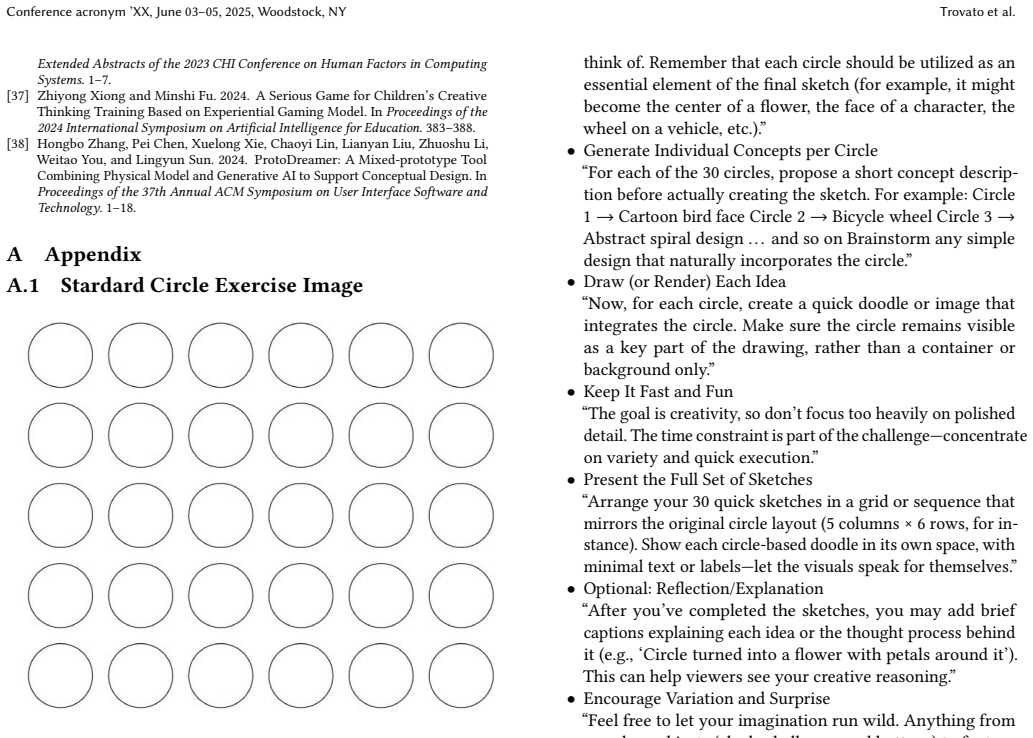
The Circles Exercise is the central instrument: participants are given a sheet of blank circles and asked to draw as many objects as possible with each circle as part of the drawing. The paper builds a 10-category coding scheme for drawn objects (animals, daily objects, human figures, nature elements, vehicles, sport equipment, food, mechanics, icons, others) and a separate scheme for material utilization approaches (direct use, personification, circle-based abstraction, complex composition, use as background). Narrow creativity is operationalized with exploration–exploitation metrics: number of categories used (exploration), and number of frequent and highly frequent categories plus the percentage of drawings inside them (exploitation). A category is 'frequent' if its count exceeds the individual's per-category average and 'highly frequent' if it exceeds the average by one standard deviation. These metrics are applied identically to human drawings and to GenAI outputs under zero-shot, few-shot, and chain-of-thought prompting.
What would settle it
Recode the same drawings with a much finer taxonomy (e.g., 50 subcategories) or with different thresholds (e.g., median and quartiles); if the fraction of outputs in 'frequent' categories drops below about one-third, the narrow-creativity conclusion would be an artifact of the 10-category coding scheme and threshold choice.
Extended reading notes
Core claim
The paper's central claim is that narrow creativity—the tendency to explore only a subset of an available design space—is not exclusive to humans but also characterizes generative AI performing the same creative task. In the 28-circle exercise, humans draw an average of 5.6 of 10 object categories and put roughly 70% of their drawings in their own frequent categories; GenAI under chain-of-thought prompting reaches the same 70% concentration, and its higher average of 7.5 categories still leaves a third of the design space untouched. The authors interpret this as evidence that GenAI can produce a larger volume of incremental ideas at low cost but, like humans, anchors to familiar, high-frequency concepts and does not substantially expand creative boundaries. They additionally find that humans favor simple sketches while GenAI favors detailed illustrations and color, a difference in expressive modality rather than in ideational breadth.
Load-bearing premise
The whole comparison rests on treating the 10-category coding scheme and the within-individual mean/standard-deviation thresholds as a valid measure of creative breadth; if a different taxonomy or threshold were used, the concentration percentages and the conclusion about narrow creativity could change.
Editorial extensions
If this is right
- Humans and GenAI both concentrate on a few familiar object categories in open-ended ideation tasks, so creative breadth cannot be assumed to increase just by using an AI generator.
- Chain-of-thought prompting raises reasoning quality but leaves the category distribution largely unchanged (70% of CoT outputs fall in frequent categories), so prompting alone is not a sufficient remedy for narrow creativity.
- Few-shot prompting with human examples makes GenAI's category usage quantitatively closer to human behavior, suggesting that human examples can steer AI output but also inherit human fixation.
- Creativity support tools should measure both exploration (number of categories) and exploitation (concentration) rather than only output count or novelty.
- Because GenAI's limitation is in breadth, not volume, tools that explicitly push generation toward underused categories may complement AI's strengths.
Reading between the lines
- The similarity between human and GenAI narrowness likely reflects a shared anchoring on prototype or high-frequency concepts; for GenAI this may be a property of likelihood-based training rather than a cognitive constraint.
- If the coding taxonomy were made finer (e.g., dozens of subcategories), the measured 'narrowness' might shrink or shift, so the quantitative thresholds are as important as the qualitative claim.
- The same experimental template could be extended to text domains, such as story prompts or product feature lists, to test whether narrow creativity generalizes beyond visual sketching.
- A practical testable extension is to add a 'diversity reward' or explicit penalty on repeated categories during decoding; the paper's metrics would directly detect whether such an intervention broadens the design space.
Editorial analysis
A structured set of objections, weighed in public.
Referee Report
Summary. The paper investigates 'narrow creativity' in humans and generative AI through the Circles Exercise. Human drawings from 224 students (3367 drawings total) are coded into categories of drawn objects, approaches to material utilization, and artistic expression; GenAI outputs under zero-shot, few-shot, and chain-of-thought (CoT) prompting are coded with the same scheme. The authors report mean counts of used, frequent, and highly frequent categories, and proportions of drawings falling into those categories, concluding that both humans and GenAI concentrate on a limited subset of the design space, with CoT only partially mitigating this narrowness.
Significance. If the claims were supported, this would be a useful empirical contribution to HCI creativity-support research: it applies a classic creativity exercise to GenAI, compares multiple prompting strategies, and proposes quantitative metrics. The human dataset (224 participants) is a valuable resource, and the attempt to probe several aspects of creative output (object categories, material use, artistic expression) is commendable. However, the central metric's validity and the absence of inferential statistics mean that the headline conclusions are not currently established.
major comments (5)
- [§4.1, Table 1] The metric '% of drawings in frequent categories' is not a valid measure of concentration because it is not monotonically related to how evenly a person's drawings are spread across categories. For a participant using all 10 categories with counts (3,3,3,3,3,3,3,3,2,2), the per-category mean is 2.8 and the eight categories with 3 circles are 'frequent,' yielding 85.7% frequent—a nearly uniform distribution labeled as highly concentrated. Conversely, a participant using 7 categories with 4 circles each has 0% frequent. Thus the 70–81% values in Table 1 are in the range produced by balanced category usage, and the conclusion in §4.2.1 that a large share in frequent categories indicates narrow creativity is unsupported. The authors should redesign the metric (e.g., normalized entropy, Gini coefficient, or a separate analysis of category count and evenness) or clearly separate the number of categories used from the equality of their use.
- [§4.3, Tables 1–3] All comparative claims about prompting strategies and human–AI alignment are made without inferential statistics. There are no sample sizes for the GenAI conditions, no confidence intervals, and no statistical tests; for example, the claims in §4.3.1 that few-shot results align with human performance and in §4.3.2 that CoT does not substantially expand variety rest on point estimates whose variability is unknown. The authors should report the number of GenAI runs/images per condition, compute effect sizes, and perform appropriate tests or explicitly reframe the analysis as descriptive only.
- [§3.2, §4.1] The GenAI experiment is underspecified: the authors do not state which OpenAI model and version was used, how many independent generations were performed per prompting condition, how images were sampled or excluded, and whether the human coding scheme was applied by the same coders to GenAI outputs under blinding conditions. Without these details, the pilot results cannot be assessed for reliability or generality.
- [§4.1] The coding process mentions two coders who resolved disagreements through discussion, but no inter-rater reliability statistic (e.g., Cohen's kappa) is reported for the object-category coding or for the material-utilization coding. Since the entire analysis depends on these subjective judgments, the authors should provide reliability measures.
- [Appendix A.4 vs §3.1] The task description is inconsistent: the human task uses a sheet with 28 blank circles, while the CoT prompt instructs the model to use 30 circles in a 5×6 grid. Additionally, the human dataset contains 3367 drawings from 224 students, an average of roughly 15 drawings per student, which is well below 28; the authors should clarify whether students left many circles blank and how partial responses were handled in computing per-individual metrics.
minor comments (6)
- [Throughout] There are several typos and formatting issues, including 'Quantative' (Section 4.1), 'Proportations' (Section 4.1), 'Excercise' (Section 3.1), and the phrase '# of the equation cat.' in the metric list; these should be corrected.
- [Table 2] In Table 2, the few-shot row for '# of highly freq. apch.' shows '- -' with no explanation; the authors should state whether no category exceeded the threshold or whether the data were unavailable.
- [Figure 5] Figure 5 includes an 'Unkown' category, but the text does not define how unknown cases were coded or whether they were excluded from the metric computations; please clarify.
- [Table 3] Table 3 reports percentages for artistic expressions, but the denominators are unclear: the 'use of colors' and 'use of annotations' rows appear to be per-drawing and not mutually exclusive; specify whether these are percentages of drawings, participants, or something else.
- [Abstract] The abstract claims that GenAI 'produces a larger volume of incremental innovations at a low cost,' but the manuscript does not report generation time, cost, or a direct measure of innovativeness; please either support this claim with data or soften it.
- [First page template] The first page contains placeholder text 'Trovato et al.' and the ACM reference format is incomplete (e.g., missing conference name); the template placeholders should be completed before submission.
Circularity Check
No significant circularity: the narrow-creativity findings are empirical measurements, not consequences of the metric definitions.
full rationale
The paper's central claim that humans and GenAI explore constrained subsets of the design space is supported by directly measured quantities, such as the average number of used categories (humans 5.6 of 10; CoT 7.5 of 10), which are not definitional outcomes. The '% frequent categories' metric is an operational proxy for exploitation; while its construct validity is debatable (a near-uniform distribution can produce high values, as the skeptic notes), the conclusion does not reduce to the metric by construction because the measured percentages could in principle have been low, and the paper also relies on category-distribution histograms and numbers of used, frequent, and highly frequent categories. No parameter is fitted to a target result, and no load-bearing claim depends on a self-citation: references [8] and [29] are self-citations but serve only as background examples of GenAI use in design and art. The derivation chain is therefore self-contained; concerns about the frequent-category metric's validity are correctness risks, not circularity.
Assumptions & free parameters
free parameters (4)
- category schema =
10 categories
- frequent threshold =
within-individual mean
- highly frequent threshold =
mean + 1 standard deviation
- material utilization schema =
5 approaches
assumptions (4)
- domain assumption The Torrance Circles Exercise is a valid measure of human creativity.
- domain assumption Category concentration (exploitation of few categories) measures narrow creativity.
- domain assumption OpenAI outputs are representative of generative AI generally.
- domain assumption The classroom sample is representative of human performance.
Cite this review
Pith. "Pith review of Investigating Creativity in Humans and Generative AI Through Circles Exercises." pith.science (2026). https://pith.science/paper/XACZEAMO
@misc{pith2026250207292,
  author       = {Pith},
  title        = {Pith review of: Investigating Creativity in Humans and Generative AI Through Circles Exercises},
  year         = {2026},
  howpublished = {\url{https://pith.science/paper/XACZEAMO}},
  note         = {Machine review of arXiv:2502.07292}
}
read the original abstract
Generative AI (GenAI) is transforming the creativity process. However, as presented in this paper, GenAI encounters "narrow creativity" barriers. We observe that both humans and GenAI focus on limited subsets of the design space. We investigate this phenomenon using the "Circles Exercise," a creativity test widely used to examine the creativity of humans. Quantitative analysis reveals that humans tend to generate familiar, high-frequency ideas, while GenAI produces a larger volume of incremental innovations at a low cost. However, similar to humans, it struggles to significantly expand creative boundaries. Moreover, advanced prompting strategies, such as Chain-of-Thought (CoT) prompting, mitigate narrow creativity issues but still fall short of substantially broadening the creative scope of humans and GenAI. These findings underscore both the challenges and opportunities for advancing GenAI-powered human creativity support tools.
Figures


Figures from the paper (4 more)


Forward citations
Cited by 1 Pith paper
-
An Exploratory Study on Multi-modal Generative AI in AR Storytelling
The paper maps how storytellers prefer to use AI-generated text, audio, images, videos, and 3D content to augment AR stories, based on a 223-video analysis and two user studies with 30 participants.
Reference graph
Works this paper leans on
-
[1]
2025. MyMap AI Idea Generator. https://www.mymap.ai/idea-generator. Ac- cessed: 2025-01-24
work page 2025
-
[2]
Tuhin Chakrabarty, Philippe Laban, Divyansh Agarwal, Smaranda Muresan, and Chien-Sheng Wu. 2024. Art or artifice? large language models and the false promise of creativity. In Proceedings of the CHI Conference on Human Factors in Computing Systems. 1–34
work page 2024
-
[3]
Tuhin Chakrabarty, Vishakh Padmakumar, Faeze Brahman, and Smaranda Mure- san. 2024. Creativity Support in the Age of Large Language Models: An Empirical Study Involving Professional Writers. In Proceedings of the 16th Conference on Creativity & Cognition. 132–155
work page 2024
-
[4]
Kerry Shih-Ping Chang and Brad A Myers. 2012. WebCrystal: understanding and reusing examples in web authoring. In Proceedings of the SIGCHI Conference on Human Factors in Computing Systems . 3205–3214
work page 2012
-
[5]
DaEun Choi, Sumin Hong, Jeongeon Park, John Joon Young Chung, and Juho Kim. 2024. CreativeConnect: Supporting Reference Recombination for Graphic Design Ideation with Generative AI. In Proceedings of the CHI Conference on Human Factors in Computing Systems . 1–25
2024
-
[6]
David H Cropley, Kelsey E Medeiros, and Adam Damadzic. 2023. The intersection of human and artificial creativity. In Creative provocations: Speculations on the future of creativity, technology & learning . Springer, 19–34
work page 2023
-
[7]
Edward De Bono and Efrem Zimbalist. 1970. Lateral thinking. Penguin London
work page 1970
-
[8]
Runlin Duan, Nachiketh Karthik, Jingyu Shi, Rahul Jain, Maria C Yang, and Karthik Ramani. 2024. ConceptVis: Generating and Exploring Design Con- cepts for Early-Stage Ideation Using Large Language Model. In International Design Engineering Technical Conferences and Computers and Information in En- gineering Conference, Vol. 88377. American Society of Mech...
work page 2024
Show all 39 references
-
[9]
Bob Eberle. 1996. Scamper on: Games for imagination development. Prufrock Press Inc
1996
-
[10]
Ziv Epstein, Aaron Hertzmann, Investigators of Human Creativity, Memo Akten, Hany Farid, Jessica Fjeld, Morgan R Frank, Matthew Groh, Laura Herman, Neil Leach, et al. 2023. Art and the science of generative AI. Science 380, 6650 (2023), 1110–1111
2023
-
[11]
Min Fan, Xinyue Cui, Jing Hao, Renxuan Ye, Wanqing Ma, Xin Tong, and Meng Li. 2024. StoryPrompt: Exploring the Design Space of an AI-Empowered Creative Storytelling System for Elementary Children. In Extended Abstracts of the CHI Conference on Human Factors in Computing Systems . 1–8
2024
-
[12]
Ronald A Finke, Thomas B Ward, and Steven M Smith. 1996. Creative cognition: Theory, research, and applications. MIT press
1996
-
[13]
David G Jansson and Steven M Smith. 1991. Design fixation. Design studies 12, 1 (1991), 3–11
1991
-
[14]
Michal Jirásek and František Sudzina. 2020. Big five personality traits and cre- ativity. Quality Innovation Prosperity 24, 3 (2020), 90–105
2020
-
[15]
Kevin Gonyop Kim, Richard Lee Davis, Alessia Eletta Coppi, Alberto Cattaneo, and Pierre Dillenbourg. 2022. Mixplorer: Scaffolding Design Space Exploration through Genetic Recombination of Multiple Peoples’ Designs to Support Novices’ Creativity. In Proceedings of the 2022 CHI ...
2022
-
[16]
Scott R Klemmer, Michael Thomsen, Ethan Phelps-Goodman, Robert Lee, and James A Landay. 2002. Where do web sites come from? Capturing and interacting with design history. In Proceedings of the SIGCHI conference on Human factors in computing systems. 1–8
2002
-
[17]
Eric Knight and Will Harvey. 2015. Managing exploration and exploitation paradoxes in creative organisations. Management Decision 53, 4 (2015), 809–827
2015
-
[18]
Jungryun Kwon, Eui-Chul Jung, and Jiheon Kim. 2024. Designer-Generative AI Ideation Process: Generating Images Aligned with Designer Intent in Early-Stage Concept Exploration in Product Design. Archives of Design Research 37, 3 (2024), 7–23
2024
-
[19]
Brian Lee, Savil Srivastava, Ranjitha Kumar, Ronen Brafman, and Scott R Klemmer
-
[20]
Mina Lee, Katy Ilonka Gero, John Joon Young Chung, Simon Buckingham Shum, Vipul Raheja, Hua Shen, Subhashini Venugopalan, Thiemo Wambsganss, David Zhou, Emad A Alghamdi, et al. 2024. A Design Space for Intelligent and Interactive Writing Assistants. In Proceedings of the CHI C...
2024
-
[21]
Ying Li, Wim Vanhaverbeke, and Wilfred Schoenmakers. 2008. Exploration and exploitation in innovation: Reframing the interpretation. Creativity and innovation management 17, 2 (2008), 107–126
2008
-
[22]
Sijia Liu, Ray Lc, Kexue Fu, Qian Wan, Pinyao Liu, and Jussi Holopainen. 2024. Dreamscaping: Supporting Creativity By Drawing Inspiration from Dreams. In Proceedings of the 16th Conference on Creativity & Cognition . 93–99
2024
-
[23]
Vivian Liu, Jo Vermeulen, George Fitzmaurice, and Justin Matejka. 2023. 3DALL- E: Integrating text-to-image AI in 3D design workflows. In Proceedings of the 2023 ACM designing interactive systems conference . 1955–1977
2023
-
[24]
Peng Lu, Shih-Wen Hsiao, Jian Tang, and Fan Wu. 2024. A generative-AI-based de- sign methodology for car frontal forms design. Advanced Engineering Informatics 62 (2024), 102835
2024
-
[25]
Maria Luce Lupetti and Dave Murray-Rust. 2024. (Un) making AI Magic: A Design Taxonomy. In Proceedings of the CHI Conference on Human Factors in Computing Systems. 1–21
2024
-
[26]
Robin Neuhaus, Ronda Ringfort-Felner, Daniel Courtney, Madlen Kneile, and Marc Hassenzahl. 2024. Virtual Unreality: Augmentation-Oriented Ideation Through Design Cards. In Proceedings of the CHI Conference on Human Factors in Computing Systems. 1–23
2024
-
[27]
Son The Nguyen and Theja Tulabandhula. 2023. Generative AI for Business Strategy: Using Foundation Models to Create Business Strategy Tools. arXiv preprint arXiv:2308.14182 (2023)
2023 arXiv
-
[28]
Shakked Noy and Whitney Zhang. 2023. Experimental evidence on the pro- ductivity effects of generative artificial intelligence. Science 381, 6654 (2023), 187–192
2023
-
[29]
Jingyu Shi, Rahul Jain, Runlin Duan, and Karthik Ramani. 2023. Understanding Generative AI in Art: An Interview Study with Artists on G-AI from an HCI Perspective. arXiv preprint arXiv:2310.13149 (2023)
2023 arXiv
-
[30]
Robert J Sternberg. 2006. The nature of creativity. Creativity research journal 18, 1 (2006), 87
2006
-
[31]
E Paul Torrance. 1966. Torrance tests of creative thinking. Educational and psychological measurement (1966)
1966
-
[32]
Catrinel Tromp. 2024. Creativity from constraint exploration and exploitation. Psychological reports 127, 4 (2024), 1818–1843
2024
-
[33]
Shun-Yu Wang, Wei-Chung Su, Serena Chen, Ching-Yi Tsai, Marta Misztal, Kather- ine M Cheng, Alwena Lin, Yu Chen, and Mike Y Chen. 2024. RoomDreaming: Generative-AI Approach to Facilitating Iterative, Preliminary Interior Design Exploration. In Proceedings of the CHI Conference...
2024
-
[34]
Thomas B Ward. 1994. Structured imagination: The role of category structure in exemplar generation. Cognitive psychology 27, 1 (1994), 1–40
1994
-
[35]
Jacqueline Whalley and Harley Ogier. 2020. Paperclips, circles, and six-legged spiders: An exploration of self-perceived and measured creativity among CS students. In Proceedings of the Twenty-Second Australasian Computing Education Conference. 11–20
2020
-
[36]
Blake Williford, Samantha Ray, Jung In Koh, Josh Cherian, Paul Taele, and Tracy Hammond. 2023. Exploring Creativity Support for Concept Art Ideation. In Conference acronym ’XX, June 03–05, 2025, Woodstock, NY Trovato et al. Extended Abstracts of the 2023 CHI Conference on Huma...
2023
-
[37]
Zhiyong Xiong and Minshi Fu. 2024. A Serious Game for Children’s Creative Thinking Training Based on Experiential Gaming Model. In Proceedings of the 2024 International Symposium on Artificial Intelligence for Education . 383–388
2024
-
[38]
A.3 Prompt to GenAI
Hongbo Zhang, Pei Chen, Xuelong Xie, Chaoyi Lin, Lianyan Liu, Zhuoshu Li, Weitao You, and Lingyun Sun. 2024. ProtoDreamer: A Mixed-prototype Tool Combining Physical Model and Generative AI to Support Conceptual Design. In Proceedings of the 37th Annual ACM Symposium on User In...
2024
-
[2010]
In Proceedings of the SIGCHI conference on human factors in computing systems
Designing with interactive example galleries. In Proceedings of the SIGCHI conference on human factors in computing systems . 2257–2266
Reviewed August 8, 2026 · model on record in the stance chip above.
Discussion (0). Continue with ORCID to comment.