Continuous and discontinuous transitions in the Ising-Heisenberg model on the extended Lieb lattice in a magnetic field
Pith reviewed 2026-06-27 11:38 UTC · model grok-4.3
The pith
The spin-1/2 Ising-Heisenberg model on the extended Lieb lattice maps exactly onto an effective Ising model on the square lattice.
A machine-rendered reading of the paper's core claim, the machinery that carries it, and where it could break.
Core claim
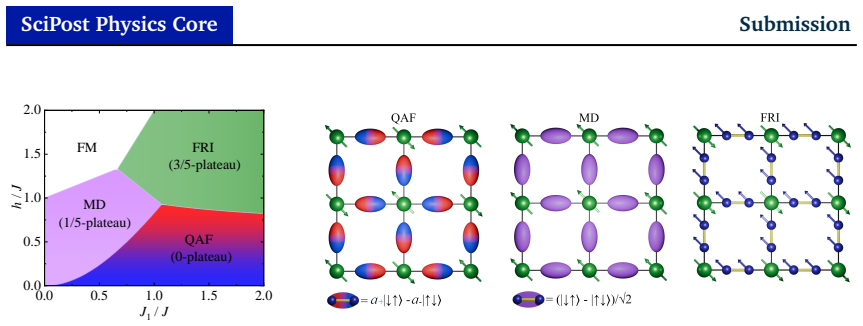
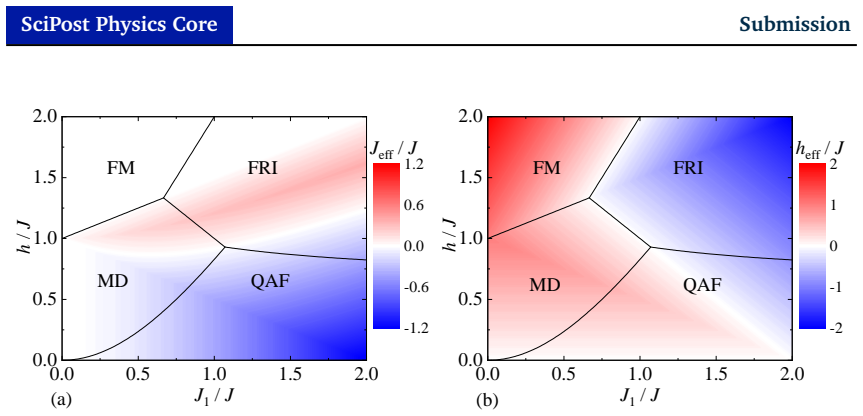
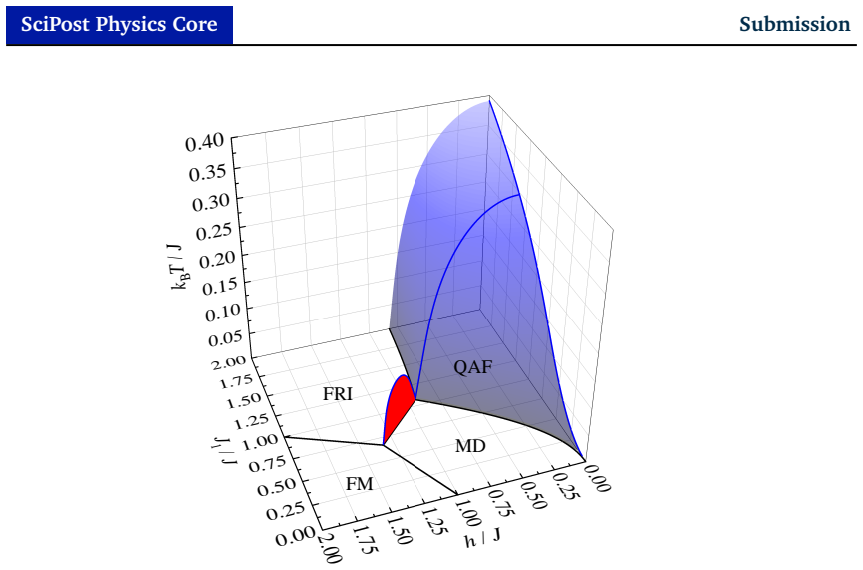
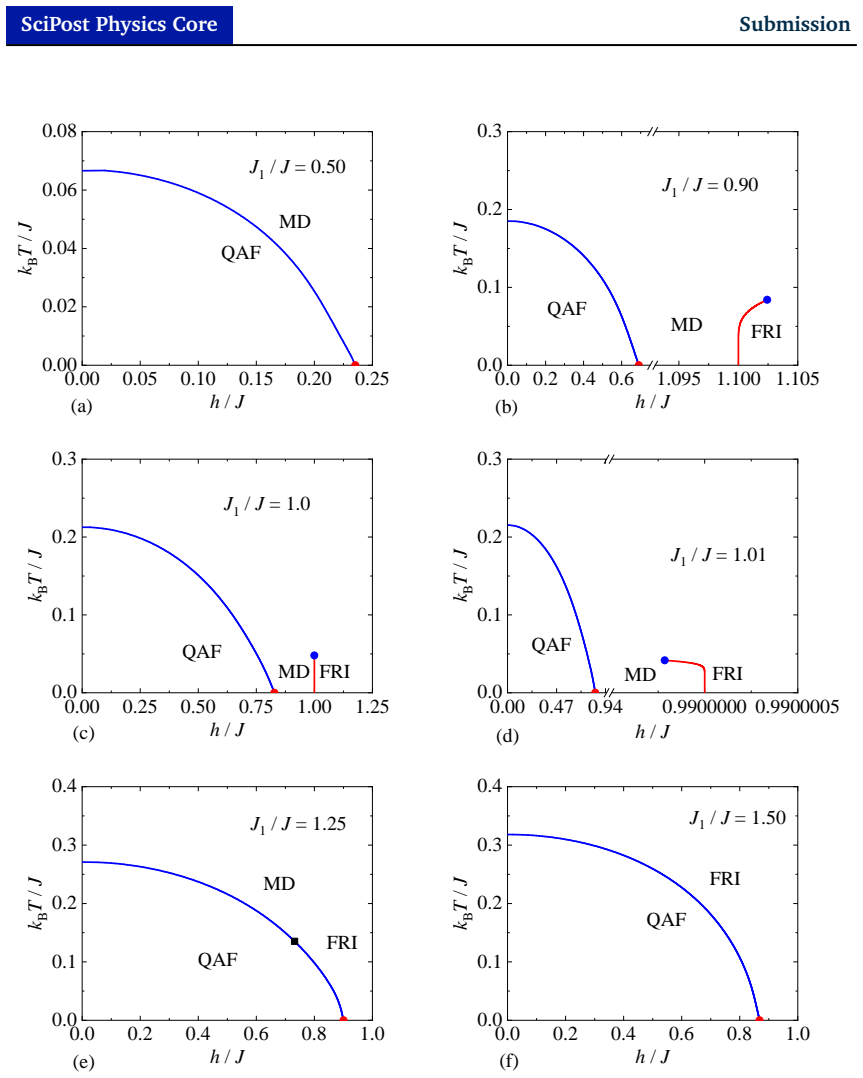
The Ising-Heisenberg model on the extended Lieb lattice in a magnetic field is exactly mapped onto an effective spin-1/2 Ising model on the square lattice. The ground-state phase diagram comprises the quantum antiferromagnetic, quantum monomer-dimer, classical ferrimagnetic and classical ferromagnetic phases. The monomer-dimer to ferrimagnetic ground-state boundary extends to finite temperatures as a dome-shaped surface of discontinuous thermal transitions bounded by a line of Ising critical points, while the quantum antiferromagnetic phase is enclosed by a surface of continuous thermal transitions.
What carries the argument
Exact mapping of the Ising-Heisenberg Hamiltonian on the extended Lieb lattice onto an effective Ising model on the square lattice, which carries the entire phase diagram and all thermal transitions.
If this is right
- The monomer-dimer to ferrimagnetic boundary lifts into a dome of first-order transitions at finite temperature.
- This dome is bounded by a line of continuous Ising critical points.
- The quantum antiferromagnetic phase is enclosed by a surface of continuous thermal transitions originating from the zero-temperature boundaries.
- Monte Carlo simulations confirm both the discontinuous and continuous character of the finite-temperature transitions.
Where Pith is reading between the lines
- The mapping technique could be applied to other decorated lattices that admit similar decimation steps.
- The dome of discontinuous transitions offers a concrete, parameter-free example for testing general theories of first-order lines terminating at critical points.
- Experimental realizations in optical lattices or molecular magnets with Lieb geometry could directly test the predicted dome shape.
Load-bearing premise
The exact mapping between the original Ising-Heisenberg Hamiltonian and the effective square-lattice Ising model remains valid across the full range of magnetic fields and interaction strengths examined.
What would settle it
A Monte Carlo simulation or material experiment that finds no dome-shaped surface of discontinuous transitions or no bounding line of Ising critical points between the monomer-dimer and ferrimagnetic regimes would falsify the mapping and its consequences.
Figures
read the original abstract
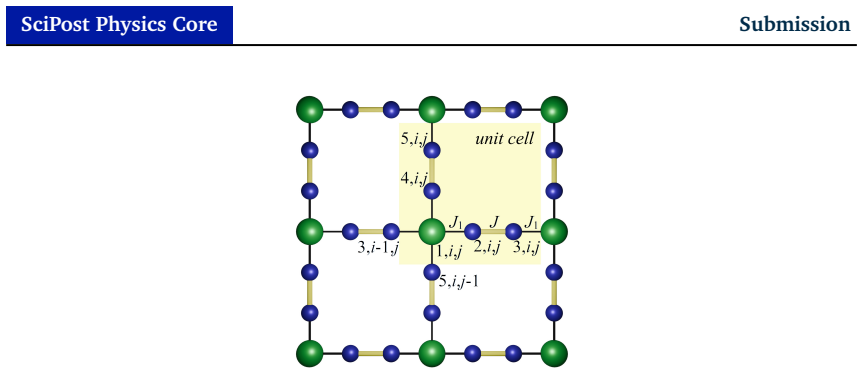
The spin-1/2 Ising-Heisenberg model on the extended Lieb lattice in a magnetic field is exactly mapped onto an effective spin-1/2 Ising model on the square lattice. The ground-state phase diagram comprises the quantum antiferromagnetic (QAF), quantum monomer-dimer (MD), classical ferrimagnetic (FRI), and classical ferromagnetic phase. The MD-FRI ground-state phase boundary extends to finite temperatures as a dome-shaped surface of discontinuous thermal transitions bounded by a line of Ising critical points. The QAF phase is enclosed by a surface of continuous thermal transitions evolving from the QAF-MD and QAF-FRI ground-state phase boundaries. Monte Carlo simulations fully confirm the existence and nature of both continuous and discontinuous thermal phase transitions obtained by exact and approximate analytical calculations.
Editorial analysis
A structured set of objections, weighed in public.
Referee Report
Summary. The manuscript claims that the spin-1/2 Ising-Heisenberg model on the extended Lieb lattice in a magnetic field admits an exact mapping onto an effective spin-1/2 Ising model on the square lattice. Using this mapping, the ground-state phase diagram is shown to consist of quantum antiferromagnetic (QAF), quantum monomer-dimer (MD), classical ferrimagnetic (FRI), and classical ferromagnetic (FM) phases. The MD-FRI ground-state boundary extends to finite temperature as a dome-shaped surface of discontinuous transitions bounded by a line of Ising critical points, while the QAF phase is enclosed by a surface of continuous thermal transitions; both are confirmed by Monte Carlo simulations.
Significance. An exact, parameter-free mapping to a solvable Ising model on the square lattice, together with Monte Carlo verification of both continuous and discontinuous transitions, would constitute a substantial advance in the exact treatment of quantum spin models on decorated lattices, enabling falsifiable predictions for phase boundaries and transition orders without adjustable parameters.
major comments (1)
- [Exact mapping derivation] The section presenting the exact mapping must explicitly derive and state the conditions under which the mapping from the original Ising-Heisenberg Hamiltonian to the effective square-lattice Ising model remains valid for arbitrary magnetic field h and all coupling strengths appearing in the QAF, MD, FRI, and FM phases; any restriction (for example, to uniform field or specific J ratios required for exact tracing over Heisenberg dimers) would prevent the claimed dome of MD-FRI discontinuous transitions and the enclosing QAF surface from holding over the full diagram.
minor comments (2)
- [Monte Carlo simulations] Monte Carlo simulation parameters (lattice sizes, number of sweeps, equilibration protocol, and error estimation) should be stated explicitly so that the reported confirmation of continuous and discontinuous transitions can be reproduced.
- [Abstract] The abstract would benefit from a single sentence stating the form of the Hamiltonian (including the range of the magnetic field term) to contextualize the mapping.
Simulated Author's Rebuttal
We thank the referee for the careful reading of our manuscript and the constructive major comment. We address the point regarding the exact mapping derivation below and agree that explicit clarification will improve the presentation.
read point-by-point responses
-
Referee: The section presenting the exact mapping must explicitly derive and state the conditions under which the mapping from the original Ising-Heisenberg Hamiltonian to the effective square-lattice Ising model remains valid for arbitrary magnetic field h and all coupling strengths appearing in the QAF, MD, FRI, and FM phases; any restriction (for example, to uniform field or specific J ratios required for exact tracing over Heisenberg dimers) would prevent the claimed dome of MD-FRI discontinuous transitions and the enclosing QAF surface from holding over the full diagram.
Authors: The exact mapping is obtained in Section II by performing the partial trace over each Heisenberg dimer exactly. Because each dimer is a two-spin problem, its partition function and the resulting effective Ising couplings and fields can be computed in closed form for any value of the magnetic field h and for arbitrary ratios of the exchange couplings. No additional restrictions on h or the couplings are imposed; the effective model parameters remain well-defined and the mapping holds throughout the parameter space of the QAF, MD, FRI, and FM phases. We acknowledge that the current text does not state these conditions with sufficient explicitness, and we will add a dedicated paragraph (and, if helpful, an appendix) in the revised manuscript that derives the effective couplings step by step and explicitly asserts validity for arbitrary h and all coupling strengths appearing in the four phases. This revision will confirm that the dome of discontinuous MD-FRI transitions and the enclosing surface of continuous QAF transitions are obtained without parameter restrictions. revision: yes
Circularity Check
Exact mapping presented as self-contained; no reduction to inputs by construction
full rationale
The central claim is an exact mapping of the spin-1/2 Ising-Heisenberg Hamiltonian on the extended Lieb lattice to an effective spin-1/2 Ising model on the square lattice, followed by analysis of ground-state phases and finite-temperature transitions confirmed by Monte Carlo simulations. No quoted step in the provided abstract or description shows a self-definitional loop, a fitted parameter renamed as a prediction, or a load-bearing result justified solely by self-citation. The mapping is asserted as exact and independent of the target phase diagram quantities, with external confirmation via simulation, making the derivation self-contained against the listed circularity patterns.
Axiom & Free-Parameter Ledger
Reference graph
Works this paper leans on
-
[1]
M. E. Fisher, The theory of equilibrium critical phenomena, Rep. Prog. Phys. 30 , 615 (1967), doi:https://doi.org/10.1088/0034-4885/30/2/306
-
[2]
K. G. Wilson, The renormalization group and critical phenomena, Rev. Mod. Phys. 55 , 583 (1983), doi:https://doi.org/10.1103/RevModPhys.55.583
-
[3]
H. E. Stanley, Scaling, universality, and renormalization: Three pillars of modern critical phenomena, Rev. Mod. Phys. 71 , S358 (1999), doi:https://doi.org/10.1103/RevModPhys.71.S358
-
[4]
Domb, On the theory of cooperative phenomena in crystals, Adv
C. Domb, On the theory of cooperative phenomena in crystals, Adv. Phys. 9, 149 (1960), doi:https://doi.org/10.1080/00018736000101189
-
[5]
Domb and M
C. Domb and M. S. Green, Phase Transition and Critical Phenomena, Vol. 1, Academic Press, New York, 1972, ISBN 978-0122203015
1972
-
[6]
R. J. Baxter, (1982) Exactly Solved Models in Statistical Mechanics, Academic Press, New York, 1982, ISBN 978-0120831821
1982
-
[7]
L. Onsager, Crystal Statistics. I. A Two-Dimensional Model with an Order-Disorder Transition, Phys. Rev. 65 , 117 (1944), doi:https://doi.org/10.1103/PhysRev.65.117
-
[8]
R. Liebmann, Statistical Mechanics of Periodic Frustrated Ising Systems, Springer-Verlag, Berlin Heidelberg, 1986, ISBN 978-3540164739, doi:10.1007/3-540-16473-1
-
[9]
H. T. Diep, Frustrated Spin Systems, World Scientific, Singapore, 2004, ISBN 978-9812560919, doi:10.1142/5697
-
[10]
A. Kalz, A. Honecker, and M. Moliner, Analysis of the phase transition for the Ising model on the frustrated square lattice, Phys. Rev. B 84 , 174407 (2011), doi:https://doi.org/10.1103/PhysRevB.84.174407
-
[11]
S. Jin, A. Sen, and A. W. Sandvik, Ashkin-Teller criticality and pseudo-first-order behavior in a frustrated Ising model on the square lattice, Phys. Rev. Lett. 108 , 045702 (2012), doi:https://doi.org/10.1103/PhysRevLett.108.045702
-
[12]
J. H. Lee, S.-Y. Kim, and J. M. Kim, Frustrated Ising model with competing interactions on a square lattice, Phys. Rev. B 109 , 064422 (2024), doi:https://doi.org/10.1103/PhysRevB.109.064422
-
[13]
M. Roos, I. F. Muhl, M. Schmidt, C. V. Morais, and F. M. Zimmer, Effects of third-neighbor interactions on the frustrated quantum Ising model, Phys. Rev. E 109 , 014144 (2024), doi:https://doi.org/10.1103/PhysRevE.109.014144
-
[14]
Ch. Chatelain, First-order transition and marginal critical behavior in a two-dimensional frustrated Ising model with efficient tensor-network implementation, Phys. Rev. E 111 , 024109 (2025), doi:https://doi.org/10.1103/PhysRevE.111.024109
-
[15]
F. Y. Wu, Exact solution of a triangular Ising model in a nonzero magnetic field. J. Stat. Phys. 40, 613 (1985), doi:https://doi.org/10.1007/BF01009892
-
[16]
P. Azaria and H. Giacomini, An exactly solvable two-dimensional Ising model with magnetic field, J. Phys. A: Math. Gen. 21, L935 (1988), doi:https://doi.org/10.1088/0305-4470/21/19/003
-
[17]
H. J. Giacomini, An exact functional relation for the partition function of a 2D Ising model with magnetic field, J. Phys. A: Math. Gen. 21, L599 (1988), doi:https://doi.org/10.1088/0305-4470/21/11/005
-
[18]
W. T. Lu and F. Y. Wu, Soluble kagome Ising model in a magnetic field, Phys. Rev. E 71, 046120 (2005), doi:https://doi.org/10.1103/PhysRevE.71.046120
-
[19]
J. H. Barry and K. A. Muttalib, Finite-field phase transitions and criticality in a generalized kagomé Ising ferromagnet: Exact solutions, Physica A 527, 121326 (2019), doi:https://doi.org/10.1016/j.physa.2019.121326
-
[20]
K. A. Muttalib and J. H. Barry, Frustration in a generalized kagom\'e Ising antiferromagnet: Exact results, Phys. Rev. E 106, 014149 (2022), doi:https://doi.org/10.1103/PhysRevE.106.014149
-
[21]
C. Lacroix, P. Mendels, and F. Mila, Introduction to frustrated magnetism, Springer, Berlin, 2010, ISBN 978-3642105883, doi:10.1007/978-3-642-10589-0
-
[22]
D. Cabra, A. Honecker, and P. Pujol, Modern Theories of Many-Particle Systems in Condensed Matter Physics, Springer Berlin Heidelberg, 2012, ISBN 978-3642104480, doi:10.1007/978-3-642-10449-7
-
[23]
N. D. Mermin and H. Wagner, Absence of Ferromagnetism or Antiferromagnetism in One- or Two-Dimensional Isotropic Heisenberg Models, Phys. Rev. Lett. 17 , 1307 (1966), doi:https://doi.org/10.1103/PhysRevLett.17.1133
-
[24]
D. C. Mattis, The many-body problem: an encyclopedia of exactly solved models in one dimension, 3rd ed. World Scientific, Singapore 1993, ISBN 978-9810214760, doi:10.1142/1666
-
[25]
T. Senthil, A. Vishwanath, L. Balents, S. Sachdev, and M. P. A. Fisher, Deconfined Quantum Critical Points, Science 303 , 1490 (2004), doi:https://doi.org/10.1126/science.1091806
-
[26]
Y. Fan, N. Xi, C. Liu, B. Normand, R. Yu, Field-controlled multicritical behavior and emergent universality in fully frustrated quantum magnets, npj Quantum Mater. 9, 25 (2024), doi:https://doi.org/10.1038/s41535-024-00636-4
-
[27]
J. Stapmanns, P. Corboz, F. Mila, A. Honecker, B. Normand, and S. Wessel, Thermal Critical Points and Quantum Critical End Point in the Frustrated Bilayer Heisenberg Antiferromagnet, Phys. Rev. Lett. 121 , 127201 (2018), doi:https://doi.org/10.1103/PhysRevLett.121.127201
-
[28]
L. Weber, A. Honecker, B. Normand, P. Corboz, F. Mila, and S. Wessel, Quantum Monte Carlo simulations in the trimer basis: first-order transitions and thermal critical points in frustrated trilayer magnets, SciPost Phys. 12 , 054 (2022), doi:https://doi.org/10.21468/SciPostPhys.12.2.054
-
[29]
L. Weber, A. Y. D. Fache, F. Mila, and S. Wessel, Thermal critical points from competing singlet formations in a plaquettized fully frustrated bilayer Heisenberg model, Phys. Rev. B 106 , 235128 (2022), doi:https://doi.org/10.1103/PhysRevB.106.235128
-
[30]
N. Caci, K. Kar l ov\' a , T. Verkholyak, J. Stre c ka, S. Wessel, and A. Honecker, Phases of the spin- 1 2 Heisenberg antiferromagnet on the diamond-decorated square lattice in a magnetic field , Phys. Rev. B 107 , 115143 (2023), doi:https://doi.org/10.1103/PhysRevB.107.115143
-
[31]
H. Kageyama, K. Yoshimura, R. Stern, N. V. Mushnikov, K. Onizuka, M. Kato, K. Kosuge, C. P. Slichter, T. Goto, and Y. Ueda, Exact dimer ground state and quantized magnetization plateaus in the two-dimensional spin system SrCu _2 (BO _3 ) _2 , Phys. Rev. Lett. 82 , 3168 (1999), doi:https://doi.org/10.1103/PhysRevLett.82.3168
-
[32]
A quantum magnetic analogue to the critical point of water,
J. Larrea Jimenez, S. P. G. Crone, E. Fogh, M. E. Zayed, R. Lortz, E. Pomjakushina, K. Conder, A. M. L\" a uchli, L. Weber, S. Wessel, A. Honecker, B. Normand, Ch. R\" u egg, P. Corboz, H. M. R\"onnow, and F. Mila, A quantum magnetic analogue to the critical point of water, Nature 592 , 370 (2021), doi:https://doi.org/10.1038/s41586-021-03411-8
-
[33]
T. Nomura, P. Corboz, A. Miyata, S. Zherlitsyn, Y. Ishii, Y. Kohama, Y. H. Matsuda, A. Ikeda, C. Zhong, H. Kageyama, F. Mila, Unveiling new quantum phases in the Shastry-Sutherland compound SrCu2(BO3)2 up to the saturation magnetic field, Nat. Commun. 14, 3769 (2023), doi:https://doi.org/10.1038/s41467-023-39502-5
-
[34]
S. Nyckees, P. Corboz, and F. Mila, Weakly first-order melting of the 1/3 plateau in the Shastry-Sutherland model, Phys. Rev. B 111, 014428 (2025), doi:https://doi.org/10.1103/PhysRevB.111.014428
-
[35]
J. Stre c ka, K. Karl'ov\' a , T. Verkholyak, N. Caci, S. Wessel, and A. Honecker, Thermal first-order phase transitions, Ising critical points, and reentrance in the Ising-Heisenberg model on the diamond-decorated square lattice in a magnetic field, Phys. Rev. B 107 , 134402 (2023), doi:https://doi.org/10.1103/PhysRevB.107.134402
-
[36]
M. E. Fisher, Transformations of Ising Models, Phys. Rev. 113 , 969 (1959), doi:https://doi.org/10.1103/PhysRev.113.969
-
[37]
O. Rojas, J. S. Valverde, and S. M. de Souza, Generalized transformation for decorated spin models, Physica A 388 ,1419 (2009), doi:https://doi.org/10.1016/j.physa.2008.12.063
-
[38]
Stre c ka, Generalized algebraic transformations and exactly solvable classical-quantum models, Phys
J. Stre c ka, Generalized algebraic transformations and exactly solvable classical-quantum models, Phys. Lett. A 374 , 3718 (2010), doi:https://doi.org/10.1016/j.physleta.2010.07.030
-
[39]
Marshall, Antiferromagnetism, Proc
W. Marshall, Antiferromagnetism, Proc. R. Soc. Lond., Ser. A 232 , 48 (1955), doi:https://doi.org/10.1098/rspa.1955.0200
-
[40]
E. Lieb and D. Mattis, Ordering Energy Levels of Interacting Spin Systems, J. Math. Phys. 3 , 749 (1962), doi:https://doi.org/10.1063/1.1724276
-
[41]
J. Stre c ka and M. Ja s c ur, Magnetic properties of exactly solvable doubly decorated Ising-Heisenberg planar models, Phys. Rev. B 66 , 174415 (2002), doi:https://doi.org/10.1103/PhysRevB.66.174415
-
[42]
E. M\" u ller-Hartmann and J. Zittartz, Interface free energy and transition temperature of the square-lattice Ising antiferromagnet at finite magnetic field, Z. Phys. B 27 , 261 (1977), doi:https://doi.org/10.1007/BF01325537
-
[43]
J. H. Barry, M. Khatun, and T. Tanaka, Exact solutions for Ising-model even-number correlations on planar lattices, Phys. Rev. B 37 , 5193 (1988), doi:https://doi.org/10.1103/PhysRevB.37.5193
-
[44]
M. Khatun, J. H. Barry and T. Tanaka, Exact solutions for even-number correlations of the square Ising model, Phys. Rev. B 42 , 4398 (1990), doi:https://doi.org/10.1103/PhysRevB.42.4398
-
[45]
J. H. Barry, T. Tanaka, M. Khatun, and C. H. M\' u nera, Exact solutions for Ising-model odd-number correlations on planar lattices, Phys. Rev. B 44 , 2595 (1991), doi:https://doi.org/10.1103/PhysRevB.44.2595
-
[46]
J. H. Barry and M. Khatun, Exact solutions for Ising-model correlation in the 3-12 (extended kagom\' e ) lattice , Phys. Rev. B 51 , 5840 (1995), doi:https://doi.org/10.1103/PhysRevB.51.5840
-
[47]
H. B. Callen, A note on Green functions and the Ising model, Phys. Lett. 4, 161 (1963), doi:https://doi.org/10.1016/0031-9163(63)90344-5
-
[48]
M. Suzuki, Generalized exact formula for the correlations of the Ising model and other classical systems, Phys. Lett. 19, 267 (1965), doi:https://doi.org/10.1016/0031-9163(65)90978-9
-
[49]
Balcerzak, On the exact identities for Ising model with arbitrary spin, J
T. Balcerzak, On the exact identities for Ising model with arbitrary spin, J. Magn. Magn. Mater. 246, 213 (2002), doi:https://doi.org/10.1016/S0304-8853(02)00056-2
-
[50]
N. Metropolis, A. W. Rosenbluth, M. N. Rosenbluth, A. H. Teller, and E. Teller, Equation of State Calculations by Fast Computing Machines, J. Chem. Phys. 21 , 1087 (1953), doi:https://doi.org/10.1063/1.1699114
discussion (0)
Sign in with ORCID, Apple, or X to comment. Anyone can read and Pith papers without signing in.