Enhanced quantum metrology by criticality-assisted noncommutative preparation
Pith reviewed 2026-05-21 04:25 UTC · model grok-4.3
The pith
Using critical evolution only to prepare the probe state creates noncommutativity with the encoding step that genuinely raises quantum Fisher information at fixed total time and energy.
A machine-rendered reading of the paper's core claim, the machinery that carries it, and where it could break.
Core claim
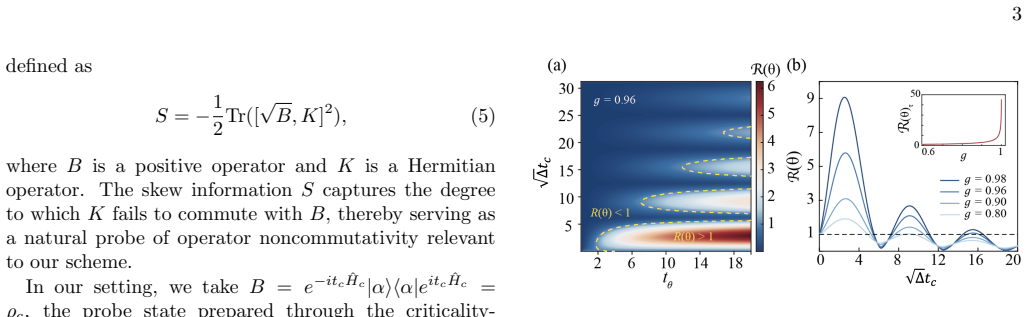
In the CANP framework, critical evolution is employed solely as a state-preparation resource. The intrinsic noncommutativity between this preparation and the subsequent parameter-encoding operation satisfies algebraic conditions that raise the quantum Fisher information. The enhancement is quantified by the Wigner-Yanase skew information, which exhibits the same critical scaling as the QFI, and it occurs without any increase in total sensing time or energy cost. The approach is shown to work in the quantum Rabi and Lipkin-Meshkov-Glick models.
What carries the argument
The criticality-assisted noncommutative preparation (CANP) framework, in which critical evolution prepares the probe state and the noncommutativity with the encoding step, measured by Wigner-Yanase skew information, produces the QFI enhancement.
Load-bearing premise
Critical evolution can serve purely as a state-preparation resource while still preserving enough noncommutativity with the encoding operation to meet the algebraic conditions for enhancement.
What would settle it
An experiment in which the preparation and encoding operations are forced to commute in a critical system, after which the QFI shows no enhancement relative to the non-critical case.
Figures


read the original abstract
Quantum criticality is a resource for quantum-enhanced metrology, but existing schemes face intrinsic limitations. These arise because using criticality directly in the encoding dynamics restricts the accessible parameters to those explicitly supported by the critical Hamiltonian, and the requirement for critical conditions narrows the effective estimation range. To solve this, we introduce a general framework termed criticality-assisted noncommutative preparation (CANP). In this approach, critical evolution is employed as a state-preparation resource. We establish the underlying algebraic conditions and show that the intrinsic noncommutativity between the preparation and encoding operations leads to a genuine enhancement of the quantum Fisher information (QFI). Remarkably, this enhancement may be achieved at fixed total sensing time and energy cost. The effect is quantified by the Wigner-Yanase skew information, which measures noncommutativity and exhibits the same critical scaling as the QFI. We demonstrate effective use of CANP in the quantum Rabi and Lipkin-Meshkov-Glick models. Our results establish CANP as a robust technique to effectively implement criticality-enhanced quantum metrology.
Editorial analysis
A structured set of objections, weighed in public.
Referee Report
Summary. The paper introduces the criticality-assisted noncommutative preparation (CANP) framework, in which critical evolution is used solely as a state preparation resource to generate a state that, when subjected to a subsequent encoding operation, yields an enhanced quantum Fisher information (QFI) due to the noncommutativity between the preparation and encoding Hamiltonians. Algebraic conditions for this enhancement are established, the effect is quantified using the Wigner-Yanase skew information which scales similarly to the QFI at criticality, and the enhancement is claimed to hold at fixed total sensing time and energy cost. The framework is demonstrated in the quantum Rabi and Lipkin-Meshkov-Glick models.
Significance. If the algebraic conditions are correctly derived and the demonstrations confirm a net QFI gain under the fixed-time constraint without additional costs, this work could provide a valuable method to harness quantum criticality for metrology without restricting the accessible parameters to those supported by the critical Hamiltonian. The separation of preparation and encoding steps could broaden the applicability of criticality-enhanced sensing.
major comments (2)
- [Demonstrations in Rabi and LMG models] In the demonstrations for the Rabi and LMG models, it is not shown that there exists a non-zero interval of t_prep/T where both the skew-information scaling and the net QFI gain survive after enforcing the fixed total time budget T = t_prep + t_encode and fixed energy cost. This is load-bearing for the central claim that enhancement is achieved at fixed total sensing time.
- [Algebraic conditions for CANP] The algebraic conditions for CANP enhancement should include explicit equations deriving how [H_prep, H_encode] ≠ 0 produces QFI gain quantified by the Wigner-Yanase skew information I_WY that scales identically to the QFI; without this, it is unclear whether the scaling follows from noncommutativity or is imposed by construction.
minor comments (2)
- [Notation and definitions] Clarify the notation for preparation time t_prep and encoding time t_encode to ensure consistency when discussing the partitioning of total time T.
- [Figures and numerical results] Add explicit comparisons in figures or tables between CANP-enhanced QFI and direct encoding QFI to illustrate the claimed gain at fixed T.
Simulated Author's Rebuttal
We thank the referee for the careful reading of our manuscript and the constructive comments, which help clarify key aspects of the CANP framework. We address each major comment below and will incorporate revisions to strengthen the presentation.
read point-by-point responses
-
Referee: [Demonstrations in Rabi and LMG models] In the demonstrations for the Rabi and LMG models, it is not shown that there exists a non-zero interval of t_prep/T where both the skew-information scaling and the net QFI gain survive after enforcing the fixed total time budget T = t_prep + t_encode and fixed energy cost. This is load-bearing for the central claim that enhancement is achieved at fixed total sensing time.
Authors: We agree that explicit demonstration of a non-zero interval for t_prep/T is important to substantiate the fixed-resource claim. While the manuscript shows QFI enhancement for representative choices of t_prep and t_encode with T held fixed (and energy cost constrained), we acknowledge that a systematic scan over the ratio was not included. In the revised manuscript we will add plots of QFI and Wigner-Yanase skew information versus t_prep/T for both the Rabi and LMG models, explicitly identifying the interval where the critical scaling and net gain persist under the fixed-T and fixed-energy constraints. revision: yes
-
Referee: [Algebraic conditions for CANP] The algebraic conditions for CANP enhancement should include explicit equations deriving how [H_prep, H_encode] ≠ 0 produces QFI gain quantified by the Wigner-Yanase skew information I_WY that scales identically to the QFI; without this, it is unclear whether the scaling follows from noncommutativity or is imposed by construction.
Authors: We thank the referee for this suggestion. The current manuscript establishes the algebraic conditions in Section II by showing that noncommutativity between H_prep and H_encode generates an additional term in the QFI that is bounded from below by the Wigner-Yanase skew information I_WY. At criticality this term inherits the same divergent scaling as the QFI because both quantities are sensitive to the closing gap and the associated long-range correlations. To make the derivation fully explicit and to demonstrate that the scaling arises from the commutator rather than being assumed, we will insert a short sequence of equations in the revised theoretical section that starts from the definition of the QFI, inserts the commutator contribution, and arrives at the I_WY bound with identical critical exponents. revision: yes
Circularity Check
No significant circularity in CANP derivation or QFI enhancement claim
full rationale
The paper first states algebraic conditions on the commutator [H_prep, H_encode] that are required for enhancement, then computes the QFI explicitly for the post-preparation state under encoding evolution in the Rabi and LMG models, showing a net gain at fixed total T = t_prep + t_encode. The Wigner-Yanase skew information is introduced separately as a quantifier of the same noncommutativity; its critical scaling is derived from the shared Hamiltonian structure rather than fitted to the QFI result or used to define the enhancement. No load-bearing step reduces to a self-citation, a renamed empirical pattern, or a parameter fit that is then relabeled as a prediction. The central claim therefore remains independent of its inputs and is externally falsifiable via the model calculations.
Axiom & Free-Parameter Ledger
axioms (1)
- standard math Quantum Fisher information and Wigner-Yanase skew information are valid figures of merit for metrological precision and noncommutativity.
invented entities (1)
-
CANP framework
no independent evidence
Reference graph
Works this paper leans on
-
[1]
V. Giovannetti, S. Lloyd, and L. Maccone, Quantum- enhanced measurements: Beating the standard quantum limit, Science306, 1330 (2004)
work page 2004
-
[2]
V. Giovannetti, S. Lloyd, and L. Maccone, Quantum metrology, Phys. Rev. Lett.96, 010401 (2006)
work page 2006
- [3]
-
[4]
M. G. A. Paris, Quantum estimation for quantum technology, Int. J. Quantum Inf.07, 125 (2009)
work page 2009
- [5]
-
[6]
L. Pezz` e, A. Smerzi, M. K. Oberthaler, R. Schmied, and P. Treutlein, Quantum metrology with nonclassical states of atomic ensembles, Rev. Mod. Phys.90, 035005 (2018)
work page 2018
-
[7]
V. Giovannetti, S. Lloyd, and L. Maccone, Advances in quantum metrology, Nat. Photon.5, 222 (2011)
work page 2011
-
[8]
M. Napolitano, M. Koschorreck, B. Dubost, N. Behbood, R. Sewell, and M. W. Mitchell, Interaction-based quantum metrology showing scaling beyond the heisenberg limit, Nature471, 486 (2011)
work page 2011
- [9]
-
[10]
D. DeMille, N. R. Hutzler, A. M. Rey, and T. Zelevinsky, Quantum sensing and metrology for fundamental physics with molecules, Nat. Phys.20, 741 (2024)
work page 2024
-
[11]
P. Zanardi and N. Paunkovi´ c, Ground state overlap and quantum phase transitions, Phys. Rev. E74, 031123 (2006)
work page 2006
-
[12]
P. Zanardi, M. G. A. Paris, and L. Campos Venuti, Quantum criticality as a resource for quantum estimation, Phys. Rev. A78, 042105 (2008)
work page 2008
-
[13]
M. Heyl, A. Polkovnikov, and S. Kehrein, Dynamical quantum phase transitions in the transverse-field ising model, Phys. Rev. Lett.110, 135704 (2013)
work page 2013
-
[14]
M. Bina, I. Amelio, and M. G. A. Paris, Dicke coupling by feasible local measurements at the superradiant quantum phase transition, Phys. Rev. E93, 052118 (2016)
work page 2016
-
[15]
I. Fr´ erot and T. Roscilde, Quantum critical metrology, Phys. Rev. Lett.121, 020402 (2018)
work page 2018
-
[16]
S. Dutta and N. R. Cooper, Critical response of a quantum van der pol oscillator, Phys. Rev. Lett.123, 250401 (2019)
work page 2019
-
[17]
V. Montenegro, C. Mukhopadhyay, R. Yousefjani, S. Sarkar, U. Mishra, M. G. Paris, and A. Bayat, Review: Quantum metrology and sensing with many- body systems, Phys. Rep.1134, 1 (2025)
work page 2025
-
[18]
H. Xu, T. Xiao, J. Huang, M. He, J. Fan, and G. Zeng, Toward heisenberg limit without critical slowing down via quantum reinforcement learning, Phys. Rev. Lett. 134, 120803 (2025). 6
work page 2025
- [19]
-
[20]
Y. Chu, S. Zhang, B. Yu, and J. Cai, Dynamic framework for criticality-enhanced quantum sensing, Phys. Rev. Lett.126, 010502 (2021)
work page 2021
-
[21]
V. Montenegro, U. Mishra, and A. Bayat, Global sensing and its impact for quantum many-body probes with criticality, Phys. Rev. Lett.126, 200501 (2021)
work page 2021
- [22]
- [23]
-
[24]
M. M. Rams, P. Sierant, O. Dutta, P. Horodecki, and J. Zakrzewski, At the limits of criticality-based quantum metrology: Apparent super-heisenberg scaling revisited, Phys. Rev. X8, 021022 (2018)
work page 2018
-
[25]
X. Zhao, Y. Yang, and G. Chiribella, Quantum Metrology with Indefinite Causal Order, Phys. Rev. Lett. 124, 190503 (2020)
work page 2020
-
[26]
P. Yin, X. Zhao, Y. Yang, Y. Guo, W.-H. Zhang, G.- C. Li, Y.-J. Han, B.-H. Liu, J.-S. Xu, G. Chiribella, G. Chen, C.-F. Li, and G.-C. Guo, Experimental super- Heisenberg quantum metrology with indefinite gate order, Nat. Phys.19, 1122 (2023)
work page 2023
-
[27]
B. Xia, J. Huang, H. Li, Z. Luo, and G. Zeng, Nanoradian-scale precision in light rotation measurement via indefinite quantum dynamics, Sci. Adv.10, eadm8524 (2024)
work page 2024
-
[28]
Y. Deng, S. Liu, X. Chen, Z. Fu, J. Bao, Y. Zheng, Q. Gong, Q. He, and J. Wang, Generalized indefinite causal orders in an integrated quantum switch, Phys. Rev. Lett.135, 160202 (2025)
work page 2025
-
[29]
V. Montenegro, S. Dornetti, A. Ferraro, and M. G. A. Paris, Enhanced quantum frequency estimation by nonlinear scrambling, Phys. Rev. Lett.135, 030802 (2025)
work page 2025
-
[30]
N. Kong, H. Wang, M. Tian, Y. Xu, G. Chen, Y. Xiang, and Q. He, Noncommutativity as a universal characterization for enhanced quantum metrology, Phys. Rev. Lett.136, 010201 (2026)
work page 2026
- [31]
-
[32]
S. L. Braunstein and C. M. Caves, Statistical distance and the geometry of quantum states, Phys. Rev. Lett. 72, 3439 (1994)
work page 1994
- [33]
-
[34]
Luo, Wigner-yanase skew information and uncertainty relations, Phys
S. Luo, Wigner-yanase skew information and uncertainty relations, Phys. Rev. Lett.91, 180403 (2003)
work page 2003
- [35]
-
[36]
See Supplemental Material for detailed demonstrations of the criticality-assisted non-commutative preparation (CANP) protocol applied to frequency estimation in the quantum Rabi model together with the corresponding measurement scheme, frequency estimation in the Lipkin–Meshkov–Glick model, momentum-displacement estimation in the quantum Rabi model, as we...
-
[37]
X.-W. Luo, C. Zhang, and S. Du, Quantum squeezing and sensing with pseudo-anti-parity-time symmetry, Phys. Rev. Lett.128, 173602 (2022)
work page 2022
- [38]
-
[39]
C. Yu, M. Tian, N. Kong, M. Fadel, X. Huang, and Q. He, Exceptional-point-induced nonequilibrium entanglement dynamics in bosonic networks, npj Quantum Inf.12, 14 (2025)
work page 2025
discussion (0)
Sign in with ORCID, Apple, or X to comment. Anyone can read and Pith papers without signing in.