The Solar Neutrino and Astro-Particle PhYsics (SNAPPY) CubeSat Development
Pith reviewed 2026-07-02 00:59 UTC · model grok-4.3
The pith
The SNAPPY CubeSat will qualify a gallium detector that uses timed particle pairs to detect solar neutrinos in space.
A machine-rendered reading of the paper's core claim, the machinery that carries it, and where it could break.
Core claim
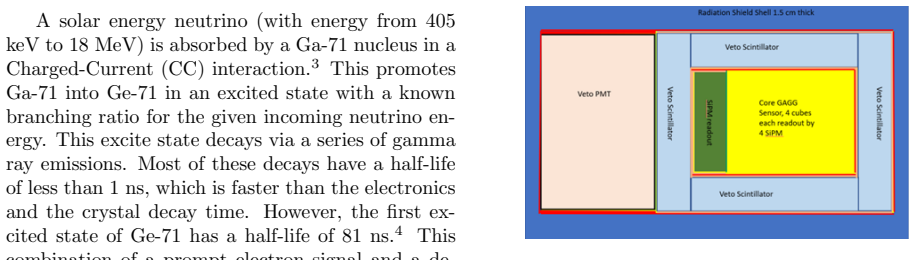
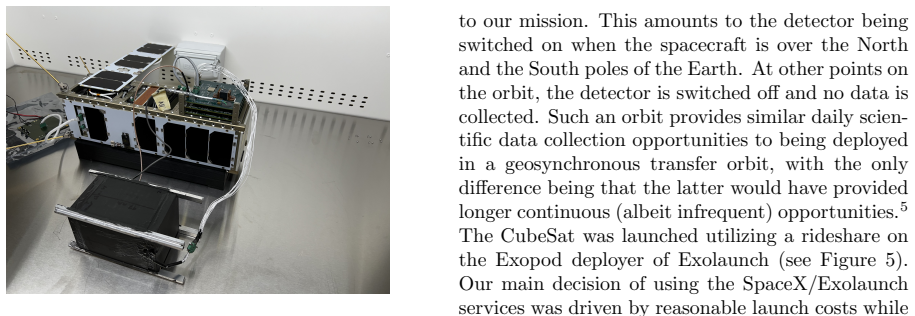
The SNAPPY CubeSat carries a 0.1-kg gallium detector inside an active veto array and patented tungsten-powder shielding to collect double-pulse signals from solar neutrinos while operating in polar low-Earth orbit above the Van Allen belts, with the goal of characterizing background and proving that the timed particle pairs can be isolated from cosmic rays.
What carries the argument
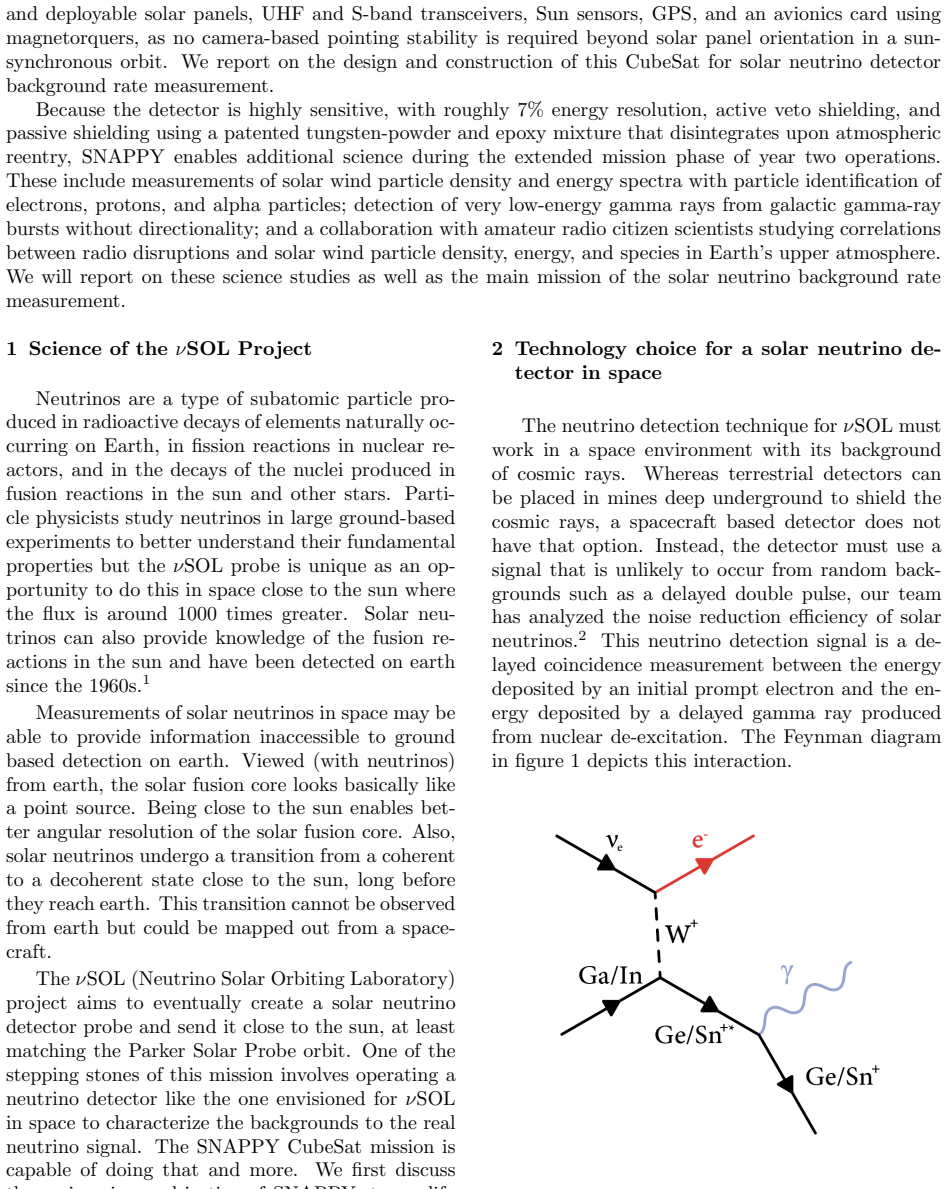
The nuSol technology, which detects solar neutrinos by identifying two particles emitted in a timed sequence from gallium isotope decays to separate them from cosmic ray events.
If this is right
- The mission will characterize the true deep-space background for the gallium double-pulse signal.
- Fast electronics will be tested for reliable selection and analysis of the double-pulse signal.
- Extended operations in year two will measure solar wind particle density and energy spectra with identification of electrons, protons, and alpha particles.
- Extended operations will also detect very low-energy gamma rays from galactic gamma-ray bursts without directionality.
Where Pith is reading between the lines
- If the double-pulse method succeeds, similar small detectors could be added to other satellites for ongoing solar monitoring.
- The shielding material that disintegrates on reentry could reduce risks for future instruments returning from orbit.
- Data from the orbit could guide whether larger versions of the detector become practical for dedicated neutrino missions.
Load-bearing premise
A polar low-Earth orbit at 450 km or higher supplies conditions similar to deep space above the Van Allen belts for reliable double-pulse signal collection.
What would settle it
Absence of a statistically significant number of double-pulse events that can be selected and analyzed by the fast electronics after data collection would show the technology does not work as described.
Figures



read the original abstract
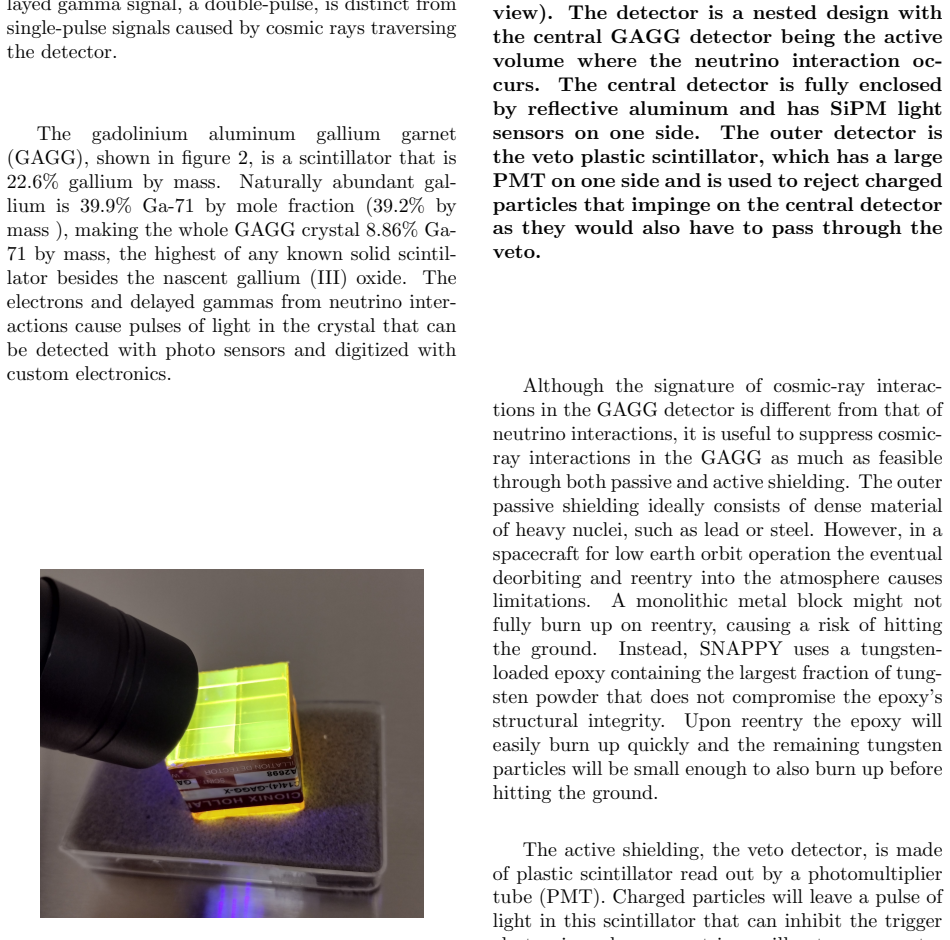
The SNAPPY CubeSat, which was launched May 3, 2026, will demonstrate and space qualify the nuSol neutrino-detection technology. The nuSol technology detects solar neutrinos using a gallium isotope which decays by emitting two particles spaced apart in time; this allows differentiating neutrino events from cosmic rays. In the NIAC Phase II project review in 2021, concept and science were determined to be feasible; however, two precursor studies were recommended before pursuing a full mission study. These studies were to characterize the true deep-space background for the detector's gallium double-pulse signal and to collect a statistically significant number of double-pulse events demonstrating that fast electronics can reliably select and analyze this signal. To test double-pulse signals in space, a NIAC Phase III funded building a 3U CubeSat carrying a 0.1-kg gallium-aluminum-gadolinium-garnet detector housed within an active veto array and shielding. Because the detector requires deep-space-like conditions, the CubeSat is designed for a polar low-Earth orbit at 450 km or higher altitude, collecting data over the Earth's poles above the Van Allen belts. The detector is highly sensitive, with roughly 7-percent energy resolution, with active veto shielding and passive shielding using a patented tungsten-powder and epoxy mixture that disintegrates upon atmospheric reentry. SNAPPY enables additional science during the extended mission phase of year two operations. These include measurements of solar wind particle density and energy spectra with particle identification of electrons, protons, and alpha particles; detection of very low-energy gamma rays from galactic gamma-ray bursts without directionality.
Editorial analysis
A structured set of objections, weighed in public.
Referee Report
Summary. The manuscript outlines the development of the SNAPPY 3U CubeSat, launched on May 3, 2026, to demonstrate the nuSol technology for detecting solar neutrinos. The technology relies on a gallium isotope detector that produces temporally spaced double-pulse signals from neutrino interactions, enabling separation from cosmic ray backgrounds. The design includes a 0.1 kg gallium-aluminum-gadolinium-garnet detector with active veto shielding and passive tungsten-powder epoxy shielding, targeted for a polar low-Earth orbit at altitudes of 450 km or higher to provide conditions above the Van Allen belts. The paper references prior NIAC Phase II and III reviews and describes additional science objectives such as solar wind particle measurements and low-energy gamma ray detection from galactic bursts during the extended mission phase.
Significance. If the described mission achieves its goals, it would represent a significant step in qualifying compact neutrino detection technology for space applications, potentially enabling future missions in astro-particle physics. The paper serves as a record of the engineering and mission design process for this technology demonstration, building on established NIAC feasibility assessments. However, as it presents no new data or analysis, its scientific impact is prospective rather than immediate.
minor comments (2)
- [Abstract] Abstract: the statement that the detector is 'highly sensitive, with roughly 7-percent energy resolution' lacks any supporting detail on calibration, simulation, or measurement; a brief reference or citation to the basis for this figure would aid clarity for instrumentation readers.
- [Abstract] Abstract: the description of the orbit choice states it provides 'deep-space-like conditions' but does not quantify residual background rates or Van Allen belt passage effects at 450 km; adding even a short estimate would strengthen the design rationale.
Simulated Author's Rebuttal
We thank the referee for their review of the manuscript and for recommending minor revision. The provided report accurately summarizes the SNAPPY CubeSat development and its objectives as a technology demonstration mission. No specific major comments were enumerated under the MAJOR COMMENTS section.
Circularity Check
No derivations, equations, or predictions; purely a mission description
full rationale
The manuscript is a project overview of CubeSat development and mission design for technology demonstration. It contains no equations, derivations, predictions, or quantitative analysis that could reduce to fitted parameters or self-citations. References to prior NIAC Phase II/III reviews are external feasibility determinations, not internal load-bearing steps. The nuSol description is presented as established context rather than a new result derived within the paper. The central content is engineering implementation details for a polar LEO mission, with no claimed first-principles results or statistical predictions.
Axiom & Free-Parameter Ledger
Reference graph
Works this paper leans on
-
[1]
Solar neutrinos: A scientific puzzle.Science, 191:264– 267, 1976
John N Bahcall and Raymond Davis Jr. Solar neutrinos: A scientific puzzle.Science, 191:264– 267, 1976
1976
-
[2]
Solomey, Brooks Hart- sock, Tyler Nolan, O
Jonathan Folkerts, N. Solomey, Brooks Hart- sock, Tyler Nolan, O. Pacheco, and G. Pawloski. Method to reduce noise for measurement of 7 be and 8 b solar neutrinos on gallium-71.Nuclear Instruments and Methods in Physics Research Section A: Accelerators, Spectrometers, Detec- tors and Associated Equipment, 1072:170116, 11 2024
2024
-
[3]
Haxton and Evan Rule
W.C. Haxton and Evan Rule. The gallium solar neutrino capture cross section revisited.Physics Letters B, 861:139259, 2025
2025
-
[4]
Nuclear data sheets for a = 71.Nuclear Data Sheets, 112(1):133–273, 2011
Khalifeh Abusaleem and Balraj Singh. Nuclear data sheets for a = 71.Nuclear Data Sheets, 112(1):133–273, 2011
2011
-
[5]
Dutta, K
A. Dutta, K. Messick, H. Meyer, and N. Solomey. Mission design for solar neutrino and astro- particle physics (snappy) experiment. In AAS/AIAA Space Flight Mechanics Meeting, number AAS 25-120 in AAS/AIAA Meeting Pro- ceedings, January 2025
2025
-
[6]
Messick, A
K. Messick, A. Dutta, H. Meyer, and N. Solomey. Magnetorquer only control of a 3u cubesat with limited pointing requirements. InAAS/AIAA Space Flight Mechanics Meeting, number AAS 25-213 in AAS/AIAA Meeting Proceedings, Jan- uary 2025
2025
-
[7]
Mission analysis for an in- space solar neutrino detection experiment.Acta Astronautica, 239:420–433, 2026
Kyle Messick, Atri Dutta, Holger Meyer, and Nickolas Solomey. Mission analysis for an in- space solar neutrino detection experiment.Acta Astronautica, 239:420–433, 2026. Sutin 8 40 th Annual Small Satellite Conference
2026
discussion (0)
Sign in with ORCID, Apple, or X to comment. Anyone can read and Pith papers without signing in.