REVIEW 4 major objections 8 minor 1 cited by
SCENIC: Scene-aware Semantic Navigation with Instruction-guided Control
T0 review · 4 major / 8 minor · reviewed 2026-08-11 · deepseek-v4-flash
Pith's one-line read SCENIC is a diffusion model that generates physically plausible human motion adapting to complex 3D scenes while following natural-language instructions such as "walking upstairs like a zombie."
desk verdict A solid unification of text-controlled motion synthesis with terrain adaptation, but the quantitative scene-constraint evidence is partly inherited from the terrain-fitting pipeline and real-scene generalization is only qualitative. read the letter →
The pith
A machine-rendered reading of the paper's core claim, the machinery that carries it, and where it could break.
The reading
What carries the argument
The load-bearing object is the pair of scene representations. Goal-centric canonicalization re-expresses the motion and the scene in the coordinate frame of the current sub-goal, so the model learns to generate motion that converges to the target rather than merely conditioning on it. The ego-centric scene embedding is a heightmap-like distance field sampled on a 144-point grid centered at the root with orientation relative to the root's yaw, which gives the diffusion transformer local geometry without global coordinates. Frame-wise text tokens, obtained by reducing CLIP embeddings with PCA, align language with each frame so style can switch mid-sequence, and autoregressive diffusion with physics guidance, which penalizes foot penetration and enforces contact, stitches the segments into long plausible motions.
What would settle it
Measure penetration depth and foot-contact distance on held-out raw real-scene scans that were never run through the terrain-fitting pipeline, using motion capture of a person walking the same paths, and compare SCENIC against its baselines; if SCENIC's advantage disappears, the fitting process rather than the model was carrying the scene-constraint score.
Extended reading notes
Core claim
The paper's central claim, stated on its own terms, is that scene-aware and semantically controlled motion synthesis can be solved in one model rather than composed from separate modules. Concretely, SCENIC takes a 3D scene, a trajectory of sub-goals, and a text prompt, and outputs SMPL-parameterized motion segments that converge on each goal, adapt to the terrain underfoot, avoid penetrations, and follow the requested style. The authors report the lowest penetration, contact distance, goal-reaching error, FID, and foot-skate values among the compared methods on their test set, and 75.6% of user-study participants preferred SCENIC over the two baselines. They also show qualitative generalization to four real-scene datasets, where the model was trained only on synthetic fitted terrain patches.
Load-bearing premise
The load-bearing premise is that motion clips paired with automatically chosen and deformed synthetic heightmap patches form a training distribution that transfers to real scenes, since every quantitative scene-constraint number is measured on patches produced by that same fitting pipeline.
Editorial extensions
If this is right
- A single model can follow compound instructions such as "walk upstairs like a zombie" while keeping feet on the stairs and avoiding body-scene penetration.
- Because synthesis is autoregressive over sub-goals, the same model produces arbitrarily long navigation sequences rather than fixed-length clips.
- Per-frame text tokens let motion style change mid-sequence, so a character can transition from crouching to hopping without breaking scene constraints.
- A companion interaction module extends the framework to object contact, so navigation can end in actions such as sitting on a sofa or lying down.
- Training on synthetic fitted terrain patches transfers to unseen real indoor scenes from Replica, Matterport3D, HPS, and LaserHuman.
Reading between the lines
- Left implicit in the paper: the quantitative scene-constraint metrics are computed on synthetic test patches produced by the same fitting pipeline, so the reported penetration and contact numbers may partly measure the fitting process rather than the model's generalization.
- A testable extension would evaluate SCENIC on unmodified real-world scans with quantitative foot-ground contact measurements, separating model skill from data construction.
- The dual representation could transfer to dynamic obstacles and object-carrying tasks, since the ego-centric distance field is agnostic to whether the geometry it encodes is static.
- The frame-wise text alignment suggests SCENIC could serve as a controllable motion prior for downstream planning or reinforcement-learning pipelines, though the paper does not explore that use.
Editorial analysis
A structured set of objections, weighed in public.
Referee Report
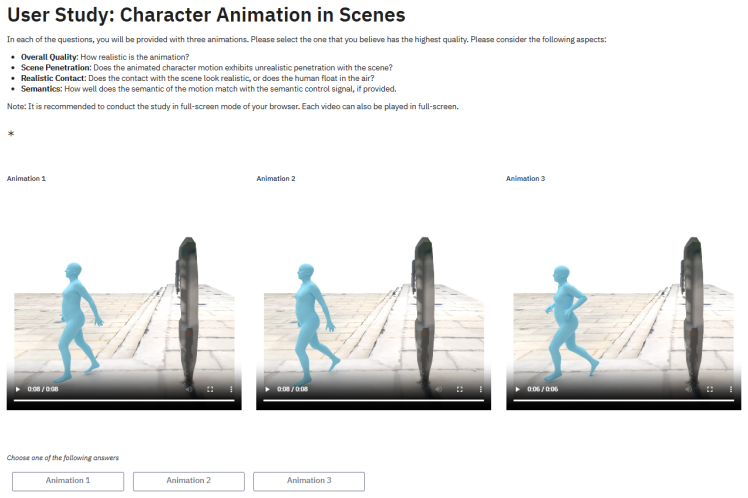
Summary. The paper introduces SCENIC, a diffusion-based method for synthesizing human motion that adapts to uneven terrain while following text instructions. The model uses a hierarchical representation: a goal-centric canonical coordinate frame for long-horizon navigation and a local ego-centric distance field for terrain geometry, combined with frame-wise text tokens and an autoregressive segment generation process. A physics-based guidance term is applied at inference to encourage foot-ground contact and prevent penetration. The authors build a synthetic dataset by fitting motion-capture segments onto 4m x 4m heightmap patches from Source Engine terrains, and evaluate on scene constraints (penetration, contact distance), goal accuracy, motion realism (FID, diversity, foot-skate), and a 24-participant user study, reporting improvements over text- and scene-conditioned baselines. Qualitative generalization to four real-scene datasets is shown.
Significance. If substantiated, SCENIC would be a valuable step toward unified text- and scene-controlled motion synthesis, combining two lines of research that are usually separate. The dual canonical/local representation and the frame-wise text conditioning are sensible design choices, and the synthetic data pipeline addresses the scarcity of paired motion-scene-text data. The paper is generally well written and includes ablations and a user study. However, the quantitative evidence for terrain adaptation is weakened by the circularity of the terrain-fitting evaluation, and the text-control claim lacks a direct quantitative metric. With additional experiments on real scenes or non-fitted terrains and proper statistical reporting, the work could be a solid contribution.
major comments (4)
- [Appendix 2.1, §4.3, Table 1] The scene-constraint metrics (Penetration and Contact distance) in Table 1 are computed on test terrain patches that were selected and deformed using the same objective as the evaluation metrics: the fitting process in Appendix 2.1 minimizes Efit = Econtact + Epenetration + Ejump (Eqs. 4-7), where Econtact and Epenetration are the exact errors later reported as Contact distance and Penetration in Sec. 4.3. Because the test terrains were fitted to the ground-truth foot contacts, the low numbers (1.57 cm, 4.51 cm) are partly inherited from data construction and do not by themselves demonstrate that the model generalizes to arbitrary terrain geometry. Real-scene results on HPS, Matterport3D, Replica, and LaserHuman are presented only qualitatively. This is the main load-bearing gap for the central claim of terrain adaptation. I recommend evaluating on the actual 3D meshes of real-scene datasets (e.g., by measuring penetration and contact of the generated SMPL bodies against the scans) or on a held-out terrain set generated without fitting to the test motions.
- [§4.4, Table 1] All metrics in Table 1 are reported as single values without error bars, multiple sampling seeds, or significance tests. Several of the claimed improvements are small in absolute terms (e.g., penetration 1.57 vs. 1.98 cm; contact distance 4.51 vs. 5.55 cm), and diffusion sampling is stochastic. The authors should report mean plus/minus std over at least three seeds (or multiple sampling runs per model) and include a paired significance test (e.g., bootstrap or Wilcoxon) for the headline scene-constraint and goal-reaching metrics.
- [§3.6, §4.4, Table 1] The contribution of the proposed physics guidance Jphys is not ablated, and the text 'For a fair comparison with baselines, the inference guidance is not activated for all comparisons' is ambiguous. If guidance was disabled in Table 1, then the reported scene-constraint values do not reflect the paper's proposed guidance mechanism; if it was enabled, the comparison is not fair because the baselines lack an equivalent component. Please clarify which setting produced Table 1 and add an ablation 'Ours without Jphys' to isolate its effect.
- [§4.3, Table 1] No quantitative metric directly measures text-motion alignment. The 'Multimodality' column is described as 'the alignment between the generated motion and the text instruction,' but the reported values (ground truth 6.023, Ours 6.354) are a diversity measure, not an alignment score. The text-control claim rests mainly on qualitative examples and the user study, which is a holistic preference judgment. I recommend adding a standard retrieval-based metric (e.g., motion-to-text retrieval accuracy) or computing CLIP-space similarity between the prompt and the generated motion to substantiate fine-grained text control.
minor comments (8)
- [Appendix 2.1] The citation 'Botsch and Kobbelt et al. [?]' is missing the full reference; please add the complete bibliographic entry.
- [Table 1] The caption does not define the arrows (down-arrow, up-arrow, right-arrow) nor specify whether lower or higher is better for each column; please add a legend.
- [§4.4] The description of 'Multimodality' as a text-alignment measure is inconsistent with its actual definition as a diversity metric; correct either the description or the metric.
- [§4.1] The dataset statistics are inconsistent: Table 2 sums to about 168 minutes, which at 30 fps and 60-frame clips yields roughly 5,000 unique segments, while the text claims 15,000 sequences. Please clarify how mirroring and the three fitted terrains inflate the count, and confirm whether the 1,000 test sequences are unique motion clips or augmented copies.
- [§3.6] The phrase 'For a fair comparison with baselines, the inference guidance is not activated for all comparisons' is confusing; please rewrite to state explicitly which configuration (with or without guidance) generated the numbers in Table 1.
- [§3.2] The scene embedding is described as 'projecting from the point grid perpendicularly toward the scene'; please specify the projection direction (e.g., downward) and how the distance is computed when the ray does not intersect the scene.
- [§4.5] Qualitative results are shown only for HPS and Matterport3D in Figures 3 and 5; Replica and LaserHuman are mentioned but not displayed. Either include representative examples for these datasets or refer the reader to the supplementary video.
- [§4.4] The user study reports 75.6% preference, but no confidence interval or statistical test is given for this proportion; please report a binomial confidence interval given the 24 participants and 7 questions.
Circularity Check
Scene-constraint metrics are computed on synthetic terrains fitted to the reference motions using the same foot-contact and penetration objective that the metrics report, so the quantitative terrain-adaptation claim is partly inherited from data construction.
-
fitted input called prediction
[Sec. 4.1; Sec. 4.3; Appendix 2.1, Eqs. 4-7; Table 1]
"The terrains with minimized foot contact and penetration error are retrieved, where the error is computed similarly to Equation 3. ... Econtact = Σ_i Σ_j c^i_j (h^i_j − J^i_feet,j)^2, Epenetration = Σ_i Σ_j (1 − c^i_j) max(h^i_j − J^i_feet,j, 0). ... Penetration (cm) measures the average penetration distance for all the human body vertices [31, 39, 79, 80], obtained by querying all body vertices from the computed SDF of the testing scenes. Contact distance (cm) evaluates the average distance to the scene when there is contact."
The heightmap patches used as training and testing scenes are selected by brute-force search and then RBF-edited to minimize Efit = Econtact + Epenetration + Ejump (Eqs. 4-7), which penalizes foot-height mismatch during contact and foot penetration during non-contact. The evaluation metrics in Table 1, Penetration and Contact distance, measure the same quantities on those same fitted test patches (Sec. 4.3). Since the test set is drawn from the fitted dataset (1000 reserved sequences), the low penetration (1.57 cm) and contact distance (4.51 cm) are partly guaranteed by construction rather than produced by the model's scene reasoning.
full rationale
The main quantitative support for terrain adaptation is compromised because the evaluation set is generated by the same objective as the metrics. The patch-selection and terrain-deformation pipeline minimizes foot contact and penetration errors (Appendix 2.1) on the very test patches where Penetration and Contact distance are reported (Table 1), so the absolute numbers are partly inherited from data construction rather than from the model's learned scene reasoning. I found no load-bearing self-citation chain: the cited prior work is used for standard representations (heightmaps, distance fields, SMPL, motion datasets) and does not carry the central argument. The text-control and goal-reaching evaluations are not circular: text alignment is evaluated with learned FID/multimodality metrics, and goal-reaching is measured by positional and rotational error to specified goals, independent of the fitting objective. The user study on real scenes (HPS, Matterport) provides some external support for generalization, but those results are qualitative. Overall, this is a partial circularity in the scene-constraint evaluation, not a fully forced derivation.
Assumptions & free parameters
free parameters (7)
- Physics guidance weight alpha =
3 (physics), 50 (smoothness), 50 (collision)
- Positional loss weight lambda =
4
- Text embedding dimensionality D =
64
- Scene grid size and resolution =
1.2m x 1.2m grid, 144 points
- Segment length N and seed frames k =
N=40, k=10
- Terrain fitting jump threshold l =
0.3m
- Number of fitted terrains per motion =
3
assumptions (5)
- domain assumption SMPL parameterization faithfully represents human body motion for training and evaluation.
- domain assumption CLIP text embeddings, after PCA to 64 dimensions, preserve the semantic distinctions needed for motion control.
- standard math The diffusion model can learn to reverse the forward noising process conditioned on scene, text, and seed motion.
- ad hoc to paper Synthetic terrain patches fitted to motion capture data are representative of real-world indoor scenes.
- ad hoc to paper Source Engine heightmap terrains provide sufficient geometric diversity for training a generalizable scene-aware model.
Cite this review
Pith. "Pith review of SCENIC: Scene-aware Semantic Navigation with Instruction-guided Control." pith.science (2026). https://pith.science/paper/XH73GVKW
@misc{pith2026241215664,
  author       = {Pith},
  title        = {Pith review of: SCENIC: Scene-aware Semantic Navigation with Instruction-guided Control},
  year         = {2026},
  howpublished = {\url{https://pith.science/paper/XH73GVKW}},
  note         = {Machine review of arXiv:2412.15664}
}
read the original abstract
Synthesizing natural human motion that adapts to complex environments while allowing creative control remains a fundamental challenge in motion synthesis. Existing models often fall short, either by assuming flat terrain or lacking the ability to control motion semantics through text. To address these limitations, we introduce SCENIC, a diffusion model designed to generate human motion that adapts to dynamic terrains within virtual scenes while enabling semantic control through natural language. The key technical challenge lies in simultaneously reasoning about complex scene geometry while maintaining text control. This requires understanding both high-level navigation goals and fine-grained environmental constraints. The model must ensure physical plausibility and precise navigation across varied terrain, while also preserving user-specified text control, such as ``carefully stepping over obstacles" or ``walking upstairs like a zombie." Our solution introduces a hierarchical scene reasoning approach. At its core is a novel scene-dependent, goal-centric canonicalization that handles high-level goal constraint, and is complemented by an ego-centric distance field that captures local geometric details. This dual representation enables our model to generate physically plausible motion across diverse 3D scenes. By implementing frame-wise text alignment, our system achieves seamless transitions between different motion styles while maintaining scene constraints. Experiments demonstrate our novel diffusion model generates arbitrarily long human motions that both adapt to complex scenes with varying terrain surfaces and respond to textual prompts. Additionally, we show SCENIC can generalize to four real-scene datasets. Our code, dataset, and models will be released at \url{https://virtualhumans.mpi-inf.mpg.de/scenic/}.
Figures


Figures from the paper (3 more)


Forward citations
Cited by 1 Pith paper
-
Perceiving and Acting in First-Person: A Dataset and Benchmark for Egocentric Human-Object-Human Interactions
Claimed first large-scale egocentric and multi-view dataset of human-object-human assistance (11.4 hours, 1.2M frames) with three benchmarks; only the abstract was assessable because the submitted body text is a diffe...
Reference graph
Works this paper leans on
-
[1]
In: Proceedings of the IEEE/CVF Conference on Computer Vision and Pattern Recognition (CVPR)
Ara ´ujo, J.a.P., Li, J., Vetrivel, K., Agarwal, R., Wu, J., Gopinath, D., Clegg, A.W., Liu, K.: Circle: Capture in rich contextual environments. In: Proceedings of the IEEE/CVF Conference on Computer Vision and Pattern Recognition (CVPR). pp. 21211–21221 (June
-
[2]
In: Proceedings of the IEEE/CVF Con- ference on Computer Vision and Pattern Recognition (2024) 2, 6
Barquero, G., Escalera, S., Palmero, C.: Seamless human motion composition with blended positional encodings. In: Proceedings of the IEEE/CVF Con- ference on Computer Vision and Pattern Recognition (2024) 2, 6
2024
-
[3]
In: IEEE Conference on Computer Vision and Pattern Recognition (CVPR) (June 2022) 3
Bhatnagar, B.L., Xie, X., Petrov, I., Sminchisescu, C., Theobalt, C., Pons-Moll, G.: Behave: Dataset and method for tracking human object interactions. In: IEEE Conference on Computer Vision and Pattern Recognition (CVPR) (June 2022) 3
2022
-
[4]
Braun, J., Christen, S., Kocabas, M., Aksan, E., Hilliges, O.: Physically plausible full-body hand- object interaction synthesis 3
-
[5]
In: International Confer- ence on 3D Vision (3DV 2024) (2024) 3
Braun, J., Christen, S., Kocabas, M., Aksan, E., Hilliges, O.: Physically plausible full-body hand- object interaction synthesis. In: International Confer- ence on 3D Vision (3DV 2024) (2024) 3
2024
-
[6]
In: CVPR (2024) 3, 4
Cen, Z., Pi, H., Peng, S., Shen, Z., Yang, M., Shuai, Z., Bao, H., Zhou, X.: Generating human motion in 3d scenes from text descriptions. In: CVPR (2024) 3, 4
2024
-
[7]
In: CVPR (2022) 2, 4
Chan, E.R., Lin, C.Z., Chan, M.A., Nagano, K., Pan, B., Mello, S.D., Gallo, O., Guibas, L., Tremblay, J., Khamis, S., Karras, T., Wetzstein, G.: Efficient geometry-aware 3D generative adversarial networks. In: CVPR (2022) 2, 4
2022
-
[8]
International Conference on 3D Vision (3DV) (2017) 2, 6, 8, 13
Chang, A., Dai, A., Funkhouser, T., Halber, M., Niess- ner, M., Savva, M., Song, S., Zeng, A., Zhang, Y .: Matterport3d: Learning from rgb-d data in indoor en- vironments. International Conference on 3D Vision (3DV) (2017) 2, 6, 8, 13
2017
Show all 97 references
-
[9]
arxiv:2410.18977 (2024) 2
Chen, L.H., Dai, W., Ju, X., Lu, S., Zhang, L.: Motionclr: Motion generation and training- free editing via understanding attention mechanisms. arxiv:2410.18977 (2024) 2
2024 arXiv
-
[10]
In: SIGGRAPH (2024) 2
Chen, R., Shi, M., Huang, S., Tan, P., Komura, T., Chen, X.: Taming diffusion probabilistic models for character control. In: SIGGRAPH (2024) 2
2024
-
[11]
In: Proceedings of the IEEE/CVF Conference on Computer Vision and Pat- tern Recognition (2023) 2
Chen, X., Jiang, B., Liu, W., Huang, Z., Fu, B., Chen, T., Yu, G.: Executing your commands via mo- tion diffusion in latent space. In: Proceedings of the IEEE/CVF Conference on Computer Vision and Pat- tern Recognition (2023) 2
2023
-
[12]
In: Proceedings of the IEEE/CVF Conference on Computer Vision and Pattern Recognition (CVPR) (2022) 3
Christen, S., Kocabas, M., Aksan, E., Hwangbo, J., Song, J., Hilliges, O.: D-grasp: Physically plausi- ble dynamic grasp synthesis for hand-object interac- tions. In: Proceedings of the IEEE/CVF Conference on Computer Vision and Pattern Recognition (CVPR) (2022) 3
2022
-
[13]
Cong, P., Wang, Z., Dou, Z., Ren, Y ., Yin, W., Cheng, K., Sun, Y ., Long, X., Zhu, X., Ma, Y .: Laserhuman: Language-guided scene-aware human motion genera- tion in free environment (2024) 2, 3, 5, 8, 9
2024
-
[14]
In: Conference on Computer Vision and Pattern Recognition(CVPR), year=2024 3
Cui, J., Liu, T., Liu, N., Yang, Y ., Zhu, Y ., Huang, S.: Anyskill: Learning open-vocabulary physical skill for interactive agents. In: Conference on Computer Vision and Pattern Recognition(CVPR), year=2024 3
2024
-
[15]
In: Computer Vision and Pat- tern Recognition (CVPR) (2023) 2
Dabral, R., Mughal, M.H., Golyanik, V ., Theobalt, C.: Mofusion: A framework for denoising-diffusion- based motion synthesis. In: Computer Vision and Pat- tern Recognition (CVPR) (2023) 2
2023
-
[16]
Diller, C., Dai, A.: Cg-hoi: Contact-guided 3d human- object interaction generation (2024) 3
2024
-
[17]
In: Proceedings IEEE Con- ference on Computer Vision and Pattern Recognition (CVPR) (2024) 3
Diomataris, M., Athanasiou, N., Taheri, O., Wang, X., Hilliges, O., Black, M.J.: W ANDR: Intention-guided human motion generation. In: Proceedings IEEE Con- ference on Computer Vision and Pattern Recognition (CVPR) (2024) 3
2024
-
[18]
In: Euro- pean Conference on Computer Vision (ECCV) (2024) 2
Ghosh, A., Dabral, R., Golyanik, V ., Theobalt, C., Slusallek, P.: Remos: 3d motion-conditioned reac- tion synthesis for two-person interactions. In: Euro- pean Conference on Computer Vision (ECCV) (2024) 2
2024
-
[19]
In: Proceedings of the IEEE/CVF Conference on Computer Vision and Pattern Recogni- tion (CVPR) (2022) 2, 4
Guo, C., Zou, S., Zuo, X., Wang, S., Ji, W., Li, X., Cheng, L.: Generating diverse and natural 3d human motions from text. In: Proceedings of the IEEE/CVF Conference on Computer Vision and Pattern Recogni- tion (CVPR) (2022) 2, 4
2022
-
[20]
In: Proceed- ings of the 28th ACM International Conference on Multimedia
Guo, C., Zuo, X., Wang, S., Zou, S., Sun, Q., Deng, A., Gong, M., Cheng, L.: Action2motion: Condi- tioned generation of 3d human motions. In: Proceed- ings of the 28th ACM International Conference on Multimedia. pp. 2021–2029 (2020) 8
2020
-
[21]
In: IEEE Conference on Computer Vision and Pattern Recognition (CVPR) (2021) 2, 6, 7, 8, 13
Guzov, V ., Mir, A., Sattler, T., Pons-Moll, G.: Human poseitioning system (hps): 3d human pose estima- tion and self-localization in large scenes from body- mounted sensors. In: IEEE Conference on Computer Vision and Pattern Recognition (CVPR) (2021) 2, 6, 7, 8, 13
2021
-
[22]
In: Proceedings of the International Conference on Computer Vision 2021 (Oct 2021) 3, 5, 6
Hassan, M., Ceylan, D., Villegas, R., Saito, J., Yang, J., Zhou, Y ., Black, M.: Stochastic scene-aware mo- tion prediction. In: Proceedings of the International Conference on Computer Vision 2021 (Oct 2021) 3, 5, 6
2021
-
[23]
CoRR abs/2302.00883 (2023) 3
Hassan, M., Guo, Y ., Wang, T., Black, M.J., Fidler, S., Peng, X.B.: Synthesizing physical character-scene interactions. CoRR abs/2302.00883 (2023) 3
2023 arXiv
-
[24]
arXiv:2204.03458 (2022) 5
Ho, J., Salimans, T., Gritsenko, A., Chan, W., Norouzi, M., Fleet, D.J.: Video diffusion models. arXiv:2204.03458 (2022) 5
2022 arXiv
-
[25]
In: Thirty-Eighth Conference on Artificial Intelligence, AAAI 2024 2
Hoang, N.M., Gong, K., Guo, C., Mi, M.B.: Mo- tionmix: Weakly-supervised diffusion for controllable motion generation. In: Thirty-Eighth Conference on Artificial Intelligence, AAAI 2024 2
2024
-
[26]
ACM Trans
Holden, D., Komura, T., Saito, J.: Phase-functioned neural networks for character control. ACM Trans. Graph. 36(4) (2017) 2, 3, 5
2017
-
[27]
ACM Trans
Holden, D., Saito, J., Komura, T.: A deep learning framework for character motion synthesis and editing. ACM Trans. Graph. (2016) 2
2016
-
[28]
Huang, Y ., Wan, W., Yang, Y ., Callison-Burch, C., Yatskar, M., Liu, L.: Como: Controllable motion generation through language guided pose code editing (2024) 2
2024
-
[29]
In: SIGGRAPH Asia Confer- ence Papers (2024) 2, 3, 4, 5
Jiang, N., He, Z., Li, H., Chen, Y ., Huang, S., Zhu, Y .: Autonomous character-scene interaction synthesis from text instruction. In: SIGGRAPH Asia Confer- ence Papers (2024) 2, 3, 4, 5
2024
-
[30]
In: ICCV (2023) 3
Jiang, N., Liu, T., Cao, Z., Cui, J., Chen, Y ., Wang, H., Zhu, Y ., Huang, S.: Full-body articulated human- object interaction. In: ICCV (2023) 3
2023
-
[31]
In: Proceedings of the IEEE/CVF Conference on Computer Vision and Pattern Recognition
Jiang, N., Zhang, Z., Li, H., Ma, X., Wang, Z., Chen, Y ., Liu, T., Zhu, Y ., Huang, S.: Scaling up dynamic human-scene interaction modeling. In: Proceedings of the IEEE/CVF Conference on Computer Vision and Pattern Recognition. pp. 1737–1747 (2024) 2, 3, 4, 6, 8
2024
-
[32]
In: Proceedings of the IEEE/CVF International Conference on Computer Vi- sion (2023) 2, 5
Karunratanakul, K., Preechakul, K., Suwajanakorn, S., Tang, S.: Guided motion diffusion for control- lable human motion synthesis. In: Proceedings of the IEEE/CVF International Conference on Computer Vi- sion (2023) 2, 5
2023
-
[33]
Kim, J., Kim, J., Na, J., Joo, H.: Parahome: Parame- terizing everyday home activities towards 3d genera- tive modeling of human-object interactions (2024) 3
2024
-
[34]
arXiv preprint arXiv:2209.00349 (2022) 2
Kim, J., Kim, J., Choi, S.: Flame: Free-form language-based motion synthesis & editing. arXiv preprint arXiv:2209.00349 (2022) 2
2022 arXiv
-
[35]
In: IEEE/CVF International Conference on Computer Vision, ICCV 2023, 2
Kong, H., Gong, K., Lian, D., Mi, M.B., Wang, X.: Priority-centric human motion generation in discrete latent space. In: IEEE/CVF International Conference on Computer Vision, ICCV 2023, 2
2023
-
[36]
Kulkarni, N., Rempe, D., Genova, K., Kundu, A., Johnson, J., Fouhey, D., Guibas, L.: Nifty: Neural object interaction fields for guided human motion syn- thesis (2023) 3
2023
-
[37]
arXiv preprint arXiv:2301.02667 (2023) 3
Lee, J., Joo, H.: Locomotion-action-manipulation: Synthesizing human-scene interactions in complex 3d environments. arXiv preprint arXiv:2301.02667 (2023) 3
2023 arXiv
-
[38]
arXiv preprint arXiv:2409.15904 (2024) 2, 4
Li, C., Chibane, J., He, Y ., Pearl, N., Geiger, A., Pons-Moll, G.: Unimotion: Unifying 3d human motion synthesis and understanding. arXiv preprint arXiv:2409.15904 (2024) 2, 4
2024 arXiv
-
[39]
Li, J., Clegg, A., Mottaghi, R., Wu, J., Puig, X., Liu, C.K.: Controllable human-object interaction synthesis 2, 3, 5, 8
-
[40]
In: ECCV (2024)
Li, J., Clegg, A., Mottaghi, R., Wu, J., Puig, X., Liu, C.K.: Controllable human-object interaction synthe- sis. In: ECCV (2024)
2024
-
[41]
ACM Transactions on Graph- ics 42(6) (Dec 2023) 3
Li, J., Wu, J., Liu, C.K.: Object motion guided hu- man motion synthesis. ACM Transactions on Graph- ics 42(6) (Dec 2023) 3
2023
-
[42]
In: IEEE/CVF Winter Con- ference on Applications of Computer Vision, W ACV 2024 3
Li, Q., Wang, J., Loy, C.C., Dai, B.: Task-oriented human-object interactions generation with implicit neural representations. In: IEEE/CVF Winter Con- ference on Applications of Computer Vision, W ACV 2024 3
2024
-
[43]
In: ICLR (2024) 2
Li, S., Gu, T., Yang, Z., Lin, Z., Liu, Z., Ding, H., Yang, L., Loy, C.C.: Duolando: Follower gpt with off-policy reinforcement learning for dance accompa- niment. In: ICLR (2024) 2
2024
-
[44]
International Journal of Computer Vision (2024) 2
Liang, H., Zhang, W., Li, W., Yu, J., Xu, L.: Inter- gen: Diffusion-based multi-human motion generation under complex interactions. International Journal of Computer Vision (2024) 2
2024
-
[45]
arXiv preprint arXiv:2312.02700 (2023) 3, 4
Liu, X., Hou, H., Yang, Y ., Li, Y .L., Lu, C.: Revisit human-scene interaction via space occupancy. arXiv preprint arXiv:2312.02700 (2023) 3, 4
2023 arXiv
-
[46]
In: The Twelfth International Conference on Learning Representations (2024) 3
Liu, X., Yi, L.: Geneoh diffusion: Towards general- izable hand-object interaction denoising via denoising diffusion. In: The Twelfth International Conference on Learning Representations (2024) 3
2024
-
[47]
ACM Trans
Loper, M., Mahmood, N., Romero, J., Pons-Moll, G., Black, M.J.: SMPL: A skinned multi-person lin- ear model. ACM Trans. Graphics (Proc. SIGGRAPH Asia) 34 (Oct 2015) 4
2015
-
[48]
arxiv:2310.12978 (2023) 2
Lu, S., Chen, L.H., Zeng, A., Lin, J., Zhang, R., Zhang, L., Shum, H.Y .: Humantomato: Text-aligned whole-body motion generation. arxiv:2310.12978 (2023) 2
2023 arXiv
-
[49]
In: The Twelfth International Conference on Learning Representations (2024) 2, 3
Luo, Z., Cao, J., Merel, J., Winkler, A., Huang, J., Ki- tani, K.M., Xu, W.: Universal humanoid motion repre- sentations for physics-based control. In: The Twelfth International Conference on Learning Representations (2024) 2, 3
2024
-
[50]
arXiv preprint arXiv:2403.15709 (2024) 2
Ma, S., Cao, Q., Zhang, J., Tao, D.: Contact-aware human motion generation from textual descriptions. arXiv preprint arXiv:2403.15709 (2024) 2
2024 arXiv
-
[51]
In: 2019 IEEE/CVF International Conference on Computer Vision, ICCV 2019, Seoul, Korea (South), October 27 - November 2, 2019 2
Mahmood, N., Ghorbani, N., Troje, N.F., Pons-Moll, G., Black, M.J.: AMASS: archive of motion capture as surface shapes. In: 2019 IEEE/CVF International Conference on Computer Vision, ICCV 2019, Seoul, Korea (South), October 27 - November 2, 2019 2
2019
-
[52]
ACM Trans
Merel, J., Tunyasuvunakool, S., Ahuja, A., Tassa, Y ., Hasenclever, L., Pham, V ., Erez, T., Wayne, G., Heess, N.: Catch & carry: reusable neural controllers for vision-guided whole-body tasks. ACM Trans. Graph. (2020) 3
2020
-
[53]
In: International Conference on 3D Vision (3DV) (March 2024) 2, 3
Mir, A., Puig, X., Kanazawa, A., Pons-Moll, G.: Gen- erating continual human motion in diverse 3d scenes. In: International Conference on 3D Vision (3DV) (March 2024) 2, 3
2024
-
[54]
Pan, L., jingbo Wang, Huang, B., Zhang, J., Wang, H., Tang, X., Wang, Y .: Synthesizing physically plausible human motions in 3d scenes (2023) 3
2023
-
[55]
arXiv preprint arXiv:2312.06553 (2023) 3
Peng, X., Xie, Y ., Wu, Z., Jampani, V ., Sun, D., Jiang, H.: Hoi-diff: Text-driven synthesis of 3d human-object interactions using diffusion models. arXiv preprint arXiv:2312.06553 (2023) 3
2023 arXiv
-
[56]
In: CVPR Workshop on Human Motion Genera- tion (2024) 2
Petrovich, M., Litany, O., Iqbal, U., Black, M.J., Varol, G., Peng, X.B., Rempe, D.: Multi-track time- line control for text-driven 3d human motion genera- tion. In: CVPR Workshop on Human Motion Genera- tion (2024) 2
2024
-
[57]
In: Proceedings of the IEEE/CVF International Conference on Computer Vi- sion (ICCV) (October 2023) 3
Pi, H., Peng, S., Yang, M., Zhou, X., Bao, H.: Hier- archical generation of human-object interactions with diffusion probabilistic models. In: Proceedings of the IEEE/CVF International Conference on Computer Vi- sion (ICCV) (October 2023) 3
2023
-
[58]
In: 2019 IEEE/CVF International Conference on Computer Vi- sion, ICCV 2019, Seoul, Korea (South), October 27 - November 2, 2019 (2019) 5
Prokudin, S., Lassner, C., Romero, J.: Efficient learn- ing on point clouds with basis point sets. In: 2019 IEEE/CVF International Conference on Computer Vi- sion, ICCV 2019, Seoul, Korea (South), October 27 - November 2, 2019 (2019) 5
2019
-
[59]
In: Pro- ceedings IEEE/CVF Conf
Punnakkal, A.R., Chandrasekaran, A., Athanasiou, N., Quiros-Ramirez, A., Black, M.J.: BABEL: Bod- ies, action and behavior with english labels. In: Pro- ceedings IEEE/CVF Conf. on Computer Vision and Pattern Recognition (CVPR) (2021) 2
2021
-
[60]
In: Conference on Computer Vision and Pattern Recognition (CVPR) (2023) 2, 3
Rempe, D., Luo, Z., Peng, X.B., Yuan, Y ., Kitani, K., Kreis, K., Fidler, S., Litany, O.: Trace and pace: Controllable pedestrian animation via guided trajec- tory diffusion. In: Conference on Computer Vision and Pattern Recognition (CVPR) (2023) 2, 3
2023
-
[61]
arXiv preprint arXiv:2303.01418 (2023) 2, 4
Shafir, Y ., Tevet, G., Kapon, R., Bermano, A.H.: Human motion diffusion as a generative prior. arXiv preprint arXiv:2303.01418 (2023) 2, 4
2023 arXiv
-
[62]
In: The Twelfth International Conference on Learning Repre- sentations (2024) 4
Shafir, Y ., Tevet, G., Kapon, R., Bermano, A.H.: Hu- man motion diffusion as a generative prior. In: The Twelfth International Conference on Learning Repre- sentations (2024) 4
2024
-
[63]
ACM Trans
Starke, S., Zhang, H., Komura, T., Saito, J.: Neural state machine for character-scene interactions. ACM Trans. Graph. 38(6) (2019) 3, 4
2019
-
[64]
arXiv preprint arXiv:1906.05797 (2019) 2, 7, 8
Straub, J., Whelan, T., Ma, L., Chen, Y ., Wijmans, E., Green, S., Engel, J.J., Mur-Artal, R., Ren, C., Verma, S., Clarkson, A., Yan, M., Budge, B., Yan, Y ., Pan, X., Yon, J., Zou, Y ., Leon, K., Carter, N., Briales, J., Gillingham, T., Mueggler, E., Pesqueira, L., Savva, M.,...
2019 arXiv
-
[65]
In: Conference on Computer Vision and Pattern Recognition (CVPR) (2022), https: //goal.is.tue.mpg.de 3
Taheri, O., Choutas, V ., Black, M.J., Tzionas, D.: GOAL: Generating 4D whole-body motion for hand- object grasping. In: Conference on Computer Vision and Pattern Recognition (CVPR) (2022), https: //goal.is.tue.mpg.de 3
2022
-
[66]
In: International Conference on 3D Vision (3DV 2024) (2024) 3
Taheri, O., Zhou, Y ., Tzionas, D., Zhou, Y ., Ceylan, D., Pirk, S., Black, M.J.: Grip: Generating interac- tion poses conditioned on object and body motion. In: International Conference on 3D Vision (3DV 2024) (2024) 3
2024
-
[67]
In: ICCV (2023) 2
Tanaka, M., Fujiwara, K.: Role-aware interaction gen- eration from textual description. In: ICCV (2023) 2
2023
-
[68]
In: Conference on Computer Vision and Pattern Recognition (CVPR) (2023) 3
Tendulkar, P., Sur´ıs, D., V ondrick, C.: Flex: Full-body grasping without full-body grasps. In: Conference on Computer Vision and Pattern Recognition (CVPR) (2023) 3
2023
-
[69]
In: The Eleventh International Conference on Learn- ing Representations (2023) 2, 4, 8
Tevet, G., Raab, S., Gordon, B., Shafir, Y ., Cohen-or, D., Bermano, A.H.: Human motion diffusion model. In: The Eleventh International Conference on Learn- ing Representations (2023) 2, 4, 8
2023
-
[70]
CoRR abs/2311.17135 (2023) 2
Wan, W., Dou, Z., Komura, T., Wang, W., Jayara- man, D., Liu, L.: Tlcontrol: Trajectory and lan- guage control for human motion synthesis. CoRR abs/2311.17135 (2023) 2
2023 arXiv
-
[71]
In: Proceedings of the IEEE/CVF Conference on Computer Vision and Pattern Recognition (CVPR) (2024) 3
Wang, Z., Chen, Y ., Jia, B., Li, P., Zhang, J., Zhang, J., Liu, T., Zhu, Y ., Liang, W., Huang, S.: Move as you say, interact as you can: Language-guided human mo- tion generation with scene affordance. In: Proceedings of the IEEE/CVF Conference on Computer Vision and Pattern...
2024
-
[72]
In: Advances in Neu- ral Information Processing Systems (NeurIPS) (2022) 3
Wang, Z., Chen, Y ., Liu, T., Zhu, Y ., Liang, W., Huang, S.: Humanise: Language-conditioned human motion generation in 3d scenes. In: Advances in Neu- ral Information Processing Systems (NeurIPS) (2022) 3
2022
-
[73]
CoRR abs/2403.11208 (2024) 3
Wu, Q., Shi, Y ., Huang, X., Yu, J., Xu, L., Wang, J.: THOR: text to human-object interaction diffusion via relation intervention. CoRR abs/2403.11208 (2024) 3
2024 arXiv
-
[74]
In: The Twelfth International Con- ference on Learning Representations (2024) 2
Xie, Y ., Jampani, V ., Zhong, L., Sun, D., Jiang, H.: Omnicontrol: Control any joint at any time for human motion generation. In: The Twelfth International Con- ference on Learning Representations (2024) 2
2024
-
[75]
In: ICCV (2023) 3
Xu, S., Li, Z., Wang, Y .X., Gui, L.Y .: Interdiff: Gen- erating 3d human-object interactions with physics- informed diffusion. In: ICCV (2023) 3
2023
-
[76]
arXiv preprint arXiv:2403.19652 (2024) 3
Xu, S., Wang, Z., Wang, Y .X., Gui, L.Y .: Inter- dreamer: Zero-shot text to 3d dynamic human-object interaction. arXiv preprint arXiv:2403.19652 (2024) 3
2024
-
[77]
In: AAAI (2018) 8
Yan, S., Xiong, Y ., Lin, D.: Spatial temporal graph convolutional networks for skeleton-based ac- tion recognition. In: AAAI (2018) 8
2018
-
[78]
European Conference on Com- puter Vision (2024) 3
Yang, J., Niu, X., Jiang, N., Zhang, R., Siyuan, H.: F- hoi: Toward fine-grained semantic-aligned 3d human- object interactions. European Conference on Com- puter Vision (2024) 3
2024
-
[79]
In: IEEE Conference on Computer Vision and Pattern Recognition (CVPR) (June 2023) 8
Yi, H., Huang, C.H.P., Tripathi, S., Hering, L., Thies, J., Black, M.J.: MIME: Human-aware 3D scene gen- eration. In: IEEE Conference on Computer Vision and Pattern Recognition (CVPR) (June 2023) 8
2023
-
[80]
arXiv:2404.10685 (2024) 2, 3, 4, 5, 8
Yi, H., Thies, J., Black, M.J., Peng, X.B., Rempe, D.: Generating human interaction motions in scenes with text control. arXiv:2404.10685 (2024) 2, 3, 4, 5, 8
2024 arXiv
-
[81]
arXiv preprint arXiv:2406.19353 (2024) 3
Zhang, C., Liu, Y ., Xing, R., Tang, B., Yi, L.: Core4d: A 4d human-object-human interaction dataset for collaborative object rearrangement. arXiv preprint arXiv:2406.19353 (2024) 3
2024 arXiv
-
[82]
ACM Trans
Zhang, H., Ye, Y ., Shiratori, T., Komura, T.: Manip- net: neural manipulation synthesis with a hand-object spatial representation. ACM Trans. Graph. (2021) 3
2021
-
[83]
arXiv preprint arXiv:2404.00299 (2024) 3
Zhang, J., Zhang, J., Song, Z., Shi, Z., Zhao, C., Shi, Y ., Yu, J., Xu, L., Wang, J.: Hoi-m3: Capture multi- ple humans and objects interaction within contextual environment. arXiv preprint arXiv:2404.00299 (2024) 3
2024 arXiv
-
[84]
arXiv preprint arXiv:2208.15001 (2022) 2
Zhang, M., Cai, Z., Pan, L., Hong, F., Guo, X., Yang, L., Liu, Z.: Motiondiffuse: Text-driven human mo- tion generation with diffusion model. arXiv preprint arXiv:2208.15001 (2022) 2
2022 arXiv
-
[85]
In: 2023 IEEE/CVF Interna- tional Conference on Computer Vision, ICCV 2
Zhang, M., Guo, X., Pan, L., Cai, Z., Hong, F., Li, H., Yang, L., Liu, Z.: Remodiffuse: Retrieval-augmented motion diffusion model. In: 2023 IEEE/CVF Interna- tional Conference on Computer Vision, ICCV 2
2023
-
[86]
arXiv preprint arXiv:2308.12969 (2023) 3
Zhang, W., Dabral, R., Leimk ¨uhler, T., Golyanik, V ., Habermann, M., Theobalt, C.: Roam: Robust and object-aware motion generation using neural pose de- scriptors. arXiv preprint arXiv:2308.12969 (2023) 3
2023 arXiv
-
[87]
In: European Conference on Com- puter Vision (ECCV) (October 2022) 3
Zhang, X., Bhatnagar, B.L., Starke, S., Guzov, V ., Pons-Moll, G.: Couch: Towards controllable human- chair interactions. In: European Conference on Com- puter Vision (ECCV) (October 2022) 3
2022
-
[88]
In: Arxiv
Zhang, X., Bhatnagar, B.L., Starke, S., Petrov, I.A., Guzov, V ., Dhamo, H., P ´erez Pellitero, E., Pons- Moll, G.: Force: Dataset and method for intuitive physics guided human-object interaction. In: Arxiv. vol. 2403.11237 (2024) 3
2024 arXiv
-
[89]
In: SIGGRAPH, Technical Papers (2024) 2
Zhang, Z., Liu, R., Aberman, K., Hanocka, R.: Tedi: Temporally-entangled diffusion for long-term motion synthesis. In: SIGGRAPH, Technical Papers (2024) 2
2024
-
[90]
In: Arxiv
Zhao, K., Li, G., Tang, S.: A diffusion-based autore- gressive motion model for real-time text-driven mo- tion control. In: Arxiv. vol. abs/2410.05260 (2024) 3, 8
2024 arXiv
-
[91]
In: International conference on computer vi- sion (ICCV) (2023) 2, 3
Zhao, K., Zhang, Y ., Wang, S., Beeler, T., , Tang, S.: Synthesizing diverse human motions in 3d indoor scenes. In: International conference on computer vi- sion (ICCV) (2023) 2, 3
2023
-
[92]
arXiv preprint arXiv:2312.02256 (2023) 2
Zhou, W., Dou, Z., Cao, Z., Liao, Z., Wang, J., Wang, W., Liu, Y ., Komura, T., Wang, W., Liu, L.: Emdm: Efficient motion diffusion model for fast, high-quality motion generation. arXiv preprint arXiv:2312.02256 (2023) 2
2023 arXiv
-
[93]
In: The IEEE Conference on Computer Vision and Pattern Recognition (CVPR) (June 2019) 4 APPENDIX
Zhou, Y ., Barnes, C., Jingwan, L., Jimei, Y ., Hao, L.: On the continuity of rotation representations in neu- ral networks. In: The IEEE Conference on Computer Vision and Pattern Recognition (CVPR) (June 2019) 4 APPENDIX
2019
-
[94]
We utilized animations derived from the HPS [21] and Matterport [8] datasets for this purpose
Details on User Study Our evaluation encompasses a human perceptual study, which is aimed at assessing both the ability of our methods to satisfy scene constraints and their controllability through text. We utilized animations derived from the HPS [21] and Matterport [8] datas...
-
[95]
Dataset 2.1. Terrain Fitting Process Since capturing simultaneously human motion with scenes that include diverse terrains is expensive and difficult, we leverage a method that fits 2 second motion segments (60 frames) onto a set of 20,000 4x4 meters terrain patches to obtain ...
-
[96]
Patch Selection: Identify the three best-matching ter- rain patches using a brute-force search that minimizes a comprehensive error function
-
[97]
The error function Efit comprises three key components: Econtact ensures foot height matches ground contact point
Terrain Refinement: Apply a Radial Basis Function (RBF) mesh editing technique to ensure precise foot placement accuracy. The error function Efit comprises three key components: Econtact ensures foot height matches ground contact point. Epenetration prevents intersection when ...
Reviewed August 11, 2026 · model on record in the stance chip above.
Discussion (0). Continue with ORCID to comment.