Temperature distribution measurement on three-phase contact line in liquid nitrogen using two-color temperature-sensitive paint
Pith reviewed 2026-06-25 23:10 UTC · model grok-4.3
The pith
Two-color temperature-sensitive paint reveals a localized temperature minimum at the liquid-nitrogen three-phase contact line.
A machine-rendered reading of the paper's core claim, the machinery that carries it, and where it could break.
Core claim
The measured temperature fields revealed a localized temperature minimum at the observed three-phase contact line, suggesting localized cooling associated with phase change. Quantitative analysis showed that the average temperature in the liquid region remained nearly constant, whereas the temperature in the gas region increased with increasing heat flux. These observations reveal a non-uniform thermal structure around the cryogenic three-phase contact line.
What carries the argument
The two-color temperature-sensitive paint (2C-TSP) technique, which uses a temperature-sensitive dye and a temperature-insensitive reference dye to compute temperature from luminescence intensity ratios while compensating for refraction and reflection at the liquid-gas interface.
If this is right
- The 2C-TSP technique enables direct temperature visualization at cryogenic three-phase contact lines where infrared thermography is impractical.
- A temperature minimum appears at the contact line under all tested heat fluxes of 110, 430, and 900 W/m2, indicating phase-change cooling.
- Liquid-region temperatures stay nearly constant while gas-region temperatures increase with higher heat flux.
- The observations demonstrate a non-uniform thermal structure around the contact line in liquid nitrogen.
Where Pith is reading between the lines
- The temperature data could be combined with heat-flux measurements to estimate local evaporation rates at the contact line.
- The method may be extended to other cryogenic fluids or engineering systems involving phase change, such as cooling or propulsion devices.
- Repeated measurements at varying surface conditions could test how surface properties affect the observed temperature minimum.
Load-bearing premise
The two-color intensity ratio fully compensates for optical intensity changes caused by refraction and reflection at the liquid-gas interface, yielding accurate absolute temperatures at cryogenic conditions without additional corrections.
What would settle it
An independent temperature measurement at the contact line using a different sensor that fails to show the localized minimum, or a calibration test demonstrating that interface effects still distort the intensity ratio at liquid-nitrogen temperatures.
Figures

read the original abstract
Cryogenic phase-change phenomena play an important role in a wide range of engineering applications, including cryogenic cooling systems, superconducting technologies, and space propulsion systems. In particular, the three-phase contact line is recognized as a key region governing evaporation and heat transfer. However, direct measurements of temperature distributions near cryogenic three-phase contact lines remain limited because conventional infrared thermography becomes increasingly difficult at extremely low temperatures. In this study, a two-color temperature-sensitive paint (2C-TSP) technique was applied to visualize the temperature field around a liquid-nitrogen three-phase contact line. A temperature-sensitive dye and a temperature-insensitive reference dye were incorporated into a single coating, enabling robust temperature measurements based on luminescence intensity ratios by compensating for changes in optical intensity caused by refraction and reflection at the liquid-gas interface. Temperature distributions were measured under three heating conditions with heat fluxes of 110, 430, and 900 W/m2. The measured temperature fields revealed a localized temperature minimum at the observed three-phase contact line, suggesting localized cooling associated with phase change. Quantitative analysis showed that the average temperature in the liquid region remained nearly constant, whereas the temperature in the gas region increased with increasing heat flux. These observations reveal a non-uniform thermal structure around the cryogenic three-phase contact line. The present results demonstrate that 2C-TSP is a promising technique for direct visualization of temperature fields around cryogenic three-phase contact lines and provides new insights into phase-change phenomena in liquid nitrogen.
Editorial analysis
A structured set of objections, weighed in public.
Referee Report
Summary. The manuscript reports an experimental application of two-color temperature-sensitive paint (2C-TSP) to map temperature fields near a liquid-nitrogen three-phase contact line. A temperature-sensitive dye combined with a reference dye is used to form intensity ratios that are claimed to compensate for optical intensity variations due to refraction and reflection at the liquid-gas interface. Measurements at heat fluxes of 110, 430, and 900 W/m² are presented; the results indicate a localized temperature minimum at the contact line (interpreted as phase-change cooling), nearly constant average temperature in the liquid region, and increasing temperature in the gas region with heat flux.
Significance. If the absolute temperature accuracy is established, the work supplies direct, spatially resolved temperature data at a cryogenic contact line where infrared methods are impractical. Such measurements could inform models of evaporation and heat transfer in cryogenic systems. The 2C-TSP approach itself is a methodological contribution for handling interface optical effects, though its performance at 77 K requires explicit confirmation.
major comments (1)
- [Method description / Results] The central claim of a localized temperature minimum at the contact line (Abstract and Results) rests on the quantitative accuracy of the reported temperatures. The method description states that the intensity ratio compensates for refraction and reflection at the liquid-gas interface without further corrections, yet no interface-specific calibration data, residual error bounds, or comparison against independent sensors (e.g., thermocouples) under the stated heat fluxes are supplied to demonstrate that the compensation holds to the precision needed to resolve the minimum.
minor comments (2)
- [Results] No error bars, uncertainty estimates, or repeatability metrics accompany the temperature fields or the reported minimum.
- [Methods] Calibration details for the 2C-TSP coating at cryogenic temperatures (dye concentrations, excitation wavelengths, and reference temperature points) are not provided.
Simulated Author's Rebuttal
We thank the referee for the careful and constructive review. The concern regarding validation of the temperature accuracy at the interface is noted, and we respond point by point below.
read point-by-point responses
-
Referee: [Method description / Results] The central claim of a localized temperature minimum at the contact line (Abstract and Results) rests on the quantitative accuracy of the reported temperatures. The method description states that the intensity ratio compensates for refraction and reflection at the liquid-gas interface without further corrections, yet no interface-specific calibration data, residual error bounds, or comparison against independent sensors (e.g., thermocouples) under the stated heat fluxes are supplied to demonstrate that the compensation holds to the precision needed to resolve the minimum.
Authors: We agree that quantitative validation is required to substantiate the reported temperature minimum. The two-color ratio is presented as compensating for interface-induced intensity variations through the reference dye, but the manuscript does not include dedicated interface calibration curves, residual error quantification, or thermocouple comparisons at the stated heat fluxes and 77 K conditions. In the revised manuscript we will add interface-specific calibration data obtained under the experimental geometry, together with estimated error bounds on the temperature measurements. We will also discuss the practical difficulties of placing thermocouples at the contact line without perturbing the paint layer or the phase-change process, and include any available cross-checks or limitations. revision: yes
Circularity Check
No circularity: pure experimental measurement with no derivations or self-referential reductions
full rationale
This is an experimental paper reporting direct temperature field measurements via 2C-TSP on a cryogenic contact line. The abstract and description contain no equations, no fitted parameters, no model predictions, and no derivation chain. The intensity-ratio compensation is presented as an intrinsic property of the dual-dye coating rather than a result derived from or fitted to the target data. No self-citations are invoked as load-bearing premises, and the observed temperature minimum is reported as a measurement outcome, not a constructed prediction. The work is therefore self-contained against external benchmarks and receives the default non-finding for experimental reports lacking any of the enumerated circular patterns.
Axiom & Free-Parameter Ledger
axioms (1)
- domain assumption Luminescence intensity ratio from temperature-sensitive and reference dyes accurately reflects local temperature after compensation for optical path changes at the liquid-gas interface
Reference graph
Works this paper leans on
-
[1]
Simonini, M
A. Simonini, M. Dreyer, A. Urbano, F. Sanfedino, T. Himeno, P. Behruzi, M. Avila, J. Pinho, L. Peveroni, J.-B. Gouriet, Cryogenic propellant management in space: open challenges and perspectives, npj Microgravity, 10(1) (2024)
2024
-
[2]
Vaghela, V.J
H. Vaghela, V.J. Lakhera, B. Sarkar, Forced flow cryogenic cooling in fusion devices: A review, Heliyon, 7(1) (2021) e06053
2021
-
[3]
Krinner, S
S. Krinner, S. Storz, P. Kurpiers, P. Magnard, J. Heinsoo, R. Keller, J. Lütolf, C. Eichler, A. Wallraff, Engineering cryogenic setups for 100-qubit scale superconducting circuit systems, EPJ Quantum Technology, 6(1) (2019) 2
2019
-
[4]
Flynn, Cryogenic Engineering, Revised and Expanded, CRC Press, 2004
T. Flynn, Cryogenic Engineering, Revised and Expanded, CRC Press, 2004
2004
-
[5]
Barron, G.F
R.F. Barron, G.F. Nellis, Cryogenic Heat Transfer, CRC Press, 2017
2017
-
[6]
V.P. Carey, Liquid Vapor Phase Change Phenomena: An Introduction to the Thermophysics of Vaporization and Condensation Processes in Heat Transfer Equipment, Third Edition, Taylor & Francis, 2016
2016
-
[7]
Potash, P.C
M. Potash, P.C. Wayner, Evaporation from a two-dimensional extended meniscus, Int. J. Heat Mass Transfer, 15(10) (1972) 1851-1863
1972
-
[8]
Wagner, P
E. Wagner, P. Stephan, High-Resolution Measurements at Nucleate Boiling of Pure FC-84 and FC-3284 and Its Binary Mixtures, J. Heat Transfer, 131(12) (2009) 121008-121008-121012
2009
-
[9]
Ibrahem, M.F
K. Ibrahem, M.F. Abd Rabbo, T. Gambaryan-Roisman, P. Stephan, Experimental investigation of evaporative heat transfer characteristics at the 3-phase contact line, Exp. Therm Fluid Sci., 34(8) (2010) 1036-1041
2010
-
[10]
Gerardi, J
C. Gerardi, J. Buongiorno, L.-w. Hu, T. McKrell, Study of bubble growth in water pool boiling through synchronized, infrared thermometry and high-speed video, Int. J. Heat Mass Transfer, 53(19-20) (2010) 4185-4192
2010
-
[11]
Liu, J.P
T. Liu, J.P. Sullivan, K. Asai, C. Klein, Y. Egami, Pressure and Temperature Sensitive Paints, 2 ed., Springer, Cham, 2021
2021
-
[12]
Al Hashimi, C.F
H. Al Hashimi, C.F. Hammer, M.T. Lebon, D. Zhang, J. Kim, Phase-Change Heat Transfer Measurements Using Temperature-Sensitive Paints, J. Heat Transfer, 140(3) (2017). 7
2017
-
[13]
Matsuda, O
Y. Matsuda, O. Kawanami, R. Orimo, K. Uete, A. Watanabe, Y. Egami, H. Yamaguchi, T. Niimi, Simultaneous measurement of gas-liquid interface motion and temperature distribution on heated surface using temperature-sensitive paint, Int. J. Heat Mass Transfer, 153 (2020)
2020
-
[14]
S. Baba, S. Saito, N. Takada, S. Someya, Visualization of flow boiling heat transfer using temperature sensitive paint with high spatial and temporal resolution, Int. J. Heat Mass Transfer, 197 (2022) 123367
2022
-
[15]
Hirai, A
Y. Hirai, A. Mallette, Y. Nishio, W. Patterson, Y. Hasegawa, H. Sakaue, Visualization of icing of supercooled water using Tb(III)-based temperature-sensitive paint, Sensors and Actuators A: Physical, 285 (2019) 599-602
2019
-
[16]
Hatanaka, M
K. Hatanaka, M. Fukamachi, Y. Sato, T. Yabuki, Heat transfer at the contact line of an evaporating meniscus observed by fluorescence thermal microscopy, Int. J. Heat Mass Transfer, 258 (2026)
2026
-
[17]
Egami, Y
Y. Egami, Y. Matsumura, S. Fujino, K. Ojika, H. HOrie, Y. Matsuda, Development of Two-Color Pressure-Sensitive Paint with Less Photochemical Interference Between Dyes, in: AIAA SCITECH 2024 Forum, AIAA, Orlando, FL, 2024
2024
-
[18]
Egami, Y
Y. Egami, Y. Matsumura, Y. Matsuda, Development of Photostable Fast-Responding Mixed-Type Two- Color Pressure-Sensitive Paint, AIAA J., 0(0) (2026) 1-10
2026
-
[19]
Egami, U
Y. Egami, U. Fey, C. Klein, J. Quest, V. Ondrus, U. Beifuss, Development of new two-component temperature-sensitive paint (TSP) for cryogenic testing, Meas. Sci. Technol., 23(11) (2012) 115301
2012
-
[20]
Linstrom, W.G
NIST Chemistry WebBook, in: P.J. Linstrom, W.G. Mallard (Eds.), National Institute of Standards and Technology, 2025
2025
-
[21]
McLean, Referenced Pressure Paint and the Ratio of Ratios, in: Proceedings of the Sixth Annual Pressure Sensitive Paint Workshop, The Boeing Company, Seattle, Washington, 1998
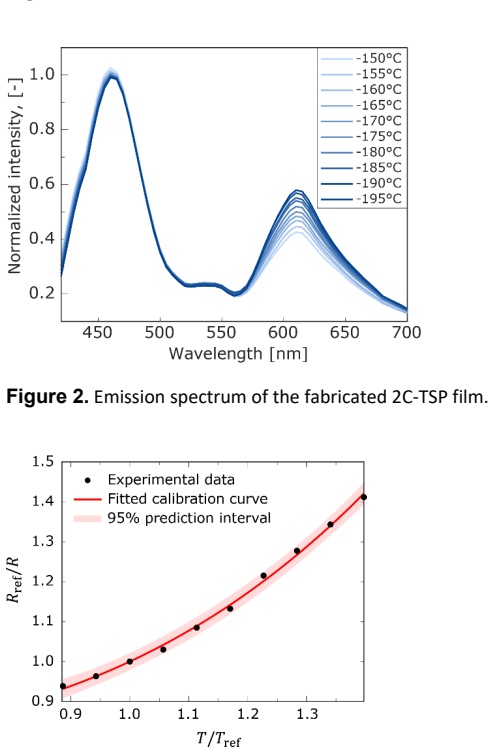
D. McLean, Referenced Pressure Paint and the Ratio of Ratios, in: Proceedings of the Sixth Annual Pressure Sensitive Paint Workshop, The Boeing Company, Seattle, Washington, 1998. 8 Figures and Tables Figure 1. Representative FE-SEM image of the fabricated 2C-TSP film. Figure 2. Emission spectrum of the fabricated 2C-TSP film. Figure 3. Calibration curve ...
1998
discussion (0)
Sign in with ORCID, Apple, or X to comment. Anyone can read and Pith papers without signing in.