Quantum simulation of molecular excited-state manifolds and energies using the TEPID-ADAPT-VQE algorithm
Pith reviewed 2026-06-30 07:22 UTC · model grok-4.3
The pith
TEPID-ADAPT-VQE prepares multiple molecular excited states by variationally diagonalizing one truncated low-temperature Gibbs state.
A machine-rendered reading of the paper's core claim, the machinery that carries it, and where it could break.
Core claim
TEPID-ADAPT variationally diagonalizes a truncated low-temperature Gibbs state, enabling the simultaneous preparation of multiple excited states within a single optimization. Applied to H2, LiH, and linear H4 across bond lengths that span weakly and strongly correlated regimes, the algorithm reproduces excited-state spectra and potential energy curves to within chemical accuracy. A modified MORE-ADAPT-VQE achieves similar accuracy but requires several hyperparameters whose best values depend on the specific molecule and geometry.
What carries the argument
The truncated low-temperature Gibbs state, which is diagonalized variationally to obtain the manifold of low-lying excited states in one run.
If this is right
- Multiple excited states become available after one variational optimization instead of separate runs for each state.
- The method maintains accuracy across both weak and strong electron correlation regimes for small molecules.
- Only a single temperature parameter sets the energy window for the targeted states.
- Adaptive ansatz growth produces circuits short enough for near-term quantum hardware.
Where Pith is reading between the lines
- The single-hyperparameter design may reduce the difficulty of variational optimization landscapes compared with multi-parameter alternatives.
- If the truncation of the Gibbs state remains valid for larger systems, the same framework could address excited states in photochemistry or catalysis.
- The approach could be combined with other density-matrix techniques to target states at different energy scales without redesigning the ansatz.
Load-bearing premise
The truncated low-temperature Gibbs state must capture the low-lying excited states without significant mixing from higher states, and the adaptive variational circuit must approximate that state closely enough for the tested molecules.
What would settle it
If the computed excited-state energies for any of the studied molecules at any tested geometry deviate from exact diagonalization results by more than chemical accuracy (roughly 1.6 millihartree), the accuracy claim would be falsified.
Figures




read the original abstract
The simulation of molecular excited states is a key challenge in quantum chemistry and a promising application for quantum computing. In this work, we investigate the efficacy of the truncated eigenvalue parametrized initial density adaptive variational algorithm (TEPID-ADAPT-VQE) for computing low-lying excited states and potential energy surfaces. TEPID-ADAPT variationally diagonalizes a truncated low-temperature Gibbs state, enabling the simultaneous preparation of multiple excited states within a single optimization. We apply the method to H$_2$, LiH, and linear H$_4$ across bond lengths spanning weakly and strongly correlated regimes. The adaptive derivative-assembled problem-tailored (ADAPT) ansatz construction yields compact circuits suitable for near-term hardware. We also implement a modified version of the MORE-ADAPT-VQE algorithm for comparison with TEPID-ADAPT. We find that both algorithms accurately reproduce excited-state spectra and potential energy curves within chemical accuracy for all the molecules and geometries studied. However, TEPID-ADAPT has the advantage of utilizing only a single, physically motivated hyperparameter (temperature) that controls the energy scale at which excited states are targeted, while MORE-ADAPT utilizes multiple hyperparameters whose optimal values depend sensitively on the target problem. These results demonstrate that combining adaptive ansatz construction with density-matrix-based formulations provides an efficient framework for excited-state quantum chemistry on near-term devices.
Editorial analysis
A structured set of objections, weighed in public.
Referee Report
Summary. The manuscript introduces the TEPID-ADAPT-VQE algorithm, which variationally diagonalizes a truncated low-temperature Gibbs state to prepare multiple low-lying excited states simultaneously within a single optimization using an adaptive ADAPT ansatz. It benchmarks the method on H2, LiH, and linear H4 across weakly and strongly correlated bond lengths, claiming reproduction of excited-state spectra and potential energy curves to chemical accuracy, and compares it favorably to a modified MORE-ADAPT-VQE on the basis of having only a single physically motivated hyperparameter (temperature).
Significance. If the numerical results hold under the stated assumptions, the work supplies a density-matrix-based route to excited-state manifolds that requires fewer tunable parameters than subspace-expansion alternatives and produces compact circuits, which would be a useful addition to the near-term quantum chemistry toolkit.
major comments (2)
- [Abstract and § on TEPID-ADAPT formulation] The central claim that the eigenstates of the truncated low-T Gibbs state coincide with the target low-lying manifold rests on the unverified assumption of negligible higher-state contamination. For linear H4 at stretched geometries the spectrum is dense; no overlap, fidelity, or trace-norm data between the variationally obtained states and the exact eigenstates of the truncated operator are supplied, leaving open whether reported chemical accuracy reflects faithful diagonalization or cancellation.
- [Abstract] The abstract states that both TEPID-ADAPT and MORE-ADAPT reproduce spectra 'within chemical accuracy for all the molecules and geometries studied,' yet the supplied text contains no tables of absolute or relative errors, no error bars, no circuit-depth metrics, and no explicit exclusion criteria for the temperature cutoff. Without these data the quantitative claim cannot be assessed.
minor comments (1)
- [Abstract] The expansion of the TEPID acronym is given only in the abstract; repeating it once in the methods section would improve readability.
Simulated Author's Rebuttal
We thank the referee for their thorough review and constructive comments on our manuscript. We address each major comment below and have revised the manuscript to incorporate additional data and clarifications as needed.
read point-by-point responses
-
Referee: [Abstract and § on TEPID-ADAPT formulation] The central claim that the eigenstates of the truncated low-T Gibbs state coincide with the target low-lying manifold rests on the unverified assumption of negligible higher-state contamination. For linear H4 at stretched geometries the spectrum is dense; no overlap, fidelity, or trace-norm data between the variationally obtained states and the exact eigenstates of the truncated operator are supplied, leaving open whether reported chemical accuracy reflects faithful diagonalization or cancellation.
Authors: We agree that explicit verification of state fidelity would strengthen the manuscript. While the chemical accuracy in energies provides indirect support, we will add overlap and fidelity metrics (and trace-norm distances where relevant) between the variationally obtained states and the exact eigenstates of the truncated Gibbs operator, with particular attention to the linear H4 stretched geometries. These will be included in a new subsection or appendix in the revised version. revision: yes
-
Referee: [Abstract] The abstract states that both TEPID-ADAPT and MORE-ADAPT reproduce spectra 'within chemical accuracy for all the molecules and geometries studied,' yet the supplied text contains no tables of absolute or relative errors, no error bars, no circuit-depth metrics, and no explicit exclusion criteria for the temperature cutoff. Without these data the quantitative claim cannot be assessed.
Authors: We acknowledge that the abstract claim would be better supported by explicit quantitative summaries. In the revised manuscript we will add a table of absolute and relative errors (with error bars where applicable) for all reported energies, include circuit-depth metrics for the final ADAPT ansatze, and provide explicit criteria used to select the temperature cutoff (including how the truncation threshold was determined). These additions will allow direct assessment of the chemical-accuracy claim. revision: yes
Circularity Check
No significant circularity; method is self-contained with external benchmarks
full rationale
The TEPID-ADAPT-VQE approach defines a variational optimization over a truncated low-temperature Gibbs state whose eigenstates are targeted for excited-state preparation. All reported accuracies are obtained by direct numerical comparison against exact diagonalization or established reference values for H2, LiH, and H4 at multiple bond lengths. No equation in the derivation reduces to a fitted parameter renamed as a prediction, no load-bearing premise rests on self-citation, and the single temperature hyperparameter is chosen on physical grounds rather than tuned to reproduce the target spectra. The derivation chain therefore remains independent of its own outputs.
Axiom & Free-Parameter Ledger
free parameters (1)
- temperature
axioms (1)
- domain assumption A variational optimization over an adaptive ansatz can accurately approximate the truncated low-temperature Gibbs state for the studied molecules.
Reference graph
Works this paper leans on
-
[1]
TheL 2 andL ∞ energy errors are shown
Temperature dependence Figure 4 examines the accuracy of excited states ob- tained via TEPID-ADAPT as a function of inverse tem- peratureβfor H 4. TheL 2 andL ∞ energy errors are shown. Asβincreases, corresponding to lower effec- tive temperatures, both theL2 andL ∞ errors increase. Errors in higher excited states grow because a circuit trained on a low-t...
-
[2]
Figure 5 shows results from weighted MORE-ADAPT for the average energy error for H2 and H4 as a func- tion of a parameterαthat controls the distribution of weights viaw k = e−αλk N
Weight choice With weighted MORE-ADAPT, the absolute error of the lowest-indexed energy level increases on average by a factor of approximately5×10 4 when transitioning from weightsw i > w j fori < j, withw k ∈[0.5,1]to equal weightsw k = 1 m for the H4 system atd= 1.2Å. Figure 5 shows results from weighted MORE-ADAPT for the average energy error for H2 a...
-
[3]
H. R. Grimsley and F. A. Evangelista, Challenging ex- cited states from adaptive quantum eigensolvers: sub- space expansions vs. state-averaged strategies, Quantum Science and Technology10, 025003 (2025)
2025
-
[4]
P. B. Armentrout, Chemistry of excited electronic states, Science251, 175 (1991)
1991
-
[5]
Z. J. Knepp, G. M. Repa, and L. A. Fredin, Excited- state methods for molecular systems: Performance, pit- 8 falls, and practical guidance, Chemical Physics Reviews 6, 021304 (2025)
2025
-
[6]
Jankowska and A
J. Jankowska and A. L. Sobolewski, Modern theoretical approaches to modeling the excited-state intramolecular proton transfer: An overview, Molecules26, 5140 (2021)
2021
-
[7]
G. Liu, C. Zhang, S. M. Ciborowski, A. Asthana, L. Cheng, and K. H. Bowen, Mapping the electronic structure of the uranium (vi) dinitride molecule, un2, The Journal of Physical Chemistry A124, 6486 (2020)
2020
-
[8]
B. F. Curchod and A. J. Orr-Ewing, Perspective on the- oretical and experimental advances in atmospheric pho- tochemistry, The Journal of Physical Chemistry A128, 6613 (2024)
2024
-
[9]
González, D
L. González, D. Escudero, and L. Serrano-Andrés, Progress and challenges in the calculation of electronic excited states, ChemPhysChem13, 28 (2012)
2012
-
[10]
J. M. Herbert, Visualizing and characterizing excited states from time-dependent density functional theory, Physical Chemistry Chemical Physics26, 3755 (2024)
2024
-
[11]
Olsen, The casscf method: A perspective and commen- tary, International Journal of Quantum Chemistry111, 3267 (2011)
J. Olsen, The casscf method: A perspective and commen- tary, International Journal of Quantum Chemistry111, 3267 (2011)
2011
-
[12]
F. A. Evangelista, Perspective: Multireference coupled cluster theories of dynamical electron correlation, The Journal of Chemical Physics149(2018)
2018
-
[13]
Y. S. Yordanov, C. H. W. Barnes, and D. R. M. Arvidsson-Shukur, Molecular-excited-state calculations with the qubit-excitation-based adaptive variational quantum eigensolver protocol, Physical Review A106, 032434 (2022)
2022
-
[14]
H. Gao, S. Imamura, A. Kasagi, and E. Yoshida, Dis- tributed implementation of full configuration interaction for one trillion determinants, Journal of Chemical Theory and Computation 10.1021/acs.jctc.3c01190 (2024)
-
[15]
P. J. Knowles and N. C. Handy, A determinant based fullconfigurationinteractionprogram,ComputerPhysics Communications54, 75 (1989)
1989
-
[16]
Li and J
Y. Li and J. Lu, Optimal orbital selection for full con- figuration interaction (optorbfci): Pursuing the basis set limit under a budget, Journal of Chemical Theory and Computation16, 6207 (2020)
2020
-
[17]
Rishi, A
V. Rishi, A. Perera, M. Nooijen, and R. J. Bartlett, Ex- cited states from modified coupled cluster methods: Are they any better than eom ccsd?, The Journal of Chemical Physics146(2017)
2017
-
[18]
A. D. Laurent and D. Jacquemin, Td-dft benchmarks: a review, International Journal of Quantum Chemistry 113, 2019 (2013)
2019
-
[19]
Lischka, D
H. Lischka, D. Nachtigallova, A. J. Aquino, P. G. Szalay, F. Plasser, F. B. Machado, and M. Barbatti, Multirefer- ence approaches for excited states of molecules, Chemical reviews118, 7293 (2018)
2018
-
[20]
Higgott, D
O. Higgott, D. Wang, and S. Brierley, Variational quan- tum computation of excited states, Quantum3, 156 (2019)
2019
-
[21]
K. M. Nakanishi, K. Mitarai, and K. Fujii, Subspace- search variational quantum eigensolver for excited states, Phys. Rev. Res.1, 033062 (2019)
2019
-
[22]
Asthana, A
A. Asthana, A. Kumar, V. Abraham, H. R. Grims- ley, Y. Zhang, L. Cincio, S. Tretiak, P. A. Dub, S. E. Economou, E. Barnes, and N. J. Mayhall, Quantum self- consistent equation-of-motion method for molecular ex- citation energies, Chemical Science14, 2405 (2023)
2023
-
[23]
Gocho, H
S. Gocho, H. Nakamura, S. Kanno, Q. Gao, T. Kobayashi, T. Inagaki, and M. Hatanaka, Excited state calculations using variational quantum eigensolver with spin-restricted ansätze and automatically-adjusted constraints, npj Computational Materials9, 13 (2023)
2023
-
[24]
Cadi Tazi and A
L. Cadi Tazi and A. J. W. Thom, Folded-spectrum vqe for molecular excited states, Journal of Chemical Theory and Computation20, 2491 (2024)
2024
-
[25]
Dutta, C
R. Dutta, C. Cianci, A. V. Soudackov, Y. Wang, C. Xu, D. A. Mazziotti, L. F. Santos, and V. S. Batista, Qumode-based variational quantum eigensolver for molecular excited states, Journal of Chemical Theory and Computation (2026)
2026
-
[26]
Kumar, A
A. Kumar, A. Asthana, V. Abraham, T. D. Crawford, N. J. Mayhall, Y. Zhang, L. Cincio, S. Tretiak, and P. A. Dub, Quantum simulation of molecular response prop- erties in the nisq era, Journal of chemical theory and computation19, 9136 (2023)
2023
-
[27]
P. J. Ollitrault, A. Kandala, C.-F. Chen, P. K. Barkout- sos, A. Mezzacapo, M. Pistoia, S. Sheldon, S. Woerner, J. M. Gambetta, and I. Tavernelli, Quantum equation of motion for computing molecular excitation energies on a noisy quantum processor, Physical Review Research2, 043140 (2020)
2020
-
[28]
J. R. McClean, Z. Jiang, N. C. Rubin, R. Babbush, and H. Neven, Decoding quantum errors with subspace ex- pansions, Nature communications11, 636 (2020)
2020
-
[29]
Urbanek, D
M. Urbanek, D. Camps, R. Van Beeumen, and W. A. de Jong, Chemistry on quantum computers with virtual quantum subspace expansion, Journal of chemical theory and computation16, 5425 (2020)
2020
-
[30]
Y. S. Yordanov, V. Armaos, C. H. W. Barnes, and D. R. M. Arvidsson-Shukur, Qubit-excitation-based adaptive variational quantum eigensolver, Communica- tions Physics4, 228 (2021)
2021
-
[31]
H. R. Grimsley, S. E. Economou, E. Barnes, and N. J. Mayhall, An adaptive variational algorithm for exact molecular simulations on a quantum computer, Nature Communications10, 3007 (2019)
2019
-
[32]
H. R. Grimsley and F. A. Evangelista, Challenging ex- cited states from adaptive quantum eigensolvers, Quan- tum Science and Technology10, 025003 (2025)
2025
-
[33]
B. Sambasivam, K. Sherbert, K. Shirali, N. J. May- hall, A. W. Harrow, E. Barnes, and S. E. Economou, Tepid-adapt: Adaptive variational method for simultane- ous preparation of low-temperature gibbs and low-lying eigenstates, arXiv (2025), arXiv:2503.14490 [quant-ph]
-
[34]
Jordan and E
P. Jordan and E. Wigner, Über das paulische äquivalen- zverbot, Zeitschrift für Physik47, 631 (1928)
1928
-
[35]
S. B. Bravyi and A. Y. Kitaev, Fermionic quantum com- putation, Annals of Physics298, 210 (2002)
2002
-
[36]
The Qiskit Nature developers and contributors, Qiskit nature
-
[37]
C. Hong, L. Colmenarez, L. Ding, C. L. Benavides- Riveros, and C. Schilling, Refining the weighted subspace-search variational quantum eigensolver: com- pression of ansätze into a single pure state and optimiza- tion of weights (2023)
2023
-
[38]
Ding, C.-L
L. Ding, C.-L. Hong, and C. Schilling, Ground and Ex- cited States from Ensemble Variational Principles, Quan- tum8, 1525 (2024)
2024
-
[39]
Fletcher,Practical Methods of Optimization, 2nd ed
R. Fletcher,Practical Methods of Optimization, 2nd ed. (John Wiley & Sons, Chichester, UK, 1987)
1987
-
[40]
W. J. Hehre, R. F. Stewart, and J. A. Pople, Self- consistent molecular orbital methods. i. use of gaus- 9 sian expansions of slater-type atomic orbitals, Journal of Chemical Physics51, 2657 (1969)
1969
-
[41]
L. R. Kahn, P. J. Hay, and I. Shavitt, Theoretical study of curve crossing: ab initio calculations on the four low- est 1Σ+ states of lif, The Journal of Chemical Physics 61, 3530 (1974), https://pubs.aip.org/aip/jcp/article- pdf/61/9/3530/18893239/3530_1_online.pdf
1974
-
[42]
J. A. Pople, Quantum chemical models (nobel lecture), Reviews of Modern Physics71, 1267 (1999)
1999
-
[43]
W. Dobrautz, S. Völker, and G. K.-L. Chan, Towards real chemical accuracy on current quantum hardware through the transcorrelated method, arXiv (2023), arXiv:2303.02007 [quant-ph]
-
[44]
D. G. Truhlar, Potential energy surfaces, Lecture Notes, University of Minnesota (2004)
2004
-
[45]
Fuchs, Y.-M
M. Fuchs, Y.-M. Niquet, K. Burke, and X. Gonze, De- scription of bond dissociation with density-functional theory, Journal of Chemical Physics122, 094116 (2005)
2005
-
[46]
J. W. Hollett and P. M. W. Gill, The two faces of static correlation, Journal of Chemical Physics134, 114111 (2011)
2011
-
[47]
P. G. Anastasiou, Y. Chen, N. J. Mayhall, E. Barnes, andS.E.Economou,Tetris-adapt-vqe: Anadaptivealgo- rithm that yields shallower, denser circuit ansätze, Phys- ical Review Research6, 013254 (2024)
2024
-
[48]
J. Lee, W. J. Huggins, M. Head-Gordon, and K. B. Wha- ley, Generalized unitary coupled cluster wave functions for quantum computation, Journal of Chemical Theory and Computation15, 311 (2019)
2019
-
[49]
H. L. Tang, V. Shkolnikov, G. S. Barron, H. R. Grim- sley, N. J. Mayhall, E. Barnes, and S. E. Economou, Qubit-adapt-vqe: An adaptive algorithm for construct- ing hardware-efficient ansätze on a quantum processor, PRX Quantum2, 020310 (2021)
2021
-
[50]
Ramôa, P
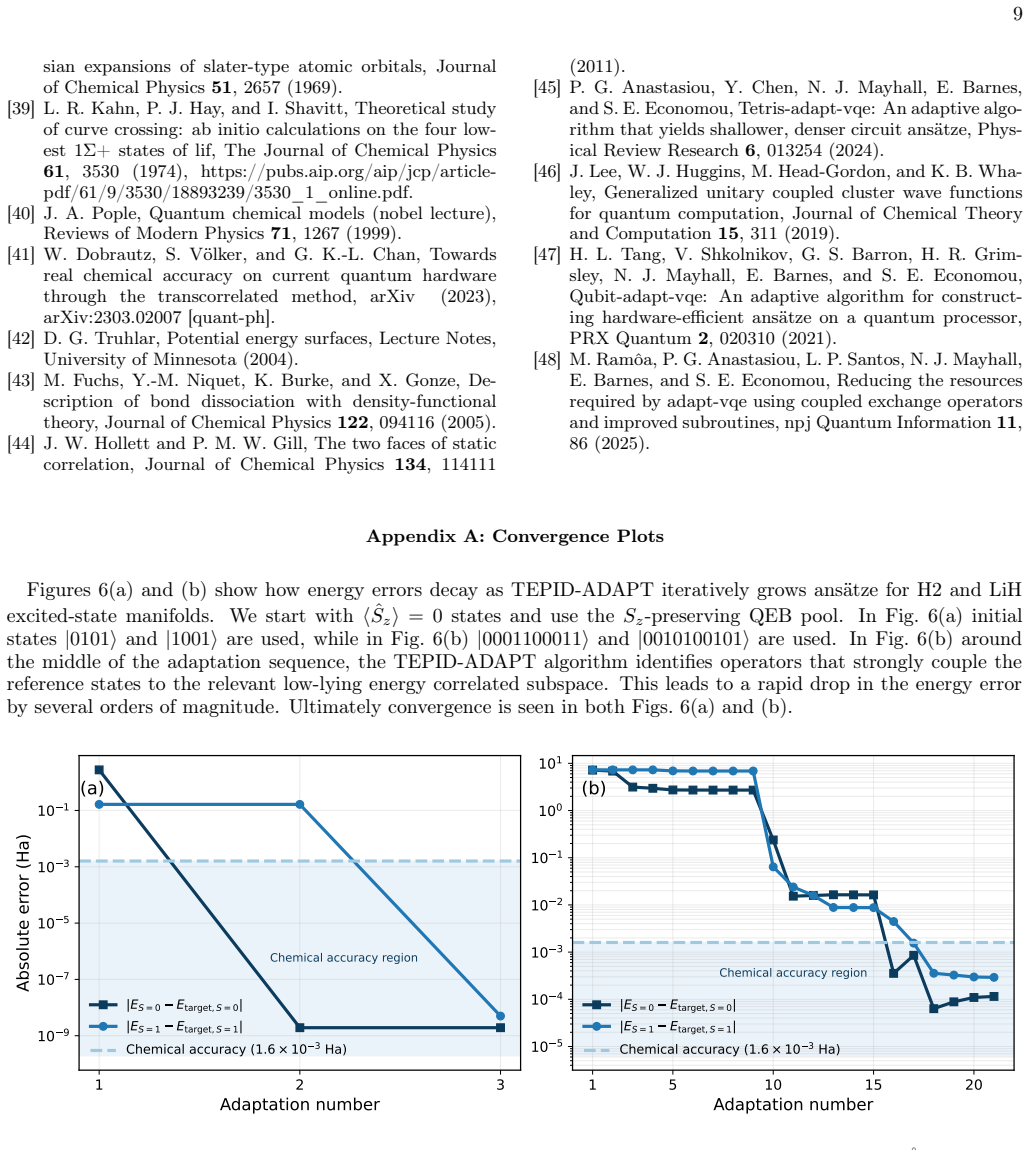
M. Ramôa, P. G. Anastasiou, L. P. Santos, N. J. Mayhall, E. Barnes, and S. E. Economou, Reducing the resources required by adapt-vqe using coupled exchange operators and improved subroutines, npj Quantum Information11, 86 (2025). Appendix A: Convergence Plots Figures 6(a) and (b) show how energy errors decay as TEPID-ADAPT iteratively grows ansätze for H2...
2025
discussion (0)
Sign in with ORCID, Apple, or X to comment. Anyone can read and Pith papers without signing in.