The Large Smooth Patch on Comet 9P/Tempel 1: Remnant of a Recent Past Event
Pith reviewed 2026-05-23 17:45 UTC · model grok-4.3
The pith
A single gravitational flow event 600 to 1200 years ago formed the large smooth patch on comet 9P/Tempel 1 along with nearby terraces and other smooth units.
A machine-rendered reading of the paper's core claim, the machinery that carries it, and where it could break.
Core claim
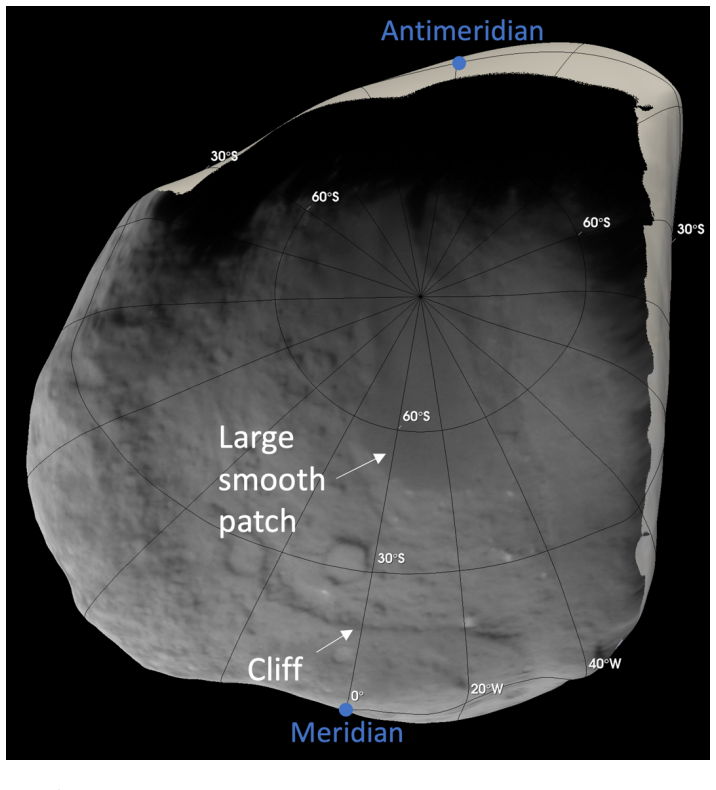
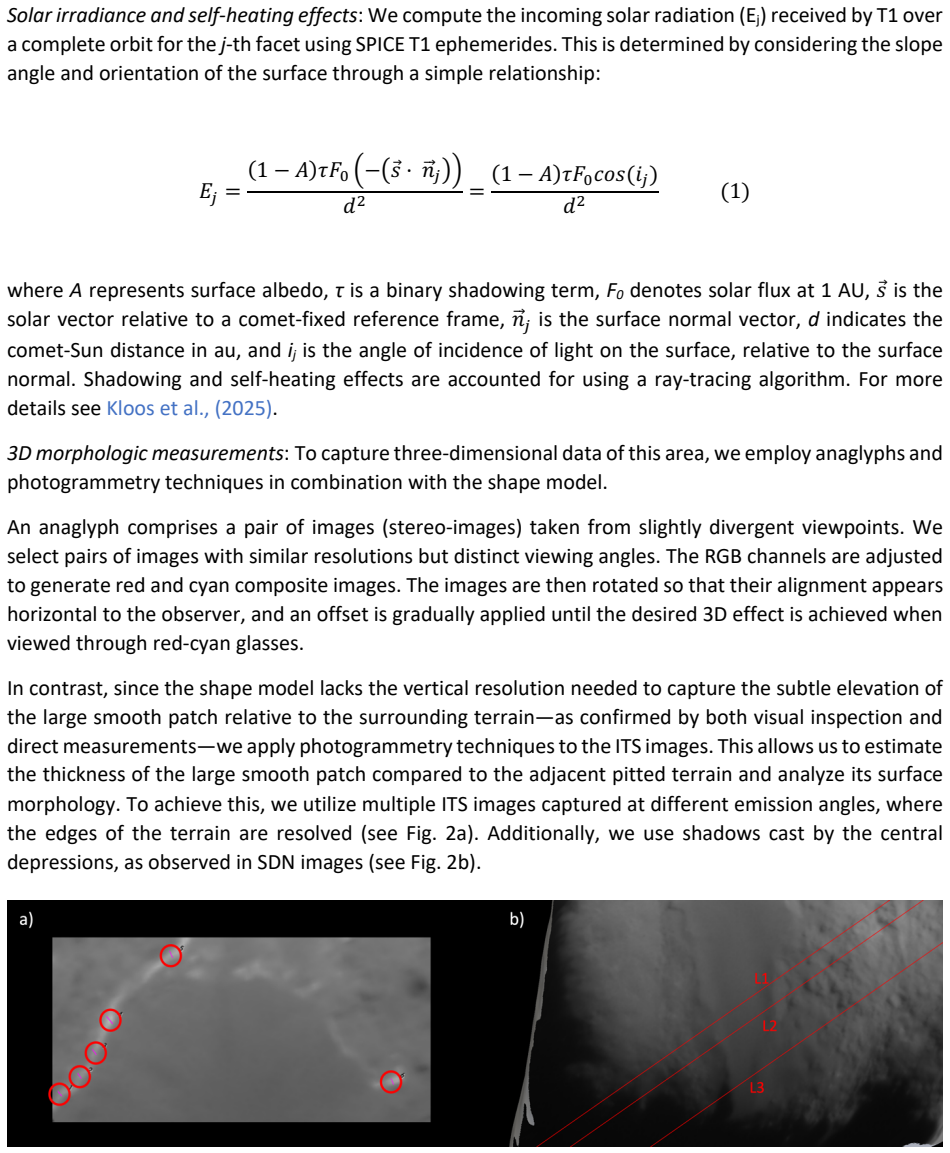
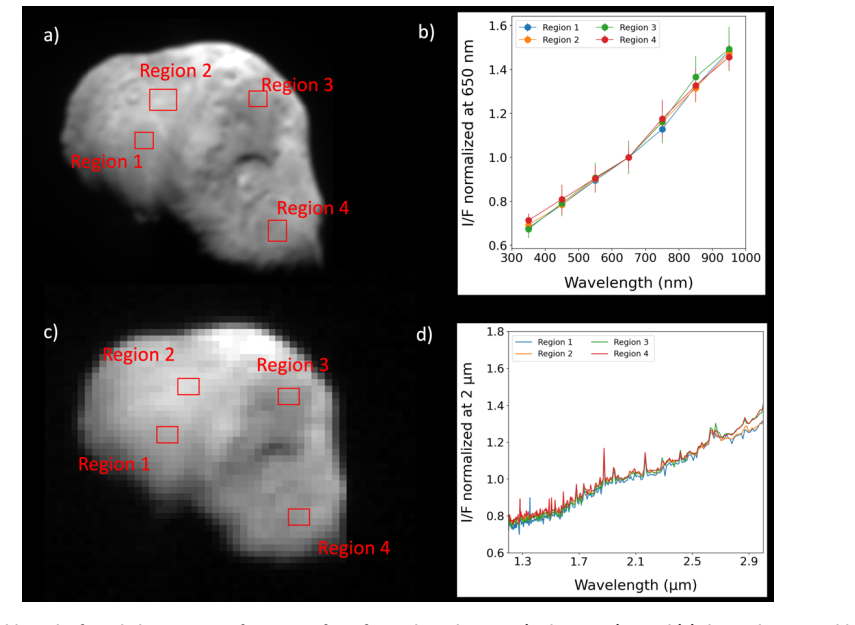
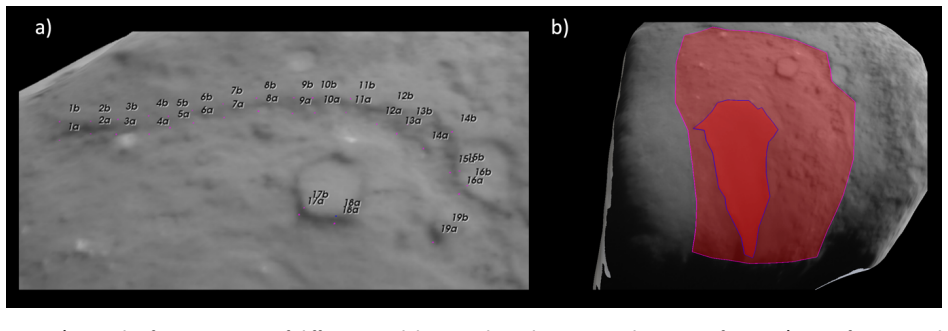
Morphological and spectral analysis reveals that the smooth patch has a thickness of approximately 25 meters, a notable lobate U-shape, and a spectral composition indistinguishable from the surrounding terrain, which favors an endogenous origin. Gravitational flow simulations demonstrate that a single event could have formed the large smooth patch, the secondary smooth units observed on other faces of the comet, and the topographic terrace features adjacent to the northern smooth unit. We estimate this event occurred between 600 and 1,200 years ago, a temporal window that notably coincides with a period of abrupt orbital changes caused by multiple close encounters with Jupiter. We propose 0.
What carries the argument
Gravitational flow simulations that reconstruct how surface material could move downslope under the comet's weak gravity to produce the observed smooth deposits and terraces from one release of material.
If this is right
- The smooth patch and related features share a common endogenous origin through mass movement instead of separate external processes.
- Multiple smooth regions on different parts of the nucleus can be produced by one flow event.
- External gravitational perturbations from planetary encounters can initiate surface mass flows on cometary nuclei.
- The surface geology of short-period comets records dynamical interactions with Jupiter on century timescales.
Where Pith is reading between the lines
- Similar single-event flows could be identified on other Jupiter-family comets by comparing their smooth deposits with known close-approach histories.
- If the triggering link holds, comets that experienced recent strong tidal or spin changes should display fresh lobate smooth units.
- The still-unresolved internal trigger mechanism might be tested by modeling tidal stresses during the Jupiter passages against the observed flow directions.
- More precise shape models from future missions could check whether the simulated flow paths match the exact boundaries of the terraces and secondary patches.
Load-bearing premise
The assumption that the close Jupiter encounters directly triggered the mass flow rather than the match in timing being coincidental and that the flow simulations reproduce the actual surface movement without hidden parameters or adjustments.
What would settle it
Independent age dating of the smooth patch material or crater counts on the patch surface that place its formation outside the 600-1200 year interval.
Figures

read the original abstract
We present a comprehensive reassessment of the region containing the large smooth patch on comet 9P/Tempel 1, leveraging data from the Deep Impact and Stardust-NExT missions, an updated stereophotoclinometry-based shape model, and numerical simulations. The study seeks to understand the nature, the triggering mechanism, and the chronology of this distinctive feature. Morphological and spectral analysis reveals that the smooth patch has a thickness of approximately 25 meters, a notable lobate U-shape, and a spectral composition indistinguishable from the surrounding terrain, which favors an endogenous origin. Gravitational flow simulations demonstrate that a single event could have formed the large smooth patch, the secondary smooth units observed on other faces of the comet, and the topographic terrace features adjacent to the northern smooth unit. We estimate this event occurred between 600 and 1,200 years ago, a temporal window that notably coincides with a period of abrupt orbital changes caused by multiple close encounters with Jupiter. We propose that these encounters may have played a role in triggering a mass flow. Although with the underlying mechanism still unresolved, these results shed new light on the geology of cometary nuclei and on the role of external dynamical processes in shaping their surfaces.
Editorial analysis
A structured set of objections, weighed in public.
Referee Report
Summary. The paper reassesses the large smooth patch on comet 9P/Tempel 1 using Deep Impact and Stardust-NExT mission data, an updated stereophotoclinometry shape model, morphological/spectral analysis, and gravitational flow simulations. It claims the ~25 m thick lobate U-shaped patch, secondary smooth units, and adjacent terraces formed in a single endogenous mass-flow event 600-1200 years ago, with the timing coinciding with Jupiter encounters that may have triggered the flow.
Significance. If the simulation parameters prove independently constrained and the model validated, the work would strengthen evidence for recent surface modification on cometary nuclei and the possible influence of external orbital dynamics. The integration of multi-mission observations with flow modeling is a constructive approach, and the spectral indistinguishability supporting endogenous material is a clear observational strength.
major comments (3)
- [Simulation methods] Simulation methods section: The gravitational flow model inputs (bulk density, internal friction angle, cohesion, yield criterion) are not demonstrated to be fixed by independent constraints such as laboratory measurements on ice-dust mixtures, photometric surface-strength estimates, or in-situ mission data; if instead adjusted to reproduce the observed ~25 m thickness and lobate morphology, the single-event reproduction is consistent but does not demonstrate occurrence.
- [Chronology and discussion] Chronology and discussion section: The 600-1200 yr age window is derived from orbital encounter timing (independent of the surface feature), yet the claim that these encounters triggered the mass flow lacks a demonstrated causal mechanism or quantitative link separate from the simulation outcomes and timing coincidence; this interpretive step is load-bearing for the proposed external trigger.
- [Methods and results] Methods and results: No error analysis, sensitivity tests on parameter choices, or validation of the flow model against known benchmarks for low-gravity granular flows on cometary surfaces is presented, leaving the central claim that simulations support a single-event origin dependent on unexamined assumptions.
minor comments (2)
- [Abstract] Abstract: The clause 'with the underlying mechanism still unresolved' is ambiguous and should be clarified regarding whether it refers to the flow trigger or another aspect.
- [Figures] Figure captions: Ensure all simulation output panels are explicitly labeled with the exact parameter set used so readers can assess reproducibility.
Simulated Author's Rebuttal
We thank the referee for their constructive comments, which help clarify the scope and limitations of our modeling and interpretive claims. We address each major comment below and will revise the manuscript accordingly.
read point-by-point responses
-
Referee: Simulation methods section: The gravitational flow model inputs (bulk density, internal friction angle, cohesion, yield criterion) are not demonstrated to be fixed by independent constraints such as laboratory measurements on ice-dust mixtures, photometric surface-strength estimates, or in-situ mission data; if instead adjusted to reproduce the observed ~25 m thickness and lobate morphology, the single-event reproduction is consistent but does not demonstrate occurrence.
Authors: The parameters were drawn from published ranges for cometary ice-dust mixtures and low-gravity granular flows, with some tuning to match the observed deposit. We will revise the methods section to explicitly cite the literature sources for each input, include a table of adopted values with their provenance, and add a paragraph stating that the simulations demonstrate morphological consistency with a single flow event rather than proving its occurrence. revision: yes
-
Referee: Chronology and discussion section: The 600-1200 yr age window is derived from orbital encounter timing (independent of the surface feature), yet the claim that these encounters triggered the mass flow lacks a demonstrated causal mechanism or quantitative link separate from the simulation outcomes and timing coincidence; this interpretive step is load-bearing for the proposed external trigger.
Authors: The manuscript already notes that the underlying mechanism is unresolved. We will revise the discussion to more clearly distinguish the independently derived orbital chronology from the hypothesis of a possible trigger, emphasizing the temporal coincidence as suggestive rather than causal. The language will be adjusted to avoid any implication of a demonstrated mechanism. revision: yes
-
Referee: Methods and results: No error analysis, sensitivity tests on parameter choices, or validation of the flow model against known benchmarks for low-gravity granular flows on cometary surfaces is presented, leaving the central claim that simulations support a single-event origin dependent on unexamined assumptions.
Authors: We agree that these elements are needed. The revised manuscript will incorporate sensitivity tests on the key parameters (within literature ranges), quantitative error estimates on simulated deposit thickness, and references to prior validation of the same flow model on other small-body surfaces. This will be added to the methods and results sections. revision: yes
Circularity Check
No significant circularity; derivation relies on independent orbital data and simulation outputs
full rationale
The paper's chain uses mission-derived shape models and spectral data as inputs, then presents gravitational flow simulations as demonstrating morphological consistency with a single event, followed by an age estimate (600-1200 yr) drawn from separate orbital encounter calculations that predate and are independent of the surface features. No equations, parameter-fitting steps, or self-citations are quoted that reduce the central claim to a tautology or fitted input renamed as prediction. The coincidence with Jupiter encounters is presented as interpretive context rather than a load-bearing derivation step. The analysis remains self-contained against external benchmarks such as spacecraft data and known dynamical histories.
Axiom & Free-Parameter Ledger
axioms (1)
- domain assumption Gravitational flow can be adequately modeled by the numerical simulations used without additional unstated parameters or material properties specific to this comet.
Lean theorems connected to this paper
-
IndisputableMonolith/Foundation/AlexanderDuality.lean; IndisputableMonolith/Cost/FunctionalEquation.leanreality_from_one_distinction; washburn_uniqueness_aczel unclear?
unclearRelation between the paper passage and the cited Recognition theorem.
Gravitational flow simulations demonstrate that a single event could have formed the large smooth patch... We assume a mean density of 400 kg/m³... The simulation assumes a flow with no inertia... seeds are systematically placed at each grid point.
What do these tags mean?
- matches
- The paper's claim is directly supported by a theorem in the formal canon.
- supports
- The theorem supports part of the paper's argument, but the paper may add assumptions or extra steps.
- extends
- The paper goes beyond the formal theorem; the theorem is a base layer rather than the whole result.
- uses
- The paper appears to rely on the theorem as machinery.
- contradicts
- The paper's claim conflicts with a theorem or certificate in the canon.
- unclear
- Pith found a possible connection, but the passage is too broad, indirect, or ambiguous to say the theorem truly supports the claim.
discussion (0)
Sign in with ORCID, Apple, or X to comment. Anyone can read and Pith papers without signing in.