REVIEW 2 major objections 30 references
Self-Supervised Mask-Aware Transformers for Fault-Tolerant FBG Force Sensing in Minimally Invasive Surgical Robotics
T0 review · 2 major / 0 minor · reviewed 2026-06-26 · grok-4.3
Pith's one-line read A single self-supervised mask-aware Transformer enables fault-tolerant force sensing from 8-channel FBG sensors by handling arbitrary channel failures without per-pattern models.
desk verdict A single mask-aware Transformer beats the 255-model bank on simulated FBG channel loss but the robustness claim rests on untested transfer from curriculum to real dropouts. read the letter →
The pith
A machine-rendered reading of the paper's core claim, the machinery that carries it, and where it could break.
The reading
What carries the argument
Mask-aware Transformer encoder that explicitly conditions on channel availability during both masked reconstruction pretraining and force regression fine-tuning.
What would settle it
Run the trained model on a held-out dataset collected from physical 8-channel FBG sensors that experienced genuine fiber fractures and check whether RMSE under exactly 4-channel loss stays at or below 0.0126 N while remaining lower than the 255-model bank baseline.
Extended reading notes
Core claim
The authors claim that a mask-aware Transformer pretrained via masked-channel reconstruction on unlabeled data and fine-tuned using a balanced clean-and-corrupted-view objective with dynamic corruption curriculum, together with a parallel heteroscedastic uncertainty head, achieves 0.0066 N RMSE for nominal 8-channel force estimation and degrades to only 0.0126 N under severe 4-channel failures. This outperforms a comprehensive bank of 255 per-pattern neural networks (0.0154 N at 4-channel loss) while eliminating pattern-specific calibration.
Load-bearing premise
Simulated channel corruptions and the training curriculum will produce behavior that matches real intermittent fiber fractures encountered during actual procedures.
Editorial extensions
If this is right
- One model replaces the combinatorial explosion of 255 separate networks for every possible failure pattern.
- Pattern-specific calibration is no longer required at deployment time.
- Per-axis uncertainty estimates are produced in a single forward pass without ensembles.
- Performance degrades gracefully rather than collapsing under dynamic and diverse channel losses.
Reading between the lines
- The mask-aware pretraining strategy might transfer to other multi-channel sensor arrays that suffer intermittent dropouts, such as distributed strain gauges in robotics or medical devices.
- Because the model learns from unlabeled streams, it could support lightweight online adaptation when a new sensor configuration is introduced with only a small amount of fresh labeled data.
- Hardware designers might reduce built-in channel redundancy if software-level masking already provides reliable fallback.
Editorial analysis
A structured set of objections, weighed in public.
Referee Report
Summary. The paper proposes a single unified self-supervised mask-aware Transformer for multi-channel FBG force sensing in minimally invasive surgical robotics. The model is pretrained via masked-channel reconstruction and fine-tuned with a balanced clean-and-corrupted-view objective plus dynamic corruption curriculum; it also includes a heteroscedastic uncertainty head. On an 8-channel catheter-scale dataset the unified model reports 0.0066 N nominal RMSE degrading to 0.0126 N under 4-channel simulated failures, outperforming a bank of 255 pattern-specific networks (0.0154 N at 4-channel loss) while eliminating per-pattern calibration.
Significance. If the reported robustness generalizes, the work would meaningfully reduce the exponential calibration cost of combinatorial model banks for fault-tolerant FBG sensing, a practical bottleneck in constrained surgical workspaces. The self-supervised pretraining on unlabeled streams and single-pass uncertainty estimation are clear engineering strengths that could transfer to other multi-sensor robotic systems.
major comments (2)
- [Abstract and Evaluation] Abstract and Evaluation section: the headline claim of graceful degradation (0.0066 N to 0.0126 N) and superiority over the 255-model bank rests entirely on simulated channel masks applied to the 8-channel dataset. No experiments with actual hardware-induced dropouts (fiber bend/fracture statistics, temporal correlations, workspace-constrained patterns) or sim-to-real distribution shift are reported, which is load-bearing for the fault-tolerance contribution.
- [Methods] Methods section: the manuscript supplies no information on dataset cardinality, train/test splits, cross-validation procedure, or whether the dynamic corruption curriculum was tuned on the same data used for the final RMSE numbers. Without these details it is impossible to determine whether the reported gains are statistically significant or free of overfitting/data leakage.
Simulated Author's Rebuttal
We thank the referee for the detailed and constructive feedback. We address each major comment below, indicating planned revisions where the manuscript can be strengthened without misrepresenting the work.
read point-by-point responses
-
Referee: [Abstract and Evaluation] Abstract and Evaluation section: the headline claim of graceful degradation (0.0066 N to 0.0126 N) and superiority over the 255-model bank rests entirely on simulated channel masks applied to the 8-channel dataset. No experiments with actual hardware-induced dropouts (fiber bend/fracture statistics, temporal correlations, workspace-constrained patterns) or sim-to-real distribution shift are reported, which is load-bearing for the fault-tolerance contribution.
Authors: We agree that the reported results rely on simulated channel masks rather than measured hardware failures. This controlled simulation enables exhaustive evaluation over all combinatorial patterns, which is difficult to achieve with physical experiments. We will add a limitations paragraph in the revised Discussion section that explicitly states the reliance on simulation, describes the dropout model assumptions, and notes the absence of real fiber-fracture statistics or sim-to-real transfer experiments. This clarifies the scope of the fault-tolerance claims without altering the reported numbers. revision: partial
-
Referee: [Methods] Methods section: the manuscript supplies no information on dataset cardinality, train/test splits, cross-validation procedure, or whether the dynamic corruption curriculum was tuned on the same data used for the final RMSE numbers. Without these details it is impossible to determine whether the reported gains are statistically significant or free of overfitting/data leakage.
Authors: We acknowledge the omission. The revised Methods section will report the dataset cardinality, the train/validation/test split ratios, the cross-validation procedure employed, and confirmation that the dynamic corruption curriculum hyperparameters were selected exclusively on the validation set (held out from the test data used for the final RMSE figures). These additions will enable assessment of statistical significance and reproducibility. revision: yes
- Experiments using actual hardware-induced dropouts (fiber bend/fracture statistics, temporal correlations, workspace-constrained patterns) or sim-to-real validation, as the current study is limited to simulated masks on the existing labeled dataset and no such real-failure data were collected.
Circularity Check
No significant circularity in derivation or evaluation chain
full rationale
The paper follows standard self-supervised pretraining (masked-channel reconstruction) and supervised fine-tuning pipelines with a corruption curriculum and uncertainty head. Reported RMSE figures (0.0066 N nominal, 0.0126 N at 4-channel loss) are direct empirical evaluations on the 8-channel dataset against an external 255-model bank baseline; no equations, definitions, or self-citations reduce these metrics to fitted constants or self-referential constructions by construction. The central claims rest on observable performance differences rather than tautological reductions.
Assumptions & free parameters
Cite this review
Pith. "Pith review of Self-Supervised Mask-Aware Transformers for Fault-Tolerant FBG Force Sensing in Minimally Invasive Surgical Robotics." pith.science (2026). https://pith.science/paper/XM4TA7F5
@misc{pith2026260618628,
  author       = {Pith},
  title        = {Pith review of: Self-Supervised Mask-Aware Transformers for Fault-Tolerant FBG Force Sensing in Minimally Invasive Surgical Robotics},
  year         = {2026},
  howpublished = {\url{https://pith.science/paper/XM4TA7F5}},
  note         = {Machine review of arXiv:2606.18628}
}
read the original abstract
In minimally invasive surgical robotics, catheter-scale Fiber Bragg Grating (FBG) sensors are promising due to their ability to estimate multi-dimensional forces by multiplexing several optical channels. However, deploying these compact multi-channel sensors introduces two critical engineering challenges: inherent nonlinear cross-axis coupling during complex deformations, and intermittent channel dropouts caused by fiber fractures in constrained workspaces. These compounding issues severely degrade force estimation. Existing fault-tolerant approaches rely on combinatorial model banks, which scale exponentially with the channel count and demand prohibitively expensive per-pattern calibration. In this paper, we propose a unified, self-supervised mask-aware Transformer that explicitly models channel availability to enable graceful degradation under diverse and dynamic sensor failures. The encoder is pretrained via masked-channel reconstruction on unlabeled data streams and fine-tuned for force regression using a balanced clean-and-corrupted-view objective alongside a dynamic corruption curriculum. Furthermore, a parallel uncertainty head, trained via heteroscedastic Gaussian negative log-likelihood, predicts per-axis confidence in a single forward pass, circumventing the overhead of multi-pass ensembles. Evaluated on a catheter-scale 8-channel FBG dataset, our single unified model achieves a nominal Root Mean Square Error (RMSE) of 0.0066~N and degrades gracefully to 0.0126~N under severe 4-channel failures. This significantly outperforms a comprehensive model bank of 255 per-pattern neural networks (0.0154~N at 4-channel loss) while eliminating pattern-specific calibration.
Figures


Figures from the paper (5 more)
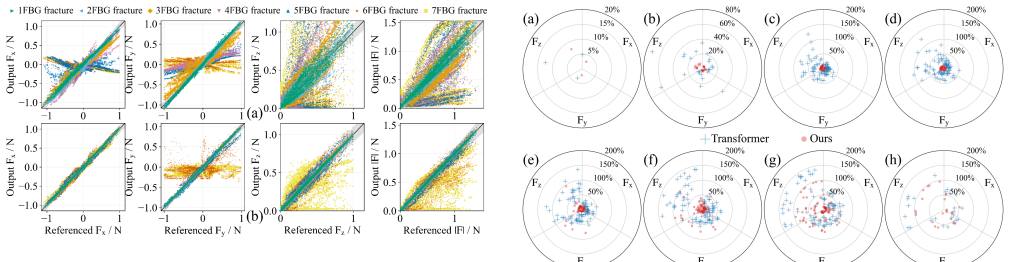


Reference graph
Works this paper leans on
-
[1]
Development of a fiber Bragg grating-based force sensor for minimally invasive surgery–case study of ex-vivo tissue palpation,
L. Gan, W. Duan, T. O. Akinyemi, W. Du, O. M. Omisore, and L. Wang, “Development of a fiber Bragg grating-based force sensor for minimally invasive surgery–case study of ex-vivo tissue palpation,” IEEE Transactions on Instrumentation and Measurement, vol. 72, pp. 1–12, 2021
2021
-
[2]
Haptic feedback and force-based teleoperation in surgical robotics,
R. V . Patel, S. F. Atashzar, and M. Tavakoli, “Haptic feedback and force-based teleoperation in surgical robotics,”Proceedings of the IEEE, vol. 110, no. 7, pp. 1012–1027, 2022
2022
-
[3]
An FBG-based flexible force sensor for stable grasping in a grow-and-twine gripping system,
W. Lai, H. D. Nguyen, J. Liu, X. Chen, and S. J. Phee, “An FBG-based flexible force sensor for stable grasping in a grow-and-twine gripping system,”IEEE Sensors Journal, 2025
2025
-
[4]
FBG-based triaxial force sensor integrated with an eccentrically configured imaging probe for endoluminal optical biopsy,
Z. Wu, A. Gao, N. Liu, Z. Jin, and G.-Z. Yang, “FBG-based triaxial force sensor integrated with an eccentrically configured imaging probe for endoluminal optical biopsy,” in2020 IEEE International Conference on Robotics and Automation (ICRA). IEEE, 2020, pp. 1625–1631
2020
-
[5]
A high-precision miniature 3D tactile force sensor based on fiber Bragg grating for minimally invasive surgery,
S. Dong, T. Yang, Y . Lou, D. Luo, B. Yang, H. Liu, J. Wu, and Y . Dong, “A high-precision miniature 3D tactile force sensor based on fiber Bragg grating for minimally invasive surgery,”IEEE Transactions on Instrumentation and Measurement, 2025
2025
-
[6]
FBG-based triaxial contact force sensor with segment- by-segment sensitivity separation method using a single fiber,
Y . Lou, S. Dong, T. Yang, X. Wan, L. Zhang, D. Luo, J. Wu, H. Liu, and Y . Dong, “FBG-based triaxial contact force sensor with segment- by-segment sensitivity separation method using a single fiber,”IEEE Sensors Journal, vol. 25, no. 1, pp. 505–514, 2024
2024
-
[7]
Fiber Bragg grating force sensors for minimally invasive surgery: State of the art, challenges, and opportunities,
S. Dong, T. Huang, L. Chen, S. Yin, Q. Chang, D. Han, Y . Li, B. Zhang, H. Liao, and F. Chen, “Fiber Bragg grating force sensors for minimally invasive surgery: State of the art, challenges, and opportunities,”SmartBot, p. e70040, 2026
2026
-
[8]
A miniature triaxial fiber optic force sensor for flexible ureteroscopy,
Y . Deng, T. Yang, S. Dai, and G. Song, “A miniature triaxial fiber optic force sensor for flexible ureteroscopy,”IEEE Transactions on Biomedical Engineering, vol. 68, no. 8, pp. 2339–2347, 2020
2020
Show all 30 references
-
[9]
Multifunctional magnetic catheter robot with triaxial force sensing capability for minimally invasive surgery,
S. Fu, S. Dong, H. Shen, Z. Chen, G. Ma, M. Cai, C. Huang, Q. Peng, C. Bai, Y . Dong,et al., “Multifunctional magnetic catheter robot with triaxial force sensing capability for minimally invasive surgery,” Research, vol. 8, p. 0681, 2025
2025
-
[10]
Three- dimensional force sensor based on fiber Bragg grating for medical puncture robot,
X. Li, J. Lin, Y . Pang, D. Yang, L. Zhong, and Z. Li, “Three- dimensional force sensor based on fiber Bragg grating for medical puncture robot,” inPhotonics, vol. 9, no. 9. MDPI, 2022, p. 630
2022
-
[11]
Fiber Bragg grating-based triaxial force sensor with parallel flexure hinges,
A. Gao, Y . Zhou, L. Cao, Z. Wang, and H. Liu, “Fiber Bragg grating-based triaxial force sensor with parallel flexure hinges,”IEEE Transactions on Industrial Electronics, vol. 65, no. 10, pp. 8215–8223, 2018
2018
-
[12]
Development of force sensing techniques for robot-assisted laparoscopic surgery: A review,
Y . Hao, H. Zhang, Z. Zhang, C. Hu, and C. Shi, “Development of force sensing techniques for robot-assisted laparoscopic surgery: A review,”IEEE Transactions on Medical Robotics and Bionics, vol. 6, no. 3, pp. 868–887, 2024
2024
-
[13]
A high-precision miniature triaxial FBG force sensor for detecting tissue anomalies,
S. Dong, Z. Liu, Y . Lou, D. Luo, J. Wu, B. Yang, H. Liu, T. Yang, and Y . Dong, “A high-precision miniature triaxial FBG force sensor for detecting tissue anomalies,”Journal of Lightwave Technology, vol. 42, no. 17, pp. 6143–6152, 2024
2024
-
[14]
Fault- tolerant six-axis FBG force/moment sensing for robotic interventions,
T. Li, J. Guo, H. Zheng, S. Wang, L. Qiu, and H. Ren, “Fault- tolerant six-axis FBG force/moment sensing for robotic interventions,” IEEE/ASME Transactions on Mechatronics, vol. 28, no. 6, pp. 3537– 3550, 2023
2023
-
[15]
Modular and fault-tolerant three-axial FBG-based force sensing for transoral surgical robots,
T. Li, P. Huang, S. Wang, L. Qiu, C. Li, and H. Ren, “Modular and fault-tolerant three-axial FBG-based force sensing for transoral surgical robots,”IEEE Transactions on Industrial Electronics, vol. 71, no. 12, pp. 16 739–16 750, 2024
2024
-
[16]
What uncertainties do we need in Bayesian deep learning for computer vision?
A. Kendall and Y . Gal, “What uncertainties do we need in Bayesian deep learning for computer vision?”Advances in Neural Information Processing Systems, vol. 30, 2017
2017
-
[17]
Dropout as a Bayesian approximation: Representing model uncertainty in deep learning,
Y . Gal and Z. Ghahramani, “Dropout as a Bayesian approximation: Representing model uncertainty in deep learning,” inInternational Conference on Machine Learning. PMLR, 2016, pp. 1050–1059
2016
-
[18]
Simple and scalable predictive uncertainty estimation using deep ensembles,
B. Lakshminarayanan, A. Pritzel, and C. Blundell, “Simple and scalable predictive uncertainty estimation using deep ensembles,” Advances in Neural Information Processing Systems, vol. 30, 2017
2017
-
[19]
Learning-based tip contact force estimation for FBG-embedded continuum robots,
M. Roshanfar, P. Fekri, R. H. Nguyen, C. He, P. H. Kang, J. Drake, E. Diller, and T. Looi, “Learning-based tip contact force estimation for FBG-embedded continuum robots,” in2025 IEEE International Conference on Robotics and Automation (ICRA). IEEE, 2025, pp. 844–850
2025
-
[20]
A fault-tolerant sensor fusion in mobile robots using multiple model Kalman filters,
M. Kheirandish, E. A. Yazdi, H. Mohammadi, and M. Mohammadi, “A fault-tolerant sensor fusion in mobile robots using multiple model Kalman filters,”Robotics and autonomous systems, vol. 161, p. 104343, 2023
2023
-
[21]
LSM-2: Learning from incomplete wearable sensor data,
M. A. Xu, G. Narayanswamy, K. Ayush, D. Spathis, S. Liao, S. A. Tailor, A. Metwally, A. A. Heydari, Y . Zhang, J. Garrison,et al., “LSM-2: Learning from incomplete wearable sensor data,”arXiv preprint arXiv:2506.05321, 2025
2025
-
[22]
Multiscale-attention masked autoencoder for missing data imputation of wind turbines,
Y . Fan, C. Feng, R. Wu, C. Liu, and D. Jiang, “Multiscale-attention masked autoencoder for missing data imputation of wind turbines,” Knowledge-Based Systems, vol. 299, p. 112114, 2024
2024
-
[23]
Masked autoencoders are scalable vision learners,
K. He, X. Chen, S. Xie, Y . Li, P. Doll ´ar, and R. Girshick, “Masked autoencoders are scalable vision learners,” inProc. IEEE/CVF Conf. on Computer Vision and Pattern Recognition, 2022, pp. 16 000–16 009
2022
-
[24]
BERT: Pre- training of deep bidirectional transformers for language understand- ing,
J. Devlin, M.-W. Chang, K. Lee, and K. Toutanova, “BERT: Pre- training of deep bidirectional transformers for language understand- ing,” inProceedings of NAACL-HLT, 2019, pp. 4171–4186
2019
-
[25]
Learning representations from incomplete EHR data with dual-masked autoen- coding,
X. Xiang, D. Restrepo, H. Jeong, Y . Jia, and L. A. Celi, “Learning representations from incomplete EHR data with dual-masked autoen- coding,”arXiv preprint arXiv:2602.15159, 2026
2026
-
[26]
A transformer-based framework for multivariate time series representation learning,
G. Zerveas, S. Jayaraman, D. Patel, A. Bhamidipaty, and C. Eick- hoff, “A transformer-based framework for multivariate time series representation learning,” inProc. ACM SIGKDD Conf. on Knowledge Discovery and Data Mining, 2021, pp. 2114–2124
2021
-
[27]
MaskCAE: Masked convolutional AutoEncoder via sensor data re- construction for self-supervised human activity recognition,
D. Cheng, L. Zhang, L. Qin, S. Wang, H. Wu, and A. Song, “MaskCAE: Masked convolutional AutoEncoder via sensor data re- construction for self-supervised human activity recognition,”IEEE Journal of Biomedical and Health Informatics, vol. 28, no. 5, pp. 2687–2698, 2024
2024
-
[28]
An FBG tactile sensor array and self- supervisedcontrastive learning transformer for tumordepth estimation in robotic palpation,
S. Dong, P. Sun, J. Cai, A. Zhu, Z. Zhou, T. Huang, H. Liao, Z. Yi, L. Yang,et al., “An FBG tactile sensor array and self- supervisedcontrastive learning transformer for tumordepth estimation in robotic palpation,”Research Square preprint, 2026
2026
-
[29]
Attention is all you need,
A. Vaswani, N. Shazeer, N. Parmar, J. Uszkoreit, L. Jones, A. N. Gomez, L. Kaiser, and I. Polosukhin, “Attention is all you need,” in Advances in Neural Information Processing Systems, 2017
2017
-
[30]
Wavelength- phase hybrid coded catheter tip three-axis force optical fiber sensor with uncertain environment self-adaptivity,
T. Li, Z. Zhao, J. Guo, P. Huang, Y . Tan, and Z. Zhou, “Wavelength- phase hybrid coded catheter tip three-axis force optical fiber sensor with uncertain environment self-adaptivity,”IEEE/ASME Transactions on Mechatronics, vol. 29, no. 6, pp. 4144–4155, 2024
2024
Reviewed June 26, 2026 · model on record in the stance chip above.
Discussion (0). Continue with ORCID to comment.