REVIEW 4 major objections 5 minor 55 references
Edge-guided Non-local Fully Convolutional Network for Salient Object Detection
T0 review · 4 major / 5 minor · reviewed 2026-08-14 · deepseek-v4-flash
Pith's one-line read ENFNet claims that embedding edge priors into hierarchical FCN features via a spatial affine transform yields state-of-the-art salient object detection on five benchmarks.
desk verdict A plausible incremental extension of NLDF with a clean edge-guidance idea, but the ablation does not isolate the edge prior from added capacity. read the letter →
The pith
A machine-rendered reading of the paper's core claim, the machinery that carries it, and where it could break.
The reading
What carries the argument
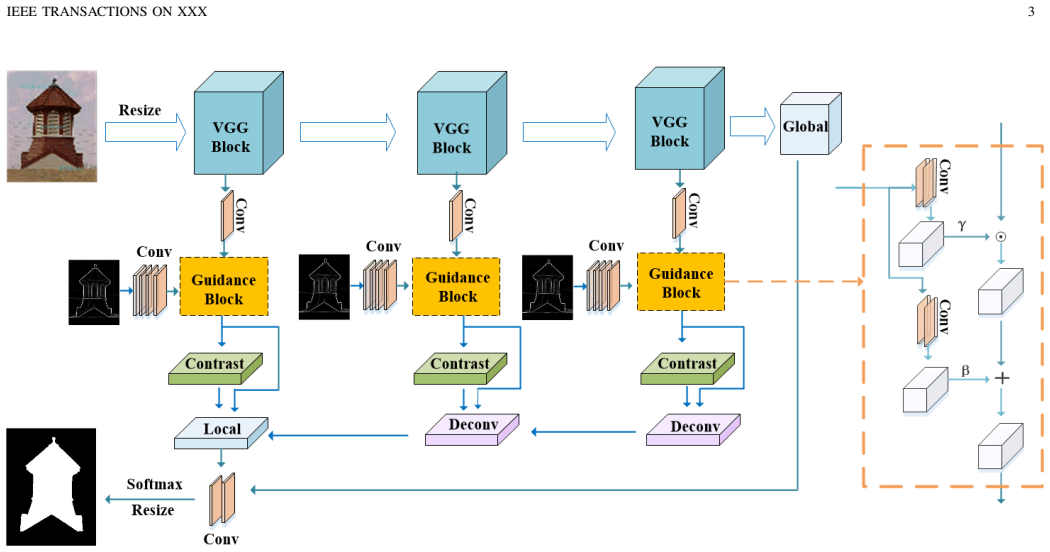
The central machinery is the edge guidance block, a spatially feature-wise affine transform. A condition network built from four $3 \times 3$ convolutional layers turns an EdgeBoxes edge map into per-scale features, from which two branches predict scale maps $\gamma$ and $\beta$. The transform $\mathrm{EGB}(X_i \mid \gamma, \beta) = X_i \odot \gamma + \beta$ embeds the edge prior into each hierarchical feature map. The same block feeds contrast features $X^c_i = X^F_i - \mathrm{AvgPool}(X^F_i)$, which capture local foreground/background differences, and the deconvolution path that fuses local and global features. The IoU boundary loss ties the edge guidance to sharp predicted boundaries.
What would settle it
Compare ENFNet against its zero-edge-guidance variant on a subset of images where EdgeBoxes returns no edges or edges that disagree with ground-truth object boundaries: if the edge-guided model does not beat the no-guidance variant there, the reported gains come from other components. A direct experiment could replace the EdgeBoxes maps with random or inverted edge maps and check whether the F-measure improvements persist.
Extended reading notes
Core claim
The paper claims that embedding edge prior knowledge into hierarchical FCN features fixes the blurred-boundary weakness of saliency detectors. The proposed ENFNet builds on the non-local deep FCN of [20], computes edge maps with EdgeBoxes [22], and passes them through a condition network that predicts per-pixel affine parameters ($\gamma$, $\beta$). Each side-output feature $X_i$ is transformed by $\mathrm{EGB}(X_i \mid \gamma, \beta) = X_i \odot \gamma + \beta$, so the edge guidance acts both feature-wise and spatially. Downstream, local contrast features are formed by subtracting each edge-aware feature from its local average, global context comes from the top of the network, and a cross-entropy plus IoU boundary loss trains the whole model. Trained only on MSRA-B and evaluated on HKU-IS, PASCAL-S, DUT-OMRON, ECSSD, and SOD, the method reports the best F-measure and MAE among thirteen compared methods, with the largest F-measure gains over the second-best method being +2.6% on DUT-OMRON and +2.1% on SOD.
Load-bearing premise
The claim assumes that the edge maps produced by Edge Boxes are accurate enough, across all test images, to serve as trustworthy boundary priors; on low-contrast or cluttered images where the edge detector fails, the guidance could mislead the network.
Editorial extensions
If this is right
- Saliency detectors built on FCN backbones can recover boundary sharpness without replacing the backbone, by inserting edge-guidance blocks at multiple scales.
- The guidance block is cheap enough that the full model retains a 0.08-second per-image runtime on a single consumer GPU.
- Using edge guidance in all five hierarchical scales beats using only three scales or none, so the hierarchical embedding itself contributes to the reported gains.
- The improvements concentrate on difficult datasets (DUT-OMRON, SOD), where cluttered backgrounds and low contrast make boundaries hard, so edge guidance matters most where boundary cues are scarce.
- The reported MAE reductions, such as 15% and 9% relative decreases over the runner-up on DUT-OMRON and SOD, imply the method not only localizes objects but also predicts saliency values closer to ground truth.
Reading between the lines
- The paper leaves implicit that the same affine edge-guidance block is a generic conditioning mechanism: it could be plugged into other dense prediction networks (semantic segmentation, instance boundaries) wherever an external boundary prior is available.
- Because the edge maps come from an off-the-shelf proposal method rather than a learned edge detector, an end-to-end version that learns edges jointly might close the gap further; this is an extension, not something the paper tests.
- The reported gains (under 3 F-measure points) suggest the main effect is boundary refinement rather than discovery of new salient regions; a test that isolates boundary-pixel accuracy, such as F-measure on only boundary bands, would show whether that is the real source.
- The method's dependence on EdgeBoxes means its generalization on image types where EdgeBoxes produces few edges, such as low-contrast natural scenes, is an open question rather than established behavior.
Signed reviews
Editorial analysis
A structured set of objections, weighed in public.
Referee Report
Summary. The paper proposes ENFNet, a VGG-16-based fully convolutional network for salient object detection. The architecture extracts hierarchical multi-scale features from five side outputs, computes local contrast features by subtracting local averages, incorporates a global context branch, and uses a proposed edge guidance block (EGB) that applies a spatial affine transform conditioned on edge maps to the multi-scale features. The model is trained end-to-end on MSRA-B with a cross-entropy loss plus an IoU boundary loss, and is evaluated on five public benchmarks. The authors report that ENFNet achieves the best F-measure and MAE among 13 compared methods on all datasets, with the largest gains over NLDF on DUT-OMRON and SOD, and they include an ablation varying the number of edge guidance blocks.
Significance. If the reported results are robust, the paper would provide a simple and reasonably efficient mechanism for incorporating boundary priors into a saliency network, with consistent though modest gains across five benchmarks. The evaluation is conventional and the comparison set is broad, and the runtime of 0.08 s per image is a practical strength. However, the central attribution of the improvement to edge information is not established by the current experiments: the ablation confounds the edge prior with added model capacity, the edge-map generation step is both mis-cited and under-specified, and the boundary-loss formulation is not fully reproducible. No code or error bars are provided. The significance is therefore conditional on the authors closing these reproducibility and attribution gaps.
major comments (4)
- [Section IV-C, Table III] The ablation study does not isolate the benefit of the edge prior. The 'Zero EGB' condition removes the entire edge guidance block and its condition network, while 'Three EGB' and 'Five EGB' add many convolutional layers (Table I shows each block contains two or more convolutions plus the shared condition network). The comparison therefore confounds the presence of edge information with a substantial increase in model capacity. A control experiment with the same added layers but with constant or random edge input, or an ablation that removes only the edge conditioning while keeping the affine transform capacity, is needed to support the claim that edge information rather than capacity drives the reported gains.
- [Section III-C] The paper states that edge maps are extracted using 'the existing method [22]', but reference [22] is Zitnick and Dollár's Edge Boxes, an object-proposal method, not a dense edge detector. The manuscript does not describe how Edge Boxes outputs are converted into the 176×176 edge maps XE_i that feed the condition network. This is a reproducibility gap at the exact point where the novelty of the method lies; the authors need to specify the edge extraction procedure, the preprocessing, and whether separate edge maps are computed for each of the five scales.
- [Section III-D, Eqs. (5)-(8)] The IoU boundary loss is underspecified. It is unclear how the Sobel operator followed by tanh is applied to form C_j and Ĉ_j from the ground-truth and predicted saliency maps, whether these boundary maps are computed at each scale j or only at the output resolution, and how the intersection and union counts are made differentiable for backpropagation. In addition, λ_j and γ_j are introduced as per-term weights in Eq. (5) but in Section III-E they are set to the scalar value 1, leaving the multi-scale or multi-loss structure of the objective ambiguous.
- [Section IV-B, Table II] The central claim that ENFNet 'achieves the best performance on all datasets' rests on margins that are often small relative to the second-best method (e.g., 0.915 vs 0.902 max F on HKU-IS and 0.843 vs 0.831 on PASCAL-S), but the paper reports no variance, number of runs, or significance tests. Since the network is trained with a fixed seed and no code is provided, the reader cannot determine whether these differences are meaningful. The authors should report standard deviations or at least specify the evaluation protocol and training runs used to obtain the reported numbers.
minor comments (5)
- [Section IV-A, Eq. (9)] The F-measure formula as printed has a typo: the denominator should be β²·Precision + Recall, not β²·Precision·Recall; as written, the expression is independent of Precision and Recall.
- [Section V] The future-work paragraph contains unresolved placeholders '[ ?]' for semantic priors and thermal infrared data; these should be replaced with appropriate citations or removed.
- [Section IV-A] The sentence 'we only calcute the evaluation metrics on the test dataset on HKU-IS' is unclear; the authors should specify how the HKU-IS train/test split is determined and state whether all images are used for the other datasets.
- [Table I] There are typographical and specification issues in Table I: 'kernal' should be 'kernel', and the table should report the input and output tensor shapes of the condition network and how the shared intermediate condition is distributed to the five edge guidance blocks.
- [Section III-B] The text says the local feature XL has size 176×176 and is then upsampled to 352×352 for fusion with the global feature, while the network output is stated to be 176×176; the final resolution and the role of the 352×352 feature should be clarified.
Circularity Check
No circularity found; the paper is an empirical architecture study with end-to-end training on MSRA-B and evaluation on held-out benchmarks.
full rationale
The paper makes no mathematical derivation that reduces to fitted parameters, and its central claim is an empirical performance comparison. ENFNet is trained end-to-end on MSRA-B and tested on five held-out datasets, with the edge guidance block receiving edge maps from an external method (Edge Boxes, [22]) rather than from the saliency ground truth or from ENFNet's own output. The comparison against NLDF [20] is a standard baseline comparison, not a fitted parameter renamed as a prediction. The ablation study (Table III) compares configurations with five, three, and zero edge guidance blocks; while adding blocks also adds network capacity and therefore does not perfectly isolate the edge-prior benefit, that is a correctness or attribution concern, not circularity. The paper's use of self-citations is limited to building on prior architectures (NLDF, SFT) and does not invoke a uniqueness theorem or otherwise use self-citation as load-bearing proof. The missing details about how Edge Boxes outputs are converted into the edge maps used by the condition network are reproducibility gaps, not circular steps. Overall, the derivation chain is self-contained with respect to the external benchmarks, and no circularity is present.
Assumptions & free parameters
free parameters (3)
- Loss weights λ_j and γ_j =
1
- Number of edge guidance blocks =
5
- Learning rate =
10^-5
assumptions (3)
- domain assumption Edge maps from Edge Boxes [22] provide a useful boundary prior for all test datasets.
- domain assumption The loss function in Eq. (5) reasonably approximates the Mumford-Shah functional and the IOU boundary loss is effective.
- standard math Pretrained VGG-16 features are a suitable backbone for saliency detection.
Cite this review
Pith. "Pith review of Edge-guided Non-local Fully Convolutional Network for Salient Object Detection." pith.science (2026). https://pith.science/paper/XN7G4ASX
@misc{pith2026190802460,
  author       = {Pith},
  title        = {Pith review of: Edge-guided Non-local Fully Convolutional Network for Salient Object Detection},
  year         = {2026},
  howpublished = {\url{https://pith.science/paper/XN7G4ASX}},
  note         = {Machine review of arXiv:1908.02460}
}
read the original abstract
Fully Convolutional Neural Network (FCN) has been widely applied to salient object detection recently by virtue of high-level semantic feature extraction, but existing FCN based methods still suffer from continuous striding and pooling operations leading to loss of spatial structure and blurred edges. To maintain the clear edge structure of salient objects, we propose a novel Edge-guided Non-local FCN (ENFNet) to perform edge guided feature learning for accurate salient object detection. In a specific, we extract hierarchical global and local information in FCN to incorporate non-local features for effective feature representations. To preserve good boundaries of salient objects, we propose a guidance block to embed edge prior knowledge into hierarchical feature maps. The guidance block not only performs feature-wise manipulation but also spatial-wise transformation for effective edge embeddings. Our model is trained on the MSRA-B dataset and tested on five popular benchmark datasets. Comparing with the state-of-the-art methods, the proposed method achieves the best performance on all datasets.
Figures


Figures from the paper (3 more)


Reference graph
Works this paper leans on
-
[22]
Edge boxes: Locating object proposals from edges,
C. L. Zitnick and P. Doll ´ar, “Edge boxes: Locating object proposals from edges,” inProceedings of IEEE European Conference on Computer Vision, 2014
work page 2014
-
[1]
Saliency driven total variation segmentation,
M. Donoser, M. Urschler, M. Hirzer, and H. Bischof, “Saliency driven total variation segmentation,” in Proceedings of IEEE European Con- ference on Computer Vision , 2009
work page 2009
-
[2]
An approach to streaming video segmentation with sub-optimal low-rank decomposition,
C. Li, L. Lin, W. Zuo, W. Wang, and J. Tang, “An approach to streaming video segmentation with sub-optimal low-rank decomposition,” IEEE Transactions on Image Processing, vol. 25, no. 5, pp. 1947–1960, 2016
work page 1947
-
[3]
Weighted low- rank decomposition for robust grayscale-thermal foreground detection,
C. Li, X. Wang, L. Zhang, J. Tang, H. Wu, and L. Lin, “Weighted low- rank decomposition for robust grayscale-thermal foreground detection,” IEEE Transactions on Circuits and Systems for Video Technology , vol. 27, no. 4, pp. 725–738, 2017
work page 2017
-
[4]
Region-based saliency detection and its application in object recognition,
Z. Ren, S. Gao, L. Chia, and I. W. Tsang, “Region-based saliency detection and its application in object recognition,” IEEE Transactions on Circuits System Video Technongy, vol. 24, no. 5, pp. 769–779, 2014
work page 2014
-
[5]
Adaptive object tracking by learning background context,
A. Borji, S. Frintrop, D. N. Sihite, and L. Itti, “Adaptive object tracking by learning background context,” in Proceedings of IEEE Conference on Computer Vision and Pattern Recognition Workshops , 2012
work page 2012
-
[6]
Learning collaborative sparse representation for grayscale-thermal tracking,
C. Li, H. Cheng, S. Hu, X. Liu, J. Tang, and L. Lin, “Learning collaborative sparse representation for grayscale-thermal tracking,”IEEE Transactions on Image Processing, vol. 25, no. 12, pp. 5743–5756, 2016
work page 2016
-
[7]
Visual tracking via dynamic graph learning,
C. Li, L. Lin, W. Zuo, J. Tang, and M. H. Yang, “Visual tracking via dynamic graph learning,” IEEE Transactions on Pattern Analysis and Machine Intelligence, 2019
work page 2019
Show all 55 references
-
[8]
Unsupervised salience learning for person re-identification,
R. Zhao, W. Ouyang, and X. Wang, “Unsupervised salience learning for person re-identification,” in Proceedings of IEEE Conference on Computer Vision and Pattern Recognition, , 2013
2013
-
[9]
Saliency filters: Contrast based filtering for salient region detection,
F. Perazzi, P. Kr ¨ahenb¨uhl, Y . Pritch, and A. Hornung, “Saliency filters: Contrast based filtering for salient region detection,” in Proceedings of IEEE Conference on Computer Vision and Pattern Recognition , 2012
2012
-
[10]
Saliency detection via graph-based manifold ranking,
C. Yang, L. Zhang, H. Lu, X. Ruan, and M. Yang, “Saliency detection via graph-based manifold ranking,” in Proceedings of IEEE Conference on Computer Vision and Pattern Recognition , 2013
2013
-
[11]
Hierarchical saliency detection,
Q. Yan, L. Xu, J. Shi, and J. Jia, “Hierarchical saliency detection,” in Proceedings of IEEE Conference on Computer Vision and Pattern Recognition,, 2013
2013
-
[12]
Deep saliency with encoded low level distance map and high level features,
G. Lee, Y .-W. Tai, and J. Kim, “Deep saliency with encoded low level distance map and high level features,” in Proceedings of IEEE Conference on Computer Vision and Pattern Recognition , 2016
2016
-
[13]
Deep saliency with encoded low level dis- tance map and high level features,
G. Lee, Y . Tai, and J. Kim, “Deep saliency with encoded low level dis- tance map and high level features,” in Proceedings of IEEE Conference on Computer Vision and Pattern Recognition , 2016
2016
-
[15]
Deep contrast learning for salient object detection,
G. Li and Y . Yu, “Deep contrast learning for salient object detection,” in Proceedings of IEEE Conference on Computer Vision and Pattern Recognition, 2016
2016
-
[16]
A unified approach to salient object detection via low rank matrix recovery,
X. Shen and Y . Wu, “A unified approach to salient object detection via low rank matrix recovery,” in Proceedings of IEEE Conference on Computer Vision and Pattern Recognition , 2012
2012
-
[17]
Deeply supervised salient object detection with short connections,
Q. Hou, M. Cheng, X. Hu, A. Borji, Z. Tu, and P. H. S. Torr, “Deeply supervised salient object detection with short connections,” in Proceedings of IEEE Conference on Computer Vision and Pattern Recognition, 2017
2017
-
[18]
Amulet: Aggre- gating multi-level convolutional features for salient object detection,
P. Zhang, D. Wang, H. Lu, H. Wang, and X. Ruan, “Amulet: Aggre- gating multi-level convolutional features for salient object detection,” in Proceedings of IEEE International Conference on Computer Vision , 2017. IEEE TRANSACTIONS ON XXX 10
2017
-
[19]
Look, perceive and segment: Finding the salient objects in images via two-stream fixation-semantic cnns,
X. Chen, A. Zheng, J. Li, and F. Lu, “Look, perceive and segment: Finding the salient objects in images via two-stream fixation-semantic cnns,” in Proceedings of IEEE International Conference on Computer Vision, 2017
2017
-
[20]
Non-local deep features for salient object detection,
Z. Luo, A. K. Mishra, A. Achkar, J. A. Eichel, S. Li, and P. Jodoin, “Non-local deep features for salient object detection,” in Proceedings of IEEE Conference on Computer Vision and Pattern Recognition , 2017
2017
-
[21]
Salprop: Salient object propos- als via aggregated edge cues,
P. Mukherjee, B. Lall, and S. Tandon, “Salprop: Salient object propos- als via aggregated edge cues,” in Proceedings of IEEE International Conference on Image Processing , 2017
2017
-
[23]
Recovering realistic texture in image super-resolution by deep spatial feature transform,
X. Wang, K. Yu, C. Dong, and C. C. Loy, “Recovering realistic texture in image super-resolution by deep spatial feature transform,” in Proceedings of IEEE Conference on Computer Vision and Pattern Recognition, 2018
2018
-
[24]
Visual saliency based on multiscale deep features,
G. Li and Y . Yu, “Visual saliency based on multiscale deep features,” in Proceedings of IEEE Conference on Computer Vision and Pattern Recognition
-
[25]
The secrets of salient object segmentation,
Y . Li, X. Hou, C. Koch, J. M. Rehg, and A. L. Yuille, “The secrets of salient object segmentation,” in Proceedings of IEEE Conference on Computer Vision and Pattern Recognition , 2014
2014
-
[26]
A database of human segmented natural images and its application to evaluating segmentation algorithms and measuring ecological statistics,
D. R. Martin, C. C. Fowlkes, D. Tal, and J. Malik, “A database of human segmented natural images and its application to evaluating segmentation algorithms and measuring ecological statistics,” in Proceedings of IEEE European Conference on Computer Vision , 2001
2001
-
[27]
Saliency detection with recurrent fully convolutional networks,
L. Wang, L. Wang, H. Lu, P. Zhang, and X. Ruan, “Saliency detection with recurrent fully convolutional networks,” in Proceedings of IEEE European Conference on Computer Vision , 2016
2016
-
[28]
Recurrent attentional networks for saliency detection,
J. Kuen, Z. Wang, and G. Wang, “Recurrent attentional networks for saliency detection,” in Proceedings of IEEE Conference on Computer Vision and Pattern Recognition , 2016
2016
-
[29]
Saliency detection by multi- context deep learning,
R. Zhao, W. Ouyang, H. Li, and X. Wang, “Saliency detection by multi- context deep learning,” inProceedings of IEEE Conference on Computer Vision and Pattern Recognition , 2015
2015
-
[30]
Deep networks for saliency detection via local estimation and global search,
L. Wang, H. Lu, X. Ruan, and M. Yang, “Deep networks for saliency detection via local estimation and global search,” inProceedings of IEEE Conference on Computer Vision and Pattern Recognition , 2015
2015
-
[31]
Detect globally, refine locally: A novel approach to saliency detection,
T. Wang, L. Zhang, S. Wang, H. Lu, G. Yang, X. Ruan, and A. Borji, “Detect globally, refine locally: A novel approach to saliency detection,” in Proceedings of IEEE Conference on Computer Vision and Pattern Recognition, 2018
2018
-
[32]
Very deep convolutional networks for large-scale image recognition,
K. Simonyan and A. Zisserman, “Very deep convolutional networks for large-scale image recognition,” in 3rd International Conference on Learning Representations, 2015
2015
-
[33]
Holistically-nested edge detection,
S. Xie and Z. Tu, “Holistically-nested edge detection,” in Proceedings of the IEEE International Conference on Computer Vision , 2015
2015
-
[34]
Deeply supervised salient object detection with short connections,
Q. Hou, M.-M. Cheng, X. Hu, A. Borji, Z. Tu, and P. H. Torr, “Deeply supervised salient object detection with short connections,” in Proceedings of the IEEE Conference on Computer Vision and Pattern Recognition, 2017
2017
-
[35]
A stagewise refinement model for detecting salient objects in images,
T. Wang, A. Borji, L. Zhang, P. Zhang, and H. Lu, “A stagewise refinement model for detecting salient objects in images,” inProceedings of IEEE International Conference on Computer Vision , 2017
2017
-
[36]
Salient object detection via fast R-CNN and low-level cues,
X. Wang, H. Ma, and X. Chen, “Salient object detection via fast R-CNN and low-level cues,” in Proceedings of IEEE International Conference on Image Processing , 2016
2016
-
[37]
Edge preserving and multi- scale contextual neural network for salient object detection,
X. Wang, H. Ma, X. Chen, and S. You, “Edge preserving and multi- scale contextual neural network for salient object detection,” IEEE Transactions Image Processing, vol. 27, no. 1, pp. 121–134, 2018
2018
-
[38]
An edge-based approach to motion detection,
A. D. Sappa and F. Dornaika, “An edge-based approach to motion detection,” inComputational Science International Conference, Reading, 2006
2006
-
[39]
Deep edge-aware saliency detection,
J. Zhang, Y . Dai, F. Porikli, and M. He, “Deep edge-aware saliency detection,” CoRR, vol. abs/1708.04366, 2017
2017 arXiv
-
[40]
A simple pooling- based design for real-time salient object detection,
J. Liu, Q. Hou, M. Cheng, J. Feng, and J. Jiang, “A simple pooling- based design for real-time salient object detection,” Computer Research Repository, vol. abs/1904.09569, 2019
1904 arXiv
-
[41]
Edge-aware convolution neural network based salient object detection,
W. Guan, T. Wang, J. Qi, L. Zhang, and H. Lu, “Edge-aware convolution neural network based salient object detection,” IEEE Signal Processing Letters, vol. 26, no. 1, pp. 114–118, 2019
2019
-
[42]
R3net: Recurrent residual refinement network for saliency detection,
Z. Deng, X. Hu, L. Zhu, X. Xu, J. Qin, G. Han, and P.-A. Heng, “R3net: Recurrent residual refinement network for saliency detection,” in Proceedings of IEEE International Joint Conference on Artificial Intelligence, 2018
2018
-
[43]
Learning to refine object segments,
P. O. Pinheiro, T. Lin, R. Collobert, and P. Doll ´ar, “Learning to refine object segments,” in Proceedings of IEEE Conference on European Conference on Computer Vision , 2016
2016
-
[44]
Optimal approximations by piece- wise smooth functions and associated variational problems,
Mumford, David, Shah, and Jayant, “Optimal approximations by piece- wise smooth functions and associated variational problems,” Communi- cations on Pure and Applied Mathematics , vol. 42, no. 5, p. 577, 1989
1989
-
[45]
Salient object detection: A discriminative regional feature integration approach,
H. Jiang, J. Wang, Z. Yuan, Y . Wu, N. Zheng, and S. Li, “Salient object detection: A discriminative regional feature integration approach,” in Proceedings of IEEE Conference on Computer Vision and Pattern Recognition, Portland, 2013
2013
-
[46]
Saliency optimization from robust background detection,
W. Zhu, S. Liang, Y . Wei, and J. Sun, “Saliency optimization from robust background detection,” in Proceedings of IEEE Conference on Computer Vision and Pattern Recognition , 2014
2014
-
[47]
Deepsaliency: Multi-task deep neural network model for salient object detection,
X. Li, L. Zhao, L. Wei, M. Yang, F. Wu, Y . Zhuang, H. Ling, and J. Wang, “Deepsaliency: Multi-task deep neural network model for salient object detection,” IEEE Transactions Image Processing, vol. 25, no. 8, pp. 3919–3930, 2016
2016
-
[48]
Learning uncertain convolutional features for accurate saliency detection,
P. Zhang, D. Wang, H. Lu, H. Wang, and B. Yin, “Learning uncertain convolutional features for accurate saliency detection,” in Proceedings of IEEE International Conference on Computer Vision , 2017
2017
-
[49]
Learning to detect salient objects with image-level supervision,
L. Wang, H. Lu, Y . Wang, M. Feng, D. Wang, B. Yin, and X. Ruan, “Learning to detect salient objects with image-level supervision,” in Proceedings of IEEE Conference on Computer Vision and Pattern Recognition, 2017
2017
-
[50]
V-net: Fully convolutional neural networks for volumetric medical image segmentation,
F. Milletari, N. Navab, and S. Ahmadi, “V-net: Fully convolutional neural networks for volumetric medical image segmentation,” in Fourth International Conference on 3D Vision , 2016
2016
-
[51]
Metrics for evaluating 3d medical image segmentation: analysis, selection, and tool,
A. A. Taha and A. Hanbury, “Metrics for evaluating 3d medical image segmentation: analysis, selection, and tool,” BMC Medical Imaging , vol. 15, p. 29, 2015
2015
-
[52]
Learning to detect a salient object,
T. Liu, Z. Yuan, J. Sun, J. Wang, N. Zheng, X. Tang, and H. Shum, “Learning to detect a salient object,” IEEE Trans. Pattern Analysis Machine Intelligence, vol. 33, no. 2, pp. 353–367, 2010
2010
-
[53]
Tensorflow: Large- scale machine learning on heterogeneous distributed systems,
M. Abadi, A. Agarwal, P. Barham, E. Brevdo, Z. Chen, C. Citro, G. S. Corrado, A. Davis, J. Dean, M. Devin, S. Ghemawat, I. J. Goodfellow, A. Harp, G. Irving, M. Isard, Y . Jia, R. J´ozefowicz, L. Kaiser, M. Kudlur, J. Levenberg, D. Man ´e, R. Monga, S. Moore, D. G. Murray, C. ...
2016 arXiv
-
[54]
The pascal visual object classes challenge 2007 (voc2007) development kit,
Everingham, Mark, Winn, and John, “The pascal visual object classes challenge 2007 (voc2007) development kit,” International Journal of Computer Vision, vol. 111, no. 1, pp. 98–136, 2006
2007
-
[55]
Salient object detection: A bench- mark,
A. Borji, D. N. Sihite, and L. Itti, “Salient object detection: A bench- mark,” in Proceedings of IEEE Conference on European Conference on Computer Vision, 2012
2012
-
[56]
Frequency- tuned salient region detection,
R. Achanta, S. S. Hemami, F. J. Estrada, and S. S ¨usstrunk, “Frequency- tuned salient region detection,” in Proceedings of IEEE Conference on Computer Vision and Pattern Recognition , 2009
2009
Reviewed August 14, 2026 · model on record in the stance chip above.
Discussion (0). Continue with ORCID to comment.