REVIEW 3 major objections 5 minor 47 references
Diagnosing as Cardiologists Do: ECG Agents with Doctor-Grounded Priors for Clinical Reasoning Across Diseases and Populations
T0 review · 3 major / 5 minor · reviewed 2026-08-14 · deepseek-v4-flash
Pith's one-line read A compact, doctor-grounded ECG model can read above junior human readers and transfer across continents, suggesting supervision design matters more than model scale.
desk verdict A novel, credible ECG-MLLM training pipeline whose 'measurement-grounded visual reading' mechanism is not yet proven — send to serious peer review, but demand the rendering disclosure and the promised ablation. read the letter →
The pith
A machine-rendered reading of the paper's core claim, the machinery that carries it, and where it could break.
The reading
What carries the argument
The load-bearing mechanism is a visible-prior ladder built into every training example: a twelve-lead ECG rendered on standard electrocardiographic grid paper at 25 mm/s and 10 mm/mV so that time and voltage become measurable pixel distances; a colour overlay marking P (green), QRS (red), and T (blue) wave segments; and an eight-section structured report generated under a grounding protocol that permits only measurements and device-determined diagnoses. Every number asserted in a report originates from a 303-field automatic measurement panel derived from waveform delineation, so interval, rate, and axis claims are anchored to quantities a clinician could redraw from the tracing. Low-rank supervised fine-tuning of a general two-billion-parameter vision-language backbone is the only trainable component, which isolates the effect of data design from the effect of model scale.
What would settle it
Render a held-out set of ECGs at 50 mm/s instead of 25 mm/s with the same clinical content and check whether reported PR, QRS, and QT intervals rescale correctly; if they do not, the model is reciting values rather than measuring the grid. In addition, count how often outputs contain phrases that cannot be visually derived from a static grid image—such as the '0.005–150 Hz diagnostic bandwidth with 60 Hz notch' reported in Appendix B.2—to test whether template text leaks into allegedly measurement-grounded reports.
Extended reading notes
Core claim
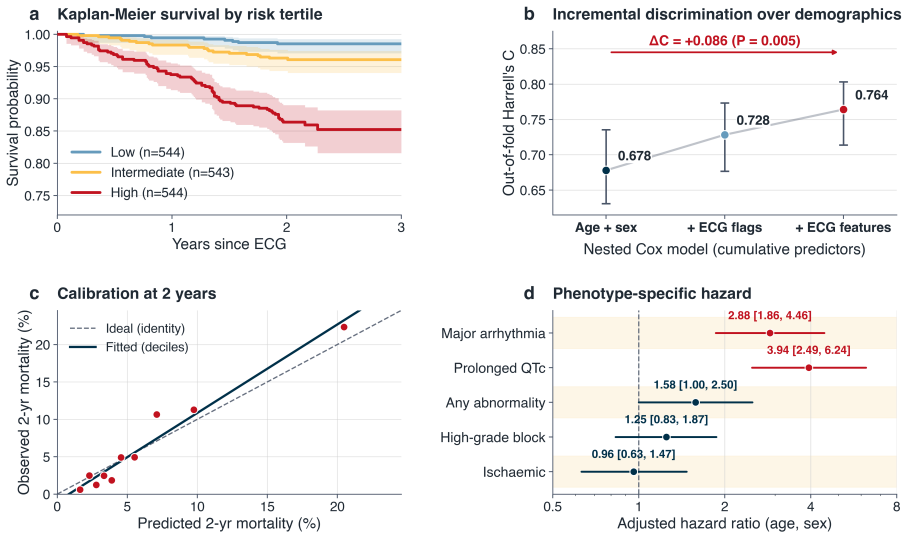
The central discovery is that cardiologist-grounded priors—visible waveform anatomy, a calibrated grid for measurement, and reports that attach every conclusion to a measured quantity—convert ECG interpretation from label imitation into measurement-grounded reading. A two-billion-parameter model, fine-tuned only through low-rank adaptation and without architectural changes, improves heart-rate measurement error to 0.43 bpm (versus 6.45 bpm for the strongest zero-shot frontier system), recovers 50.8% of critical findings on an unseen PTB-XL cohort while every compared frontier zero-shot system stayed below 10.3%, and reaches a junior-reader tier on CODE-test, exceeding the medical-student and emergency-resident tiers on five of six diagnoses. Without retraining it keeps macro-F1 between 0.644 and 0.840 across Brazilian, Chinese, and German cohorts, where a ResNet1d-101 classifier trained on the same source data collapses to 0.049–0.470. The paper also finds that the structure of its generated reports carries emergent prognostic value on a zero-contact Chagas cardiomyopathy cohort, improving an age-and-sex Cox model's concordance index by $\Delta C=+0.086$, even though the model never saw mortality outcomes.
Load-bearing premise
The central claim depends on LUMINAECG's reports being produced by reading the waveform, grid, and colour-coded wave segments in the rendered image, rather than by reproducing memorized template language or device metadata that may have leaked into the supervision.
Editorial extensions
If this is right
- Medical multimodal agents for measurement-intensive diagnostics can reach clinically useful performance without frontier-scale parameter counts, redirecting effort from model size to supervision design.
- Doctor-grounded supervision behaves as a transportable prior: an agent trained in one health system keeps diagnostic quality on unseen populations and devices, addressing a known failure mode of closed-set ECG classifiers.
- Because generated reports carry independent prognostic signal, the report itself becomes a clinical artifact: readable, checkable, and risk-relevant, not just a post-hoc explanation of a label.
- Quantitative grounding gives clinicians an audit trail—heart-rate, PR, and QRS errors of 0.43 bpm, 8.97 ms, and 4.48 ms—so the agent's numbers can be verified against the tracing the same way a colleague's reading would be.
- Critical-finding recall of 50.8% versus below 10.3% for frontier zero-shot systems suggests that safety-relevant ECG misses are governed more by training-data grounding than by model size.
Reading between the lines
- A direct ablation—removing the colour overlay, distorting the grid scale, or withholding device-derived metadata strings—would isolate how much of the gain comes from true visual measurement versus memorized report structure; the paper does not report such ablations.
- The same supervision recipe is a natural candidate for other measurement-intensive visual diagnostics, such as echocardiography or retinal imaging, where calibrated scales and structured reporting conventions exist.
- The emergent prognostic association suggests structured diagnostic transcription encodes physiology beyond label content; a testable extension would corrupt the numeric measurements in training reports and see whether the mortality signal degrades.
- CODE-test junior-reader alignment is a benchmark result, not a deployment licence: prospective validation, local reader panels, and adjustment for comorbidities would be required before clinical use.
Editorial analysis
A structured set of objections, weighed in public.
Referee Report
Summary. LuminaECG is a 2B vision-language model fine-tuned on 12-lead ECG images rendered on grid paper with color-coded P/QRS/T segment overlays, paired with structured eight-section reports generated by gpt-4o from a numeric measurement panel. The paper evaluates the model on held-out MIMIC-IV-ECG report generation and numeric measurement, critical-finding recall on PTB-XL, diagnostic performance on CODE-test against human reader tiers, cross-cohort transfer to Brazil, China, and Germany, and emergent prognostic value in the Sami-Trop cohort. The main claims are that doctor-grounded visual supervision, rather than model scale, yields measurement-grounded ECG interpretation that surpasses junior-reader tiers and transfers across populations.
Significance. If the central attribution holds, this is an important contribution to medical multimodal LLM design: a compact 2B model trained with explicit grid, color-coded wave segments, and structured measurement-grounded reports outperforms much larger zero-shot systems on ECG measurement and diagnosis, and transfers across continents without retraining. The use of external benchmarks (CODE-test, PTB-XL, Chapman, Sami-Trop) with no training contact is a strong point, as is the out-of-fold prognostic analysis and the public release of model weights and a project page. The paper also provides a rare comparison against human reader tiers and critical-finding recall, going beyond aggregate F1. However, the specific attribution of the gains to the visual priors is not yet isolated from potential textual shortcuts, and the internal MIMIC evaluation is partly circular with respect to the training supervision. These concerns are fixable with additional disclosure and ablations.
major comments (3)
- [§5.1 (Image rendering) and §2] The central attribution claim is not yet supported because the rendered ECG image content is not disclosed and the promised shortcut ablation is absent. Section 5.1 describes the grid, 6×2 layout, and color overlay, but never states whether printed headers, numeric measurements, or device-interpretation text are removed from the rendered images. If text is present, the model could read the diagnosis and measurements rather than measure the waveform, and the benchmark gains would not demonstrate measurement-grounded visual reading. The paper explicitly promises to test 'whether the model reads from these priors or from correlated shortcuts' (end of §2), yet no such experiment appears; the only ablation-style row, pretrain-2B in Table A1, is a no-SFT baseline and does not vary the image content. Appendix B.2 adds evidence of non-visual template content: the model outputs '0.005–150 Hz diagnostic bandwidth with 60 Hz notch' and '0.0005–150 Hz diagnostic bandwidth' from static grid images, values that cannot be inferred from the waveform. This makes the missing content disclosure and ablation decisive for the mechanism claim. Please disclose the exact rendering content (including whether any text or metadata is present) and add ablations that remove the grid, remove the color overlay, and add or remove printed text to isolate which visual components drive the gains.
- [§3.1, §5.1 (MIMIC-IV-ECG evaluation)] The report-generation and numeric-measurement evaluations on MIMIC-IV-ECG are partly circular with respect to the training supervision. The reference reports appear to be the same gpt-4o-generated reports produced from the numeric panel used to construct training examples (§5.1), and the numeric references are derived from the same delineator pipeline. High BLEU/ROUGE/CIDEr and low MAE therefore measure agreement with the model's own training distribution rather than independent clinical quality. Please state explicitly whether the evaluation references are the same as those used in training, and provide an independent validation, such as a small sample of reports scored by cardiologists or measurements compared with manually annotated intervals, to support the claim of 'measurement-grounded ECG reporting' (Finding 1).
- [§3.6 (Emergent prognostic value)] The prognostic analysis does not pre-specify the report-derived feature set. With 104 deaths in Sami-Trop, selecting features such as the major-arrhythmia flag and prolonged QTc from the full report-derived panel can inflate the reported ΔC and hazard ratios. The paper should report the full candidate feature list, the selection procedure, and whether the bootstrap confidence interval accounts for selection. The out-of-fold design is a strength, but outcome-based feature selection would still bias the estimate; a pre-registered feature set or a sensitivity analysis entering all features simultaneously would strengthen Finding 5.
minor comments (5)
- [§3.3] The sentence about ECG-R1 is internally inconsistent: recovering 1.1% of critical findings implies missing 98.9%, but the text says 'missing 81%'. Please clarify what the 81% refers to.
- [Table A1] The row label 'pretrain-2B (ablation, no SFT)' is misleading because this row is a no-fine-tuning baseline, not an ablation of the grid, overlay, or textual priors. Renaming it would avoid confusion with the promised shortcut ablation.
- [Appendix B.2] '0.0005–150 Hz diagnostic bandwidth' in the fourth case is likely a typo for '0.05–150 Hz'; please correct it.
- [§5.1] The term 'doctor-grounded' overstates the supervision: the training reports are written by gpt-4o from a numeric panel rather than by cardiologists. Please clarify the extent of direct clinician involvement in constructing the supervision data and consider softening the terminology accordingly.
- [§3.4 and Table A2] The comparison with human reader tiers relies on published benchmark values from the original CODE study. Please state explicitly that the reader protocol in that study (annotation set, number of readers, adjudication) matches the protocol used here, or provide a precise citation to the reader study.
Circularity Check
No circular derivation: the diagnostic and prognostic claims rest on external labels and outcomes that are independent of the training pipeline; the missing shortcut ablation is a support gap, not a circular step.
full rationale
The paper's central diagnostic claims are evaluated against external, independently labeled benchmarks: CODE-test adjudicated labels, PTB-XL SCP codes, Chapman-Shaoxing SNOMED codes, and Sami-Trop mortality outcomes. These targets were not used to construct the training supervision, so the reported macro-F1, cross-cohort transfer, and delta-C results are not equivalent to training inputs by construction. The MIMIC-IV-ECG report-generation and numeric-measurement results are held-out supervised evaluations against references produced by the same NeuroKit-based delineator and gpt-4o grounding protocol that generated the training reports; this shared pipeline is a methodological limitation for interpreting low MAE as evidence of visual waveform measurement, but it is not circular, because the 79,981 test records are disjoint from the 719,828 training records and the model was not fitted to the test references. The paper explicitly says it will 'test below whether the model reads from these priors or from correlated shortcuts' (Section 2), yet no such content-ablation experiment appears in the main text or appendices; Table A1's pretrain-2B row only removes supervised fine-tuning. Appendix B.2 also shows LuminaECG outputting non-visual, template-like content such as '0.005-150 Hz diagnostic bandwidth with 60 Hz notch,' which would indicate text-reading shortcuts if the rendered images contain printed device metadata. However, the paper never states whether the rendered images include printed text or measurements, so this remains an unsupported mechanism claim rather than a demonstrated case of a prediction reducing to its input. There is no load-bearing self-citation chain, no imported uniqueness theorem, and no fitted parameter renamed as a prediction on the external benchmarks. The deficiency is empirical support for the mechanism, not circularity of the derivation.
Assumptions & free parameters
free parameters (1)
- Prognostic report-derived feature set =
not specified
assumptions (4)
- domain assumption The NeuroKit-based delineator and the MIMIC device measurements provide sufficiently accurate ground truth for all measurements and diagnoses used in supervision and evaluation.
- domain assumption Rendered ECG grid images preserve all clinically relevant temporal and voltage information at a resolution a 2B vision-language model can extract.
- ad hoc to paper gpt-4o reports generated from the numeric panel and constrained by a grounding protocol are a faithful proxy for clinician reasoning.
- domain assumption Label harmonization across MIMIC, PTB-XL, Chapman, and CODE-test preserves the clinical meaning of the six CODE-6 diagnoses.
Cite this review
Pith. "Pith review of Diagnosing as Cardiologists Do: ECG Agents with Doctor-Grounded Priors for Clinical Reasoning Across Diseases and Populations." pith.science (2026). https://pith.science/paper/XOQ3NE5T
@misc{pith2026260809053,
  author       = {Pith},
  title        = {Pith review of: Diagnosing as Cardiologists Do: ECG Agents with Doctor-Grounded Priors for Clinical Reasoning Across Diseases and Populations},
  year         = {2026},
  howpublished = {\url{https://pith.science/paper/XOQ3NE5T}},
  note         = {Machine review of arXiv:2608.09053}
}
read the original abstract
Cardiologists interpret electrocardiograms by localizing waveform components, measuring rhythm and interval patterns, and translating these structured observations into diagnostic evidence. Whether this expert reading process can serve as an effective prior for ECG agents remains unclear. To address this question, we introduce LuminaECG, a clinically structured ECG reasoning framework that reformulates ECG interpretation as measurement-grounded visual reading. ECG signals are rendered on standard electrocardiographic grid paper to preserve the spatial and scale cues used in clinical reading. P-wave, QRS-complex, and T-wave boundaries are explicitly delineated, and color-coded segmentation decomposes the waveform into discrete visual measurement primitives. A general 2B vision-language backbone is then trained with low-rank supervised fine-tuning to associate these primitives with diagnostic reasoning, without architectural modification. Across open, proprietary, and ECG-specialist zero-shot baselines, LuminaECG improves both waveform measurement and diagnostic recovery. It reaches a clinically meaningful reader tier on the CODE-test benchmark, transfers across geographically diverse ECG datasets without retraining, and generates reports whose structure contains an emergent prognostic signal. These findings suggest that effective ECG agents require not only larger models, but supervision that preserves the alignment between measurable waveform evidence and clinical knowledge.
Figures


Reference graph
Works this paper leans on
-
[1]
Zachi I Attia, Suraj Kapa, Francisco Lopez-Jimenez, Paul M McKie, Dorothy J Ladewig, Gaurav Satam, Patricia A Pellikka, Maurice Enriquez-Sarano, Peter A Noseworthy, Thomas M Munger, Samuel J Asirvatham, Christopher G Scott, Rickey E Carter, and Paul A Friedman. Screening for cardiac contractile dysfunction using an artificial intelligence--enabled electro...
-
[2]
Zachi I Attia, Peter A Noseworthy, Francisco Lopez-Jimenez, Samuel J Asirvatham, Abhishek J Deshmukh, Bernard J Gersh, Rickey E Carter, Xiaoxi Yao, Alejandro A Rabinstein, Brad J Erickson, Suraj Kapa, and Paul A Friedman. An artificial intelligence-enabled ECG algorithm for the identification of patients with atrial fibrillation during sinus rhythm: a ret...
-
[3]
Towards domain generalization for ECG and EEG classification: Algorithms and benchmarks
Aristotelis Ballas and Christos Diou. Towards domain generalization for ECG and EEG classification: Algorithms and benchmarks. IEEE Transactions on Emerging Topics in Computational Intelligence, 2023
work page 2023
-
[4]
Yoshua Bengio, J \'e r \^o me Louradour, Ronan Collobert, and Jason Weston. Curriculum learning. In International Conference on Machine Learning (ICML), 2009. doi:10.1145/1553374.1553380
arXiv 2009
-
[5]
Meyer, Yuning Chai, and Yong Jae Lee
Mu Cai, Haotian Liu, Dennis Park, Siva Karthik Mustikovela, Gregory P. Meyer, Yuning Chai, and Yong Jae Lee. ViP-LLaVA : Making large multimodal models understand arbitrary visual prompts. In Proceedings of the IEEE/CVF Conference on Computer Vision and Pattern Recognition (CVPR), 2024
work page 2024
-
[6]
Generating radiology reports via memory-driven transformer
Zhihong Chen, Yan Song, Tsung-Hui Chang, and Xiang Wan. Generating radiology reports via memory-driven transformer. In Proceedings of the 2020 Conference on Empirical Methods in Natural Language Processing (EMNLP), pages 1439--1449, 2020
work page 2020
-
[7]
Philip de Chazal, Maria O'Dwyer, and Richard B. Reilly. Automatic classification of heartbeats using ECG morphology and heartbeat interval features. IEEE Transactions on Biomedical Engineering, 51 0 (7): 0 1196--1206, 2004
work page 2004
-
[8]
E. William Hancock, Barbara J. Deal, David M. Mirvis, Peter Okin, Paul Kligfield, and Leonard S. Gettes. AHA/ACCF/HRS recommendations for the standardization and interpretation of the electrocardiogram. part V : Electrocardiogram changes associated with cardiac chamber hypertrophy. Journal of the American College of Cardiology, 53 0 (11): 0 992--1002, 200...
Show all 47 references
-
[9]
Hannun, Pranav Rajpurkar, Masoumeh Haghpanahi, Geoffrey H
Awni Y. Hannun, Pranav Rajpurkar, Masoumeh Haghpanahi, Geoffrey H. Tison, Codie Bourn, Mintu P. Turakhia, and Andrew Y. Ng. Cardiologist-level arrhythmia detection and classification in ambulatory electrocardiograms using a deep neural network. Nature Medicine, 25 0 (1): 0 65-...
2019 doi
-
[10]
MINA : Multilevel knowledge-guided attention for modeling electrocardiography signals
Shenda Hong, Cao Xiao, Tengfei Ma, Hongyan Li, and Jimeng Sun. MINA : Multilevel knowledge-guided attention for modeling electrocardiography signals. In Proceedings of the 28th International Joint Conference on Artificial Intelligence (IJCAI), pages 5888--5894, 2019
2019
-
[11]
Hu, Yelong Shen, Phillip Wallis, Zeyuan Allen-Zhu, Yuanzhi Li, Shean Wang, Lu Wang, and Weizhu Chen
Edward J. Hu, Yelong Shen, Phillip Wallis, Zeyuan Allen-Zhu, Yuanzhi Li, Shean Wang, Lu Wang, and Weizhu Chen. LoRA : Low-rank adaptation of large language models. In International Conference on Learning Representations, 2022
2022
-
[12]
Lungren, Andrew Y
Saahil Jain, Ashwin Agrawal, Adriel Saporta, Steven Truong, Du Nguyen Duong, Tan Bui, Pierre Chambon, Yuhao Zhang, Matthew P. Lungren, Andrew Y. Ng, Curtis P. Langlotz, and Pranav Rajpurkar. RadGraph : Extracting clinical entities and relations from radiology reports. In Advan...
2021
-
[13]
ECG-R1 : Protocol-guided and modality-agnostic MLLM for reliable ECG interpretation, 2026
Jiarui Jin, Haoyu Wang, Xingliang Wu, Xiaocheng Fang, Xiang Lan, Zihan Wang, Deyun Zhang, Bo Liu, Yingying Zhang, Xian Wu, Hongyan Li, and Shenda Hong. ECG-R1 : Protocol-guided and modality-agnostic MLLM for reliable ECG interpretation, 2026. URL https://arxiv.org/abs/2602.04279
2026 arXiv
-
[14]
Deep learning based ECG segmentation for delineation of diverse arrhythmias
Chankyu Joung, Mijin Kim, Taejin Paik, Seong-Ho Kong, Seung-Young Oh, Won Kyeong Jeon, Jae-hu Jeon, Joong-Sik Hong, Wan-Joong Kim, Woong Kook, Myung-Jin Cha, and Otto van Koert. Deep learning based ECG segmentation for delineation of diverse arrhythmias. PLoS One, 19 0 (6): 0 ...
2024
-
[15]
Physics-informed machine learning
George Em Karniadakis, Ioannis G Kevrekidis, Lu Lu, Paris Perdikaris, Sifan Wang, and Liu Yang. Physics-informed machine learning. Nature Reviews Physics, 3 0 (6): 0 422--440, 2021. doi:10.1038/s42254-021-00314-5
2021 doi
-
[16]
Gettes, James J
Paul Kligfield, Leonard S. Gettes, James J. Bailey, Rory Childers, Barbara J. Deal, E. William Hancock, Gerard van Herpen, Jan A. Kors, Peter Macfarlane, David M. Mirvis, Olle Pahlm, Pentti Rautaharju, and Galen S. Wagner. AHA/ACCF/HRS recommendations for the standardization a...
2007 doi
-
[17]
Pawan Kumar, Benjamin Packer, and Daphne Koller
M. Pawan Kumar, Benjamin Packer, and Daphne Koller. Self-paced learning for latent variable models. In Advances in Neural Information Processing Systems (NeurIPS), 2010
2010
-
[18]
GEM : Empowering MLLM for grounded ECG understanding with time series and images
Xiang Lan, Feng Wu, et al. GEM : Empowering MLLM for grounded ECG understanding with time series and images. arXiv preprint arXiv:2503.06073, 2025
2025
-
[19]
LLaVA-Med : Training a large language-and-vision assistant for biomedicine in one day
Chunyuan Li, Cliff Wong, Sheng Zhang, Naoto Usuyama, Haotian Liu, Jianwei Yang, Tristan Naumann, Hoifung Poon, and Jianfeng Gao. LLaVA-Med : Training a large language-and-vision assistant for biomedicine in one day. In Advances in Neural Information Processing Systems (NeurIPS...
2023
-
[20]
Let's verify step by step
Hunter Lightman, Vineet Kosaraju, Yura Burda, Harri Edwards, Bowen Baker, Teddy Lee, Jan Leike, John Schulman, Ilya Sutskever, and Karl Cobbe. Let's verify step by step. In International Conference on Learning Representations (ICLR), 2024. arXiv:2305.20050
2024 arXiv
-
[21]
Knowledge-enhanced multimodal ECG representation learning with arbitrary-lead inputs
Che Liu, Cheng Ouyang, Zhongwei Wan, Haozhe Wang, Wenjia Bai, and Rossella Arcucci. Knowledge-enhanced multimodal ECG representation learning with arbitrary-lead inputs. In Findings of the Association for Computational Linguistics: EMNLP 2025, 2025. arXiv:2502.17900
2025 arXiv
-
[22]
Zero-shot ECG classification with multimodal learning and test-time clinical knowledge enhancement
Che Liu et al. Zero-shot ECG classification with multimodal learning and test-time clinical knowledge enhancement. arXiv preprint arXiv:2403.06659, 2024
2024 arXiv
-
[23]
Teaching multimodal LLMs to comprehend 12-lead electrocardiographic images
Ruoqi Liu, Yuelin Bai, Xiang Yue, and Ping Zhang. Teaching multimodal LLMs to comprehend 12-lead electrocardiographic images. npj Digital Medicine, 2026. doi:10.1038/s41746-026-02551-3
2026 doi
-
[24]
A wavelet-based ECG delineator: evaluation on standard databases
Juan Pablo Mart \'i nez, Rute Almeida, Salvador Olmos, Ana Paula Rocha, and Pablo Laguna. A wavelet-based ECG delineator: evaluation on standard databases. IEEE Transactions on Biomedical Engineering, 51 0 (4): 0 570--581, 2004
2004
-
[25]
ECG-FM : An open electrocardiogram foundation model
Kaden McKeen, Laura Oliva, Sameer Masood, Augustin Toma, Barry Rubin, and Bo Wang. ECG-FM : An open electrocardiogram foundation model. arXiv preprint arXiv:2408.05178, 2024
2024 arXiv
-
[26]
Improving factual completeness and consistency of image-to-text radiology report generation
Yasuhide Miura, Yuhao Zhang, Emily Tsai, Curtis Langlotz, and Dan Jurafsky. Improving factual completeness and consistency of image-to-text radiology report generation. In Proceedings of the 2021 Conference of the North American Chapter of the Association for Computational Lin...
2021
-
[27]
Guiding masked representation learning to capture spatio-temporal relationship of electrocardiogram
Yeongyeon Na, Minje Park, Yunwon Tae, and Sunghoon Joo. Guiding masked representation learning to capture spatio-temporal relationship of electrocardiogram. In International Conference on Learning Representations (ICLR), 2024
2024
-
[28]
ECG-QA : A comprehensive question answering dataset combined with electrocardiogram
Jungwoo Oh, Gyubok Lee, Seongsu Bae, Joon-myoung Kwon, and Edward Choi. ECG-QA : A comprehensive question answering dataset combined with electrocardiogram. In Advances in Neural Information Processing Systems (NeurIPS), Datasets and Benchmarks Track, 2023. arXiv:2306.15681
2023 arXiv
-
[29]
Bleu: a method for automatic evaluation of machine translation
Kishore Papineni, Salim Roukos, Todd Ward, and Wei-Jing Zhu. Bleu: a method for automatic evaluation of machine translation. In Proceedings of the 40th Annual Meeting of the Association for Computational Linguistics, pages 311--318. Association for Computational Linguistics, 2002
2002
-
[30]
DENS-ECG : A deep learning approach for ECG signal delineation
Abdolrahman Peimankar and Sadasivan Puthusserypady. DENS-ECG : A deep learning approach for ECG signal delineation. Expert Systems with Applications, 165: 0 113911, 2021
2021
-
[31]
Qwen3-VL : A frontier vision-language family
Qwen Team . Qwen3-VL : A frontier vision-language family. https://qwenlm.github.io/blog/qwen3-vl/, 2025
2025
-
[32]
Physics-informed neural networks: A deep learning framework for solving forward and inverse problems involving nonlinear partial differential equations
Maziar Raissi, Paris Perdikaris, and George Em Karniadakis. Physics-informed neural networks: A deep learning framework for solving forward and inverse problems involving nonlinear partial differential equations. Journal of Computational Physics, 378: 0 686--707, 2019
2019
-
[33]
Ribeiro, Manoel Horta Ribeiro, Gabriela M
Ant \^o nio H. Ribeiro, Manoel Horta Ribeiro, Gabriela M. M. Paix \ a o, Derick M. Oliveira, Paulo R. Gomes, J \'e ssica A. Canazart, Milton P. S. Ferreira, Carl R. Andersson, Peter W. Macfarlane, Wagner Meira, Thomas B. Sch \"o n, and Antonio Luiz P. Ribeiro. Automatic diagno...
2020 doi
-
[34]
What does CLIP know about a red circle? Visual prompt engineering for VLMs
Aleksandar Shtedritski, Christian Rupprecht, and Andrea Vedaldi. What does CLIP know about a red circle? Visual prompt engineering for VLMs . In International Conference on Computer Vision (ICCV), 2023. arXiv:2304.06712
2023 arXiv
-
[35]
Artificial intelligence-enhanced electrocardiography in cardiovascular disease management
Konstantinos C Siontis, Peter A Noseworthy, Zachi I Attia, and Paul A Friedman. Artificial intelligence-enhanced electrocardiography in cardiovascular disease management. Nature Reviews Cardiology, 18 0 (7): 0 465--478, 2021. doi:10.1038/s41569-020-00503-2
2021 doi
-
[36]
Deep learning for ECG analysis: Benchmarks and insights from PTB-XL
Nils Strodthoff, Patrick Wagner, Tobias Schaeffter, and Wojciech Samek. Deep learning for ECG analysis: Benchmarks and insights from PTB-XL . IEEE Journal of Biomedical and Health Informatics, 25 0 (5): 0 1519--1528, 2021. doi:10.1109/JBHI.2020.3022989
2021
-
[37]
Deal, Leonard S
Borys Surawicz, Rory Childers, Barbara J. Deal, Leonard S. Gettes, James J. Bailey, Anton Gorgels, E. William Hancock, Mark Josephson, Paul Kligfield, Jan A. Kors, Peter Macfarlane, Jay W. Mason, David M. Mirvis, Peter Okin, Olle Pahlm, Pentti M. Rautaharju, Gerard van Herpen,...
2009
-
[38]
Towards generalist biomedical AI
Tao Tu, Shekoofeh Azizi, Danny Driess, Mike Schaekermann, Mohamed Amin, Pi-Chuan Chang, Andrew Carroll, Chuck Lau, Ryutaro Tanno, Ira Ktena, et al. Towards generalist biomedical AI . NEJM AI, 1 0 (3), 2024. doi:10.1056/AIoa2300138
2024 doi
-
[39]
Lawrence Zitnick, and Devi Parikh
Ramakrishna Vedantam, C. Lawrence Zitnick, and Devi Parikh. CIDEr : Consensus-based image description evaluation. In IEEE Conference on Computer Vision and Pattern Recognition (CVPR), pages 4566--4575. IEEE, 2015. doi:10.1109/CVPR.2015.7299087
2015
-
[40]
Wagner, Peter Macfarlane, Hein Wellens, Mark Josephson, Anton Gorgels, David M
Galen S. Wagner, Peter Macfarlane, Hein Wellens, Mark Josephson, Anton Gorgels, David M. Mirvis, Olle Pahlm, Borys Surawicz, Paul Kligfield, Rory Childers, and Leonard S. Gettes. AHA/ACCF/HRS recommendations for the standardization and interpretation of the electrocardiogram. ...
2009 doi
-
[41]
PTB-XL , a large publicly available electrocardiography dataset
Patrick Wagner, Nils Strodthoff, Ralf-Dieter Bousseljot, Dieter Kreiseler, Fatima I Lunze, Wojciech Samek, and Tobias Schaeffter. PTB-XL , a large publicly available electrocardiography dataset. Scientific Data, 7 0 (1): 0 154, 2020
2020
-
[42]
Contrastive region guidance: Improving grounding in vision-language models without training
David Wan, Jaemin Cho, Elias Stengel-Eskin, and Mohit Bansal. Contrastive region guidance: Improving grounding in vision-language models without training. In European Conference on Computer Vision (ECCV), 2024. arXiv:2403.02325
2024 arXiv
-
[43]
MEIT : Multimodal electrocardiogram instruction tuning on large language models for report generation
Zhongwei Wan, Che Liu, Xin Wang, Chaofan Tao, Hui Shen, Jing Xiong, Rossella Arcucci, Huaxiu Yao, and Mi Zhang. MEIT : Multimodal electrocardiogram instruction tuning on large language models for report generation. In Findings of the Association for Computational Linguistics: ...
2025
-
[44]
Chain-of-thought prompting elicits reasoning in large language models
Jason Wei, Xuezhi Wang, Dale Schuurmans, Maarten Bosma, Brian Ichter, Fei Xia, Ed H Chi, Quoc V Le, and Denny Zhou. Chain-of-thought prompting elicits reasoning in large language models. In Advances in Neural Information Processing Systems (NeurIPS), 2022. arXiv:2201.11903
2022 arXiv
-
[45]
Set-of-mark prompting unleashes extraordinary visual grounding in GPT-4V
Jianwei Yang, Hao Zhang, Feng Li, Xueyan Zou, Chunyuan Li, and Jianfeng Gao. Set-of-mark prompting unleashes extraordinary visual grounding in GPT-4V . arXiv preprint arXiv:2310.11441, 2023
2023 arXiv
-
[46]
Multi-class arrhythmia detection from twelve-lead varied-length ECG using attention-based time-incremental convolutional neural network
Qihang Yao, Ruxin Wang, Xiaomao Fan, Jikui Liu, and Ye Li. Multi-class arrhythmia detection from twelve-lead varied-length ECG using attention-based time-incremental convolutional neural network. Information Fusion, 53: 0 174--182, 2020
2020
-
[47]
ECG-Chat : A large ECG -language model for cardiac disease diagnosis
Yubao Zhao et al. ECG-Chat : A large ECG -language model for cardiac disease diagnosis. arXiv preprint arXiv:2408.08849, 2024
2024 arXiv
Reviewed August 14, 2026 · model on record in the stance chip above.
Discussion (0). Continue with ORCID to comment.