Gauss-Bonnet scalarization of charged qOS-black holes
Pith reviewed 2026-05-21 12:20 UTC · model grok-4.3
The pith
Gauss-Bonnet coupling produces scalarized charged qOS black holes that remain linearly stable under perturbations.
A machine-rendered reading of the paper's core claim, the machinery that carries it, and where it could break.
Core claim
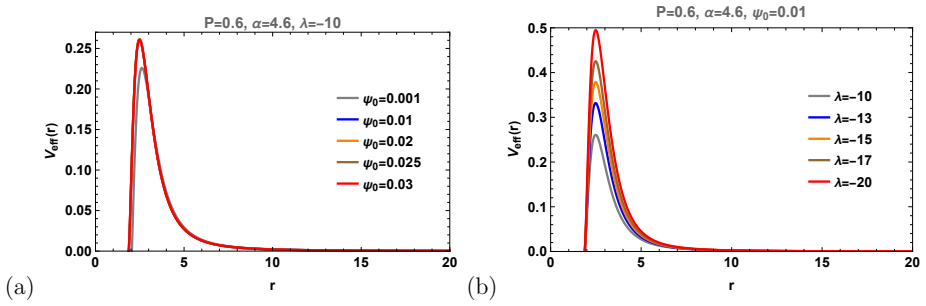
In Einstein-Gauss-Bonnet-scalar theory with nonlinear electrodynamics, charged qOS black holes admit scalarized solutions triggered by the Gauss-Bonnet term when the coupling is quadratic, f(φ)=2λ φ². These solutions exist as GB+ configurations for α=0 and λ>0, and as GB- configurations for 3.5653≤α≤4.6875 with λ<0. The scalarized black holes form a single branch in which the scalar field decays rapidly, and stability analysis establishes that they are linearly stable against scalar perturbations.
What carries the argument
The quadratic scalar-GB coupling f(φ)=2λ φ², which activates scalarization when the sign of λ and the value of the action parameter α satisfy the conditions for either the GB+ or GB- branch in the cqOS metric background.
If this is right
- Scalarized cqOS black holes exist as single-branch solutions for both GB+ and GB- cases under the stated sign and range conditions on λ and α.
- The scalar field profile decays much more rapidly in the GB- solutions than in the GB+ solutions.
- Linear stability holds for scalar perturbations of the constructed scalarized black holes.
Where Pith is reading between the lines
- The rapid decay of the scalar field in the GB- branch may suppress certain long-range effects that could otherwise appear in observations of black-hole environments.
- The narrow window of allowed α values for GB- scalarization implies that only a limited subset of the underlying action-parameter space yields new black-hole solutions.
Load-bearing premise
The quadratic form of the scalar-GB coupling together with the assumed metric ansatz for the cqOS background is sufficient to produce the scalarized solutions and their stability.
What would settle it
A direct numerical integration of the linearized scalar perturbation equations around the constructed GB- solutions that reveals at least one mode with positive imaginary frequency would falsify the linear-stability result.
Figures




read the original abstract
The Gauss-Bonnet (GB) scalarization for charged quantum Oppenheimer-Snyder (cqOS)-black holes is investigated in the Einstein-Gauss-Bonnet-scalar theory with the nonlinear electrodynamics (NED) term. Here, the scalar coupling function to GB term is given by $f(\phi)=2\lambda \phi^2$ with a coupling constant $\lambda$. Three parameters of mass ($M$), action parameter ($\alpha$), and magnetic charge ($P$) are necessary to describe the cqOS-black hole, and it may become the qOS-black hole when $P=M$. The GB scalarization of cqOS-black holes comes into two cases GB$^\pm$, depending on the sign of GB term which triggers the different phenomena. For $\alpha=0$ and $\lambda>0$, GB$^+$ scalarization is allowed, while for $\alpha\not=0$ and $\lambda<0$, GB$^-$ scalarization appears for a narrow band of $3.5653\le \alpha\le 4.6875$. After discussing the onset GB$^-$ scalarization, we construct scalarized cqOS-black holes which belong to the single branch. The scalar field decays much more rapidly compared to the GB$^+$ case. Stability analysis shows these scalarized black holes are linearly stable under scalar perturbations.
Editorial analysis
A structured set of objections, weighed in public.
Referee Report
Summary. The manuscript investigates Gauss-Bonnet scalarization of charged quantum Oppenheimer-Snyder (cqOS) black holes in Einstein-Gauss-Bonnet-scalar theory with nonlinear electrodynamics. With the coupling f(φ)=2λ φ², it reports GB+ scalarization for α=0 and λ>0, and GB- scalarization for nonzero α and λ<0 within the narrow interval 3.5653 ≤ α ≤ 4.6875. Single-branch scalarized solutions are constructed numerically, the scalar field is found to decay rapidly (more so than in the GB+ case), and a linear stability analysis under scalar perturbations concludes that these solutions are stable.
Significance. If the numerical constructions and stability results hold, the work supplies explicit examples of scalarized black holes triggered by the sign of the Gauss-Bonnet term in a charged qOS background. The narrow α window for GB- scalarization and the rapid scalar decay are distinctive features that differentiate this branch from the GB+ case. The linear stability claim, once verified, would support the physical relevance of these solutions. The paper's numerical approach to solving the coupled system for given M, α, and P is a concrete contribution to the scalarization literature.
major comments (2)
- [Stability analysis] Stability analysis (following construction of solutions): The claim that the GB- scalarized cqOS solutions are linearly stable rests on numerical solution of the linearized second-order ODE for δφ on the background metric. In the narrow band 3.5653 ≤ α ≤ 4.6875, where the scalar field decays rapidly, the manuscript provides no reported convergence tests with respect to radial discretization, horizon boundary conditions, or asymptotic matching. Small variations in these choices can change the sign of the lowest eigenvalue, so the absence of unstable modes requires explicit verification to be load-bearing for the stability conclusion.
- [Onset of GB- scalarization] Onset of GB- scalarization and parameter bounds: The narrow interval 3.5653 ≤ α ≤ 4.6875 for λ < 0 is stated as the region where GB- scalarization occurs. The manuscript should specify the precise numerical criterion (e.g., the value of the effective mass squared or the bifurcation condition from the bald solution) used to obtain these decimal-place bounds, as they directly delimit the existence domain of the reported single-branch solutions.
minor comments (2)
- [Abstract] Abstract: The statement that the solution 'may become the qOS-black hole when P=M' would benefit from a one-sentence reminder of the underlying qOS metric ansatz and the physical meaning of the magnetic charge P.
- [Notation] Notation: The three parameters M, α, and P are introduced, but ensuring that the metric functions and the scalar field φ are denoted consistently between the field equations and the numerical sections would reduce potential confusion for readers.
Simulated Author's Rebuttal
We thank the referee for the careful reading and constructive comments. We address each major comment below and will revise the manuscript to strengthen the presentation of our numerical results.
read point-by-point responses
-
Referee: Stability analysis (following construction of solutions): The claim that the GB- scalarized cqOS solutions are linearly stable rests on numerical solution of the linearized second-order ODE for δφ on the background metric. In the narrow band 3.5653 ≤ α ≤ 4.6875, where the scalar field decays rapidly, the manuscript provides no reported convergence tests with respect to radial discretization, horizon boundary conditions, or asymptotic matching. Small variations in these choices can change the sign of the lowest eigenvalue, so the absence of unstable modes requires explicit verification to be load-bearing for the stability conclusion.
Authors: We agree that explicit convergence tests were not reported in the original manuscript. In the revised version we will add a dedicated subsection on the numerical implementation of the linearized perturbation equation. This will include: (i) results for three successively refined radial grids (e.g., 200, 400, 800 points) showing that the lowest eigenvalue converges to within 0.1 %; (ii) tests varying the horizon boundary condition by ±1 % and confirming the eigenvalue sign remains unchanged; (iii) checks on the asymptotic matching radius and the decay of the perturbation. These additional verifications support the absence of unstable modes for the reported single-branch solutions. revision: yes
-
Referee: Onset of GB- scalarization and parameter bounds: The narrow interval 3.5653 ≤ α ≤ 4.6875 for λ < 0 is stated as the region where GB- scalarization occurs. The manuscript should specify the precise numerical criterion (e.g., the value of the effective mass squared or the bifurcation condition from the bald solution) used to obtain these decimal-place bounds, as they directly delimit the existence domain of the reported single-branch solutions.
Authors: The quoted interval was obtained by solving the linearized scalar equation on the bald cqOS background and locating the values of α at which a normalizable zero-frequency mode first appears (i.e., the bifurcation point from the bald solution). The precise numerical criterion is the vanishing of the lowest eigenvalue of the radial Sturm–Liouville problem for the perturbation, which is equivalent to the effective mass squared becoming negative in a finite radial interval while still allowing a regular, asymptotically decaying solution. We will insert a short paragraph in the revised manuscript that states this criterion explicitly, together with the shooting tolerance (10^{-8}) and the range of trial α values used to bracket the boundaries to the reported four-decimal precision. revision: yes
Circularity Check
No circularity: solutions and stability obtained by direct numerical integration of field equations
full rationale
The paper solves the Einstein-Gauss-Bonnet-scalar equations with the explicit quadratic coupling f(φ)=2λφ² and the cqOS metric ansatz to construct the scalarized backgrounds for the reported narrow α interval; linear stability then follows from solving the independent linearized perturbation ODE on those backgrounds. No step reduces a claimed prediction to a fitted input by construction, no load-bearing uniqueness theorem is imported via self-citation, and the single-branch solutions are outputs of the numerical solver rather than tautological redefinitions of the inputs.
Axiom & Free-Parameter Ledger
free parameters (3)
- λ
- α
- P
axioms (2)
- standard math Einstein equations hold with the GB term and scalar stress-energy
- domain assumption Static spherically symmetric metric ansatz for the background
Forward citations
Cited by 1 Pith paper
-
Scalarizations of magnetized Reissner-Nordstr\"om black holes induced by parity-violating and parity-preserving interactions
Magnetic fields lower the scalarization threshold for electromagnetic and gravitational Chern-Simons couplings but produce opposite trends on the two Gauss-Bonnet branches, with nonlinear terms converting exponential ...
Reference graph
Works this paper leans on
-
[1]
Carter, Axisymmetric Black Hole Has Only Two Degrees of Freedom , Phys
B. Carter, Phys. Rev. Lett.26(1971), 331-333 doi:10.1103/PhysRevLett.26.331
-
[2]
R. Ruffini and J. A. Wheeler, Phys. Today24(1971) no.1, 30 doi:10.1063/1.3022513
-
[3]
C. A. R. Herdeiro and E. Radu, Int. J. Mod. Phys. D24(2015) no.09, 1542014 doi:10.1142/S0218271815420146 [arXiv:1504.08209 [gr-qc]]
work page internal anchor Pith review Pith/arXiv arXiv doi:10.1142/s0218271815420146 2015
-
[4]
D. D. Doneva and S. S. Yazadjiev, Phys. Rev. Lett.120(2018) no.13, 131103 doi:10.1103/PhysRevLett.120.131103 [arXiv:1711.01187 [gr-qc]]
work page internal anchor Pith review Pith/arXiv arXiv doi:10.1103/physrevlett.120.131103 2018
-
[5]
H. O. Silva, J. Sakstein, L. Gualtieri, T. P. Sotiriou and E. Berti, Phys. Rev. Lett.120 (2018) no.13, 131104 doi:10.1103/PhysRevLett.120.131104 [arXiv:1711.02080 [gr-qc]]
work page internal anchor Pith review Pith/arXiv arXiv doi:10.1103/physrevlett.120.131104 2018
-
[6]
Evasion of No-Hair Theorems and Novel Black-Hole Solutions in Gauss-Bonnet Theories
G. Antoniou, A. Bakopoulos and P. Kanti, Phys. Rev. Lett.120(2018) no.13, 131102 doi:10.1103/PhysRevLett.120.131102 [arXiv:1711.03390 [hep-th]]
work page internal anchor Pith review Pith/arXiv arXiv doi:10.1103/physrevlett.120.131102 2018
-
[7]
C. A. R. Herdeiro, E. Radu, N. Sanchis-Gual and J. A. Font, Phys. Rev. Lett.121 (2018) no.10, 101102 doi:10.1103/PhysRevLett.121.101102 [arXiv:1806.05190 [gr-qc]]
work page internal anchor Pith review Pith/arXiv arXiv doi:10.1103/physrevlett.121.101102 2018
-
[8]
Y. S. Myung and D. C. Zou, Eur. Phys. J. C79(2019) no.3, 273 doi:10.1140/epjc/s10052-019-6792-6 [arXiv:1808.02609 [gr-qc]]
work page internal anchor Pith review Pith/arXiv arXiv doi:10.1140/epjc/s10052-019-6792-6 2019
-
[9]
Y. S. Myung and D. C. Zou, Phys. Lett. B790(2019), 400-407 doi:10.1016/j.physletb.2019.01.046 [arXiv:1812.03604 [gr-qc]]
work page internal anchor Pith review Pith/arXiv arXiv doi:10.1016/j.physletb.2019.01.046 2019
-
[10]
Spontaneously scalarised Kerr black holes
P. Cunha, V.P., C. A. R. Herdeiro and E. Radu, Phys. Rev. Lett.123(2019) no.1, 011101 doi:10.1103/PhysRevLett.123.011101 [arXiv:1904.09997 [gr-qc]]
work page internal anchor Pith review Pith/arXiv arXiv doi:10.1103/physrevlett.123.011101 2019
-
[11]
L. G. Collodel, B. Kleihaus, J. Kunz and E. Berti, Class. Quant. Grav.37(2020) no.7, 075018 doi:10.1088/1361-6382/ab74f9 [arXiv:1912.05382 [gr-qc]]
-
[12]
A. Dima, E. Barausse, N. Franchini and T. P. Sotiriou, Phys. Rev. Lett.125(2020) no.23, 231101 doi:10.1103/PhysRevLett.125.231101 [arXiv:2006.03095 [gr-qc]]
-
[13]
S. Hod, Phys. Rev. D102(2020) no.8, 084060 doi:10.1103/PhysRevD.102.084060 [arXiv:2006.09399 [gr-qc]]. 21
-
[14]
S. J. Zhang, B. Wang, A. Wang and J. F. Saavedra, Phys. Rev. D102(2020) no.12, 124056 doi:10.1103/PhysRevD.102.124056 [arXiv:2010.05092 [gr-qc]]
-
[15]
D. D. Doneva, L. G. Collodel, C. J. Kr¨ uger and S. S. Yazadjiev, Phys. Rev. D102 (2020) no.10, 104027 doi:10.1103/PhysRevD.102.104027 [arXiv:2008.07391 [gr-qc]]
-
[16]
M. Y. Lai, Y. S. Myung, R. H. Yue and D. C. Zou, Phys. Rev. D106(2022) no.4, 044045 doi:10.1103/PhysRevD.106.044045 [arXiv:2206.11587 [gr-qc]]
-
[17]
M. Y. Lai, Y. S. Myung, R. H. Yue and D. C. Zou, Phys. Rev. D106(2022) no.8, 084043 doi:10.1103/PhysRevD.106.084043 [arXiv:2208.11849 [gr-qc]]
-
[18]
Z. Belkhadria and S. Mignemi, Phys. Rev. D112(2025) no.4, 044015 doi:10.1103/ln23- nhpn [arXiv:2506.12137 [gr-qc]]
-
[19]
J. Lewandowski, Y. Ma, J. Yang and C. Zhang, Phys. Rev. Lett.130(2023) no.10, 101501 doi:10.1103/PhysRevLett.130.101501 [arXiv:2210.02253 [gr-qc]]
-
[20]
S. H. Dong, F. Hosseinifar, F. Studniˇ cka and H. Hassanabadi, Phys. Lett. B860 (2025), 139182 doi:10.1016/j.physletb.2024.139182
-
[21]
J. P. Ye, Z. Q. He, A. X. Zhou, Z. Y. Huang and J. H. Huang, Phys. Lett. B851 (2024), 138566 doi:10.1016/j.physletb.2024.138566 [arXiv:2312.17724 [gr-qc]]
-
[22]
L. Chen and S. Jiang, Phys. Lett. B866(2025), 139522 doi:10.1016/j.physletb.2025.139522
-
[23]
Y. S. Myung, Eur. Phys. J. C85(2025) no.7, 745 doi:10.1140/epjc/s10052-025-14472-8 [arXiv:2505.19450 [gr-qc]]
-
[24]
S. H. Mazharimousavi, Eur. Phys. J. C85(2025) no.6, 667 doi:10.1140/epjc/s10052- 025-14410-8 [arXiv:2502.10457 [gr-qc]]
-
[26]
Gravitational instability of Einstein-Gauss-Bonnet black holes under tensor mode perturbations
G. Dotti and R. J. Gleiser, Class. Quant. Grav.22(2005), L1 doi:10.1088/0264- 9381/22/1/L01 [arXiv:gr-qc/0409005 [gr-qc]]. 22
work page internal anchor Pith review Pith/arXiv arXiv doi:10.1088/0264- 2005
-
[27]
D. D. Doneva, S. Kiorpelidi, P. G. Nedkova, E. Papantonopoulos and S. S. Yazad- jiev, Phys. Rev. D98(2018) no.10, 104056 doi:10.1103/PhysRevD.98.104056 [arXiv:1809.00844 [gr-qc]]
work page internal anchor Pith review Pith/arXiv arXiv doi:10.1103/physrevd.98.104056 2018
-
[28]
Y. S. Myung and D. C. Zou, Phys. Rev. D98(2018) no.2, 024030 doi:10.1103/PhysRevD.98.024030 [arXiv:1805.05023 [gr-qc]]
work page internal anchor Pith review Pith/arXiv arXiv doi:10.1103/physrevd.98.024030 2018
-
[29]
Spontaneous scalarization of charged black holes at the approach to extremality
Y. Brihaye and B. Hartmann, Phys. Lett. B792, 244-250 (2019) doi:10.1016/j.physletb.2019.03.043 [arXiv:1902.05760 [gr-qc]]
work page internal anchor Pith review Pith/arXiv arXiv doi:10.1016/j.physletb.2019.03.043 2019
-
[30]
H. Guo, W. L. Qian and B. Wang, Phys. Rev. D112(2025) no.8, 8 doi:10.1103/861k- 193h [arXiv:2506.02445 [gr-qc]]
-
[31]
H. Guo, H. Liu and Y. S. Myung, Eur. Phys. J. C86(2026) no.2, 204 doi:10.1140/epjc/s10052-026-15407-7 [arXiv:2512.22433 [gr-qc]]
-
[32]
J. L. Bl´ azquez-Salcedo, D. D. Doneva, J. Kunz and S. S. Yazadjiev, Phys. Rev. D98, no.8, 084011 (2018) doi:10.1103/PhysRevD.98.084011 [arXiv:1805.05755 [gr-qc]]
work page internal anchor Pith review Pith/arXiv arXiv doi:10.1103/physrevd.98.084011 2018
-
[33]
A. Jansen, Eur. Phys. J. Plus132(2017) no.12, 546 doi:10.1140/epjp/i2017-11825-9 [arXiv:1709.09178 [gr-qc]]. 23
work page internal anchor Pith review Pith/arXiv arXiv doi:10.1140/epjp/i2017-11825-9 2017
discussion (0)
Sign in with ORCID, Apple, or X to comment. Anyone can read and Pith papers without signing in.