Engineering Delocalization in Graphene Nanoribbons via Quasiperiodic Edges and Electronic Interactions
Pith reviewed 2026-05-15 02:44 UTC · model grok-4.3
The pith
Quasiperiodic Fibonacci edges and weak electron interactions together produce a conductive delocalized regime in graphene nanoribbons.
A machine-rendered reading of the paper's core claim, the machinery that carries it, and where it could break.
Core claim
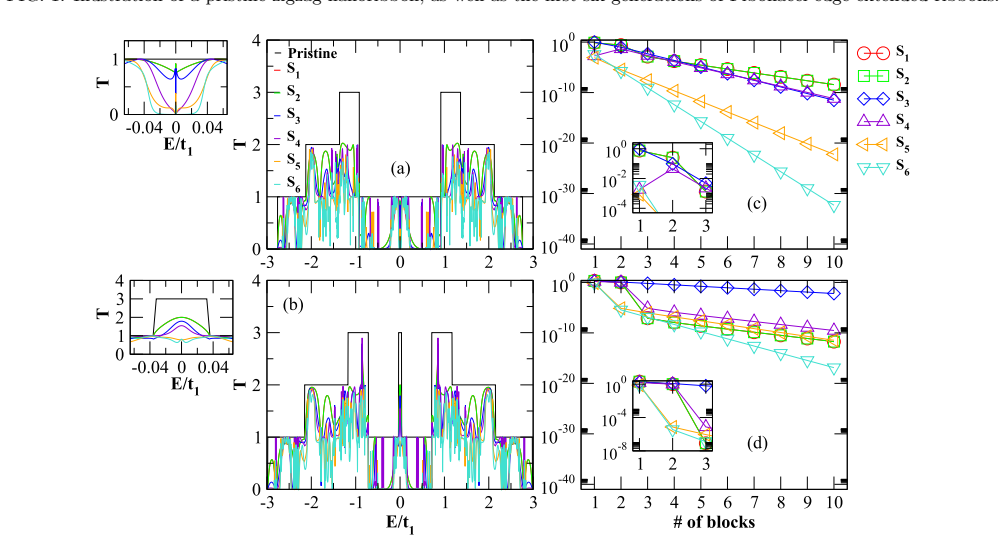
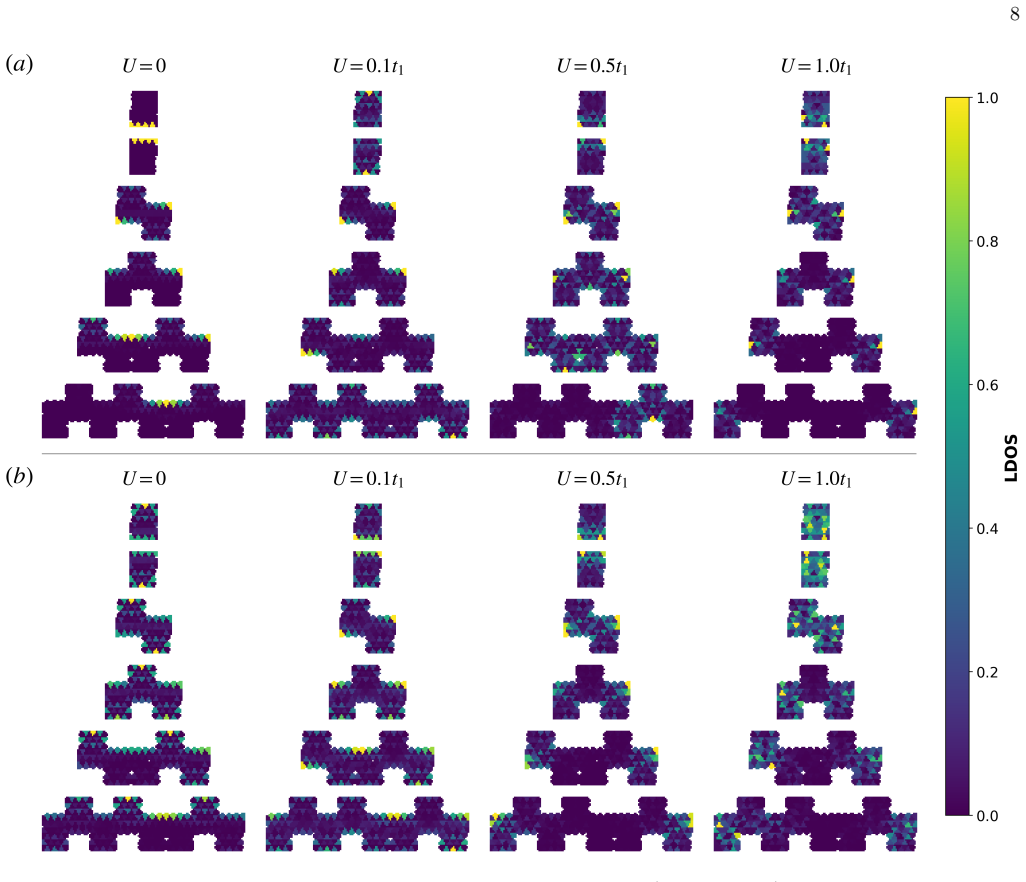
Within the Landauer-Büttiker formalism the calculations reveal three regimes: geometric localization when interactions are absent, a conductive regime with transmission oscillations of increasing multiplicity for weak interactions in which delocalization arises from the geometry-correlation interplay, and a return to localization when strong repulsion dominates.
What carries the argument
Quasiperiodic Fibonacci-type edge extensions on zigzag graphene nanoribbons, combined with the self-consistent mean-field Hubbard approximation, that switches the system between localized and delocalized transport.
If this is right
- Quasiperiodic edge patterning can be used to induce delocalization at moderate interaction strengths.
- The multiplicity of transmission oscillations increases with Fibonacci generation order in the weak-interaction window.
- Strong electron repulsion returns the system to a localized state.
- Transport properties can be modulated by simultaneous control of edge geometry and interaction strength.
Where Pith is reading between the lines
- The same edge-engineering strategy could be tested in other two-dimensional materials whose edges admit quasiperiodic modifications.
- Device experiments that vary gate voltage to tune interaction strength while measuring conductance oscillations would directly probe the predicted regimes.
- Corrections beyond mean-field theory might shift the interaction thresholds separating the three transport regimes.
Load-bearing premise
The self-consistent mean-field Hubbard approximation remains reliable across the interaction strengths examined and the chosen first- and third-nearest-neighbor hoppings capture all relevant edge physics.
What would settle it
Absence of a conductive regime containing transmission oscillations at weak interaction strengths in either further calculations or in transport measurements on fabricated structures would show that the claimed delocalization does not emerge.
Figures





read the original abstract
We investigate localization effects in zigzag graphene nanoribbons with quasiperiodic Fibonacci-type edge extensions, accounting for electron-electron interactions. We employ a tight-binding model that includes first- and third-nearest-neighbor hoppings, in which electronic interactions are treated within a self-consistent mean-field Hubbard approximation. Charge transport properties are calculated using the Landauer-B\"uttiker formalism. Our results reveal that the combination of quasiperiodic geometry and electronic interactions gives rise to nontrivial transport phenomena. Specifically, the system exhibits three transport regimes: in the non-interacting case, we observe geometric localization. For weak interactions, the system shows a conductive regime with transmission oscillations, whose multiplicity increases with the Fibonacci generation order. In this regime, delocalization emerges from the interplay between geometry and interaction-induced correlations. Finally, for strong interactions, repulsion dominates, and the system returns to a localized state. Our results demonstrate that quasiperiodic edge engineering, combined with electronic interaction control, offers a promising path to modulate transport in graphene nanoribbons.
Editorial analysis
A structured set of objections, weighed in public.
Referee Report
Summary. The manuscript examines localization and transport in zigzag graphene nanoribbons featuring quasiperiodic Fibonacci-type edge extensions. Using a tight-binding model with first- and third-nearest-neighbor hoppings and treating interactions via self-consistent mean-field Hubbard approximation, combined with Landauer-Büttiker formalism for transport, the authors identify three regimes: geometric localization in the non-interacting limit, a conductive regime with Fibonacci-order-dependent transmission oscillations at weak interactions due to geometry-interaction interplay, and return to localization at strong interactions.
Significance. If the results hold, this work demonstrates a mechanism for engineering delocalization in graphene nanoribbons through the combination of quasiperiodic edge geometry and tunable electronic interactions. This could have implications for designing tunable nanoelectronic devices where transport properties are controlled by edge structure and interaction strength.
major comments (2)
- [Methods] Methods section: the central claim of interaction-induced delocalization at weak U rests on the self-consistent mean-field Hubbard treatment, yet the manuscript provides neither benchmarks against fluctuation-retaining methods (e.g., exact diagonalization on small approximants) nor a discussion of the approximation's validity for incommensurate quasiperiodic edge potentials, where charge-density modulations may be underestimated.
- [Results] Results section (transmission and conductance figures): no error bars, self-consistency convergence thresholds, or explicit numerical values for the free parameters U and t3 are reported, rendering the boundaries of the three transport regimes and the asserted Fibonacci-order dependence of oscillations difficult to reproduce or assess quantitatively.
minor comments (2)
- [Abstract] Abstract and introduction: the relative magnitude of the third-nearest-neighbor hopping t3 with respect to the nearest-neighbor term is not stated, although it is listed among the model ingredients.
- [Figures] Figure captions: captions for the transmission plots could explicitly list the Fibonacci generation orders and the specific U values (in units of t) corresponding to the weak- and strong-interaction regimes shown.
Simulated Author's Rebuttal
We thank the referee for their careful reading of our manuscript and for the constructive comments. We address each major comment below and will revise the manuscript to enhance clarity, reproducibility, and discussion of methodological limitations.
read point-by-point responses
-
Referee: [Methods] Methods section: the central claim of interaction-induced delocalization at weak U rests on the self-consistent mean-field Hubbard treatment, yet the manuscript provides neither benchmarks against fluctuation-retaining methods (e.g., exact diagonalization on small approximants) nor a discussion of the approximation's validity for incommensurate quasiperiodic edge potentials, where charge-density modulations may be underestimated.
Authors: We acknowledge the limitations of the self-consistent mean-field Hubbard approximation, which neglects fluctuations that may be relevant for incommensurate quasiperiodic potentials and could lead to underestimation of charge-density modulations. For the system sizes needed to approximate the Fibonacci edge structures, exact diagonalization on small approximants is not feasible and would not capture the incommensurate character. In the revised manuscript we will add an explicit discussion of the approximation's validity in this context, including references to prior applications in graphene nanoribbons and a caveat regarding potential underestimation of modulations. We cannot provide new benchmarks against fluctuation-retaining methods within the scope of the present work. revision: partial
-
Referee: [Results] Results section (transmission and conductance figures): no error bars, self-consistency convergence thresholds, or explicit numerical values for the free parameters U and t3 are reported, rendering the boundaries of the three transport regimes and the asserted Fibonacci-order dependence of oscillations difficult to reproduce or assess quantitatively.
Authors: We agree that explicit parameter values and convergence details are necessary for reproducibility. In the revised manuscript we will report the specific values used (U = 0.5t for the weak-interaction conductive regime and U = 2t for the strong-interaction localized regime, with t3 = 0.1t), the self-consistency threshold (maximum charge-density change < 10^{-5} per site), and a statement on numerical precision (transmission values converged to within 10^{-4}). Because the calculations are deterministic within the mean-field framework, statistical error bars are not applicable; we will instead add a note clarifying the numerical accuracy. revision: yes
Circularity Check
Direct numerical solution of mean-field Hubbard model via Landauer-Büttiker yields three transport regimes with no definitional or fitted-parameter circularity
full rationale
The derivation consists of constructing a tight-binding Hamiltonian with fixed first- and third-nearest-neighbor hoppings, solving it self-consistently in the mean-field Hubbard approximation, and then computing transmission via the Landauer-Büttiker formula. No parameter is fitted to a subset of results and then relabeled as a prediction; the three regimes (geometric localization, interaction-induced conductive oscillations, and strong-U localization) are outputs of the numerical procedure rather than inputs. No self-citation is invoked as a uniqueness theorem or to smuggle an ansatz, and the central claim does not reduce to a renaming of a known empirical pattern. The low score of 2 reflects only the routine use of a standard approximation whose validity is not independently benchmarked in the manuscript, but this does not create circularity in the reported derivation chain.
Axiom & Free-Parameter Ledger
free parameters (2)
- on-site interaction U
- third-nearest-neighbor hopping t3
axioms (2)
- domain assumption Mean-field decoupling of the Hubbard interaction term is sufficient to capture correlation effects on transport.
- standard math The Landauer-Buttiker formalism applies to the coherent, zero-temperature limit of the quasiperiodic ribbon.
Lean theorems connected to this paper
-
IndisputableMonolith/Cost/FunctionalEquation.leanwashburn_uniqueness_aczel unclear?
unclearRelation between the paper passage and the cited Recognition theorem.
We employ a tight-binding model that includes first- and third-nearest-neighbor hoppings, in which electronic interactions are treated within a self-consistent mean-field Hubbard approximation... T(E) = Tr[t(E) t†(E)]
-
IndisputableMonolith/Foundation/RealityFromDistinction.leanreality_from_one_distinction unclear?
unclearRelation between the paper passage and the cited Recognition theorem.
the system exhibits three transport regimes... delocalization emerges from the interplay between geometry and interaction-induced correlations
What do these tags mean?
- matches
- The paper's claim is directly supported by a theorem in the formal canon.
- supports
- The theorem supports part of the paper's argument, but the paper may add assumptions or extra steps.
- extends
- The paper goes beyond the formal theorem; the theorem is a base layer rather than the whole result.
- uses
- The paper appears to rely on the theorem as machinery.
- contradicts
- The paper's claim conflicts with a theorem or certificate in the canon.
- unclear
- Pith found a possible connection, but the passage is too broad, indirect, or ambiguous to say the theorem truly supports the claim.
Reference graph
Works this paper leans on
-
[1]
Initialize the per-site densities with a uniform half- filling seed: ⟨ni⟩(0) = 0.5
-
[2]
Build the device Hamiltonian HM F[{⟨ni⟩(k)}] by assigning on-site potentials U ⟨ni⟩(k)
-
[3]
Compute the LDOS on the energy grid; integrate the LDOS to obtain ⟨ni⟩new
-
[4]
Form the residual r(k) = ⟨ni⟩new − ⟨ni⟩(k) and up- date the density using an Anderson mixing routine [48–50] with history length 5 and damping param- eter α = 0.1
-
[5]
Repeat steps 2–4 until the relative convergence cri- terion ∥⟨ni⟩(k+1) − ⟨ni⟩(k)∥ ∥⟨ni⟩(k)∥ < 10−6 (8) is met or until a maximum of 25,000 iterations is reached. Note that this criterion monitors the relative change in the on-site electron density between successive iter- ations, and is independent of any energy regularization parameter; the chosen tolera...
work page 2025
-
[6]
Editorial, Nature Physics 20 (2024), 10.1038/s41567-023- 02381-0
- [7]
-
[8]
D. B. Fonseca, L. F. C. Pereira, and A. L. R. Barbosa, Phys. Rev. B 107, 155432 (2023)
work page 2023
-
[9]
J. F. Sierra, J. Fabian, R. K. Kawakami, S. Roche, and S. O. Valenzuela, Nature Nanotechnology 16, 856–868 (2021)
work page 2021
-
[10]
Spintronics in 2d graphene-based van der waals heterostructures,
D. T. Perkins and A. Ferreira, “Spintronics in 2d graphene-based van der waals heterostructures,” in En- cyclopedia of Condensed Matter Physics (Elsevier, 2024) p. 205–222
work page 2024
- [11]
- [12]
-
[13]
T.-J. Liu, F. M. Arnold, A. Ghasemifard, Q.-L. Liu, D. Golze, A. Kuc, and T. Heine, Phys. Rev. Mater. 9, 014203 (2025)
work page 2025
-
[14]
D. B. Fonseca, A. L. R. Barbosa, and L. F. C. Pereira, Phys. Rev. B 110, 075421 (2024)
work page 2024
-
[15]
S. a. d. A. Sousa-Júnior, M. V. d. S. Ferraz, J. P. de Lima, and T. P. Cysne, Phys. Rev. B 111, 035411 (2025)
work page 2025
- [16]
-
[17]
R. S. K. Houtsma, J. de la Rie, and M. Stöhr, Chem. Soc. Rev. 50, 6541 (2021)
work page 2021
-
[18]
A. Kinikar, X. Xu, M. D. Giovannantonio, O. Grön- ing, K. Eimre, C. A. Pignedoli, K. Müllen, A. Narita, P. Ruffieux, and R. Fasel, Advanced Materials 35, 2306311 (2023)
work page 2023
-
[19]
A. H. Castro Neto, F. Guinea, N. M. R. Peres, K. S. Novoselov, and A. K. Geim, Rev. Mod. Phys. 81, 109 (2009)
work page 2009
- [20]
-
[21]
M. Kim, S. Xu, A. Berdyugin, A. Principi, S. Slizovskiy, N. Xin, P. Kumaravadivel, W. Kuang, M. Hamer, R. Kr- ishna Kumar, et al. , Nature communications 11, 2339 (2020)
work page 2020
- [22]
-
[23]
Y.-W. Son, M. L. Cohen, and S. G. Louie, Nature 444, 347 (2006)
work page 2006
-
[24]
J.-P. Joost, A.-P. Jauho, and M. Bonitz, Nano Letters 19, 9045 (2019) , pMID: 31735027
work page 2019
-
[25]
E. Abrahams, P. W. Anderson, D. C. Licciardello, and T. V. Ramakrishnan, Phys. Rev. Lett. 42, 673 (1979)
work page 1979
-
[26]
P. W. Anderson, Phys. Rev. 109, 1492 (1958)
work page 1958
-
[27]
M. Evaldsson, I. V. Zozoulenko, H. Xu, and T. Heinzel, Phys. Rev. B 78, 161407 (2008)
work page 2008
-
[28]
E. R. Mucciolo, A. H. Castro Neto, and C. H. Lewenkopf, 12 Phys. Rev. B 79, 075407 (2009)
work page 2009
-
[29]
C. D. Nunez, P. A. Orellana, and L. Rosales, Journal of Applied Physics 120, 164310 (2016)
work page 2016
-
[30]
S. Nakaharai, T. Iijima, S. Ogawa, S. Suzuki, S.- L. Li, K. Tsukagoshi, S. Sato, and N. Yokoyama, ACS Nano 7, 5694 (2013) , pMID: 23786356, https://doi.org/10.1021/nn401992q
-
[31]
J. H. García, B. Uchoa, L. Covaci, and T. G. Rappoport, Phys. Rev. B 90, 085425 (2014)
work page 2014
-
[32]
F. Gargiulo, G. Autès, N. Virk, S. Barthel, M. Rösner, L. R. M. Toller, T. O. Wehling, and O. V. Yazyev, Phys. Rev. Lett. 113, 246601 (2014)
work page 2014
- [33]
-
[34]
W. Dias and M. Lyra, Physica A: Statistical Mechanics and its Applications 411, 35 (2014)
work page 2014
- [35]
-
[36]
D. Fonseca, A. Barbosa, F. Moraes, G. Almeida, and F. de Moura, Physics Letters A 526, 129963 (2024)
work page 2024
-
[37]
H. García-Cervantes, F. J. García-Rodríguez, G. J. Es- calera Santos, R. Rodríguez-González, and I. Rodríguez- Vargas, Journal of Applied Physics 138, 014301 (2025)
work page 2025
-
[38]
A. L. Barbosa, J. R. Lima, Ícaro S.F. Bezerra, and M. L. Lyra, Physica E: Low-dimensional Systems and Nanos- tructures 124, 114210 (2020)
work page 2020
-
[39]
J. R. da Silva, A. L. Barbosa, and L. F. C. Pereira, Micro and Nanostructures 168, 207295 (2022)
work page 2022
-
[40]
N. Macé, N. Laflorencie, and F. Alet, SciPost Phys. 6, 050 (2019)
work page 2019
-
[41]
N. Macé, A. Jagannathan, and F. Piéchon, Phys. Rev. B 93, 205153 (2016)
work page 2016
-
[42]
A. Štrkalj, E. V. H. Doggen, I. V. Gornyi, and O. Zil- berberg, Phys. Rev. Res. 3, 033257 (2021)
work page 2021
-
[43]
W. M. Zheng, Phys. Rev. A 35, 1467 (1987)
work page 1987
- [44]
- [45]
-
[46]
Datta, Quantum transport: atom to transistor (Cam- bridge university press, 2005)
S. Datta, Quantum transport: atom to transistor (Cam- bridge university press, 2005)
work page 2005
- [47]
-
[48]
A. Ferretti, A. Calzolari, R. Di Felice, F. Manghi, M. J. Caldas, M. B. Nardelli, and E. Molinari, Phys. Rev. Lett. 94, 116802 (2005)
work page 2005
-
[49]
A. Ferretti, A. Calzolari, R. Di Felice, and F. Manghi, Phys. Rev. B 72, 125114 (2005)
work page 2005
-
[50]
A. R. Rocha, V. M. García-Suárez, S. Bailey, C. Lam- bert, J. Ferrer, and S. Sanvito, Phys. Rev. B 73, 085414 (2006)
work page 2006
-
[51]
C. W. Groth, M. Wimmer, A. R. Akhmerov, and X. Waintal, New Journal of Physics 16, 063065 (2014)
work page 2014
-
[52]
O. V. Yazyev, Reports on Progress in Physics 73, 056501 (2010)
work page 2010
- [53]
-
[54]
H. F. Walker and P. Ni, SIAM Journal on Numerical Analysis 49, 1715 (2011)
work page 2011
- [55]
- [56]
- [57]
-
[58]
J. W. Kantelhardt, S. Zschiegner, E. Koscielny-Bunde, S. Havlin, A. Bunde, and H. E. Stanley, Physica A: Sta- tistical Mechanics and Its Applications 316, 87 (2002)
work page 2002
discussion (0)
Sign in with ORCID, Apple, or X to comment. Anyone can read and Pith papers without signing in.