Rethinking Feature Alignment in Generalist Graph Anomaly Detection: A Relational Fingerprint-based Approach
Pith reviewed 2026-06-29 23:08 UTC · model grok-4.3
The pith
A relational fingerprint aligns heterogeneous graph features semantically to support anomaly detection on unseen graphs without retraining.
A machine-rendered reading of the paper's core claim, the machinery that carries it, and where it could break.
Core claim
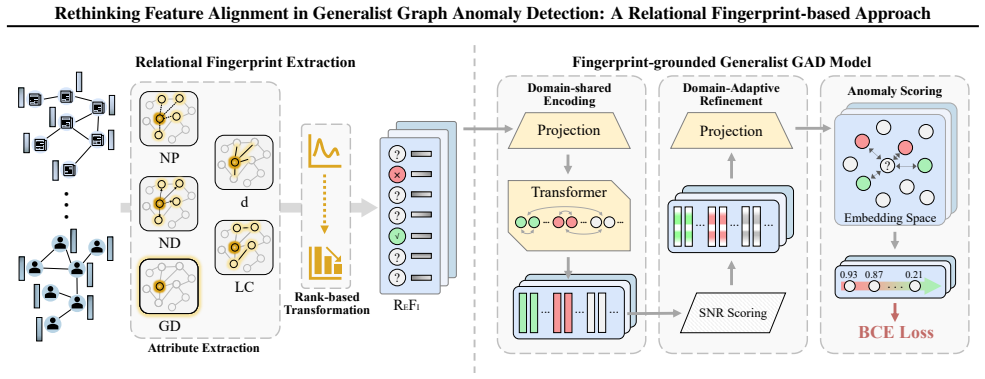
The paper establishes that heterogeneous raw features can be aligned through a universal and semantics-aware Relational Fingerprint (ReFi) that encodes anomaly-indicative cues from contextual and structural perspectives, enabling a fingerprint-grounded generalist GAD model that combines a transformer-based encoder for domain-invariant knowledge with an SNR-guided refinement module for domain-specific adaptation.
What carries the argument
The Relational Fingerprint (ReFi), a universal representation that encodes anomaly-indicative cues from both contextual and structural perspectives in a semantics-preserving way.
If this is right
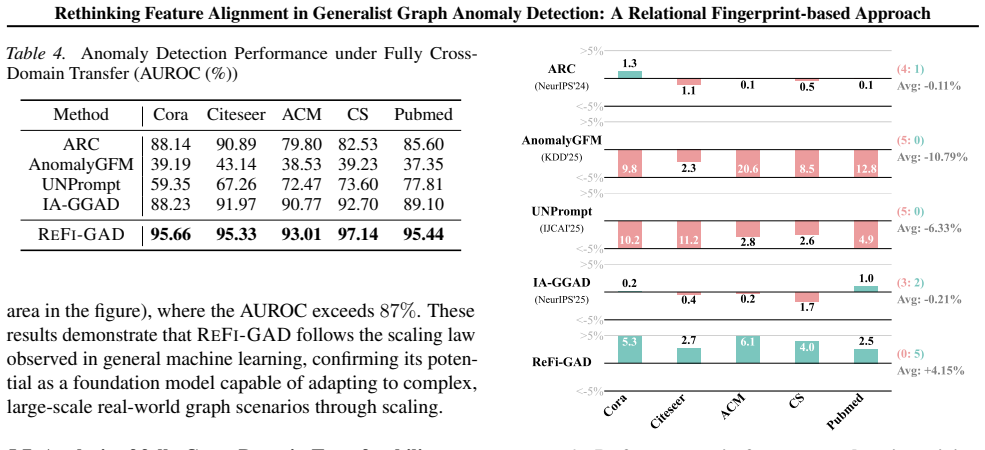
- ReFi-GAD significantly outperforms state-of-the-art methods across 14 datasets.
- The approach avoids negative transfer when tested on unseen graphs.
- Domain-invariant knowledge captured by the transformer combines with domain-specific refinement via the SNR module.
Where Pith is reading between the lines
- The fingerprint construction might transfer to other cross-domain graph tasks such as node classification or link prediction.
- Testing ReFi on graphs with extreme density differences or high noise levels would reveal whether the relational encoding remains stable.
- If relational structure proves more consistent than raw features, similar fingerprint methods could reduce reliance on feature harmonization in broader graph transfer settings.
Load-bearing premise
A single universal relational fingerprint can encode anomaly-indicative cues from contextual and structural perspectives in a semantics-preserving way across heterogeneous graphs.
What would settle it
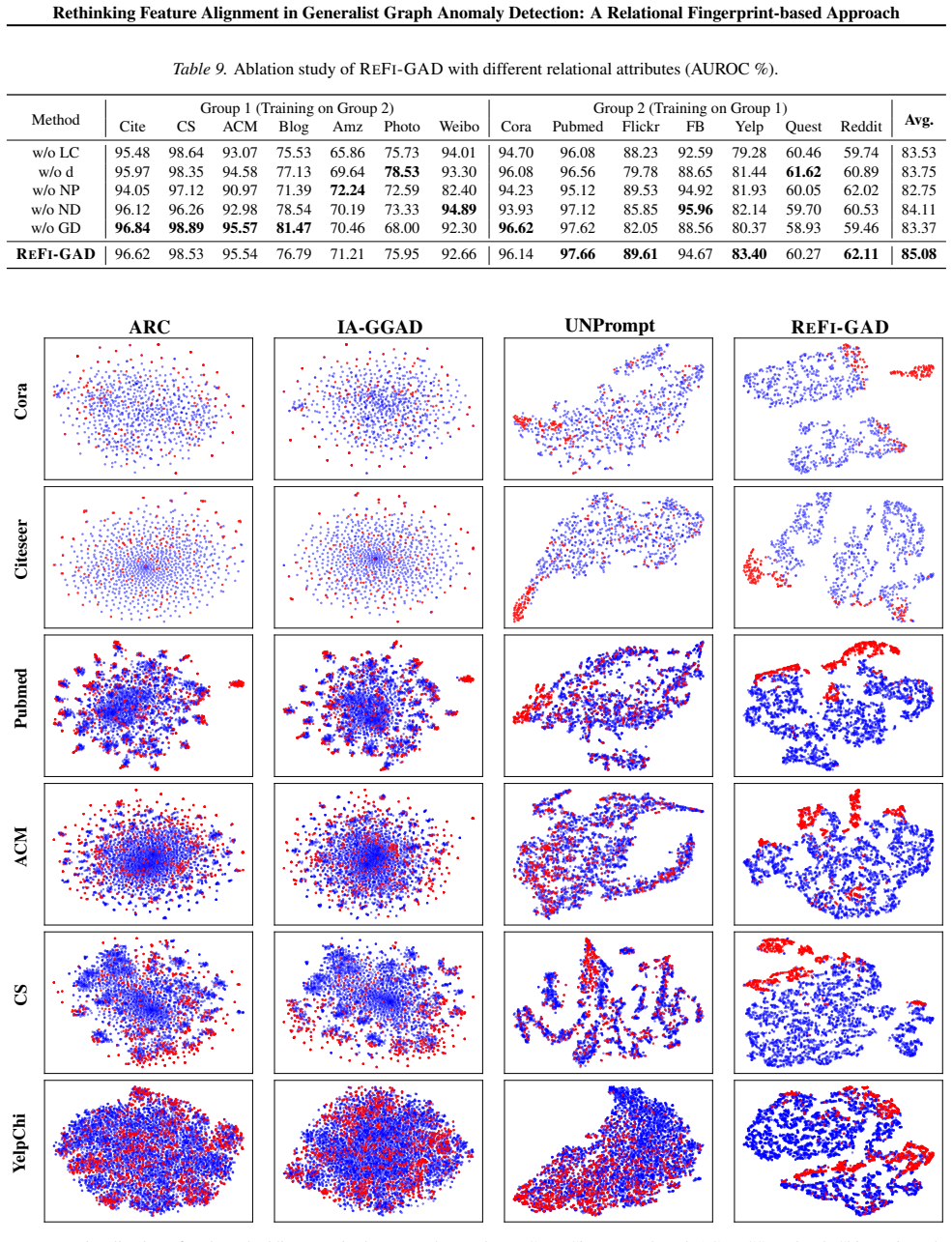
Applying the ReFi-GAD model to a new collection of graphs with mismatched feature semantics and observing either negative transfer or no gain over PCA baselines would falsify the claim.
Figures


read the original abstract
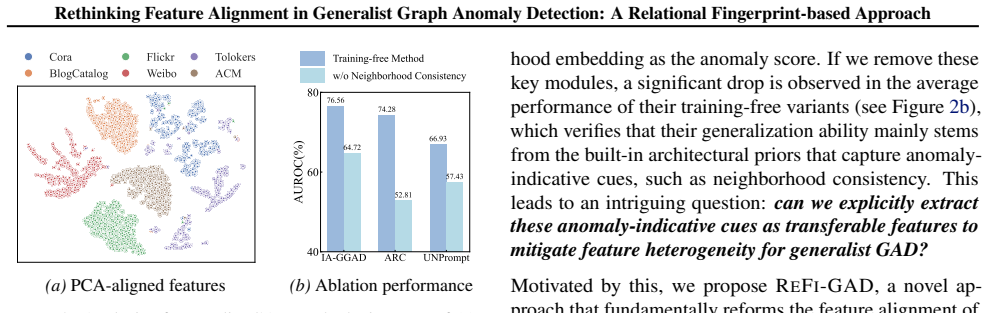
Generalist graph anomaly detection (GAD) aims to detect anomalies on unseen graphs without graph-specific retraining. Nevertheless, existing approaches primarily focus on aligning heterogeneous features across different data domains via PCA-based projection, which harmonizes feature dimensions ignores feature semantics. As a result, GAD models fail to learn transferable semantic knowledge, and even exhibit negative transfer on unseen graphs. To address this issue, we propose a Relational Fingerprint-based generalist GAD approach (ReFi-GAD for short), aligning heterogeneous raw features with a universal and semantics-aware Relational Fingerprint (ReFi) that encodes anomaly-indicative cues from both contextual and structural perspectives. Building on ReFi, we design a fingerprint-grounded generalist GAD model, which combines a transformer-based encoder to capture domain-invariant knowledge with an SNR-guided refinement module for domain-specific adaptation. Extensive experiments on 14 datasets demonstrate that ReFi-GAD significantly outperforms state-of-the-art methods.
Editorial analysis
A structured set of objections, weighed in public.
Referee Report
Summary. The paper claims that PCA-based feature alignment in generalist GAD ignores semantics and causes negative transfer on unseen graphs. It proposes ReFi-GAD, which aligns heterogeneous raw features via a universal Relational Fingerprint (ReFi) encoding anomaly-indicative cues from contextual and structural perspectives; this is paired with a transformer encoder for domain-invariant knowledge and an SNR-guided refinement module for domain-specific adaptation, with experiments showing significant outperformance over SOTA on 14 datasets.
Significance. If the ReFi construction can be shown to produce domain-invariant yet semantics-preserving embeddings that reliably encode anomaly cues, the approach would address a core limitation in cross-domain GAD transfer and enable more robust generalist models without retraining.
major comments (2)
- [Abstract and §3] Abstract and §3: The central claim that a single ReFi produces anomaly-indicative embeddings that are both domain-invariant and semantics-preserving across heterogeneous graphs lacks any formal invariance argument or cross-domain consistency metric on the ReFi vectors; without this, it is unclear whether the relational operations avoid embedding domain-specific feature statistics that would cause the transformer to learn non-transferable knowledge.
- [Abstract] Abstract: The stated outperformance on 14 datasets is presented without derivation details, error analysis, ablation on the semantic-preservation property, or direct comparison of ReFi vectors across domains, leaving the load-bearing assumption that ReFi solves negative transfer unvalidated in the reported results.
minor comments (2)
- [§3] Clarify the exact relational operations used to construct the contextual and structural components of ReFi, including any hyperparameters or aggregation choices.
- [§4] The SNR-guided refinement module description would benefit from an explicit equation or pseudocode showing how the signal-to-noise ratio is computed and applied.
Simulated Author's Rebuttal
We thank the referee for the constructive comments, which identify areas where additional rigor can strengthen the manuscript. We address each major comment below and will revise accordingly.
read point-by-point responses
-
Referee: [Abstract and §3] Abstract and §3: The central claim that a single ReFi produces anomaly-indicative embeddings that are both domain-invariant and semantics-preserving across heterogeneous graphs lacks any formal invariance argument or cross-domain consistency metric on the ReFi vectors; without this, it is unclear whether the relational operations avoid embedding domain-specific feature statistics that would cause the transformer to learn non-transferable knowledge.
Authors: We agree that a formal invariance argument and explicit cross-domain consistency metric would strengthen the central claim. The ReFi construction relies on relational operations that encode relative contextual and structural cues rather than absolute feature values, which is intended to promote invariance; however, the current manuscript presents this primarily through design rationale and empirical transfer results. In the revised version we will add a dedicated subsection in §3 providing a formal analysis of the invariance properties under the relational operations, along with quantitative cross-domain consistency metrics (e.g., distribution divergence or average similarity) computed on ReFi vectors from different source domains. revision: yes
-
Referee: [Abstract] Abstract: The stated outperformance on 14 datasets is presented without derivation details, error analysis, ablation on the semantic-preservation property, or direct comparison of ReFi vectors across domains, leaving the load-bearing assumption that ReFi solves negative transfer unvalidated in the reported results.
Authors: The reported results demonstrate consistent gains over baselines, but we acknowledge that the manuscript would benefit from more granular validation of the semantic-preservation and negative-transfer claims. In the revision we will augment the experimental section and appendix with: (i) full derivation details and statistical significance tests for the 14-dataset results, (ii) error analysis including standard deviations across runs, (iii) a targeted ablation isolating the semantic-preservation contribution of ReFi, and (iv) direct cross-domain comparisons (e.g., embedding visualizations and similarity statistics) of ReFi vectors to empirically support the reduction in negative transfer. revision: yes
Circularity Check
No circularity; new ReFi construction and model are independent of inputs
full rationale
The paper introduces a novel Relational Fingerprint (ReFi) to align features and a transformer-plus-SNR model without any equations, fitted parameters, or self-citations that reduce the claimed predictions or universality to the inputs by construction. The central claim (ReFi encodes anomaly cues in a domain-invariant yet semantics-preserving way) is presented as an empirical design choice open to external validation on the 14 datasets, not a self-definitional or fitted-input loop. No load-bearing step matches the enumerated circularity patterns.
Axiom & Free-Parameter Ledger
axioms (1)
- domain assumption Heterogeneous raw features across graphs can be aligned via a universal relational fingerprint that preserves anomaly semantics from context and structure
invented entities (1)
-
Relational Fingerprint (ReFi)
no independent evidence
Reference graph
Works this paper leans on
-
[1]
Deep anomaly detection on attributed networks
Ding, K., Li, J., Bhanushali, R., and Liu, H. Deep anomaly detection on attributed networks. InProceedings of the 2019 SIAM International Conference on Data Mining, pp. 594–602. SIAM,
2019
-
[2]
Smoothgnn: Smoothing-aware gnn for unsupervised node anomaly detection
Dong, X., Zhang, X., Sun, Y ., Chen, L., Yuan, M., and Wang, S. Smoothgnn: Smoothing-aware gnn for unsupervised node anomaly detection. InProceedings of the ACM on Web Conference 2025, pp. 1225–1236,
2025
-
[3]
Addressing heterophily in graph anomaly detection: A perspective of graph spectrum
Gao, Y ., Wang, X., He, X., Liu, Z., Feng, H., and Zhang, Y . Addressing heterophily in graph anomaly detection: A perspective of graph spectrum. InProceedings of the ACM Web Conference 2023, pp. 1528–1538,
2023
-
[4]
Ivanov, S. and Prokhorenkova, L. Boost then convolve: Gradient boosting meets graph neural networks.arXiv preprint arXiv:2101.08543,
-
[5]
Kipf, T. N. and Welling, M. Semi-supervised classifica- tion with graph convolutional networks.arXiv preprint arXiv:1609.02907,
work page internal anchor Pith review Pith/arXiv arXiv
-
[6]
Heterogeneous graph neural networks for malicious account detection
Liu, Z., Chen, C., Yang, X., Zhou, J., Li, X., and Song, L. Heterogeneous graph neural networks for malicious account detection. InProceedings of the 27th ACM In- ternational Conference on Information and Knowledge Management, pp. 2077–2085,
2077
-
[7]
arXiv preprint arXiv:2410.14886 , year=
Niu, C., Qiao, H., Chen, C., Chen, L., and Pang, G. Zero- shot generalist graph anomaly detection with unified neighborhood prompts.arXiv preprint arXiv:2410.14886,
-
[8]
Platonov, O., Kuznedelev, D., Diskin, M., Babenko, A., and Prokhorenkova, L. A critical look at the evaluation of gnns under heterophily: Are we really making progress? arXiv preprint arXiv:2302.11640,
-
[9]
Pitfalls of Graph Neural Network Evaluation
Shchur, O., Mumme, M., Bojchevski, A., and G¨unnemann, S. Pitfalls of graph neural network evaluation.arXiv preprint arXiv:1811.05868,
work page internal anchor Pith review Pith/arXiv arXiv
-
[10]
Network together: Node classification via cross-network deep network embedding.IEEE Transactions on Neural Networks and Learning Systems, 32(5):1935–1948,
Shen, X., Dai, Q., Mao, S., Chung, F.-l., and Choi, K.-S. Network together: Node classification via cross-network deep network embedding.IEEE Transactions on Neural Networks and Learning Systems, 32(5):1935–1948,
1935
-
[11]
Veliˇckovi´c, P., Cucurull, G., Casanova, A., Romero, A., Lio, P., and Bengio, Y . Graph attention networks.arXiv preprint arXiv:1710.10903,
work page internal anchor Pith review Pith/arXiv arXiv
-
[12]
A semi-supervised graph attentive network for financial fraud detection
Wang, D., Lin, J., Cui, P., Jia, Q., Wang, Z., Fang, Y ., Yu, Q., Zhou, J., Yang, S., and Qi, Y . A semi-supervised graph attentive network for financial fraud detection. In Proceedings of the 2019 IEEE International Conference on Data Mining (ICDM), pp. 598–607. IEEE,
2019
-
[13]
Unsuper- vised domain adaptive graph convolutional networks
Wu, M., Pan, S., Zhou, C., Chang, X., and Zhu, X. Unsuper- vised domain adaptive graph convolutional networks. In Proceedings of the Web Conference 2020, pp. 1457–1467,
2020
-
[14]
one-for-all
and CHRN (Gao et al., 2023), optimize feature smoothness and neighborhood consistency. Although effective within their respective domains, these methods generally lack cross-domain generalization. Models trained on one graph (e.g., citation network) often fail catastrophically on another (e.g., social network) due to substantial differences in graph struc...
2023
-
[15]
tackles feature space shift and graph structure shift through anomaly-driven invariant learning, extracting domain-invariant features and structural correspondences for robust zero-shot performance. However, simply unifying feature dimensions or prompting strategies is insufficient to bridge the complex semantic gaps between heterogeneous graph data, ofte...
2009
-
[16]
However, in the specific realm of Generalist Graph Anomaly Detection, explicit representation alignment remains sig- nificantly under-explored
or attention mechanisms to learn domain-invariant node embeddings, effectively handling structural heterogeneity. However, in the specific realm of Generalist Graph Anomaly Detection, explicit representation alignment remains sig- nificantly under-explored. Since generalist models aim to generalize to completely unseen graphs, traditional alignment strate...
2024
-
[17]
emphasizes learning invariant anomaly patterns across graph distributions, aiming to enhance robustness and generalization under distribution shifts. D.3. Experimental Details D.3.1. METRICS Following existing work (Tang et al., 2023; Qiao & Pang, 2023; Pang et al., 2021), we employ two popular and complementary metrics to comprehensively evaluate the det...
2023
-
[18]
RankCiteseer CS ACM BlogCatalog Amazon Photo Weibo GAD Methods GCN 48.32±1.03 56.19±1.23 50.43±1.04 43.06±0.92 58.69±0.17 47.70±2.10 46.40±1.82 11.57 GAT 63.11±1.92 59.25±0.94 61.48±0.94 60.50±0.73 54.84±2.68 45.63±1.39 73.51±2.66 9.14 CoLA 73.81±2.87 65.99±2.30 54.94±4.14 60.58±5.07 65.02±10.86 65.18±1.52 41.08±7.06 8.00 SmoothGNN 90.42±8.81 78.65±5.25 7...
2082
-
[19]
Method Group 1 (Training on Group
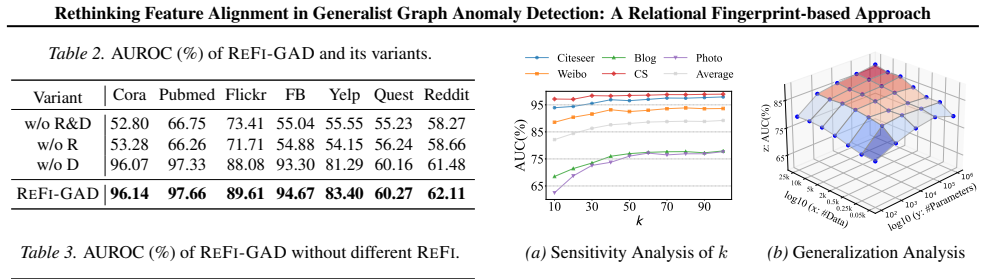
Avg.Cite CS ACM Blog Amz Photo Weibo Cora Pubmed Flickr FB Yelp Quest Reddit w/o R&D 61.41 70.94 62.96 73.0883.6264.98 79.12 52.80 66.75 73.41 55.04 55.55 55.23 58.27 65.23 w/o R 60.88 71.26 63.37 72.27 81.78 65.91 75.00 53.28 66.26 71.71 54.88 54.15 56.24 58.66 64.69 w/o D 95.95 98.42 94.6476.7970.39 75.90 91.57 96.07 97.33 88.08 93.30 81.29 60.16 61.48 ...
-
[20]
Avg.Cite CS ACM Blog Amz Photo Weibo Cora Pubmed Flickr FB Yelp Quest Reddit w/o LC 95.48 98.64 93.07 75.53 65.86 75.73 94.01 94.70 96.08 88.23 92.59 79.28 60.46 59.74 83.53 w/o d 95.97 98.35 94.58 77.13 69.6478.5393.30 96.08 96.56 79.78 88.65 81.4461.6260.89 83.75 w/o NP 94.05 97.12 90.97 71.3972.2472.59 82.40 94.23 95.12 89.53 94.92 81.93 60.05 62.02 82...
discussion (0)
Sign in with ORCID, Apple, or X to comment. Anyone can read and Pith papers without signing in.