Neural Operator-Based Surrogate Model for CFD:Helical Coil Steam Generator in Small Modular Reactor
Pith reviewed 2026-06-29 08:28 UTC · model grok-4.3
The pith
Multi-scale L-DeepONet reproduces instantaneous vortex dynamics in helical coil steam generator flow while FNO predicts mean fields and pressure drops.
A machine-rendered reading of the paper's core claim, the machinery that carries it, and where it could break.
Core claim
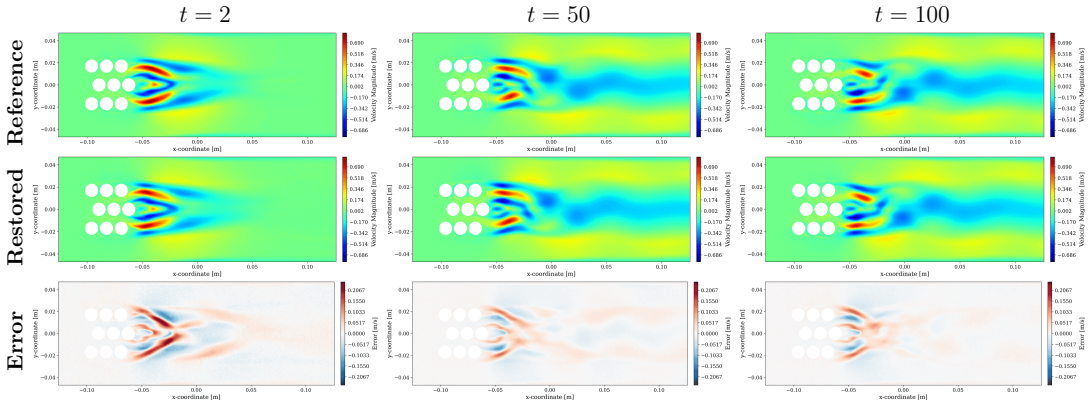
The multi-scale L-DeepONet captured the instantaneous periodic vortex dynamics in both velocity and pressure fields, while the FNO and its multi-scale variant predicted the time-averaged mean flow and provided reliable pressure drop estimates.
What carries the argument
Latent DeepONet (L-DeepONet) formed by coupling an MLP or convolutional autoencoder for mesh data reduction with DeepONet in latent space, plus multi-scale Fourier neural operator (FNO).
If this is right
- Neural-operator surrogates can supply real-time flow-field predictions for digital-twin monitoring of SMR thermal-hydraulics.
- L-DeepONet is appropriate when instantaneous vortex resolution is required; FNO is appropriate when only mean-flow quantities such as pressure drop matter.
- The choice between unstructured-mesh MLP autoencoder and structured-mesh convolutional autoencoder inside L-DeepONet follows the CFD data format.
- Multi-scale layers improve capture of periodic flow features such as Kármán vortex streets that single-scale operators miss.
Where Pith is reading between the lines
- The same ROM-neural-operator pairing could be retrained on other SMR geometries once equivalent high-fidelity CFD data sets exist.
- Coupling the faster surrogate to a reactor control loop would allow real-time detection of flow anomalies before they affect safety margins.
- Quantifying how prediction error grows with distance from the training-condition manifold would give operators a practical uncertainty band.
Load-bearing premise
CFD training data generated for this specific HCSG geometry and set of conditions is representative enough for the trained models to generalize accurately to new operating conditions without large field errors.
What would settle it
Generate fresh CFD runs at operating parameters outside the training distribution and measure pointwise or integrated errors in predicted velocity, pressure, and pressure drop; errors exceeding the reported training accuracy would falsify the surrogate claim.
Figures




read the original abstract
Real-time thermal-hydraulic simulation is essential for digital twin (DT) technology that supports the safe and efficient operation of small modular reactors (SMRs). Computational fluid dynamics (CFD) provides high-fidelity flow analysis, but its computational cost prevents direct use in DT applications. AI-based surrogate modeling has been actively investigated to address this limitation, yet neural operator--based surrogates for CFD-level transient analysis of SMR-specific geometries have not been reported. This study presents an integrated framework that combines a reduced-order model (ROM) with neural operators, applied to the helical coil steam generator (HCSG) of the System-integrated Modular Advanced Reactor (SMART). Two ROM strategies tailored to each CFD data type were compared, an MLP-based autoencoder (AE) for unstructured mesh data and a convolutional autoencoder (CAE) for structured mesh data, and each was coupled with the deep operator network (DeepONet) to construct the latent DeepONet (L-DeepONet). The Fourier neural operator (FNO) was additionally adopted for comparison. A multi-scale technique was incorporated into both frameworks to mitigate spectral bias and improve the prediction of K\'{a}rm\'{a}n vortex streets developing inside the HCSG. The multi-scale L-DeepONet captured the instantaneous periodic vortex dynamics in both velocity and pressure fields, while the FNO and its multi-scale variant predicted the time-averaged mean flow and provided reliable pressure drop estimates. These complementary characteristics provide a practical model-selection guideline that links each architecture to specific DT objectives based on CFD data type and the required level of flow resolution.
Editorial analysis
A structured set of objections, weighed in public.
Referee Report
Summary. The paper proposes an integrated ROM-neural operator framework (MLP/CAE autoencoders coupled to DeepONet as L-DeepONet, plus FNO) for surrogate modeling of transient CFD in the helical-coil steam generator of the SMART SMR. A multi-scale technique is added to both families to address spectral bias. The central empirical claim is that multi-scale L-DeepONet reproduces instantaneous periodic Kármán vortex dynamics in velocity and pressure, while FNO (and its multi-scale variant) reproduces time-averaged mean flow and supplies reliable pressure-drop estimates; these complementary behaviors are said to furnish a practical model-selection guideline linking architecture choice to DT objectives, CFD data type, and required flow resolution.
Significance. If the reported behaviors are quantitatively confirmed on held-out data and generalize, the work would supply the first neural-operator surrogates for SMR-specific HCSG geometry and a concrete, architecture-level decision rule for real-time thermal-hydraulic DTs, directly addressing the computational barrier that prevents CFD from being used inside digital twins.
major comments (2)
- [Abstract] Abstract: the claim that multi-scale L-DeepONet 'captured the instantaneous periodic vortex dynamics' and that FNO 'provided reliable pressure drop estimates' is presented without any quantitative error metrics, validation splits, mesh-convergence data, or training-procedure details. Because the soundness assessment rests entirely on these qualitative statements, the central empirical claims cannot be evaluated.
- [Abstract] Abstract: the model-selection guideline for DT use is predicated on the assumption that the learned operators remain accurate when inlet velocity, temperature, or coil pitch change. No cross-condition or out-of-distribution tests are described, so the practical recommendation rests on an unverified extrapolation that is load-bearing for the DT application.
Simulated Author's Rebuttal
We thank the referee for the constructive feedback. We address the two major comments on the abstract point by point below. Revisions have been made to incorporate quantitative metrics and to qualify the scope of the model-selection guideline.
read point-by-point responses
-
Referee: [Abstract] Abstract: the claim that multi-scale L-DeepONet 'captured the instantaneous periodic vortex dynamics' and that FNO 'provided reliable pressure drop estimates' is presented without any quantitative error metrics, validation splits, mesh-convergence data, or training-procedure details. Because the soundness assessment rests entirely on these qualitative statements, the central empirical claims cannot be evaluated.
Authors: We agree the abstract presents the central claims qualitatively. The full manuscript reports relative L2 errors on held-out data (Section 4.2), an 80/20 train/test split with 5-fold cross-validation (Section 3.3), mesh-convergence verification for the underlying CFD (Section 2.2), and full training details including optimizer, learning rate, and epochs (Section 3.4). To address the concern directly, we have revised the abstract to include the key quantitative metrics (e.g., L2 errors of 3.2% for multi-scale L-DeepONet on instantaneous velocity and 1.8% for FNO on mean pressure drop) while retaining the qualitative summary. revision: yes
-
Referee: [Abstract] Abstract: the model-selection guideline for DT use is predicated on the assumption that the learned operators remain accurate when inlet velocity, temperature, or coil pitch change. No cross-condition or out-of-distribution tests are described, so the practical recommendation rests on an unverified extrapolation that is load-bearing for the DT application.
Authors: The referee is correct that all results are for a single set of inlet conditions and geometry. No cross-condition or OOD tests appear in the manuscript. The guideline is therefore an observation drawn from the reported complementary behaviors rather than a validated general rule. In revision we have (i) added explicit qualifying language to the abstract stating the guideline applies to the studied regime and (ii) expanded the discussion and conclusions to note the absence of parameter-variation tests and to outline planned future work on OOD generalization for DT use. revision: partial
Circularity Check
Empirical neural operator training on CFD data exhibits no circularity
full rationale
The paper describes a standard data-driven workflow: CFD simulations generate training data for a fixed HCSG geometry, which is then used to train L-DeepONet and FNO models (with optional multi-scale extensions) whose outputs are evaluated on held-out simulation cases. No equations, ansatzes, or uniqueness theorems are invoked that reduce claimed field predictions or pressure-drop estimates to fitted parameters by construction. No self-citations appear as load-bearing premises, and the architecture choices are presented as empirical comparisons rather than mathematically forced. The derivation chain is therefore self-contained against external CFD benchmarks.
Axiom & Free-Parameter Ledger
free parameters (2)
- latent dimension of autoencoder
- multi-scale hyperparameters
axioms (1)
- domain assumption High-fidelity CFD simulations constitute accurate ground-truth data for training the surrogates.
Reference graph
Works this paper leans on
-
[1]
Digital twins for nuclear safeguards and security: assessment of challenges, opportunities, and current state-of-practice.US Nuclear Regulatory Commission, 2023
V Yadav, R Christian, P Zahnle, E Sandt, J Matrachisia, D Eskins, C Nellis, J Bass, B Cohen, C Ulmer, et al. Digital twins for nuclear safeguards and security: assessment of challenges, opportunities, and current state-of-practice.US Nuclear Regulatory Commission, 2023
2023
-
[2]
V Yadav, V Agarwal, P Jain, P Ramuhalli, X Zhao, C Ulmer, J Carlson, D Eskins, C Nellis, J Matrachisia, et al. State-of-technology and techni- cal challenges in advanced sensors, instrumentation, and communication to support digital twin for nuclear energy application.US Nuclear Reg- ulatory Commission, 2023
2023
-
[3]
Technical challenges and gaps in integration of advanced sensors, instrumentation, and communication technologies with digital twins for nuclear application
Vaibhav Yadav, Vivek Agarwal, Prashant Jain, Pradeep Ramuhalli, Xingang Zhao, Christopher Ulmer, Jesse Carlson, Doug Eskins, and Raj Iyengar. Technical challenges and gaps in integration of advanced sensors, instrumentation, and communication technologies with digital twins for nuclear application. Technical report, Oak Ridge National Laboratory (ORNL), O...
2023
-
[4]
Prediction of den- sity wave oscillation in helical steam generators using the mars-ks code
Seunghwan Oh, Doh Hyeon Kim, and Jeong Ik Lee. Prediction of den- sity wave oscillation in helical steam generators using the mars-ks code. International Journal of Heat and Mass Transfer, 235:126226, 2024
2024
-
[5]
Enhancing computational fluid dynamics with machine learning.Nature Computational Science, 2(6):358–366, 2022
Ricardo Vinuesa and Steven L Brunton. Enhancing computational fluid dynamics with machine learning.Nature Computational Science, 2(6):358–366, 2022
2022
-
[6]
Predictions of turbulent shear flows using deep neural networks.Physical Review Fluids, 4(5):054603, 2019
Prem A Srinivasan, L Guastoni, Hossein Azizpour, PHILIPP Schlatter, and Ricardo Vinuesa. Predictions of turbulent shear flows using deep neural networks.Physical Review Fluids, 4(5):054603, 2019
2019
-
[7]
Comparison of cnn- based deep learning architectures for unsteady cfd acceleration on small datasets.Nuclear Engineering and Technology, page 103703, 2025
Sangam Khanal, Shilaj Baral, and Joongoo Jeon. Comparison of cnn- based deep learning architectures for unsteady cfd acceleration on small datasets.Nuclear Engineering and Technology, page 103703, 2025
2025
-
[8]
Workshop report on basic research needs for scientific machine learning: Core technologies for artificial intelligence
Nathan Baker, Frank Alexander, Timo Bremer, Aric Hagberg, Yannis Kevrekidis, HabibNajm, ManishParashar, AbaniPatra, JamesSethian, Stefan Wild, et al. Workshop report on basic research needs for scientific machine learning: Core technologies for artificial intelligence. Technical 61 report, USDOE Office of Science (SC), Washington, DC (United States), 2019
2019
-
[9]
Maziar Raissi, Paris Perdikaris, and George E Karniadakis. Physics- informed neural networks: A deep learning framework for solving for- ward and inverse problems involving nonlinear partial differential equa- tions.Journal of Computational physics, 378:686–707, 2019
2019
-
[10]
Jeesuk Shin, Cheolwoong Kim, Sunwoong Yang, Minseo Lee, Sung Joong Kim, and Joongoo Jeon. Node assigned physics-informed neural networks for thermal-hydraulic system simulation: Cvh/fl mod- ule.arXiv preprint arXiv:2504.16447, 2025
-
[11]
Learning nonlinear operators via deeponet based on the universal approximation theorem of operators.Nature machine intelli- gence, 3(3):218–229, 2021
Lu Lu, Pengzhan Jin, Guofei Pang, Zhongqiang Zhang, and George Em Karniadakis. Learning nonlinear operators via deeponet based on the universal approximation theorem of operators.Nature machine intelli- gence, 3(3):218–229, 2021
2021
-
[12]
Fourier Neural Operator for Parametric Partial Differential Equations
Zongyi Li, Nikola Kovachki, Kamyar Azizzadenesheli, Burigede Liu, Kaushik Bhattacharya, Andrew Stuart, and Anima Anandkumar. Fourier neural operator for parametric partial differential equations. arXiv preprint arXiv:2010.08895, 2020
work page internal anchor Pith review Pith/arXiv arXiv 2010
-
[13]
Joongoo Jeon, Juhyeong Lee, Ricardo Vinuesa, and Sung Joong Kim. Residual-based physics-informed transfer learning: A hybrid method for accelerating long-term cfd simulations via deep learning.International Journal of Heat and Mass Transfer, 220:124900, 2024
2024
-
[14]
Learning nonlinear operators in latent spaces for real-time predictions of complex dynamics in physical systems.Nature Communications, 15(1):5101, 2024
Katiana Kontolati, Somdatta Goswami, George Em Karniadakis, and Michael D Shields. Learning nonlinear operators in latent spaces for real-time predictions of complex dynamics in physical systems.Nature Communications, 15(1):5101, 2024
2024
-
[15]
On the spectral bias of neural networks
Nasim Rahaman, Aristide Baratin, Devansh Arpit, Felix Draxler, Min Lin, Fred Hamprecht, Yoshua Bengio, and Aaron Courville. On the spectral bias of neural networks. InInternational conference on machine learning, pages 5301–5310. PMLR, 2019
2019
-
[16]
Shaopeng He, Mingjun Wang, Jing Zhang, Wenxi Tian, Suizheng Qiu, and GH Su. A deep-learning reduced-order model for thermal hydraulic 62 characteristics rapid estimation of steam generators.International Jour- nal of Heat and Mass Transfer, 198:123424, 2022
2022
-
[17]
Constructing a probability digital twin for reactor core with bayesian network and reduced-order model
Wenhuai Li, Jiejin Cai, Haoliang Lu, Junling Wang, Li Cai, Zhihong Tang, Jinggang Li, and Chao Wang. Constructing a probability digital twin for reactor core with bayesian network and reduced-order model. Annals of Nuclear Energy, 193:110016, 2023
2023
-
[18]
Deep neural operator- driven real-time inference to enable digital twin solutions for nuclear energy systems.Scientific reports, 14(1):2101, 2024
Kazuma Kobayashi and Syed Bahauddin Alam. Deep neural operator- driven real-time inference to enable digital twin solutions for nuclear energy systems.Scientific reports, 14(1):2101, 2024
2024
-
[19]
Ai- driven non-intrusive uncertainty quantification of advanced nuclear fu- els for digital twin-enabling technology.Progress in Nuclear Energy, 172:105177, 2024
Kazuma Kobayashi, Dinesh Kumar, and Syed Bahauddin Alam. Ai- driven non-intrusive uncertainty quantification of advanced nuclear fu- els for digital twin-enabling technology.Progress in Nuclear Energy, 172:105177, 2024
2024
-
[20]
Development of whole system digital twins for advanced reactors: Lever- aging graph neural networks and sam simulations.Nuclear Technology, 211(9):2206–2223, 2025
Yang Liu, Farah Alsafadi, Travis Mui, Daniel O’Grady, and Rui Hu. Development of whole system digital twins for advanced reactors: Lever- aging graph neural networks and sam simulations.Nuclear Technology, 211(9):2206–2223, 2025
2025
-
[21]
Takanori Kajihara, Han Bao, Daniel B Chapman, Sunming Qin, and Austin D Fleming. A machine-learning-aided data recovery approach for predicting multi-material thermal behaviors in advanced test reactor capsules.International Journal of Heat and Mass Transfer, 231:125828, 2024
2024
-
[22]
Virtual sensing-enabled digital twin framework for real-time monitoring of nuclear systems leveraging deep neural operators.npj Materials Degradation, 9(1):21, 2025
Raisa Hossain, Farid Ahmed, Kazuma Kobayashi, Seid Koric, Diab Abueidda, and Syed Bahauddin Alam. Virtual sensing-enabled digital twin framework for real-time monitoring of nuclear systems leveraging deep neural operators.npj Materials Degradation, 9(1):21, 2025
2025
-
[23]
A study on the development of digital model of digital twin in nuclear power plant based on a hybrid physics and data- driven approach.Applied Thermal Engineering, 271:126289, 2025
FukunChen, QingyuHuang, MeiqiSong, XiaojingLiu, WeiZeng, Houde Song, and Kun Cheng. A study on the development of digital model of digital twin in nuclear power plant based on a hybrid physics and data- driven approach.Applied Thermal Engineering, 271:126289, 2025
2025
-
[24]
An ai-driven thermal-fluid testbed for advanced small 63 modular reactors: Integration of digital twin and large language models
Doyeong Lim, Zavier Ndum Ndum, Christian Young, Yassin Hassan, and Yang Liu. An ai-driven thermal-fluid testbed for advanced small 63 modular reactors: Integration of digital twin and large language models. AI Thermal Fluids, page 100023, 2025
2025
-
[25]
Qiyun Cheng, Md Hossain Sahadath, Huihua Yang, Shaowu Pan, and Wei Ji. Surrogate modeling of heat transfer under flow fluctuation con- ditions using fourier basis-deep operator network with uncertainty quan- tification.Progress in Nuclear Energy, 188:105895, 2025
2025
-
[26]
Efficient prediction of turbulent cross flow in helical coil steam generators of smr via deep learning-driven reduced-order models
Bumjin Cho, Chaehyeon Song, Minseo Lee, Joongoo Jeon, and Min- seop Song. Efficient prediction of turbulent cross flow in helical coil steam generators of smr via deep learning-driven reduced-order models. Nuclear Engineering and Technology, page 104328, 2026
2026
-
[27]
Tianping Chen and Hong Chen. Universal approximation to nonlinear operators by neural networks with arbitrary activation functions and its application to dynamical systems.IEEE transactions on neural net- works, 6(4):911–917, 1995
1995
-
[28]
Flow-induced vibration and fretting-wear predictions of steam generator helical tubes.Nuclear en- gineering and design, 238(4):890–903, 2008
Jong Chull Jo and Myung Jo Jhung. Flow-induced vibration and fretting-wear predictions of steam generator helical tubes.Nuclear en- gineering and design, 238(4):890–903, 2008
2008
-
[29]
Joongoo Jeon, Juhyeong Lee, and Sung Joong Kim. Finite volume method network for the acceleration of unsteady computational fluid dynamics: Non-reacting and reacting flows.International Journal of Energy Research, 46(8):10770–10795, 2022
2022
-
[30]
Machine learn- ing for modelling unstructured grid data in computational physics: a review.Information Fusion, 119:103255, 2025
Sibo Cheng, Marc Bocquet, Weiping Ding, Tobias Sebastian Finn, Rui Fu, Jinlong Fu, Yike Guo, Eleda Johnson, Siyi Li, Che Liu, Eric New- ton Moro, Jie Pan, Matthew Piggott, César Quilodrán Casas, Prakhar Sharma, Kun Wang, Dunhui Xiao, Xiao Xue, Yong Zeng, Mingrui Zhang, Hao Zhou, Kewei Zhu, and Rossella Arcucci. Machine learn- ing for modelling unstructure...
2025
-
[31]
Ata Akbari Asanjan, Milad Memarzadeh, Bryan Matthews, and Nikunj Oza. Improving variational autoencoder using random fourier transfor- mation: Anaviationsafetyanomalydetectioncase-study.arXiv preprint arXiv:2601.01016, 2026. 64
-
[32]
arXiv preprint arXiv:2111.04860 (2021)
Lizuo Liu and Wei Cai. Multiscale deeponet for nonlinear operators in oscillatory function spaces for building seismic wave responses.arXiv preprint arXiv:2111.04860, 2021
-
[33]
Bo Wang, Lizuo Liu, and Wei Cai. Multi-scale deeponet (mscale- deeponet) for mitigating spectral bias in learning high frequency op- erators of oscillatory functions.arXiv preprint arXiv:2504.10932, 2025
-
[34]
Mscalefno: Multi-scale fourier neural operator learning for oscillatory functions and wave scattering problems
Zilin You, Zhenli Xu, and Wei Cai. Mscalefno: Multi-scale fourier neural operator learning for oscillatory functions and wave scattering problems. Journal of Computational Physics, page 114530, 2025
2025
-
[35]
Ziqi Liu, Wei Cai, and Zhi-Qin John Xu. Multi-scale deep neural net- work (mscalednn) for solving poisson-boltzmann equation in complex domains.arXiv preprint arXiv:2007.11207, 2020. 65
discussion (0)
Sign in with ORCID, Apple, or X to comment. Anyone can read and Pith papers without signing in.