Reactor operation induced thermal effects on neutron flux measurements using ³He neutron detectors at a TRIGA Mk II research reactor
Pith reviewed 2026-06-26 12:21 UTC · model grok-4.3
The pith
Neutron counts from ³He detectors drop as reactor pool temperature rises during steady-state TRIGA operation.
A machine-rendered reading of the paper's core claim, the machinery that carries it, and where it could break.
Core claim
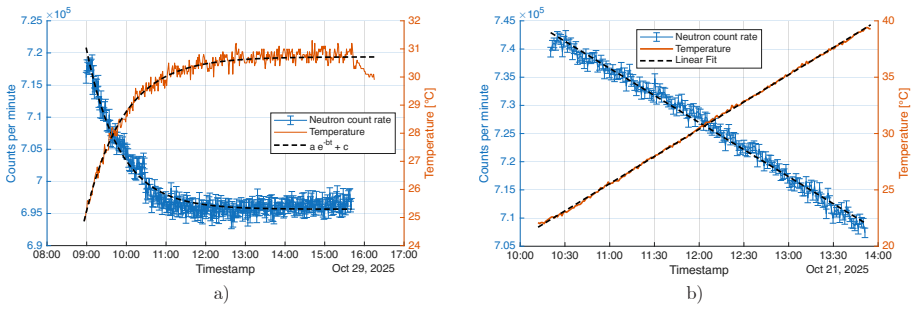
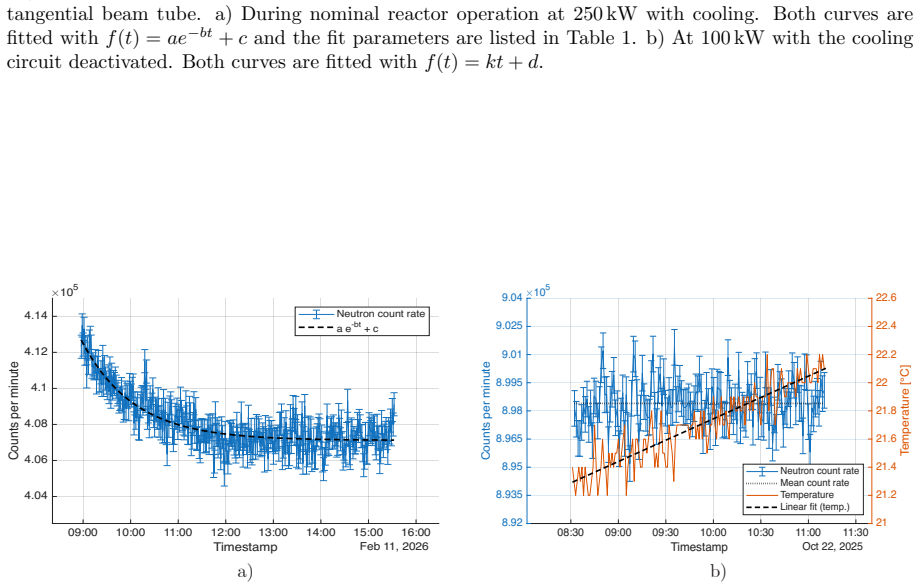
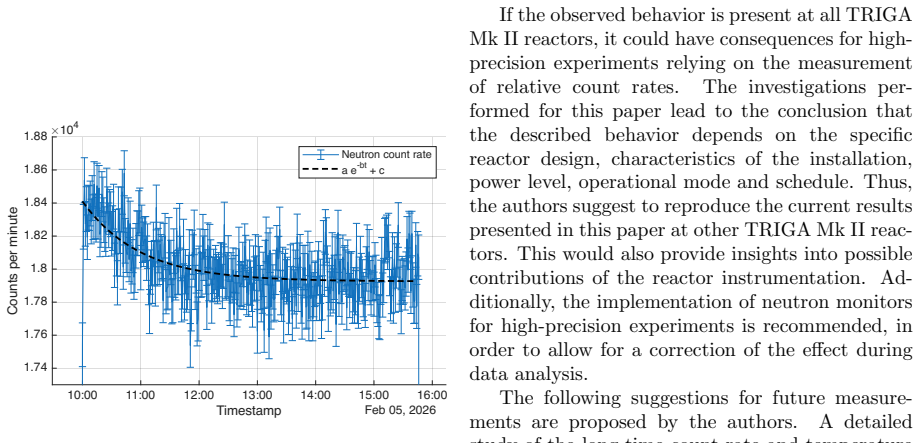
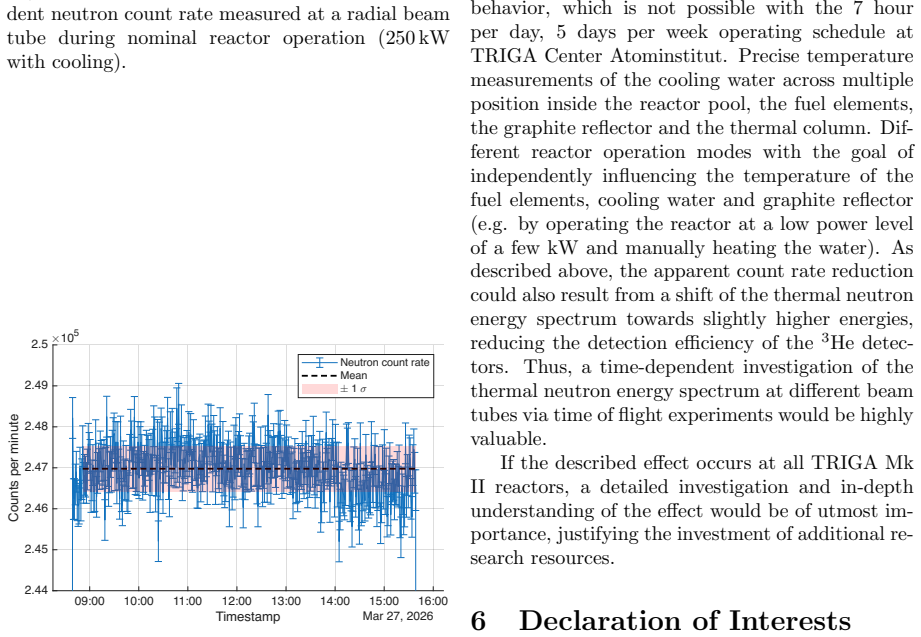
A variation of the measured neutron flux using ³He detectors at a TRIGA Mk II nuclear research reactor during steady-state operation is reported. The observed effect shows a statistically significant anti-correlation between the temperature in the reactor pool and recorded neutron counts. Following reactor start-up under nominal operating conditions, the effect occurs for a specific time period until thermal equilibrium and a constant neutron count rate are reached.
What carries the argument
The statistically significant anti-correlation between reactor pool temperature and ³He detector neutron counts, observed through simultaneous measurements in varied configurations.
If this is right
- The count rate reaches a stable value only after thermal equilibrium is established.
- Detector response varies with position relative to the reactor core during the transient period.
- Further dedicated measurements are required to isolate the physical origin of the temperature dependence.
Where Pith is reading between the lines
- Calibration protocols for ³He detectors at similar research reactors may need an explicit waiting period or temperature correction after start-up.
- The same anti-correlation could appear in other gas-filled neutron detectors if the mechanism is thermal expansion or gas-density change inside the tube.
- Routine monitoring of pool temperature alongside neutron counts could serve as a simple diagnostic for when flux readings become reliable.
Load-bearing premise
The reported drop in counts is produced by reactor-induced thermal effects on the detectors or their immediate environment rather than by detector drift, electronics, or other unmeasured changes in reactor power or geometry.
What would settle it
Repeating the measurements while holding pool temperature fixed (for example by external cooling) and still observing a time-dependent count-rate change after start-up would falsify the thermal-effect claim.
Figures

read the original abstract
A variation of the measured neutron flux using $^3$He detectors at a TRIGA Mk II nuclear research reactor during steady-state operation is reported in this article. The observed effect shows a statistically significant anti-correlation between the temperature in the reactor pool and recorded neutron counts. Following reactor start-up under nominal operating conditions, the effect occurs for a specific time period until thermal equilibrium and a constant neutron count rate are reached. Simultaneous neutron and temperature measurements are performed in different configurations around the reactor in order to gain qualitative insights about the temperature dependent count rate behavior. Possible origins of the effect are identified and further measurements for a more detailed investigation are suggested.
Editorial analysis
A structured set of objections, weighed in public.
Referee Report
Summary. The manuscript reports an observed variation in neutron flux measurements using ³He detectors at a TRIGA Mk II research reactor during steady-state operation. It claims a statistically significant anti-correlation between reactor pool temperature and recorded neutron counts, occurring after start-up until thermal equilibrium is reached, based on simultaneous measurements in multiple configurations. Possible origins are identified qualitatively, with suggestions for further work.
Significance. If the reported anti-correlation is robustly isolated from confounding reactor conditions and shown to arise from detector thermal response (e.g., via gas density or electronics effects), the result would be relevant for precision neutron monitoring in research reactors and could motivate temperature compensation protocols. The multi-configuration approach provides some qualitative insight, but the absence of quantitative modeling or controls limits immediate impact.
major comments (3)
- [Abstract] Abstract: The central claim of a 'statistically significant anti-correlation' is asserted without any reported data, correlation coefficient, p-value, error bars, sample size, or description of the statistical method. This is load-bearing for the primary result and prevents verification of the claim.
- The interpretation attributes the count-rate variation to reactor-induced thermal effects on the detectors, yet no forward modeling (e.g., ideal-gas-law density change in the ³He volume) or control measurements (fixed-power runs with external heating, or cross-checks against independent power monitors) are presented to exclude co-varying reactor spectrum or power effects.
- No details are given on detector dead-time corrections, electronics stability monitoring, or exclusion criteria for data segments, all of which are required to isolate a temperature dependence from instrumental drift during the post-start-up transient.
minor comments (1)
- [Abstract] The abstract and text would benefit from explicit numerical values for the observed count-rate change and temperature range to allow readers to assess the effect size.
Simulated Author's Rebuttal
We thank the referee for their careful and constructive review of our manuscript. We address each major comment point by point below, indicating where revisions will be made to improve clarity, transparency, and support for the claims.
read point-by-point responses
-
Referee: [Abstract] Abstract: The central claim of a 'statistically significant anti-correlation' is asserted without any reported data, correlation coefficient, p-value, error bars, sample size, or description of the statistical method. This is load-bearing for the primary result and prevents verification of the claim.
Authors: We agree that the abstract lacks the quantitative statistical details needed for immediate verification. The full manuscript contains the underlying time-series data and analysis, but these were not summarized in the abstract. In the revised version we will expand the abstract to report the Pearson correlation coefficient, associated p-value, sample size, and a brief description of the method (including how uncertainties were propagated). Error bars and the full dataset will be emphasized in the main text and figures. revision: yes
-
Referee: The interpretation attributes the count-rate variation to reactor-induced thermal effects on the detectors, yet no forward modeling (e.g., ideal-gas-law density change in the ³He volume) or control measurements (fixed-power runs with external heating, or cross-checks against independent power monitors) are presented to exclude co-varying reactor spectrum or power effects.
Authors: The study is observational and reports the anti-correlation under normal steady-state operation after start-up; no dedicated forward modeling or control experiments were performed. The multi-configuration measurements (different detector positions and orientations) were intended to provide qualitative discrimination against global reactor-power or spectrum changes. In revision we will add a discussion paragraph with order-of-magnitude estimates using the ideal-gas law for ³He density variation and will explicitly state the absence of control runs as a limitation while outlining suggested future experiments. revision: partial
-
Referee: No details are given on detector dead-time corrections, electronics stability monitoring, or exclusion criteria for data segments, all of which are required to isolate a temperature dependence from instrumental drift during the post-start-up transient.
Authors: We accept that these methodological details were omitted. The original analysis applied standard dead-time corrections and verified electronics stability via reference channels, with data segments selected after reactor power had stabilized; however, these steps were not documented. The revised manuscript will include a dedicated methods subsection describing the dead-time model, stability monitoring protocol, and explicit exclusion criteria used to avoid transient periods. revision: yes
Circularity Check
Purely observational report; no equations, derivations, or self-citations present
full rationale
The manuscript is an experimental report describing measured anti-correlation between pool temperature and ³He count rate under steady-state reactor operation. It presents simultaneous measurements in multiple configurations, notes the time to thermal equilibrium, and lists possible origins while suggesting further work. No equations, fitted parameters, predictions, or derivations appear in the abstract or described content. No self-citations are invoked to justify uniqueness, ansatzes, or load-bearing premises. The central claim is therefore an empirical observation whose validity rests on data collection and statistical significance rather than any chain that reduces to its own inputs by construction.
Axiom & Free-Parameter Ledger
Reference graph
Works this paper leans on
-
[1]
Disturb- ing the Universe
Freeman Dyson and Hans Bethe. “Disturb- ing the Universe”. In:Physics Today32.12 (1979), pp. 51–52.issn: 0031-9228
1979
-
[2]
M., B¨ ock, H., Hampel, G., Iunikova, A., Marshall, F., Miller, G
Bartholomew, K. M., B¨ ock, H., Hampel, G., Iunikova, A., Marshall, F., Miller, G. E., Nacir, B., Rao, D. V. H., Razvi, J., Ridikas, D., Salvini, A., Villa, M., & Wall, D.History, Development and Future of TRIGA Research Reactors. Vienna: International Atomic En- ergy Agency, 2016.isbn: 978-92-0-102016-1
2016
-
[3]
Dornbl¨ uthstr
VacuTec Meßtechnik GmbH.He-3 NEU- TRON DETECTORS. Dornbl¨ uthstr. 14a, 01277 Dresden, Germany.url:https : / / www.vacutec-gmbh.de/fileadmin/VacuTec- Files/produkte/umwelt/Zaehlrohre__GM- _ _ P - _ _ N - _ / Neutronen _ Zaehlrohre / He - 3 _ NEUTRON _ DETECTORS _ flyer _ 710 _ 3 . pdf (visited on 01/09/2026)
2026
-
[4]
Dornbl¨ uthstr
VacuTec Meßtechnik GmbH.Application He-3 Neutron Detectors. Dornbl¨ uthstr. 14a, 01277 Dresden, Germany.url:https : / / www.vacutec-gmbh.de/fileadmin/VacuTec- Files/produkte/umwelt/Zaehlrohre__GM- _ _ P - _ _ N - _ / Neutronen _ Zaehlrohre / Application _ He - 3 _ Neutron _ Detectors . pdf(visited on 01/09/2026)
2026
-
[5]
Product catalog
Canberra Eurisys.Helium-3 Neutron Detec- tors. Product catalog. English. Jan. 2023
2023
-
[6]
KG.MRS-2000
mesytec GmbH & Co. KG.MRS-2000. Man- ufacturer’s website for the MRS-2000 all- in-one preamplifier. 2025.url:https : / / www . mesytec . com / products / neutron - scattering / MRS - 2000 . html(visited on 01/09/2026)
2000
-
[7]
2026.url:https : / / www
Amptek Inc.MCA-8000D Digital Multichan- nel Analyzer. 2026.url:https : / / www . amptek . com / products / multichannel - analyzers/mca-8000d-digital-multichannel- analyzer(visited on 01/09/2026)
2026
-
[8]
2026.url:https : / / www
Amptek Inc.DPPMCA Display & Acquisi- tion Software. 2026.url:https : / / www . amptek . com / software / dp5 - digital - pulse-processor-software/dppmca-display- acquisition-software(visited on 01/09/2026)
2026
-
[9]
Calex Electronics Limited.Excelog 6 Tem- perature Indicators and Controllers. 2026. url:https://www.calex.co.uk/product/ temperature - measurement / temperature - indicators-and-controllers/excelog-6/ (visited on 01/09/2026)
2026
-
[10]
2026.url:https : / / at
RS Components.RS PRO Glass Fibre Ex- posed Junction Type K Thermocouple, 10m, Ø1/0.3mm. 2026.url:https : / / at . rs - online . com / web / p / thermoelemente / 8722610(visited on 01/09/2026)
2026
-
[11]
The reflection of X-rays by crystals
William Henry Bragg and William Lawrence Bragg. “The reflection of X-rays by crystals”. In:Proceedings of the Royal Society of Lon- don. Series A, Containing Papers of a Math- ematical and Physical Character88.605 (July 1913), pp. 428–438.issn: 2053-9150.doi:10. 1098/rspa.1913.0040
arXiv 1913
-
[12]
The CRAB facility at the TU Wien TRIGA reactor: status and related physics program
H. Abele et al. “The CRAB facility at the TU Wien TRIGA reactor: status and related physics program”. In: (2025).doi:10.48550/ ARXIV.2505.15227
arXiv 2025
-
[13]
Ultra-small-angle neu- tron scattering studies of artificial lattices
Erwin Jericha et al. “Ultra-small-angle neu- tron scattering studies of artificial lattices”. In:Journal of Applied Crystallography36.3 (Apr. 2003), pp. 778–782.issn: 0021-8898. doi:10.1107/s0021889803003868. 7
-
[14]
The coherent scatter- ing length of 86Kr determined by neutron interferometry
B.P. Terburg et al. “The coherent scatter- ing length of 86Kr determined by neutron interferometry”. In:Nuclear Instruments and Methods in Physics Research Section A: Accelerators, Spectrometers, Detectors and Associated Equipment324.1-2 (Jan. 1993), pp. 247–252.issn: 0168-9002.doi:10.1016/ 0168-9002(93)90984-p
1993
-
[15]
Thomas Buchberger.Neutronenradiographis- che Untersuchungen an Tantal-Tritium-Helium- Systemen. ger. 1986
1986
-
[16]
A Piecewise Rotation of the Circle, IPR Maps and Their Connection with Translation Surfaces
D. C. Henzlova et al. “Neutron Detectors”. In:Nondestructive Assay of Nuclear Mate- rials for Safeguards and Security. Springer Nature Switzerland, 2024, pp. 325–358.isbn: 9783031582776.doi:10.1007/978- 3- 031- 58277-6_15. 8
discussion (0)
Sign in with ORCID, Apple, or X to comment. Anyone can read and Pith papers without signing in.