REVIEW 3 major objections 4 minor 40 references
An element-wise approach for simulating transcranial MRI-guided focused ultrasound thermal ablation
T0 review · 3 major / 4 minor · reviewed 2026-08-14 · deepseek-v4-flash
Pith's one-line read This paper establishes that separately simulated phased-array elements, combined with CT-derived skull acoustic properties optimized against MR thermometry, predict focal heating in transcranial ultrasound to an $R^2$ of 0.74 in 32…
desk verdict A clinically valuable and honestly reported validation of a known simulation strategy, with one data-driven regime switch that complicates the physical story but not the out-of-sample result. read the letter →
The pith
A machine-rendered reading of the paper's core claim, the machinery that carries it, and where it could break.
The reading
What carries the argument
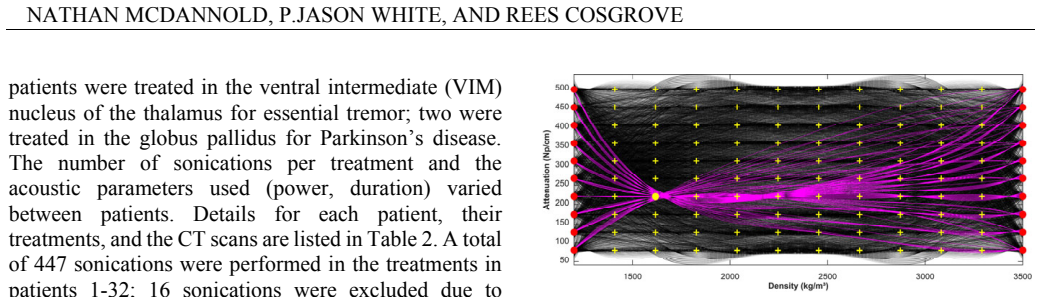
The central object is the element-wise simulation library: each transducer element is treated as a 1 cm flat circular piston and simulated separately with the k-Wave toolbox in a $44 \times 44 \times 492$ voxel grid at 0.325 mm spacing, then the resulting complex pressure fields are stored so that any phase and magnitude distribution can be combined in memory. The argument is carried by two fitted polynomial relationships connecting CT-derived skull density to acoustic properties: attenuation vs. density, $\alpha(\rho) \approx \sum_m A_m \rho^m$, and inverse sound speed vs. density, $1/c(\rho) \approx \sum_m B_m \rho^m$. A simplified attenuation model and a transmission-coefficient model based on acoustic impedances and Snell's law allowed the authors to test 10,000 candidate density/attenuation and density/sound speed curves per sonication, and the bioheat equation was then used to estimate temperature rise from the resulting pressure fields.
What would settle it
Measure skull sound speed directly before and after high-intensity sonication, for example by through-skull time-of-flight or transmission measurements on ex vivo human skulls exposed to comparable acoustic energies; if the sound speed does not shift in the way the fitted second density/sound speed curve describes, the two-curve model and the reported validation $R^2$ would not generalize.
Extended reading notes
Core claim
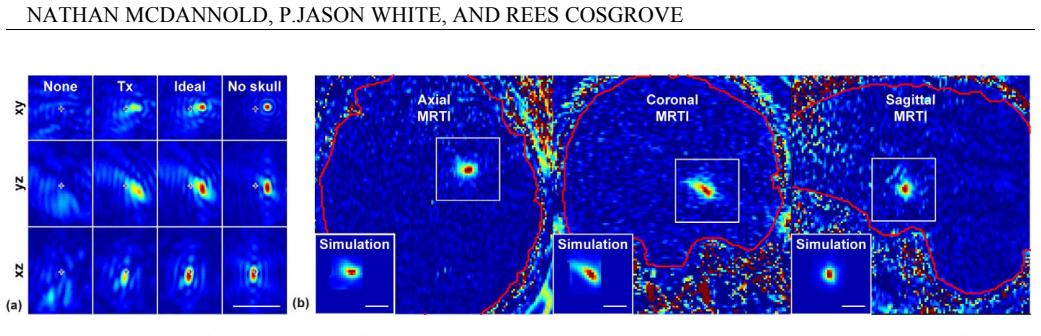
The central claim is that an element-wise simulation approach, in which each of the 993 active phased-array elements is modeled separately and the complex pressure fields are rotated and interpolated into a common frame, can predict the focal temperature rise and heating geometry of clinical transcranial focused ultrasound treatments. Using the manufacturer's phase and magnitude corrections, the simulations reproduced the relative peak temperature rise with $R^2 = 0.74$ in the first 32 patients and $R^2 = 0.71$ in 40 additional patients, and the simulated focal dimensions and obliquity correlated with MR thermometry at $R^2 = 0.62$ and $R^2 = 0.74$, respectively. The paper further claims that the growing mismatch between simulated and measured heating after accumulated acoustic energy reflects an irreversible change in skull sound speed, and that a second density/sound speed polynomial, fitted to the deviant sonications, improves predictions in those cases. The energy required to reach an ablative temperature of 55°C varied by an order of magnitude across patients, from 3.3 to 36.1 kJ, indicating wide patient-to-patient variability in skull transmission.
Load-bearing premise
The paper's second fitted curve rests on the assumption that the growing mismatch between simulated and measured heating after accumulated acoustic energy is an irreversible change in skull sound speed that a second density/sound speed polynomial can capture, even though the sonications used to fit that curve were themselves selected as deviations from the optimized attenuation model, making the data split model-dependent.
Editorial extensions
If this is right
- If the element-wise library is built once, any phase or magnitude correction scheme can be evaluated rapidly, enabling near-real-time exploration of beam steering and aberration correction without rerunning full three-dimensional simulations.
- The optimized CT-density to attenuation and sound speed relationships, fitted on 32 patients and validated on 40 more, give other transcranial focused ultrasound modeling efforts a directly usable parameterization for human skull bone.
- Because the simulations reproduce focal obliquity, including cases where heating tilts in two planes and extends toward the internal capsule, they can flag off-target heating risks that single-plane MR thermometry may miss.
- The finding that ablative energy varies from 3.3 to 36.1 kJ across patients, with simulations predicting this energy at $R^2 = 0.45$, suggests that simulation-based screening could supplement the currently used skull density ratio, though the most difficult patients remain poorly predicted.
- The two-curve density/sound speed model implies that skull acoustic properties can change during a treatment, and that the observed loss of treatment efficiency at high accumulated acoustic energy is at least partly a sound speed effect that can be modeled.
Reading between the lines
- A likely next step, not demonstrated in the paper, is to use MRTI feedback during a treatment to update the assumed skull sound speed curve between sonications, turning the two-curve model into an adaptive correction scheme.
- The systematically more diffuse heating seen in MRTI compared with simulation points to unmodeled acoustic pathways such as shear-wave conversion at oblique incidence, reverberation, or nonlinear propagation; adding these to the element-wise framework is a testable extension that could close the gap in focal width and in the observed cooling-rate mismatch.
- Because the deviant sonications used to fit the second density/sound speed curve were themselves selected using the optimized attenuation model, the second curve should be validated against direct measurements of skull sound speed before and after sonication, for example through-skull time-of-flight in ex vivo bone, rather than inferred only from temperature mismatch.
- The worst-outlier patients, who needed more than 20 kJ to reach ablative temperature without being predicted by any single skull metric, hint that factors beyond density-based attenuation, such as microstructural scattering or localized skull heterogeneity, need to enter the model; a concrete test would be whether per-element phase-error or scattering terms improve prediction in exactly those pati
Signed reviews
Editorial analysis
A structured set of objections, weighed in public.
Referee Report
Summary. The paper proposes an element-wise simulation framework for transcranial MRI-guided focused ultrasound (TcMRgFUS). Each element of a hemispherical phased array is simulated separately with the k-Wave toolbox, using the same CT-derived skull model and the phase/magnitude values used during treatment, and the pressure fields are combined and fed into a bioheat solver to estimate temperature rise. Using MRTI data from 32 patients (431 sonications), the authors optimize polynomial relationships between CT-derived skull density and acoustic attenuation and sound speed, including a second sound-speed relationship intended to apply after a presumed irreversible change in skull properties during treatment. They validate the optimization on 40 additional patients (396 sonications), reporting R2 of 0.74 for the training cohort and 0.71 for the validation cohort for relative peak temperature rise, and R2 of 0.62 and 0.74 for focal dimensions and obliquity. The paper also reports that measured heating is more spatially diffuse than simulated and that the acoustic energy required to reach an ablative thermal dose varies by an order of magnitude.
Significance. If the central claim holds, this is a substantial clinical modeling contribution: a large (72-patient) dataset with per-element simulations, MRTI comparison, and an independent validation cohort is rare in this field, and the element-wise architecture is genuinely useful for rapid iteration over phase/magnitude schemes. The paper ships explicit optimized coefficients (Table 3), uses the open-source k-Wave toolbox, and reports falsifiable comparisons to measured heating shape, size, and obliquity. The independent 40-patient validation is a real strength. However, the main predictive claim is weakened by the post-hoc, residual-defined regime switch for the second sound-speed curve: the reported R2 figures do not correspond to a single fixed predictive model, and the paper's own Discussion acknowledges that the assumed physical mechanism may be incorrect. The approach and the optimization framework are nevertheless valuable, and the identified limitations appear addressable with additional analysis.
major comments (3)
- [Section II.D and III.B (Eq. 6, Fig. 7)] The 'after skull change' density/sound speed curve is fitted to sonications that were selected automatically as 'deviants' using the optimized attenuation model (two or more sonications exceeding two standard deviations above the mean difference in Fig. 7d-f). This selection is a function of the model's own residuals, so the second polynomial in Table 3 is fit to the residual patterns of the first model rather than to independently measured physical changes. Because the reported R2 values (0.74 and 0.71) include sonications simulated with this second curve, the paper does not report the predictive performance of a single fixed predictor. Please report, for both the training and validation cohorts, the R2, slope, and intercept for non-deviant sonications under the 'before' curve alone, for the deviant sonications under the 'after' curve, and for a pre-specified two-regime model in which the switch point is fixed in advance (e.g., based on accumulated acoustic energy) rather than selected by residual inspection.
- [Section III.E and Discussion (Fig. 11)] The validation on patients 33-72 inherits the same residual-based regime switch: deviant sonications in the validation patients are identified using the optimized attenuation model's residual plot (Fig. 11c-d) and then simulated with the 'after' curve. Thus the out-of-sample R2 does not independently test the substantive claim that a change in skull sound speed causes the deviation. The Discussion itself states that the change may not be spatially uniform or binary, that sound speed 'may not even be correct' as the dominant factor, and that patients 27 and 30 deviate without prior accumulated energy. These admissions indicate that the second curve could be an overfit to residual patterns from missing physics (e.g., shear-mode transmission, nonlinear propagation, incorrect thermal properties). Please re-analyze the validation cohort with a pre-specified switch rule and report the performance difference between the two-curve model and a single-curve model; also report how many validation sonications would be classified as deviant by the fixed rule and whether the 'after' curve actually improves out-of-sample prediction.
- [Section III.B and Abstract] The abstract and results sections report R2 of 0.74 for patients 1-32 and 0.71 for patients 33-72 without flagging that the first number is in-sample: the attenuation polynomial (Eq. 3) and both sound-speed polynomials (Eq. 6) were optimized on the MRTI temperatures of patients 1-32, and the deviant-selection threshold was also chosen from these data. Presenting 0.74 as the 'agreed well' number conflates training and validation performance. Please label the 0.74 as training performance in the abstract, results, and conclusion, and lead with the out-of-sample result for the pre-specified fixed model, including separate metrics for non-deviant and deviant subsets.
minor comments (4)
- [Equations (2)-(5) and (6)-(11)] The typesetting of several equations is garbled, with missing subscripts and an unclear grid-size variable, which makes the polynomial coefficient definitions and summation limits hard to follow; please revise the notation for publication.
- [Fig. 5a] The visual comparison uses 50% contours for MRTI and 25% contours for simulated heating; this asymmetry should be stated in the main text as well as the caption, and the systematic underestimation of focal dimensions (R2 0.62 with simulated widths smaller than measured) should be discussed as a limitation rather than only as a correlation.
- [Table 3] The optimized coefficients are presented without uncertainties or a statement of the density range over which they were fit; please provide confidence intervals or a plot of the curves overlaid on the observed density histogram.
- [Section IV (Discussion)] The candid acknowledgment that the deviation 'may not even be correct to assume that the sound speed is the dominant factor' is appreciated, but the conclusion still states the model predicted focal temperature rise 'on average'; please qualify the conclusions to reflect the unresolved mechanism.
Circularity Check
Reported R² for deviant sonications depends on a post-hoc regime switch keyed to the optimized attenuation model's own residuals; the external validation of the fitted curves is otherwise genuine and keeps the circularity partial.
-
fitted input called prediction
[Section II.D (Eqs. 6–11) and Section III.B, Fig. 7]
"Those deviant points, shown as red crosses, were selected automatically for each patient when two or more sonications exceeded a cut-off of two standard deviations above the mean difference (indicated by the light blue regions in FIG. 7d-f) for the optimized attenuation model. ... The relationship that minimized the error between the simulations and measurements was found for the sonications that deviated from the model after attenuation optimization."
The post-change density/sound speed curve is not an independent predictor: its coefficients are obtained by minimizing error on the subset of sonications defined by the optimized attenuation model's residuals. In the reported agreement (Fig. 7c; R² 0.74 patients 1–32, 0.71 patients 33–72), those same deviant sonications are then assigned the post-change curve, so their 'predicted' temperatures are fitted to the very outcome used to select them. For patients 33–72 the curve coefficients are fixed, but deviant status is still determined from the measured residual against the optimized attenuation model, so the validation R² evaluates a retrospective regime switch rather than a fixed prospective model.
full rationale
Overall the paper is largely self-contained: the element-wise k-Wave simulations, MRTI processing, and the validation on 40 additional patients give the density/attenuation and density/sound speed relationships genuine out-of-sample support. There is no self-citation chain or imported uniqueness theorem; the initial Pichardo et al. relationships are used only as a starting point and are explicitly re-optimized. The main circularity concern is confined to the second ('after skull change') sound speed curve: it is fitted to sonications selected by the optimized attenuation model's residuals, and those same sonications are included in the reported R² with the post-change curve. This makes the in-sample R² (0.74) partly a fit and makes even the validation R² (0.71) dependent on a post-hoc regime switch, since the deviant classification uses the measured outcome. Because the validation set is large and the curve coefficients themselves are not refit on patients 33–72, the central claim is not wholly circular; a score of 4 reflects this partial circularity. If one treated only the non-deviant, fixed-model predictions as the claim, the circularity score would be near 0.
Assumptions & free parameters
free parameters (5)
- Attenuation polynomial coefficients A0-A4 =
5.71E+03, -9.02E+00, 5.40E-03, -1.41E-06, 1.36E-10
- Sound speed polynomial coefficients B0-B4 (before skull change) =
3.68E-03, -5.95E-06, 4.13E-09, -1.28E-12, 1.48E-16
- Sound speed polynomial coefficients B0-B4 (after skull change) =
1.24E-03, -7.63E-07, 1.69E-10, 5.31E-16, -2.79E-18
- Deviant sonication selection threshold =
Two standard deviations above the mean difference
- CT Hounsfield unit to density calibration =
-1000 HU = air, 57 HU = soft tissue
assumptions (6)
- domain assumption Element-wise pressure fields can be superposed linearly to form the total field.
- ad hoc to paper Primary attenuation effects occur along the z-direction only.
- ad hoc to paper Deviations in heating/energy trajectories are caused primarily by a change in skull sound speed.
- domain assumption Loss at skull interfaces is dominated by initial reflections; multiple reflections are ignored.
- ad hoc to paper Skull attenuation and inverse sound speed are 4th-order polynomials of CT density.
- standard math Pennes bioheat equation with constant perfusion and literature thermal properties describes brain heating.
Cite this review
Pith. "Pith review of An element-wise approach for simulating transcranial MRI-guided focused ultrasound thermal ablation." pith.science (2026). https://pith.science/paper/XU5ZG2G7
@misc{pith2026190902372,
  author       = {Pith},
  title        = {Pith review of: An element-wise approach for simulating transcranial MRI-guided focused ultrasound thermal ablation},
  year         = {2026},
  howpublished = {\url{https://pith.science/paper/XU5ZG2G7}},
  note         = {Machine review of arXiv:1909.02372}
}
read the original abstract
This work explored an element-wise approach to model transcranial MRI-guided focused ultrasound (TcMRgFUS) thermal ablation, a noninvasive approach to neurosurgery. Each element of the phased array transducer was simulated individually and could be simultaneously loaded into computer memory, allowing for rapid calculation of the pressure field for different phase offsets used for beam steering and aberration correction. We simulated the pressure distribution for 431 sonications in 32 patients, applied the phase and magnitude values used during treatment, and estimated the resulting temperature rise. We systematically varied the relationship between CT-derived skull density and the acoustic attenuation and sound speed to obtain the best agreement between the predictions and MR temperature imaging (MRTI). The optimization was validated with simulations of 396 sonications from 40 additional treatments. After optimization, the predicted and measured heating agreed well (R2: 0.74 patients 1-32; 0.71 patients 33-72). The dimensions and obliquity of the heating in the simulated temperature maps correlated well with the MRTI (R2: 0.62, 0.74 respectively), but the measured heating was more spatially diffuse. The energy needed to achieve ablation varied by an order of magnitude (3.3-36.1 kJ). While this element-wise approach requires more computation time up front, it can be performed in parallel. It allows for rapid calculation of the three-dimensional heating at the focus for different phase and magnitude values on the array. We also show how this approach can be used to optimize the relationship between CT-derived skull density and acoustic properties. While the relationships found here need further validation in a larger patient population, these results demonstrate the promise of this approach to model TcMRgFUS.
Figures


Figures from the paper (10 more)


Reference graph
Works this paper leans on
-
[1]
W. J. Elias, N. Lipsman, W. G. Ondo, P. Ghanouni, Y. G. Kim, W. Lee, M. Schwartz, K. Hynynen, A. M. Lozano, B. B. Shah, D. Huss, R. F. Dallapiazza, R. Gwinn, J. Witt, S. Ro, H. M. Eisenberg, P. S. Fishman, D. Gandhi, C. H. Halpern, R. Chuang, P. K. Butts, T. S. Tierney, M. T. Hayes, G. R. Cosgrove, T. Yamaguchi, K. Abe, T. Taira, and J. W. Chang, A Random...
work page 2016
-
[2]
A. E. Bond, B. B. Shah, D. S. Huss, R. F. Dallapiazza, A. Warren, M. B. Harrison, S. A. Sperling, X. Q. Wang, R. Gwinn, J. Witt, S. Ro, and W. J. Elias, Safety and Efficacy of Focused Ultrasound Thalamotomy for Patients With Medication-Refractory, Tremor-Dominant Parkinson Disease: A Randomized Clinical Trial , JAMA Neurol 74, 1412 (2017)
work page 2017
- [3]
-
[4]
N. Y. Jung, C. K. Park, M. Kim, P. H. Lee, Y. H. Sohn, and J. W. Chang, The efficacy and limits of magnetic resonance-guided focused ultrasound pallidotomy for Parkinson's disease: a Phase I clinical trial, J Neurosurg 130, 1853 (2019)
work page 2019
-
[5]
H. H. Jung, S. J. Kim, D. Roh, J. G. Chang, W. S. Chang, E. J. Kweon, C. H. Kim, and J. W. Chang, Bilateral thermal capsulotomy with MR-guided focused ultrasound for patients with treatment- refractory obsessive-compulsive disorder: a proof- of-concept study, Mol Psychiatry 20, 1205 (2015)
work page 2015
-
[6]
N. Lipsman, Y. Meng, A. J. Bethune, Y. Huang, B. Lam, M. Masellis, N. Herrmann, C. Heyn, I. Aubert, A. Boutet, G. S. Smith, K. Hynynen, and S. E. Black, Blood-brain barrier opening in Alzheimer's disease using MR-guided focused ultrasound, Nat Commun 9, 2336 (2018)
work page 2018
-
[7]
T. Mainprize, N. Lipsman, Y. Huang, Y. Meng, A. Bethune, S. Ironside, C. Heyn, R. Alkins, M. Trudeau, A. Sahgal, J. Perry, and K. Hynynen, Blood-Brain Barrier Opening in Primary Brain Tumors with Non-invasive MR-Guided Focused Ultrasound: A Clinical Safety and Feasibility Study, Sci Rep 9, 321 (2019)
work page 2019
- [8]
Show all 40 references
-
[9]
Boutet, M
A. Boutet, M. Ranjan, J. Zhong, J. Germann, D. Xu, M. L. Schwartz, N. Lipsman, K. Hynynen, G. A. Devenyi, M. Chakravarty, E. Hlasny, M. Llinas, C. S. Lozano, G. J. B. Elias, J. Chan, A. Coblentz, A. Fasano, W. Kucharczyk, M. Hodaie, and A. M. Lozano, Focused ultrasound thalamo...
2018
-
[10]
W. S. Chang, H. H. Jung, E. Zadicario, I. Rachmilevitch, T. Tlusty, S. Vitek, and J. W. Chang, Factors associated with successful magnetic resonance-guided focused ultrasound treatment: efficiency of acoustic energy delivery through the skull, J Neurosurg 124, 411 (2016)
2016
-
[11]
Hughes, Y
A. Hughes, Y. Huang, M. L. Schwartz, and K. Hynynen, The reduction in treatment efficiency at high acoustic powers during MR-guided transcranial focused ultrasound thalamotomy for Essential Tremor, Med Phys 45, 2925 (2018)
2018
-
[12]
G. T. Clement and K. Hynynen, A non-invasive method for focusing ultrasound through the human skull, Phys Med Biol 47, 1219 (2002)
2002
-
[13]
J. F. Aubry, M. Tanter, M. Pernot, J. L. Thomas, and M. Fink, Experimental demonstration of noninvasive transskull adaptive focusing based on prior computed tomography scans , J Acoust Soc Am 113, 84 (2003)
2003
-
[14]
C. W. Connor, G. T. Clement, and K. Hynynen, A unified model for the speed of sound in cranial bone based on genetic algorithm optimization, Phys Med Biol 47, 3925 (2002)
2002
-
[15]
Pichardo, V
S. Pichardo, V. W. Sin, and K. Hynynen, Multi- frequency characterization of the speed of sound and attenuation coefficient for longitudinal transmission of freshly excised human skulls , Phys Med Biol 56, 219 (2011)
2011
-
[16]
U. Vyas, P. Ghanouni, C. H. Halpern, J. Elias, and K. B. Pauly, Predicting variation in subject thermal response during transcranial magnetic resonance guided focused ultrasound surgery: Comparison in seventeen subject datasets , Med Phys 43, 5170 (2016)
2016
-
[17]
Pulkkinen, B
A. Pulkkinen, B. Werner, E. Martin, and K. Hynynen, Numerical simulations of clinical focused ultrasound functional neurosurgery , Phys Med Biol 59, 1679 (2014)
2014
-
[18]
S. A. Leung, T. D. Webb, R. R. Bitton, P. Ghanouni, and P. K. Butts, A rapid beam simulation framework for transcranial focused ultrasound, Sci Rep 9, 7965 (2019)
2019
-
[19]
G. T. Clement, J. White, and K. Hynynen, Investigation of a large- area phased array for focused ultrasound surgery through the skull, Phys Med Biol 45, 1071 (2000). NATHAN MCDANNOLD, P.JASON WHITE, AND REES COSGROVE 21
2000
-
[20]
H. H. Pennes, Analysis of tissue and arterial blood temperatures in the resting human forearm. 1948 [classical article], J Appl Physiol 85, 5 (1998)
1998
-
[21]
B. E. Treeby and B. T. Cox, k-Wave: MATLAB toolbox for the simulation and reconstruction of photoacoustic wave fields , J Biomed Opt 15, 021314 (2010)
2010
-
[22]
Odeen and D
H. Odeen and D. L. Parker, Improved MR thermometry for laser in terstitial thermotherapy , Lasers Surg Med 51, 286 (2019)
2019
-
[23]
Ishihara, A
Y. Ishihara, A. Calderon, H. Watanabe, K. Okamoto, Y. Suzuki, and K. Kuroda, A precise and fast temperature mapping using water proton chemical shift, Magn Reson Med 34, 814 (1995)
1995
-
[24]
A. H. Chung, F. A. Jolesz, and K. Hynynen, Thermal dosimetry of a focused ultrasound beam in vivo by magnetic resonance imaging, Med Phys 26, 2017 (1999)
1999
-
[25]
McDannold, G
N. McDannold, G. T. Clement, P. Black, F. Jolesz, and K. Hynynen, Transcranial magnetic resonance imaging- guided focused ultrasound surgery of brain tumors: initial findings in 3 patients , Neurosurgery 66, 323 (2010)
2010
-
[26]
A. H. Chung, K. Hynynen, V. Colucci, K. Oshio, H. E. Cline, and F. A. Jolesz, Optimization of spoiled gradient-echo phase imaging for in vivo localization of a focused ultrasound beam , Magn Reson Med 36, 745 (1996)
1996
-
[27]
F. A. Duck, in Physical Properties of Tissue. A Comprehensive Reference Book, 1 ed., Edited by F. A. Duck (Academic Press, London, 1990), Chap. 4
1990
-
[28]
S. A. Goss, R. L. Johnston, and F. Dunn, Comprehensive compilation of empirical ultrasonic properties of mammalian tissues , J Acoust Soc Am 64, 423 (1978)
1978
-
[29]
Hertzberg, O
Y. Hertzberg, O. Naor, A. Volovick, and S. Shoham, Towards multifocal ultrasonic neural stimulation: pattern generation algorithms , J Neural Eng 7, 056002 (2010)
2010
-
[30]
Legon, A
W. Legon, A. Rowlands, A. Opitz, T. F. Sato, and W. J. Tyler, Pulsed ultrasound differentially stimulates somatosensory circuits in humans as indicated by EEG and FMRI, PLoS ONE 7, e51177 (2012)
2012
-
[31]
deviants
that do not require high acoustic exposure levels, as modifying the spatial pressure field would likely reduce the peak pressure amplitude at the focus. To achieve this goal, we need to better predict the shape of the focal heating. The heating measured with MRTI was more diff...
-
[32]
C. D. Arvanitis, N. Vykhodtseva, F. Jolesz, M. Livingstone, and N. McDannold, Cavitation- enhanced nonthermal ablation in deep brain targets: feasibility in a large animal model , J Neurosurg 1 (2015)
2015
-
[33]
P. J. White, G. T. Clement, and K. Hynynen, Longitudinal and shear mode ultrasound propagation in human skull bone, Ultrasound Med Biol 32, 1085 (2006)
2006
-
[34]
Pinton, J
G. Pinton, J. F. Aubry, M. Fink, and M. Tanter, Effects of nonlinear ultrasound propagation on high intensity brain therapy , Med Phys 38, 1207 (2011)
2011
-
[35]
Schneider, E
U. Schneider, E. Pedroni, and A. Lomax, The calibration of CT Hounsfield units for radiotherapy treatment planning, Phys Med Biol 41, 111 (1996)
1996
-
[36]
T. D. Webb, S. A. Leung, J. Rosenberg, P. Ghanouni, J. J. Dahl, N. J. Pelc, and K. B. Pauly, Measurements of the Relationship Between CT Hounsfield Units and Acoustic Velocity and How It Changes With Photon Energy and Reconstruction Method, IEEE Trans Ultrason Ferroelectr Freq...
2018
-
[37]
M. L. Schwartz, R. Yeung, Y. Huang, N. Lipsman, V. Krishna, J. D. Jain, M. G. Chapman, A. M. Lozano, and K. Hynynen, Skull bone marrow injury caused by MR-guided focused ultrasound for cerebral functional procedures , J Neurosurg 1 (2018)
2018
-
[38]
Pinton, J
G. Pinton, J. F. Aubry, E. Bossy, M. Muller, M. Pernot, and M. Tanter, Attenuation, scattering, and absorption of ultrasound in the skull bone , Med Phys 39, 299 (2012)
2012
-
[39]
Robertson, E
J. Robertson, E. Martin, B. Cox, and B. E. Treeby, Sensitivity of simulated transcranial ultrasound fields to acoustic medium property maps, Phys Med Biol 62, 2559 (2017)
2017
-
[40]
skull density ratio
A. Boutet, D. Gwun, R. Gramer, M. Ranjan, G. J. B. Elias, D. Tilden, Y. Huang, S. X. Li, B. NATHAN MCDANNOLD, P.JASON WHITE, AND REES COSGROVE 22 Davidson, H. Lu, P. Tyrrell, R. M. Jones, A. Fasano, K. Hynynen, W. Kucharczyk, M. L. Schwartz, and A. M. Lozano, The relevance of ...
2019
Reviewed August 14, 2026 · model on record in the stance chip above.
Discussion (0). Continue with ORCID to comment.