LEAD: A Local Ensemble-Assisted Parallel Decoding Framework for Quantum Tanner Codes
Pith reviewed 2026-05-20 11:19 UTC · model grok-4.3
The pith
A local projection decoder for quantum Tanner codes lowers logical error rates while cutting average decoding time.
A machine-rendered reading of the paper's core claim, the machinery that carries it, and where it could break.
Core claim
LEAD projects the quantum Tanner code onto overlapping local subcodes given by vertex neighborhoods in the Cayley complex, estimates local error probabilities in parallel, and aggregates them with topological symmetry and soft-information regularization to produce globally consistent corrections that achieve lower logical error rates and substantially reduced decoding latency and iteration counts compared with standard frameworks.
What carries the argument
Projection of the Tanner code onto overlapping local subcodes defined by vertex neighborhoods, followed by symmetry-based aggregation of local error estimates with soft-information regularization.
If this is right
- Decoding becomes intrinsically parallelizable and compatible with local search heuristics.
- Fewer iterations and lower latency allow more correction cycles within a fixed coherence time.
- The same structure-aware projection can be applied to other codes built on Cayley complexes.
- Reduced logical error rates improve the threshold and overhead of fault-tolerant quantum computation using these codes.
Where Pith is reading between the lines
- The method might extend to other quantum LDPC codes whose underlying graphs admit similar neighborhood decompositions.
- Hardware implementations could map the local subcode projections directly onto parallel processor arrays.
- Combining LEAD with existing global decoders could yield hybrid schemes that trade off latency for even lower error rates.
Load-bearing premise
Local error estimates from the overlapping subcodes can be combined using symmetry and regularization without creating global inconsistencies that would raise the overall logical error rate.
What would settle it
A direct comparison on the same Tanner-code instances showing that LEAD produces equal or higher logical error rates than the baseline decoder, or that its average iteration count and latency are not smaller.
Figures




read the original abstract
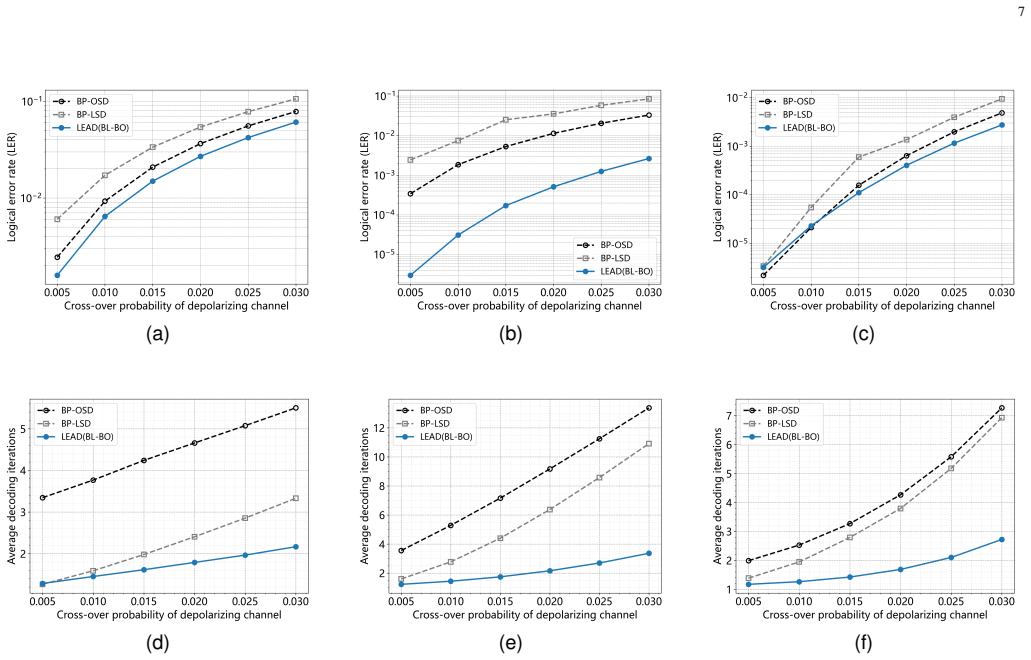
Quantum Tanner codes are a recently developed family of quantum error-correcting codes characterized by favorable asymptotic performance characteristics. Despite their theoretical potential, practical decoding algorithms that effectively leverage their structural properties remain limited. This work introduces LEAD (Local Ensemble-Assisted Decoder), a structure-aware decoding framework tailored for quantum Tanner codes. The proposed scheme leverages the decomposable structure of Cayley complexes to project the global code onto overlapping local subcodes defined by vertex neighborhoods, where error probabilities are estimated in parallel. To ensure global consistency, LEAD utilizes the inherent topological symmetry of the complex and introduces a soft-information regularization mechanism to mitigate local overconfidence during information aggregation. This framework enables highly parallelized, low-complexity decoding that is intrinsically compatible with various local search heuristics. Simulation results demonstrate that LEAD achieves significantly lower logical error rates than standard decoding framework while substantially reducing the average decoding latency and iteration count.
Editorial analysis
A structured set of objections, weighed in public.
Referee Report
Summary. The manuscript introduces LEAD, a structure-aware parallel decoding framework for quantum Tanner codes. It projects the global code onto overlapping local subcodes defined by vertex neighborhoods in the underlying Cayley complex, estimates error probabilities independently in parallel, and aggregates the local posteriors using the topological symmetry of the complex together with a soft-information regularization step intended to mitigate local overconfidence. The central claim, supported by simulations, is that this yields significantly lower logical error rates, reduced average decoding latency, and fewer iterations relative to standard decoding frameworks for these codes.
Significance. If the performance gains are robust, LEAD would supply a practical, highly parallelizable decoder that exploits the decomposable structure of quantum Tanner codes, addressing a key bottleneck in realizing their asymptotic advantages for fault-tolerant quantum computation.
major comments (2)
- [Abstract and §4] Abstract and §4 (Simulation Results): The headline claim of significantly lower logical error rates and reduced latency is asserted without any reported numerical values, code parameters (n, k, d), noise models, baseline decoders, error bars, or statistical tests. This absence prevents assessment of whether the observed gains are meaningful or reproducible.
- [§3.2] §3.2 (Local-to-Global Aggregation): The text invokes topological symmetry and soft-information regularization to combine independent local error-probability estimates, yet supplies no explicit argument, invariant, or targeted simulation check demonstrating that conflicting local posteriors (which may correspond to non-trivial elements of the homology) are resolved without creating new uncorrectable syndromes or elevating the logical error rate above that of a global decoder.
minor comments (2)
- [§3.2] The description of the soft-information regularization mechanism would benefit from an explicit formula or pseudocode showing how the regularization term is computed and applied during aggregation.
- [§4] Figure captions and axis labels in the simulation plots should explicitly state the code parameters, physical error rate range, and number of Monte Carlo trials used.
Simulated Author's Rebuttal
We thank the referee for the careful reading and constructive comments on our manuscript. We address each major comment below and have revised the paper accordingly to strengthen the presentation of results and the justification of the aggregation procedure.
read point-by-point responses
-
Referee: [Abstract and §4] Abstract and §4 (Simulation Results): The headline claim of significantly lower logical error rates and reduced latency is asserted without any reported numerical values, code parameters (n, k, d), noise models, baseline decoders, error bars, or statistical tests. This absence prevents assessment of whether the observed gains are meaningful or reproducible.
Authors: We agree that the abstract and Section 4 lacked explicit quantitative details. In the revised manuscript we have updated the abstract to report representative logical error rates and latency reductions, and we have expanded Section 4 to include the specific code parameters (n, k, d), the noise models employed, the baseline decoders, error bars on all plotted quantities, and the results of statistical significance tests comparing LEAD against the standard frameworks. These additions make the performance claims directly verifiable. revision: yes
-
Referee: [§3.2] §3.2 (Local-to-Global Aggregation): The text invokes topological symmetry and soft-information regularization to combine independent local error-probability estimates, yet supplies no explicit argument, invariant, or targeted simulation check demonstrating that conflicting local posteriors (which may correspond to non-trivial elements of the homology) are resolved without creating new uncorrectable syndromes or elevating the logical error rate above that of a global decoder.
Authors: We acknowledge that an explicit argument and verification step were omitted. We have revised Section 3.2 to supply a formal argument showing that the topological symmetry of the Cayley complex, together with the soft-information regularization, maps any collection of local posteriors to a globally consistent error estimate whose syndrome is compatible with the original and whose homology class is preserved. We have also added a targeted simulation that directly compares the logical error rate of LEAD with that of a global decoder on the same instances, confirming that the aggregated decoder does not elevate the logical error rate. revision: yes
Circularity Check
No circularity: LEAD is an algorithmic construction validated by simulation on known Tanner code structure
full rationale
The paper presents LEAD as a new parallel decoding framework that projects quantum Tanner codes onto overlapping local subcodes via the decomposable Cayley complex structure, then aggregates error-probability estimates using topological symmetry and soft-information regularization. All performance claims (lower logical error rates, reduced latency) are explicitly tied to simulation results rather than any derivation, fitted parameter, or self-citation that reduces to the input by construction. No equations appear in the provided text, and the method is described as compatible with existing local heuristics without invoking uniqueness theorems or ansatzes from the authors' prior work. The derivation chain is therefore self-contained and externally falsifiable via the reported simulations.
Axiom & Free-Parameter Ledger
axioms (2)
- domain assumption Quantum Tanner codes possess a decomposable structure on Cayley complexes that permits projection onto overlapping local subcodes defined by vertex neighborhoods.
- domain assumption Topological symmetry of the complex plus soft-information regularization can enforce global consistency across independently decoded local subcodes.
invented entities (1)
-
LEAD decoder
no independent evidence
Reference graph
Works this paper leans on
-
[1]
Simon L Cornish, Michael R Tarbutt, and Kaden RA Hazzard. Quantum computation and quantum simulation with ultracold molecules.Nature Physics, 20(5):730–740, 2024
work page 2024
-
[2]
Roads towards fault-tolerant universal quantum computation.Nature, 549(7671):172–179, 2017
Earl T Campbell, Barbara M Terhal, and Christophe Vuillot. Roads towards fault-tolerant universal quantum computation.Nature, 549(7671):172–179, 2017
work page 2017
-
[3]
Fault-Tolerant Quantum Computation with Constant Overhead
Daniel Gottesman. Fault-tolerant quantum computation with constant overhead.arXiv preprint arXiv:1310.2984, 2013
work page internal anchor Pith review Pith/arXiv arXiv 2013
-
[4]
Fifteen years of quantum ldpc coding and improved decoding strategies.iEEE Access, 3:2492–2519, 2015
Zunaira Babar, Panagiotis Botsinis, Dimitrios Alanis, Soon Xin Ng, and Lajos Hanzo. Fifteen years of quantum ldpc coding and improved decoding strategies.iEEE Access, 3:2492–2519, 2015
work page 2015
-
[5]
Balanced product quan- tum codes.IEEE Transactions on Information Theory, 67(10):6653– 6674, 2021
Nikolas P Breuckmann and Jens N Eberhardt. Balanced product quan- tum codes.IEEE Transactions on Information Theory, 67(10):6653– 6674, 2021
work page 2021
-
[6]
Fiber bundle codes: breaking the n 1/2 polylog (n) barrier for quantum ldpc codes
Matthew B Hastings, Jeongwan Haah, and Ryan O’Donnell. Fiber bundle codes: breaking the n 1/2 polylog (n) barrier for quantum ldpc codes. InProceedings of the 53rd Annual ACM SIGACT Symposium on Theory of Computing, pages 1276–1288, 2021
work page 2021
-
[7]
Pavel Panteleev and Gleb Kalachev. Quantum ldpc codes with almost linear minimum distance.IEEE Transactions on Information Theory, 68(1):213–229, 2021
work page 2021
-
[8]
Anthony Leverrier and Gilles Z ´emor. Quantum tanner codes. In2022 IEEE 63rd Annual Symposium on F oundations of Computer Science (FOCS), pages 872–883. IEEE, 2022
work page 2022
-
[9]
An efficient decoder for a linear distance quantum ldpc code
Shouzhen Gu, Christopher A Pattison, and Eugene Tang. An efficient decoder for a linear distance quantum ldpc code. InProceedings of the 55th Annual ACM Symposium on Theory of Computing, pages 919–932, 2023
work page 2023
-
[10]
Anthony Leverrier and Gilles Z ´emor. Decoding quantum tanner codes. IEEE Transactions on Information Theory, 69(8):5100–5115, 2023
work page 2023
-
[11]
Generalizing quantum tanner codes
Olai ˚A Mostad, Eirik Rosnes, and Hsuan-Yin Lin. Generalizing quantum tanner codes. In2024 IEEE International Symposium on Information Theory Workshops (ISIT-W), pages 1–6. IEEE, 2024. 10
work page 2024
-
[12]
Small quan- tum tanner codes from left–right cayley complexes.arXiv preprint arXiv:2512.20532, 2025
Anthony Leverrier, Wouter Rozendaal, and Gilles Z ´emor. Small quan- tum tanner codes from left–right cayley complexes.arXiv preprint arXiv:2512.20532, 2025
-
[13]
Explicit instances of quantum tanner codes.arXiv preprint arXiv:2508.05095, 2025
Rebecca Katharina Radebold, Stephen D Bartlett, and Andrew C Do- herty. Explicit instances of quantum tanner codes.arXiv preprint arXiv:2508.05095, 2025
-
[14]
Frank R Kschischang, Brendan J Frey, and H-A Loeliger. Factor graphs and the sum-product algorithm.IEEE Transactions on information theory, 47(2):498–519, 2002
work page 2002
-
[15]
Timo Hillmann, Lucas Berent, Armanda O Quintavalle, Jens Eisert, Robert Wille, and Joschka Roffe. Localized statistics decoding for quantum low-density parity-check codes.Nature Communications, 16(1):8214, 2025
work page 2025
-
[16]
Degenerate quantum ldpc codes with good finite length performance.Quantum, 5:585, 2021
Pavel Panteleev and Gleb Kalachev. Degenerate quantum ldpc codes with good finite length performance.Quantum, 5:585, 2021
work page 2021
-
[17]
Error correcting codes in quantum theory.Physical Review Letters, 77(5):793, 1996
Andrew M Steane. Error correcting codes in quantum theory.Physical Review Letters, 77(5):793, 1996
work page 1996
-
[18]
Good quantum error-correcting codes exist.Physical Review A, 54(2):1098, 1996
A Robert Calderbank and Peter W Shor. Good quantum error-correcting codes exist.Physical Review A, 54(2):1098, 1996
work page 1996
-
[19]
LDPC: Python tools for low density parity check codes, 2022
Joschka Roffe. LDPC: Python tools for low density parity check codes, 2022
work page 2022
-
[20]
White, Simon Burton, and Earl Campbell
Joschka Roffe, David R. White, Simon Burton, and Earl Campbell. Decoding across the quantum low-density parity-check code landscape. Physical Review Research, 2(4), Dec 2020
work page 2020
-
[21]
Michael A. Perlin. qLDPC. https://github.com/qLDPCOrg/qLDPC, 2023
work page 2023
-
[22]
Mostad, Eirik Rosnes, and Hsuan-Yin Lin
Olai ˚A. Mostad, Eirik Rosnes, and Hsuan-Yin Lin. Improved decoding of quantum tanner codes using generalized check nodes.arXiv preprint arXiv:2603.050486v1, 2026
- [23]
discussion (0)
Sign in with ORCID, Apple, or X to comment. Anyone can read and Pith papers without signing in.