REVIEW 5 major objections 5 minor 1 cited by
Energy and Age-Aware MAC for Low-Power Massive IoT
T0 review · 5 major / 5 minor · reviewed 2026-08-08 · deepseek-v4-flash
Pith's one-line read A threshold-based ALOHA protocol that gates transmissions on both battery level and Age of Information reduces average data age by 24% to 90% compared to age-only random access in energy-harvesting IoT networks.
desk verdict A plausible energy-aware extension of ADRA whose headline gains currently rest on an elliptical transmission probability that is undefined at battery levels above B−E; the qualitative idea is reasonable, but the numbers need a fix before they can be trusted. read the letter →
The pith
A machine-rendered reading of the paper's core claim, the machinery that carries it, and where it could break.
The reading
What carries the argument
The load-bearing mechanism is a two-stage gate: first the battery-feasibility check $E_i(t)\ge E+E_{\min}$, then the weighted normalized threshold $(1-\alpha)E_i^{\mathrm{norm}}(t)+\alpha\Delta_i^{\mathrm{norm}}(t)\ge \tau$. The parameters $\alpha$, $\tau$, and $c$ are chosen by exhaustive search for each device count. The transmission probability $p$ takes one of three battery-dependent forms, with the elliptical form being the paper's recommended option. The paper also builds a discrete-time Markov chain for battery levels and one for AoI, linked through the transmission probability, to describe the stationary behavior, though the closed-form analysis is limited to the constant-$p$ case.
What would settle it
Fix the protocol parameters at their optimum for one device count (for example $D=50$) and evaluate the average AoI and age-violation probability at a different count (for example $D=200$) against ADRA with its own per-count optimization; if the performance gap narrows or reverses, the claimed improvement depends on knowing $D$ in advance.
Extended reading notes
Core claim
The central claim is that coupling battery state with age in both the gating threshold and the transmission probability yields better freshness than age alone. Specifically, the paper proposes the condition $(1-\alpha)E_i^{\mathrm{norm}}(t)+\alpha \Delta_i^{\mathrm{norm}}(t)\ge \tau$, where $E_i^{\mathrm{norm}}$ is normalized battery and $\Delta_i^{\mathrm{norm}}$ is normalized AoI, combined with the hard safety check $E_i(t)\ge E+E_{\min}$. Among three probability functions for the actual transmission attempt, the elliptical function $p=c\left(1-\sqrt{1-\left(\frac{(B-E_{\min})E_i^{\mathrm{norm}}}{B-E_{\min}-E}\right)^2}\right)$ is reported to minimize average AoI for small device counts and match the linear function for larger ones. The paper reports average AoI reductions of 24% to 90% relative to the age-dependent random access (ADRA) baseline, with the concluding remarks citing gains up to 60%, while maintaining battery levels above $E_{\min}$ and a lower age-violation probability.
Load-bearing premise
The reported gains assume that the protocol parameters — the weighting $\alpha$, the threshold $\tau$, and the probability scale $c$ — are optimized for the exact number of devices $D$, and that these optimized settings are achievable in practice; if the optimal parameters do not carry over to other network sizes or energy conditions, the advantage over ADRA may shrink.
Editorial extensions
If this is right
- Energy-harvesting IoT deployments can get fresher status updates than age-only random access without depleting batteries.
- The elliptical battery-dependent transmission probability outperforms a constant probability, showing that energy-aware randomization is a useful design knob.
- The proposed policy keeps age-violation probability roughly 20% lower than transmitting with no policy, even when both use $p=1$.
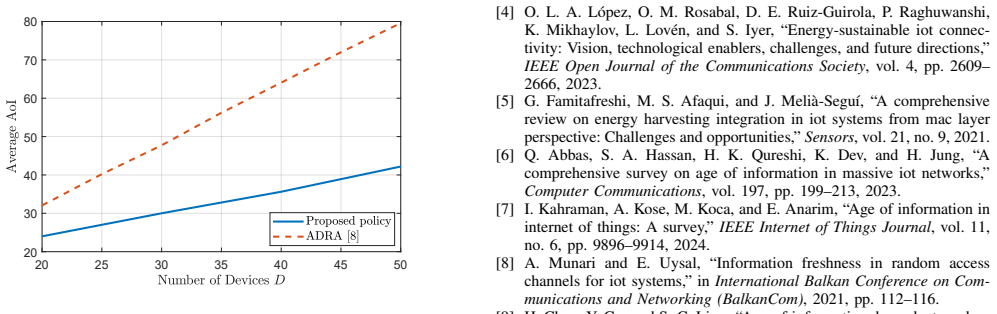
- The performance gap between the joint policy and ADRA widens as device count grows, suggesting the protocol scales better to massive networks.
Reading between the lines
- A practical deployment would need an online estimator for device count or a parameter-free rule, since exhaustive search per $D$ is not a deployable adaptation strategy; this is an extension the paper does not address.
- The same joint energy-age gate could be tested in other random access settings, such as unslotted ALOHA or carrier-sense protocols, where battery level could act as a distributed backoff signal.
- The spread between the abstract's 24%-90% and the conclusion's up-to-60% suggests the gain is regime-dependent; a useful follow-up is to map which device counts and energy arrival rates produce the largest gains.
- Deriving a closed-form average AoI for the linear and elliptical probability functions would enable gradient-based parameter optimization, replacing the exhaustive search.
Editorial analysis
A structured set of objections, weighed in public.
Referee Report
Summary. The paper proposes an energy- and age-aware threshold-based slotted ALOHA policy for IoT networks with energy-harvesting devices. Each device transmits when its battery and AoI satisfy a weighted threshold condition, with a transmission probability that is a function of the normalized battery level; three functional forms are considered (constant, linear, elliptical). The authors provide a DTMC-based characterization of the energy and AoI processes, optimize the protocol parameters by exhaustive search for each device count D, and compare the resulting AAoI and AVP with the ADRA scheme of [9]. The central claim is that the proposed policy, especially with the elliptical transmission probability, reduces AAoI by 24% to 90% relative to ADRA while keeping battery levels above E_min.
Significance. If the claimed gains were robust, the paper would make a useful contribution by extending age-dependent random access to energy-harvesting devices and showing that simple battery-aware transmission policies yield large freshness improvements. The authors also make a fair comparison by optimizing the ADRA threshold and transmission probability. However, the central numerical claims currently rest on an undefined transmission probability function, on per-scenario parameter optimization without generalization tests, and on simulation results without statistical uncertainty quantification. The DTMC analysis is explicitly acknowledged as insufficient to obtain closed-form results for the proposed policies. The conditional significance is therefore moderate: the qualitative direction of the results is plausible, but the quantitative claims are not yet supported in a reproducible way.
major comments (5)
- [Section III-A, Eq. (10)] The elliptical transmission probability is undefined for most of the battery range. With Enorm_i = (E_i - E_min)/(B - E_min), the square-root argument is 1 - ((E_i - E_min)/(B - E_min - E))^2. Whenever E_i > B - E, which is a large portion of the state space including the full-battery state, the ratio exceeds 1 and the square root is negative. For the paper's parameters (B=100, E=10, E_min=1), at full battery the ratio is 99/89 > 1. The text states that p reaches its maximum at full battery, but Eq. (10) cannot be evaluated there and no clamping or domain restriction is provided. Since Section IV identifies the elliptical function as the best-performing option, the reported AAoI and AVP improvements over ADRA cannot be reproduced from the given equations. The function needs a corrected definition (e.g., with numerator E_i - E_min - E or an explicit clamp) and the simulations must be rerun with that definition.
- [Abstract and Section V] The reported gain magnitude is inconsistent. The abstract claims an improvement of '24% up to 90%' relative to previously proposed age-dependent protocols, while the conclusion states that 'the gains were shown to be as high as 60%'. These numbers describe different quantities or different regimes, but the paper does not reconcile them. The authors should specify the metric, the comparison baseline, and the parameter regime for each figure, and use one consistent set of headline numbers.
- [Section IV] The parameters α, τ, and c are optimized by exhaustive search separately for each device count D, and the reported AAoI and AVP values are then measured on the same scenarios used for optimization. This makes the reported improvement a fitting artifact rather than an independent property of the protocol. The paper provides no sensitivity analysis, no test with parameters held fixed across D, and no practical rule for setting α, τ, and c without a priori knowledge of the number of devices. A robustness experiment (e.g., optimizing on one D and evaluating on nearby D values, or reporting the performance over a grid of parameters) is needed to support the scalability claim.
- [Section III-B] The energy DTMC in Eqs. (11)-(14) treats the transmission probability p as a state-independent constant, but the proposed policies use p as a function of the battery level (and, through the threshold condition, also of the AoI). Consequently, the stationary distribution ε_i obtained from this DTMC does not describe the proposed policy except in the constant-p case. Since Eq. (20) uses ε_i to compute P_E and Eq. (22) uses it to compute the average energy level used in the fictional threshold T of Eq. (21), the analytical characterization in Section III-B does not actually support the main contribution. The authors should either restrict the DTMC analysis to the constant-p case or provide a consistent state-dependent treatment.
- [Section IV] The simulation results are presented without error bars, confidence intervals, or any indication of the number of Monte Carlo runs. In Fig. 6 the linear and elliptical curves nearly coincide for D ≥ 80, and in Fig. 7 the gap between the proposed scheme and ADRA could be within statistical noise for some D values. The authors should report the number of independent simulation runs and the resulting uncertainty, or at least quantify the standard error of the reported AAoI and AVP values.
minor comments (5)
- [Section I] There is a typo in the sentence 'In this paper We consider an IoT network...'; 'We' should be lowercase.
- [Section III-A] For the elliptical function, the text states that p is minimal when E_i(t) = E + E_min, but Eq. (10) does not evaluate to zero at that point (unless E = 0). This should be clarified or corrected together with the domain issue.
- [Section II-B] The term 'A VP' appears inconsistently as 'A VP' and 'AVP' (e.g., in Eq. (4) and in Section IV). Please use a single notation.
- [Section III-B] The sentence 'Note that we do not explicitly specify p to increase tractability' should be expanded to state which p is used in Eqs. (11)-(14); as written, it is unclear whether p denotes the constant K, the linear function, or the elliptical function.
- [Section IV] The scalability statement 'the trends in both curves show that our solution is more scalable, as they grow further apart with D' is based on D ∈ [20,50] in Fig. 7, which is a narrow range; the claim should be limited to the simulated range or supported by data for larger D.
Circularity Check
No significant circularity: the protocol's derivation and comparison are self-contained, with the ADRA baseline external and the reported gains emerging from simulation rather than from fitted inputs.
full rationale
The derivation chain is self-contained. The access policy is defined independently in Section III via the energy and age threshold (Eqs. 7 and 8) and the three transmission probability options, including the elliptical form in Eq. 10. The comparison in Section IV is made against ADRA [9], an external baseline whose parameters are also optimized on the same footing, as stated: 'For a fair comparison, we optimize the age threshold and p in ADRA for each point.' The DTMC analysis explicitly follows the derivations from [9] and is not used as the source of the headline gains, which are obtained from Monte Carlo simulation. No load-bearing argument rests on a self-citation: references [1], [3], and [4] are background material, and the ADRA result is external. The exhaustive search over alpha, tau, and c for each D means the reported AAoI/AVP values are in-sample optima rather than out-of-sample predictions, but the improvement over ADRA is an emergent simulation outcome rather than an algebraic consequence of the fitted parameters, so it does not reduce to the inputs by construction. The domain issue in Eq. (10) for battery levels above B-E is a correctness concern, not circularity.
Assumptions & free parameters
free parameters (3)
- α (age-energy weight) =
optimized by exhaustive search (values not tabulated)
- τ (threshold) =
optimized by exhaustive search (values not tabulated)
- c (probability function parameter) =
c=2.0 (linear), c=1.2 (elliptical) for D=30 in Fig. 2
assumptions (5)
- domain assumption Energy arrivals are i.i.d. Bernoulli with probability η and battery capacity B is finite
- domain assumption Collision channel: simultaneous transmission by two or more devices causes packet loss; no capture effect
- domain assumption When a device's AoI reaches Δmax, the stale packet is discarded and a fresh packet is immediately available, resetting age to 1
- ad hoc to paper Devices are symmetric and homogeneous, and collision probability is approximated as q = (1-p')^{D-1}
- ad hoc to paper The transmission probability p is treated as state-independent in the energy DTMC and as p' = p P_E in the age DTMC
Cite this review
Pith. "Pith review of Energy and Age-Aware MAC for Low-Power Massive IoT." pith.science (2026). https://pith.science/paper/XWKOVRL5
@misc{pith2026250208344,
  author       = {Pith},
  title        = {Pith review of: Energy and Age-Aware MAC for Low-Power Massive IoT},
  year         = {2026},
  howpublished = {\url{https://pith.science/paper/XWKOVRL5}},
  note         = {Machine review of arXiv:2502.08344}
}
read the original abstract
Efficient multiple access remains a key challenge for emerging Internet of Things (IoT) networks comprising a large set of devices with sporadic activation, thus motivating significant research in the last few years. In this paper, we consider a network wherein IoT sensors capable of energy harvesting (EH) send updates to a central server to monitor the status of the environment or machinery in which they are located. We develop energy-aware ALOHA-like multiple access schemes for such a scenario using the Age of Information (AoI) metric to quantify the freshness of an information packet. The goal is to minimize the average AoI across the entire system while adhering to energy constraints imposed by the EH process. Simulation results show that applying the designed multiple access scheme improves performance from 24% up to 90% compared to previously proposed age-dependent protocols by ensuring low average AoI and achieving scalability while simultaneously complying with the energy constraints considered.
Figures


Figures from the paper (4 more)


Forward citations
Cited by 1 Pith paper
-
Foundations for Energy-Aware Zero-Energy Devices: From Energy Sensing to Adaptive Protocols
This paper provides a survey and conceptual framework for energy-aware protocol design in zero-energy IoT devices, organized around energy information acquisition, task energy profiles, storage dynamics, and harvestin...
Reference graph
Works this paper leans on
-
[9]
Age-of-information dependent random access for massive iot networks,
H. Chen, Y . Gu, and S.-C. Liew, “Age-of-information dependent random access for massive iot networks,” in IEEE Conference on Computer Communications Workshops (INFOCOM WKSHPS), 2020, pp. 930–935
work page 2020
-
[13]
Age of information in slotted aloha with energy harvesting,
K. Ngo, G. Durisi, A. G. I. Amat et al. , “Age of information in slotted aloha with energy harvesting,” in Global Communications Conference , 2023
work page 2023
-
[1]
Zero-energy devices for 6g: Technical enablers at a glance,
O. L ´opez, R. K. Singh, D.-T. Phan-Huy, E. Katranaras, N. Mazloum, R. J ¨antti, H. Khan, O. Rosabal, P. Alexias, P. Raghuwanshi, D. Ruiz- Guirola, B. Singh, A. H ¨oglund, D. P. Van, A. Azarbahram, and J. Famaey, “Zero-energy devices for 6g: Technical enablers at a glance,” 2024. [Online]. Available: https://arxiv.org/abs/2402.09244
arXiv 2024
-
[2]
Energy harvesting in wireless sensor networks: A comprehensive review,
F. K. Shaikh and S. Zeadally, “Energy harvesting in wireless sensor networks: A comprehensive review,” Renewable and Sustainable Energy Reviews, vol. 55, pp. 1041–1054, 2016
work page 2016
-
[3]
Massive wireless energy transfer: En- abling sustainable iot toward 6g era,
O. L. A. L ´opez, H. Alves, R. D. Souza, S. Montejo-S ´anchez, E. M. G. Fern´andez, and M. Latva-Aho, “Massive wireless energy transfer: En- abling sustainable iot toward 6g era,” IEEE Internet of Things Journal , vol. 8, no. 11, pp. 8816–8835, 2021
work page 2021
-
[4]
O. L. A. L ´opez, O. M. Rosabal, D. E. Ruiz-Guirola, P. Raghuwanshi, K. Mikhaylov, L. Lov ´en, and S. Iyer, “Energy-sustainable iot connec- tivity: Vision, technological enablers, challenges, and future directions,” IEEE Open Journal of the Communications Society , vol. 4, pp. 2609– 2666, 2023
work page 2023
-
[5]
G. Famitafreshi, M. S. Afaqui, and J. Meli `a-Segu´ı, “A comprehensive review on energy harvesting integration in iot systems from mac layer perspective: Challenges and opportunities,” Sensors, vol. 21, no. 9, 2021
work page 2021
-
[6]
A comprehensive survey on age of information in massive iot networks,
Q. Abbas, S. A. Hassan, H. K. Qureshi, K. Dev, and H. Jung, “A comprehensive survey on age of information in massive iot networks,” Computer Communications , vol. 197, pp. 199–213, 2023
work page 2023
Show all 14 references
-
[7]
Age of information in internet of things: A survey,
I. Kahraman, A. Kose, M. Koca, and E. Anarim, “Age of information in internet of things: A survey,” IEEE Internet of Things Journal , vol. 11, no. 6, pp. 9896–9914, 2024
2024
-
[8]
Information freshness in random access channels for iot systems,
A. Munari and E. Uysal, “Information freshness in random access channels for iot systems,” in International Balkan Conference on Com- munications and Networking (BalkanCom) , 2021, pp. 112–116
2021
-
[10]
Achieving the age-energy tradeoff with a finite-battery energy harvesting source,
B. T. Bacinoglu, Y . Sun, E. Uysal–Bivikoglu, and V . Mutlu, “Achieving the age-energy tradeoff with a finite-battery energy harvesting source,” in IEEE International Symposium on Information Theory (ISIT) , 2018, pp. 876–880
2018
-
[11]
Age-minimal online policies for energy harvesting sensors with random battery recharges,
A. Arafa, J. Yang, and S. Ulukus, “Age-minimal online policies for energy harvesting sensors with random battery recharges,” in IEEE International Conference on Communications (ICC) , 2018, pp. 1–6
2018
-
[12]
Age-minimal online poli- cies for energy harvesting sensors with incremental battery recharges,
A. Arafa, J. Yang, S. Ulukus, and H. V . Poor, “Age-minimal online poli- cies for energy harvesting sensors with incremental battery recharges,” in Information Theory and Applications Workshop (ITA) , 2018, pp. 1–10
2018
-
[14]
Information theory and communication networks: An unconsummated union,
A. Ephremides and B. Hajek, “Information theory and communication networks: An unconsummated union,” IEEE Transactions on Informa- tion Theory , vol. 44, no. 6, pp. 2416–2434, 1998
1998
Reviewed August 8, 2026 · model on record in the stance chip above.
Discussion (0). Continue with ORCID to comment.