REVIEW 4 major objections 5 minor 46 references
PINN-FEM: A Hybrid Approach for Enforcing Dirichlet Boundary Conditions in Physics-Informed Neural Networks
T0 review · 4 major / 5 minor · reviewed 2026-08-10 · deepseek-v4-flash
Pith's one-line read Hybrid PINN-FEM enforces Dirichlet boundary conditions exactly with a finite-element boundary layer and a neural-network interior.
desk verdict Confounded optimizer comparison and ambiguous 2D ansatz undercut an otherwise practical FE-layer twist on distance-function BC enforcement. read the letter →
The pith
A machine-rendered reading of the paper's core claim, the machinery that carries it, and where it could break.
The reading
What carries the argument
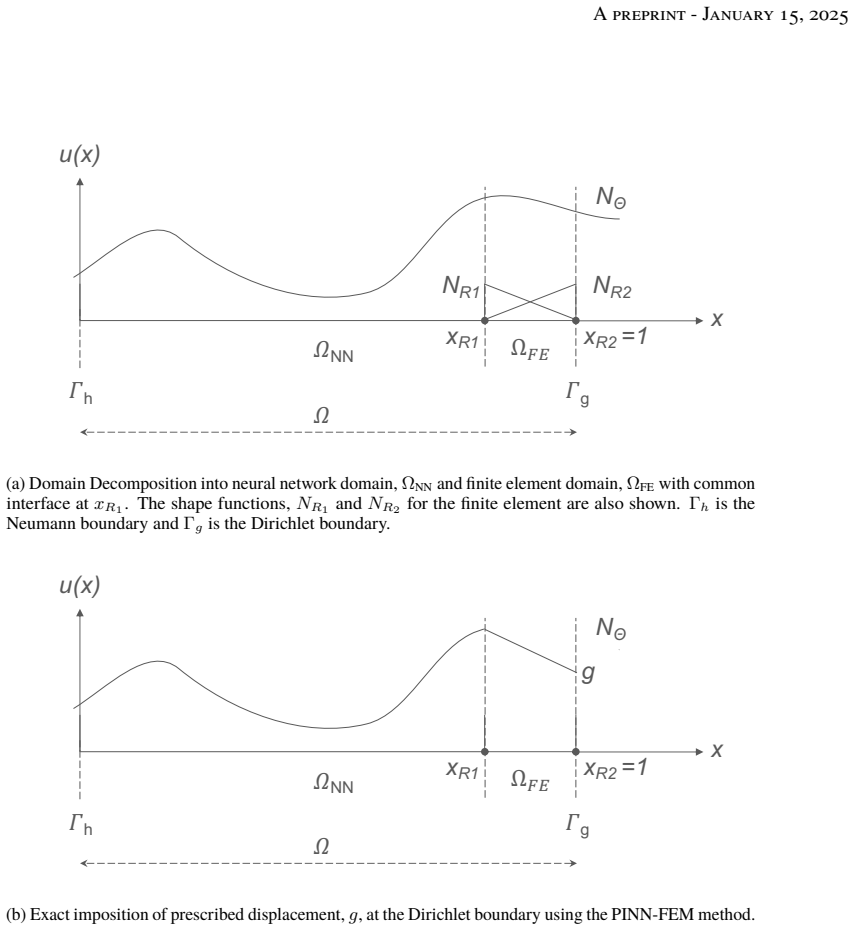
The central object is the decomposed trial space: the domain $\Omega$ is split into an FEM region $\Omega_{FE}$ adjacent to the Dirichlet boundary and a neural network region $\Omega_{NN}$, with interface $\Gamma_I$. In the FEM strip, linear shape functions carry the prescribed boundary value $g$ into the trial field, so the Dirichlet data are enforced strongly; in the interior, the neural network $N_\theta(x)$ is free. The carrying identity is the energy functional $E(u)=\int_\Omega (\tfrac12 \varepsilon : C : \varepsilon - f\cdot u)\,d\Omega - \int_{\Gamma_h} h\cdot u\,d\Gamma$, minimized over the hybrid field, which automatically absorbs Neumann conditions and makes the loss a scalar potential energy rather than a residual sum.
What would settle it
Compute the value of the hybrid trial field on both sides of the interface $\Gamma_I$ for a problem with nonzero prescribed displacement $g$ and compare: if $u|_{\Omega_{FE}} - u|_{\Omega_{NN}} \neq 0$ at the interface, the trial space is discontinuous and the reported errors do not correspond to a solution of the original boundary value problem. A direct check would be a two-dimensional plate with constant nonzero $g$ and a single-element FEM strip, evaluating the field at $\Gamma_I$ and at $\Gamma_g$.
Extended reading notes
Core claim
On the paper's own terms, the central discovery is that domain decomposition with finite elements at the boundary converts the Dirichlet condition from a soft loss term into a strong constraint, while the interior stays mesh-free and flexible. The hybrid displacement field is $u=N_\theta(x)N_D(x)+g$ in the FEM strip and $u=N_\theta(x)$ in the neural network region, with an energy-based loss derived from the principle of minimum potential energy. This is claimed to be exact at the Dirichlet boundary, automatically consistent with Neumann conditions through the variational formulation, and general enough to handle discontinuous and point boundary conditions where global distance-function constructions fail. The reported numbers show improvements such as a reduction in relative error for the crack problem from $0.07$ (ADF) to $0.05$ for $u_x$, and for the cantilever beam from $0.56$ (soft) to $0.0009$ for $u_x$.
Load-bearing premise
The two-dimensional trial field $u=N_\theta N_D+g$ presupposes a shape-function field $N_D$ that is $0$ on the Dirichlet boundary and $1$ at the interface with the neural network region; the paper does not define such a field for a multi-element strip or verify continuity of the hybrid field at the interface, so if this construction fails the energy is minimized over discontinuous trial functions.
Editorial extensions
If this is right
- The Dirichlet condition becomes a strong constraint built into the trial field, so no boundary-loss weight $\beta$ needs tuning in the energy loss.
- Neumann conditions are absorbed by the variational formulation, so the loss function needs no separate traction residual.
- Discontinuous and point Dirichlet data, which break global distance-function constructions, still fit inside a conforming local FEM mesh.
- On smooth problems the method can reach near-analytical accuracy, as in the cantilever case with relative errors around $10^{-4}$.
Reading between the lines
- A natural extension the authors leave implicit: the strip construction could be applied to time-dependent boundary data by making the FE layer track a moving Dirichlet boundary or by using space-time shape functions.
- The same energy-loss argument suggests the method should extend to finite-deformation hyperelasticity, where a potential energy is still well defined, as long as the interface continuity condition is built into the ansatz.
- One testable extension: using full quadrature in the FEM strip rather than a single Gauss point should improve accuracy where strain varies strongly inside the strip.
- The hybrid ansatz could also serve as a mesh-conforming initializer for standard FEM solvers, since it supplies a field that already matches the boundary-layer geometry.
Editorial analysis
A structured set of objections, weighed in public.
Referee Report
Summary. The paper proposes PINN-FEM, a hybrid method that enforces Dirichlet boundary conditions exactly by decomposing the computational domain into a finite element layer adjacent to the boundary and a neural network interior, and trains the network by minimizing a potential-energy loss. The method is described for 1D, 2D, and 3D, and evaluated on six 2D linear elasticity problems against soft-boundary (Soft), approximate-distance-function (ADF), and distance-function (DF) PINN baselines. The authors report that PINN-FEM consistently outperforms these baselines in relative ℓ1 displacement error, and they highlight robustness on problems with discontinuous, point, and crack-like boundary conditions.
Significance. If substantiated, PINN-FEM would provide a practical mechanism for strong Dirichlet enforcement in energy-based PINNs, including for boundary conditions that distance-function methods cannot represent. The paper draws on established blending ideas from mesh-free methods and on the deep energy method, so the conceptual novelty is moderate; the main value would be a demonstrated, reproducible robustness advantage across several boundary geometries. However, the current experimental design changes the optimizer together with the boundary-enforcement method, and the 2D trial-space definition is incomplete, so the reported superiority is not yet established. The method's energy-based loss and exact boundary handling are attractive, but the evidence as presented is insufficient for a strong claim.
major comments (4)
- [§4.3.1 / Table 2] Section 4.3.1 states that PINN-FEM is trained with LBFGS while all baselines (Soft, ADF, DF) are trained with Adam, and this same optimizer assignment is reused in every subsequent experiment (Sections 4.3.2–4.3.6). Table 2 therefore varies two factors simultaneously: the boundary-condition strategy and the optimizer. Because LBFGS is typically much more effective than Adam on small over-parameterized energy-minimization problems, the large reported gaps (for example, e(uy)=0.0003 for PINN-FEM versus 0.56 for Soft in the cantilever experiment) cannot be attributed to the FEM-layer boundary enforcement. A controlled comparison with identical optimizers, or at least a cross of optimizer and method, is required to support the paper's central claim.
- [§3.2.1, Eqs. (16)–(20)] The discretized 1D energy in Eqs. (16)–(20) omits the body-force term −∫ f u dx that is present in the continuous energy of Eq. (13), and the traction work is written as hNθ,x|0 instead of hNθ(0). As a result, minimizing Eq. (21) does not correspond to minimizing the potential energy of the boundary value problem (10)–(12). The same body-force omission appears in the both-ends version, Eqs. (27)–(32). These equations need to be corrected and the subsequent energy balance re-derived; as written, the 1D formulation is not a valid variational statement of the model problem.
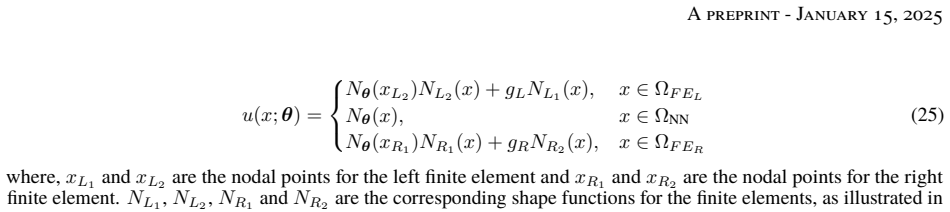
- [§3.3, Eq. (33)] The 2D trial field u = Nθ(x)ND(x) + g in ΩFE is not a well-defined finite element interpolation as written. If ND is a scalar blending function equal to 1 on the interface ΓI and 0 on Γg, then on ΓI the field becomes Nθ + g, which is discontinuous with the interior field Nθ unless g = 0. If ND instead denotes a vector of element shape functions, the product form does not match standard nodal interpolation, and the extension of the prescribed boundary data g into the interior of ΩFE is not specified. The paper must define ND precisely (for example, as a piecewise-linear function with ND=1 on ΓI and ND=0 on Γg, or by replacing the ansatz with u = Σ_i Nθ(x_i)N_i(x) + Σ_{j∈Γg} g_jN_j(x)) and demonstrate that the resulting trial space is a subset of H^1. Without this, the 2D energy minimization is performed over an ill-defined trial space.
- [§3.3, Eq. (37)] The energy in the FEM region is evaluated by one-point quadrature at a single centroid over the whole ΩFE region. Since ΩFE contains many triangular elements and the strain field varies between elements, this is not the standard per-element constant-strain quadrature used in linear FEM. The approximation error introduced by collapsing the entire FE layer to one centroid should be quantified, or the energy should be assembled element-wise; otherwise the reported accuracy of the 2D method may reflect this additional quadrature approximation rather than the proposed hybrid construction.
minor comments (5)
- [§4.1 / §4.3.1] Section 4.1 says the collocation points are the centroids of the triangles, while Sections 4.3.1 and 4.3.4 say the collocation points are the nodal points of the mesh; please clarify which is actually used.
- [§3.2.1, Eq. (17); §3.2.2, Eq. (28)] Eq. (17) contains the typo 'gR2 NR2,x' and Eq. (28) contains 'gL2' and 'gR2' where the prescribed boundary values g, gL, and gR should appear; these likely are transcription errors from the shape-function indices.
- [§4.2, Eq. (47)] The soft-boundary weight β is introduced but its value and tuning procedure are never reported; please state the value used for all soft baseline runs.
- [Table 2] Several rows in Table 2 are missing entries for ADF and DF baselines; the text explains the reasons, but a footnote in the table itself would make the comparison clearer at a glance.
- [References] Reference [46] should be 'Timoshenko and Goodier' rather than 'Goodyear'; please correct.
Circularity Check
No significant circularity: PINN-FEM is a direct variational method and its accuracy claims are checked against external FEM/analytic references.
full rationale
The paper's derivation chain is self-contained. The trial space in Eqs. (14), (25), and (33) encodes the Dirichlet data by construction, and the loss in Eqs. (21), (32), and (39) is the exact potential energy functional (9) restricted to that trial space; minimizing it is the standard Ritz/energy method, not a fitting of any parameter to the target output. No parameter is trained against the FEM/Abaqus or Timoshenko reference solutions; those references enter only in the relative-error metric (49). There are no self-citations by the authors, and the cited FEM-meshless blending literature [31-36] is independent prior work used as motivation, not as a uniqueness theorem. The concerns raised by the reader and skeptic are real but are not circularity: the 2D ansatz in Eq. (33) does not specify ND or verify continuity at the interface, and the optimizer (LBFGS vs Adam) is confounded with the method in Table 2, weakening the empirical comparison. Under-specification and experimental confounding affect validity, not whether the result reduces by definition to its inputs. Hence score 0.
Assumptions & free parameters
free parameters (1)
- FE layer mesh size =
0.1 mm
assumptions (3)
- domain assumption The minimizer of the total potential energy functional (Eq. 9) satisfies the equilibrium equation and natural boundary conditions (principle of minimum potential energy).
- ad hoc to paper The FEM shape functions ND are exactly zero on the Dirichlet boundary and exactly one at the interface, making the hybrid trial function conforming.
- ad hoc to paper The strain energy in the FE region can be accurately approximated by evaluating the strain at the element centroid and multiplying by the region area (one-point quadrature).
Cite this review
Pith. "Pith review of PINN-FEM: A Hybrid Approach for Enforcing Dirichlet Boundary Conditions in Physics-Informed Neural Networks." pith.science (2026). https://pith.science/paper/XX5DUZ2T
@misc{pith2026250107765,
  author       = {Pith},
  title        = {Pith review of: PINN-FEM: A Hybrid Approach for Enforcing Dirichlet Boundary Conditions in Physics-Informed Neural Networks},
  year         = {2026},
  howpublished = {\url{https://pith.science/paper/XX5DUZ2T}},
  note         = {Machine review of arXiv:2501.07765}
}
read the original abstract
Physics-Informed Neural Networks (PINNs) solve partial differential equations (PDEs) by embedding governing equations and boundary/initial conditions into the loss function. However, enforcing Dirichlet boundary conditions accurately remains challenging, often leading to soft enforcement that compromises convergence and reliability in complex domains. We propose a hybrid approach, PINN-FEM, which combines PINNs with finite element methods (FEM) to impose strong Dirichlet boundary conditions via domain decomposition. This method incorporates FEM-based representations near the boundary, ensuring exact enforcement without compromising convergence. Through six experiments of increasing complexity, PINN-FEM outperforms standard PINN models, showcasing superior accuracy and robustness. While distance functions and similar techniques have been proposed for boundary condition enforcement, they lack generality for real-world applications. PINN-FEM bridges this gap by leveraging FEM near boundaries, making it well-suited for industrial and scientific problems.
Figures

Figures from the paper (1 more)

Reference graph
Works this paper leans on
-
[1]
Machine learning and big scientific data
Tony Hey, Keith Butler, Sam Jackson, and Jeyarajan Thiyagalingam. Machine learning and big scientific data. Philosophical Transactions of the Royal Society A, 378(2166):20190054, 2020
work page 2020
-
[2]
Eric Mjolsness and Dennis DeCoste. Machine learning for science: state of the art and future prospects.science, 293(5537):2051–2055, 2001
work page 2001
-
[3]
Physics- informed machine learning.Nature Reviews Physics, 3(6):422–440, 2021
George Em Karniadakis, Ioannis G Kevrekidis, Lu Lu, Paris Perdikaris, Sifan Wang, and Liu Yang. Physics- informed machine learning.Nature Reviews Physics, 3(6):422–440, 2021. 18 A preprint - January 15, 2025
work page 2021
-
[4]
Learning mesh-based simulation with graph networks.arXiv preprint arXiv:2010.03409, 2020
Tobias Pfaff, Meire Fortunato, Alvaro Sanchez-Gonzalez, and Peter W Battaglia. Learning mesh-based simulation with graph networks.arXiv preprint arXiv:2010.03409, 2020
arXiv 2010
-
[5]
Learningnonlinearoperators viadeeponetbasedontheuniversalapproximationtheoremofoperators
LuLu, PengzhanJin, GuofeiPang, ZhongqiangZhang, andGeorgeEmKarniadakis. Learningnonlinearoperators viadeeponetbasedontheuniversalapproximationtheoremofoperators. Naturemachineintelligence,3(3):218–229, 2021
work page 2021
-
[6]
Zongyi Li, Nikola Kovachki, Kamyar Azizzadenesheli, Burigede Liu, Kaushik Bhattacharya, Andrew Stuart, and Anima Anandkumar. Fourier neural operator for parametric partial differential equations.arXiv preprint arXiv:2010.08895, 2020
arXiv 2010
-
[7]
Solving the wave equation with physics-informed deep learning
Ben Moseley, Andrew Markham, and Tarje Nissen-Meyer. Solving the wave equation with physics-informed deep learning. arXiv preprint arXiv:2006.11894, 2020
arXiv 2006
-
[8]
ShengzeCai, ZhipingMao, ZhichengWang, MinglangYin, andGeorgeEmKarniadakis. Physics-informedneural networks (pinns) for fluid mechanics: A review.Acta Mechanica Sinica, 37(12):1727–1738, 2021
work page 2021
Show all 46 references
-
[9]
Nsfnets(navier-stokesflownets): Physics-informed neural networks for the incompressible navier-stokes equations.Journal of Computational Physics, 426:109951, 2021
XiaoweiJin,ShengzeCai,HuiLi,andGeorgeEmKarniadakis. Nsfnets(navier-stokesflownets): Physics-informed neural networks for the incompressible navier-stokes equations.Journal of Computational Physics, 426:109951, 2021
2021
-
[10]
Physics-informed neural networks for power systems
George S Misyris, Andreas Venzke, and Spyros Chatzivasileiadis. Physics-informed neural networks for power systems. In2020 IEEE power & energy society general meeting (PESGM), pages 1–5. IEEE, 2020
2020
-
[11]
Predictionofporousmediafluidflowusingphysicsinformed neural networks.Journal of Petroleum Science and Engineering, 208:109205, 2022
MuhammadMAlmajidandMoatazOAbu-Al-Saud. Predictionofporousmediafluidflowusingphysicsinformed neural networks.Journal of Petroleum Science and Engineering, 208:109205, 2022
2022
-
[12]
Deep learning of two-phase flow in porous media via theory-guided neural networks.SPE Journal, 27(02):1176–1194, 2022
Jian Li, Dongxiao Zhang, Nanzhe Wang, and Haibin Chang. Deep learning of two-phase flow in porous media via theory-guided neural networks.SPE Journal, 27(02):1176–1194, 2022
2022
-
[13]
A unified deep artificial neural network approach to partial differential equations in complex geometries.Neurocomputing, 317:28–41, 2018
Jens Berg and Kaj Nyström. A unified deep artificial neural network approach to partial differential equations in complex geometries.Neurocomputing, 317:28–41, 2018
2018
-
[14]
Maziar Raissi, Paris Perdikaris, and George E Karniadakis. Physics-informed neural networks: A deep learning framework for solving forward and inverse problems involving nonlinear partial differential equations.Journal of Computational physics, 378:686–707, 2019
2019
-
[15]
Dgm: A deep learning algorithm for solving partial differential equations
Justin Sirignano and Konstantinos Spiliopoulos. Dgm: A deep learning algorithm for solving partial differential equations. Journal of computational physics, 375:1339–1364, 2018
2018
-
[16]
The deep ritz method: A deep learning-based numerical algorithm for solving variational problems
Yu B EW. The deep ritz method: A deep learning-based numerical algorithm for solving variational problems. Commun Math Stat, 6(1):1–12, 2018
2018
-
[17]
Solving high-dimensional partial differential equations using deep learning
Jiequn Han, Arnulf Jentzen, and Weinan E. Solving high-dimensional partial differential equations using deep learning. Proceedings of the National Academy of Sciences, 115(34):8505–8510, 2018
2018
-
[18]
Variational physics-informed neural networks for solving partial differential equations.arXiv preprint arXiv:1912.00873, 2019
Ehsan Kharazmi, Zhongqiang Zhang, and George Em Karniadakis. Variational physics-informed neural networks for solving partial differential equations.arXiv preprint arXiv:1912.00873, 2019
1912 arXiv
-
[19]
Automatic differentiation in machine learning: a survey.Journal of machine learning research, 18(153):1–43, 2018
Atilim Gunes Baydin, Barak A Pearlmutter, Alexey Andreyevich Radul, and Jeffrey Mark Siskind. Automatic differentiation in machine learning: a survey.Journal of machine learning research, 18(153):1–43, 2018
2018
-
[20]
Stochastic gradient learning in neural networks.Proceedings of Neuro-Nımes, 91(8):12, 1991
Léon Bottou et al. Stochastic gradient learning in neural networks.Proceedings of Neuro-Nımes, 91(8):12, 1991
1991
-
[21]
A deep collocation method for the bending analysis of kirchhoff plate.arXiv preprint arXiv:2102.02617, 2021
Hongwei Guo, Xiaoying Zhuang, and Timon Rabczuk. A deep collocation method for the bending analysis of kirchhoff plate.arXiv preprint arXiv:2102.02617, 2021
2021 arXiv
-
[22]
A comparison study of deep galerkin method and deep ritz method for elliptic problems with different boundary conditions.arXiv preprint arXiv:2005.04554, 2020
Jingrun Chen, Rui Du, and Keke Wu. A comparison study of deep galerkin method and deep ritz method for elliptic problems with different boundary conditions.arXiv preprint arXiv:2005.04554, 2020
2005 arXiv
-
[23]
Int-deep: A deep learning initialized iterative method for nonlinear problems.Journal of computational physics, 419:109675, 2020
Jianguo Huang, Haoqin Wang, and Haizhao Yang. Int-deep: A deep learning initialized iterative method for nonlinear problems.Journal of computational physics, 419:109675, 2020
2020
-
[24]
Automatically imposing boundary conditions for boundary valueproblemsbyunifiedphysics-informedneuralnetwork
Khang A Luong, Thang Le-Duc, and Jaehong Lee. Automatically imposing boundary conditions for boundary valueproblemsbyunifiedphysics-informedneuralnetwork. EngineeringwithComputers , 40(3):1717–1739, 2024
2024
-
[25]
WeiLi,MartinZBazant,andJunerZhu. Aphysics-guidedneuralnetworkframeworkforelasticplates: Comparison of governing equations-based and energy-based approaches.Computer Methods in Applied Mechanics and Engineering, 383:113933, 2021
2021
-
[26]
The deep ritz method: a deep learning-based numerical algorithm for solving variational problems
Bing Yu et al. The deep ritz method: a deep learning-based numerical algorithm for solving variational problems. Communications in Mathematics and Statistics, 6(1):1–12, 2018. 19 A preprint - January 15, 2025
2018
-
[27]
Anenergyapproachtothesolutionofpartialdifferentialequations incomputationalmechanicsviamachinelearning: Concepts,implementationandapplications
Esteban Samaniego, Cosmin Anitescu, Somdatta Goswami, Vien Minh Nguyen-Thanh, Hongwei Guo, Khader Hamdia,XiaoyingZhuang,andTimonRabczuk. Anenergyapproachtothesolutionofpartialdifferentialequations incomputationalmechanicsviamachinelearning: Concepts,implementationandapplicatio...
2020
-
[28]
A deep energy method for finite deformation hyperelasticity.European Journal of Mechanics-A/Solids, 80:103874, 2020
Vien Minh Nguyen-Thanh, Xiaoying Zhuang, and Timon Rabczuk. A deep energy method for finite deformation hyperelasticity.European Journal of Mechanics-A/Solids, 80:103874, 2020
2020
-
[29]
Parametric deepenergyapproachforelasticityaccountingforstraingradienteffects
Vien Minh Nguyen-Thanh, Cosmin Anitescu, Naif Alajlan, Timon Rabczuk, and Xiaoying Zhuang. Parametric deepenergyapproachforelasticityaccountingforstraingradienteffects. ComputerMethodsinAppliedMechanics and Engineering, 386:114096, 2021
2021
-
[30]
Xiaoying Zhuang, Hongwei Guo, Naif Alajlan, Hehua Zhu, and Timon Rabczuk. Deep autoencoder based energy method for the bending, vibration, and buckling analysis of kirchhoff plates with transfer learning.European Journal of Mechanics-A/Solids, 87:104225, 2021
2021
-
[31]
A coupled finite element-element-free galerkin method
Ted Belytschko, Daniel Organ, and Yury Krongauz. A coupled finite element-element-free galerkin method. Computational Mechanics, 17(3):186–195, 1995
1995
-
[32]
Enrichment and coupling of the finite element and meshless methods
Antonio Huerta and Sonia Fernández-Méndez. Enrichment and coupling of the finite element and meshless methods. International Journal for Numerical Methods in Engineering, 48(11):1615–1636, 2000
2000
-
[33]
Hierarchical enrichment for bridging scales and mesh-free boundary conditions
Gregory J Wagner and Wing Kam Liu. Hierarchical enrichment for bridging scales and mesh-free boundary conditions. International Journal for Numerical Methods in Engineering, 50(3):507–524, 2001
2001
-
[34]
Element-free galerkin methods in combination with finite element approaches.Computer Methods in Applied Mechanics and Engineering, 135(1-2):143–166, 1996
Dries Hegen. Element-free galerkin methods in combination with finite element approaches.Computer Methods in Applied Mechanics and Engineering, 135(1-2):143–166, 1996
1996
-
[35]
Hybrid fem-nn models: Combining artificial neural networks with the finite element method.Journal of Computational Physics, 446:110651, 2021
Sebastian K Mitusch, Simon W Funke, and Miroslav Kuchta. Hybrid fem-nn models: Combining artificial neural networks with the finite element method.Journal of Computational Physics, 446:110651, 2021
2021
-
[36]
Enforcement of essential boundary conditions in meshless approximations using finite elements.Computer Methods in Applied Mechanics and Engineering, 131(1-2):133–145, 1996
Yury Krongauz and Ted Belytschko. Enforcement of essential boundary conditions in meshless approximations using finite elements.Computer Methods in Applied Mechanics and Engineering, 131(1-2):133–145, 1996
1996
-
[37]
Efficient physics informed neural networks coupled with domain decomposition methods for solving coupled multi-physics problems
Long Nguyen, Maziar Raissi, and Padmanabhan Seshaiyer. Efficient physics informed neural networks coupled with domain decomposition methods for solving coupled multi-physics problems. InAdvances in Computational Modeling and Simulation, pages 41–53. Springer, 2022
2022
-
[38]
A physics-informed deep learning framework for inversion and surrogate modeling in solid mechanics.Computer Methods in Applied Mechanics and Engineering, 379:113741, 2021
Ehsan Haghighat, Maziar Raissi, Adrian Moure, Hector Gomez, and Ruben Juanes. A physics-informed deep learning framework for inversion and surrogate modeling in solid mechanics.Computer Methods in Applied Mechanics and Engineering, 379:113741, 2021
2021
-
[39]
Butterworth-Heinemann, 2013
Gui-Rong Liu and Siu Sin Quek.The finite element method: a practical course. Butterworth-Heinemann, 2013
2013
-
[40]
Multi-task learning using uncertainty to weigh losses for scene geometry and semantics
Alex Kendall, Yarin Gal, and Roberto Cipolla. Multi-task learning using uncertainty to weigh losses for scene geometry and semantics. InProceedings of the IEEE conference on computer vision and pattern recognition, pages 7482–7491, 2018
2018
-
[41]
Multi-fidelity physics-constrained neural network and its application in materials modeling
Dehao Liu and Yan Wang. Multi-fidelity physics-constrained neural network and its application in materials modeling. Journal of Mechanical Design, 141(12):121403, 2019
2019
-
[42]
Understanding and mitigating gradient pathologies in physics- informed neural networks.arXiv preprint arXiv:2001.04536, 2020
Sifan Wang, Yujun Teng, and Paris Perdikaris. Understanding and mitigating gradient pathologies in physics- informed neural networks.arXiv preprint arXiv:2001.04536, 2020
2001 arXiv
-
[43]
Courier Corporation, 2012
Cornelius Lanczos.The variational principles of mechanics. Courier Corporation, 2012
2012
-
[44]
Exact imposition of boundary conditions with distance functions in physics- informed deep neural networks.Computer Methods in Applied Mechanics and Engineering, 389:114333, 2022
N Sukumar and Ankit Srivastava. Exact imposition of boundary conditions with distance functions in physics- informed deep neural networks.Computer Methods in Applied Mechanics and Engineering, 389:114333, 2022
2022
-
[45]
A three-dimensional finite element mesh generator with built-in pre-and post-processing facilities.International Journal for Numerical Methods in Engineering, 11:79, 2020
Christophe Geuzaine and Jean-François Remacle. A three-dimensional finite element mesh generator with built-in pre-and post-processing facilities.International Journal for Numerical Methods in Engineering, 11:79, 2020
2020
-
[46]
Elasticity theory.M: Science, 1975
So P Timoshenko and J Goodyear. Elasticity theory.M: Science, 1975. 20
1975
Reviewed August 10, 2026 · model on record in the stance chip above.
Discussion (0). Continue with ORCID to comment.