REVIEW 5 major objections 4 minor 1 cited by
Constructing two completely independent spanning trees in the dual-cube
T0 review · 5 major / 4 minor · reviewed 2026-08-01 · deepseek-v4-flash
Pith's one-line read The n-dimensional dual-cube F_n contains two completely independent spanning trees for every n ≥ 5, and a recursive algorithm constructs them with diameters 5n+5 and 5n+7 for n ≥ 6.
desk verdict New existence result for two CIST in dual-cubes with a genuinely useful cluster-based framework — but the load-bearing base case is under-verified as written. read the letter →
The pith
A machine-rendered reading of the paper's core claim, the machinery that carries it, and where it could break.
The reading
What carries the argument
The cluster decomposition of F_n is the load-bearing structure: it turns a large graph into a complete bipartite quotient K_{2^{n-1},2^{n-1}} whose vertices are hypercubes. Lemma 1 ('generator pairs') guarantees local CIST inside Q_{n-1} with any two prescribed vertices internal in each tree; Lemma 2 supplies two edge-disjoint Hamiltonian paths on the quotient. The combination fixes, for each cluster, which vertices must be internal in T_1 and T_2, so gluing local trees along the paths yields two spanning trees that are edge-disjoint and share no internal vertex. The recursive diameter control selects cross-edges close to local centers, producing the 5n+5 / 5n+7 diameters.
What would settle it
Re-run the integer-linear-programming model for all 455 (v,x,y) configurations in Q_4 with the generator constraints; if any instance is infeasible, Lemma 1's base case fails and Theorem 2 collapses. Separately, instantiate Lemma 2's construction with m=8 and primes p=3, q=5 to see that the two Hamiltonian paths in K_{8,8} share edges, contradicting the lemma as stated.
Extended reading notes
Core claim
The central claim is that the n-dimensional dual-cube F_n contains two completely independent spanning trees for every n ≥ 5. The proof decomposes F_n into its (n−1)-dimensional hypercube clusters, treats the quotient of clusters as a complete bipartite graph, and shows that two edge-disjoint Hamiltonian paths on that quotient can be combined with local CIST inside each cluster. The key lemma asserts that for any n ≥ 4 and any two disjoint vertex pairs in Q_n, there exist two CIST of Q_n in which the prescribed pairs are internal vertices; the base case n=4 is verified exhaustively by an integer-linear-programming search. The recursive algorithm F-2CIST assembles the trees from an optimized
Load-bearing premise
The construction rests on a computer search over all 455 configurations in the 4-dimensional hypercube base case, which the paper reports as feasible without releasing the program or certificates.
Editorial extensions
If this is right
- Every dual-cube F_n with n ≥ 5 supports two CIST, so between any two vertices there are two internally vertex-disjoint paths, one in each tree.
- For n ≥ 6, the F-2CIST-Recursive algorithm yields two explicit CIST with diameters 5n+5 and 5n+7, growing linearly with the dimension.
- At the same vertex count, the dual-cube's CIST diameters stay close to the hypercube's 2n−1, so the link-sparse topology remains competitive for fault-tolerant routing.
- If Conjecture 1 holds, k CIST in Q_n would produce k CIST in F_{n+1}, potentially multiplying the number of independent routing backbones.
Reading between the lines
- The quotient-plus-local-generators scheme is a reusable template: any network built from hypercube clusters wired as a complete bipartite graph should inherit CIST from edge-disjoint Hamiltonian structures on the quotient, so other hypercube variants with cluster layouts are natural targets.
- The per-dimension diameter increment of 5 is tied to the chosen inter-cluster shortest-path trees; adjusting the local tree shapes or the cross-edge selection rule could reduce the constant.
- The base case n=4 is checked by an unreleased ILP, so a human-readable constructive proof for Q_4 would remove the computational dependency from the whole induction.
- The text reports F_5 diameters as 29 and 31 in the introduction and 28 and 31 in Theorem 3; resolving this discrepancy is needed before benchmarking the recursive formula.
Editorial analysis
A structured set of objections, weighed in public.
Referee Report
Summary. The paper proves that for every n ≥ 5 the n-dimensional dual-cube F_n admits two completely independent spanning trees (CIST), and gives a recursive algorithm, F-2CIST-Recursive, claimed to produce two CIST with diameters 5n+5 and 5n+7 for n ≥ 6. The proof strategy is to decompose F_n into clusters isomorphic to Q_{n-1}, first finding two edge-disjoint Hamiltonian paths in the quotient graph K_{2^{n-1},2^{n-1}}, then constructing local CIST inside every cluster with prescribed internal vertices matched to the cross-edge endpoints. A base case for n = 5 is obtained by ILP plus a local optimization step.
Significance. If the proof is repaired, the result is a natural and useful contribution: it establishes the first CIST existence theorem for the dual-cube, a sparser hypercube variant, and it gives an explicit recursive construction with linear diameter. The conceptual decomposition into an inter-cluster Hamiltonian-path problem and a local hypercube CIST problem with prescribed internal vertices is elegant and likely to be reusable. The paper also proposes a plausible conjecture about lifting k CIST from Q_n to F_{n+1}. However, the proof as written is not reliable: the base-case verification is undercounted, a central induction case is missing, Lemma 2 is false as stated, and the diameter formulas in Theorem 4 are asserted rather than proved. These are load-bearing issues, though they appear repairable within the existing framework.
major comments (5)
- [Section 3, Lemma 1, base case] The claimed exhaustive ILP verification is not exhaustive. Fixing u = 0000, v has 15 choices and {x,y} is an unordered pair from the remaining 14 vertices, so the number of configurations is 15·C(14,2) = 1365, not C(15,3) = 455. Enumerating unordered triples {v,x,y} covers only one role assignment per triple; the three assignments are not equivalent under automorphisms fixing 0 because the internal Hamming distance of the second pair depends on which vertex is v. This is load-bearing because Lemma 1 is invoked for every cluster Q_{n-1} in Theorem 2. Please correct the enumeration, run all 1365 (or provide a rigorous reduction), and make the ILP instances or feasibility certificates available.
- [Section 3, Lemma 1, induction step] The induction omits the 2+2 distribution in which {u,v} lie in one copy of Q_n and {x,y} lie in the other. Cases 1–3 cover 4+0, 3+1, and 2+2 with one vertex of each tree in each copy, but not u_i=v_i=0, x_i=y_i=1. Consequently the assertion in Case 4 that the only remaining pattern is u_i=v_i≠x_i=y_i for every i is false. In addition, Case 3 is internally inconsistent: after stating that the relevant cross-pairs are (u^{i,0},v^{i,1}) and (x^{i,0},y^{i,1}), the subcases switch to (u,y) and (x,v), and Subcase 3.2 assumes u0–y1 is an edge but then connects copies using (v0,v1) and (x0,x1), never using the assumed edge. A coherent repair of this induction is needed before Lemma 1 can support Theorem 2.
- [Section 3, Lemma 2] The construction P_p and P_q is not edge-disjoint for arbitrary distinct primes p,q. In K_{m,m} the paths share edges whenever p ≡ ±q (mod m). For example, with m=16, p=3 and q=13, the edge 7_0–10_1 lies on both P_3 and P_13. Since m=2^{n-1}, such pairs of primes exist in the stated range. The underlying existence claim is true — K_{m,m} has edge-disjoint Hamiltonian cycles — but the lemma as stated is false. Because the explicit P_p/P_q are used to determine the required internal vertices in each cluster, the construction in Theorems 2 and Algorithm 1 must either use a correct edge-disjoint pair of Hamiltonian paths or add a hypothesis on p,q.
- [Section 4, Theorem 4] The proof of Theorem 4 asserts diam(T_1)=5n+5 and diam(T_2)=5n+7 for n≥6, but no induction calculation is given. 'By repeating the same construction recursively, we obtain the following equality' is not a proof: one must account for the distances within the four copies, the lengths contributed by the three cross-edges, and the choice of the extremal copies at each level. The base values in §4.2 are 29 and 31, so the recurrence would give 35 and 37 for n=6, but the paper does not show how these are computed from the local tree data. Please provide a genuine inductive distance analysis.
- [Section 4 and Appendix B] The explicit base-case data for F_5 is internally inconsistent. In Table 4, the row for cluster 14^0 contains the parent value 20 in a 16-vertex Q_4 cluster, which is outside the vertex set. Several vectors in Tables 3 and 4 have fewer than 16 entries (e.g., rows 7^0 and 11^0 in Table 3). Since these local trees are the basis for the diameter claims and the recursive algorithm, the tables need to be regenerated and corrected, or the code/solver output must be supplied so the reader can verify the claimed F_5 construction.
minor comments (4)
- [Section 4, Theorem 3] Theorem 3 states diameters 28 and 31, while §4.2 computes diam(T_1)=29 and diam(T_2)=31, and the abstract/introduction say 29 and 31. Please reconcile.
- [Section 4, Algorithm 3] Algorithm 3 calls F-2CIST-Base for the F_5 copies, but the proof of Theorem 4 uses trees produced by F-2CIST-Base and F-2CIST-Enhanced. Clarify which algorithm is actually the base of the recursion.
- [Section 3, Lemma 1, Case 3.1] There is a typo: 'Q^{i,0}_1' should be 'Q^{i,0}_n'.
- [Appendix B] The formatting of Tables 3 and 4 makes the columns (cluster, generators, center, parent vector) hard to parse; a legend explaining the row format would help.
Circularity Check
No circular dependency between the construction and the claimed conclusions.
full rationale
The derivation chain is not circular. Lemma 1 is proved by induction with a base case checked by an ILP that searches for witness trees; the ILP is not used to fit any parameter to the conclusion. Lemma 2 offers an explicit (though possibly flawed) modular construction for edge-disjoint Hamiltonian paths in the contracted graph, relying on standard Hamiltonian decomposition facts rather than on the target result. Theorem 2 assembles local CIST inside hypercube clusters with inter-cluster paths; nothing in the assembly assumes the existence of the final trees. Section 4's diameter formulas are computed from the constructed trees, not used as input constraints. There are no self-citations invoked as load-bearing external theorems: the ILP model is given in Appendix A, and the only overlapping-author citation ([17]) is the source of an ILP formulation whose constraints are restated in full. The known gaps — the undercount of all pairings in the n=4 enumeration and the apparent false claim that any two distinct primes give edge-disjoint Hamiltonian paths — are correctness/verification concerns, not instances where an output is equivalent to an input by construction.
Assumptions & free parameters
assumptions (6)
- standard math Hasunuma characterization (Theorem 1): CIST iff edge-disjoint and each vertex internal in at most one tree.
- standard math K_{m,m} with m=2^{n-1} contains two edge-disjoint Hamiltonian paths (folklore, [13]).
- ad hoc to paper Exhaustive ILP verification for the base case n=4 of Lemma 1 is correct.
- ad hoc to paper ILP model in Appendix A correctly encodes the CIST existence problem.
- standard math Vertex-transitivity of the hypercube permits fixing one vertex in the ILP enumeration.
- domain assumption Recursive construction of F_n from four copies of F_{n-1} as described (Section 2) is the intended dual-cube structure.
Cite this review
Pith. "Pith review of Constructing two completely independent spanning trees in the dual-cube." pith.science (2026). https://pith.science/paper/Y3BGE7UD
@misc{pith2026260725917,
  author       = {Pith},
  title        = {Pith review of: Constructing two completely independent spanning trees in the dual-cube},
  year         = {2026},
  howpublished = {\url{https://pith.science/paper/Y3BGE7UD}},
  note         = {Machine review of arXiv:2607.25917}
}
abstract
In this paper, we prove the existence of two completely independent spanning trees in the $n$-dimensional dual-cube $F_n$, a variant of the hypercube, for every $n \geq 5$. To this end, we use the hypercube structure of the clusters of $F_n$ to extend the construction of CIST from the $(n-1)$-dimensional hypercube to the dual-cube. In addition, we propose a recursive algorithm that builds the two trees while improving their diameters. Finally, we propose a conjecture concerning the existence of $k$ completely independent spanning trees in the dual-cube.
Figures

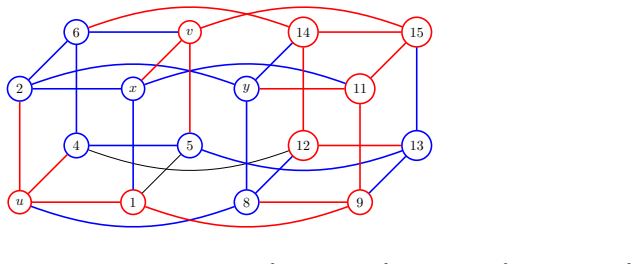

Figures from the paper (6 more)


Forward citations
Cited by 1 Pith paper
-
An explicit construction of two completely independent spanning trees in the four-dimensional dual-cube
F_4, the four-dimensional dual-cube, admits two completely independent spanning trees, completing the classification for all n≥4.
Reference graph
Works this paper leans on
-
[1]
T. Araki. Dirac’s Condition for Completely Independent Spanning Trees.Journal of Graph Theory, 77(3):171–179, 2014. doi:10.1002/jgt.21780
-
[2]
Barabde, S
R. Barabde, S. A. Mane, and S. A. Kandekar. Construction and conditions for completely independent spanning trees in hypercubes and regular bipartite graphs, Mar. 2025
2025
-
[3]
Chang, K.-J
Y.-H. Chang, K.-J. Pai, C.-C. Hsu, J.-S. Yang, and J.-M. Chang. Constructing dual- CISTs of folded divide-and-swap cubes.Theoretical Computer Science, 856:75–87, Feb
-
[4]
Y.-H. Chen, S.-M. Tang, K.-J. Pai, and J.-M. Chang. Constructing dual-CISTs with short diameters using a generic adjustment scheme on bicubes.Theoretical Computer Science, 878-879:102–112, July 2021. doi:10.1016/j.tcs.2021.05.031
-
[5]
Y.-H. Chen, K.-J. Pai, H.-J. Lin, and J.-M. Chang. Constructing tri-CISTs in shuffle-cubes. Journal of Combinatorial Optimization, 44(5):3194–3211, Dec. 2022. doi:10.1007/s10878- 022-00863-0
-
[6]
B. Cheng, J. Fan, D. Wang, and J. Yang. A Reliable Broadcasting Algorithm in Locally Twisted Cubes. In2015 IEEE 2nd International Conference on Cyber Security and Cloud Computing, pages 323–328, Nov. 2015. doi:10.1109/CSCloud.2015.13
-
[7]
B. Cheng, D. Wang, and J. Fan. Constructing completely independent spanning trees in crossed cubes.Discrete Applied Mathematics, 219:100–109, Mar. 2017. doi:10.1016/j.dam.2016.11.019
-
[8]
B. Cheng, D. Wang, and J. Fan. Independent spanning trees in networks: A survey.ACM Computing Surveys, 55(14S):1–29, 2023. doi:10.1145/3591110
doi:10.1145/3591110 2023
Show all 31 references
-
[9]
G. Fan, Y. Hong, and Q. Liu. Ore’s condition for completely independent spanning trees. Discrete Applied Mathematics, 177:95–100, Nov. 2014. doi:10.1016/j.dam.2014.06.002. 17
2014 doi
-
[10]
Hasunuma
T. Hasunuma. Completely independent spanning trees in the underlying graph of a line digraph.Discrete Mathematics, 234(1):149–157, 2001. doi:https://doi.org/10.1016/S0012- 365X(00)00377-0
2001 doi
-
[11]
Hasunuma
T. Hasunuma. Completely Independent Spanning Trees in Maximal Planar Graphs. In G. Goos, J. Hartmanis, J. van Leeuwen, and L. Kuˇ cera, editors,Graph-Theoretic Concepts in Computer Science, pages 235–245, Berlin, Heidelberg, 2002. Springer. doi:10.1007/3-540- 36379-3 21
2002 doi
-
[12]
Hong and H
X. Hong and H. Zhang. A Hamilton sufficient condition for completely independent spanning tree.Discrete Applied Mathematics, 279:183–187, May 2020. ISSN 0166- 218X. doi:10.1016/j.dam.2019.08.013. URLhttps://www.sciencedirect.com/science/ article/pii/S0166218X19303865
2020 doi
-
[13]
Laskar and B
R. Laskar and B. Auerbach. On decomposition of r-partite graphs into edge-disjoint hamilton circuits.Discrete Mathematics, 14(3):265–268, Jan. 1976. doi:10.1016/0012-365X(76)90039- X
1976 doi
-
[14]
Y. Li, S. Peng, and W. Chu. Hamiltonian cycle embedding for fault tolerance in dual-cube. InThe IASTED International Conference on Networks, Parallel and Distributed Processing, and Applications, pages 1–6, 2002
2002
-
[15]
Ma and J
J. Ma and J. Cai. Fan’s condition for completely independent spanning trees, Feb. 2025. URLhttp://arxiv.org/abs/2502.11522. arXiv:2502.11522 [math]
2025 arXiv
-
[16]
S. A. Mane, S. A. Kandekar, and B. N. Waphare. Constructing spanning trees in aug- mented cubes.Journal of Parallel and Distributed Computing, 122:188–194, Dec. 2018. doi:10.1016/j.jpdc.2018.08.006
2018 doi
-
[17]
Moinet, B
A. Moinet, B. Darties, N. Gastineau, J.-L. Baril, and O. Togni. Completely indepen- dent spanning trees for enhancing the robustness in ad-hoc Networks. In2017 IEEE 13th International Conference on Wireless and Mobile Computing, Networking and Com- munications (WiMob), pages 6...
2017
-
[18]
K.-J. Pai. Designing an Algorithm to Improve the Diameters of Completely Independent Spanning Trees in Crossed Cubes. InNew Trends in Computer Technologies and Applica- tions, pages 433–439, Singapore, 2019. Springer. doi:10.1007/978-981-13-9190-3 46
2019 doi
-
[19]
Pai and J.-M
K.-J. Pai and J.-M. Chang. Constructing two completely independent spanning trees in hypercube-variant networks.Theoretical Computer Science, 652:28–37, Nov. 2016. doi:10.1016/j.tcs.2016.08.024
2016 doi
-
[20]
Pai and J.-M
K.-J. Pai and J.-M. Chang. Improving the diameters of completely independent span- ning trees in locally twisted cubes.Information Processing Letters, 141:22–24, Jan. 2019. doi:10.1016/j.ipl.2018.09.006
2019 doi
-
[21]
Pai, J.-S
K.-J. Pai, J.-S. Yang, S.-C. Yao, S.-M. Tang, and J.-M. Chang. Completely Independent Spanning Trees on Some Interconnection Networks.IEICE Transactions on Information, E97-D(9):2514–2517, Sept. 2014. doi:10.1587/transinf.2014EDL8079
2014 doi
-
[22]
Pai, R.-S
K.-J. Pai, R.-S. Chang, R.-Y. Wu, and J.-M. Chang. A two-stages tree-searching algorithm for finding three completely independent spanning trees.Theoretical Computer Science, 784: 65–74, Sept. 2019. doi:10.1016/j.tcs.2019.03.035. 18
2019 doi
-
[23]
Pai, R.-S
K.-J. Pai, R.-S. Chang, and J.-M. Chang. A protection routing with secure mechanism in M¨ obius cubes.Journal of Parallel and Distributed Computing, 140:1–12, June 2020. doi:10.1016/j.jpdc.2020.02.007
2020 doi
-
[24]
P´ eterfalvi
F. P´ eterfalvi. Two counterexamples on completely independent spanning trees.Discrete Mathematics, 312(4):808–810, Feb. 2012. doi:10.1016/j.disc.2011.11.015
2012 doi
-
[25]
Qin and R.-X
X.-W. Qin and R.-X. Hao. Reliability analysis based on the dual-CIST in shuffle-cubes.Ap- plied Mathematics and Computation, 397:125900, May 2021. doi:10.1016/j.amc.2020.125900
2021
-
[26]
B. R. Shaw. Completely independent spanning trees in the hypercube, Dec. 2024
2024
-
[27]
Shih, H.-C
Y.-K. Shih, H.-C. Chuang, S.-S. Kao, and J. J. M. Tan. Mutually independent Hamil- tonian cycles in dual-cubes.The Journal of Supercomputing, 54(2):239–251, Nov. 2010. doi:10.1007/s11227-009-0317-2
2010 doi
-
[28]
Wu and H
C. Wu and H. Wu. On self-similarity and hamiltonicity of dual-cubes. InProceedings International Parallel and Distributed Processing Symposium, pages 7–pp. IEEE, 2003
2003
-
[29]
Fault-tolerant routing and disjoint paths in dual-cube: a new interconnection network
Yamin Li and Shietung Peng. Fault-tolerant routing and disjoint paths in dual-cube: a new interconnection network. InProceedings. Eighth International Conference on Par- allel and Distributed Systems. ICPADS 2001, pages 315–322. IEEE Comput. Soc, 2001. doi:10.1109/ICPADS.2001.934835
2001
-
[30]
Yang, K.-J
Y.-X. Yang, K.-J. Pai, R.-S. Chang, and J.-M. Chang. Constructing Two Completely Inde- pendent Spanning Trees in Balanced Hypercubes.IEICE Transactions on Information and Systems, E102.D(12):2409–2412, Dec. 2019. doi:10.1587/transinf.2019PAL0001. Appendices A Linear modeling L...
2019 doi
-
[2021]
doi:10.1016/j.tcs.2020.12.023
2020 doi
Reviewed August 1, 2026 · model on record in the stance chip above.
Discussion (0). Continue with ORCID to comment.